life · Neodruidry · Witchcraft

Mabon 2023 (Or, “And then we accidentally gatecrashed a youth group.”)

I hope everyone had a good autumnal equinox, as rainy and chilly as it may have been!

Friday saw my Handsome Assistant and I hurriedly packing — he’d had to work and wasn’t able to get time off, and I’d spent most of Thursday processing fruits and vegetables and baking things. So, we pretty much grabbed whatever seemed like it’d come in handy for camping, shoved it in the car, and zoomed off.

A few hours later, we were driving down winding roads through the forest during golden hour, looking at the Shenandoah Mountains bathed in that soft orange light and listening to the wind through the trees. I couldn’t help myself — I turned on The Hu, and I turned it up.

We pulled into the campground moments later, windows down and music blaring, and hopped out to use the bathroom before going to find our group. There was a handful of people standing by one of the cabins in the distance, so we cheerfully strode up to them to discover that they were actually complete strangers. Baffled strangers. Slightly disturbed strangers.

“Um. Is this the MeetUp group…?” I asked.

“… No. This is a Lutheran Youth Group.”

“… Oh. Sorry. Mybadgottagobye!”

A few more moments and a short drive later, we found our actual campground.

After this minor slipup, the rest of the weekend passed with feasting (so much feasting), singing, chanting, poems, stories, a bonfire, divination, and rain (so much rain).

We stayed in a cabin affectionately called the Murder Cabin. Oddly enough, this was called the Murder Cabin before I discovered that one of the bunks had what appeared to be a bloodstain (it was not. We discovered this after a friend realized it looked too shiny to be blood and tentatively touched it. It was still wet and slightly oily, and we both jumped back shouting, “Oh God! Oh no! Oh God! Oh God!” One of our other friends woke up in the middle of the night to discover that he was sharing his bunk with a family of fieldmice, and I feel like fieldmice are too cute to just hang out in a Murder Cabin.)

I’d stayed in a cabin just like this as a kid, when I went to summer camp one year. I knew that they fit a twelve-year-old reasonably well but wasn’t entirely sure how well they’d fit one jacked, full grown human man and a smaller, more gremlin-style human at the same time. We’d brought our tent but forgot a second sleeping bag and the air mattress. As a result, we both crammed into a single sleeping bag, in a single bunk, and he ended up with his butt out the window and the beginnings of hypothermia. (I, however, felt fine and toasty where I was, nestled in the sleeping bag with him as a draft blocker.)

I always feel energized by being in the woods with friends. At events like this, I honestly rarely sleep. The first WickerMan I went to, I stayed up for three days then went home and absolutely crashed for a day and a half. This was no different — Handsome Assistant and I stayed up until about threeish every evening, only going back to the cabin once everyone else was ready to go back to theirs, too. (The first night, we accidentally dropped his heavy leather coat from the top bunk and startled one of our bunkmates awake, but they were very good-natured about it.)

I didn’t drink, which was probably good. I’m the kind of drunk who immediately starts complimenting strangers, telling people I love them, and becoming Eternal Best Friends with people whose names I may or may not actually remember in the morning. Also, I get terrible hangovers.
I did, however, enjoy some herbal medicine and enough sugar to send a hummingbird into a diabetic coma. (These things are probably connected.)

The Mabon ritual was beautiful. It was originally planned for outdoors, but there was a ton of rain and a big drop in temperature, so we moved it into a pavilion instead. We sang and chanted, taking turns going to a meditation tent for some solitary reflection and relaxation. When we each returned, we took a small wooden lantern as a reminder of the light that we’d each carry within us through the dark months.

Afterward, there was a feast. I’d brought pumpkin bread, strawberry scones, a vegan quiche, and vegan queso and chips, but the only things that had survived the previous day were the scones, so I put them out alongside the other dishes. Handsome Assistant grilled venison and bison burgers and brought homemade blackberry mead, someone had made a gorgeous salad with pecans, apples, greens, and pomegranate, there were black and white cookies (perfect for the equinox), breads, cheeses, fruits, salads, and just so much beautiful food.

One of the completely unironically fun things about this gathering was that it was two separate groups. On one hand, there were the Druids. On the other, there were the pan-Pagans, with more of a Witchy vibe. It was just neat seeing the similarities and differences in cultures and practices. Kind of a “fancy” versus “feral” groove, in the best way. As someone who has identified with both Druids and Witches at various points, I can see why I ended up on the path of Druidry.

After the ritual, the rain stopped for a bit. A friend built a fire, and those of us who didn’t go to bed early went out to stand around it, tell jokes and stories, and get warm and dry again. (An awning had dumped what felt like a cup of water down the back of my neck, so I was turning like a person-shaped pile of döner kebab to make sure I got evenly dry and toasty.)

This same friend remarked that he was sad that the weekend was almost over. I agreed. Even though it’d been cold and rainy, the laughing, the camaraderie, and the connection was just so awesome. I pointed out that, while it was almost over, it was also a day closer to next year’s.

And that’s what it’s about, right? Recognize the turning of the year. We’re heading into the cold days, but that just means that there’s an entire spring and summer ahead in the future. Just like I came home and crashed for seventeen (!) hours straight, I’ll have a restful winter and be ready to run amok again.

Books · Neodruidry

The Book of Hedge Druidry: A Complete Guide for the Solitary Seeker

Recently, I had enough free time to finally finish reading Joanna van der Hoeven’s The Book of Hedge Druidry: A Complete Guide for the Solitary Seeker. While not completely solitary myself (I’m a solo practitioner, but still part of a group), I still wanted to see what new information and perspective I could gain from van der Hoeven’s work.

It’s an impressively comprehensive guide, split into four sections: theory, practice, study, and technique. The book begins by delving into what the Druids were, their history, and what became of them. After that comes a breakdown of the cosmology in van der Hoeven’s (and, from my experience, most) Druidry. She follows this with practice: meditation, spellcraft, prayer, ritual, and so on. There are rites and rituals geared specifically for hedge Druids, herblore, the Ogham, and even ethics.

I can’t vouch for the historical accuracy of all of the information presented here, but that’s something I’ve kind of come to expect from most books about witchcraft and paganism. Van der Hoeven does appear to have done her homework, as each reference has a citation. At this point, I don’t even really try to point out historical inaccuracies unless they’re particularly glaring (like one book’s claims about an “ancient Irish potato Goddess”). One thing I liked was the acknowledgement of the divide between the Druids and modern Druidry — no one can really, factually claim to follow the same faith and practices as the ancient Celtic peoples, we’re all working from what’s more-or-less a reproduction. That doesn’t mean modern Druidry has any less poignancy or value, it’s just the truth.

Books like this tend to hold the most appeal for beginners, since they tend to go over well-trodden ground. Even so, I thoroughly enjoyed it — particularly the section on rites and rituals. Ever since I began to use the ADF ritual structure, I haven’t really been doing as much as I used to outside of that, since most everything I do follows that structure. I took a lot of inspiration from The Book of Hedge Druidry, both for practices to incorporate into my ADF-structured solo rituals, and as small workings on their own.

The book concludes with a section on ethics and acting within one’s community as a teacher and leader. Rather than the (in my opinion) rigid and often misinterpreted Threefold Law, van der Hoeven gives a thorough description of what it means to be centered, know yourself, and be able to act with honor for the good of everyone and everything around you. There’s no judgment, no finger-wagging, and no westernized idea of karma, just an explanation of what it means to act for the highest good.

Had I come at this book from a different perspective, there’s one specific area that would’ve disappointed me: The lack of real information on hedge riding. The bit of information provided about the Other worlds is enough to pique curiosity, but not really enough to prepare a solitary practitioner for journeying or spirit work.

All told, I found this book to be an accessible introduction to Druidry for the solitary (or just solo) practitioner. While I’ve definitely benefited from the study programs and ritual structure ADF provides, if I was completely on my own, van der Hoeven’s work would serve as a great jumping off point. I definitely recommend it to anyone curious about modern Druidry, or even just looking to expand their magical or religious bookshelf.

divination · life · Neodruidry · Witchcraft

Ruis and Saille.

ADF-structured rituals have an oracle portion that gives us an opportunity to know how our offerings were received, know which blessings we are receiving in turn, and get messages from the spirits we work with. I’ve always used tarot for this, but I’ve been curious about branching out into journeying, geomancy, and other means of divination.

All of this is to say that, for my reading this week, I didn’t pull a card at all.

I’ve been trying to learn to divine using Ogham staves. It’s more than a little challenging for me — memorization isn’t my strong suit (to put it mildly), and the Ogham alphabet is visually very simple. That means that, somewhat like my experience with the Tarot of Marseilles, there isn’t a whole lot for me to go on. Unlike the ToM, however, Ogham letters don’t have suits or numerical cycles on their side, which makes it even more difficult.

My best bet? Lots of practice. There are far fewer Ogham letters than there are tarot cards, so I’m bound to absorb some of it eventually.

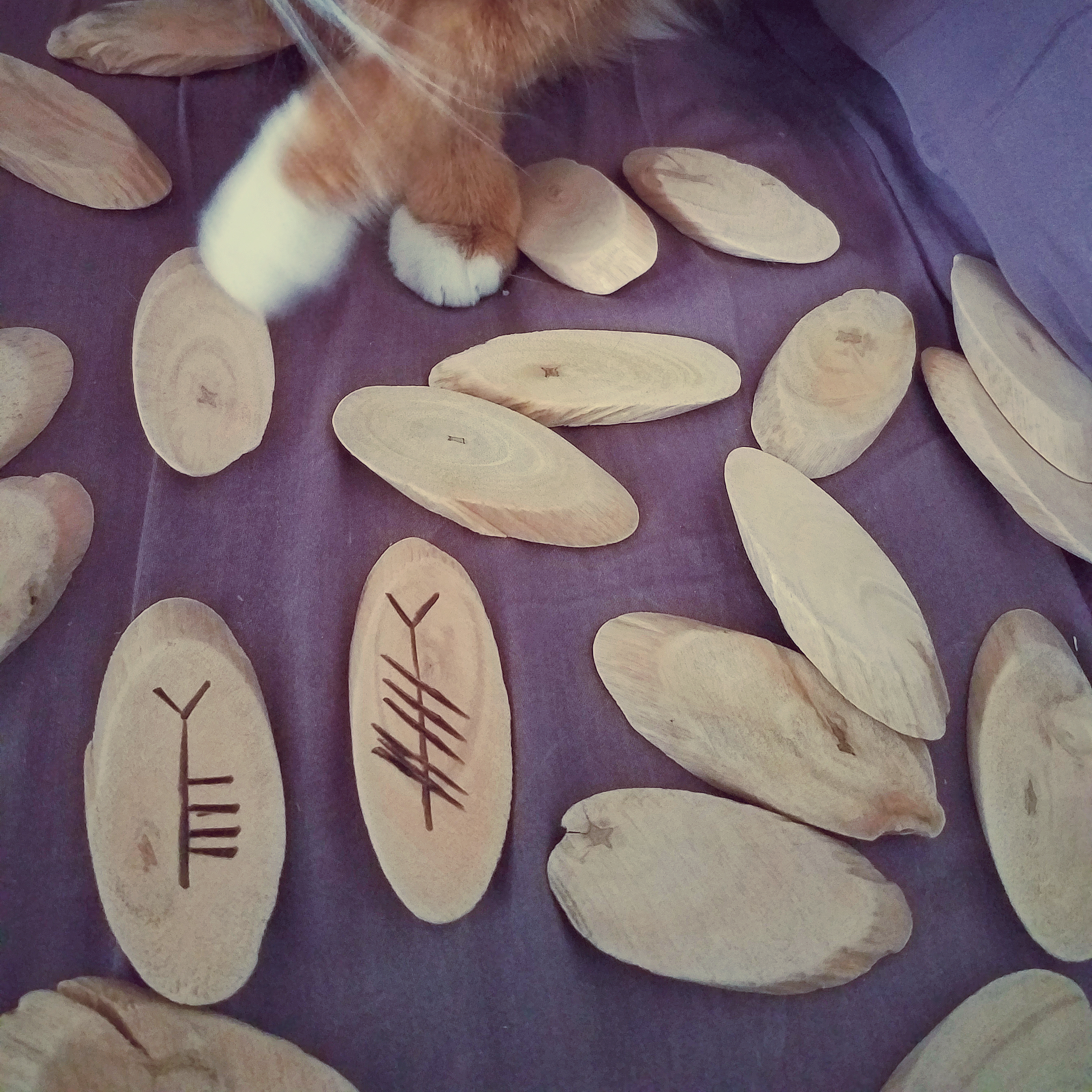
This week, I drew two staves. Since I can’t exactly shuffle wood, I placed them face down, mixed them up, and drew them the way I would a tarot card: I moved my receptive hand over the pieces, and waited for the little energetic “tug” that led me to the right ones.

An orange cat paws at a set of driftwood Ogham staves,
Kiko attempting to draw staves for me, featuring hazel and elder.

I drew Elder (Ruis) and Willow (Saille).

Elder stands for the passing of an old cycle. This can be something that is due to pass, or something that we want to hold onto. The elder tree has a lot of connections to death and rebirth, so it’s a reminder that the only constant is change.

Willow stands for balance and equilibrium. In some sources I’ve read, it also stands for cycles, learning, and taking time to accumulate knowledge before acting.

I’ve experienced a lot of synchronicity with regards to both of these things, just in the past two or three days alone. It’s a supermoon in Virgo. This afternoon, I was listening to a webinar about living as a highly sensitive person (which, for me, is pretty much shorthand for “on the verge of a nervous meltdown basically always”), and Dr. Christine Page was giving a talk about inviting change in order to quit burning yourself out and making yourself sick. I mean, as I was typing this, I had to pause because I got an alert on my phone. It was an email: “Tips for Working With Change,” from Sharon Ramel.

It’s spring, the birds are singing, the weather’s warming, the sap is starting to run. The trees are still bare, but there are plenty of little signs that the soil’s beginning to wake up. I can’t say that I know exactly what changes the willow and the elder and pointing to, but I can’t help but look forward to them.


life · Neodruidry

It’s decided (sort of)!

After finishing the Dedicant Path, I needed to figure out what to do. Continue with the Initiate Path? See what’s required to pursue ordainment? Join a Guild or Kin and follow their path of instruction? I gave myself until the 8th to decide, and I did.

For now, I’m going with the first one. Having read about it, it sounds like it will bring me the closest to where I want to be. The curriculum covers things that I have experience in, and that I know interest me (trancework, divination, ceremonial magic), and covers things that interest me, but which I lack confidence in (liturgy, the bardic arts).

I did apply to join a few Guilds as well, but I think I want to work on them afterward.
It’s funny — it all feels almost like declaring a major in college. (Hopefully it’ll involve less organic chem.)

The only thing standing between me and the Initiate’s Path right now is the Initiate’s letter. It’s the answers to three questions, seemingly designed to figure out why, exactly, the respondent is interested in pursuing initiation, and how they plan to use it when they have it. Knowing I’d spend weeks writing and re-writing if I let myself, I answered and explained myself as best as I could, and fired it off.

Now I just have to wait. I’ll know if it was acceptable within the next few weeks, then I get to jump into another round of reading and writing!