divination · Witchcraft

The Whole Show — Combining Divination Methods

I love divination. Back when I’d just started learning, I knew that divination — more than any other magical skill — was something I wanted to become good at. I have different tarot decks that I use for different purposes, oracle decks, Lenormand cards, a set of ogham staves, a set of runes, a scrying bowl, and multiple stones that I use for crystal scrying. There’s just one problem: What do I use?

I used to get tripped by that a lot. Which method was going to be easier? Which was going to be more explicit? Which would be more accurate?

A set of carved wooden runes.

Why not use them all?

At first, I hesitated. Admittedly, some part of me was afraid that reading multiple divination methods would give me answers that were confusing at best, and contradictory at worst. It seemed like an easy way to end up concluding that divination wasn’t telling me anything useful to begin with.

Nonetheless, I pushed on. It had to be worth a try, right? In retrospect, I’m very glad I did.

When I have a very pressing question, I do a lot. I cast a rune and an ogham stave. I read a tarot spread of my own devising. I draw an oracle card. I scry in a stone or bowl. I go outside and see what the birds’re doing and what the trees have to tell me. I drop into a trance and see what bubbles up to the surface.

And every time, it paints a very clear, coherent picture.

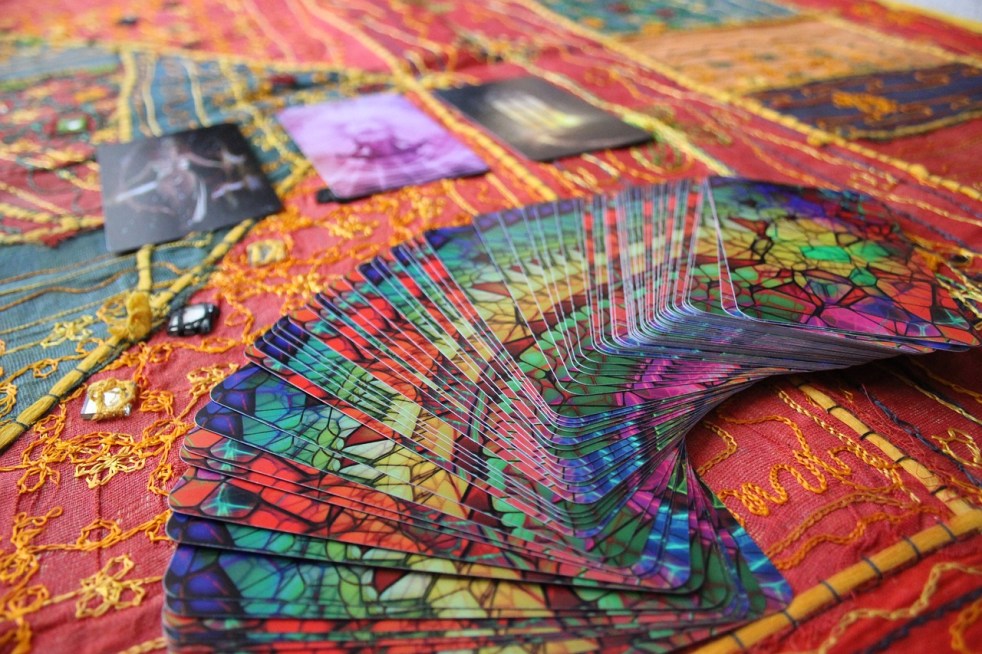
Tarot cards on a purple velvet cloth.

Each method has its own use case and emphasis, so how do you put all of that together?

The trickiest part is viewing each method in their own cultural context. Many guides to runes and ogham, for example, have simplified the meanings to the point where they’re very far removed from their original* interpretation.

(* Or allegedly original. There are large gaps in our historic knowledge of how some divination methods were used, which adds to the confusion. One example of this is the ogham forfeda. Is Mor the beech, Scots pine, or the sea?)

The lack of consensus means that it’s not really doable to just jump into multiple different divination methods and combine them immediately. It’s important to work with each one separately, to learn its limitations and develop a kind of personal interpretation of its meaning. This doesn’t mean that you have to reinvent the wheel by discarding all of their conventional interpretations, but I highly recommend keeping a divination record that allows you to look back and see how each reading turned out. This can show you what cards, runes, symbols, and so forth tend to show up for you, and when.

After that, the only question is what order to put everything in. Personally, I enjoy laying out the tarot spread first, then ogham, then runes, and finally an oracle card. Once I have this story before me, I consult nature and, if need be, scry or enter a trance.

Putting the results together is honestly the easiest part. Here’s how things shake out for me:

  • Tarot tends to show me the “why” of a situation — what feelings, mindsets, energies, and hidden facors are bringing something about.
  • If I use Lenormand, it tells me the “what.” While it might seem like that would be extremely useful, I usually skip Lenormand reading. Believe it or not, knowing what happens is usually a lot less important than knowing all of the other stuff. Think of it like being told the future by a genie who’s a bit of a prick — knowing what isn’t as helpful as knowing why, how you’ll feel about it, and what you need to do to.
  • Runes usually highlight the most important connecting concepts that unify the whole for me.
  • Ogham usually tells me what to do or focus on.
  • Oracle cards generally offer reassurance, or a way to look at the bright side and get through a difficult situation.
  • Nature augury tells me if a situation is generally positive or negative. If something very unusual appears to me, it can give more specific information akin to ogham reading.

If this sounds like a lot of work, it certainly can be! It’s also very rewarding, and even a bit thrilling to see everything come together.

If this interests you, but you don’t want to perform it yourself, that’s totally understandable. This is one of several readings I can do for you, if you like. Just check out my shop!

animals · divination

The Magical Meaning of Starlings

Since there are still small, belligerent starlings all over the yard, I figured I’d make the best of a very noisy situation and write a bit on their magical significance. While I mostly know them as small weirdoes who periodically walk up to me and gape to be fed (which is almost admirable in its temerity, to be honest), they’re powerful, sacred animals in their own right.

Despite their ubiquity in my area, starlings aren’t native to the United States. The story is that they were brought here in the late 1800s in what is, perhaps, the silliest fashion imaginable. A German-American Shakespeare enthusiast named Eugene Schieffelin wanted the US to have all of the birds mentioned in Shakespeare’s plays, so he imported and released about sixty to eighty of them. (Invasive species who?) However entertaining this tale might be, it most likely isn’t actually true.

Shakespeare’s mention of starlings refers to their talent at mimicry:

Nay,

I’ll have a starling shall be taught to speak

Nothing but “Mortimer,” and give it him

To keep his anger still in motion.

spoken by Hotspur, in Act 1, Scene 3 of Henry IV
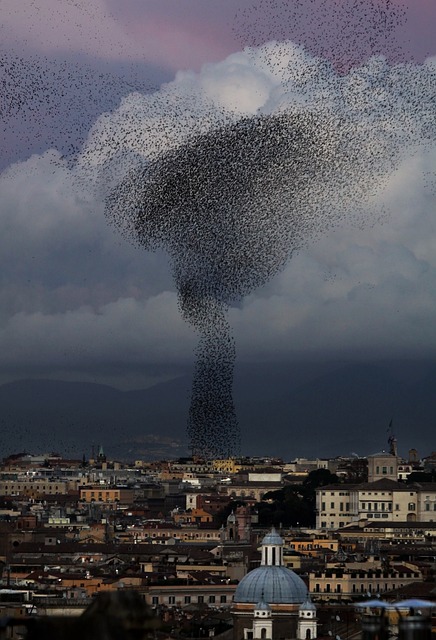
A murmuration of birds over a city, against a dark, cloudy sky.

In Rome, however, starlings were more than a curiosity or a passing note in a play. Starlings form very large, elaborate migrating flocks called murmurations. These are exceptionally striking formations of thousands of individual birds who seem to cover the sky in a flowing, undulating mass. Augurs, diviners who read the movement of birds, would watch these murmurations to receive messages from their gods. Some forms and flows were very good omens. Others, not so much.

In the Welsh Mabinogion, Branwen is sent to Ireland to marry King Matholwch . Her marriage is far from happy, however, so she tames a starling and teaches it to speak. She sends the starling back to Wales, where it alerts her brother Bran to come and save her.

Starlings can mimic far more than words. Mozart kept one as a pet, and it learned to repeat portions of his compositions. When it died, he was heartbroken. He performed a funeral that his biographer (and wife’s second husband) described thus:

When a bird died, he arranged a funeral procession, in which everyone who could sing had to join in, heavily veiled – made a sort of requiem, epitaph in verse.

Georg Nikolaus von Nissen 

Starlings also seem to imprint readily on people. Personally, I have made every attempt to avoid them, however their babies still don’t seem to have any issue strolling up to me with their mouths open, expectantly. It’s kind of like walking up to a grizzly bear and demanding spaghetti.

In general, the starling’s place in folklore seems to have been secured by their ability to bond with people, and their talent at mimicking speech and other sounds they encounter. Just watch this one, who not only imitates a human, but flawlessly mimics an Alexa unit immediately afterward:

It’s almost eerie!

Starlings are said to represent everything from freedom, to prosperity, to love. Given their folklore, they’re most strongly connected to communication and divination.

To divine using a flock of starlings (or even just one, though they always seem to show up in groups!) involves noting their number and behavior. It can sometimes be hard to count starlings, particularly since they can number in the thousands within a single murmuration.

If you observe them in flight, like the ancient Romans, pay attention to the shapes they form. What do they evoke for you?

Note the direction in which they’re flying. This means both the cardinal direction, and their relative direction. The east represents beginnings, renewal, spring, and the dawn. The south represents a climax, an apex, summer, and high noon. The west represents a decline, a release, autumn, and twilight. The north represents endings, death, winter, and midnight.

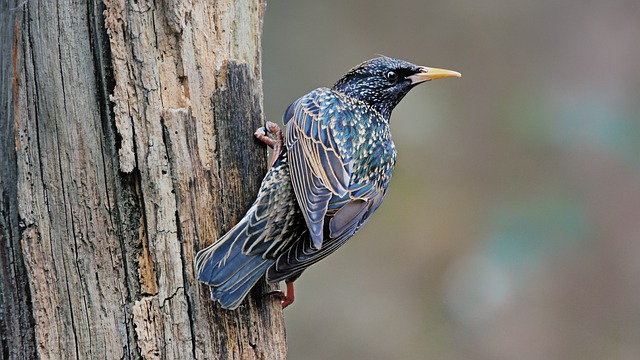
A starling clinging to the trunk of a tree.

In terms of relative directions, birds flying to the right generally indicates a positive or affirmative response. Birds flying to the left generally indicates a negative response.

As with any divination method, keep a journal of what you see and your interpretations. After some time has passed, revisit what you wrote and see how accurate it was. This can help you decode what the flight of birds means specifically to you.

Starlings are polarizing little guys. Some people absolutely love these noisy, funny little birds, while others hate them. I’ve come to be amused by their antics, though I’m also looking forward to when their fledglings are finally grown and it’s time for them to migrate!

animals · divination

The Magical Meaning and Symbolism of Starlings

Since there are still small, belligerent starlings all over the yard, I figured I’d make the best of a very noisy situation and write a bit on starling symbolism and magical significance. While I mostly know them as small weirdoes who periodically walk up to me and gape to be fed (which is almost admirable in its temerity, to be honest), they’re powerful, sacred animals in their own right.

Despite their ubiquity in my area, starlings aren’t native to the United States. The story is that they were brought here in the late 1800s in what is, perhaps, the silliest fashion imaginable. A German-American Shakespeare enthusiast named Eugene Schieffelin wanted the US to have all of the birds mentioned in Shakespeare’s plays, so he imported and released about sixty to eighty of them. (Invasive species who?) However entertaining this tale might be, it most likely isn’t actually true.

Shakespeare’s mention of starlings refers to their talent at mimicry:

Nay,

I’ll have a starling shall be taught to speak

Nothing but “Mortimer,” and give it him

To keep his anger still in motion.

spoken by Hotspur, in Act 1, Scene 3 of Henry IV
A murmuration of birds over a city, against a dark, cloudy sky.

In Rome, however, starlings were more than a curiosity or a passing note in a play, and starling symbolism was a important thing. Starlings form very large, elaborate migrating flocks called murmurations. These are exceptionally striking formations of thousands of individual birds who seem to cover the sky in a flowing, undulating mass. Augurs, diviners who read the movement of birds, would watch these murmurations to receive messages from their gods. Some forms and flows were very good omens. Others, not so much.

In the Welsh Mabinogion, Branwen is sent to Ireland to marry King Matholwch . Her marriage is far from happy, however, so she tames a starling and teaches it to speak. She sends the starling back to Wales, where it alerts her brother Bran to come and save her.

Starlings can mimic far more than words. Mozart kept one as a pet, and it learned to repeat portions of his compositions. When it died, he was heartbroken. He performed a funeral that his biographer (and wife’s second husband) described thus:

When a bird died, he arranged a funeral procession, in which everyone who could sing had to join in, heavily veiled – made a sort of requiem, epitaph in verse.

Georg Nikolaus von Nissen 

Starlings also seem to imprint readily on people. Personally, I have made every attempt to avoid them, however their babies still don’t seem to have any issue strolling up to me with their mouths open, expectantly. It’s kind of like walking up to a grizzly bear and demanding spaghetti.

In general, the starling’s place in folklore seems to have been secured by their ability to bond with people, and their talent at mimicking speech and other sounds they encounter. Just watch this one, who not only imitates a human, but flawlessly mimics an Alexa unit immediately afterward:

It’s almost eerie!

Starlings are said to represent everything from freedom, to prosperity, to love. Given their folklore, starling symbolism is most strongly connected to communication and divination.

To divine using a flock of starlings (or even just one, though they always seem to show up in groups!) involves noting their number and behavior. It can sometimes be hard to count starlings, particularly since they can number in the thousands within a single murmuration.

If you observe them in flight, like the ancient Romans, pay attention to the shapes they form. What do they evoke for you?

Note the direction in which they’re flying. This means both the cardinal direction, and their relative direction. The east represents beginnings, renewal, spring, and the dawn. The south represents a climax, an apex, summer, and high noon. The west represents a decline, a release, autumn, and twilight. The north represents endings, death, winter, and midnight.

A starling clinging to the trunk of a tree.

In terms of relative directions, birds flying to the right generally indicates a positive or affirmative response. Birds flying to the left generally indicates a negative response.

As with any divination method, keep a journal of what you see and your interpretations. After some time has passed, revisit what you wrote and see how accurate it was. This can help you decode what the flight of birds means specifically to you.

Starlings are polarizing little guys. Some people absolutely love these noisy, funny little birds, while others hate them. I’ve come to be amused by their antics, though I’m also looking forward to when their fledglings are finally grown and it’s time for them to migrate!

Plants and Herbs · Witchcraft

Yarrow Folklore and Magical Properties

You know, I never really connected with yarrow. I know it’s kind of a magical herb staple, but I was always more into mugwort and its ilk. For some reason, yarrow just didn’t quite grab me the way that certain other herbs did.

All of that aside, I have lots of it now. When I embarked on my crusade to murder the grass and replace it with useful things (my rules are that they must either feed me or the local fauna, and preferably both), yarrow was a natural fit. It’s a lovely plant that gets tall enough to fill the space in my flower beds, and it’s very aromatic. Working with it in a gardening capacity has given me a new appreciation for it as a magical and medicinal herb, and the bees really seem to enjoy it.

Yarrow Folklore and Magical Uses

Yarrow is one of the oldest medicinal herbs. Like, pre-pre-history old. Archaeologists have identified yarrow among the belongings of a 65,000 year old Neanderthal.

Achillea specimens are found pretty much everywhere, with the exception of Africa and Antarctica. There are Achillea millefolium subspecies found in Europe, Asia, the Arctic, the Himalayas, the Alps, the Carpathians, the western US, Alaska, the US in general, and one particular that’s endemic solely to California. It’s probably not surprising that it’s often considered an aggressive weed, and may be best confined to areas that you either don’t mind having it take over, or allow you to control its spread.

Interestingly, all of these subspecies seem to have different medicinal effects. There’s some overlap, of course, but each subspecies appears to have different ratios of medicinal compounds.

The genus Achillea is named for the Greek hero Achilles. Chiron taught him the plant’s medicinal properties (specifically using it to treat wounds — hence its other common name, woundwort) and carried it into battle. It’s anti-inflammatory and antibacterial, so it’s a good plant to reach for to treat minor cuts, scrapes, and bruises.

White, yellow, and pink yarrow flowers in a green field at sunset.
Chiron was half-man, half-horse, and a great healer. That makes him the Centaur for Disease Control.

This connection with battle may be why yarrow is also used as an herb for courage.

Yarrow is a protective and purifying herb. Like many herbs used to cleanse and protect, this action is borne out by its ability to repel pests. Experiments with birds using yarrow as a nest lining found that it inhibits the growth of parasites. The connection between repelling pests and magical protection is seen pretty often, as with pennyroyal, or fennel, for example.

In Europe, scattering yarrow across the threshold of a home was believed to keep evil from entering.

Yarrow is historically a divination herb. In China, one way to cast the I Ching involved counting stalks of yarrow. In Europe, it was used for love divination. You’d take a yarrow leaf and stick it up your nose, tickling yourself with it as you said,

Yarroway, yarroway

Bear a white blow.

If my love love me,

Let my nose bleed now.”

Traditional

Another method for love-divination involved placing yarrow under your pillow. If you dreamt of your love, it was a positive omen. If you had a bad dream, or dreamt of other people, it wasn’t.

An old Gaelic incantation for yarrow-picking went thus:

I pluck the smooth yarrow,

That my finger be sweeter,

That my lips be warmer,

That my voice be gladder.”

Yarrow was said to be a sacred plant to the ancient Druids, used for weather divination.

In the Victorian language of flowers, yarrow represented everlasting love.

Yarrow is connected to Venus and the element of Water.

Using Yarrow

Since so many practitioners of witchcraft and Druidry have pets and small children, I probably wouldn’t recommend just strewing your threshold with yarrow. Instead, scatter some of the dried herb under your front doormat, where curious hands or snouts can’t get into it. You can also grow yarrow near your front door — it’ll feed your local pollinators and help keep evil away.

Yarrow hydrosol is another useful way to work with this herb. It’s good for your skin. (For real, an ointment containing yarrow was researched for its ability to help heal episiotomies. Ouch!) It can also have a purifying effect, so it’s a nice way to prepare yourself for rituals. The leaves and hydrosol are also fragrant, so the scent is a nice for getting into a magical mindset.

For divination, you could either learn to cast the I Ching with traditional yarrow stalks, or include it in a spray or sachet to use while reading tarot, runes, or Ogham staves. Including it in a dream pillow is said to lead to prophetic dreams.

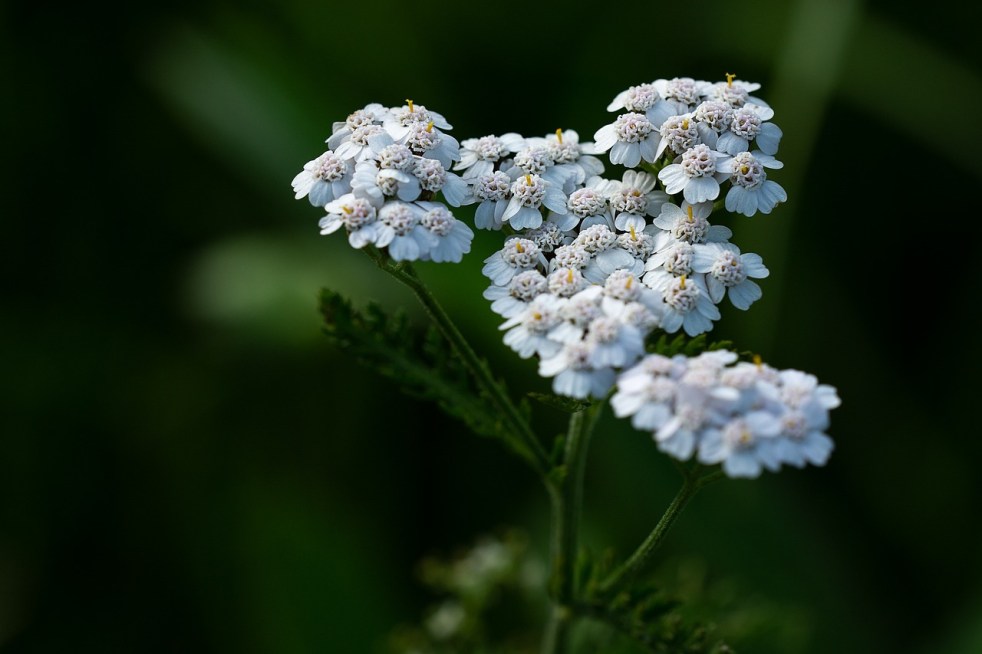
A soft, dreamy image of pink yarrow flowers.

As a Venus-ruled herb, it’s also a good choice to include in love jars or sachets. Traditionally, its power was to help the user find their true love, and keep lovers together. That makes it a worthwhile addition to spell to draw in true love and help it last.

Medicinally, yarrow hydrosols, infusions, and ointments are great for topical conditions like stings, bug bites, scrapes, burns, scratches, cuts, and bruises. (Never put anything ointment-y over deep wounds, puncture wounds, or animal bites, however.) Teabags or poultices of yarrow are also nice for easing sore eyes — just be careful not to get yarrow in them! If you’re allergic to yarrow or other members of the Asteraceae family, skip yarrow and use something else.

This herb is also used for treating a ton of internal conditions, from digestive trouble to colds and flu. But, like I mentioned previously, each subspecies seems to have its specialties. Before using yarrow internally, you should consult with a qualified herbal practitioner to choose the safest and most effective herbs for your condition.

Uncategorized

Blueberry (and Bilberry) Folklore and Magical Properties

I love blueberries. Few things are as delightful as a fat slice of warm blueberry pie or cobbler, with a generous dollop of ice cream (or non-dairy ice cream equivalent, as it were).

I was very excited to find that the previous occupants of this house had planted some blueberry bushes in the back yard. Unfortunately, these bushes weren’t exactly thriving — they’d been planted in an area that’s under trees. It gets plenty of light during the late autumn to early spring, but very little in the warm months. Our soil is also hard clay, and it didn’t appear that the area had been given much organic matter.

So, as much as it worried me to do it, my spouse and I uprooted these bushes and moved them into a much sunnier spot, blended well with a generous amount of shredded bark and leaf compost. We also planted two more bushes of a different variety, to fill out the tree guild we’re building around the Chehalis apple tree I talked about two weeks ago.

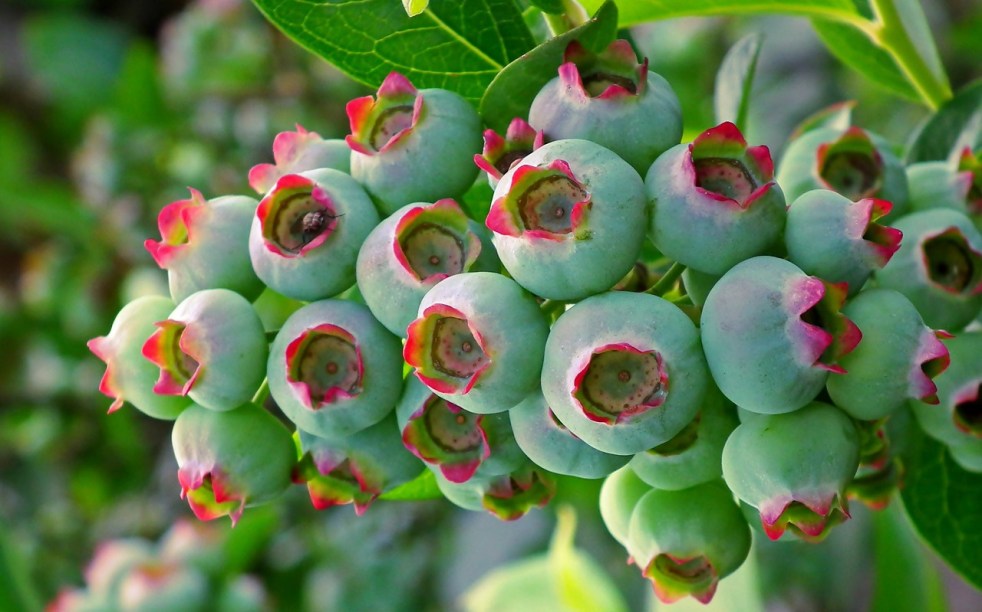
A cluster of ripening blueberries on a bush.
Some lovely little unripe blueberries on one of the bushes in the back yard.

This post isn’t about soil composition and permaculture, though I could definitely go on for volumes if it was.

No. Today, I want to get into some of the folklore and magical uses of these wonderful little balls of deliciousness.

It should be noted that blueberries (Vaccinium angustifolium, V. corymbosum, et al) are a strictly New World fruit. There’s a European relative called the bilberry (or European blueberry, Vaccinium myrtillus) that’s very similar, and the magical properties of these fruits are virtually interchangeable. If you live in an area where bilberries are native, use bilberries. If you live where blueberries grow, use those instead.

Blueberry and Bilberry Folklore

While blueberries are named for their deep purplish-blue color, the name “bilberry” is likely of Scandinavian origin. The Danish word bølle means “whortleberry,” which is another word for certain members of Vaccinium including the bilberry.

You can tell blue- and bilberries apart by their fruits. Blueberries grow in clusters, are a purplish-blue, and have a blossom end that looks a bit like a pentagon with five pointed flaps. Bilberries grow alone or in pairs, are almost black, and have a circular, smoother blossom end.

A bilberry on a bilberry shrub. The blossom end is facing upward, showing a distinct lack of the pointed flaps found on blueberries.
As you can see from this bilberry’s “butt,” they have rounder blossom ends and lack the pointy flappy bits of American blueberries. Compare it to the unripe blueberries in the photo above this one.

In Ireland, bilberries (fraochán or fraughan) are traditionally gathered during the last Sunday in July and the first of August. The first of August is Lughnasadh, a festival marking the beginning of the harvest season. Bilberries and blueberries are a traditional addition to Lughnasadh festivities all around the world.

Since gathering bilberries was traditional for the beginning of the harvest season, they were treated as a kind of oracle. If the crop was abundant, other crops would similarly flourish. If the bilberries did poorly, everything else would, too.

In ancient Greece, bilberries came from Herme’s son Myrtillus. King Oenomaus of Pisa had been given a prophecy: He would one day be killed by a son-in-law. Seeking to avoid this fate, Oenomaus decided to prevent his daughter, Hippodamia, from ever marrying by challenging every one of her would-be suitors to a chariot race on the Isthmus of Corinth. If the suitor won, he’d get Hippodamia. If he lost, Oenomaus would kill him. Since Oenomaus’ chariot was pulled by horses given to him by the god Ares, there was no way he could ever lose.

Then came Pelops. Hippodamia fell for him immediately, and went to her father’s servant, Myrtillus, for a favor. She wanted him to sabotage her father’s chariot so he’d lose the race, and Myrtillus, full of unrequited love for Hippodamia, agreed. On the day of the race, Myrtillus switched the metal linchpins of Oenomaus’ chariot with ones made of beeswax. Oenomaus’ chariot flipped, and Pelops beat him easily.

Some versions of the story say that Oenomaus, with his dying breath, asked to be avenged. Pelops then threw Myrtillus into the sea, and Hermes turned him into a bilberry shrub when he washed to shore. Another version says that Pelops, Hippodamia, and Myrtillus were traveling, when they stopped at an island so Pelops could fetch his new bride some water. When he returned, Hippodamia was in tears. Myrtillus had tried to sleep with her, she cried, while Myrtillus protested that she had promised to do so in exchange for sabotaging Oenomaus’ chariot. The enraged Pelops then killed Myrtillus.

In the folklore of some of the people indigenous to blueberry’s native range, blueberries are called “star berries” for the star-shaped blossom end.

In the Victorian language of flowers, bilberry represents treachery. This symbolism is likely borrowed from the Greek story of Myrtillus.

Blueberry and Bilberry Magical Uses

Blue- and bilberries are associated with protection and luck in European witchcraft.

Dried bilberry leaves are used in protective powders but can also be used whole for prosperity and luck.

The fruit is similarly used for protection and hex-breaking.

(Considering bilberry’s associations with treachery and crop divination, I wonder if their protective properties stem from their connection to physical danger and starvation. Today, we know that fruits like blueberry and bilberry can protect against oxidative cellular damage due to their antioxidant content, but their traditional connection to protection goes back much farther.)

Using Blueberries and Bilberries

Blueberries and bilberries couldn’t be simpler to use. For kitchen witches, include them in recipes for protection and the removal of malevolent enchantments.

Crushing the fresh berries can yield a pigment suitable for drawing protective sigils on paper talismans, the skin, and anywhere else you might need them. Just bear in mind — both of these berries are sweet, and your talismans may be sticky and likely to attract bees this way!

To protect your property, dry bilberry or blueberry leaves. Powder them well, then sprinkle the powder around the perimeter of your home or yard.

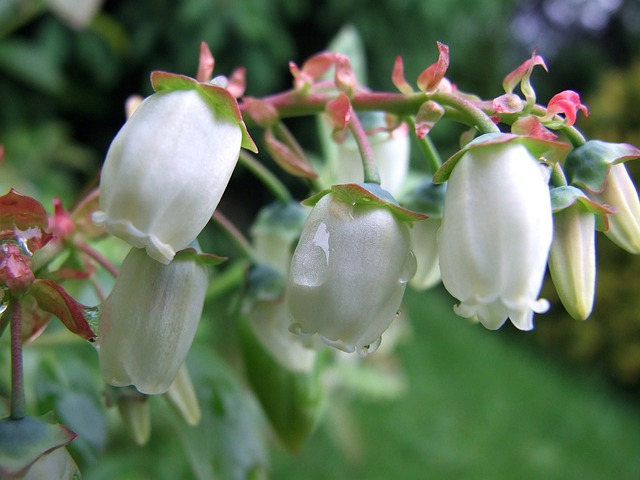
White, bell-shaped blueberry blossoms.

To break a hex, jinx, or run of bad luck, burn dried blue- or bilberry leaves. Use the smoke to fumigate the same way you’d use incense smoke.

Blueberry and bilberry don’t appear to be reversing herbs. That is, they don’t return treachery or malevolent magic to the sender. They just keep it from affecting you.

Since bil- and blueberry seems to predominantly be a protective herb, I would hesitate to use it solely for drawing luck. It appears that it’s virtue in luck drawing lies in its ability to get rid of jinxes and other things that hold you back. For luck spells, then, I’d pair blueberry or bilberry leaves with an ingredient used more specifically for attracting good luck. The berry leaves can clean up the things standing the way of your luck, and the other ingredients can draw it in. Allspice, chamomile, and fenugreek are all good options to consider here.

Interestingly, strawberries are sometimes used in small amounts for luck drawing. You could then theoretically make a jam, smoothie, or pie with both blueberries and strawberries, and, when appropriately made and empowered, use it to attract good luck to you.

It remains to be seen how my poor transplanted blueberries do, but the newer ones seem to be thriving. When the time is right, I’ll harvest the fruits and some of the leaves, and hopefully have enough protection and hex-breaking to last me all year!

Neodruidry · Witchcraft

Rainwater Folklore and Magical Uses

As we get closer to summer, my area experiences more and more thunderstorms. Honestly, even though rain gives me terrible headaches, I kind of love it. I’ve always been very into the energy of loud crashes of thunder and bright flashes of lightning. Now, I always set out containers to catch some to save and use later.

Rainwater is said to have special properties depending on the season and conditions. (I’m also including dew under this category for practical reasons, even though it doesn’t come from the sky.)

Rainwater Magical Properties and Folklore

Dew, specifically the dew gathered on the first of May, is said to preserve youth and enhance beauty.

According to Lexa Roséan’s The Encyclopedia of Magickal Ingredients: A Wiccan Guide to Spellcasting, storm water is useful for increasing one’s personal charisma. Each season’s rain helps with a specific aspect here:

  • Spring storm water is for sensuality and attractiveness to romantic partners.
  • Summer storm water is for is for magnetism and raw sex appeal.
  • Autumn storm water is to make oneself develop an irresistible, Rapsutin-like appeal.
  • Winter storm water is for endurance, and is said to make one a formidable foe against business or political competitors.

Of all of these, winter storm water is the hardest to come by, while autumn storm water is said to be the darkest and most dangerous.

Rain falling on pavement.

I usually use storm water to cleanse and charge things, including myself. I’ll usually gather the water one day, then, on the next clear day, placed a closed container of it with crystals, flower essences, etc. in a sunny or moonlit spot. After that, I use it to asperge or mist myself. I even charged some under the Tau Herculids meteor shower!

Dip a sprig of rosemary or fresh vervain in storm water, and use it to asperge altars, tools, or sacred spaces before working. This will cleanse and energize them.

After about *mumblemumble* years, I haven’t noticed any difference in the water’s properties based on the intensity of the storm. Weaker storms just produce weaker water. While this may be helpful if you’re looking for gentler energy, like for sleep magic, you may be better off just using moonlight-charged water to begin with rather than fussing with storm water.

Some practitioners assign elemental properties to rainwater based on the conditions during which it was collected. Lightning storms produce rainwater aligned with the element of Fire. Windstorms (like hurricanes or tornados) produce rainwater aligned with Air. Rain collected as drips from trees or other tall plants is aligned with Earth. Personally, I would caution against collecting storm water during a windstorm — wind borne debris cause the majority of damage during these storms, and any container you put out can easily become a dangerous projectile.

Some also assign astrological properties to stormwater based on the time of its collection. A waxing moon brings increase, and a waning moon brings decrease. Every day of the week, even every hour, is ruled by a planet. The moon also passes through the various signs of the zodiac. Storm water collected on a Friday, during a Venus hour, when the full moon is in Taurus would, therefore, be a powerful tool for attracting love. (You’d also be catching stormwater in November in that case, which Roséan says will enhance your Rasputin-like qualities, so maybe bear that in mind too!)

From my own experience, and most sources I’ve read, stormwater shouldn’t be kept indefinitely. It’s best used within the first month or so after you’ve collected it. Keeping it in the refrigerator can help slow down the proliferation of algae and other organisms.

In my tradition, sacred water is water gathered from three natural sources, and is used in every formal ritual. I often catch rainwater to serve as one of these, and combine it with sea and stream water.

Using Rainwater

Please check the laws about gathering rainwater in your area. In some places, it’s illegal to do so. This is to protect the environment — a lot of times, it isn’t the mere fact that you’re collecting the water, but the amount. You might be able to get away with a small container, or a single rain barrel’s worth, but laws against collecting rain exist to stop people who end up diverting that water from places that need it.

To use water from rain or storms, put out a container. You’ll probably want a wide bowl, or some other vessel that’s much wider than it is deep. It’ll be easier to catch water that way.

When the storm ends, the container’s full, or you feel like you have enough water, bring it inside.

Run it through a coffee filter or several layers of cheesecloth to clear out any bits of grass, twigs, leaves, mulch, dirt, bugs, or dust that might’ve been blown into it.

Pour the filtered water into a container, preferably one with a lid.

I don’t recommend consuming rainwater of any type without thorough boiling or some other form of treatment. While it’s (usually) clean when it comes out of the clouds, it can collect all kinds of pesticides and others -cides as it drips off of leaves. It can also pick up bacteria, viruses, and parasites from the soil (or worse — dog, cat, bird, rodent, or insect feces) if it splashes off of the ground or outdoor furniture. I’m not even going to get into what gets into it if you have to collect it near a road. While I won’t deny that there’s a certain faerielike, cottage core appeal to sipping fresh rainwater, there are also many reasons why people regularly dropped dead before water treatment became a thing.

If you do need to drink storm water for your purposes, consider setting out a covered bottle or jar of clean water during the storm rather than collecting the rainwater itself. Much like you can charge water with sunlight or moonlight, you can also charge it with some of the power of thunder and lightning. (And you won’t turn into a summer camp for amoebas.)

A little storm water, placed in a dark, solid-colored bowl, is wonderful for scrying.

You can also use storm water as a base for door washes, floor washes, or ritual baths. Steep some herbs in it or infuse it with crystals (I like to use sunlight and a special glass jar for this), then pour it into your bath or wash water.

Here ’til Niagara falls,
j.

divination · life

Reading Lenormand and Tarot — Together.

The end of October marks the beginning of a new year for me, and that means taking stock. I like to do this with something I jokingly call “the whole hog,” a single reading that uses tarot, Lenormand cards, Ogham, and oracle cards to give me as complete a picture as possible. It’s fun, interesting, accurate, and, once you’re used to it, surprisingly easy.

There’s really no reason not to combine whatever forms of cartomancy or sortilege you like best. I’m not suggesting you shuffle all of your cards together, of course (I mean, the differences in size and texture would turn that into a nightmare). There’s only one thing you have to keep in mind:

Each type of card is best suited to a certain type of question.

For example, you wouldn’t want to ask a Lenormand deck what energies you need to focus on for the coming year. (Coffin + Birds + Woman + Lilies + Bear will tell you a lot, but not that.) Similarly, you don’t want to ask an oracle deck what will happen if you make a specific decision, because drawing a card that tells you, “Remember, you are enough” isn’t going to be… well, enough. Combining decks is more of a holistic approach to a question or problem, allowing you to explore it across multiple dimensions.

What’s the difference between tarot reading and reading Lenormand cards?

Lenormand is very specific and concrete. A basic reading might entail asking something like, “What will happen if I accept this job offer?” You then shuffle the deck, then fan it out and look for the signifier relating either to yourself, or the question at hand. (Personally, I usually choose a signifier related to my question.) The two cards in front of it, the card itself, and the two cards behind it are the reply. They’re able to give you very detailed information, like, “A woman will deliver you a message related to your career, which will result in a social engagement and creative opportunity.”

Tarot, I’ve found, is better suited for describing the energies around a situation. If you ask your tarot deck the same question, you may draw cards indicating celebration, growth, female energies, and even communication. It won’t necessarily indicate a specific situation that you may anticipate, but it will tell you how you’ll feel about it.

Tarot also has a lot of psychological and spiritual overtones, where Lenormand is all practical. Many tarot readers would bristle at the idea of tarot reading as fortune telling, but that’s pretty much exactly what Lenormand cards purport to be — a tool for telling fortunes.

This is a mixed blessing. Reading Lenormand is simple, though not necessarily easy. There are only a few spreads, and cards are always read the same way: in pairs, with their own set of grammar, the way one might read a sentence. For people used to the fluidity of tarot, where there are millions of different spreads, multiple interpretations of the same card, reversals, and a heavy emphasis on intuition, Lenormand can feel rigid. On the other hand, for people used to reading Lenormand cards, tarot can feel too vague and subjective.

So how do you put them together?

The trick is to choose your subject matter carefully. Remember, Lenormand is best suited for concrete answers to questions. (Think “What-ifs,” and things of that sort.) Tarot is best for exploring the energies, archetypes, and other less concrete aspects of a situation.

Combining the two goes something like this:

  1. Consider the situation you want answers about. What ways are there to approach it? Do you have a certain approach you favor? What specific steps are you planning to take in order to address it? Keep this in mind, or write it down.
  2. Next, consider how this situation extends beyond the physical world. Imagine that you have questions about a romantic relationship. Outside of this relationship’s impact on your daily life, what kind of effect will it have on your highest good and spiritual growth? What’s do you need to know about what’s happening beneath the surface?
  3. Formulate a set of questions based on this information. One should be a straightforward “What-if” based on the approach you plan to take. Another should be related to how this situation will impact you spiritually and mentally.
  4. Choose a signifier in your Lenormand deck. If you identify as a man or woman, this can be the Man or Lady cards. If you don’t identify as either, feel that another card is more appropriate, or are reading for someone else, choose a signifier that relates to the situation. (For example, the Tree card is often used as a signifier in health-related readings.)
  5. Shuffle the deck. Keep your “What-if” question in mind.
  6. Fan the deck out, face up. Look for the signifier you chose.
  7. Read the two cards in front of it, the card itself, and the two cards behind it. This will describe a chain of events. (Remember: No future is set in stone. This tells you the outcome if all of the people, energies, and other factors remain the same as they are right now.)
  8. Write your interpretation down.
  9. Next, shuffle your tarot deck. Keep your second question in mind.
  10. Read your tarot cards using a spread of your choice (or draw the top card, top three cards, and so on).
  11. Write this interpretation down.

You now have answers that cover two different aspects of your question. One tells you what will happen purely in the physical realm, the other tells you the mental, emotional, and spiritual impact it will have. Put together, you can develop a pretty accurate (and very helpful) picture.

This isn’t limited to Lenormand and tarot cards, either. As I mentioned, I’ve done something similar with Ogham staves, oracle cards, and more. The only thing to keep in mind is that each type of divination has its strengths and weaknesses. None are inherently superior or inferior, they’re just different. Think of them like cardiologists and plumbers — both are professionals in their fields, but you don’t necessarily want them to have to do each other’s jobs!

divination

The Sun, some fruit, and a guy with a sword.

Okay, so “fruit” is a bit of a misnomer. I felt like using the gorgeous Tarot de Maria-Celia deck this week, and it’s not so much about the fruit imagery. Still!

I gave myself a little three-card spread. I’ve been working on fine-tuning a spread of my own devising, but I didn’t feel like I needed quite that level of detail for a simple weekly reading, you know? For getting a general feel of things, three cards is usually plenty for me.

I drew Le Soleil, Neuf de Deniers, and Roy d’Epée. For the most part, these have the same meanings that they do in RWS-style decks. For the most part.

Le Soleil, believe it or not, has some surprising parallels with Le Diable. It, too, has two minions — both with red sashes like shackles around their necks. While the Devil is deception, manipulation, and control, the Sun is its opposite — the light banishes shadows, and brings everything into clarity. The Devil is entrapment, the Sun is freedom. The Devil is the addiction that saps your energy and your money, the Sun is vitality, growth, and prosperity.

It’s a great sign for new beginnings. Like the return of the sun heralds the new growth of spring, It’s regeneration.

The Neuf de Deniers follows this. Unlike other decks, Marseilles-style decks don’t really have a lot of imagery for the pips cards — just a graphic representation of their suit and numeric value. Deniers (Coins or Pentacles) is the suit of material wealth. Nine is the last number before ten, the ultimate culmination of the suit’s cycle.

It’s a sign of achievement. Material comfort and freedom are at hand, hard work is rewarded. It’s a sign to celebrate!

More than that, though, it points to a time of balance. You’ve achieved this success through hard work and staying in harmony with your surroundings. Prosperity doesn’t always come in the form of a paycheck — sometimes it’s the abundance of the land.

Lastly, there’s the Roy (Roi) d’Epée. He can be a significant person, or merely the qualities of the ruler of the suit of Swords. His power is of the intellect, he is logical and incisive. He can also be a bit of a prick — he’s cunning, but also scheming. He’s intelligent, but may be cold. He is an authority, but may be too detached. As advice, he says to turn away from the emotions for now, and trust in logic and reason.

Taken together, this is a good sign! Le Soleil indicates success, growth, vitality, and fulfillment. Le Neuf de Deniers indicates comfort, abundance, and autonomy. Le Roy d’Epée says that obtaining, enjoying, and maintaining this requires intelligence and discernment. As advice, they say to spread joy and celebrate, but keep a cool head and let intellect lead the way.

Personally, I’m excited. Even as the days become shorter and the nights lengthen, I can feel that solar energy. I feel relaxed, happy, and fruitful. I’m hydrated, moisturized, and well-rested. My vibes are high, my mind is clear, and I can’t wait to see what’s next.

I hope your omens are just as positive. We could all use a little good news.

P.S.: If you’d like a tarot reading, all of the readings in my shop are still 30% off! Place an order, and you’ll have your reading, my interpretation, and a pic of the cards I pulled for you within 48 hours.

divination · life

The Page of Wands Squawks Again (Again)

I feel like I draw the Page of Wands more than any other card. Honestly.

I’m not surprised that he’s appeared again, though. He’s all creativity, adventure, and youthful enthusiasm. He’s good news and fast messages. In career readings, he might mean a work trip. In love readings, he’s playfulness and vacations.

So, considering this past weekend’s adventures, I kind of figured he’d turn up soon.

My partner and I want to go kayaking one of these days, by which I mean “he wants to go kayaking, and I am figuring out ways to cover every tragedy that can possibly happen while kayaking.” I don’t do super well with the sun beating down on me, so summer isn’t my ideal time for outdoor sports. The couple of weeks between the beginning of September and the end of October are perfect for me. There’s only one problem: htf do you kayak?

I mean, I get it. Sit in the boaty part, do the paddles, motion happens. I have had to row things before. Still, there’s something about the thought of taking a kayak out on a river that makes my throat tense up.
(That thing is anxiety disorder. Even with medication and a great therapist, some of it sticks around.)

I feel like kayaking would be fun, on a conceptual level. Neither of us have ever done it before, so I have automatically adopted the position of Learning Everything That Can Go Wrong and Preemptively Thwarting It.

(Incidentally, while this is doubtless one of my more annoying traits, it also makes me fantastic on road trips. Need Benadryl? A tampon? A snake venom extraction kit? A small fire extinguisher? Emergency backup water? A convenient source of potassium? I’ve got you. I prepare for everything like it’s the first ten minutes of an action movie where we end up on an island infested with crocodiles.)

My partner says, “Let’s go price kayaks this w-,” and before he can even say “-eekend,” my brain’s off to the races. We’ll need life vests, for one. That’s obvious. Swimsuits — no, wetsuits, since the water won’t be as warm as it would be in July. Water shoes. A waterproof bag to hold stuff. Lessons. What if I lose my ID? I’ll write my identifying information on myself in case I drown. What if we accidentally go over a dam and one of us breaks something? I’ll have to bring a bandana I can use to make a sling. Do I remember how to give first aid for a spine or neck injury? What if I fall in the water and the cold knocks the wind out of me? It happened at summer camp once, and I wasn’t allowed to swim after that. (Fortunately, what I lacked in ability-to-breathe-in-cold-water, I made up for in ability-to-spot-and-subsequently-escape-from-bears-that-got-to-the-blueberry-patch-before-I-did.)

When I was five, my grandparents took me to the beach. I splashed and played happily, but, when my grandma noticed that I’d gone a little too far out and called me back, I couldn’t return. Caught in the undertow, I floundered and sputtered until someone had to come drag me out and do whatever they do to kids they’re afraid will dry drown. As clearly as I remember the helpless feeling of being caught in the current, everything after that is like someone smeared my memories with Vaseline.

Years later, my grandpa was careful to keep me out of the waves. He always fished a lot, and I used to love sitting by the buckets of fish he brought home, seeing what kind of hitchhikers had snuck into the water. Sometimes I’d find a tiny crab, or a snail, or even a sea urchin.

Finally, one day, he decided he’d teach my siblings and me to fish and set crab traps. The other kids were too young to sit and wait for a bite, so they mostly spent the day running around and dropping bait down each other’s shirts. While they did that, I felt a bite on one of the bamboo poles. My tiny heart pounding with excitement, I reeled in my catch. Was it a flounder? A salmon? A tuna? Maybe it was a shark.

It was not a shark.

To this day, I’m not sure. Nobody was able to definitively identify what I pulled up from the depths.

I’m reminded of Eddie Izzard’s bit about the Biblical flood. If it was supposed to cleanse the Earth of evil, there must have been a lot of evil fish and ducks left over.

This fish was silvery. It had spiny fins that flared out like claws, and a long, undershot jaw full of pointed, mean-looking teeth. It thrashed with the strength of something several times its size and, when we put it in the bucket with the rest of our catch, the results were… bad. It didn’t seem like it had much meat on it, either — whatever biological real estate it possessed seemed to be taken up entirely by teeth, spines, and hate.

While it churned the water in the bucket and snapped at the air in fury, Grandpa suggested throwing it back. My tiny child eyes immediately welled up with tears.

“But… I caught it. It’s my fishy.”

I was formulating plans for filling my kiddie pool with table salt and hose water so I could keep it, maybe befriend it through some kind of piscine Stockholm Syndrome. Unfortunately, it died on the way home (as fish in plastic Home Depot buckets are wont to do). I kept it in the freezer for several months afterward, like some kind of incredibly creepy trophy. Sometimes, I’d chase my brother around the house with it. Every so often, I’d take it out to look at it and feel a tiny, bone-deep, neanderthal thrill of survival, as if this dead fish was an assurance that I’d be able to live on a deserted island for a really long time if I needed to.

I have not been fishing again.

It would probably surprise you to find out that I’m a devotee of Manannán mac Lir. It surprised the shit out of me when I finally came to that realization, I’ll tell you that much.

The Page of Wands means news and adventures. And now we’re going kayaking. Hopefully the devotee thing counts for something, because, after surviving almost drowning and whatever the hell I put in that fish bucket, I would not want to explain to my seafaring ancestors that I died in three feet of water because I kayaked wrong.

“Sure,” I reply, “This weekend.”

divination

The Five of Cups, the Whiny Card

It’s hard not to feel disproportionately let down by a minor disappointment sometimes. I mean, it’s in the word — a disappointment is a thing that disappoints. Even if it’s something small, that can suck.

I didn’t have a specific question in mind this week, I just wanted to draw a card to give me some clarity and something to think about. Go figure, I drew the Five of Cups… Or, as I like to think of it, “the whiny punkass card.”

Maybe I’m not being fair, though. This is also a card of bereavement, loss, and heartbreak. The thing is, those things can all be represented by other cards in the deck. The Five of Cups carries its own particular connotations here that they don’t.

Observe:

This guy is clearly upset about the three upended cups in front of him, and understandably so. What’re those things, gold? They’re probably pretty expensive cups full of some bomb-ass wine, or extremely fancy water. Here’s the thing, though: There isn’t even anyone else in the image. He’s probably the one who knocked them over in the first place. Even if he wasn’t, what did he do, leave his expensive cups alone on the ground where raccoons could get at them? Do not put your cups on the ground, guy, that idea is bad.

That’s not all. While he’s weeping into his cloak about his three dumped over cups, there are still two perfectly good cups behind him. Not only that, there’s a river like ten feet away. Just pick up your cups and go refill them, my dude. It would not even be difficult.

Anyway, I am sorry to say that this is pretty apt. I’ve experienced an extremely trivial disappointment (a payment processing company deemed my business against their TOS, and I don’t even have the energy to argue the point right now), and let it more or less ruin my night. This will not do. As much as it sucks to be made to feel like I’m not good enough for a credit card processing company (of all things), I have so much else I could be focusing on that isn’t that. I mean, they’re not even the only payment processing company I work with. This situation is literally less important than finding out that Mr. Yogato’s froyo place is out of bananas and Teddy Grahams.

That’s not the only disappointment I’ve had, but trust me, the other ones are even more laughable.

And yet… It stings and I complain.

I have more than two cups still full behind me. There are rivers around me. The loss is closer to a shot glass than it is to three chalices. It’s going to be okay.