There’s a path. It doesn’t look like a remarkable one from the entrance, but it’s one my Handsome Assistant and I return to time and again. At one end, it’s nice and flat and more or less perfect for me to try to help rebuild my endurance after the flu.
The unremarkable entrance hides a number of absolutely delightful things. A large overhanging rock that’s supposedly a paleolithic shelter. Verdant fields of alien-looking skunk cabbage. Interesting-looking lichen. Giant mushrooms.
It was sunny and warm. The trees’re still skeletal, so there wasn’t much shade from the early spring sun at all. My Handsome Assistant and I joked about huddling under the rock shelter for shade. He said after all these eons, it’d probably choose that exact moment to crack in half and fall down. I chuckled. So did he. So did a tree.
“Ha ha ha!” It said, in a woman’s voice. “Ha ha!”
“The fuck,” I replied. I followed the sound as best as I could and saw a dark shape perched on a bare branch.
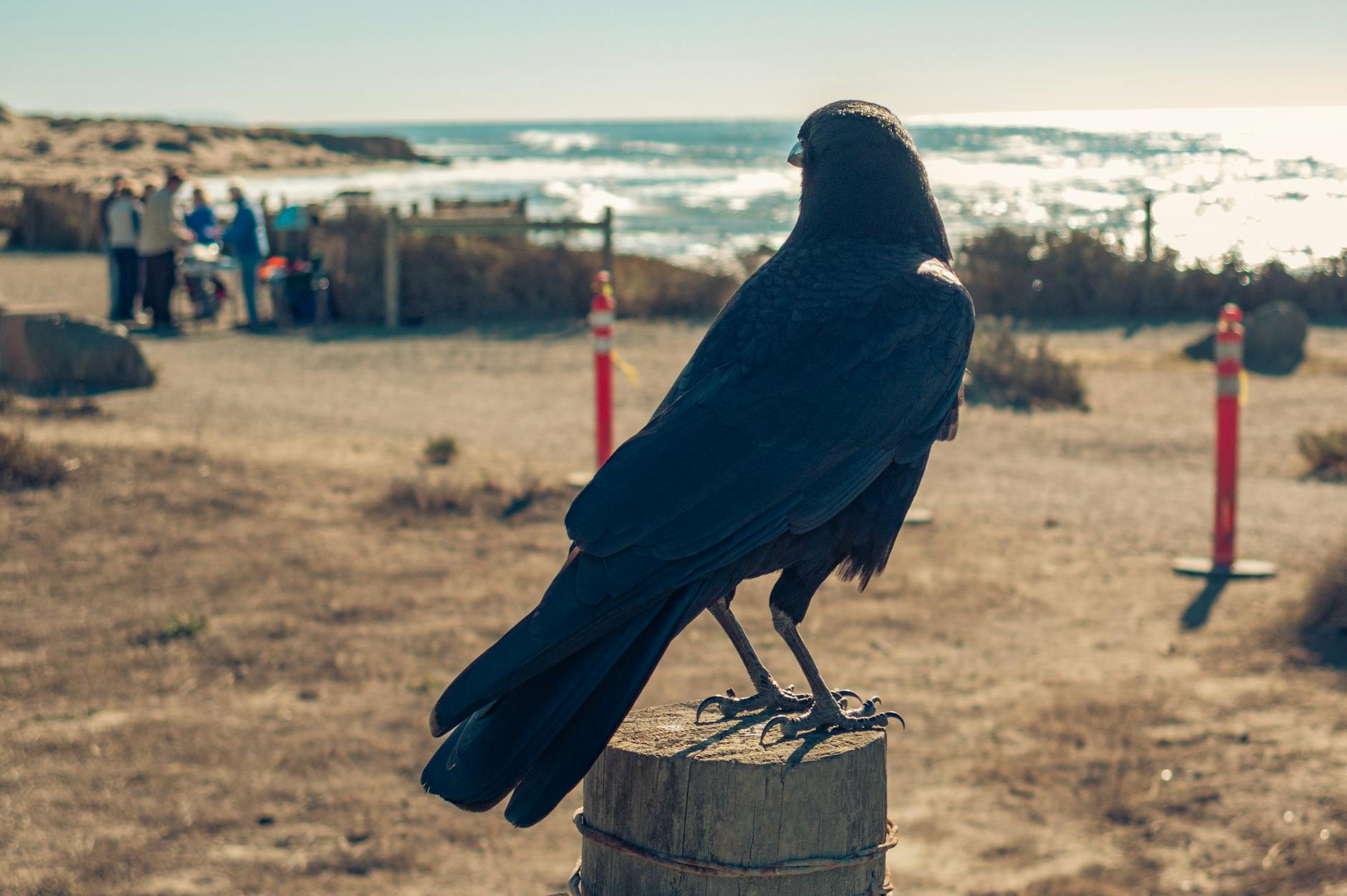
A crow.
And the little shit was laughing. Not just a caw that sounded like a laugh, a full-on, almost disturbingly human imitation of a laugh, in context.
This is why forests get reputations for being haunted.
It’s not my first run in with an imitating crow, either. I have one buddy who hangs around the yard and whom I have dubbed “2014 Hyundai Elantra.” This is because his favored mode of communication is making the exact boop-boop sound of a car alarm disarming. I don’t know why. I don’t know what they are attempting to convey with this. But they seem to find it positively delightful, and I’m not gonna lie, I kind of love it too.
It also goes to show that birds will decide to imitate whatever they want. I accidentally ruined a friend’s Quaker parrot this way, because I have the kind of vocal tonality that small things seem to respond well to. He was acting up, so I jokingly called him a brat. On occasion when I’d see him after that, I’d greet him with a little, “Hi, Brat!” It wasn’t even that often! He had way more contact with the people he actually… you know, lived with. Nonetheless, this little bird would puff himself up very proudly, make himself tall, and proclaim, “Brat!” Then do a little head-bob dance because he was very pleased with himself. My friend tried to sort of morph it into him asking for “Bread,” but to no avail. Brat it was, and he’d be damned if he was going to change his ways.
(To be fair, he was a brat at times. I parrot sat him once and, despite being very sleepy, he refused to go back in his cage. Refused. Banging things. Throwing things. You name it. I’d take him out, and he’d snuggle up in the crook of my elbow and go right back to sleep. Lather, rinse, repeat.)
All of this is to say that birds are weird as hell. You never know what they’ll latch onto… A middle aged woman’s laugh. The sound of a car’s key fob. Self-identifying as a tiny agent of chaos. Being the reason forests get reputations and aliens don’t visit us.
My Handsome Assistant, some friends, and I try to go to at least one Renaissance Faire every year — usually the MD or PA Ren Faire. If you’re not familiar with them (they seem to mostly be an American thing), Ren Faires are basically big mostly-outdoor markets, made to look like a Tudor era village. There’s food, entertainment, and people often like to wear loosely Renaissance or fantasy-inspired costumes to go. They’re a lot of fun, and I’ve found some very cool stuff (and people!) at them. This year, we went to the PA Renaissance Faire in Manheim, PA, at Mount Hope Estate.
I don’t really do a lot of shopping during the rest of the year — I might go to a thrift shop if I have a specific item of clothing or houseware that I’m looking for, but otherwise I’m all about make, make do, and mend — so I save up to get to go a little wild at Ren Faires and Pagan Pride Day. We usually have a list of things we’re looking for specifically. For my Handsome Assistant, this is usually belts, bags, or additions to his costume. For me, this year I was looking for handmade instruments and fountain pens.
(We also tend to buy a lot of tea anytime we take a vacation or day trip. I joke that it’s how I time things. When we run out of tea, it’s time to get out of the house.)
Stuff
First, shopping at the PA Ren Faire. Like I mentioned above, we bought some tea because we always do. I did also get a very nice cherry wood fountain pen from Denyan Designs (which is currently loaded with Diamine Writer’s Blood).
My Handsome Assistant got a lovely cloak from Up Your Kilt/As You Like It (“Because if it’s not as you like it, it has no business being up your kilt!”). It’s a very nice, versatile olive color, thick and warm, and long enough to fold and wear in a lot of different ways. He also got some new bracers to replace his old, plasticky costume set.
The World’s Best Hat
“It probably fits you fine! Stop flirting with it and just get the hat.”
I like hats. I started liking hats when I first shavedmy head and realized that my choices were a) start wearing a lot more hats and bandanas, or b) rub sunscreen into my head every day. Even now that it’s only half-shaved, I’m still very careful to keep the sun off of my head. (Melanoma is not invited to my pizza party.)
I went to the PA Ren Faire wearing a sun hat already, like I usually do — it goes with my costume, and helps keep my decidedly not period-correct hair from detracting too much from the “look.”
Then I saw the hat. A black bowler. Satin braid around the rim, with a fringe of tiny teal crystals all around. A wide teal ribbon as a band, festooned with peacock feathers. Teal tulle and a purple ribbon trailing from the back. All of my favorite colors. It was gorgeous, and also looked to be entirely too small. Still, I kept going back to it. I didn’t want to try it on in the shop, because some shops are touchy about that. I took it down from the display, admired it, and put it back. I took it down again, took off my sun hat, and compared the two side by side. Finally, my Handsome Assistant just threw his hands up. Just get the hat.
So, I did. It fit like it was made for me. It didn’t quite go with my costume, but it was safely ensconced in a bag and I was already planning all of the outfits I’d wear it with. (Like this really cool jacket I got when we went to New Hope.)
And Then I Wore the Hat
We ducked into Oh, Jessa!, a bright, showy clothing shop. I wasn’t really looking for another costume piece, but I’m a sucker for bright colors and shiny things as much as any toddler or corvid.
(Sometimes, I take pictures of interesting color combinations so I can play around with them while painting.)
Then I checked the tag — XS. I’m a fine weight for my size, with a decent amount of muscle, but I don’t know of any reality in which I can make myself occupy an extra small. Still, it looked like it might fit, and it did lace up…
“If you’re about a size 4 or 5, it’ll probably fit,” one of the very nice shopkeepers told me. I had my doubts, and it was more than I wanted to spend on a piece I hadn’t planned for, but just trying it on wouldn’t hurt, right?
Go figure, it was incredibly comfortable. The colors were the perfect jewel tones that suit my complexion (aggressively beige, very neutral, greenish in undertone, with a tendency to tan). It provided the perfect amount of support, even loosely laced in a hurry over a very voluminous chemise.
I stepped out and asked my Handsome Assistant to hand me the hat. It was a perfect match — down to the peacock feathers on the brim and the decidedly peacock-like tail of the ruffled bottom of the vest. This is going to sound very “and then everyone clapped,” but three people exclaimed about how good it all looked together. I took the tag from the vest, handed it to the person at the register, and left wearing it and the world’s best hat.
When we got outside, my Handsome Assistant wanted to take some pictures. I was awkwardly posing (I hate pictures), when a tiny, adorable child ran up to me and looked up, eyes enormous.
“I like your costume!”
“Thank you!”
“Do you want a-” I couldn’t make out the last bit.
“Sure!” I was already sold. I probably would’ve followed this kid into battle.
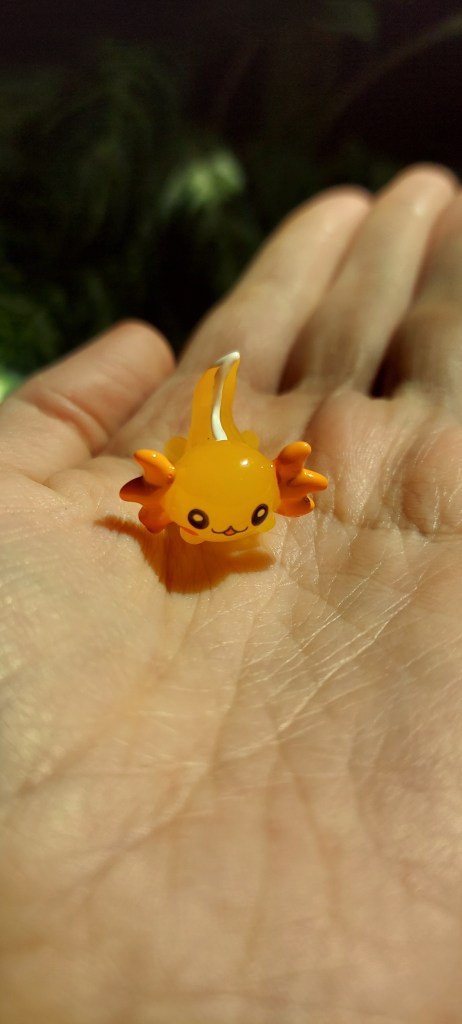
They handed me something and quickly ran away, back to their parents. I looked down at my hand, and you guys.
It was a tiny orange axolotl. I think my heart melted and ran out of my body.
(For real, kids don’t mess around and have a very well-deserved reputation for having no filter. A sincere compliment from a tiny child is worth more to me than every compliment I’ve ever received from an adult.)
I did also get several other compliments on the hat that day, which was a pretty big boost to my confidence and overall mood. Assuming that sky burials aren’t legal by the time I bite the grass, I am going to be buried in this hat.
Food
It’s not easy to avoid eggs, dairy, or meat at places/events like this, because food is usually done for flavor and convenience and the majority of Americans don’t really have an issue with any of those dietary components. Just in case, I stashed some Feel bars in my belt bag before we left.
(I also keep a 3″ knife, waterproof matches, a multitool, bug spray, a tick spoon, four kinds of lip balm, a can of Emergency Seltzer, a fountain pen, and two kinds of suncreen in my regular, every day backpack. I am nothing if not extremely prepared, always.)
The PA Ren Faire had more food options for me this year, which I liked — I knew there’d probably be a baked potato stall, giant pickles, and possibly a spot for steamed vegetables and rice, but there was also a place for walking tacos, vegetable crudités, and fruit salad.
If you’re not like me, there’re a lot more options. Giant smoked turkey legs, barbecue, sausage, pizza, you name it.
The only caveat is that pretty much all of the food is cash-only (or uses “Coin of the Realm,” tokens you can get near the entrance). Credit card fees can be pretty brutal for businesses that primarily do a large volume of small transactions — picture being charged $1 processing fee on one $100 transaction, versus $1 on each of 20 $5 transactions. To circumvent this, food vendors don’t take credit or debit cards. It can be slightly annoying if you aren’t expecting it but isn’t a big deal if you come prepared. Also, water is expensive, it can get hot, and it’s important to stay hydrated when you’re walking so much, so we brought our own glass water bottles to refill them at fountains/sinks as needed.
Fun
So, the PA Ren Faire has parades, jousting, and a variety of comedy shows, plays, demonstrations, and musicians.
We passed by a troll sitting under a bit of a ruined bridge, singing loudly. There were two boxes in front of him: one labeled “keep playing,” and the other labeled “hush money.” At that point, my Handsome Assistant’s curiosity was piqued and he made up his mind that we were going to watch the troll show.
As it turns out, Hob the Troll was delightful. It’s an all-ages show, so there’s nothing too racy, but all of the songs had a great balance of “stuff kids will get and laugh at” and “stuff only adults will get and laugh at.” My favorites were the song about Fröštïë the Snowman, the Dread Ship Montessori, and a “children’s drinking song” about that juvenile rite of passage: making Potions.
(Side note, when my younger sibling was four or so, he was complaining of a bad stomachache out of nowhere. A couple of hours later, he produced a two-liter soda bottle filled with a mixture of tap water, Pert Plus 2-in-1 shampoo, and the insides of a yellow highlighter and loudly warned, “Nobody drink this.”)
Also! We met a beautiful African pied crow named Goose. Like the pied crow at Pagan Pride Day, Goose accepted donations. What’s more, he’d take the donation from you, hop onto a cash box, and deposit it inside. And let me tell you, this boy was so freaking happy and excitedto do his tiny job!
We walked up to the area where he accepted donations, and he was full on hopping all along his perch, onto the cash box, off of the cash box, doing little spins, bobbing his head, all just super stoked to get to do his thing, because doing his thing means treats and praise.
Goose, the African pied crow, being very excited to get to deposit donations.
Also there were unicorns.
The PA Ren Faire was a fun, albeit very tiring day. I wish we’d been able to get to more than one Faire this year, but it seems like everywhere sold out pretty quickly. Fortunately, I’m probably going to get plenty of wear out of The Hat long before next year’s Faire season rolls around!
Note: This post contains some affiliate links. These links allow me to earn a small “finder’s fee” on purchases, at no additional cost to you. Thank you for supporting artists, artisans, and this site!
I’m not usually one to categorize myself with a single “core” or “vibe,” but I’ve been described plenty often as Goblin- or Crowcore. Honestly,I agree. My ideal aesthetic is “abandoned baroque theater slowly being reclaimed by an adjacent swamp,” and I apologize to no one.
The trouble is, I also like parties. When it comes to entertaining that matches my crowcore party vibe, I usually come up short. (Martha Stewart ain’t exactly jumping at the chance to chime in on this one.) Besides, I’m not into filling my house with mass-market goods. I don’t like it when things are too matchy-matchy, and slow decor is my speed. Stuff that’s secondhand, handmade, or straight-up found in the yard? Yes.
During the big Mabon feast, I ended up having to bring my contributions in things like silicone bags and mixing bowls. (Which is a bit less “slow decor and thoughtful consumption” and a bit more “first apartment” than what I was going for.) So, since we’re getting closer to the autumn/winter holiday season, I figured I’d put together a list of Things I Find Cool for Fall Parties. If you’re like me, maybe you find them cool also. Enjoy!
1. Nice Serving Dishes
If food is art, a really nice serving dish is like an excellent frame. Not only will good serving dishes make foods look better, they’ll make them easier to serve. One thing I lack is serving dishes, but I found some by CreatingComfortLab that I really like. They’re a Ukranian-American company that makes all of their ceramics by hand, and they have beautiful dinnerware (I like their serving dishes in green or black, around $48-58 each).
If you prefer to thrift your crowcore party dinnerware, shops like GraniteStateAntiques have some beautiful vintage pieces, like this Pyrex forest fancies casserole dish. It’s a versatile piece that I really like, and looks great when mixed with newer, handmade dishes.
During certain times of year, all you need to do to find a good goblincore party centerpiece is go outside — there’re tons of pieces of interesting wood with really beautiful lichen and moss, cool stones, and fresh flowers. That isn’t an option for everyone, though, but artisans like AuroraMOSSDesigns use natural materials to create beautiful, interesting centerpieces for coffee tables and dining tables alike. Check this one out:
If you prefer to make your own, you can also find small ornaments to help bring your centerpiece to the next level. I’m particularly fond of these handmade mushroom ornaments by juliecollings — mushrooms often lose their colors and shape during the drying process, but these can give you the same look in a more robust, longer-lasting form.
3. Eclectic Glassware
I like mismatched dishes — it’s much more my speed to have things that go together, rather than match. I also really enjoy vintage water goblets, in a whole array of shapes and colors. I keep my eyes peeled for them every time I go to a secondhand shop, but it takes time to build up a collection capable of serving a group. Sellers like SecondSongHomestead and ValmontVintage have a selection of colorful, eclectic vintage glasses available.
4. Candlesticks
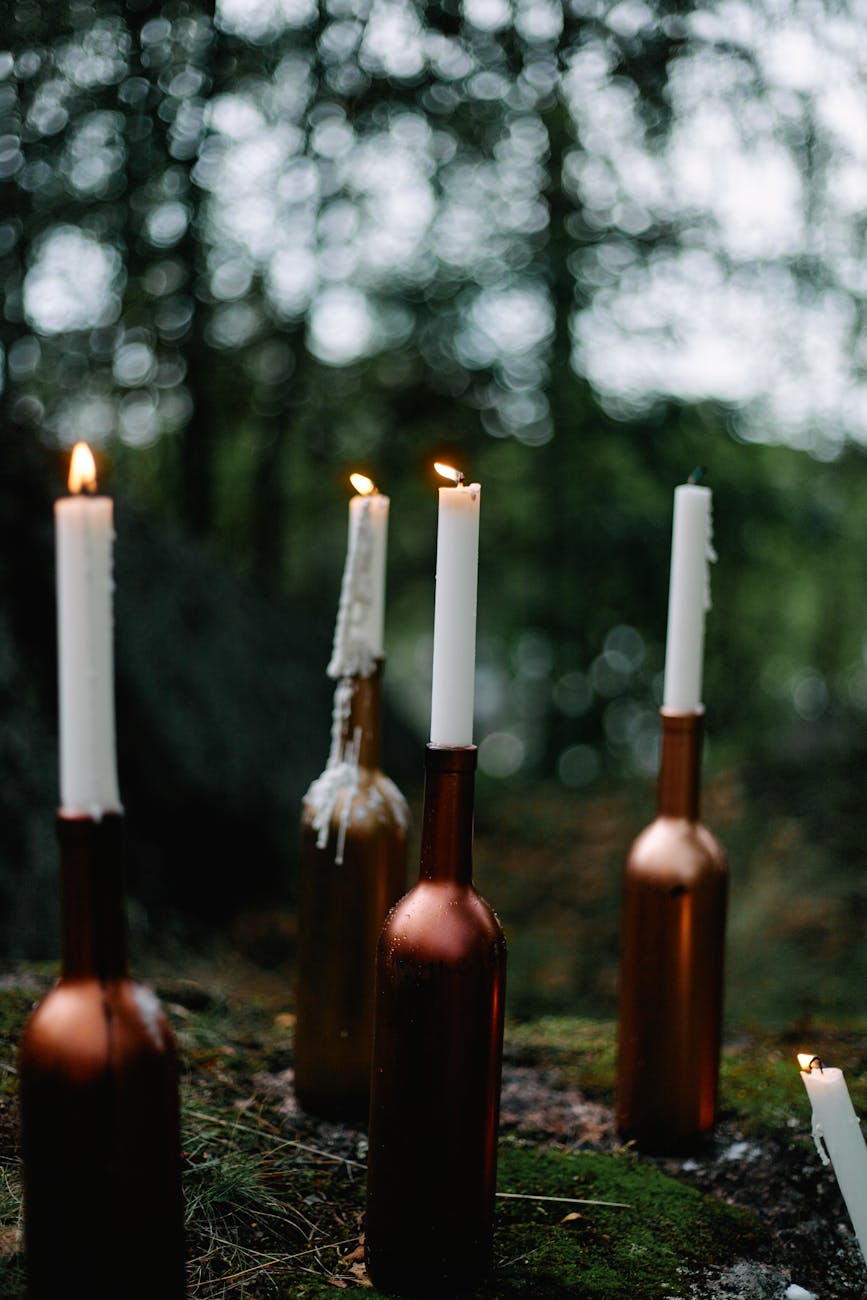
I’m a sucker for brass candlesticks (mismatched, just like my glasses). They’re another thing I keep an eye out for whenever I’m looking through secondhand shops. When they’re old, they develop some unique and lovely patinas, but they also polish up beautifully.
As with vintage water glasses, it can sometimes be difficult to find specific pieces to round out the look that you’re going for. A nice group of brass candlesticks, filled with natural beeswax candles, is a really beautiful addition to a crowcore party table or buffet when you’re entertaining. If you’re hunting for a specific shape or style of candlestick, and can’t seem to find it, TheCherryAttic and pamscrafts7631 might be able to help you. They both have groups of assortedbrass candlesticks, sold separately so you can pick exactly what you’re looking for ($9-30).
I mean, not for humans. I trust you probably have things figured out on that front. (If not, maybe try this post’s recipe for banana bread — it’s really good.)
These are snacks specially formulated for corvids — crows, ravens, jays, and magpies. AnitaApothecaryShop has a bagged blend for feeding your familiars, while OrganicRawRootsFarm has a whole starter kit for feeding crows. Pair it with a dish of fresh, clean water (they like to dunk their food), and you’ll likely have bird friends showing up in no time.
7. Tunes
The last thing a party needs is some ambience. If you’re into fantasy lofi, check out Medieval Lofi. If Pagan and witchy music is more your vibe, I’ve put together a playlist (that I listen to all the time):
This past Saturday was Pagan Pride at the Unitarian Universalist Congregation of Frederick. If you’ve never been, I highly recommend it — there’s live music, workshops on a variety of subjects, food, and tons of vendors of all kinds of cool stuff!
(I, personally, came away with a mug, some artwork, a mushroom-shaped incense holder, a pin, a set of earrings, dried organic lavender, magnesium butter, a really cool jar shaped like a skull, a hand-dyed and block printed bandana, and a display of a mossy log set with three corked test tubes. The stump in the front yard has been putting out a ton of interesting mushrooms lately, and I’ve been dehydrating what I can identify. I’m looking forward to displaying them once they’re done!)
This year, I decided to skip the workshops in favor of hanging out with friends (actually, many of the friends that I just saw at the Mabon celebration), listening to music, and eating delicious sorbet. The Street Cow‘s Cowabunga sorbet pop is non-dairy, real fruit puree, and awesome.
Also, I met some very handsome lads.
This is Spectre.
Spectre is fine, it was just toasty out and he is a young boy who is very excited to see new things.
He was part of Avian Encounters, a group of falconers who provide people with the chance to learn about and see raptors close up. These are all trained birds, kept by licensed professionals who know how to properly feed, care for, and mentally engage them. Getting to see birds like this up close is a rare and fascinating experience.
They also had a little screech owl, an American kestrel…
And (oh, be still my heart) a gorgeous African pied crow.
“May I take a picture of him?” I asked, barely able to contain my excitement.
“Sure! If you make a donation, you can also hold him and take a picture.”
!!!!
Needless to say, I did. He sat still for a short video (the picture to the right is a still), before hopping back to his handler. The whole time, I gushed to him (like a starstruck dork) about how pretty he is.
Human celebrities are all well and good (I saw one of my favorite musicians not long ago and managed to be surprisingly normal about it). A really cool bird or bug, though? I will absolutely lose my mind.
Pagan Pride is delightful every year, but this year was particularly special. I really hope Avian Encounters is there next year, too — the birds are all beautiful, alert, and well cared-for, and it’s a great opportunity to learn more about them and get some close-up reference photos for paintings.
He’s back. At least, I’m pretty certain sure it’s him, though he appears able to fly now. This crow has a distinctive appearance and a set of behaviors I had previously only observed in Boink, so I am somewhat confident in my assertion that The Shed-Dwelling Scrunglemuppet Has Returned.
Last year, he spent evenings roosting in the big apple tree, and mornings and afternoons sitting on top of the shed. When I went outside, he’d run to the far side to “hide.” If he heard the back door close, his little head would pop up over the shed’s roofline to see if I was still there. If not, he’d hop his way over to the feeders to grab some food before the other crows came.
Now, he appears with the rest of the family. He still appears to be pushed away from the food and scolded, and he still does the same goofy little run, but he’s at least better able to get away from predators. I don’t think there are many animals who would go out of their way to eat a Boink, but there are certainly creatures who would take the opportunity to hunt a land-locked crow.
Boink still has to be a bit opportunistic when he eats. He’s still scrungy. His tail is still kind of karked up, and I don’t think he’s capable of not looking bedraggled, but his flight feathers are back and that’s what’s important.
Crows (and corvids in general) can be pretty divisive. I don’t think I’ve met someone who can just take or leave them — it’s always either a fervent love, or a deep dislike.
And I get it, honestly. They’re noisy. They’ve been known to eat nestlings, eggs, and small mammals. To many, they’re a nuisance and they don’t understand why anyone would go out of their way to make their yard more attractive to these birds.
Ever since we moved here, I’ve been feeding a small family of crows whom I’ve come to love dearly. I’ve hesitated to feed other species, because I don’t want to encourage them to congregate (and potentially spread avian flu) when that isn’t their normal feeding pattern. While the debate about feeding birds and crow/raven behavior will likely never come to an end, here are a couple of things I’ve personally observed when making an effort to coexist with crows:
They’re very smart. (Like, really smart.)
With most members of corvidae, you’re dealing with a very intelligent animal. With crows specifically, something on the level of a toddler or a very bright dog.
I wanted to mention this right off the bat because it heavily impacts a lot of my other points.
They’re also opportunistic.
In general, crows aren’t really hunter hunters. They do eat meat, and they will eat young, weak, or sick animals, but they’re opportunistic feeders. If the opportunity isn’t there, or there’s an easier source of high-value food somewhere else, they’ll go elsewhere.
Crows are also a prey species for larger carnivores. When they’re eating, they’re vulnerable because their attention is directed toward that and not toward looking for threats. This is why groups typically have a sentry or two, to keep an eye on things while the others feed.
A blue jay, one of the more colorful members of the corvid family. Photo by Pixabay on Pexels.com
They’re also still wild animals, no matter how closely they may coexist with humans. Wild animals will go for easier-to-get food sources whenever possible, because more challenging ones a) aren’t guaranteed, and b) require more effort (read: calories) and attention to access. The exception to this seems to be when there’s a particularly appealing, usually calorie-dense food item available that’ll make up for the potential danger and extra effort expended to get it.
You can direct their behavior.
With the above things in mind, you can direct their behavior to a degree.
I’ll give you an example. When I worked in pet retail, I had customers that’d come in and complain that squirrels and large birds that kept getting into their bird feeders. We had tons of anti-squirrel technology available — baffles, special lubricants for poles, specially shaped feeders, and even battery powered ones that vibrated, spun, or did all kinds of other gymnastics. I’d gently try to guide these customers to dedicated platform feeders and bags of corn, but they always turned it down. No matter what they bought, they’d be back in a few weeks for something else. A greased pole was no longer enough, because the squirrel learned how to jump from a tree at just the right angle to defeat it. A specially shaped feeder wasn’t enough, because the crows would team up to work around it. The cycle would inevitably repeat, until they finally just gave up and bought the platform feeder and the bag of corn. After that, the squirrels and large birds would eat the easy to access food, and the smaller birds had their own.
Since this crow population was already established here (and has since grown due to habitat destruction caused by some recent construction), giving them high-value, easy to access food has ensured that I get to keep more of the fruit and vegetables from my garden. This isn’t just because the crows don’t take as much, either — they’ve also done quite a bit to keep various garden pests away.
I don’t leave their food unattended — I usually feed them items I know they like, then sit out there just a few feet away with my own lunch. I have never once been harassed for my food. I’m pretty sure it’s because, like other intelligent animals, they’re able to distinguish between what food is given to them and what food is mine. Why bother me to eat off of my plate, when their plates are right over there? Why run the risk of a potential conflict with a human when they have accessible, desirable food already?
They might not impact songbird populations in the way most people think.
This study covers the relationship between various predator and prey species. One of its findings is that, as prey species numbers increase, so do predator species numbers, and there isn’t strong evidence that native (non-invasive) predators alone drive species decline.
A single predator, or small group of predators, can impact local numbers of prey animals, but don’t appear to correlate with a decline in overall numbers. The thing here is that crows are, like I said, opportunistic. They take prey from nests, where other predators are more likely to be less discriminating and take reproductively mature animals (since those are the ones they’re most likely to encounter out and about). Many corvids are also very territorial — an established family of crows will actively drive off other, larger, less opportunistic predators. They appear to exert both a predatory and protective influence on local prey species.
While I offer food for the local birds and squirrels, I’m careful not to do it every day. (Water, on the other hand, is always available.) Nobody goes hungry, and there seems to be less impetus for them to eat what I’m growing or trying to protect, but they still need to engage in natural foraging behavior.
This works in my case because this crow family had already established this area as their territory. If you listen to their calls, you can hear them relaying from one tree to the next. While they’ll cover a lot of ground in order to find food and water, a sentry alerts the others when there are snacks available. They can go about their business and stop by when there’s food.
(One funny thing I’ve noticed is that their vocalizations change when I’m on the deck, whether I’m putting food out or not, like they’re telling everyone that it’s almost time to eat. Once, I was only watering a few plants and went right back inside, and I got to hear a very excited crow call trail off into something that sounded unmistakably like disappointment.)
They’re not just garbage birds.
Crows (and many other members of corvidae) will get into dumpsters if there’s an opportunity, somewhat rightly earning them the nickname of “garbage chickens.” Stories abound of people feeding them fries, chips, and other very palatable, salty, oily, and largely carbohydrate-based foods. These really aren’t optimal dietary contributions for them, though, and having a positive relationship with your local corvids should mean taking their actual nutritional needs into account.
I explored the foraging habits of crows, plus the diets fed to pet pied crows in captivity as well as crows and ravens at rehabilitation centers. In the end, I came up with a mixture of cat or puppy kibble, cracked corn, raisins, and a low sodium, unfortified cereal as a base. To that, I add hardboiled eggs (cut into quarters, shell attached), dried mealworms or black soldier fly larvae, peanuts (in the shell), and fruit, depending on what I have on hand. Sometimes, if I have the leftover tail end of a loaf of homemade bread, I’ll cut that into cubes and toss it in too. This all seems to work out pretty well — they appear to enjoy it, and they’ve got some of the darkest, shiniest feathers I’ve ever seen on an urban crow.
They may not really react to humans like you might expect.
One thing people bring up often is that crows will get used to humans, which will cause problems.
There are definitely cases of birds, including corvids, losing their fear in areas with frequent, close contact with a variety of people. Anyone who’s ever tried to eat French fries on a boardwalk can probably give you several examples. (I was almost eaten by a pelican when I was little. It was a defining experience.)
I can’t speak to this in general, but I can point out my own observations as someone dealing with an urban crow population that already has a lot of incidental contact with humans. Like I mentioned above, I also stay out there by the feeders after I fill them. While the family of crows has certainly grown bolder with time, this change in behavior seems to be limited to me. If I’m out there and my Handsome Assistant joins me, their behavior switches gears immediately. They keep their distance, and even make some unique vocalizations. If I’m there with a stranger, the difference is even more stark. As intelligent animals with the capacity to recognize individuals, they seem to have drawn some very firm lines between “human what puts the food,” “other human,” and “some guy, idk.”
One interesting experiment with ravens kind of highlights this. A researcher was teaching a raven to trade, by offering the bird a small piece of cheese (a high-value food item) in exchange for a piece of bread (a lower-value one). At one point, the researcher accepted the raven’s bread, then had the audacity to eat the cheese right in front of them. The raven, understandably pissed, refused to engage in any more trading exercises… but only with that particular researcher.
Sometimes, they just leave (and that can be a good thing).
Animals have their own agenda, though it’s often tempting to see them through a humanized lens. I’ve seen a lot of posts from people asking why their local population of crows just left — do the birds not like them anymore? Did they offend them somehow???
The truth is, wild animals have their own schedule. They likely won’t, don’t need to, and shouldn’t come hang out every day. During summer, when a lot of fruits ripen and grains are harvested, crows are likely to go off to agricultural areas to eat the dropped grain. They also have babies, so they’ll be off doing parent activities. In winter, they may need to go to a more desirable climate or more abundant food and water source. If the larger murder of crows is going off to do something, a given crow family will go with them.
If they stop showing up for a while, it can honestly be a good sign because it means they’re still being wild birds. It might suck if larger carnivores move in and start causing trouble in their absence, but that’s nature for you.
A magpie. Photo by Manuel Torres Garcia on Pexels.com
On top of all of this stuff, I’ve also noticed some interesting impacts on my hyper-local environment since I began putting food out for these birds:
There actually seems to be more biodiversity now.
In the beginning, I was lucky to get some house sparrows, starlings, and the occasional mourning dove. As time goes on, I’ve begun to see more species. Like, a lot more. Blue jays, cardinals, finches, dark-eyed juncos, woodpeckers, and grackles, to name a few. (Even a mockingbird that has absolutely given the crows a run for their money when it comes to territoriality.)
Part of this may be because there’s more food available, but most of the food I put out consists of things that would appeal to crows and jays, not necessarily other species. I have, however, noticed that the local crows do a lot to keep the smaller birds safe, because…
They will not tolerate nonsense.
I’ve written before about how this family of crows have effectively become my unpaid, unasked-for yard bouncers. In addition to dispatching particularly chaotic squirrels, I’ve seen them bounce bigger predators, too. They’ll get together and mob a hawk (which is honestly fascinating to watch). They’ll chase away stray and feral animals. They’ll even warn me if there’s a particularly suspicious snake in the vicinity. They’ve kept rats, mice, and grubs away, too. They have very definite ideas about Who Belongs and Who Does Not.
These crows seem like a protection racket. Like a dragon that demands an occasional sacrifice from a local village, or a rat snake that keeps mice and rats out of a chicken coop in exchange for the occasional egg. It’s weird, but I’ve seen them on my deck, coexisting perfectly fine with the smaller birds and other squirrels… So, I guess it’s all chill?
I’ve actually gotten a ton of free food out of the deal.
Granted, a lot of this is because I’m not particularly fussy about garden borders. If something neat springs up, isn’t a noxious weed, and won’t run the risk of poisoning me, I’m inclined to let it be and see what happens.
As it turns out, “what happens” is a ton of volunteer tomatoes, corn, grapes, and berries. (The smaller birds even planted a bunch of millet and broccoli.)
They’ve also brought me occasional small gifts, but I can’t eat those.
When it comes to coexisting with these incredible animals, the important thing to remember is that a) they’re very smart, b) they have the capacity to remember and distinguish between individuals, and c) they’re wild. While it might seem flattering to feel needed and loved like you would with, say, a dog, that’s counterproductive to a wild animal’s survival both physically and mentally. It is possible to interact positively with them without harming their ability to live without you, and this should be the goal of anyone who really loves these birds.
As the weather warms up, the crows come back in force. They distribute themselves around the perimeter of their territory, sending a single “caw” in a kind of relay. As far as I can tell, it seems to mean, “Hi, I’m a bird! Status update: Still a bird!”
This single “caw” is passed from sentry to sentry until something happens to disrupt it. That could be a cat, an owl, a snake, or the sudden appearance of a quantity of snacks.
One of these sentries is positioned in the big maple tree in the back yard. As far as I can tell, he has exactly one mission: Keep tabs on my comings and goings.
I know this because I hear his single cries throughout the day, echoed by the equally single cries of his family group. As soon as I show up on the back deck, that single “caw” turns into a rapid series of calls. If I start putting out the crow salad, the shouts get even faster and more high-pitched. By the time I turn around to go back inside, the apple trees and the roof are full of black shapes.
Pardon the raindrops on the window pane.
Sometimes, they don’t even wait for me to go all the way inside before they swoop in and start eating. If they’re particularly feisty, they’ll barely hop away when I go out to refill. This seems to be out of a sense of avian practicality, rather than fear — it really seems like they fly up to the roofs to wait in order to be out of the way, not because they’re genuinely wary of me anymore.
I’ve found a mix of food that doesn’t seem to appeal much to other bird species, so this family can feed safely without concerns about being hassled or coming into contact with pathogens from unrelated birds that might otherwise swarm the feeder.
I can’t be positive, but I’m also reasonably certain that this sentry is the same li’l nerd who came and stared in my bathroom window after my Handsome Assistant and I returned from being out of town for a few days.
I can’t overstate how helpful they’ve been to have around — they deal with nuisance animals, and I’ve gotten a ton of free garden plants from them (and one small bouncy ball). I love this band of weirdos so much. It always makes me so happy to see them.
Not long ago, I wrote about the family of starlings that had pretty much taken over. A squawping mass of tiny kicks, punches, flung food, and babies that would walk up and demand to be fed by anything that moved (and a few things that didn’t).
While they were fun to watch, they also seemed to drive away a lot of the other birds that visited me — especially the crows. Given how much energy I’d put into building a relationship with my local crows, this bummed me out. Still, I knew that starlings aren’t forever, and it wouldn’t be long before they’d join a migratory murmuration and the yard would be peaceful once again.
At that point, I figured, I could try attracting crows again. They might not bethesamefamily that I’d growntolove, but I knew this area was hospitable to breeding populations of crows and would easily become so again.
Anyhow, the starlings have gone on their yearly vacation. I discovered this when I woke up the other morning to big, black shadows passing over the skylight. I went to investigate, and what to my wondering eyes should appear but…
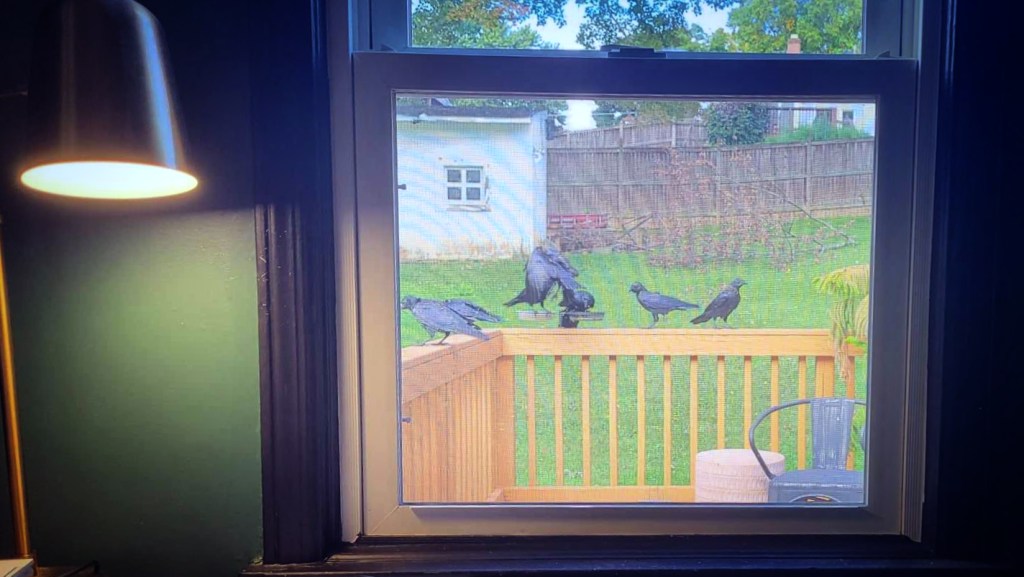
The view from my Handsome Assistant’s office. Not shown: The other six crows at the feeder on the other side of the deck.
All of the crows. At the same time.
I knew it was the same group because they have a handful of pretty visually and behaviorally distinct individuals. They scrapped over cat kibble, raisins, nuts, and fancy organic peanut butter cereal (which is apparently a very hot commodity among corvids). I went outside to refill the feeders once they’d nearly wiped them out, and they flew off to the roof, waited for me to finish, and immediately swooped back to resume feeding.
It feels nice. As far-fetched as it seemed, there was always a nagging fear that I’d done something wrong somehow. Something to drive them away. Crows are intelligent, perceptive creatures, and I’ve heard stories of them spurning people for things like imitating the wrong crow calls. It’s good to have some confirmation that it wasn’t me — if anything, it seems like they’d been champing at the bit to get back and hang out.
It was also great to see how much they remembered. In the beginning, they’d fly off when I went outside. Things got to the point where they’d hop to the roof, at most, and wait for me to fill the feeders. Sometimes, if I was sitting down on the deck, they’d land near me to eat anyhow. Despite their hiatus, they still aren’t afraid. A couple flaps to perch on the roof, or the fence, or the shed, and they’re content to wait patiently and watch me put more food down.
Well, okay. Not disappeared, they’re just sort of close by instead of hanging out on my various sheds and/or porch. Personally, I blame the starlings.
Starlings have a bit of a reputation. They’re invasive, noisy, arrive in hordes, and get into tiny brawls everywhere. They fight in the birdbath and knock it over, upsetting the mourning doves. They fight in the seeds and kick them everywhere. They kick each other off of the deck railing like this is a tiny Sparta, and every one of them is a miniature Leonidas.
It’s just this, constantly, all day, every day.
They’re also bullies. Since they travel in groups, often with masses of babies in tow, they have no problem starting fights with birds much larger than them. Starlings are tiny compared to crows, but they do outnumber them greatly. Crows will kill and eat baby birds, so the starling families seem to go on the offensive as a matter of course.
It’s not like they have to fight a whole bunch, either. Crows have good memories, and starlings are loud. It probably only takes one fight for a crow to hear a flock of starlings and not exactly feel up to facing down an army of shrieking lilliputian kickboxers.
A gull, probably about to get his face rearranged.
Starlings also have basically no sense of self-preservation. In the past day, I’ve seen a baby starling walk up and gape its mouth at a reflection, a sparrow, and a squirrel. This afternoon, one of them flew to my kitchen window, stood on the outside sill, and gaped at me through the glass. I wished I’d gotten a picture of this, but I did not as I was too busy staring in shock at this stunning display of hubris.
Sorry, kid. I keep the feeders filled, but I’m not about to go outside to spit bugs into your tiny face. Also, where are your parents?
Fortunately, starlings are migratory. They’ll hang around during the summer, like a swarm of drunk college kids in Punta Cana, then pack up and leave. I know the crows are still here because I hear and see them around. They just tend to go to the feeders very early and very late, when they’re less likely to be harassed.
So, my spouse and I went to an out-of-town family shindig the weekend before July 4th. It was a lot of fun — there was a ton of food, live music, and a huge crowd of interesting people to talk to (many of whom are also Garden People like me).
When I came back, the yard was silent. My heart dropped into my stomach.
Was it because I wasn’t there to keep the food and water replenished? Was it the fireworks? Had someone gotten injured or killed, scaring the whole murder away? Did something happen to Boink?
I put fresh water and the usual mix of food (peanut butter cereal, cat kibble, dried bugs, and berries) out, but all I got was a clamorous mob of starlings.
(Apparently a group of starlings can be called an “affliction,” which sounds about right. I love all of the birds that come to my home, but most of these are, to put it bluntly, invasive shrieking dickheads who throw things.)
A day went by, then another. I lost sleep and felt my urge to write or paint completely sapped. So much of my art is inspired by these magnificent little weirdos, I hated the idea of working on a painted bird when the real ones had disappeared.
Then this happened.
“hey, you there? you guys back n- oh, you poopin?”
The crows returned by having this guy rock up to the bathroom window (please ignore the spots on the glass — the rain and pollen have fingerpainted everything) and stare inside. They twisted their head from one side to the other, very deliberately peering in. If they had hands, they probably would’ve cupped them around their eyes to see better.
It was funny, but, in retrospect, also somewhat concerning. Did they watch us leave? Did they send someone to stare into our house every day to see if we were back yet? There are so many windows, you guys, why did they pick the bathroom?!
Anyhow, the big maple tree is once again filled with raucous caws and shiny black birds. I’ve seen Magni and Muse, and even Boink has once again taken up his position on top of the shed. (I have no idea where — or how, for that matter — he went for several days at a time. I’m just glad he’s back.)
It does my heart good to see them. I just kind of wish they’d maybe peeked in the kitchen instead.















 Marble Crow