
Neodruidry · Witchcraft

Can you use birthday candles for magic?

I love candle magic, but I don’t do it quite as often as I’d like for one simple reason: It usually requires letting a candle burn completely, ideally uninterrupted, and who’s got that kind of time? There are options for getting around this, of course, but a lot of them are less than ideal. If only there was something smaller, that could burn more quickly. Something like… oh, I don’t know. A birthday candle.
There’s gotta be some kind of birthday candle witchcraft out there, right?

Burning candles against white textile.
Photo by Jill Burrow on Pexels.com

So, you’ve got a candle spell to work, and one big problem — you can’t just leave it burning while you go on about life. There are some suggestions in old books, things like placing the candle in a cauldron or bathtub with an inch or two of water in it, so it’ll be immediately doused if it falls over. As someone who grew up with a firefighter, however, these suggestions make my teeth itch.

Fortunately, there’re better options out there than “stick a candle in your bathtub and hope for the best.” If you absolutely have to, you can snuff a candle and re-light it when you’re able to pay more attention to it. You might even be able to work this into your spell itself, by performing it every night for a series of nights and only burning a little of the candle at a time.

The other option, of course, is to use a really tiny candle.

There’s nothing wrong with using birthday candles in spells. They pack much of the same characteristics of full-sized candles (the element of Fire, the act of burning, the presence of a flame, the wax and wick being consumed) in a tiny package. There are a couple of things to consider before swapping all of your pillars, jars, and chime candles for a package of birthday candles, though.

Birthday candles are little and don’t take long to burn completely. When time is of the essence, or you can’t afford to take your eyes off of a candle for even a second (hello, friends with children or pets), then you need something that can work quickly.

That aside, there’s another reason why you might want to try using birthday candles: portability.

I have a crane bag. For Druids/Neodruids, this is a container of tools for field work, power objects, and/or everything that you might need for performing a ritual at any time, in any place. I’ve got tiny incense sticks, small statues, stones, bits of wood, airline-sized bottles of whiskey, a small bowl, a tiny bell, a rattle, etc. Birthday candles fit nicely here, and I don’t have to worry about disposing of a plastic or aluminum cup like I would with a tea light.

They’re inexpensive

Birthday candles are cheap and plentiful. You can find them in any grocery store, in decently sized packs that should last you for a while. Honestly, you’ve probably already got some in a junk drawer or the back of a cabinet in your kitchen right now.

In cultures that celebrate birthdays with cake and candles, there’s a tiny ritual associated with their use. The candles are placed on the cake, one for every year of the recipient’s age, and lit. The recipient closes their eyes, makes a wish, and tries to blow out all of the candles in one breath.

Cupcakes on a table with lighted candles and balloons.
Photo by Cup of Couple on Pexels.com

Honestly, if you mention birthday candles to anyone in the US, it’s likely that one of the first things they’ll think of is making a wish. Sure, it’s a cute little ritual primarily targeted at kids. It’s still a ritual, though. It’s still a positive association between birthday candles and wishes.

This is something that other candles don’t really have. Can you imagine parking an eight-inch-tall pillar candle in the middle of a sheet cake? Eleven or twelve tea lights? A massive jar of something labeled “Sun Dried Cotton”?

Depending on your particular birthday candle witchcraft goals, that connection with wishes is something you can tap into.

They’re easy to clean up

As a candle burns, the wax turns to liquid and is carried up the wick to be used as fuel for the flame. This process is more efficient for some candles and some types of wax than it is for others. Scented candles, for example, produce a lot of liquid wax to let the fragrance dissipate. Taper candles are used primarily for light, not scent, so they have a different shape and generally don’t produce much messy liquid wax. Birthday candles are only supposed to burn as long as it takes to blow them out, so they burn pretty neatly. Maybe a drop or two of dripped wax, if that.

If you’re not a fan of either cleaning old wax out of your candle holders, or digging holes to bury the remains of spell candles, birthday candles offer easy clean up and disposal.

The small size of a birthday candle doesn’t give you a whole lot of real estate for inscribing sigils, words, etc. If you have a particularly steady hand, you may be able to do something with the tip of a straight pin or sewing needle. Otherwise, if your spell calls for inscribing a candle with something, skip the birthday candle witchcraft and go for a chime, votive, or even pillar instead.

Unlike other candles, birthday candles are meant to go out easily. This can be a pain if you’ve got a situation that makes it tough to keep a candle lit. A stray breeze, whether from the outdoors or sudden movement, can leave you scrambling to re-light your candle mid-spell. It’s a major concentration breaker, if nothing else.

Some spells call for snuffing a re-lighting a candle, generally over a period of several days. Taper, knob, or pillar candles are good for this. Birthday candles, not so much. Can you imagine having to mark a tiny birthday candle into seven equal segments, and burn one single segment each night for a week? By the time you got it lit, you’d need to immediately snuff it again.

Birthday candle holders usually come in the form of either those little plastic or metal cups with a spike on the bottom, or an entire cake. Neither of these are particularly ideal when you only need to burn one candle, on a flat surface.

If you have trouble figuring out how to securely set up a birthday candle, get yourself a basic glass votive or tealight cup, and a handful or two of sand. Poke the birthday candle into the sand, and you should be good to go. If any of the melted wax gets on the sand, it’s easy to scoop it out and bury or otherwise dispose of it along with any other remains of your birthday candle witchcraft.

Like I said, I love candle magic. I also have three cats and the attention span of a brine shrimp, and I need candles that I can easily travel with. For me, birthday candles are a valuable and useful magical tool.

life · Witchcraft

Really, if you think about it, I’m just helping them sell their house (in a sense).

I can’t say I’ve ever lived in a very close-knit community. My custodial parent was tired and angry all of the time, so we didn’t really do community activities, either. Now that I’m adult enough to do that kind of thing on my own, I love it. I can’t say that I really have any super close friends in my neighborhood, but I still love things like street fairs, farmers’ markets, and that gem and mineral show we went to not that long ago.

That’s why I approached the sudden appearance of a “For Sale” sign in my neighbor’s front yard with equal excitement and trepidation.

The house belongs to an older couple who have an adult daughter and young grandchild. It’s just like the others on my street — a post-war Cape Cod in a decent-sized yard, but theirs has an addition to give it some more space.

I never really saw the owners much, so I’ve never had the chance to really get to know them. I’m pretty much a golden retriever in a human suit, and my baffling levels of friendliness and desire for connections to other organisms yearn for expression, so this is a regret on my part. Honestly, the people who own the place could’ve moved weeks ago.

But this now raises a question: Who’s gonna buy it and move in? We’re in a walkable location that’s not far from DC, so I could see it going to someone who wants to Airbnb it (which is kind of a huge problem in this area in general). I hope not, though.

Honestly, I just hope whoever chooses to move in doesn’t suck.

Then I figured — if you can use magic to draw love, luck, and friendship into your life, why not cool neighbors?

Two candles, one pink and one yellow, lay sideways under a chunk of rose quartz. They are surrounded by four black Herkimer diamonds, and a stick of cedar incense burns just above them. There's a small quantity of incense ash on the wood near the candles.

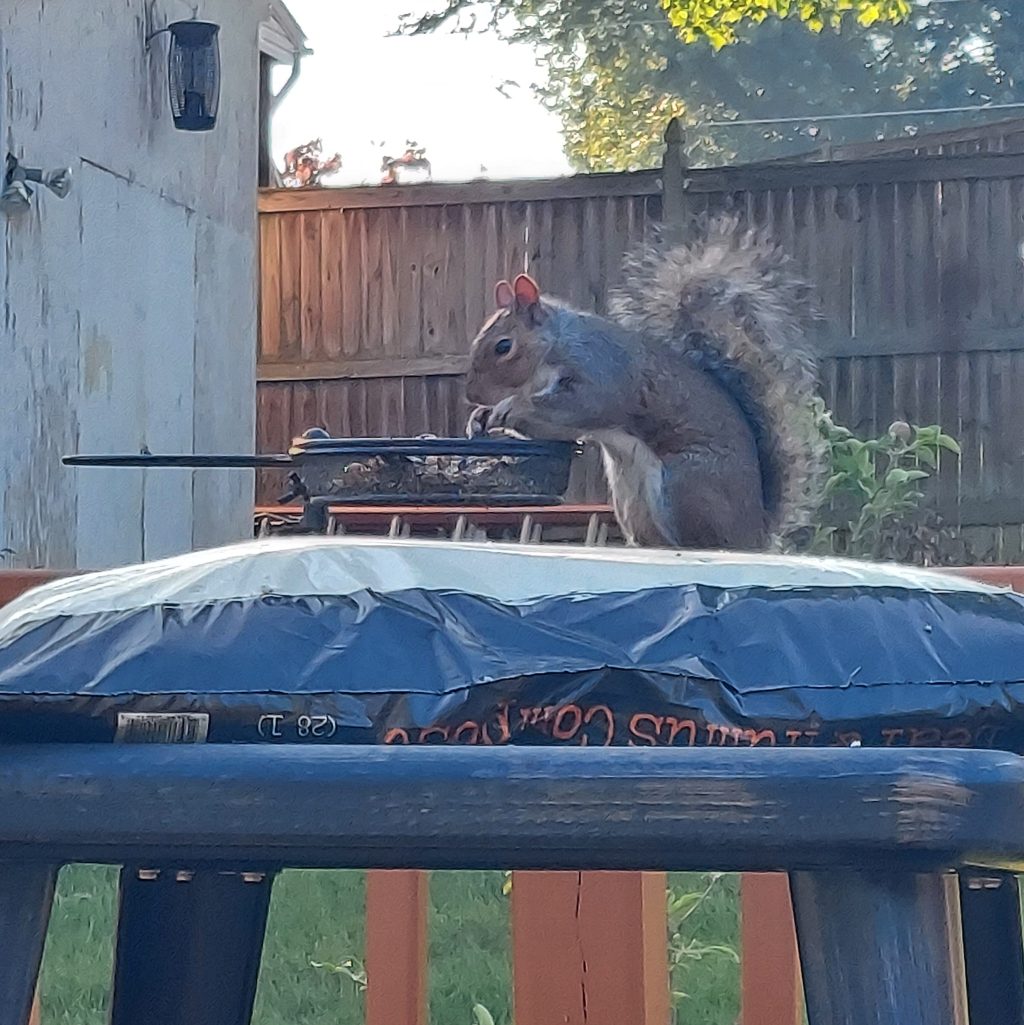
This train of thought it what has found me sitting on my deck, fuming a set of candles (pink for platonic good feelings, yellow for friendship) and a bit of rose quartz in cedar incense, all while arguing with Frederick de Bonesby that it is actually very rude to let his gigantic ass take up the entire platform feeder, and there is a line of sparrows squabbling behind him while they wait their turn.

(Frederick de Bonesby does not care. His primary concern is maintaining his skin and his flesh and his fats, even though he is a tubby squirrel and not a powerful 92-year-old lich. He does this chiefly through consuming copious amounts of peanuts and dried corn.)

A squirrel sits on the railing of a deck, paws busily rummaging through a pile of nuts and seeds in a platform feeder.

But I digress.

Really, I’ve been using yard work as a kind of stealth mission. See, there’s a porcelain berry vine (pretty, but invasive) near the driveway that needs to be torn out. It’s right next to the fence dividing the properties, and also right by our gate. According to my calculations, this makes it an excellent spot to conceal a sweetening jar, which I can do by digging up the porcelain berry vine and stealthily burying the jar in its place.

I could fill it with sugar syrup and honey. Cinnamon and petals from the big Virginia rose bush in the front yard. Clover blossoms snuck from the edge where our yards meet.

I could also modify a love spell to attract a good neighbor. There are a bunch of them that involve listing the ideal qualities of a potential lover. But instead of “physically attractive” and “financially independent,” I could put things like, I don’t know, “fond of crows,” and “has strong feelings against lawns,” and “doesn’t think the entire LGBT community is a cadre of secret predators.”
Really, the principle is the same.

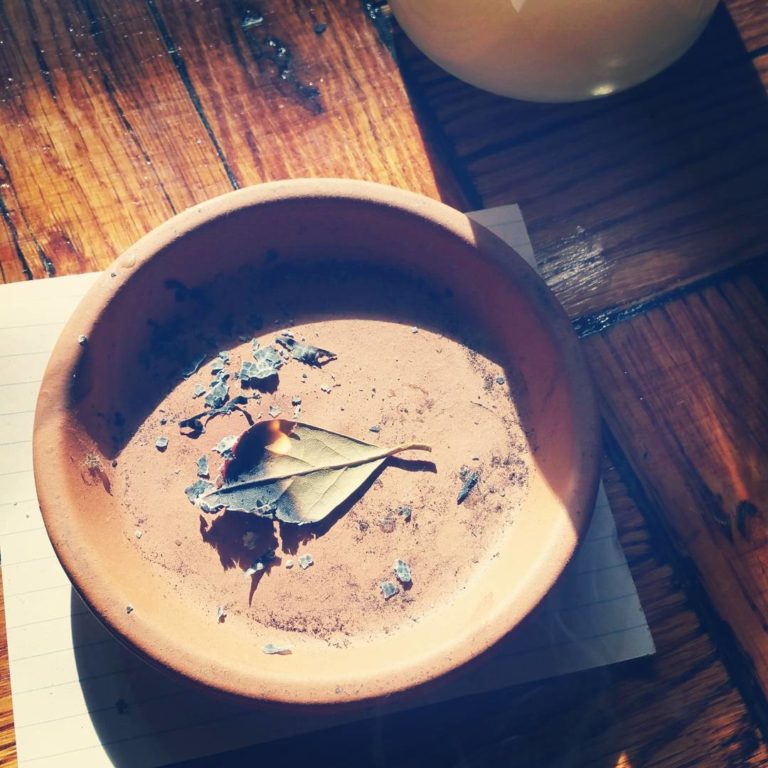
I could fold up the list and put it in a sachet with a magnet and the right herbs and stones. I could take the items on the list, write them on bay leaves, and sit on my deck while I burn them and blow the smoke to the four winds.

A terracotta dish holding a burning bay leaf.

I could whisper my wishes to a handful of birdseed, throw it on the ground, and let the birds carry them where they need to go.

I’m also considering modifying another love spell that involves using human image candles. It’s a kind of sympathetic magic where you take an image candle of the appropriate gender for each person, then move them incrementally closer together over a period of seven days, burning the candles a little bit each night. Once they reach each other, you burn them together and either bury the remains near your front door, or melt the wax together, pour it into a mold with bits of herbs, and make a pretty charm of it.

I could find a candle shaped like a house instead, then mark it with the address. Then I’d just need a general human-shaped image candle (or even a plain white one, in a pinch). The moving and lighting part would be the same. Once all I’ve got is stubs and wicks, I could hide the candles under the sweetening jar where the porcelain berry will… have… used to have been.
(I don’t know how tenses work for situations like this. I feel like I need Douglas Adam’s help.)

Honestly, I just want neighbors like the two ladies whose tend was next to mine during a celebration I attended years ago. One was a Unitarian Minister, one was an experienced mushroom forager, and they were very kind, generous, and friendly (and fabulous cooks). One of the first things they said to us was, “Nice to meet you! Breakfast is at seven.”

A lot of people consider such spells questionably ethical, even if you perform them without the intent to manipulate a specific person’s behavior. If you really think about it, in a way, I’m kind of just helping my neighbors to sell their house. I’m also attracting people who don’t want to exploit the area for its Airbnb potential and prefer native ecological diversity to monoculture lawns.

So really, I’m also kind of in in the right.

I just hope none of my other neighbors see me burying a bunch of jars and candle stubs in the front yard, or it could get awkward.

Neodruidry · Plants and Herbs · Witchcraft

It’s Imbolc season. Get the bucket.

I think a big part of what kept me from really connecting with a lot of Wiccan-based Paganism when I was younger was that, at the time, the available source material was pretty prescriptive. Sabbats were on specific days, with specific traditions attached, and there was an onus the follower to do things “right.”

Having lived in a pretty big range of climates, I can say that that’s had an impact, too. It’s hard to feel in the harvest or growing seasons when they just don’t line up with the harvest and growing seasons where these traditions were based. If the wheel of the year is supposed to reconnect humanity to nature and its cycles, a strict interpretation is the opposite of helpful. When I lived in California, for example, it felt like observing the traditional sacred days was sometimes counterproductive — spring didn’t look like it did in Europe, or even in the Eastern US. Neither did winter. It made things feel rote, which robbed them of meaning.

That’s why I’m a big proponent of celebrating the High Days when and how it makes sense to do so. If your growing zone means that you’re not going to see the first signs of spring until March, or won’t ever experience cold and snowfall, then so be it.

All of this is to say that the vast majority of my High Day traditions are pragmatic (perhaps to a fault).

Imbolc passed recently, amid surgeries (one for me, one for the Certified Lap Loaf. We’re both doing well!), falling down the stairs (just me. That part of me is not doing well.), and probably other stuff that I’m forgetting because of the first two things. A lot of ADF members celebrate the High Days on the nearest weekend, which is nice. Less pressure that way when your most-of-you isn’t working correctly.

A picture of the face of a small gray tabby cat. She looks very angry, probably about the blue nylon cone surrounding her head like some kind of fucked-up satellite dish.
Don’t let the barely concealed rage fool you. She’s purring here.

To me, Imbolc is refreshment. It’s deep cleaning, washing my front door, doing repairs, and making food. (This year, it’s also starting plans for home improvements that we won’t be able to do until later spring and early summer, like replacing the roof.) It’s also almost never actually on the first of February.

I don’t set up an Imbolc altar. I follow the same basic ritual structure that I do for any other day. For me, the main difference is the feeling of lightness and renewal that I carry through doing things like scrubbing grout, cleaning out garden beds, de-scaling the dishwasher, and chucking Affresh tablets down the garbage disposal.

When you’re re-learning lost, buried, or reinvented cultural traditions, it’s easy to get caught up in the need for accuracy and correctness. It’s also easy to forget why the High Days existed in the first place — to mark significant occasions throughout the year, largely based on what people who grew crops and raised animals considered significant.
When you get too invested in following the letter of a tradition, you can lose the spirit of it.

From my house to yours, here’s a small thing that I like to do each spring. It works equally well whenever you need to feel that sense of newness and freshness that only spring can bring.

Imbolc Home Cleansing

You’ll want to have:

  • A white candle. (The golden beige of natural beeswax is fine, too.)
  • Dried vervain.
  • Water.
  • A bowl.

First, steep the vervain in some hot water, as if you were going to make a tea. (I like to put vervain and water in a clear jar, then stick it in the sun for a while to infuse. If it’s cloudy where you are, a kettle of boiling water is fine.)

Vervain flowers.

Once the infusion cools, strain out the leaves and pour the resulting liquid into the bowl.

Next, light the candle. Declare, either out loud or to yourself, that this flame represents the return of the sun — whether that’s the literal return of longer daylight hours, or a metaphorical return of warmth and light is up to you.

Carry the bowl and candle to each room of your home, moving in a clockwise direction. Set the candle down in a safe spot and use your fingers to flick the vervain infusion around the perimeter of the room (be sure to get the corners). If you have prayers or chants that feel appropriate here, use them. I usually fall into a kind of stream-of-consciousness monologue about the objective of the working. It’s less important that your words sound nice than it is that they mean something to you and help you focus on what you’re doing.

When you’re through cleansing your entire home, offer the rest of the vervain infusion to your yard, garden, or nearest patch of green stuff. If your candle is small, you can let it burn completely and dispose of the remnants. If it’s a big one, snuff it and re-use it for a cleansing or purification ritual another day.

Witchcraft

The Magical Properties of Wax

Candles are a cornerstone of some of the most simple — and powerful — magic there is. Pretty much everyone’s first spell is some form of candle spell, because they’re inexpensive, easy to come by, and effective (once you know how to use them). A lot of care and thought goes into the selection of a candle’s size, color, and even shape. This got me thinking… What about the wax?

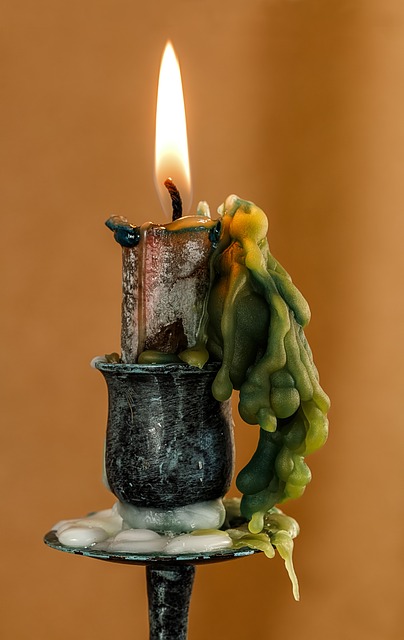
candle-397965_640.jpgCandles made from the wax of the bayberry plant are traditionally burned on new year’s in order to bring prosperity into the home. We’re also way past the days when all we had were bulk paraffin chime candles. There’s some history behind using specific wax candles for specific purposes, and a lot of options out there. It made me to do some experimenting.

Bayberry wax is typically, but not always, green. I’ve also seen plenty of bayberry candles that have turned out beige, brown, or even a grayish color. So, assuming that it isn’t the color of the wax alone that gives it its associations with prosperity, that gives me a jumping off point.


Looking at the metaphysical properties of the origins of each wax and my own experience, here’s what I’ve found:

Palm wood is said to be associated with transformation and transitions, but also peace and relaxation. Wands made of palm conduct energies around them and stimulate intuition. While not at all analogous to the living wood, petrified palm wood is protective and grounding. While those are typical traits of petrified wood in general, they seem to go hand-in-hand with palm’s ability to help us navigate transitions and upheaval.

Palm is one of the waxes I don’t have much experience with, in a magical sense. Based on its other properties, I’d use candles made of palm wax for stability and protection, particularly when it comes to weathering major life changes.

Beeswax is a bit different. Honey is frequently used in sweetening jars, to anoint other candles, and so on, because it’s sweet and sticky. It’s an attraction ingredient par excellence, and its inviting golden color certainly doesn’t hurt.

I predominantly use beeswax candles in my practice, but they’re especially good for spells that involve drawing things to you — like love, money, friendship, and so on. Good beeswax even has a warm honey smell that’s absolutely wonderful while it burns.

Another nice thing about beeswax is that it’s fairly firm. So, if you use it in a spell to bring something to you, and you want to dispose of the candle’s remains, it’s really easy to melt the candle stub down and form it into a love-, money-, or whatever-drawing amulet. Soften the wax, flatten it, and inscribe it with a rune, symbol, sigil, or even just a word expressing your intent, then use it however you please.

Paraffin is where things get a little strange. It’s a byproduct of the petroleum industry, which leads a lot of people to view it as less natural than the alternatives out there. It does release compounds like toluene into the air, which keeps it from being the best choice for anywhere that isn’t well-ventilated. I haven’t found any sources for magical properties of paraffin itself, other than as a base for candles. I was able to find a few for petroleum jelly, which is often used as a base for herbal salves, but they primarily touted its ease of use as an ointment.

Some sources cite petroleum’s origins as a good basis for ancestor magic — even going back to our non-human ancestors.

It seems that few people have really delved into the magical properties of paraffin, which I can understand. If your practice relies on using materials that are as close to nature as possible, it’s hardly going to be your first choice! Paraffin’s history of use seems to indicate that it’s like a white candle — while it might have properties of its own, it’s also a neutral, all-purpose stand-in for other waxes. Its associations with the ancient dead also make it useful for death-related or ancestor work.

candles-2681068_640.jpg

Soy is another option for candle wax. Traditionally, soybeans are associated with prosperity and luck. Soy milk is used in recipes for employment and business success. In magical cooking, soy ingredients are said to promote psychic awareness and spirituality. As the seed of the soy plant, soybeans also have obvious connotations of growth.

Soy wax is a great choice for spells and rituals for financial gain and abundance of any kind. (I like it when I’m looking to grow my bank account!) I have a fantastic soy-based candle by Enchanted Botanicals that I light before spells to establish a sacred space — that soy-seed-growth energy is an excellent foundation for spellwork.

Tallow is a bit hard to come by now, because it’s made from rendered animal fat, sticky, and not quite as appealing as other waxes for candle crafting. Since it’s sticky, it made for an excellent vehicle for magical herbs — all you had to do was roll it in fresh or dried herbs, and you were good to go. Raymond Buckland recommends against using tallow for candle magic in Advanced Candle Magic, but this seems to be a purely practical concern (tallow can be smelly and messy).

As animal fat, tallow has connotations of wealth and sacrifice. It’s a food, so, by burning it, you’re giving up something you could use for your own sustenance. This would make it a worthwhile choice for an offertory candle — as long as who- or whatever you’re offering it to doesn’t have any taboos against the animals used in making it!

For more specific magical properties, you’d have to look at its origins. Pigs are associated with abundance, prosperity, and fertility. Cows are associated with nurturing, protection, and fertility. Sheep are associated with peace, harmony, and tranquility.

There are other options for candle wax out there, including clear gel (which is probably closest to paraffin). I’d like to experiment with them and see how I can expand this list.