
This past weekend, some friends, my Handsome Assistant, and I went to the woods to celebrate Beltane.
What is Beltane? It’s a celebration of the coming summer and occurs roughly halfway between the vernal equinox and the summer solstice. Traditionally, in Ireland, it was when cattle were sent to their summer pastures. There’d be bonfires, rituals to protect the cattle, people, and homes, and lots of food.
We, lacking both cattle and pastures to which to send them, did stuff a little differently.
Really, there wasn’t a firm plan when we met up. We knew we would do something, but what it was was very much up in the air. One friend was firm about building an effigy. I was firm about there being drums and partying. Other than that…
There’s a saying that getting a group of Pagans to do anything is like herding cats. The larger the group, the harder the herding.
Nonetheless, with less than a full day to plan, write, and perform a ritual, we prevailed.
Friday night, a friend and I went to go look for a ritual site. This was pretty easy, or would have been were it not a) the woods, b) midnight, and c) Beltane.
There’s a fun bit of Beltane lore that goes thus: Samhain is the time of year when the veil between this world and the world of the dead is at its thinnest. Beltane, being pretty much the opposite of Samhain, is said to be the time of year when the veil between this world and the world of other beings is at its thinnest. These other beings are typically referred to as the fae, the Good People, etc. Depending on how you define nature spirits, this could include some cryptids. This is also the beginning of the season when UAP/UFO sightings tick upward.
What I’m saying is that it is either the best or worst time to go walk around a forest at night, depending entirely on what kind of night/rest of your life you’re trying to have.
We managed to end up in places that didn’t quite make sense. At one point, we were convinced that some of the features of the trail had switched places. When I tried to take a pic of the proposed ritual site to show everyone else, all I got were bizarre, blurry, lightleaked pictures that looked like someone ran a Holga through a dishwasher.

(Interestingly, all of my pictures of other areas were totally normal. Even ones taken that same night. However, I did discover a couple of videos I don’t remember taking, complete with music.)
All told, we ended up walking about a mile and a half (2.5 km) and taking way longer than anticipated. I texted my Handsome Assistant at one point to let him know I was still alive, but I figured “I’m still alive” and “We might be lost” were too ominous, so I tried to text him “We have entered a temporal anomaly” but what I actually sent was “we have entered temporal snomaly.” Fortunately, his phone was dead, so he wasn’t subjected to my dumbassery until much later.
Saturday morning, some of us discussed exactly what to do, while others began building. They harvested deadfall, shaped it, and fastened it together with jute. Mid-afternoon, we had lunch (and subsequently collapsed into a small food coma). Later, we played beat-the-clock against a thunderstorm as we wrote the ritual’s speaking roles, assembled the effigy, and put everything else into place.
As soon as everything was ready, we began.
And it. Was. Awesome.
There was a slow procession to the ritual circle. A soft stream of incense smoke to lift the senses and purify the space as people walked in. Two friends asperged us all with sprigs of fresh, wildcrafted mugwort and sacred water.
The circle itself was marked by colorful candle torches at each cardinal direction. We said a prayer, lighting a candle with each line. There were two short, beautiful speeches about why we were assembled today, and the significance of what we were doing. As we started a melodic chant, one friend lit the effigy.
Also, the effigy was an eight-foot-tall rearing stag…
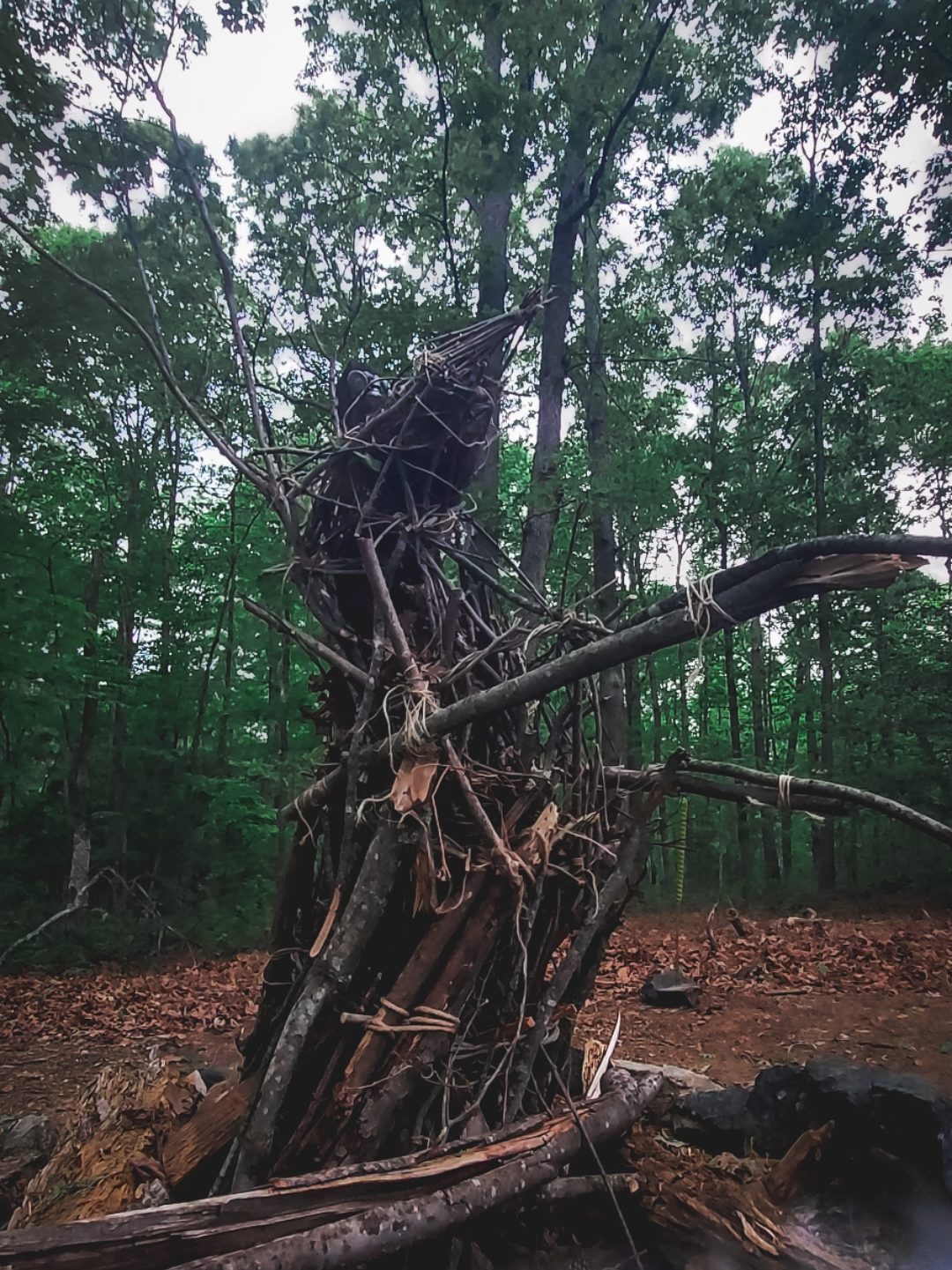
… that rapidly turned into an enormous bonfire*.
*It was a very controlled bonfire. It was in a fire pit, and there were fire extinguishers and buckets of water at the ready. I’ve had fire safety ingrained in me literally from the blastocyst stage and most of us have lots of bonfire experience, so everything was pretty locked down.

The stag is a representation of the south and the element of Fire. He’s the figurehead of summer, and this one, in particular, represented the energy ramping up toward midsummer. He’s virility, high energy, and the crouch before the leap into action.
Each of us took a dried corn husk — a physical representation of a gift we wanted to offer the group — and lit it with a candle’s flame. Then, we each added our burning cornhusks, our tiny fires, to the massive fire of the burning stag.
Once the flames reached their peak, it was party time. People drummed, rattled, danced, and sang. I played my mouth harp. We had about five or six different rhythms going at the same time, and it was delightful and excellent. There was beauty and poetry and joy and chaos and fun and even a bonus group of concerned/confused citizens.
(We tried to remember songs about fire to sing, but the only one I could think of was “Fire Water Burn” by Bloodhound Gang and it didn’t exactly fit the vibe, YKWIM.)
When the fire died down, we started the return to camp. One friend doused the remains of the fire, while another attempted to harvest a tiny flame from it. They lit a candle with this flame, and a third friend carefully carried it all the way back. My Handsome Assistant and I accompanied them, watching in nothing short of astonishment as the candle managed to burn steadily the whole way. (It had sputtered and gone out mid-ritual, so the fact that it lit and stayed lit at all was nothing short of miraculous.)
Once there, we lit a new fire with the tiny flame taken from the ritual bonfire. With that, we could still sit comfortably around the sacred fire long into the night, ’til a thunderstorm came and sent us all to bed. (As much as it’s no fun camping in the rain, there was something truly delightful about going to bed tired and happy, lulled to sleep by the sound of thunder and the tapping of raindrops.)
There’s a really big sense of accomplishment that comes with making a large thing, even especially when you get to set that thing on fire and then party around it.
Some of the friends there were brand new friends. Others have known each other for years. All of us come from incredibly diverse backgrounds, belief systems, and skillsets. Each person contributed what they could — food, ideas, tools, a pair of hands — to make this ritual a rousing success and an absolute blast.
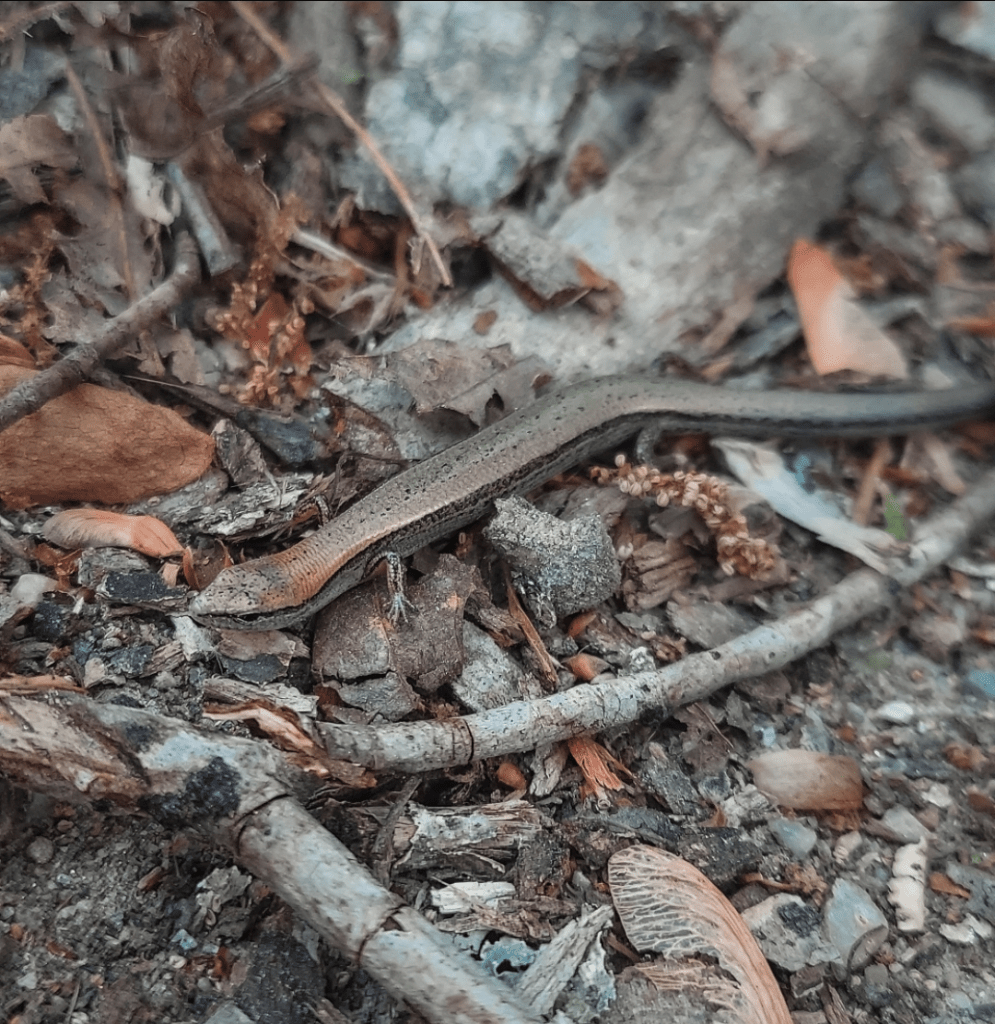
Also, I saw a coal skink (Plestiodon anthracinus, which was awesome because they’re considered endangered here), a little brown skink (Scincella lateralis), a luna moth (Actias luna), an awesome American giant millipede (Narceus americanus), and a huge and gorgeous eastern eyed click beetle (Alaus oculatus). So this was kind of a big weekend for me all around.

It’s a testament to what you can accomplish with a diverse group and a shared goal, and I still haven’t stopped smiling about it. I left with a container of the ashes from the sacred fire, a bag of apples, and what’s most likely some kind of fae curse on my cellphone. I think back on saying goodbye to everyone, and all of the hugs, and smiles, and jokes, and excitement that we managed to pull off something this cool, and it gives me the warm fuzzies. Like a tiny sacred fire that never goes out.
 Marble Crow