Blog · Just for fun

Cozy Horror Picks for October

I like cozy horror. No jump scares, just a deeply unsettling vibe. The more it blurs the lines between fiction and reality, the better. I like my horror weird, too. Surreal. Like taking a nice walk down a country lane on a soft drizzly morning and encountering something gray and viscous moving toward you that may once have been a deer.
That kind of thing.

These are my favorite pieces of cozy horror, perfect for an October afternoon:

1. I am in Eskew

I am in Eskew is a surreal horror audiodrama that follows the life of a man living (or trying to) in an ever-shifting city that seems bent on tormenting him. Every episode is essentially an audio diary, narrated by one (and eventually two) voices with the sound of rain in the background. It’s very weird.
It’s very unsettling.
It’s also weirdly soothing.

This series is also complete, so you don’t have to worry about waiting for new episodes to drop.

2. The Codex Seraphinianus

The Codex Seraphinianus is an illustrated guide to an imaginary world, complete with indecipherable writing. Why is the writing indecipherable? Because it’s meant to be — it’s asemic, and intended to convey the wonder and mystery of a child “reading” a book they don’t yet understand. While this book isn’t exactly horror, I’ve included it here because it does create a delightfully unsettling atmosphere — like a discarded relic from a complete, complex, fully fleshed-out world that you don’t understand, never knew existed, and operates entirely differently from your own.

3. Modes of Thought in Anterran Literature

This is another audiodrama, and it’s just delightful. It’s delivered as a series of lectures (and some assorted other recordings here and there) given by a professor who was once a big name in classical studies, but seems to have gone off the deep end. Upon getting tenure and the permission to teach one class of his choosing, he created “Modes of Thought in Anterran Literature” — a class dedicated to analyzing the literature of a long-dead society.

Anterra is also the world’s oldest civilization, tens of thousands of years older than any other recorded society. It was completely unknown until a Chinese submarine sank in the Pacific, coming to rest nearly on top of an Anterran city.

The character of the unnamed professor is engaging, but also soothing enough to make this a decent podcast to sleep to. There are virtually no jumpscares here — just the creeping dread of uncovering the secrets of a dead civilization, including what caused them to mysteriously collapse.

4. The Magnus Archives

The Magnus Archives is an episodic horror anthology, though all of the stories are connected by common threads. The Magnus Institute is an organization dedicated to studying the bizarre. Jonathan Sims, the Institute’s new head archivist, sits down to convert hundreds of written records to audio and, when necessary, add follow-up notes based on research by his team.

Individually, the stories are spooky enough. Once you get deep enough in, a bigger, much more frightening picture starts to emerge.

5. Welcome to Night Vale

Night Vale is a sleepy desert town with some… interesting characteristics. Welcome to Night Vale is an audiodrama in the form of a nightly news show. Hosted by the very soothing-voiced Cecil, it blends the surreal and the macabre with the everyday.

I first got into Night Vale when I was living in California, shortly after being diagnosed with intracranial hypertension. I was severely disabled at the time, unable to leave the house (or bed, most days). Night Vale kept me company, kept me entertained, and provided the perfect blend of humor, horror, and relaxation that I needed.

6. Junji Ito’s Cat Diary: Yon & Mu

Yon and Mu are two cats owned by renowned horror manga artist Junji Ito and his wife. The cat diary details Ito’s life as he adjusts to living with two cats — but, because it’s him, the illustrations are hilariously unsettling. He uses exaggerated horror to illustrate some of the most mundane aspects of living with a cat, and the end result is often more funny and heartwarming than frightening.

7. Weeping Cedars

Weeping Cedars is an audiodrama in the form of a documentary on the small upstate New York town of Weeping Cedars. It’s the site of more than its share of group violence and hysteria, but that’s not the strangest part. The town also seems to just sort of “forget” all of these tragedies, so nobody notices that things have developed a strangely cyclical — possibly even predictable — pattern.

The documentarians try to uncover the lost secrets behind these events, but is it too late? Can they do more than just sit and watch as things continue to unravel?

8. The Last Movie

The Last Movie is an audiodrama set in the same universe as Tanis (one I probably would also recommend, but sadly not beyond the first season or so). Nic Silver and MK investigate the existence of an underground — and possibly cursed — movie.

It’s short, self-contained, and very good if (like me) you’re a fan of cursed media.

9. The Dark Pool

The Dark Pool is another audiodrama, this time set in Maryland. A college professor and a group of students engage in a series of meditation exercises, and record their follow-up conversations. However, as the series goes on, it becomes terrifyingly apparent that there’s a lot more going on than just learning to quiet the mind. As the experiment continues, they begin experiencing bizarre phenomena. Will they be able to break free, or have they already gotten the attention of something they can’t escape?

Here’s hoping your autumn is equal parts cozy and strange!

Books · divination

“Spark Magic,” a fun little box of ideas.

Every summer, a Druidry group I am part of gets together to grill, tell stories, sing, and swap goods and gear. Some of these are things we’ve made (like artwork or preserves), some are things we’ve grown (like plant starts and seeds), and some are things we’ve purchased, and want to find a new home for. I’ve taken home books, macrame plant hangers, sculpture, watercolor art, camping gear, oracle cards, some vintage Le Creuset, and one very unique tool.

A black and iridescent blue box, modeled after a match box, labeled "Spark Magic. 50 ways to find your power."

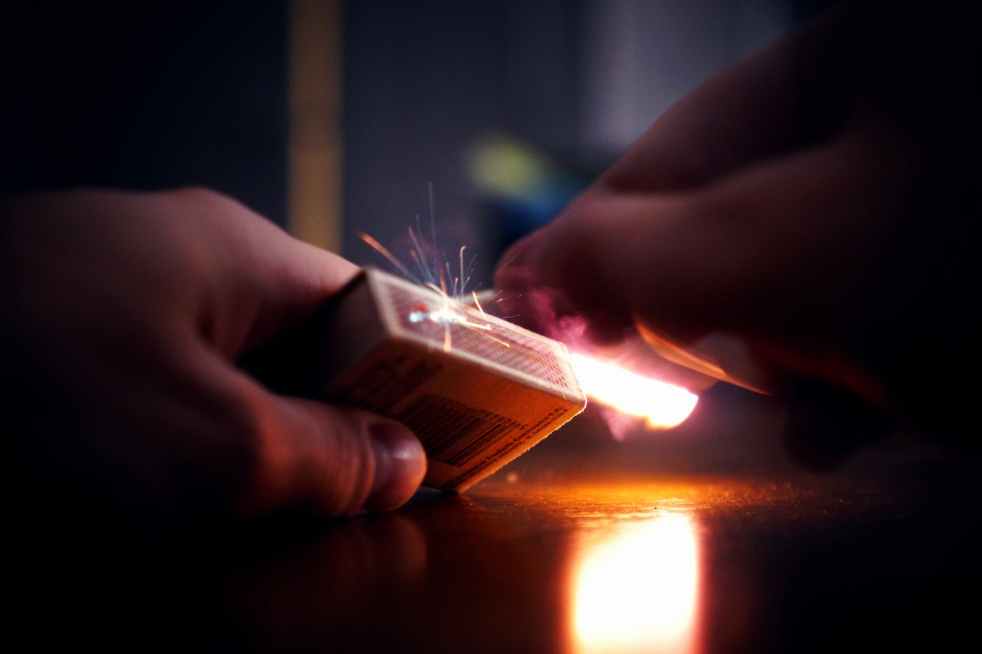
This is the Spark Magic box. It describes itself as a way to “[k]indle that inner spark,” and carries this idea through the prompts themselves. They’re all derived from various creative and spiritual practices, with a bit of self-care mixed in, printed on 50 cards shaped like matches. This makes it easy to shuffle through them just by shaking the box, plus the match design is just a really fun, unique idea.

This isn’t your standard oracle deck or list of journaling prompts, however. There are some writing prompts, of course, but this box also contains ideas for physically and mentally taking care of yourself, beautifying and enhancing the health of your immediate environment, and cultivating a regular practice to help you feel empowered and self-fulfilled.

Personally, I like it a lot. I often experience periods where I feel sort of dull and lifeless (enhanced, no doubt, by cyclothymia). While the prompts in here aren’t a substitute for a therapist, the ideas are usually pretty good at helping me to re-engage with practices that I’ve allowed to fall by the wayside. They help me feel more enthusiastic about doing stuff again. I feel like they’ve been much more helpful in this regard than the usual lists of self-care suggestions and journaling prompts that I see online.

Part of this may be due to the structure of the deck itself. It’s not a pick-and-choose list of things to do — there’s an oracle deck-style element to it. Part of the fun isn’t just drawing a match and seeing what it says, it’s taking some time to think about why I’ve drawn the specific match that I did. This also makes it fun to combine with tarot or oracle readings.

Would I recommend this? Yes, absolutely. If you’re someone who feels like they could use a little boost or some inspiration now and then, Spark Magic may be helpful for you. At $12.95, it’s also pretty inexpensive. If you like cartomancy, try combining Spark Magic with your oracle or tarot readings as a fun, interesting way to gain more insight.

Books

Let’s Read: Folklore and Symbolism of Flowers, Plants and Trees

I admit, when I first got my copy of Ernst and Johanna Lehner’s Folklore and Symbolism of Flowers, Plants and Trees, I was slightly disappointed at the size. I’d been hoping for a longer volume, while this one comes in at just 128 pages. However, despite my initial misgivings, I did enjoy this book.

For starters, it’s well organized. The first chapter covers sacred plants from Middle Eastern, Chinese, Norse, and other cultures/religions around the world. The next is a neatly alphabetized collection of folklore about flowers. From there, it goes on to cover strange and wondrous plants, and plant calendars from various cultures. The last section is a list of the floriographic meanings of each plant.

That said, this is a somewhat old book, and the majority of its sources have a Euro- or Christocentric lens. Some spellings that appear as typographical errors (Batatosk for Ratatoskr, for example) seem to be artifacts of old printing methods. Some of the wording is also outdated, like the usage of Mohammedan (an archaic term for Muslim or Islamic that’s now regarded as a misnomer at best, or offensive at worst). Some of the common names they chose to use also may be a bit strange to an English reader, like Bo Tree for Bodhi Tree. You get the idea.

While it isn’t long, the pages are large enough to hold beautiful antique illustrations and a lot of information. The entries also include the scientific name of each species (where known), which is very helpful. Relying on common names can be misleading — feverwort, also known as common centaury (Centaurium erythraea) is not the same as feverfew (Tanacetum parthenium). There are also a bunch of plants in the Gyrandra, Schenkia, and Zeltnera genera also referred to as centaury.

All told, this isn’t necessarily a book for deep dives or long reads. However, it’s a very useful quick reference for floriography, and a decent jumping off point for research into mythology and folklore. Would I say it’s indispensable? Not necessarily, but it’s been very useful to me and is really nice to have on hand. It’s best, I think, when paired with a book detailing each plant’s magical or medicinal uses. It’s a nice jumping off point for further research into folklore and mythology, but it shouldn’t be treated as the final authority.

If you’re looking for a quick mythological or floriographic reference for a wide variety of trees, herbs, and flowers, Folklore and Symbolism of Flowers, Plants and Trees is a good book to have. If you’re looking for more comprehensive information, magical uses, folk medicine, or a deeper analysis, you’ll probably want to look elsewhere.

Plants and Herbs

The robot uprising is here, and they’re trying to kill us with bad foraging advice.

When foraging, it’s said that you should be as confident identifying edible plants in the wild as you are in a grocery store. Foragers also say that the best way to learn is to have an experienced person to guide you. Not everyone has access to someone like that, though. Enter: Books about foraging.

Ripe wineberries. They are shiny, red raspberry-like fruit on a stem covered in red hairs.

Now, gathering and eating wild plants based entirely on the photos and descriptions in a book can be a bit intimidating. For some plants, this isn’t a big deal — wineberries, for example, are an invasive edible that’s really easy to pick out. Garlic mustard and wild onions, too. Some plants don’t really have poisonous lookalikes, so the odds of making a dangerous mistake are pretty slim. Others, not so much.

All of this is to say that books about foraging aren’t all bad. At least, they weren’t.

Here’s where shit gets weird.

People looking to make a quick buck have turned to artificial intelligence and Amazon’s publishing platform to pump out a lot of barely-concealed drivel. A lot of this is in the form of children’s books, I guess because they seem easier to make than a full-length novel. This is far from harmless, because children’s books play a role in the development of literacy and empathy that you don’t really want to hand off to a computer.

This attempt to cash out isn’t limited to children’s books, either. Amazon and other online book sellers have become the proud purveyors of foraging books written by AI. This isn’t really a new phenomenon, but, on the off chance any of you out there’re in the market for foraging guides, I figured I’d give you a heads up.

To be fair, a lot of these are simply useless and the worst they’ll do is waste your money. The books in this category claim to be foraging guides, but end up being about why foraging is good, listicles on the benefits of eating more fruits and vegetables, and recipe ideas. Pretty harmless overall.

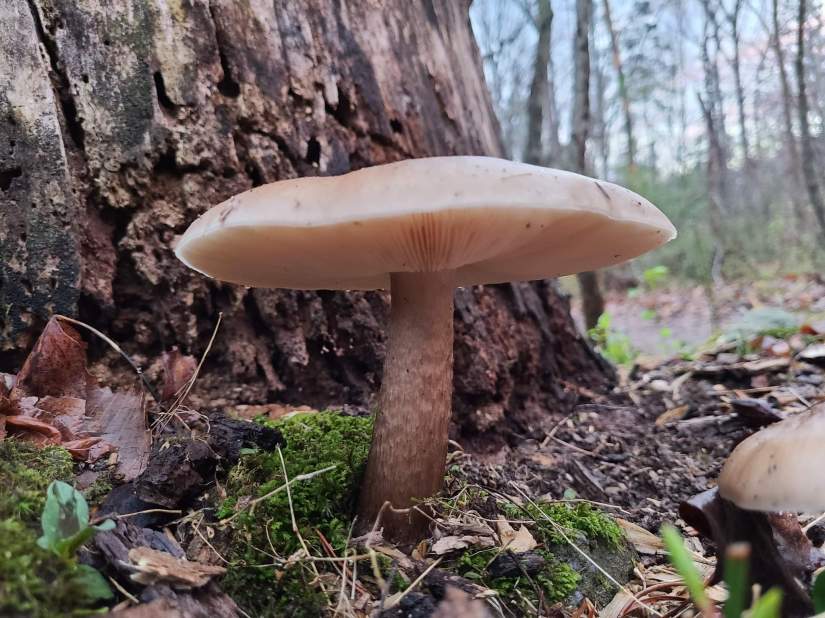
An underside view of the gills of a cream-colored mushroom.

On the other hand, there are books offering actual descriptions of “edible” plants and mushrooms(!). Some of them even list “taste” as an identifying feature of plants and fungi, which could encourage inexperienced foragers to taste things they haven’t positively identified. Since many extremely poisonous mushrooms are visually similar to harmless ones, this could get someone killed. Hell, plenty of people already mistake poisonous mushrooms for edible ones even without books encouraging them to taste them.

It’s not always easy to pick out which books are written by actual human people, and which aren’t. There are a couple of things that you can look for:

  • Publishing dates. Books written before the rise of AI generated content are a safer bet here.
  • The author’s web presence. Even if they have a photo, that doesn’t necessarily mean that they’re a person. The photo could be stolen (just see any of the fake identities on Scamfish), or made up by a different AI. Look for a blog. A Facebook page. A TikTok. An Instagram. Something to indicate an existence beyond the cover of a dodgy book.
    As this article from 404 Media states, “‘Edwin J. Smith’”’ is the author listed on two books[,] but doesn’t have any other books, or an online presence otherwise. The only Edwin J. Smith I could find was a Professor Emeritus of medicine at Indiana University from a staff list that’s more than a decade old.”
  • The author’s credentials. They should be actual, and not completely made up. Beware of author bios that offer vague, unrelated information.
  • A sample of the prose. A lot of bots pull from very varied sources, so you’ll get bits that sounds like they’re cut from a recipe blog, a florist’s website, an actual foraging manual, and so forth. These are also likely to be thrown together without much thought, because no actual humans looked at it to make sure it’d make any damn sense at all.
  • The editing. Bad, AI generated foraging guides often have mistakes that any human editor (or writer, for that matter) would pick up on right away.
  • A bad score from an AI-detection tool, like Scribbr or GPTZero. Get a sample of the text, paste it in a detection tool, and see what it says. While you’re at it, paste the author’s bio in there, too.

Again, if you’re able to, connect with an experienced foraging expert before going out in the field on your own. Your local university may be able to help you. You might even be able to find a group of foraging enthusiasts on sites like Meetup. Even if you can’t go out with a foraging expert, they may be able to recommend actual, useful guides, videos, and other resources for you.

Books · Witchcraft

The Black Toad: West Country Witchcraft and Magic

It’s been a bit since I’ve sat down to read an entire book from start to finish. To be honest, I just haven’t had the time or attention to spare. I do want to get back into providing reviews and recommendations for books, since I see so many posts on social media asking for resources.

This week, I’ll be looking at Gemma Gary’s The Black Toad. At only 133 pages (not counting the bibliography and index), it’s a slim volume. Though diminutive, it’s definitely not hurting for content!

I’ll be honest, a lot of modern books and websites about witchcraft kind of make my eyes glaze over. Now, in a time where everything just gets boiled down to vibrations, intention, and personal gnosis, all of the advice and explanations sound very samey after a while. (They’re also not terribly helpful, and then people wonder why their craft doesn’t work!)

I really enjoy books on witchcraft that have a more historic bent. When I write about herbs or minerals, I end up looking into folklore, not modern lists of associations or uses. It gets closer to the heart of the matter and keeps me from having to reinvent the wheel through personal gnosis, as it were.

All of this is to say that I really, really like The Black Toad. It covers protection, luck, plant charms, weather witchery, and cursing, broken up into the domains of Old Mother Red-Cap, Green-Cap, and Black-Cap. All of this is presented without apology — for the one with the power to heal and protect must necessarily also have the power to destroy.

A rowan branch laden with red berries.

The spells and charms aren’t written like lists of instructions. Instead, they’re detailed descriptions of historical ways that witches and wise people had for protecting themselves and their animals, improving their luck, healing, and handling their enemies. It’s more than possible to use it as a spell book, but it’s primary value, to me, is as a depiction and explanation of traditional practices.

The only downside is that scientific names aren’t (or possibly can’t be) provided for some of the plants mentioned. Take sage, for example. The mention of sage states that it was drunk for health and longevity. However, there’s a sage native to the area that isn’t a sage at all — wood sage (Teucrium scorodonia). The actual sages, the Salvia species, are native to the Mediterranean. So is this sage an imported garden sage, or native woodland germander? Unfortunately, historic resources often don’t leave us much to go on.

A stack of books, magical seals, and dried herbs. Smoke rises from a bowl of burning herbs.

Some other reviewers pointed to the use of Biblical passages in some of the formulas as a problem. However, this is ahistoric and there are plenty of traditional resources that use passages from the Bible. There’s no reason to believe that witches and wise people, historically, would have reason to look down on doing so. The attitudes of modern people toward organized religion have no bearing on what people were likely to use in the past.

I’d recommend The Black Toad to anyone with an interest in traditional western European witchcraft. It gives a useful picture of the role and domain of wise people, as well as several spells that are still useful today.

Books · life · Neodruidry

Sacred Actions: Yule

This past Sunday, one of my Meetup groups had a meeting to discuss Dana O’Driscoll‘s Sacred Actions: Living the Wheel of the Year through Earth-Centered Sustainable Practices. Luckily for me, I’d picked up a copy several months ago from Three Witches’ Tea Shop. It’d been in my “to read” pile for a bit, so I was very happy to have the extra encouragement to get into it.

We went over the first high day, Yule. For this time of year, Sacred Actions emphasizes learning one’s place in the consumption web of life — observing your consumption patterns, seeing how you can live in a way that’s more regenerative and nurturing for the Earth and other people, and learning to discern between a need and a want so that there are enough resources for everyone to live comfortably.

This chapter also encourages the reader to take a look at their ecological impact using the Footprint Calculator quiz. Mine came out at a 1.8 — meaning that, if everyone in the world lived like I do, it would take 1.8 Earths to sustain us all. Unfortunately, this number is actually at the lower end of the spectrum, but I’ll get to that in a minute.

The discussion was lively and fruitful. It was nice to know that we were all in a similar place — aware of tactics like “greenwashing” and propaganda that emphasizes individual responsibility over corporate abuses, and knowing exactly how difficult it is to engage in ethical consumption within our economic system.

One thing I particularly liked was O’Driscoll’s emphasis on regeneration and nurturing over sustainability. Sustainability is nice, but comes with a pretty heavy subtext. The implication is that we should find a way to do things that allows us to continue to live, consume, and behave in the way to which we’ve become accustomed. This isn’t just impossible, it’s not exactly a noble goal. Instead, we should work toward regeneration — giving back to the planet and exploited people to replace what has already been depleted.

(I could go into a super long and weird discussion about extinct megafauna, human cities, and the importance of poo here, but I will spare you this. Instead, here is a giant gorilla fighting a t-rex:)

The idea that we have a responsibility to more than just the planet was refreshing, too. My ecological footprint is low for someone living in a wealthy, developed nation. I’m not bragging here — the reason it’s low is that disability (and, let’s be real, an at times paralytically rigid sense of ethics) keeps me from engaging much in many aspects of society. The things that make my footprint as large as it is aren’t even things I can control. It’s almost all the snowball effect of having a long, multinational supply chain.

With that in mind, there’s only so much else I can trim. It’s frustrating to look for ways to make your lifestyle more sustainable (read: regenerative), and just get the same bits of advice over and over and over again. Use reusable paper products. (Check.) Use metal straws. (Check.) Compost. (Check.) Instead of this, O’Driscoll’s work provides some other lenses through which to consider sustainability. Even if I can’t change the supply chain that delivers the things I need, I can focus my energy on supporting, regenerating, and nurturing the people involved.

(Incidentally, I think I’ve begun to hate the word “nurturing.” I’ve seen it co-opted so many times by new-agey wellness articles about consumerist self-care strategies, I think they’ve ruined it for me. I will, however, continue to use it here for lack of a better term.)

(The phrase “nurturing the people involved” also gives me mental images of someone breastfeeding a forklift operator, but I’m not sure how else to say it. Your mileage will hopefully vary.)

The next step is to engage with the exercises. This means placing one of three ideas at the forefront of my mind for a week at a time. First, emphasizing care for the Earth and all of its inhabitants. Next, will be emphasizing people. After that, ensuring that there is enough for all.

As I write this, news stations are broadcasting about the deaths of workers in an Amazon warehouse that was hit by a tornado. The tornado wasn’t a surprise. People, driven by desperation, went to work. The company higher-ups didn’t see fit to let them stay home. Jeff Bezos says he’s heartbroken about the tragedy, but has yet to commit any actual money to providing for the families of the dead.

In the meantime, Bezos’ Earth Fund has also committed another $443M (USD) to conservation efforts, or roughly 1/500th of his net worth. A net worth that comprises assets gained through exploiting people and the planet.

His attitude and position is not unique. Remember, while you make adjustments to your lifestyle, that the people serving as conduits for environmental and human exploitation are not gods. They have names and addresses. When living sustainably as an individual only goes so far, there is always direct action.

For more information, I recommend episode 320 of The Dollop, The Wobblies Go to Everett.

Books · Neodruidry

The Book of Hedge Druidry: A Complete Guide for the Solitary Seeker

Recently, I had enough free time to finally finish reading Joanna van der Hoeven’s The Book of Hedge Druidry: A Complete Guide for the Solitary Seeker. While not completely solitary myself (I’m a solo practitioner, but still part of a group), I still wanted to see what new information and perspective I could gain from van der Hoeven’s work.

It’s an impressively comprehensive guide, split into four sections: theory, practice, study, and technique. The book begins by delving into what the Druids were, their history, and what became of them. After that comes a breakdown of the cosmology in van der Hoeven’s (and, from my experience, most) Druidry. She follows this with practice: meditation, spellcraft, prayer, ritual, and so on. There are rites and rituals geared specifically for hedge Druids, herblore, the Ogham, and even ethics.

I can’t vouch for the historical accuracy of all of the information presented here, but that’s something I’ve kind of come to expect from most books about witchcraft and paganism. Van der Hoeven does appear to have done her homework, as each reference has a citation. At this point, I don’t even really try to point out historical inaccuracies unless they’re particularly glaring (like one book’s claims about an “ancient Irish potato Goddess”). One thing I liked was the acknowledgement of the divide between the Druids and modern Druidry — no one can really, factually claim to follow the same faith and practices as the ancient Celtic peoples, we’re all working from what’s more-or-less a reproduction. That doesn’t mean modern Druidry has any less poignancy or value, it’s just the truth.

Books like this tend to hold the most appeal for beginners, since they tend to go over well-trodden ground. Even so, I thoroughly enjoyed it — particularly the section on rites and rituals. Ever since I began to use the ADF ritual structure, I haven’t really been doing as much as I used to outside of that, since most everything I do follows that structure. I took a lot of inspiration from The Book of Hedge Druidry, both for practices to incorporate into my ADF-structured solo rituals, and as small workings on their own.

The book concludes with a section on ethics and acting within one’s community as a teacher and leader. Rather than the (in my opinion) rigid and often misinterpreted Threefold Law, van der Hoeven gives a thorough description of what it means to be centered, know yourself, and be able to act with honor for the good of everyone and everything around you. There’s no judgment, no finger-wagging, and no westernized idea of karma, just an explanation of what it means to act for the highest good.

Had I come at this book from a different perspective, there’s one specific area that would’ve disappointed me: The lack of real information on hedge riding. The bit of information provided about the Other worlds is enough to pique curiosity, but not really enough to prepare a solitary practitioner for journeying or spirit work.

All told, I found this book to be an accessible introduction to Druidry for the solitary (or just solo) practitioner. While I’ve definitely benefited from the study programs and ritual structure ADF provides, if I was completely on my own, van der Hoeven’s work would serve as a great jumping off point. I definitely recommend it to anyone curious about modern Druidry, or even just looking to expand their magical or religious bookshelf.

Blog · life

Two Bards.

Tuesday night, I had the chance to see Richard Thompson perform live. It’s a show I’ve had on my bucket list ever since I was introduced to him a few years ago — he’s an incredible guitarist, and watching him play is really an amazing experience. When I stopped being able to go out much for awhile, I was legitimately afraid that I wouldn’t get well enough to be able to see him play. I only learned about Coco Robicheaux on the day of his death, and I missed the chance to see Tom Waits (who doesn’t tour very often) perform when I lived in California; two things I consider some of the biggest missed opportunities of my life.

Processed with VSCO with  preset

I think my S.O. and I were the youngest people in the audience by close to twenty or thirty years, which made me a little self-conscious when we were finding seats. (‘Scuse me, sir and/or ma’am, biker punk and tattooed millennial with a shaved head coming through.) As soon as I sat down, though, I didn’t care. I still whooped it up and applauded hard enough to jam one of my fingers.

He’d just started playing “Valerie” when we got in, which is, bar none, my favorite of his songs. It was honestly a little overwhelming — I’m embarrassed to admit it, but my heart skipped a beat and I thought I was going to have a panic attack for a few. I teared up at “Beeswing” and “1952 Vincent Black Lightning,” just like I knew I would. (Lucky for me, I’d had the foresight to forego eye makeup for this exact reason.)

The songs were moving, tragic, and hilarious by turns. His voice and guitar playing were superb. His banter made the venue feel small, with the kind of warmth and humor that turns a show into an intimate gathering.

I loved every minute of it.

And then, the next day, I found out that Terry Jones had died.

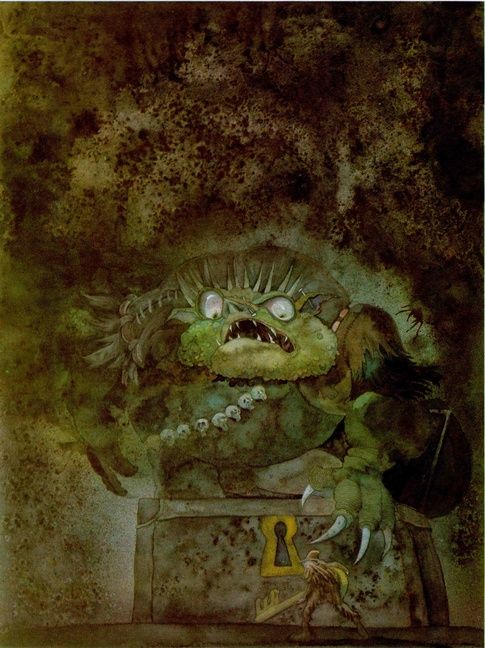
He wanted to be remembered as a comedian, but I knew him best as an author long, long before I knew anything about Monty Python’s Flying Circus. When I was a kid, we had a copy of Fairy Tales. It was my favorite children’s book — as a kid, I think I learned more important morals there than almost anywhere else. Like Three Raindrops, which taught me that everyone’s grave is the same size, and there’s no point in wasting your life on comparisons. Or Jack One-Step, which taught me the value of collective bargaining. Or The Glass Cupboard, which, I’m fairly certain, is what turned me into a tiny environmentalist.

monster
And then there’s this guy, which I’m pretty sure figured prominently in my nightmares until I was ten. Artwork by Michael Foreman.

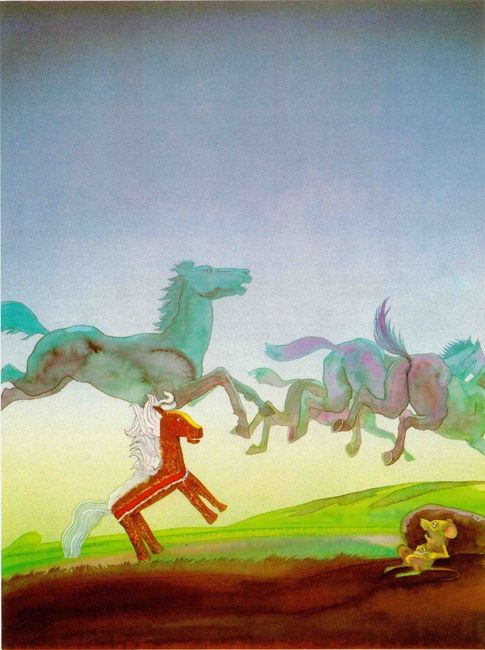
I loved Michael Foreman’s illustrations, too. To be honest, I can’t really overstate the impact they had on my imagination as a kid, or even on my artwork now. His watercolors were at once bright and soft and dreamlike, surreal and strange, occasionally with a subtly unsettling edge. They were the perfect accompaniment to stories like The Fly-By-Night and The Wonderful Cake-Horse.

cakehorse
Illustration for Terry Jones’ The Wonderful Cake-Horse, by Michael Foreman.

I’m much older now, but the stories and illustrations still mean just as much to me.

Jones’ passed after a battle with dementia. As much as we like to think that “where there’s life, there’s hope,” there’s still a very particular kind of mourning that happens when someone passes from a brain disease. There’s the loss you experience when someone is no longer who they once were, and the final loss that comes with death. Sometimes, the hardest thing to deal with is that we might not think we feel “sad enough” when someone actually dies, because we’ve spent so long mourning the person they used to be. It’s something I experienced with my grandmother, as she declined from brain cancer. As hard as it was to handle her passing, I felt guilty for feeling relief. Not for myself — I felt relief that she was beyond the pain, confusion, and anxiety that her illness had caused her.

It’s something I’ve had to come to terms with, too. Intracranial hypertension causes brain damage, and it’s very likely that I will suffer a stroke at some point and either die, or have to fight my way back from that. Sometimes, you have to mourn for yourself. The important thing is to process this grief, then get on with the hard work of living. For Jones, that was raising awareness. For my grandparents, it was my grandfather feeding, dressing, and bathing my grandmother. For me, it’s working a little more every day to try to regain some ground before I lose more of it.

I guess what I’m trying to say here is that it doesn’t matter if you’re part of an artist’s primary audience. Life’s too short to miss the concert you want to go to, or to overlook a book just because it’s intended for children. Eventually, like the Three Raindrops, we all become part of the same big, muddy puddle. Draw inspiration and spiritual nourishment anywhere you can.

Books · crystals

Crystal Power, Crystal Healing

Note: This post contains affiliate links to the book(s) I mention. These allow me to earn a small finder’s fee, at no additional cost to you. Thank you for supporting writers and this site!

cpchI recently picked up a copy of Crystal Power, Crystal Healing, by Michael Gienger, based on a recommendation by the lovely people behind Dreaming of Avalon. What really intrigued me was the idea of a more “scientific” guide to crystal healing — that is, one that’s based on trials and a definite system, as opposed to some of the very vague information circulating on the internet.

While I can’t necessarily say that the information in Gienger’s work adheres to the scientific method, it’s a fascinating read nonetheless. He breaks crystals down by their structure, mineral class, elemental composition, color, and method of formation. This yields some very interesting ways to choose a stone for your particular purpose. For example, halides have a dissolving property, chlorine-containing minerals break down tension and stress, and green minerals help release emotions. By cross-referencing your lifestyle with the specific chemical properties that would be the most helpful to you, you can find a stone to try working with — or, perhaps most interestingly, get advice for the next geological formation you should visit or move near.

A fair amount of Gienger’s advice runs contrary to what I’ve seen in numerous other crystal guides, which I rather liked. (You won’t find dodgy claims of curing cancer or reversing heart disease, for one. Any physical healing properties are discussed in a supporting sense, not a curative one.) If you’re meditating or working with one of the handful of usual suspects recommended by crystal expert and not getting anywhere, you may want to see what Gienger suggests. Even if you aren’t into working with crystals as a healing tool, the sections on lifestyles, crystal formation, and chemical properties make for a fun, intriguing read. (I learned that I’m rhombic.)

Overall, I recommend this to anyone who uses crystals, even just in a crafting or jewelry-making sense. It’s an interesting book, dense with information, and probably has something to teach even veteran crystal-workers.

divination · life

The Knight of Wands Returns

The Crow Tarot might give me a lot of Wands, Knights, and Aces, but now’s certainly a good time for ’em. (It also definitely means business when it comes to negative cards, so, to be perfectly honest, I was just happy not to have pulled the Ten of Swords again. Yikes.)

Anyhow, this week’s card is the Knight of Wands again, and man oh man am I glad to see him!

Last time, I mentioned that my S.O. and I had just finished a book, and were working on ways to turn it into something more than just a .doc file. Good news is, we’re making plenty of progress on that front! Not only are we fixing what needs to be fixed and polishing up what needs to be polished, we’re actually working on turning another manuscript we finished some time ago into a serial of some form. Though we’ve put a lot of thought into this process, neither of us have experience in publishing and none of my market research has been oriented in that direction. It’s definitely a fun learning experience, though! Besides, even if nothing comes of either of these things, I’m still happy just to have made them.

Speaking of which, I finished another painting this past weekend. Photographing them has been difficult because our overcast days have all been rainy — so, while the clouds do a great job at scattering the light and producing true-to-life color while keeping the glare down, the rain isn’t exactly easy to work around. Ah well. As the weather cools, hopefully we’ll have more cloudy days that aren’t accompanied by summer storms. I love collecting summer thunder water and the way the rain washes the pollen from the air, but I miss having dry surfaces!

The Knight of Wands stands as a reminder that enthusiasm and excitement are justified, but it’s a bad idea to get carried away with ourselves and jump headfirst into things we aren’t prepared for. Overall, it’s a very good omen. I’m going to be mindful to do my homework while my S.O. and I work toward creating the life we want to have. 💜