
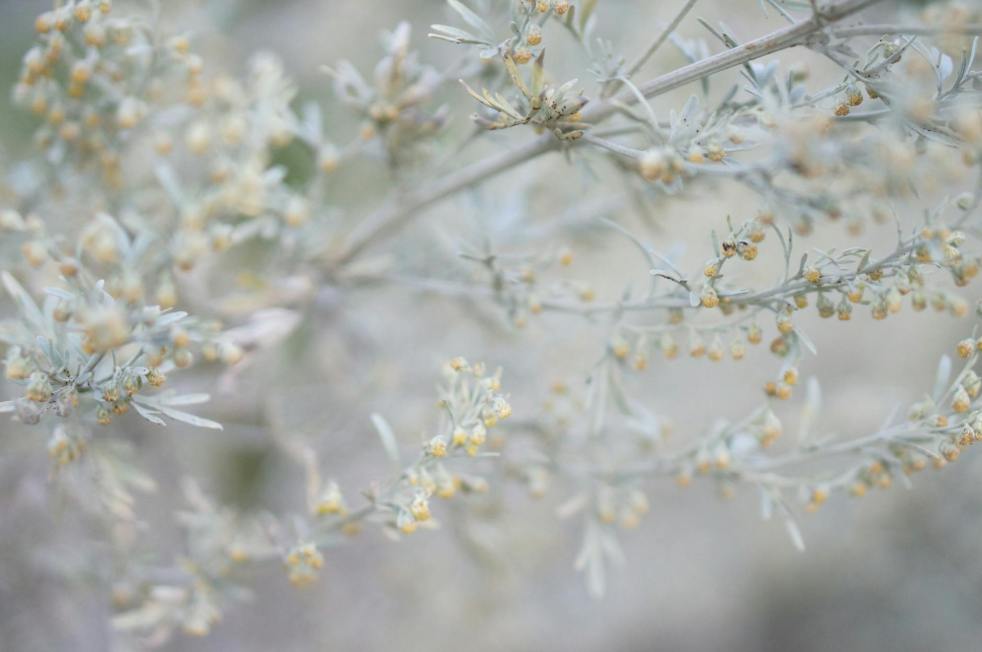
Wormwood (Artemisia absinthum) is an African/Eurasian herb and relative of mugwort that’s widely grown in Canada and the US for its ornamental, medicinal, and even magical uses. It’s also a key ingredient in genuine absinthe, and is purportedly why the drink was rumored to cause hallucinations (but more on that in a bit). While the medicinal properties of A. absinthum have since been superseded by other herbs and pharmaceuticals, it’s still a powerful magical ingredient and a beautiful ornamental plant.
Wormwood Magical Uses and Folklore
Wormwood is a very bitter herb, so much so that it’s been used over and over again in literature as a metaphor for bitterness. Shakespeare mentioned it. The Bible mentioned it.
This bitterness may, in part, be a source of its hepatoprotective properties: Bitter herbs are said to trigger the release of gastric juices, including bile from the liver, which helps sort of flush things out. This is why herbal digestifs and digestive bitters became a thing. There’s not a lot of peer-reviewed research on the subject, but bitters have a very long history of safe use as digestive aids.
Wormwood is also one of those magical plants that doubles as a pest repellent. This is something we see pop up over and over. There’s a logical progression from “herb that keeps disease-carrying pests away,” to “herb that keeps all unwanted influences at bay.” This makes wormwood valuable for protection and purification.
Interestingly, I have also seen wormwood listed as an ingredient for spirit calling. I don’t know if I’d use wormwood alone for this, but it certainly seems like it’d be a useful ingredient to make sure you’re calling the right spirits.
(I see parsley mentioned with wormwood pretty frequently, which is funny because it’s another weird one for spirit work. It is listed both as a spirit attractant and repellent, go figure.)

This herb also plays a protective role in Slavic lore. The rusalka is an entity, said to be the spirit of a young woman who died by drowning, who is associated with life-giving rain… and, after the 19th century, with madness, death, and trickery.
Carrying wormwood was a way to guard against rusalki. They are said to target young men, so guys were told to carry a sprig of wormwood with them wherever they went. A rusalka would inevitably ask if they were carrying wormwood, or parsley. Say “wormwood,” and she’ll scream and try to flee, at which point you must throw the herb at her eyes. Say “parsley,” and she’ll ensnare, drown, and/or tickle you to death.
(As someone who is a) ticklish, b) hates it, and c) was frequently tickled against my will as a child, I think I’d rather drown.)
Wormwood is also connected to divination. It’s a relative of mugwort and has many similar properties. The two aren’t entirely interchangeable, but you can often substitute one for the other in certain situations. Wormwood’s focus seems to be more connected to protection and purification, while mugwort is more psychic and divinatory.
This herb is sometimes used in love magic, but not as an attractant — its main virtue seems to lie in love divination. There are multiple recipes and instructions for tying wormwood leaves to one’s forehead, placing them under a pillow, or brewing them with other herbs and honey and anointing oneself in order to get a vision of one’s future spouse.
Wormwood is tenuously connected to the Greek goddess Artemis (and Roman goddess Diana) through its name. However, the genus name Artemisia may be a reference to Artemisia II of Caria, and not Artemis directly.
In practice, this herb is considered to be ruled by Mars and Mercury, while Artemis and Diana are Lunar deities.
Wormwood is associated with Fire (which I can certainly see, as it’s a Mars-ruled herb that likes sunny spots and dry ground), but I’ve also seen it listed as an Air plant.
The Myth of Absinthe
Contrary to popular depictions, absinthe wasn’t some kind of magic hallucination juice. Genuine absinthe does use wormwood, which contains the compound thujone. Thujone can, in concentrated form and large doses, cause hallucinations, convulsions, and death, but is present in absinthe in such tiny amounts that it doesn’t really do a whole lot. (Ironically, the compound absinthin is an anti-inflammatory and doesn’t have much to do with any of that.)
Absinthe’s hallucinatory effects have more to do with its high alcohol content (the stuff is about 50-75% ABV), the power of suggestion, and the fact that unscrupulous absinthe makers started adding copper salts as an artificial green coloring around the late 19th century.

During its heyday, absinthe was also much enjoyed by counterculture movements. This led to it being vilified by social conservatives, who had every motivation to hype up its “dangerous, toxic, and hallucinatory properties.”
So, what do you get when you mix an herb that might, potentially be toxic in specific circumstances, a buttload of alcohol, a bunch of bohemians, cheap absinthe full of poisonous colorants, and a bunch of social conservatives? You get a liquor with a legendary reputation as a toxic hallucinogen, and an unfair ban.
Using Wormwood
You can grow Artemisia absinthum fairly easily. Like mugwort, it grows in bright, dry, disturbed soil. It also self-seeds readily, so be prepared to either keep it confined to an area where it can’t do that (like a pot on a patio), deadhead the flowers, or keep up with rigorously removing new baby wormwoods as they pop up.
While wormwood isn’t as dangerous as popular depictions would have you think, it’s still a plant with toxic components that should be treated with respect.

Wormwood has historically been used as a flavoring herb. If you want to use wormwood internally, do so under the guidance of a qualified herbalist. There are multiple health and pharmacological contraindications at play here, so it’s important to be careful.
Otherwise, dried wormwood makes a wonderful addition to protective bottles, sachets, and other charms. You can:
- Grind it into a fine powder and sprinkle it on or around anything you wish to protect.
- Burn it and waft the smoke around an object or area you wish to purify.
- Keep some dried wormwood (perhaps with its cousin, mugwort) with divination tools to keep them cleansed and ready for use.
- Soak it in water and asperge spaces, objects, or people to cleanse them.
- Soak or steep it in water and use the resulting “tea” to wash your front and back doors for protection.
- Grow wormwood near doors for protection against malevolent energies, entities, or bugs. (For real, a lot of what we consider pest insects really don’t seem to like it.)
These aren’t the only uses for this herb, of course, but they’re probably the ones most in wormwood’s wheelhouse. You can also use it for love divination or spirit work, but this may depend heavily on your specific tradition, techniques, and situation.
Wormwood is a beautiful, interesting, complex, and contradictory herb. It’s a poisonous healer, a repeller and attractor of spirits, and an invaluable addition to a magical herb collection.
 Marble Crow