Plants and Herbs

Apple Folklore and Magical Properties

As I write this, the results of the US presidential election are being calculated. I’m trying to do anything other than be uselessly anxious about that all night, so I figured I’d write about a cozier topic to get my mind off of it.
Hence: Apples.

Apples are a traditional food for Samhain. This year, I had originally hoped to save at least an apple or two for us. I went out, covered about half of the young fruits with organza bags I had left over from gifts, and thought I was good to go. There were some for me, some for the local fauna, and everyone should’ve been fine. Then there was a spell of dry weather.
Anyhow, I got no apples, and also the squirrels stole all of my bags.

Then, at Mabon, we were working on masks and costumes for the Council of All Beings. Someone found a dropped googly eye, and I made a joke about them not having natural predators. That’s when it hit me — what if I put googly eyes on the apples?

“They might just attack the apples from the side without eyes,” a friend of mine said.

“I’d put them all around,” I explained. “Biblically accurate apples.”

Anyhow, as the time for various delightful apple dishes approaches (like my favorite, cornbread stuffing with sage, onions, and apples), I figured it’d be a good time to look at their folklore, mythology, and metaphysical aspects.

Jokes about Biblically accurate apples aside, the forbidden fruit of Christian mythology most likely wasn’t a member of Malus domestica. While apples are cultivated all over the world, they originate from Central Asia. The Bible also doesn’t mention the fruit by name — it’s just commonly depicted as an apple as a kind of visual shorthand.
(It’s also a fun bit of wordplay. In Latin, the worlds for both “an apple” and “an evil” are written as malum. Pronounced with a long a, it’s apple. With a short a, it’s evil.)

Photo of an apple and a knife on a blue cloth.
Photo by Ylanite Koppens on Pexels.com

In China, apples are also a source of a bit of wordplay. The funny thing is, it’s almost exactly the opposite to Latin. The word for apple (苹果) and peace (平安) both start with the same sound in Cantonese and Mandarin. As a result, apples are associated with peace.

Apples have a long and varied history in Germanic Paganism. The Norse goddess Iðunn is the keeper of golden apples that give the gods eternal youth. The Poetic Edda details eleven golden apples given to the jötunn Gerðr, as a gift from the god Freyr. In the Völsunga saga, the goddess Frigg sends King Rerir an apple as he prays for a child. Rerir’s wife eats the apple and conceives Völsung. This demonstrates a connection between apples, youth, fertility, and life.
Interestingly, the skald Thorbiorn Brúnarson also mentions “apples of Hel.” Scholar H.R. Ellis Davidson points out that this may indicate that apples were considered the “life-giving fruit of the other world.”

Three striped apples on a branch.
Photo by Julian Kirschner on Pexels.com

There is a similar connection between apples and the Otherworld in Celtic mythology, as well. Manannán mac Lir’s domain, Emhain Abhlach, translates to Isle of Apple Trees and is said to be a place where there is nothing but truth and disease and decay are absent. (Emhain Abhlach may also be where Avalon ultimately derives from.)
In the tale Echtra Cormaic, Manannán gives Cormac mac Airt gifts including a silver branch with apples of gold. This branch made magical music that was said to lull anyone suffering from sickness, injury, or childbirth to sleep.
Another tale tells of Connla, the son of Queen Aife and King Connaught. A fairy woman gives him an apple that, once eaten, becomes whole again. Infatuated with the fairy woman, Connla allows her to take him to the Otherworld where the fruit grows. The otherworldly apples give him everlasting youth, but for a great price: Connla can’t return to the land of the living.

Apples also have a lot of representation in Greek and Roman legend. The most infamous example is probably the Apple of Discord. When the Goddess of Strife, Eris, wasn’t invited to the wedding of Peleus and Thetis, she decided to start some trouble. She threw a golden apple inscribed “For the most beautiful” into the wedding party. Hera, Aphrodite, and Athena all claimed the prize, so Paris of Troy was tasked with selecting a winner. Each goddess offered him a bribe to choose her, but only Aphrodite’s bribe appealed to him — she’d give him the most beautiful woman in the world for a wife.
There was only one problem.
That woman was Helen of Sparta.
And she was married.
Whoops.
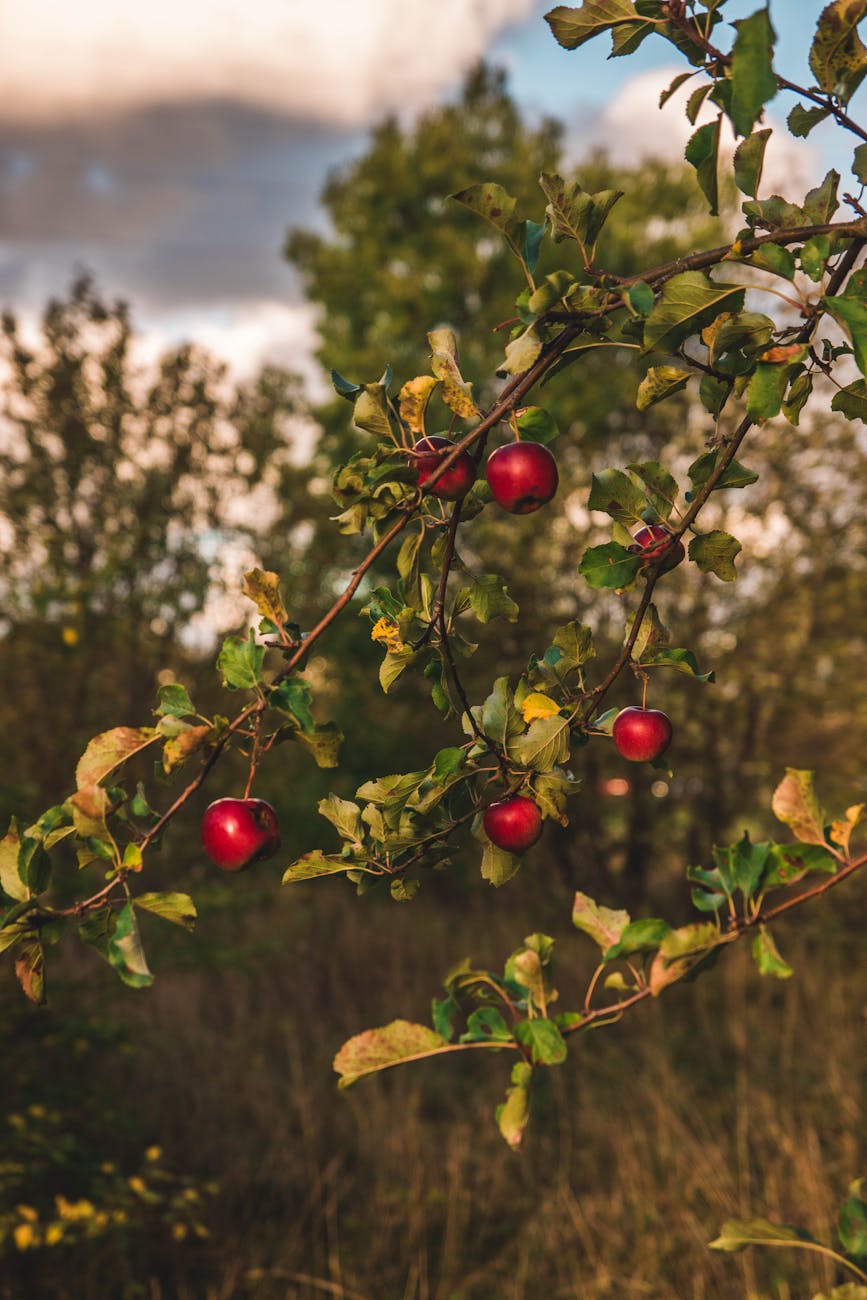
close up photography of apple tree
Photo by Kristina Paukshtite on Pexels.com

Apples were then considered sacred to Aphrodite and were even used as declarations of love. In the story of Atalanta and Hippomenes, Atalanta challenged all of her prospective suitors to races. If they could beat her, she’d marry them. (Since she was unbeatable, this seemed like a safe bet for her.) Hippomenes knew he’d never be able to outrun her, so he distracted her with three golden apples. With both his speed and his cunning, he barely managed to beat Atalanta and win her hand in marriage.
One of the labors of Hercules also involved retrieving golden apples from the Tree of Life in the Garden of the Hesperides, which creates another link between apples and life.

So, why are these fruits so deeply connected with life? Why do they come from the gods or Otherworld? Part of this might be because they literally came from afar — the ancestor of most of our modern apples came from Central Asia, so it would’ve traveled a great distance to reach the Mediterranean and Northern and Western Europe.
They may be deeply connected with life because they’re honestly pretty durable. They’ve got firm flesh and can last a long time when properly harvested and stored. That makes them an important staple in areas that experience cold winters — you could grow a bunch of apples, keep them in a cold, humid area with good air circulation, and they could last you all winter. Having a source of fresh fruit during the depths of winter could be the difference between life and death.
This may also be part of their connection with fertility. The fruit remains good in storage all through winter, when everything else withers. As a source of food when food is at its most scarce, those who have access to apples would likely experience better fertility than those who didn’t.

If you slice the fruit in half horizontally, the seeds form a pentagram.

Apple wood is considered a good material for tools for working with the fae and the Otherworld.

In modern European-based witchcraft, apples are used for fertility, healing, divination, wisdom, and knowledge. In some traditions, they are used for ancestor veneration and workings related to the dead.

They are said to be associated with the element of Water.

The simplest way to use these fruits is to eat or cook with them, first asking their help with whatever your goal or intention may be. Make your favorite sauce or pie recipe, tell each of the ingredients what you’d like them to do, thank them, and add them to your dish. Stir it clockwise with your dominant hand, serve, and enjoy.

Pies over wooden boards on the ground.
Photo by KATRIN BOLOVTSOVA on Pexels.com

You can also bury apples or place them on an ancestor altar as an offering.

Apples are frequently used for love divination. One old method involves peeling an apple in one continuous piece, then tossing the peel over your shoulder while saying, “Saint Simon and Saint Jude, on your I intrude, with this paring to discover, the first letter of my own true lover.” Look at the shape of the peel when it falls to see your true love’s initial.
Another love divination involves cutting an apple into nine equal pieces and eating them while mirror-gazing. Pierce the last piece with a knife and hold it over your shoulder, and an apparition of your true love may just appear in the mirror to take it.

When it comes to using apples for love magic, the blossoms are usually the best. (They have an amazing fragrance.) They’re seductive, but not overtly so — think of it as a sensual invitation rather than a command. They’re a great addition to a love-drawing bath, as well as baths for success, peace, and relaxation.

Apples aren’t just delicious; they have a lot of magical tradition behind them. They’re the food of the Otherworld, sustenance through the cold of winter, and a fruit of boundless fertility, youth, and eternal life.

life · Neodruidry · Plants and Herbs

Apple Folklore and Magical Properties

So, apples.

They’re versatile, inexpensive, and delicious. You can use them to carve stamps, prepare stuffing, or make a pie. Got an apple core? Feed it to worms or toss it in compost. They’re a delightful package of deliciousness, nutrition, and fiber.

They’re also pretty prominent in the religions of the areas from which they come. Eris tossed a golden apple and started the Trojan war. Iðunn’s golden apples give the gods youth, immortality, and vigor. Manannán mac Lir tempted Cormac mac Airt with a branch covered in nine apples of red gold. Emain, the otherworldly Plain of White Silver, had silver boughs with white apple blossoms.

We don’t have magic apples here, though I feel like Chehalis apples come close. I was drawn to their colors, ranging from emerald green, to golden yellow, to a pale, almost ethereal shade somewhere between the two. (I’ll just be happy if I get to eat one of these apples without the birds and wasps getting to them first!)

An apple ripening on a tree.
One of the little Chehalis apples on the tree in the back yard.

But apples are more than just magical symbols of the Otherworld, anyway. They’re also an indispensable ingredient in kitchen witchery, and even herbal healing.

Apple Folklore

Teasing out the folkloric significance of apples is more challenging than it might seem. Up until the 1800s, the word “apple” was used not just for apples, but also for as a generic term for fruits other than berries. This is why we have “oak apples” (a plant deformity caused by gall wasps), “earth apples” (cucumbers or potatoes, depending on who you ask), “love apples” (tomatoes), or “May apples” (a low-growing relative of barberry).

Ethnobotanists have made some compelling arguments for apples being used as a symbolic substitution for fly agaric mushrooms (Amanita muscaria), an entheogenic fungus. This is an interesting bit of information to keep in mind as you read through the rest of the folkloric and symbolic significance of apples.

The fruit eaten by Adam and Eve in the garden of Eden in Christian mythology is often said to be an apple. This is particularly interesting when you consider the effect of that apple and Terence McKenna’s “Stoned Ape” theory of humanity’s development. This widely-criticized theory holds that entheogens (specifically Psilocybe cubensis) are responsible for much of the progress of humankind. If Adam and Eve’s apple could be viewed as an entheogenic fungi, then the Christian story of the fall of man would be an allegory for entheogens leading to the development of clothing, agriculture, and more.

The larynx, which is usually (though certainly not always) more prominent in male humans, is called an “Adam’s apple” because of a bit of folklore that claimed that the prominence was created by the fruit sticking in Adam’s throat.

In later Christian mythology, Jesus Christ is portrayed as holding an apple. Here, the apple transforms from a sign of the fall of humanity, into a sign of redemption. Considering that this redemption leads to eternal life, this apple is somewhat akin to the apples of Iðunn.

In the Norse Prose Edda, the goddess Iðunn is said to carry an ash wood box in which she keeps golden apples. When the Norse gods begin to grow old, they eat her apples and become young again. The gods, then, depend very heavily on Iðunn’s presence and good will in order to maintain their youth and strength.

Apples weren’t always associated with youth and life, however. In the Heiðarvíga saga, the poet speaks of the “apples of Hel.” These appear to be the antithesis of Iðunn’s apples — the food of the dead.

In Greek mythology, Eris felt insulted when she wasn’t invited to the wedding of Peleus and Thetis like the other gods were. As revenge, she tossed a golden apple inscribed with the words “to the fairest” in between Hera, Athena, and Aphrodite. They immediately began arguing over who deserved it, and asked Paris to mediate. Aphrodite promised him the hand of the most beautiful woman in the world if he chose her, so he did. Unfortunately for everyone, that woman was Helen of Troy, and Paris’ decision kicked off the Trojan War.

The island of Avalon, the mythical, mystical place of Arthurian legend, is the Island of Apples. The name “Avalon” is thought to stem from the Welsh word “afal.”

In Cornwall, Kalan Gwav (Allentide) is a time for giving shiny, bright red apples to friends and family as tokens of luck.

In the Irish Echtra The Voyage of Bran, Bran mac Febail sets out on his adventure when he receives a silver apple bough brought from Emain, the Plain of White Silver.

The Irish sea god Manannán mac Lir’s golden apples emitted a kind of magic lullaby. This could soothe people afflicted with injuries or illnesses to a healing sleep. The name of his paradisical home, Emain Abhlach, comes from the Old Irish “Ablach” (“of the fruits” or “of the apples”).

Apples, fresh flowers, and sheet music on a wooden table. One of the apples has been cut in half to expose the seeds. An ornate knife sits nearby.

In the mythology of the people from the North Caucasus, there is a tree that groows magic apples capable of guaranteeing a child to whoever eats them.

During the Jewish holiday Rosh Hashanah, people dip apples in honey and eat them to bring in a sweet year ahead.

Wiccan lore views apples as a sacred symbol. This is because, when cut in half horizontally, their seeds and core form a pentagram.

An old bit of boat builder’s lore holds that it’s bad luck to make a boat from apple wood, since apple wood was used to make coffins. Doing so was believed to doom the sailors to an early grave.

A common bit of marriage folklore says that, if an unmarried woman peels an apple in one long, continuous piece, then throws it over her shoulder, the peel will fall in the shape of the first letter of her future spouse’s name.

Wassailing is an old English folk practice performed to bless the trees and bring in a big crop in the next harvest season. (I went to a wassail ceremony earlier this year, and it was a ton of fun!)

The Magical Uses of Apples

Apples are a common autumn food and addition to altars for autumn and winter holidays. This is because they’re in season during autumn, and tend to keep very well if they’re stored properly. Apple sauce, apple cider, dried apples, and carefully-stored fresh apples were vital additions to the western European diet during the cold months.

An apple bough with buds, flowers, ripe fruit, and unripe fruit is said to mark a door to the Otherworld.

In general, apples are magically associated with love, fertility, protection, and prosperity. The flowers are excellent additions to charm bags, the fruit is great for kitchen witchery, and the leaves can bring fertility and prosperity to one’s home or garden.

Using Apples in Magic

Apples are possibly one of the easiest and most convenient magical ingredients. Since apples are pretty sturdy and edible when raw, they’re often used as a kind of edible “package” for magical intentions. Hold an apple in your hands, visualize it filling with your intention, whisper your intention to it, and eat.

If you have access to apple leaves (either pruned or fallen — please don’t pick fresh leaves from the tree), bury thirteen of them in your garden. This is said to increase its productivity for the next year. I’d argue that you could also add these leaves to compost, or bury pruned or fallen apple wood in your hügelkultur mounds.

Apple blossoms are great ingredient for love magic. Their action is said to be gently seductive. They are also used for peace, contentment, and success. This suggests that they’d be a useful addition to any spell for attracting happiness into one’s life.

Apples are also said to be protective. Apple cider vinegar can be a useful (and pungent) addition to jars and bottle spells for protection against both one’s enemies and malevolent energy.

Another small Chehalis apple ripening on a tree.
Another little Chehalis apple.

I can’t tell you how excited I am for apples this year. The springtime apple blossoms were incredible, and I check on the ripening fruits with excitement every day. Here’s hoping you can find ways to incorporate these magical fruits into your meals, rituals, and daily practices.

Uncategorized

Time to prune the @#$% out of this apple tree.

I am not many things. An arborist is among them.

Unfortunately(?), with this house, I have become responsible for a smallish apple tree. I was excited to discover that it was a fruit tree when we first toured the place — there were a few sour greenish apples clinging to the scraggly branches. I didn’t know anything about apple trees, but this still seemed like a positive development.

I have since learned that apple trees are basically livestock.

I bought it a friend, a little Chehalis apple tree, so it could produce more fruit. I watered and fed it.

Like sheep, apple trees also need to be trimmed. Branches cross, or grow from weird, narrow angles, or jut straight up in the air. They weaken the tree, which sends its energy reserves to put leaves and buds on these branches that will inevitably snap in the wind and never bear fruit. They’re a source of illness, insects, and injury. In the event of some kind of apocalypse, it won’t take very long before it’s no longer fruitful — fruit trees as we know them have developed alongside humans, and we rely on each other for survival.

So that’s how I ended up on the internet looking up how to beneficially injure a small tree.

Narrow branch angles. Crossed branches. Watersprouts. I memorized what each one looked like, and how to best cut them. (At an angle, as close to the branch collars as possible.) Then, armed with a set of hedge clippers and a pair of saws, I trudged out to go sort shit out.

A dwarf apple tree that hasn't been pruned in years. It's winter, so the branches are bare.
Depicted: Fruit chaos.

I should note that I was not prepared for how much work it’d be. I figured it was cold out, so I dressed warmly — winter boots, my wedding sweatpants, a flannel, et cetera. Within minutes, I was stripping down.

The actual pruning process wasn’t too intimidating. The tree’s a dwarf, so it was easy enough to navigate the branches. I left some that I know I shouldn’t’ve, just because they were providing support for a wild grape vine that I’m hoping will return next year. Others, I either snipped with the clippers, or carefully sawed through while muttering apologies through clenched teeth.

If anything, the toughest part of the process was the anxiety. What if I cut something wrong, or that’d make it grow all weird? What if my tools weren’t clean enough, and I introduced some kind of disease into the soft, green wood? What if I was doing more harm than good?

When you’re climbing around under a tree and trying not to get cracked in the skull or speared through the eye with falling branches, it’s not the best time to start losing your nerve. I was projecting a lot of my own anxiety on the tree — I’ve been in a position where someone held me down and injured me, insisting it was for my own good, I know exactly how that feels — but maybe this wasn’t it. So, I did the tree-hugger thing.

I put my non-dominant hand on a robust branch and let myself fall into the xylem and phloem, breathing with the slow, wintry pace of the circulating sap. What I felt surprised me. There wasn’t really fear, though there was some pain. If I really had to describe it, it felt like what I imagine the cows in those hoof-trimming videos feel like. (If you haven’t fallen down that rabbit hole yet, you’re welcome.) Tension and relief. The acknowledgement that something is wrong, and fixing it won’t be fun, but the result will be worth it.

I’ll probably have to go back and do some more pruning, but I’ve got the bulk of it done. The problematic parts have been removed, so now everything else is just shaping and ensuring that the branches have enough space around them.

The end result remains to be seen. Hopefully, there’ll be plenty of apples next year!