animals · life

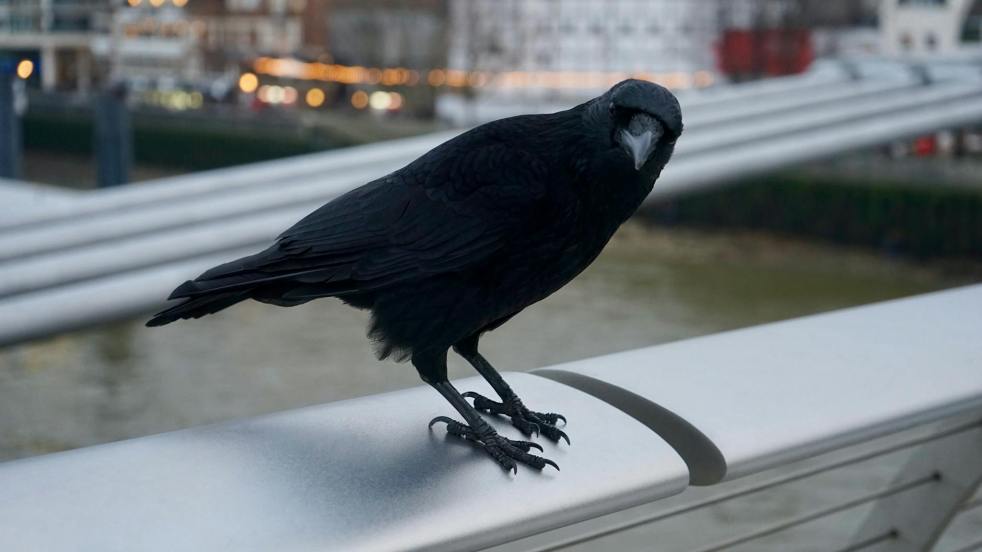
What I’ve learned from coexisting with crows.

Crows (and corvids in general) can be pretty divisive. I don’t think I’ve met someone who can just take or leave them — it’s always either a fervent love, or a deep dislike.

And I get it, honestly. They’re noisy. They’ve been known to eat nestlings, eggs, and small mammals. To many, they’re a nuisance and they don’t understand why anyone would go out of their way to make their yard more attractive to these birds.

Ever since we moved here, I’ve been feeding a small family of crows whom I’ve come to love dearly. I’ve hesitated to feed other species, because I don’t want to encourage them to congregate (and potentially spread avian flu) when that isn’t their normal feeding pattern. While the debate about feeding birds and crow/raven behavior will likely never come to an end, here are a couple of things I’ve personally observed when making an effort to coexist with crows:

With most members of corvidae, you’re dealing with a very intelligent animal. With crows specifically, something on the level of a toddler or a very bright dog.

I wanted to mention this right off the bat because it heavily impacts a lot of my other points.

In general, crows aren’t really hunter hunters. They do eat meat, and they will eat young, weak, or sick animals, but they’re opportunistic feeders. If the opportunity isn’t there, or there’s an easier source of high-value food somewhere else, they’ll go elsewhere.

Crows are also a prey species for larger carnivores. When they’re eating, they’re vulnerable because their attention is directed toward that and not toward looking for threats. This is why groups typically have a sentry or two, to keep an eye on things while the others feed.

A blue jar, perched on a twig, looks over his shoulder.
A blue jay, one of the more colorful members of the corvid family. Photo by Pixabay on Pexels.com

They’re also still wild animals, no matter how closely they may coexist with humans. Wild animals will go for easier-to-get food sources whenever possible, because more challenging ones a) aren’t guaranteed, and b) require more effort (read: calories) and attention to access. The exception to this seems to be when there’s a particularly appealing, usually calorie-dense food item available that’ll make up for the potential danger and extra effort expended to get it.

With the above things in mind, you can direct their behavior to a degree.

I’ll give you an example. When I worked in pet retail, I had customers that’d come in and complain that squirrels and large birds that kept getting into their bird feeders. We had tons of anti-squirrel technology available — baffles, special lubricants for poles, specially shaped feeders, and even battery powered ones that vibrated, spun, or did all kinds of other gymnastics. I’d gently try to guide these customers to dedicated platform feeders and bags of corn, but they always turned it down.
No matter what they bought, they’d be back in a few weeks for something else. A greased pole was no longer enough, because the squirrel learned how to jump from a tree at just the right angle to defeat it. A specially shaped feeder wasn’t enough, because the crows would team up to work around it.
The cycle would inevitably repeat, until they finally just gave up and bought the platform feeder and the bag of corn. After that, the squirrels and large birds would eat the easy to access food, and the smaller birds had their own.

Since this crow population was already established here (and has since grown due to habitat destruction caused by some recent construction), giving them high-value, easy to access food has ensured that I get to keep more of the fruit and vegetables from my garden. This isn’t just because the crows don’t take as much, either — they’ve also done quite a bit to keep various garden pests away.

I don’t leave their food unattended — I usually feed them items I know they like, then sit out there just a few feet away with my own lunch. I have never once been harassed for my food. I’m pretty sure it’s because, like other intelligent animals, they’re able to distinguish between what food is given to them and what food is mine. Why bother me to eat off of my plate, when their plates are right over there? Why run the risk of a potential conflict with a human when they have accessible, desirable food already?

This study covers the relationship between various predator and prey species. One of its findings is that, as prey species numbers increase, so do predator species numbers, and there isn’t strong evidence that native (non-invasive) predators alone drive species decline.

A single predator, or small group of predators, can impact local numbers of prey animals, but don’t appear to correlate with a decline in overall numbers. The thing here is that crows are, like I said, opportunistic. They take prey from nests, where other predators are more likely to be less discriminating and take reproductively mature animals (since those are the ones they’re most likely to encounter out and about). Many corvids are also very territorial — an established family of crows will actively drive off other, larger, less opportunistic predators. They appear to exert both a predatory and protective influence on local prey species.
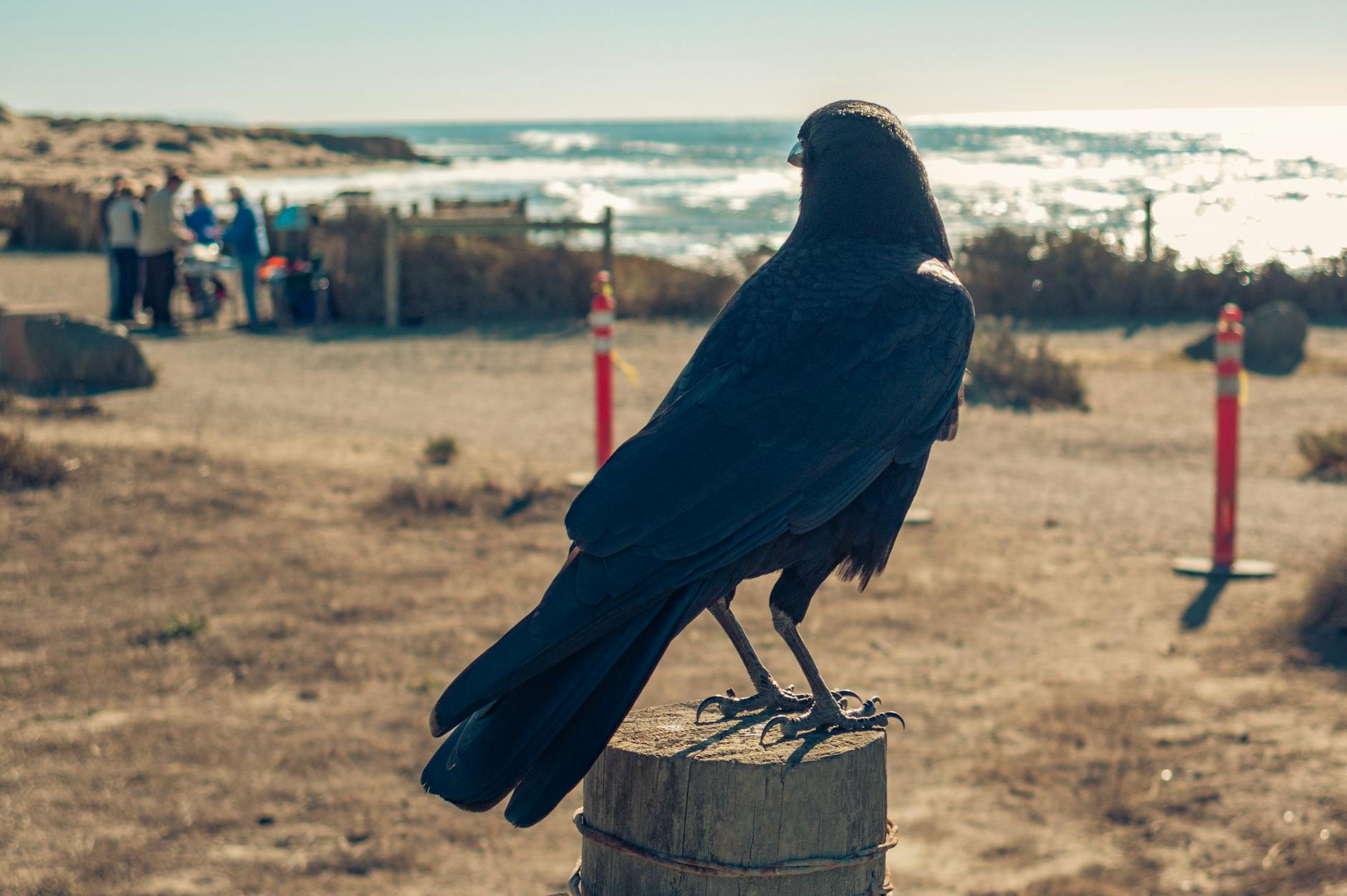
A crow, perched on a fence, observes a distant group of people.
A crow. Photo by mali maeder on Pexels.com

While I offer food for the local birds and squirrels, I’m careful not to do it every day. (Water, on the other hand, is always available.) Nobody goes hungry, and there seems to be less impetus for them to eat what I’m growing or trying to protect, but they still need to engage in natural foraging behavior.

This works in my case because this crow family had already established this area as their territory. If you listen to their calls, you can hear them relaying from one tree to the next. While they’ll cover a lot of ground in order to find food and water, a sentry alerts the others when there are snacks available. They can go about their business and stop by when there’s food.

(One funny thing I’ve noticed is that their vocalizations change when I’m on the deck, whether I’m putting food out or not, like they’re telling everyone that it’s almost time to eat. Once, I was only watering a few plants and went right back inside, and I got to hear a very excited crow call trail off into something that sounded unmistakably like disappointment.)

Crows (and many other members of corvidae) will get into dumpsters if there’s an opportunity, somewhat rightly earning them the nickname of “garbage chickens.” Stories abound of people feeding them fries, chips, and other very palatable, salty, oily, and largely carbohydrate-based foods. These really aren’t optimal dietary contributions for them, though, and having a positive relationship with your local corvids should mean taking their actual nutritional needs into account.

I explored the foraging habits of crows, plus the diets fed to pet pied crows in captivity as well as crows and ravens at rehabilitation centers. In the end, I came up with a mixture of cat or puppy kibble, cracked corn, raisins, and a low sodium, unfortified cereal as a base. To that, I add hardboiled eggs (cut into quarters, shell attached), dried mealworms or black soldier fly larvae, peanuts (in the shell), and fruit, depending on what I have on hand. Sometimes, if I have the leftover tail end of a loaf of homemade bread, I’ll cut that into cubes and toss it in too. This all seems to work out pretty well — they appear to enjoy it, and they’ve got some of the darkest, shiniest feathers I’ve ever seen on an urban crow.

One thing people bring up often is that crows will get used to humans, which will cause problems.

There are definitely cases of birds, including corvids, losing their fear in areas with frequent, close contact with a variety of people. Anyone who’s ever tried to eat French fries on a boardwalk can probably give you several examples.
(I was almost eaten by a pelican when I was little. It was a defining experience.)

I can’t speak to this in general, but I can point out my own observations as someone dealing with an urban crow population that already has a lot of incidental contact with humans. Like I mentioned above, I also stay out there by the feeders after I fill them. While the family of crows has certainly grown bolder with time, this change in behavior seems to be limited to me. If I’m out there and my Handsome Assistant joins me, their behavior switches gears immediately. They keep their distance, and even make some unique vocalizations. If I’m there with a stranger, the difference is even more stark. As intelligent animals with the capacity to recognize individuals, they seem to have drawn some very firm lines between “human what puts the food,” “other human,” and “some guy, idk.”

One interesting experiment with ravens kind of highlights this. A researcher was teaching a raven to trade, by offering the bird a small piece of cheese (a high-value food item) in exchange for a piece of bread (a lower-value one). At one point, the researcher accepted the raven’s bread, then had the audacity to eat the cheese right in front of them. The raven, understandably pissed, refused to engage in any more trading exercises… but only with that particular researcher.

Animals have their own agenda, though it’s often tempting to see them through a humanized lens. I’ve seen a lot of posts from people asking why their local population of crows just left — do the birds not like them anymore? Did they offend them somehow???

The truth is, wild animals have their own schedule. They likely won’t, don’t need to, and shouldn’t come hang out every day. During summer, when a lot of fruits ripen and grains are harvested, crows are likely to go off to agricultural areas to eat the dropped grain. They also have babies, so they’ll be off doing parent activities. In winter, they may need to go to a more desirable climate or more abundant food and water source. If the larger murder of crows is going off to do something, a given crow family will go with them.

If they stop showing up for a while, it can honestly be a good sign because it means they’re still being wild birds. It might suck if larger carnivores move in and start causing trouble in their absence, but that’s nature for you.

A magpie, flying in front of a group of rose bushes.
A magpie. Photo by Manuel Torres Garcia on Pexels.com

On top of all of this stuff, I’ve also noticed some interesting impacts on my hyper-local environment since I began putting food out for these birds:

In the beginning, I was lucky to get some house sparrows, starlings, and the occasional mourning dove. As time goes on, I’ve begun to see more species. Like, a lot more. Blue jays, cardinals, finches, dark-eyed juncos, woodpeckers, and grackles, to name a few. (Even a mockingbird that has absolutely given the crows a run for their money when it comes to territoriality.)

Part of this may be because there’s more food available, but most of the food I put out consists of things that would appeal to crows and jays, not necessarily other species. I have, however, noticed that the local crows do a lot to keep the smaller birds safe, because…

I’ve written before about how this family of crows have effectively become my unpaid, unasked-for yard bouncers. In addition to dispatching particularly chaotic squirrels, I’ve seen them bounce bigger predators, too. They’ll get together and mob a hawk (which is honestly fascinating to watch). They’ll chase away stray and feral animals. They’ll even warn me if there’s a particularly suspicious snake in the vicinity. They’ve kept rats, mice, and grubs away, too.
They have very definite ideas about Who Belongs and Who Does Not.

These crows seem like a protection racket. Like a dragon that demands an occasional sacrifice from a local village, or a rat snake that keeps mice and rats out of a chicken coop in exchange for the occasional egg. It’s weird, but I’ve seen them on my deck, coexisting perfectly fine with the smaller birds and other squirrels… So, I guess it’s all chill?

Granted, a lot of this is because I’m not particularly fussy about garden borders. If something neat springs up, isn’t a noxious weed, and won’t run the risk of poisoning me, I’m inclined to let it be and see what happens.

As it turns out, “what happens” is a ton of volunteer tomatoes, corn, grapes, and berries. (The smaller birds even planted a bunch of millet and broccoli.)

They’ve also brought me occasional small gifts, but I can’t eat those.

When it comes to coexisting with these incredible animals, the important thing to remember is that a) they’re very smart, b) they have the capacity to remember and distinguish between individuals, and c) they’re wild. While it might seem flattering to feel needed and loved like you would with, say, a dog, that’s counterproductive to a wild animal’s survival both physically and mentally. It is possible to interact positively with them without harming their ability to live without you, and this should be the goal of anyone who really loves these birds.

animals

The Magical Meaning of Black Squirrels

The other day, I was on the deck having breakfast with my local crowbros. (It’s funny — as soon as I go outside, I hear their calls pick up speed and intensity. Then they start to swoop around and gather in the big maple tree. Once some of the braver members of the family are present, they’ll start making forays to the feeders. Gradually, once they’ve proven its safe, the timid members follow suit.) This day was different, though.

This day had squirrels.
Not just the usual suspects (Freddy de Bonesby and the pruno-making delinquents), either.
Today, there was a black squirrel.

A photo of a black squirrel on a clover-covered hillside. He looks like he's just realized he left his stove on.

Black squirrels are a naturally occurring melanistic variation of grey or fox squirrels. They’re fairly rare under normal circumstances, appearing at a rate of about one for every 10,000. This is overall, however — black squirrels do occur more commonly in specific areas. They’re generally seen more often in urban places (theoretically because they blend in better there than they do elsewhere) and at the northernmost portions of their ranges (theoretically because they absorb sunlight more efficiently, keeping them warm and extending their active, foraging times during the cooler months).

Melanism in squirrels doesn’t occur with the same beautiful variety as human skin colors, and isn’t even the same as melanism in other animals. In most other animals, melanism is a recessive gene and an individual must inherit it from both parents. In humans, coloration is controlled by multiple genes that come in a variety of alleles that show incomplete dominance, resulting in an incredible variety of hair, eye, and skin colors. In squirrels, melanism is associated with the is associated with the MC1R-Δ24 E B allele EB and is incompletely dominant with the “wild” coloration allele E+. So, a squirrel that inherits two wild coloration alleles will be the color of the average gray squirrel (E+ + E+). A squirrel that inherits one copy of the melanistic allele will exhibit a dark brownish, nearly black coloration (EB + E+). A squirrel that inherits two copies will be a deep, shiny, inky black (EB + EB).

Even rarer than melanistic squirrels are leucistic squirrels — white squirrels with black eyes. These are not the same as albino squirrels, which typically have pink and blue eyes. Albino squirrels typically have poor eyesight. Leucistic squirrels have normal eyesight. Both stick out like sore thumbs to predators and generally don’t survive long in the wild.

Where I live, melanistic squirrels more common because it’s a) by a major city, where b) a bunch of them escaped from a zoo this one time.

I had seen a few here and there in the past, but I’d never seen one in the yard before. Out of curiosity, I decided to look up the magical and folkloric significance of these adorable weirdos.

Remember that bit about escaped zoo squirrels? Well, the tale goes like this: As far back as 1900, Frank Baker (superintendent of the National Zoo) repeatedly requested rare, beautiful black squirrels from several locations in Ontario, Canada. Two years later, Thomas W. Gibson (Ontario’s former commissioner of Crown lands) sent the National Zoo eight black squirrels. Canada is in the northernmost portion of the eastern gray squirrel’s (Sciurus carolinensis) range, so melanistic individuals are far more common there.
In 1906, eighteen of the black squirrels were released onto the zoo’s grounds. For some reason, people okayed this decision because they literally didn’t think they’d get out. However, being squirrels, that’s exactly what they did. As a result, DC has an exceptionally high population of melanistic squirrels.

A close-up of a black squirrel in autumn leaves.
Photo by Lauren Hedges on Pexels.com

Remember when I wrote about solar eclipses a bit ago? I briefly mentioned the Choctaw legend about greedy squirrels coming to eat the Sun. These weren’t just any squirrels, though — they were particularly hungry and mischievous black squirrels.

In Ireland and the UK, black squirrels were viewed similarly to black cats: as signs of good luck or prosperity. Rare as they are, they were also thought to have connections to the fae realm. While they don’t appear to have the “messenger” connotations of animals like crows, they are no less connected to occult knowledge.

Given squirrels’ propensity for burying things, black squirrels were associated with finding hidden treasure.

Of course, as has often happened throughout history, the spread of various forms of Christianity during the medieval period turned what were once good luck symbols into something sinister. Black animals, like cats, crows, ravens, and even squirrels, were then associated with misfortune and evil. They were often accused of being witches’ familiars.

In general, black squirrels are associated with good luck. English coal miners would keep them around for luck, and it was considered very unlucky to ever harm one.

Even in cultures where melanistic squirrels are viewed as troublesome, they were typically seen more as eccentric trickster figures than something expressly evil.

Today, places that are fortunate enough to be blessed with lots of black squirrels often take pride in it. Some of them are jokingly called “squirrel towns,” and feature black squirrels on their signs, as the subject of annual festivals, and represented on souvenirs in gift shops.

In a divinatory sense, the appearance of a black squirrel heralds a positive change of some sort.

While they may not be super rare here, black squirrels are still delightful to see. From what I’ve noticed, they seem jumpier and more skittish than other eastern gray squirrels, so being able to get a photo of one (or even a clear look at one) is a treat.

animals · life · Neodruidry

We have a spy.

As the weather warms up, the crows come back in force. They distribute themselves around the perimeter of their territory, sending a single “caw” in a kind of relay. As far as I can tell, it seems to mean, “Hi, I’m a bird! Status update: Still a bird!”

This single “caw” is passed from sentry to sentry until something happens to disrupt it. That could be a cat, an owl, a snake, or the sudden appearance of a quantity of snacks.

One of these sentries is positioned in the big maple tree in the back yard. As far as I can tell, he has exactly one mission: Keep tabs on my comings and goings.

I know this because I hear his single cries throughout the day, echoed by the equally single cries of his family group. As soon as I show up on the back deck, that single “caw” turns into a rapid series of calls. If I start putting out the crow salad, the shouts get even faster and more high-pitched. By the time I turn around to go back inside, the apple trees and the roof are full of black shapes.

A pair of crows investigate a platform filled with crow food.
Pardon the raindrops on the window pane.

Sometimes, they don’t even wait for me to go all the way inside before they swoop in and start eating. If they’re particularly feisty, they’ll barely hop away when I go out to refill. This seems to be out of a sense of avian practicality, rather than fear — it really seems like they fly up to the roofs to wait in order to be out of the way, not because they’re genuinely wary of me anymore.

I’ve found a mix of food that doesn’t seem to appeal much to other bird species, so this family can feed safely without concerns about being hassled or coming into contact with pathogens from unrelated birds that might otherwise swarm the feeder.

I can’t be positive, but I’m also reasonably certain that this sentry is the same li’l nerd who came and stared in my bathroom window after my Handsome Assistant and I returned from being out of town for a few days.

I can’t overstate how helpful they’ve been to have around — they deal with nuisance animals, and I’ve gotten a ton of free garden plants from them (and one small bouncy ball). I love this band of weirdos so much. It always makes me so happy to see them.

animals · life · Witchcraft

The Magical Meaning of Mockingbirds

I’ve been filling the little raised bed next to the house. It isn’t much, just a long, sturdy box made of cedar planks, but I didn’t want it to sit fallow for too long. I built it last autumn, a bit too late in the season to plant anything, but that’s okay — my objective was mainly to set it up and observe how it interacted with its surroundings. Would it get enough rainfall, or accumulate too much? Would the sun fall on it in the right way, or would it be too shady all day long?

Anyhow, gardening angsting aside, I returned from filling the bed with soil and compost to see a mockingbird eating on the deck. They eyed me curiously, but not warily, and didn’t seem to care much about what I did or how close I came. I said, “Hello.” They went about their business. It was all very chill. It was also interesting, because I’ve never seen a mockingbird back here before. There’ve been plenty of crows, starlings, a blue jay, juncos, house sparrows, a pair of cardinals, and absolute loads of morning derps, but no mockingbirds.

A close up of a gray mockingbird in green grass.
Photo by Tessa Riley on Pexels.com

That got me thinking: What kind of omen is a single, friendly mockingbird?

Mockingbird, known as Yapa or Yaupa, is a spirit that figures in Hopi Katsina ceremonies. Mockingbird is credited as the spirit being who first taught mankind to speak.

The Shasta people, a linguistic group of Indigenous peoples from the Klamath Mountains area of the Pacific Northwest, Mockingbird was a protector of the dead. (Considering their very protective tendencies, this makes a lot of sense.)

To people of the Southeastern US, mockingbirds were considered not only very intelligent, but capable of passing on this intelligence. Some even ate them in the hopes that they would then acquire the bird’s cleverness.

A mockingbird perched on a railing.
Photo by Connor kane on Pexels.com

In O’odham folklore, mockingbirds feature as mediators in two speeches used for rain ceremonies. In one, mockingbirds use their calls to calm a heaving Earth and bring gentle rains. In another, they carry the raucous shouts and laughter of intoxicated people to the home of the winds. The winds then send forth clouds and rain.

Across all of these Indigenous folktales and traditions, mockingbirds are known for their intelligence, ability to mimic sounds, and desire to protect.

In Harper Lee’s novel To Kill a Mockingbird, the titular bird represents innocence. It’s said that the mockingbird sings only for the pleasure of others, not for its own enjoyment — therefore, it’s a sin to kill one. In nature, they’re mostly harmless birds. They eat insects, fruit, seeds, and occasionally small reptiles or crustaceans.

They can, however, be very aggressive when it comes to defending their territory. I remember when a mockingbird built a nest just outside a hospital I was in. (It definitely made things more complicated when my Handsome Assistant came to visit me!) For this reason, they’re also associated with protection.

A mockingbird perched atop a bird feeder.
Photo by A. G. Rosales on Pexels.com

Mockingbirds are also highly intelligent. The name mockingbird comes from the birds’ talent for imitation, as does the scientific name of the northern mockingbird — Mimus polyglottos, which roughly translates to “many-tongued mimic.” They’ve been found to mimic the calls of other birds, insects, and amphibians, human voices, and even cellphones and landscaping equipment. All birds are considered messengers across various traditions, but mockingbirds are especially associated with communication and messages.

It’s said that mockingbirds can answer any question that’s asked of them. While that’s probably a lot of responsibility to pin on one bird, you can ask a mockingbird a pressing question and then observe its behavior for signs. Divination by the behavior of birds is called ornithomancy or augury, which is an ancient art that is or was practiced all around the world.

In light of all of this, I think my small gray visitor was a positive omen. I hope to see him or her many more times in the future… Just maybe not during nesting season. That could be complicated.

life

The Feline Terrible (almost) Twos

When you adopt a cat, it takes a little bit of time for their personality to unfold.

I remember bringing home Pye and Kiko — she had to stay confined for a bit, because she’d recently had an operation (one of her hind legs had been barely injured and she needed a bunch of necrotic skin and muscle removed), but Pye was free to roam around.

A small female orange tabby cat sits on the arm of a blue sofa.
She got better.

Instead, he decided to find a sunbeam on the bed and curl up. He pretty much owned the place, and he knew it immediately.

He was a kitten at the time, but an older one. At about eleven months (give or take), he was at the end of his kitten stage. Allegedly.

A few weeks later, he started misbehaving more. He wanted more attention, but he wouldn’t come over to receive it. No. Instead, he’d hassle Kiko. Push things over. Yell at the ceiling. Climb into places he didn’t fit, then sternly make eye contact as if to say, “Look what you made me do.”

We couldn’t figure out what his deal was. We figured that, as he’d become more comfortable, his true personality was coming out more. And, to be honest, he was being a bit of a dick about it.

That’s when I discovered the remedy: I had to call him over to me, make a space for him under my arm, and gently hold his face for him as he slept. He would not come cuddle of his own volition. He would not come tap or meow at me to get my attention. He’d act up, and I’d have to put him down for a nap like a cranky toddler. Once he’d slept for a bit (wearing my hand like some kind of disturbingly organic sleep mask), he’d be a perfect angel.
I don’t know, man.

A large male orange tabby cat lays on the edge of a bed. He's curled up on his side, paws in the air.
His entire internal monologue is just hold music.

He eventually grew out of this phase around age two, and it was as if it never happened. I just figured he was a weirdo and went on with life. He gradually settled down into a cat who is very much a buddy who wants to hang out with us all day, but actually prefers not to be cuddled.

Now, we have Pye, Kiko, and JJ. We’ve had JJ since she was a tiny, very sick baby, so we’ve been able to see her personality develop from the beginning. Once she hit a little over a year old… well, she suddenly started doing the same thing Pye did.

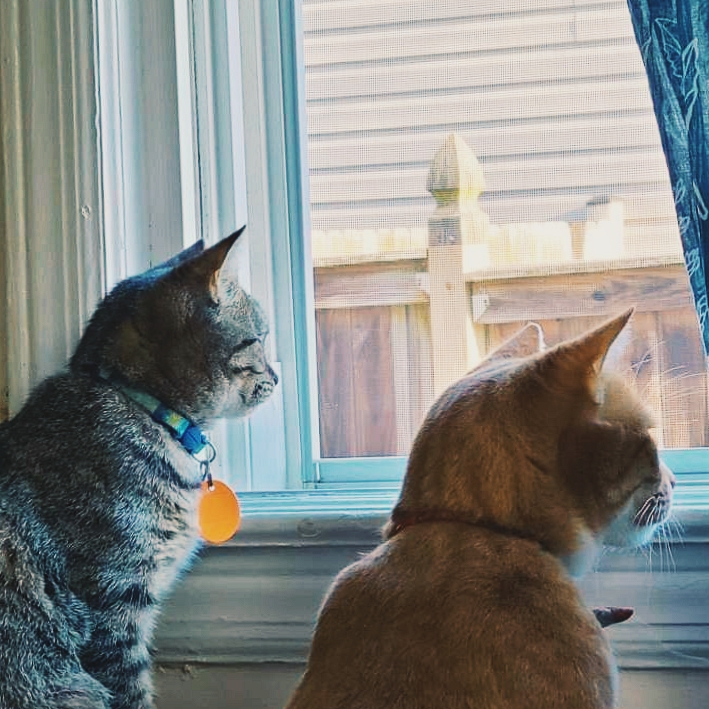
A large male orange tabby sits beside a much smaller female gray tabby. They look out of a window together.
Did he teach her the ways?

Acting up. Misbehaving. Hassling Kiko. Chewing on Pye’s face (though he’s pretty good natured about it). Being rambunctious and cranky until and unless she is given a nap. At times, circling me like a tiny shark and making small clown honking noises.

I’m not sure what it is about this age that seems to have instilled this very odd tendency in both of them. It seems like there’s some kind of physical or mental growth spurt that coincides with a) an increased need for snuggles and sleep, and b) an absolute refusal to admit it. Like human children testing boundaries and asserting their independence, it seems like they push themselves until they become tired and cranky, and I have to be the one to notice this and enforce naptime.

Pye seemed to grow out of this eventually, and I’m pretty confident JJ will too. It’s just interesting to see how nature doesn’t conform to a neat timetable — we can say that cats are kittens until one year of age, but there’s still so much growing and developing that they do beyond that. They’re not babies, but they still aren’t adults yet. There’s boundary testing and a lot of feelings, but it seems like naps and snuggles are suitable emotional reset buttons.

divination · Neodruidry · Witchcraft

Footprint Folklore & Magical Properties

With so much snow on the ground, it’s been even easier to keep track of all of the visitors to the front and back yards. From the efficient single-track prints of stray cats, to snowshoe prints of rabbits, to the rodent tracks ending in the sudden whump of an owl, they all stand out starkly in fresh snow.

A set of squirrel tracks in snow.
For example, these prints by resident Absolute Unit Frederick de Bonesby, the gray squirrel.

The weather is warming up bit by bit (it’s supposed to be in the 60s F this weekend, go figure), so the snow isn’t long for this world. With that in mind, I thought this might be a good time to look at different folk beliefs and folk magic practices involving animal tracks and footprints.

Unique footprints and strange feet are a defining characteristic of many cryptids and folk monsters:

  • The Tupi-Guarani people of Brazil have the Curupira (Tupi for “blister-covered”), a kind of demon with fiery red hair and backwards feet.
  • The Scottish have the glaistig or maighdean uaine (“Green maiden”); a gray skinned, blonde-haired woman with a long green skirt to hide her goat legs.
  • In Madagascar, there is the Kalanoro. This is a humanoid cryptid described as a small, hairy person with red eyes and backwards-facing legs and feet. While they are said to have once lived in corporeal forms, habitat destruction has left only their spirit forms behind.
  • In the Himalayas, there are Abarimon (“mountain-dweller”). These are said to be vicious humanoids with backwards feet who lived solely in a single mountain valley. While Abarimon were dangerous, they could only breathe the air of their valley home, and thus were unable to ever leave it.
  • In Trinidad and Tobago, there is the Douen. This entity is another humanoid with backwards facing feet but has the distinction of also lacking any facial features other than a mouth. If they hear a child’s name, they are said to be able to mimic the parents’ voices, calling to the child to lure them into the forest. Douen may be related to the duende, humanoid spirits from Spain and Latin America.
  • In Australia, there’s the Yowie. This is a tall creature covered in dark hair, often said to have backwards-pointing feet.
  • The Dominican Republic has La Ciguapa, a lovely wild woman with long, dark, silken hair, beautiful bronze skin, and backwards feet. While small, she is perfectly proportioned and incredibly agile. She’s said to use her beauty and agility to prey on those who are foolish enough to venture into the woods — her domain — alone.
  • On the Indian subcontinent, there are ghosts known as bhuta. These can shapeshift into any animal, but often appear as perfectly normal humans — save for their backward-facing feet.

To be honest, you’d probably be hard pressed to find a culture that doesn’t have some version of “cryptid whose main thing is having weird feet.” Many of them serve as cautionary tales against wandering dangerous places alone, especially for children. They’re the personification of situations that seem perfectly safe, or even nice (like meeting a beautiful woman on a walk in the woods), and lure you in before you notice the danger that you’re in (like the fact that she’s a cannibalistic cryptid with weird feet). Across cultures, the message here is also pretty consistent: Stay away from strangers, and out of the wilderness at night.

In northeastern Tanzania, there are a series of incredibly ancient footprints set in stone. These point to two small groups of hominids (likely members of Australopithecus afarensis) traveling in the same direction. The Maasai people associate these footprints with Lakalanga, a hero so big that he was said to leave footprints sunk into the ground wherever he walked. He is said to have helped the Maasai win a battle against a neighboring enemy, long, long ago.

In South Devon, England, a heavy snow fell in the winter of 1855. The next day, and for two days after that, mysterious sets of very hooflike marks appeared. They were in single file, roughly 4 inches long by 3 inches wide, and managed to cover a total area of about 40 to 100 miles. Strangely, these hoofprints didn’t seem to care about obstacles — they traveled straight over fences, hedgerows, walls, and even houses. Called the “Devil’s Footprints,” hypotheses for their appearance range from experimental balloons to kangaroos… But there’s still no accepted explanation.

In some magical traditions, footprints are used for sympathetic magic. Any spell benefits from the addition of something belonging to the target — a nail clipping, a lock of hair, or a scrap from their clothing, perhaps. (I once managed to pull something off by getting a target just to touch a grass poppet that I’d made, but that’s neither here nor there.) In the absence of these, footprints often suffice.

Some magical powders, like the hot foot powder used in Hoodoo, are sprinkled into a person’s footprints to control their actions. This derives from the traditional West African practice of foot track magic, brought to the Americas by the transatlantic slave trade.

Reading animal tracks is also a method of divination. While augury was traditionally divination using the flight paths of birds, you can also gather omens from the number, direction, and maker of tracks you come across.

A set of cat tracks through snow.
These belong to a stray cat. Cats conserve effort when walking trough snow by placing their hind feet directly in the prints of their forefeet.

When it comes to divination using a human’s footprints, the practice is called “ichnomancy.” This comes from the Greek “ixnos,” meaning “footstep,” and “manteia,” meaning “method of divination.”

Divining with footprints can be a little difficult, since you need to be able to read them in a mundane sense first. For example, deep footprints indicate a heavy load. Widely-spaced ones indicate a long stride, perhaps someone running. The different depths of the impression in the heel and ball of the foot areas can also tell you different things.

My first suggestion for working with animal tracks and footprints is to familiarize yourself with what you’re likely to encounter. If a deer walked through your yard, what would it look like? How about a dog, or a bear? What impressions does it leave when a bird of prey scoops up a rat, or a squirrel? Consider your connections and associations to each of these creatures. What would their appearance mean to you?

Next, consider their other qualities. Movement to the left is often considered an ill omen, while the right is considered a positive one. For example, seeing the tracks of a bear or mountain lion moving quickly toward your left could be an omen of danger. Seeing the tracks of an animal you have a positive connection to, moving at a leisurely pace toward your right, could be a very good omen.

Working with footprints in a magical context is a bit different. You can collect the dirt from within a footprint and use it to target a spell toward whoever left the footprint. You can also sprinkle magical powders or crushed herbs in someone’s tracks, or over a place where you expect them to step. (There are far too many magical powders to enumerate all of their uses and qualities here, unfortunately. Since this is a method frequently employed by Hoodoo practitioners, you may wish to consult with one for more information. Many online sellers of Hoodoo supplies offer consultations and can answer your questions on foot track magic.)

As for me, I love seeing fresh tracks in the snow. It’s a reminder that, while the outdoors seems to sleep under its cold, fluffy comforter, there’s still plenty happening. Tracks also give me another way to gauge the way everything’s activity increases as we inch closer to spring. I look forward to seeing tracks in the mud and snow just as much as I look forward to seeing new faces at the feeders and in the fruit trees.

Witchcraft

The Magical Properties of Cat Whiskers

I’ve mentioned before that I share my home with three cats — one gray tabby, and two orange ones. (And yes, the thing people say about orange cats all sharing a single brain cell is absolutely true.) We’ve taken them on a road trip. One of them has a weird obsession with exercise bikes. The second seemed baffled about how a kitten ended up in his house, but absolutely does his best to raise what he appears to assume is his kid. They’re precious, adorable dumbasses, and I love them.

A fangy-toothed cat sleeping upside down.
Pye’s enormous, doofy face.

I also periodically find shed whiskers. I can usually tell who they belong to, too — Pye’s are gigantic, Kiko’s are thin and white, and JJ manages to pull off this natural two-tone ombre that stylists would kill for.

A cat’s whiskers are an extension of their sensory organs. This doesn’t mean that they are sensory organs, however — whiskers themselves are still just hair, and don’t contain any nerve tissue themselves. So, why shouldn’t you ever cut or pull out a cat’s whiskers?

Pulling is definitely more harmful than cutting, but neither are good. Pulling out a cat’s whisker is extremely painful. (Imagine yanking your nose hairs out, one by one. I’m feeling teary just thinking about it.) Cutting a whisker isn’t painful, but it does rob the cat of an important source of information about their environment, leading to stress and anxiety.

It’s perfectly natural for cats to occasionally shed their whiskers. They’re hair, just like any other, and they have a life cycle. Cats routinely lose a whisker here and there to time, roughhousing, and generally silly cat activities. I had a cat growing up who used to sleep on the slanted base of a space heater. When he’d come to cuddle afterward, his eyebrow and whiskers would be all singed and frizzy on one side. Somehow, this never seemed to dissuade him from his favorite nappytime spot.

If you want to use a cat’s whisker as a spell ingredient, just wait until you find one. Trust me, you will eventually.
Unless you don’t have a cat.
You should make sure you have a cat first.

Traditionally, whiskers are associated with luck and protection. Interestingly, whiskers are also associated with the opposite. Since cats depend so heavily on them, a lost or broken whisker is sometimes considered an omen of bad luck.

Since cats use their whiskers to guide themselves and keep themselves safe, whiskers are connected to the concept of spiritual guidance. They may be treated as omens — seeing a cat with lost or damaged whiskers can symbolize misfortune, while finding an intact whisker can represent good luck.

Some people also consider finding a cat’s whisker as a spirit or angel sign. Since they’re connected to the idea of guidance, they may indicate that you’re receiving help from your guardian spirits, ancestors, or other guides.

Cats’ whiskers can vary in color. Some practitioners assign different meanings to each color of whisker, but I haven’t found a consistent set of meanings. Black whiskers are sometimes considered negative omens, and sometimes considered symbols of protection. Brown whiskers represent grounding (though there are certainly easier ways to ground than waiting to find a brown cat’s whisker). Gray represent neutrality, balance, or uncertainty. White whiskers, on the other hand, are generally considered lucky… as long as they aren’t broken or damaged. Some cats have multicolored whiskers, which can give them two or more meanings. In general, I don’t worry about attaching specific meanings to each color — to me, whole whiskers are lucky and broken whiskers are a sign to be cautious.

Cats are strongly associated with the deities Bast and Freya.

If you find an intact whisker, you might want to save it to use later. I find that old vitamin or medicine jars work well for this — they’re tall enough to keep from bending or breaking the whisker and make it easy to keep track of them. I keep an eye out for whiskers while I’m cleaning, and just deposit any I find into the jar.

The simplest way to use a cat’s whisker is to hold it in your dominant hand, make a wish, and burn it. Scatter any ashes of the whisker on the wind.

You can also include them in charm bags or jar spells for luck and protection. Just avoid bending or breaking them in the process!

I also sometimes leave whiskers as offerings. One of my cats looks quite a bit like the gray cats illustrated pulling Freya’s chariot, so I often place her shed whiskers on my altar.

Overall, cat’s whiskers have more positive associations than negative ones. If you’re fortunate enough to have a feline companion in your house, keep a lookout for any whiskers they leave for you to find!

life

THE BOYS’RE BACK IN TOOOO-OOO-OOOWN!

Not long ago, I wrote about the family of starlings that had pretty much taken over. A squawping mass of tiny kicks, punches, flung food, and babies that would walk up and demand to be fed by anything that moved (and a few things that didn’t).

While they were fun to watch, they also seemed to drive away a lot of the other birds that visited me — especially the crows. Given how much energy I’d put into building a relationship with my local crows, this bummed me out. Still, I knew that starlings aren’t forever, and it wouldn’t be long before they’d join a migratory murmuration and the yard would be peaceful once again.

At that point, I figured, I could try attracting crows again. They might not be the same family that I’d grown to love, but I knew this area was hospitable to breeding populations of crows and would easily become so again.

Anyhow, the starlings have gone on their yearly vacation. I discovered this when I woke up the other morning to big, black shadows passing over the skylight. I went to investigate, and what to my wondering eyes should appear but…

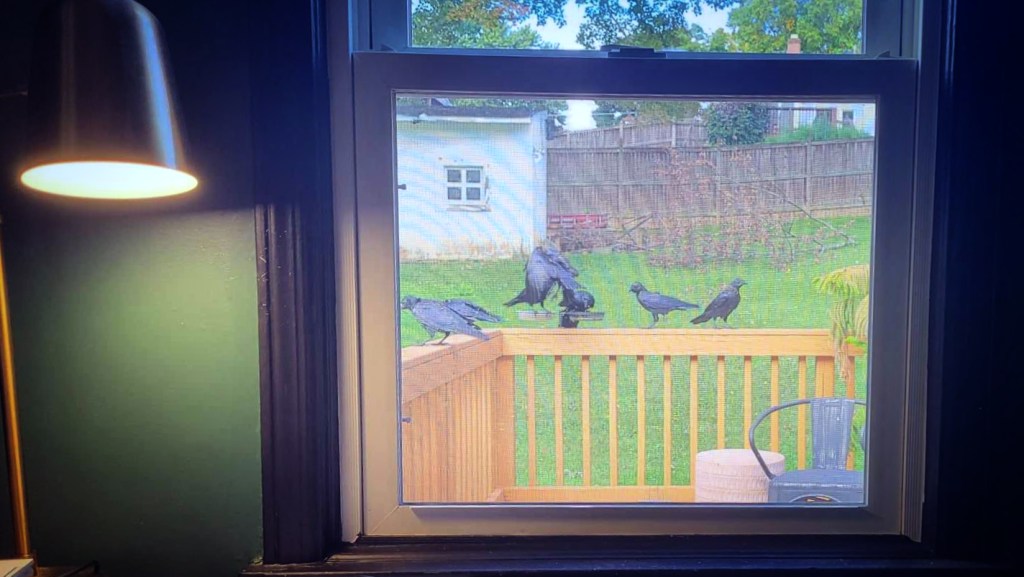
A view through a window, showing seven crows crowding around a feeder.
The view from my Handsome Assistant’s office. Not shown: The other six crows at the feeder on the other side of the deck.

All of the crows.
At the same time.

I knew it was the same group because they have a handful of pretty visually and behaviorally distinct individuals. They scrapped over cat kibble, raisins, nuts, and fancy organic peanut butter cereal (which is apparently a very hot commodity among corvids). I went outside to refill the feeders once they’d nearly wiped them out, and they flew off to the roof, waited for me to finish, and immediately swooped back to resume feeding.

It feels nice. As far-fetched as it seemed, there was always a nagging fear that I’d done something wrong somehow. Something to drive them away. Crows are intelligent, perceptive creatures, and I’ve heard stories of them spurning people for things like imitating the wrong crow calls. It’s good to have some confirmation that it wasn’t me — if anything, it seems like they’d been champing at the bit to get back and hang out.

It was also great to see how much they remembered. In the beginning, they’d fly off when I went outside. Things got to the point where they’d hop to the roof, at most, and wait for me to fill the feeders. Sometimes, if I was sitting down on the deck, they’d land near me to eat anyhow. Despite their hiatus, they still aren’t afraid. A couple flaps to perch on the roof, or the fence, or the shed, and they’re content to wait patiently and watch me put more food down.

A group of five crows swooping in to feed.

I missed these dorks so much. ❤

life · Plants and Herbs

The most important things I’ve learned about gardening.

I’ve posted a lot about my stumbling efforts at growing things, from murdering the front lawn on purpose, to accidentally planting way too many passionflower vines. It’s certainly been a learning experience, though not in any of the ways that I ever expected.

A pair of ripening pumpkins.

See, I thought I’d learn stuff about soil composition and companion planting. I kind of did the former, if by “learning about soil composition” you mean “discovering that this soil is almost entirely hard clay, good luck.” I have developed strong opinions about mulch, however.

If I had to sum up the two biggest lessons that I’ve learned in my first full year of being responsible for an entire yard, they’d go something like this:

As part of my current course of Druid studies, I’m required to plant and tend a tree (or, lacking a tree, another, smaller plant). I began this study pretty much right after my Handsome Assistant and I planted an Eastern redbud in the front (formerly grass) plot. I was given the okay to use that tree, so that’s what I’ve been working with.

The lesson is supposed to involve building a relationship from planting, watering, and helping a young tree become established, to watching it grow. To be honest, I think I’ve watered this tree maybe three times over several months. It’s native to the area. It’s fine with this soil. It’s putting out new branches and beautiful, heart-shaped leaves on a nearly daily basis.

This seemed a bit like cheating, so I thought I’d start a smaller, auxiliary tree. I wasn’t sure what to plant at first, but the birds made that decision for me: There are an abundance of mulberry sprouts, courtesy of the crows and other birds. They didn’t enjoy being moved, but are doing just fine with minimal intervention. My takeaway here if that if I have to carefully nurture a plant, it probably isn’t the right one. Nature, even transplanted nature, doesn’t really need as much intervention as one might assume.

As for the potluck… I’ve mentioned all of the pumpkins in previous entries. (They’ve made for some amazing pumpkin bread.) There’re also sprigs of various kales popping up random places where they were certainly not planted, a thriving bush of bright orange cherry tomatoes, the aforementioned mulberry bushes, and what appears to be a chia plant.

A carpenter bee, a Peck's skipper butterfly, and a sachem butterfly visiting the same flower spike on an anise hyssop plant.

Really, it seems like I don’t actually have to worry about planting fruits and vegetables myself. If I help make this place welcoming enough, tiny guests will show up and bring food. That food may not always show up where I anticipate it, but it flourishes, and I end up with more than enough to share.

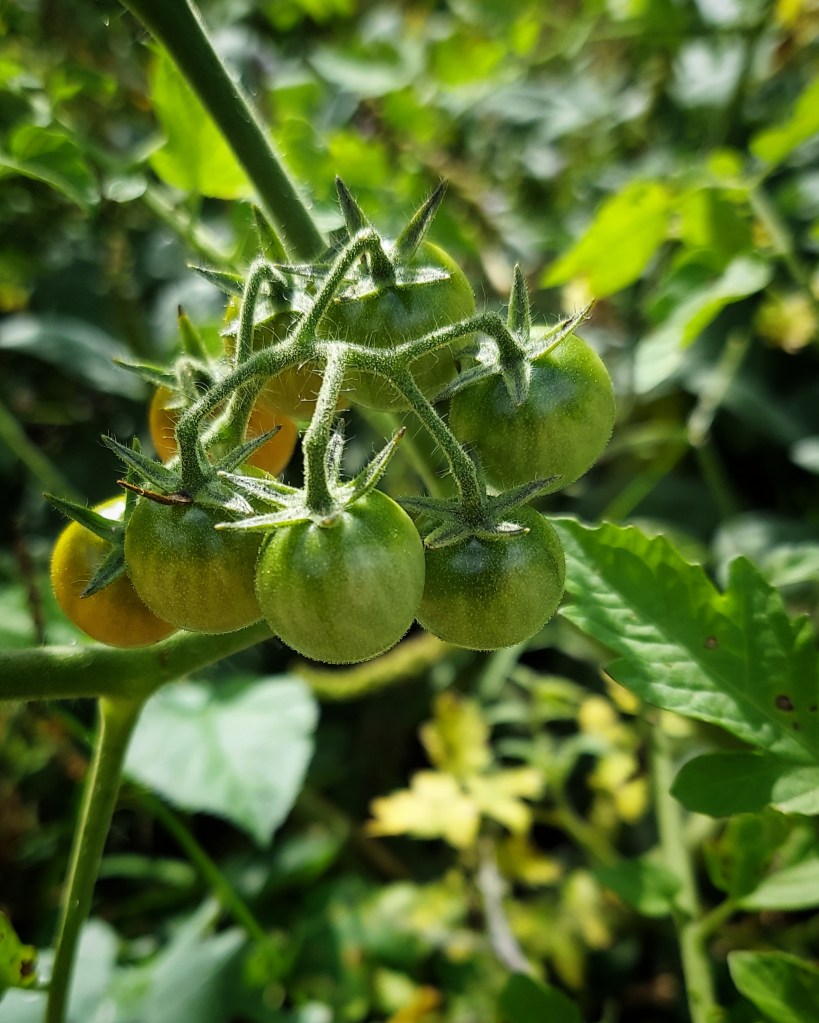
A cluster of cherry tomatoes. Most are still green, but a few are beginning to blush orange.

The plants here have mostly gone to seed, so the pollinator garden is as full of birds as it is bees and butterflies. I have no idea what horticultural surprises next spring and summer may hold, but I’m excited to find out!

Blog · life

Maybe it’s like an emotional support hornet’s nest.

I try to coexist with stuff. I really do. I don’t like confrontation, and I’ve found that even the most noxious weeds or aggressive creatures are usually helpful for something. The yard is full of edible weeds, bees, and predatory bugs, and life is pretty good. I don’t mind spiders in my house. I very carefully evict the occasional confused grass-carrying wasp or pipe organ mud dauber that wanders in.

And then there are the yellowjackets that built a nest right above the front door. There’re these two little gaps in the porch roof that didn’t really seem deep enough to say “hey, homestead in me,” but I guess I was very wrong about that. The end result? A ceiling crevice jam-packed with wasps.

During their initial building stage, they were preoccupied enough that I barely noticed them. Really, I spotted one or two flying to that spot and didn’t think much of it. When I noticed a dead yellowjacket laying on one of the leaves of the passionflower vine growing on the porch railing, I had… concerns.

When they began to get a bit more territorial, I had more concerns. If they’d built almost literally anywhere else, it would’ve been fine. The shed? No problem, just move the important stuff to the other shed, keep the door closed, and wait to clean up during winter. In the yard somewhere? Also not an issue, they can be territorial against other wasps and are pretty easily avoided by humans.

This wasn’t our first brush with yellowjackets, either. A ground-dwelling species built a massive nest in a hollow under a tree stump in the front yard. This, again, wouldn’t have been an issue were it not for the fact that people had to walk there, and the yellowjackets appeared to have very mixed feelings about the whole thing. The deal appeared to be very much the same with the ones in the porch.

My partner and I could avoid them because we knew they were there, but what about visitors? Delivery people? Mail carriers? I wasn’t trying to be the reason why an Uber Eats driver trying to make ends meet had to pay for an emergency room visit, you know?

I put in special delivery instructions a couple of times — “Wasps have taken over the porch. Please go to the side door. I cannot overstate how many wasps there are, and they are all so angry” — and keep my fingers crossed that the delivery people actually followed them. I would’ve gone out there and put up a physical sign, but that would’ve required them to get close enough to read it, and also actually going outside to tape something to an area actively swarmed by yellowjackets.

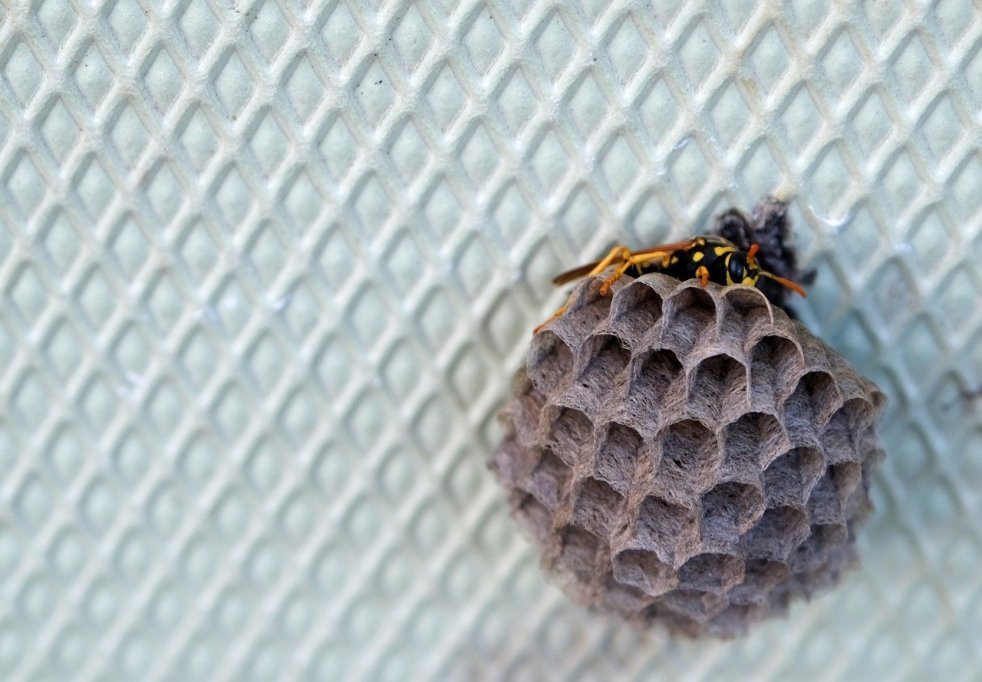
A pair of yellowjackets construct a nest in the angle formed by two wooden beams.
Like this, but with more rage.

And so, we called our Wasp Guy.

His name is Mohammed, and he is, unironically, the straight-up rawest dude I know. His company claims to provide environmentally friendly pest control, and I’m like 90% certain it’s because he just suits up and sort of… confiscates unwanted hives and nests and such. He has a huge (vacant) hornet’s nest he keeps in his van. For fun.

The man is also an absolute surgeon. If he’s there to handle a wasp nest, those wasps will be handled (probably literally) and the neighboring pollinators will never find out. None of my carpenter bees were harmed in the removing of these wasps, and still happily follow me around like dumb little hoverpuppies. The anise hyssop and coreopsis are absolutely packed with miner bees, sweat bees, honeybees, you name it. Even the ants that hang out on the passionflower on the porch (they treat the nectaries like some kind of tiny insect TGI Friday’s) seem just sort of fine with everything.

A frozen Charlotte doll in a small wooden box adorned with fragments of vacant wasp nests.
I just thought this looked cool, to be honest.

While I’m not happy we had to remove the yellowjacket nest (they’re an important predatory species for pest bugs, and, since they tolerate the cold a bit better than bees do, they pollinate early spring flowers!), I know there’s a point where insect territoriality and human territoriality collide. I’m just glad that this time was handled quickly, easily, and with minimal disruption to everyone else.

Just maybe try to build in the old maple tree or the shed on the hill next time, okay guys?