
Neodruidry · Witchcraft

Snake and Lizard Skin Folklore and Magical Uses

To be upfront, I do not have a snake. I have had snakes in the past, and I live in in an area frequented by them, and I do have a large male bearded dragon I adopted from a classified ad.

Being a healthy, full-grown bearded dragon, he occasionally goes through periods of shedding skin while being a very sulky boy. A lot of the time, he eats it in order to reclaim the protein and minerals that would otherwise be lost. Sometimes, I find pieces just kind of around, like tiny laundry.

The skins of animals have been used in ceremonies for… about as long as humans have existed, most likely, and they’re still used today. Each animal has its own power and domain, including lizards and snakes. To be honest, serpents alone have so much symbolism and mythology behind them that it’s far too much to get into here. Instead, I want to focus specifically on the folklore and magical properties of shed reptile skin.

Perhaps one of the most prevalent and enduring qualities attached to snakes is the concept of renewal or rebirth. It makes sense — unlike a lot of lizards, snakes shed their skin all at once. In a pretty short span of time, they go from appearing dull and milky-eyed, to bright, smooth, and rejuvenated.
By extension, this has also made snakes a symbol of fertility, healing, and transformation.

Snakes are also associated with protection. This is particularly true of venomous snakes.

In the Danish tale King Lindworm, an infertile queen wishes to bear a child. She follows the advice of a crone and eventually gives birth to twins: one healthy boy, and one boy who’s a half-human, half-serpent lindworm.
When the time comes for the lindworm to marry, his bride is horrified on their wedding night. The lindworm eats her. This continues over and over, until a shepherd’s daughter is brought to marry him. The clever girl wears every dress she owns on their wedding night and, when her lindworm husband insists she get undressed, she demands that he shed a layer of skin for every dress she removes. Finally, as he removes his last skin, he reveals his fully human body and is cured.
By mimicking layers of snakeskin with her clothing, the girl tricks the lindworm-prince into shedding until he is effectively “reborn” as his human self.

In some forms of American folk magic, snakeskin is carried for luck. Some people also rub it on their hands to help them “hold onto” things.

If you find a shed snakeskin on your property, it’s said to be a sign of spiritual protection. This can also be interpreted quite literally — snakes are vulnerable mid- and post-shed, so they try to do it in places where they feel safe. If a snake feels safe on your property, rats, mice, and other potential pests won’t.

A leopard gecko eyeing a mealworm.
Leopard geckos frequently eat their sheds. Before they do, though, they can end up wearing them like little lizard hoodies. Photo by Pixabay on Pexels.com

Snakes are also sometimes used as a symbol of initiation, as an extension of them as a metaphor for rebirth. In this context, they represent the death of the old self, and birth of the new. This may be part of why they’re considered symbols of wisdom — with each shed, a snake metaphorically moves into a new incarnation of itself. It’s certainly a potent metaphor for becoming wise enough to realize how little we know!

Lizards carry many of the same connections and magical associations as snakes, since they go through the same shedding and renewal process. However, since reptiles very often “recycle” their sheds while snakes don’t, there isn’t as much lore on using shed lizard skin. (After all, even if you find an uneaten one, it’s unlikely to be a very large piece.)

In general, snakes and reptiles are associated with the element of Earth.

Reptile skin is pretty delicate (and becomes more so the more it dries out), which is good to keep in mind. A freshly shed skin may seem like great material for a poppet or spell bag, but you’re likely to be disappointed once it’s fully dry and crumbly!

Shed skin from prickly, aggressive, or venomous reptiles is good for enemy work. Grind it into dust, combine it with banishing or protective herbs, and sprinkle it around the border of your home, in front of your front door, or in the footprints of an enemy in order to keep unwanted people or entities from darkening your doorstep.

A very handsome bearded dragon on a moss pole in the middle of a Monstera deliciosa.
A very handsome boy.

You can also put shed reptile skin in spell jars, bottles, or sachets for protection. I prefer jars or bottles for spells that you want to keep at home (for example, keeping a protection spell bottle near your front door), and sachets for carrying. Since they’re made of fabric, they’re soft. If you’ve got a protection sachet stuck in a purse or backpack, it’s unlikely to break and get herb dust and bits of skin on things.

You don’t have to use an entire shed skin per working. If you have access to a full snake or lizard shed, you can use pieces. Consider ways to incorporate them in workings for change (like finding a new job or home), renewal, initiation, or healing spells.

Shed reptile skins also make for powerful altar pieces. Place them in a fancy bottle, make sure they’re completely dry, cork or cap them to keep the contents protected, and place them on your altar when you have need to tap into snake or lizard energy or work with deities associated with snakes.

Avoid putting shed reptile skin in anything that’s intended to be ingested. While the risk of danger is small, reptiles can carry zoonotic pathogens like Salmonella or E. coli. If any fecal matter remains on the shed, there could be a risk of infection.

Reptiles shed their skins naturally and, if all goes well, safely and painlessly. If they aren’t eaten, these shed skins are a powerful and ethical way to work with the energies of these powerful animals.

animals

The Magical Meaning of Black Squirrels

The other day, I was on the deck having breakfast with my local crowbros. (It’s funny — as soon as I go outside, I hear their calls pick up speed and intensity. Then they start to swoop around and gather in the big maple tree. Once some of the braver members of the family are present, they’ll start making forays to the feeders. Gradually, once they’ve proven its safe, the timid members follow suit.) This day was different, though.

This day had squirrels.
Not just the usual suspects (Freddy de Bonesby and the pruno-making delinquents), either.
Today, there was a black squirrel.

A photo of a black squirrel on a clover-covered hillside. He looks like he's just realized he left his stove on.

Black squirrels are a naturally occurring melanistic variation of grey or fox squirrels. They’re fairly rare under normal circumstances, appearing at a rate of about one for every 10,000. This is overall, however — black squirrels do occur more commonly in specific areas. They’re generally seen more often in urban places (theoretically because they blend in better there than they do elsewhere) and at the northernmost portions of their ranges (theoretically because they absorb sunlight more efficiently, keeping them warm and extending their active, foraging times during the cooler months).

Melanism in squirrels doesn’t occur with the same beautiful variety as human skin colors, and isn’t even the same as melanism in other animals. In most other animals, melanism is a recessive gene and an individual must inherit it from both parents. In humans, coloration is controlled by multiple genes that come in a variety of alleles that show incomplete dominance, resulting in an incredible variety of hair, eye, and skin colors. In squirrels, melanism is associated with the is associated with the MC1R-Δ24 E B allele EB and is incompletely dominant with the “wild” coloration allele E+. So, a squirrel that inherits two wild coloration alleles will be the color of the average gray squirrel (E+ + E+). A squirrel that inherits one copy of the melanistic allele will exhibit a dark brownish, nearly black coloration (EB + E+). A squirrel that inherits two copies will be a deep, shiny, inky black (EB + EB).

Even rarer than melanistic squirrels are leucistic squirrels — white squirrels with black eyes. These are not the same as albino squirrels, which typically have pink and blue eyes. Albino squirrels typically have poor eyesight. Leucistic squirrels have normal eyesight. Both stick out like sore thumbs to predators and generally don’t survive long in the wild.

Where I live, melanistic squirrels more common because it’s a) by a major city, where b) a bunch of them escaped from a zoo this one time.

I had seen a few here and there in the past, but I’d never seen one in the yard before. Out of curiosity, I decided to look up the magical and folkloric significance of these adorable weirdos.

Remember that bit about escaped zoo squirrels? Well, the tale goes like this: As far back as 1900, Frank Baker (superintendent of the National Zoo) repeatedly requested rare, beautiful black squirrels from several locations in Ontario, Canada. Two years later, Thomas W. Gibson (Ontario’s former commissioner of Crown lands) sent the National Zoo eight black squirrels. Canada is in the northernmost portion of the eastern gray squirrel’s (Sciurus carolinensis) range, so melanistic individuals are far more common there.
In 1906, eighteen of the black squirrels were released onto the zoo’s grounds. For some reason, people okayed this decision because they literally didn’t think they’d get out. However, being squirrels, that’s exactly what they did. As a result, DC has an exceptionally high population of melanistic squirrels.

A close-up of a black squirrel in autumn leaves.
Photo by Lauren Hedges on Pexels.com

Remember when I wrote about solar eclipses a bit ago? I briefly mentioned the Choctaw legend about greedy squirrels coming to eat the Sun. These weren’t just any squirrels, though — they were particularly hungry and mischievous black squirrels.

In Ireland and the UK, black squirrels were viewed similarly to black cats: as signs of good luck or prosperity. Rare as they are, they were also thought to have connections to the fae realm. While they don’t appear to have the “messenger” connotations of animals like crows, they are no less connected to occult knowledge.

Given squirrels’ propensity for burying things, black squirrels were associated with finding hidden treasure.

Of course, as has often happened throughout history, the spread of various forms of Christianity during the medieval period turned what were once good luck symbols into something sinister. Black animals, like cats, crows, ravens, and even squirrels, were then associated with misfortune and evil. They were often accused of being witches’ familiars.

In general, black squirrels are associated with good luck. English coal miners would keep them around for luck, and it was considered very unlucky to ever harm one.

Even in cultures where melanistic squirrels are viewed as troublesome, they were typically seen more as eccentric trickster figures than something expressly evil.

Today, places that are fortunate enough to be blessed with lots of black squirrels often take pride in it. Some of them are jokingly called “squirrel towns,” and feature black squirrels on their signs, as the subject of annual festivals, and represented on souvenirs in gift shops.

In a divinatory sense, the appearance of a black squirrel heralds a positive change of some sort.

While they may not be super rare here, black squirrels are still delightful to see. From what I’ve noticed, they seem jumpier and more skittish than other eastern gray squirrels, so being able to get a photo of one (or even a clear look at one) is a treat.

animals · Neodruidry · Witchcraft

Egg Folklore and Magical Uses

Hello! If you’re in the US, hopefully you enjoyed the eclipse on Monday. I spent most of it enjoying the lovely weather, painting my porch, and experiencing the very surreal feeling of an eclipse-dimmed sun.

The family of crows who hangs out here all came to rest in the maple tree in the backyard. (I read that zoos had noted that the eclipse affected animal behavior, and some birds seemed to be agitated by this bit of celestial disruption. I’m guessing these guys figured it wouldn’t be a terrible idea to spend the eclipse in a place they knew came with food, water, and safety.) So, once the porch was finished, I spent the rest of the time relaxing, reflecting, and feeding them hardboiled eggs.

This, and the recent Spring Equinox, got me thinking about the folklore and magical properties of eggs. I don’t eat them, myself, but they’re rich with symbolism and certainly deserve a look.

In ancient Greek Orphism, there was the Orphic Egg. This was an egg, usually depicted with a serpent coiled around it, from which hatched the primordial deity Phanes.

Ancient Egypt had their own concept of a cosmic egg not unlike the Orphic Egg. There was a cosmic goose called the Great Honker (Gengen-Wer) who laid a world egg, from which the Sun and Earth hatched.

In Hinduism, there are multiple mentions of eggs. The Hiranyagarbha is similar in concept the world/cosmic egg. In one tradition, the creator deity Brahma emerged from the egg and created the world. The Shatapatha Brahmana mentions another creation story, in which the Prajapati reproduces himself, releases the waters of the world, transforms into an egg to enter the waters, then emerges from the egg to make the Earth, sky, and middle regions. In Garuda Purana, Vishnu was born from a golden egg.

A small dish of spotted quail eggs on a checkered tablecloth.
Photo by Mikhail Nilov on Pexels.com

Eggs are a strong recurring theme and metaphor for creation across cultures, and they’re also associated with the Sun. In Egypt, the Sun was sometimes conceptualized as an egg. In Australia, some Indigenous Australian peoples held that the Sun was produced during a fight between birds. Brolga the dancing crane and Dinewan the emu quarreled, and Brolga grabbed one of Dinewan’s eggs and tossed it from its nest. The egg struck a piece of wood, freeing the yolk from the shell and catching it aflame. This flaming yolk stayed in the heavens as the Sun.

In Europe, eggs were also a symbol of creation, birth, and fertility. French brides would break eggs to ensure a swift pregnancy. German farmers would rub egg yolks on their ploughs to transfer the egg’s fertility to their fields.

As in Australia and Egypt, eggs were also associated with the Sun in much of Europe. This, however, seems largely to do with the fact that both return at the same time. Most of Australia and Egypt have milder winters, but winters in much of Europe can be pretty harsh. The Spring Equinox marks the beginning of spring and longer, warmer days, which is also when birds start laying again. Even modern chickens, who’ve been selectively bred to produce far more eggs far more often, will take a break in winter if they aren’t “tricked” with supplemental lighting. Chickens literally need the Sun or eggs don’t happen!

A paperboard container of pastel-colored eggs.
Photo by ROMAN ODINTSOV on Pexels.com

Slavic egg decorating further connects eggs with the Sun, and is the source of modern Easter egg traditions. Slavic Paganism has a Sun deity named Dabog (or Dazibogu, Dazhbog, Dazhboh, Daždźboh…). Birds were his chosen creatures, for only they could get close to him. Eggs, therefore, are intimately connected to both the Sun deity, and the return of warmer weather and the fertility of animals and the land in spring. Decorating eggs was a way to honor this. The simplest form of decorated eggs, a single solid color, are to be blessed and eaten, conferring the blessing to the consumer. More elaborate designs are for ritual or amuletic purposes.

Eggs are frequently used for cleansing. In Brujeria, they’re a key component of huevo limpia — egg cleansing. Egg cleanses are also a part of Hoodoo. Sometimes, these eggs have certain restrictions imposed on them by the practitioner. For example, the egg may need to come from a specific color of hen, and be laid before noon.

Using eggs can be as simple as boiling, blessing, and eating them. They’re a traditional food for spring festivals. Though I don’t eat them myself, when I end up with some, I offer them to the birds during their breeding season. The extra protein and calcium seem to be very much appreciated.

Eggs can also be a vehicle for container magic, albeit a delicate one. To do this, make a small hole at both ends of the eggshell without shattering it. Blow through the hole to push the yolk and albumen into a separate container. Use the now-hollow egg to hold dried herbs, petition papers, or other spell materials. Hang the egg from a tree branch with a bit of twine or ribbon. When the egg eventually breaks, the spell will be released.

As with Slavic decorated eggs, you can also decorate egg shells for ritual or amuletic purposes. (For this, you may actually want to use a ceramic or wooden egg instead of a real one — whole eggs will rot, and hollowed-out eggs are very fragile.) Decorate it with wax and dye, decoupage, beadwork, painting, or, if you use wood eggs, pyrography. Choose symbols that relate to the egg’s significance to your practice — creation, fertility, birth, abundance, and so forth. Carry one with you as an amulet, or use them as altar decorations or ritual power objects.

You don’t need to buy or eat eggs to be able to work with their powerful symbolism. Purchase ones made of ceramic or wood, or you can make your own using air-dry clay or papier-mâché. They represent the earliest, oldest magic — the creation of the world, the cosmos, and everything that is. Eggs are the infinite seed of creation, and a very worthy addition to any spiritual path.

animals · life · Witchcraft

The Magical Meaning of Mockingbirds

I’ve been filling the little raised bed next to the house. It isn’t much, just a long, sturdy box made of cedar planks, but I didn’t want it to sit fallow for too long. I built it last autumn, a bit too late in the season to plant anything, but that’s okay — my objective was mainly to set it up and observe how it interacted with its surroundings. Would it get enough rainfall, or accumulate too much? Would the sun fall on it in the right way, or would it be too shady all day long?

Anyhow, gardening angsting aside, I returned from filling the bed with soil and compost to see a mockingbird eating on the deck. They eyed me curiously, but not warily, and didn’t seem to care much about what I did or how close I came. I said, “Hello.” They went about their business. It was all very chill. It was also interesting, because I’ve never seen a mockingbird back here before. There’ve been plenty of crows, starlings, a blue jay, juncos, house sparrows, a pair of cardinals, and absolute loads of morning derps, but no mockingbirds.

A close up of a gray mockingbird in green grass.
Photo by Tessa Riley on Pexels.com

That got me thinking: What kind of omen is a single, friendly mockingbird?

Mockingbird, known as Yapa or Yaupa, is a spirit that figures in Hopi Katsina ceremonies. Mockingbird is credited as the spirit being who first taught mankind to speak.

The Shasta people, a linguistic group of Indigenous peoples from the Klamath Mountains area of the Pacific Northwest, Mockingbird was a protector of the dead. (Considering their very protective tendencies, this makes a lot of sense.)

To people of the Southeastern US, mockingbirds were considered not only very intelligent, but capable of passing on this intelligence. Some even ate them in the hopes that they would then acquire the bird’s cleverness.

A mockingbird perched on a railing.
Photo by Connor kane on Pexels.com

In O’odham folklore, mockingbirds feature as mediators in two speeches used for rain ceremonies. In one, mockingbirds use their calls to calm a heaving Earth and bring gentle rains. In another, they carry the raucous shouts and laughter of intoxicated people to the home of the winds. The winds then send forth clouds and rain.

Across all of these Indigenous folktales and traditions, mockingbirds are known for their intelligence, ability to mimic sounds, and desire to protect.

In Harper Lee’s novel To Kill a Mockingbird, the titular bird represents innocence. It’s said that the mockingbird sings only for the pleasure of others, not for its own enjoyment — therefore, it’s a sin to kill one. In nature, they’re mostly harmless birds. They eat insects, fruit, seeds, and occasionally small reptiles or crustaceans.

They can, however, be very aggressive when it comes to defending their territory. I remember when a mockingbird built a nest just outside a hospital I was in. (It definitely made things more complicated when my Handsome Assistant came to visit me!) For this reason, they’re also associated with protection.

A mockingbird perched atop a bird feeder.
Photo by A. G. Rosales on Pexels.com

Mockingbirds are also highly intelligent. The name mockingbird comes from the birds’ talent for imitation, as does the scientific name of the northern mockingbird — Mimus polyglottos, which roughly translates to “many-tongued mimic.” They’ve been found to mimic the calls of other birds, insects, and amphibians, human voices, and even cellphones and landscaping equipment. All birds are considered messengers across various traditions, but mockingbirds are especially associated with communication and messages.

It’s said that mockingbirds can answer any question that’s asked of them. While that’s probably a lot of responsibility to pin on one bird, you can ask a mockingbird a pressing question and then observe its behavior for signs. Divination by the behavior of birds is called ornithomancy or augury, which is an ancient art that is or was practiced all around the world.

In light of all of this, I think my small gray visitor was a positive omen. I hope to see him or her many more times in the future… Just maybe not during nesting season. That could be complicated.

Witchcraft

The Magical Properties of Cat Whiskers

I’ve mentioned before that I share my home with three cats — one gray tabby, and two orange ones. (And yes, the thing people say about orange cats all sharing a single brain cell is absolutely true.) We’ve taken them on a road trip. One of them has a weird obsession with exercise bikes. The second seemed baffled about how a kitten ended up in his house, but absolutely does his best to raise what he appears to assume is his kid. They’re precious, adorable dumbasses, and I love them.

A fangy-toothed cat sleeping upside down.
Pye’s enormous, doofy face.

I also periodically find shed whiskers. I can usually tell who they belong to, too — Pye’s are gigantic, Kiko’s are thin and white, and JJ manages to pull off this natural two-tone ombre that stylists would kill for.

A cat’s whiskers are an extension of their sensory organs. This doesn’t mean that they are sensory organs, however — whiskers themselves are still just hair, and don’t contain any nerve tissue themselves. So, why shouldn’t you ever cut or pull out a cat’s whiskers?

Pulling is definitely more harmful than cutting, but neither are good. Pulling out a cat’s whisker is extremely painful. (Imagine yanking your nose hairs out, one by one. I’m feeling teary just thinking about it.) Cutting a whisker isn’t painful, but it does rob the cat of an important source of information about their environment, leading to stress and anxiety.

It’s perfectly natural for cats to occasionally shed their whiskers. They’re hair, just like any other, and they have a life cycle. Cats routinely lose a whisker here and there to time, roughhousing, and generally silly cat activities. I had a cat growing up who used to sleep on the slanted base of a space heater. When he’d come to cuddle afterward, his eyebrow and whiskers would be all singed and frizzy on one side. Somehow, this never seemed to dissuade him from his favorite nappytime spot.

If you want to use a cat’s whisker as a spell ingredient, just wait until you find one. Trust me, you will eventually.
Unless you don’t have a cat.
You should make sure you have a cat first.

Traditionally, whiskers are associated with luck and protection. Interestingly, whiskers are also associated with the opposite. Since cats depend so heavily on them, a lost or broken whisker is sometimes considered an omen of bad luck.

Since cats use their whiskers to guide themselves and keep themselves safe, whiskers are connected to the concept of spiritual guidance. They may be treated as omens — seeing a cat with lost or damaged whiskers can symbolize misfortune, while finding an intact whisker can represent good luck.

Some people also consider finding a cat’s whisker as a spirit or angel sign. Since they’re connected to the idea of guidance, they may indicate that you’re receiving help from your guardian spirits, ancestors, or other guides.

Cats’ whiskers can vary in color. Some practitioners assign different meanings to each color of whisker, but I haven’t found a consistent set of meanings. Black whiskers are sometimes considered negative omens, and sometimes considered symbols of protection. Brown whiskers represent grounding (though there are certainly easier ways to ground than waiting to find a brown cat’s whisker). Gray represent neutrality, balance, or uncertainty. White whiskers, on the other hand, are generally considered lucky… as long as they aren’t broken or damaged. Some cats have multicolored whiskers, which can give them two or more meanings. In general, I don’t worry about attaching specific meanings to each color — to me, whole whiskers are lucky and broken whiskers are a sign to be cautious.

Cats are strongly associated with the deities Bast and Freya.

If you find an intact whisker, you might want to save it to use later. I find that old vitamin or medicine jars work well for this — they’re tall enough to keep from bending or breaking the whisker and make it easy to keep track of them. I keep an eye out for whiskers while I’m cleaning, and just deposit any I find into the jar.

The simplest way to use a cat’s whisker is to hold it in your dominant hand, make a wish, and burn it. Scatter any ashes of the whisker on the wind.

You can also include them in charm bags or jar spells for luck and protection. Just avoid bending or breaking them in the process!

I also sometimes leave whiskers as offerings. One of my cats looks quite a bit like the gray cats illustrated pulling Freya’s chariot, so I often place her shed whiskers on my altar.

Overall, cat’s whiskers have more positive associations than negative ones. If you’re fortunate enough to have a feline companion in your house, keep a lookout for any whiskers they leave for you to find!

animals · divination

The Magical Meaning of Starlings

Since there are still small, belligerent starlings all over the yard, I figured I’d make the best of a very noisy situation and write a bit on their magical significance. While I mostly know them as small weirdoes who periodically walk up to me and gape to be fed (which is almost admirable in its temerity, to be honest), they’re powerful, sacred animals in their own right.

Despite their ubiquity in my area, starlings aren’t native to the United States. The story is that they were brought here in the late 1800s in what is, perhaps, the silliest fashion imaginable. A German-American Shakespeare enthusiast named Eugene Schieffelin wanted the US to have all of the birds mentioned in Shakespeare’s plays, so he imported and released about sixty to eighty of them. (Invasive species who?) However entertaining this tale might be, it most likely isn’t actually true.

Shakespeare’s mention of starlings refers to their talent at mimicry:

Nay,

I’ll have a starling shall be taught to speak

Nothing but “Mortimer,” and give it him

To keep his anger still in motion.

spoken by Hotspur, in Act 1, Scene 3 of Henry IV
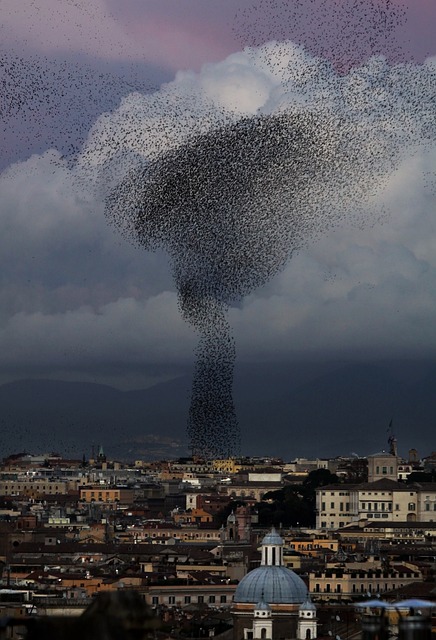
A murmuration of birds over a city, against a dark, cloudy sky.

In Rome, however, starlings were more than a curiosity or a passing note in a play. Starlings form very large, elaborate migrating flocks called murmurations. These are exceptionally striking formations of thousands of individual birds who seem to cover the sky in a flowing, undulating mass. Augurs, diviners who read the movement of birds, would watch these murmurations to receive messages from their gods. Some forms and flows were very good omens. Others, not so much.

In the Welsh Mabinogion, Branwen is sent to Ireland to marry King Matholwch . Her marriage is far from happy, however, so she tames a starling and teaches it to speak. She sends the starling back to Wales, where it alerts her brother Bran to come and save her.

Starlings can mimic far more than words. Mozart kept one as a pet, and it learned to repeat portions of his compositions. When it died, he was heartbroken. He performed a funeral that his biographer (and wife’s second husband) described thus:

When a bird died, he arranged a funeral procession, in which everyone who could sing had to join in, heavily veiled – made a sort of requiem, epitaph in verse.

Georg Nikolaus von Nissen 

Starlings also seem to imprint readily on people. Personally, I have made every attempt to avoid them, however their babies still don’t seem to have any issue strolling up to me with their mouths open, expectantly. It’s kind of like walking up to a grizzly bear and demanding spaghetti.

In general, the starling’s place in folklore seems to have been secured by their ability to bond with people, and their talent at mimicking speech and other sounds they encounter. Just watch this one, who not only imitates a human, but flawlessly mimics an Alexa unit immediately afterward:

It’s almost eerie!

Starlings are said to represent everything from freedom, to prosperity, to love. Given their folklore, they’re most strongly connected to communication and divination.

To divine using a flock of starlings (or even just one, though they always seem to show up in groups!) involves noting their number and behavior. It can sometimes be hard to count starlings, particularly since they can number in the thousands within a single murmuration.

If you observe them in flight, like the ancient Romans, pay attention to the shapes they form. What do they evoke for you?

Note the direction in which they’re flying. This means both the cardinal direction, and their relative direction. The east represents beginnings, renewal, spring, and the dawn. The south represents a climax, an apex, summer, and high noon. The west represents a decline, a release, autumn, and twilight. The north represents endings, death, winter, and midnight.

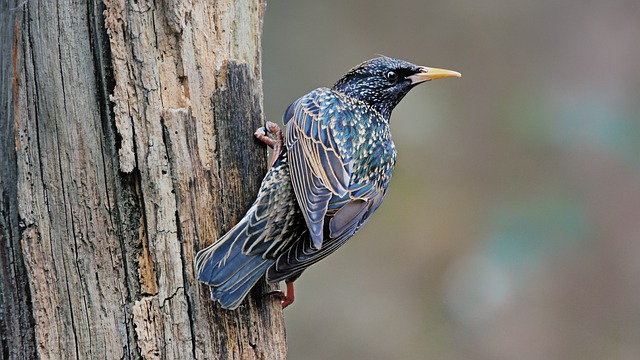
A starling clinging to the trunk of a tree.

In terms of relative directions, birds flying to the right generally indicates a positive or affirmative response. Birds flying to the left generally indicates a negative response.

As with any divination method, keep a journal of what you see and your interpretations. After some time has passed, revisit what you wrote and see how accurate it was. This can help you decode what the flight of birds means specifically to you.

Starlings are polarizing little guys. Some people absolutely love these noisy, funny little birds, while others hate them. I’ve come to be amused by their antics, though I’m also looking forward to when their fledglings are finally grown and it’s time for them to migrate!

animals · divination

The Magical Meaning and Symbolism of Starlings

Since there are still small, belligerent starlings all over the yard, I figured I’d make the best of a very noisy situation and write a bit on starling symbolism and magical significance. While I mostly know them as small weirdoes who periodically walk up to me and gape to be fed (which is almost admirable in its temerity, to be honest), they’re powerful, sacred animals in their own right.

Despite their ubiquity in my area, starlings aren’t native to the United States. The story is that they were brought here in the late 1800s in what is, perhaps, the silliest fashion imaginable. A German-American Shakespeare enthusiast named Eugene Schieffelin wanted the US to have all of the birds mentioned in Shakespeare’s plays, so he imported and released about sixty to eighty of them. (Invasive species who?) However entertaining this tale might be, it most likely isn’t actually true.

Shakespeare’s mention of starlings refers to their talent at mimicry:

Nay,

I’ll have a starling shall be taught to speak

Nothing but “Mortimer,” and give it him

To keep his anger still in motion.

spoken by Hotspur, in Act 1, Scene 3 of Henry IV
A murmuration of birds over a city, against a dark, cloudy sky.

In Rome, however, starlings were more than a curiosity or a passing note in a play, and starling symbolism was a important thing. Starlings form very large, elaborate migrating flocks called murmurations. These are exceptionally striking formations of thousands of individual birds who seem to cover the sky in a flowing, undulating mass. Augurs, diviners who read the movement of birds, would watch these murmurations to receive messages from their gods. Some forms and flows were very good omens. Others, not so much.

In the Welsh Mabinogion, Branwen is sent to Ireland to marry King Matholwch . Her marriage is far from happy, however, so she tames a starling and teaches it to speak. She sends the starling back to Wales, where it alerts her brother Bran to come and save her.

Starlings can mimic far more than words. Mozart kept one as a pet, and it learned to repeat portions of his compositions. When it died, he was heartbroken. He performed a funeral that his biographer (and wife’s second husband) described thus:

When a bird died, he arranged a funeral procession, in which everyone who could sing had to join in, heavily veiled – made a sort of requiem, epitaph in verse.

Georg Nikolaus von Nissen 

Starlings also seem to imprint readily on people. Personally, I have made every attempt to avoid them, however their babies still don’t seem to have any issue strolling up to me with their mouths open, expectantly. It’s kind of like walking up to a grizzly bear and demanding spaghetti.

In general, the starling’s place in folklore seems to have been secured by their ability to bond with people, and their talent at mimicking speech and other sounds they encounter. Just watch this one, who not only imitates a human, but flawlessly mimics an Alexa unit immediately afterward:

It’s almost eerie!

Starlings are said to represent everything from freedom, to prosperity, to love. Given their folklore, starling symbolism is most strongly connected to communication and divination.

To divine using a flock of starlings (or even just one, though they always seem to show up in groups!) involves noting their number and behavior. It can sometimes be hard to count starlings, particularly since they can number in the thousands within a single murmuration.

If you observe them in flight, like the ancient Romans, pay attention to the shapes they form. What do they evoke for you?

Note the direction in which they’re flying. This means both the cardinal direction, and their relative direction. The east represents beginnings, renewal, spring, and the dawn. The south represents a climax, an apex, summer, and high noon. The west represents a decline, a release, autumn, and twilight. The north represents endings, death, winter, and midnight.

A starling clinging to the trunk of a tree.

In terms of relative directions, birds flying to the right generally indicates a positive or affirmative response. Birds flying to the left generally indicates a negative response.

As with any divination method, keep a journal of what you see and your interpretations. After some time has passed, revisit what you wrote and see how accurate it was. This can help you decode what the flight of birds means specifically to you.

Starlings are polarizing little guys. Some people absolutely love these noisy, funny little birds, while others hate them. I’ve come to be amused by their antics, though I’m also looking forward to when their fledglings are finally grown and it’s time for them to migrate!