Plants and Herbs

Mugwort Folklore and Magical Properties

The other day, after attending the drum class I wrote about yesterday, I was waiting in the herb shop to stock up on some things I need for teas, oils, and the like. I overheard the customer in front of me talking about mugwort, and, since it’s an herb I use often, I maybe kind of eavesdropped a little bit. What followed was a really interesting conversation about herbs, dreams, lucid dreaming, dream recall, and trance work.

It was so nice to get to talk about herbs with someone outside of a purely medicinal context, that I figured that this was a good week to talk about one of my absolute favorite plants: mugwort.
(And, if you were that person, I’m so sorry for being an eavesdropping weirdo but I also had a really fun time talking to you about herbs.)

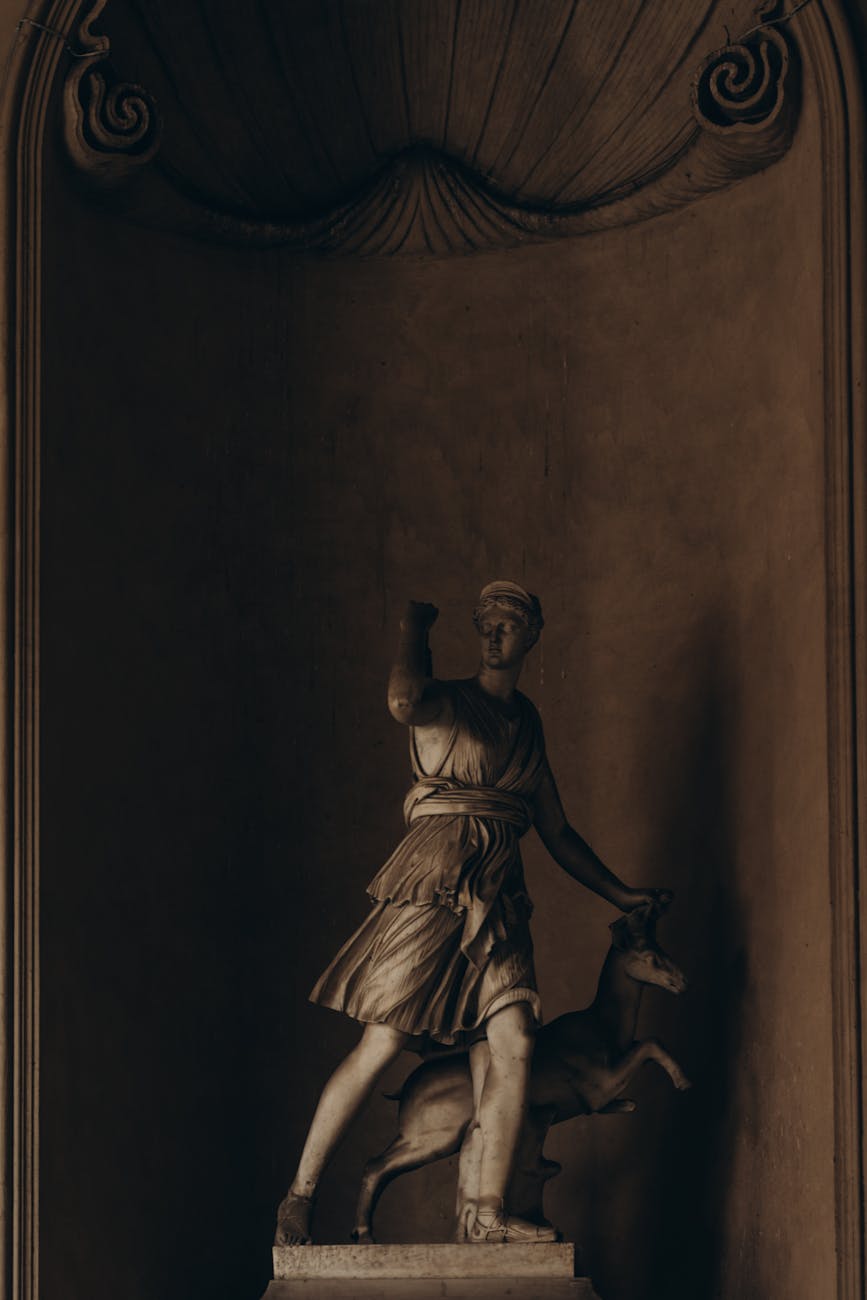
An old statue depicting Artemis alongside a stag.
Photo by V Marin on Pexels.com

Okay, I know the name “mugwort” leaves a bit to be desired in English — it’s not exactly the most phonetically pleasing word — but its scientific name is rather beautiful: Artemisia vulgaris. The “vulgaris” in this instance means “common,” like the “wort” in “mugwort” roughly translating to “plant.” Mugwort is a very interesting, very magical, and very common plant.
The “mug” in mugwort may come from its use as an insect-repelling herb. The Old English word “mygg” is where we get the modern word “midge.” Another possibility is from its use as a flavoring herb in brewing. The “Artemisia” in Artemisia vulgaris, naturally, comes from the lunar and woodland goddess Artemis.

Mugwort was an important herb to the ancient Greeks and Romans. Soldiers and travelers would place sprigs of it into their shoes, in order to ward off fatigue.

Mugwort is very commonly included in herbal blends for dreams, psychic abilities, divination, cleansing, protection, and banishing. Like so many other herbs that are used for cleansing and banishing, this may stem from mugwort’s use as a pest repellent — it can literally banish the evils of disease brought by insects, ergo it must be useful against other evils as well. (See also: Pennyroyal.)

In Christian mythology, mugwort is associated with John the Baptist. It’s said that he carried mugwort with him to ward off evil. As a result, people would wear garlands of the herb on St. John’s Day (June 24th) and toss them into fires to ensure protection for the next year.

In some shamanic practices, mugwort is a representation of ancient wisdom. This plant is often visualized as a kind of crone figure, and used to facilitate a connection to ancestors.

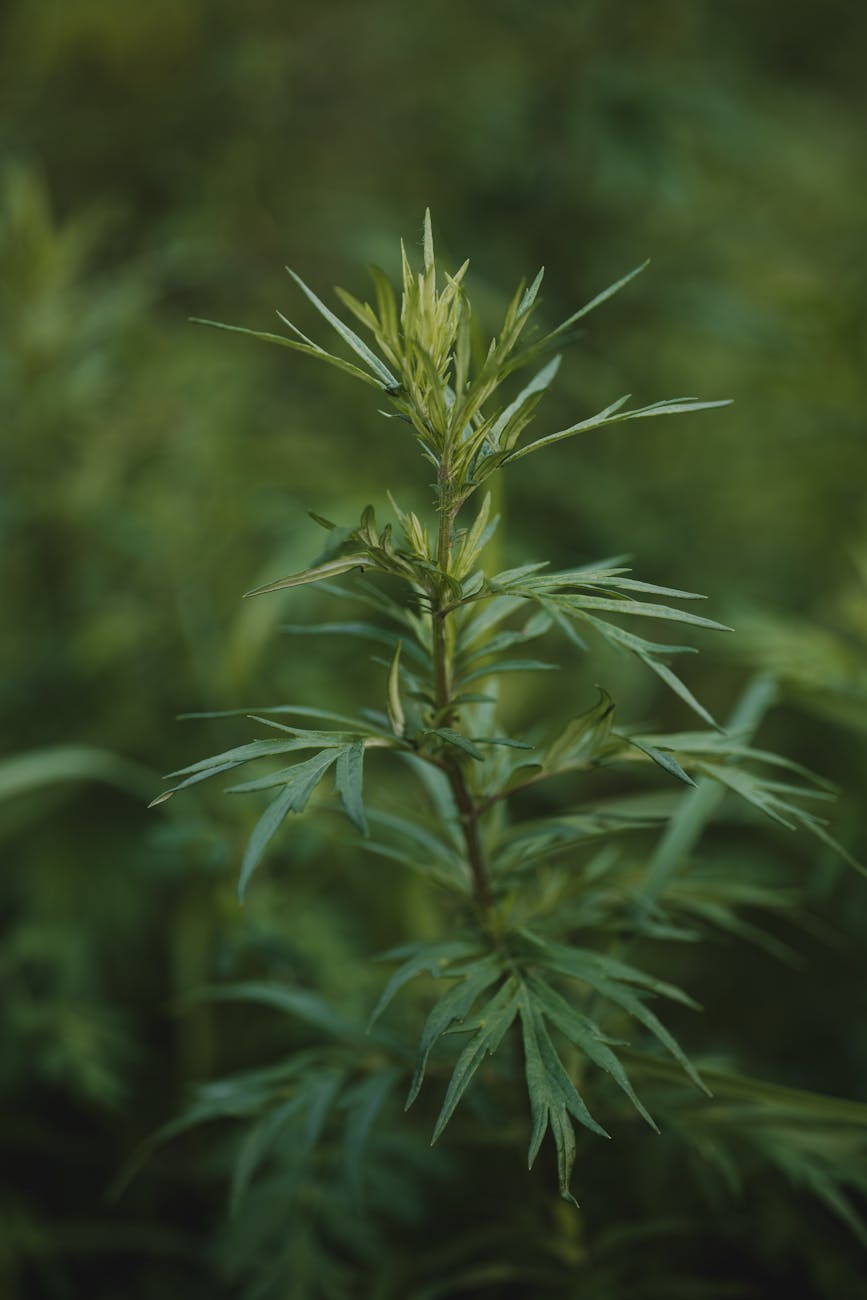
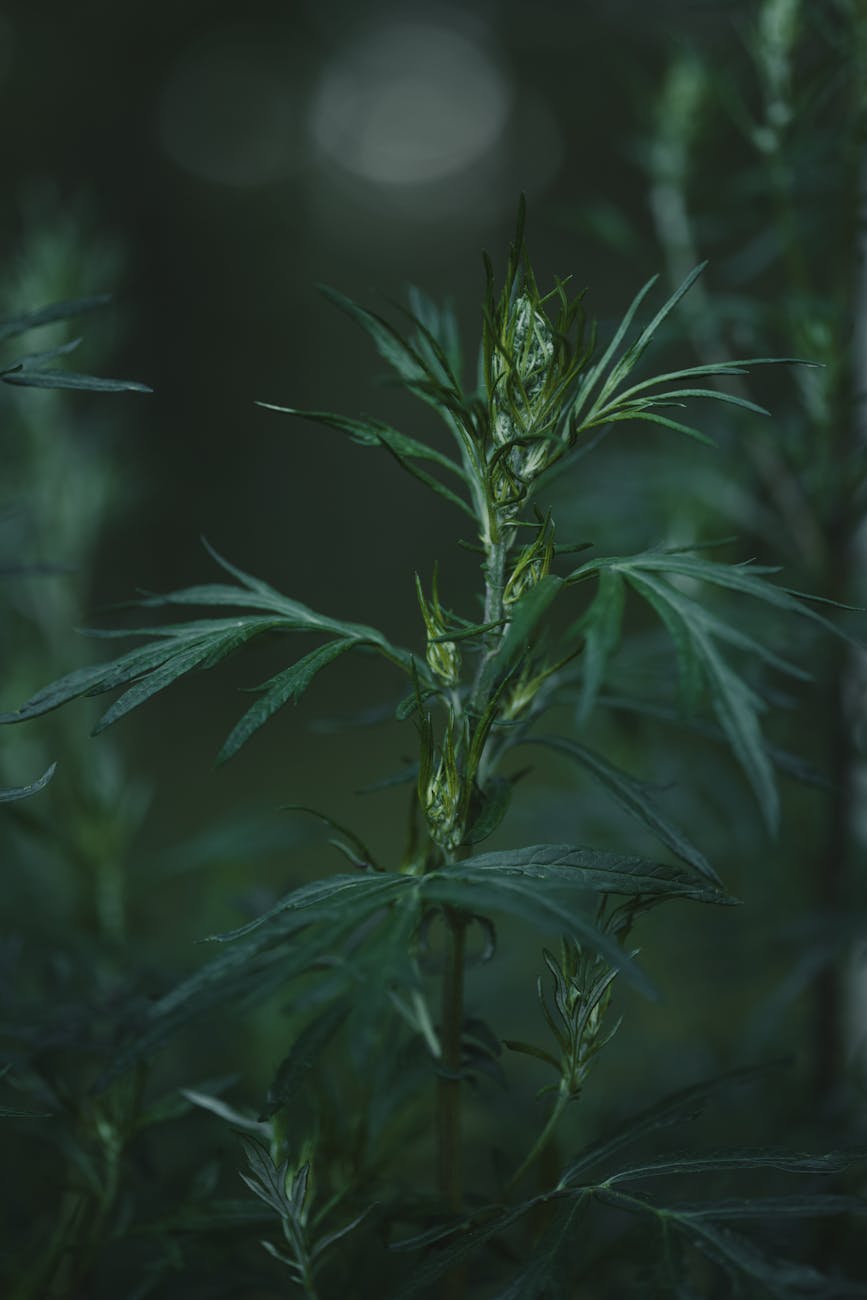
A close-up of a young sprig of mugwort.
Photo by Lauri Poldre on Pexels.com

Medicinally, mugwort was (and often still is) used to help ease difficult periods, treat menstrual irregularity, and as a mild pain reliever and anti-inflammatory. Mugwort is also used in the acupuncture practice of moxibustion, in which pieces of mugwort are placed at the end of acupuncture needles and burned.

Mugwort is also part of the Nine Herbs Charm according to one source, along with plantain, lamb’s cress, fumitory, chamomile, nettle, crab apple, chervil, and fennel. In this charm, mugwort is honored as the “oldest of plants,” strong against both poison and an unnamed force that travels the land. (This may be either a personification of evil, a venomous serpent, or a specific disease, but it’s referred to simply as “the loathsome thing.”)
The Nine Herbs Charm is a beautiful piece of poetry that combines Pagan and later Christian influences in a way that passes down important medical knowledge. The charm concludes with the recipe for a healing salve made by powdering the herbs, mixing them with old soap, mixing this with lye to make a paste, and combining it with boiled fennel. The charm is sung several times during the process — three times to each herb, then over the patient’s mouth, ears, and the wound being treated.
This is not only a magical consideration, but a practical one as well. It’s considered important to declare one’s intentions in adding an herb to a magical mixture, but the number of times the incantation is sung may correspond to how long it takes to powder and mix everything correctly. Singing it once while powdering an herb, for example, may yield a coarse consistency that doesn’t properly blend. Singing it three times, on the other hand, gives you the exact length of time needed to properly powder and mix the herbs. It’s like having a portable kitchen timer that not only tells you the recipe, it tells you what each ingredient is for and makes sure you do it right.

Mugwort was also used like hops before hops were a thing in brewing. Hops didn’t really achieve widespread use until the 15th century — before that, brewers used mugwort. It’s still used in food and teas for its unique flavor, which is like a bit astringent and savory, with a really interesting resinous character. Kind of like a mix between celery, mint, and eucalyptus.

While mugwort isn’t native to the US, it’s not exactly hard to find here, either. It does have a number of lookalikes, so you’ll want to get the help of a seasoned forager to make sure that you’re correctly IDing it. Start by looking for it in ditches, by roadsides, fields, and other places where the ground has been disturbed.
(Of course, if you’re foraging mugwort in order to consume it internally, avoid any that’s growing within ten feet of a roadside. In general, it’s better to avoid foraging near roadsides at all because the soil and plants there are contaminated by vehicular pollution. Leaving the plants in place ensures that you’re not consuming any of this pollution, and also allows them to remain and continue bioremediation.)

A large clump of mugwort, absolutely thriving next to a drainage ditch full of water.
Mugwort growing beside a drainage ditch in the Norton Marshes by Evelyn Simak is licensed under CC-BY-SA 2.0

Of course, as with many other plants, I advocate for growing mugwort if you want to develop a relationship with it. However, if you’re in the US or another area where mugwort is a problem, I recommend either growing it in containers, or trying a related native species. (Like Artemisia douglasiana, California mugwort, in the western US.)
If you’re looking for mugwort’s medicinal properties, stick with A. vulgaris or other Artemisia species specifically used in herbal medicine. Different species may not have the same active compounds in the same concentrations, and some may even have some not-very-desirable qualities as well.

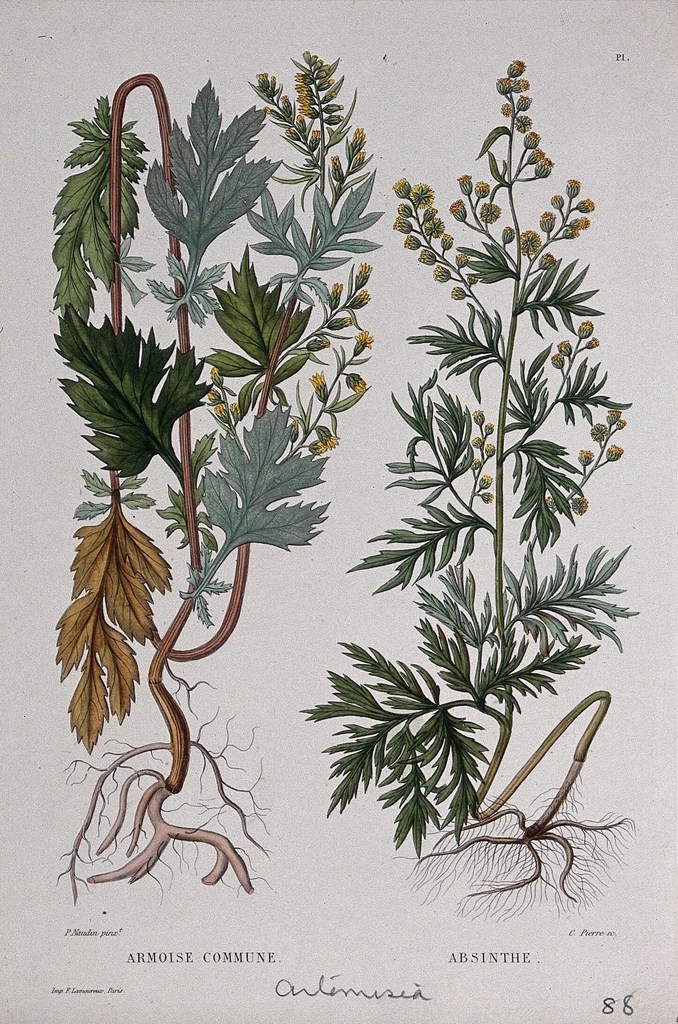
An old botanical illustration of a member of Artemisia.
The “Absinthe” on this illustration suggests wormword, Artemisia absinthum. However, the pointy leaves with green tops and silver undersides indicate mugwort.

Once you have some, using it is pretty easy:

  • Dry the leaves and add them to dream pillows along with herbs like lavender or chamomile. Squeeze the pillow and inhale the scent before dropping off to sleep.
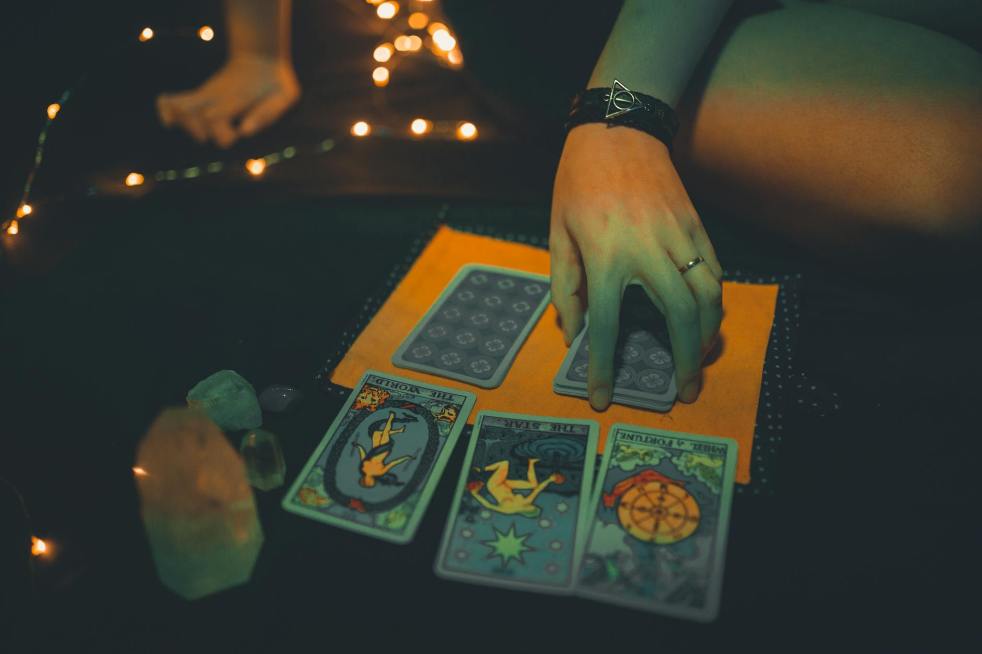
  • Add dried mugwort to incense and light it before card reading, scrying, or other forms of divination.
  • Powder it fine and combine it with protective herbs, then sprinkle them in the corners of your home or around the border of your property.
  • Rub fresh mugwort on a black candle and burn it to banish a person, entity, or situation.
  • Dry whole sprigs of mugwort, tie them into bundles either alone or with other cleansing herbs, and burn to purify spaces and prepare them for ritual work.

You can consume mugwort as a tea or flavoring agent in breads, soups, poultry dishes, or beverages. However, high consumption of this herb does come with some unpleasant side effects like muscle spasms. If you’re looking to tap into mugwort’s psychic, trance, or dream benefits, you should still avoid consuming more than you’d normally get in an herbal tea, and avoid doing so for more than two weeks at a time. More isn’t always better.

If you’re pregnant or seeking to become so, avoid consuming mugwort. One of its chief medicinal uses has been to treat menstrual irregularity by stimulating uterine contractions. So, unless a qualified herbal practitioner says to use it, it’s best to avoid mugwort in these situations.

The mugwort of European folklore may not be from the US, but its invasive and resilient nature means that its probably here to stay. If you want to enjoy the long magical, mythological, culinary, and medicinal history of this herb, I recommend growing it in a container or purchasing the pre-dried herb to add to teas, incenses, sachets, or other preparations.

life

Learning to Drum

Every Saturday, Smile Herb Shop hosts drumming lessons taught by musician Nana Frimpong. It’s something that I’ve wanted to go to ever since I first found out about it, but never had the opportunity — Smile is pretty far from where we live now, and Saturdays are often one of the few opportunities that we have to take care of things that need attention.
So, when we realized we wouldn’t be able to go camping like we originally hoped to, it seemed like a good time to finally sign up.

Initially, I felt self-conscious — my Handsome Assistant and I were the first to show up to the class, so it was only Nana and us for some time. Fortunately, Nana is a very welcoming, friendly, and engaging teacher. In between teaching drumming, he played songs for us while we did hand stretches, told us about his family and childhood in Ghana, and showed us how music had shaped his life to make him the person he is today. His message was radically inclusive, using drumming and music as a uniting force across all people and all cultures. Not only was the class really enjoyable, it was deeply moving.

Being there brought up a lot of memories for me, too. Being a little kid at Powwows, listening to the heartbeat drum and dancing with my friends. Being older, going to local burns, learning to fire spin and dancing around the burning wicker man to the sound of drums. Even this past Beltane, when I sat with a group of very welcoming strangers and drummed for the maypole dancers. Drums have been integral to so many unifying, joyful experiences in my life.
As it turns out, I really, really missed that.

Gradually, more people filtered into the class. They brought their own drums. One person very generously offered snacks. Another, equally generous, recorded the music we were making on his phone. I had never met any of these people, some didn’t even live in the same state as I do. But there’s something really unifying about playing together. Making the same motions at the same time. Hearing the voices of each different drum come together in one song.

Most of all, it’s fun.
“Fun” seems like a silly way to put it, but I don’t have a better word. It’s fun to make something beautiful with strangers, in a way that cuts to the bone through all the pretenses we dress ourselves in.
It’s fun in a way that makes those other things not matter.

Next weekend, Nana will be hosting an outdoor concert as part of his drumming classes at Smile to celebrate his birthday. Slots in his classes are very inexpensive on Eventbrite — only about $11. If you’re interested in drumming for fun, to increase your musical abilities, or for healing, I definitely recommend attending.

Neodruidry · Witchcraft

A happy and fruitful Lughnasadh!

My Handsome Assistant and I were originally intending to go on a camping trip with a local Druid group that we’re part of, but with him still recovering from his accident, we decided (at the last minute) that it might be better to focus on getting him to 100% before we try tent camping.

So, rather than having singing, dancing, feasting, and ritual in a group, we had a smaller, homey version: fresh baked breads, homebrewed peach mead, music, ritual, and a spirit feast.

An image of a feast, featuring charcuterie, fresh fruit, big strawberries, sliced carrots and cucumbers, and lots of other delicious, seasonal food.
Photo by cottonbro studio on Pexels.com

What’s a spirit feast? Exactly what it sounds like — a feast conducted for deities, ancestors, spirits of the land, guardian and guiding spirits, and any spirits to whom we may owe a debt (for example, spirits of the land affronted by new construction, tree felling, and so forth).

Unlike the “dumb suppers” of Samhain, this is not just for ancestors and the beloved dead, and it’s more like a party. Offerings are carefully chosen and high quality. Incense. Flowers. Candles. Fresh bread. Wine. Fruit. Good food, well prepared. Is it a traditional part of Lughnasadh celebrations? Not really. But Lughnasadh is a time to offer the “first fruits,” and so, in the absence of being able to party with friends, it seemed an appropriate way to offer the first fruits.
It felt right. It was equal parts fun and moving. I’ll probably make it part of my celebrations from now on.
Lughnasadh, after all, may have its origins as a funerary feast for the mother of Lugh, Tailtiu. She died of exhaustion after preparing the land for agriculture, and represents the Earth that feeds us and the plants that are harvested and die back in the high summer heat. It seemed a good idea to pay back this sacrifice and invite the spirits of the land to a feast.

This year, the fruits of our garden are particularly abundant. The Virginia roses (Rosa virginiana) are all but bowed over with fruit. The passionflower (Passiflora incarnata) vines are thick and lush and heavy with their strange purple flowers and egg-like fruit. The pumpkins are pumpkining. The beautyberry (Callicarpa americana) is both beautiful and extremely berried.

It’s very good. I hope things are very good with you, too.

Plants and Herbs · Uncategorized

Vine Folklore and Magical Uses

Hello!

Close up of a purple passionflower.
Photo by kiwiicat on Pexels.com

My passionflower is loving this weather, though the rest of the plants here seem less than enthused about the whole thing. It’s not only encompassed half the porch, it’s climbed nearly up to the roof and sent out several tendrils along the lawn. If it didn’t also put out beautiful flowers and a ton of fruit, and act as a cozy little haven for sleepy bees, I’d be tempted to cut a bunch of it down.

That got me thinking — if I did, what would I do with that much passionflower? I can only tincture so much of it. Could I weave it into baskets? Turn it into rope?

Vines, in general, have a long history as religious symbols, the subject of legend and folklore, and magical ingredients. If you, too, are experiencing a sudden flush of viny plants that you don’t know what to do with, folklore may have some ideas for you.

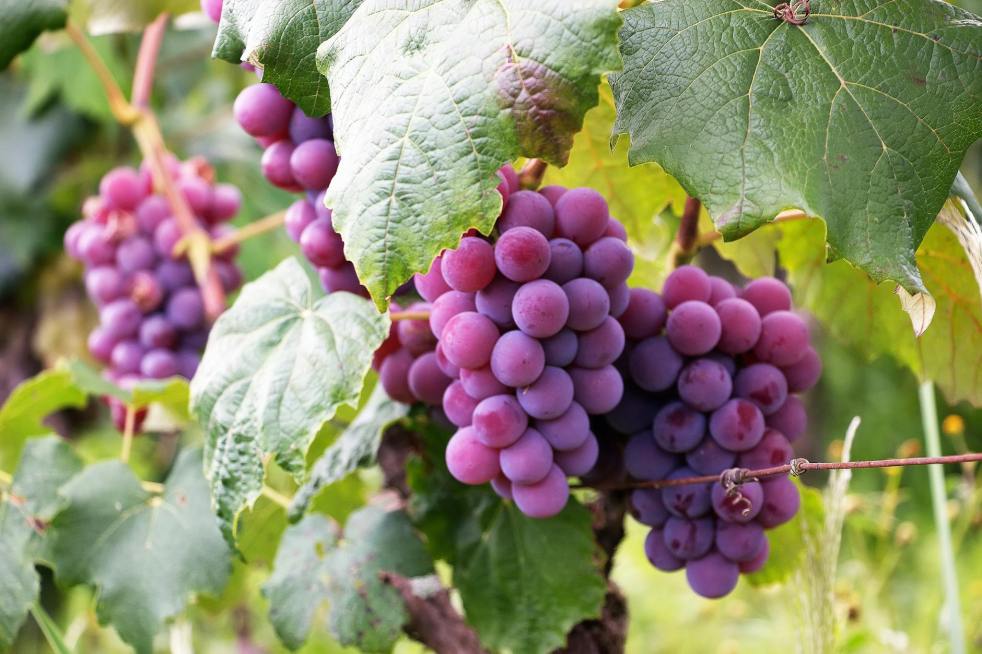
In the Ogham writing and divination system, the letter muin (ᚋ) is commonly interpreted as “vine,” and usually portrayed as either grape or ivy. However, grapes are not native to Ireland and, even when they were introduced, they never really took root there (pun intended — Ireland is not a great place to try to grow grape vines). The word “muin” also doesn’t have anything to do with vines. Instead, it refers to a thorny thicket. This has made muin one of the most controversial and seldom-agreed-upon parts of the Ogham.

The ancient Greek deity of wine, orchards, frenzy, fertility, and religious ecstasy, Dionysus, is also intimately connected to vines. (And I do mean intimately.) Not only are grape vines his domain, he is also regularly portrayed as wreathed in ivy vines. Here, the evergreen nature of ivy represents the gods’ immortality. It’s also connected to fertility and sex.

Dionysus isn’t the only one to wear an ivy crown, either. Thalia, Muse of Comedy, is also portrayed as wearing one.

In Egyptian legend, Osiris is associated with the ivy, again, because of the plant’s connection to immortality and rebirth.

There’s a Persian (now modern day Iranian) legend that tells of the origin of wine. Long, long ago, a bird dropped some seeds by a King’s feet. Intrigued, the King had the seeds planted and cared for. The seeds became sprouts, the sprouts became vines, and the vines grew heavy with grapes. Overjoyed, he had the delicious grapes picked and stored in his royal vaults.

However, grapes don’t stay fresh forever. The vault was too damp for them to dry into raisins, and too warm to chill them. Instead, the grapes began producing a dark liquid which everyone assumed was likely a deadly poison. Before the old grapes could be cleaned up and thrown away, one of the King’s wives attempted to end her life by drinking some of the grape “poison.” When the King found her later, she was far from deceased — in fact, she was dancing, singing happily, and apparently thoroughly enjoying being the first person in recorded history to ever get absolutely rocked off her tits on wine. With this evidence that the liquid was not poison and, in fact, seemed to make people quite happy, the King named it “Darou ē Shah” — The King’s Remedy.

No word on what happened to his wife, however. Therapy being in short supply thousands of years ago, one can assume she either eventually found some actual poison or developed an absolutely staggering drinking habit.

English ivy climbing a white wall.
Photo by Madison Inouye on Pexels.com

Ivy is about more than ecstasy, wine, sex, and living forever, though. One look at the growing behavior of many vines can show you exactly what else they’re good at: binding things. Even the beautiful, gentle passionflower vines climbing my front porch do so due to grasping tendrils of surprising strength and tenacity. Some vines, English ivy in particular, also get a reputation here for damaging property and killing native trees.
Depending on the context, vines are then equally as restrictive as they are freeing. Sometimes, vines are heavy with grapes and the promise of wine, intoxication, inspiration, sexual desire, and ecstasy. Sometimes, they’re ivy vines, evergreen and symbolizing enduring life and lush greenery during the winter months. Other times, they are the vines that grow around things, binding and restricting them like ropes.

Ivy is also associated with protection and healing. This may be due to its connections to immortality and rebirth. Grapes, on the other hand, are associated with fertility, money, and all things connected to the concept of abundance. Briony, on the other hand, is both money and protection. Placing money near a briony vine is said to cause it to increase.

In the tale of Sleeping Beauty, vines (sometimes) play a key role. In the Disney version, Aurora is cursed, pricks her finger, falls asleep, yadda yadda yadda, vines grow and cover everything. In an older telling, it was a dense hedge of climbing roses. One yet older version of the story (Sole, Luna, e Talia) also has Sleeping Beauty-
You know, I’ll just let Giambattista Basile tell it.

“crying aloud, he beheld her charms and felt his blood course hotly through his veins. He lifted her in his arms, and carried her to a bed, where he gathered the first fruits of love.”

Yeah. When that fails to wake her, he pulls his pants up and rides off to his castle and his already existing wife, the Queen. Sleeping Beauty only awakens again when one of the twins she subsequently births tries to nurse and accidentally sucks the splinter from her finger.
(As if that weren’t enough, the Queen gets fed up with the King’s infidelity and tries to have the children cooked and fed to her husband.)
Interestingly, vines aren’t prominent in the assault version of Sleeping Beauty — they become more important the further you get from that version, and the closer you get to Disney’s much more sanitized telling. It’s as if the presence of the vines in the story both bind Sleeping Beauty in her castle and protect her from the King.
No vines? Not even a climbing rose? You’re in for a bad time.

Vines make beautiful decorations for the home and altar. Evergreen ivy is commonly brought indoors during the winter months as a decoration, tied with swathes of ribbon, hung with bells or other ornaments, you name it.

Vines can also be used to bind things. Hollywood has portrayed magical bindings in some… interesting ways. For example, “binding” a witch à la The Craft.
This, however, is silly.

Bindings can go one of two ways: a person, thing, or situation may be bound (in the sense of binding someone with rope) to keep them/it from causing harm or otherwise interfering with you. You can also bind something to yourself. For example, a really great job that you just got, happen to enjoy, and want to make sure that you keep.

In this case, the binding is a form of sympathetic magic. You take a representation of the thing you wish to bind, and effectively tie it up with what you have on hand. (This may be vines, if you want to enlist the vine’s help and magical associations, but can also just be household twine in a pinch.) There are plenty of chants and incantations you can recite while doing so, but I find that it’s most effective if you speak from the heart — inform the subject why they are being bound, and what you hope will come of it. Put it in a jar or box, close it tightly, and keep it somewhere safe so you can undo the binding when the time comes.

To bind something to yourself, you’d use a representation of yourself (like a photo or lock of hair) and a representation of what you wish to bind to you. Wrap both objects together with the vines or string, again speaking from the heart while you do so. Place the objects in a jar or box and keep them somewhere safe.

Bindings aren’t the only type of sympathetic magic that vines are good at, though. Plant a vine (preferably not an invasive species — there are loads of native vines) along with a representation of something you wish to grow. Ask for the vine’s help, and declare that, as the vine grows, so shall grow the thing you desire. Take good care of that vine, and keep an eye on its growth.

While every species of plant has its own magical uses and depictions in legend and folklore, vines are in a class of their own. Each one has their own unique properties, but vining plants also have plenty of common ground.

life · Witchcraft

Visiting Sticks & Stones Circle

There’s a delightful metaphysical shop called Sticks & Stones Circle in Fairfax, Virginia, that my Handsome Assistant and I visit occasionally. They moved locations about a year ago, so we figured we were due for another trip. Neither of us have been out of the house much lately — him, because he’s still recovering, and I, because I’ve been busy with various tiny projects. A gentle walk around a metaphysical shop, however? Yes, please.

They used to be located in the same building, but around the back by the larger parking lot. Now, they’re out in front, by a Sherwin Williams. They don’t have a sign yet, but their distinctive front window display makes them pretty unmistakable.

A photo of a store's front window, featuring flowers, crystals, a large drum, and stained glass.
Photo by the owner of Sticks & Stones Circle.

We weren’t here for anything in particular — in fact, I’ve been on a mission to destash and declutter things. If I haven’t worn it, used it, or at least remembered it fondly for a year, out it goes.

So, this was pretty much a trip to restock some herbs and incenses that are challenging to find in our regular herb shop (Smile Herb Shop, which stocks a wonderful variety of medicinal and culinary herbs).

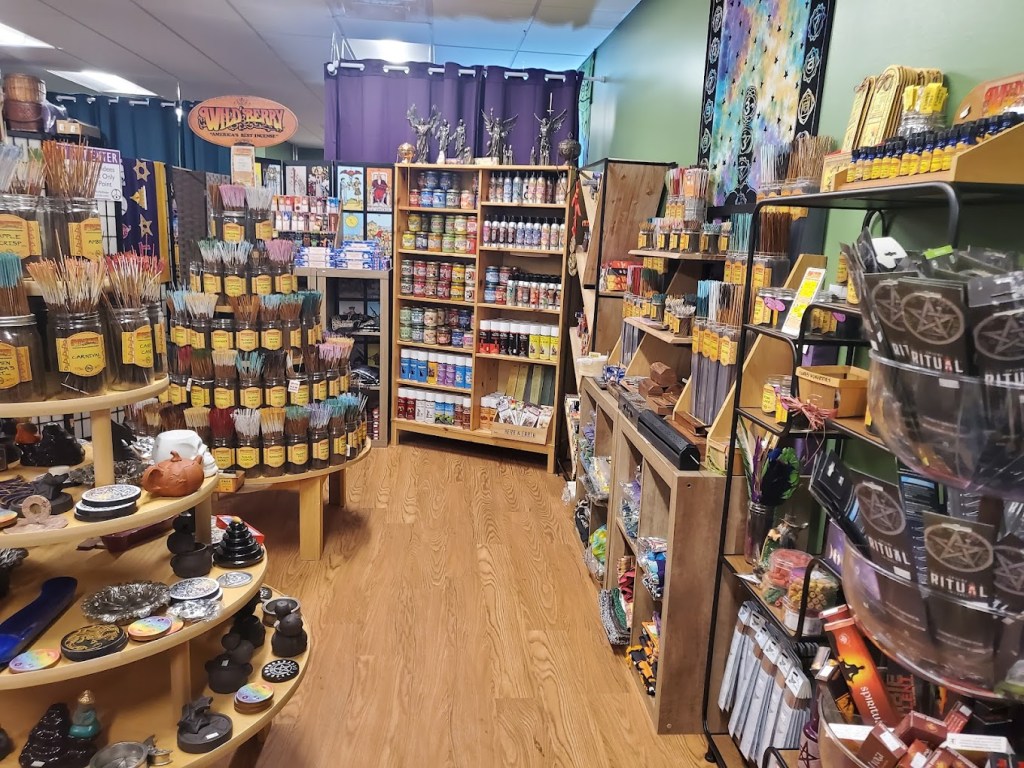
If you are on the lookout for other supplies, however, they have them in abundance — candles, sprays, oils, statuary, books, crystals, jewelry, pouches, pendulums, and altar cloths galore.

A photo of store displays, showing incense, statues, sprays, and candles.
Photo by the owner of Sticks & Stones Circle.

We left with two packs of incense (Soul Sticks Celtic Summer and Wild Wood, a very inexpensive but decent-quality natural incense), some copal resin, a small tiger’s eye owl, and a piece of golden healer quartz.
I’m a bit of a sucker for golden healers, but more on that another time.

After that, we stopped at a place called Midnight Treats. Neither of us were familiar with it but were delighted to find out that it’s a vegan bakery with the most massive (seriously, they’re 1/3 of a pound and feed two people each) cookies we’d ever seen. They have all kinds of flavors, so we picked up a small assortment: Oreo cake, cinnamon roll, birthday cake, and chocolate brownie. They didn’t disappoint either — they were warm, chewy, delicious, and have satisfied my cookie cravings for a good long while.

They also have new flavors every week. This week, they’ve added iced red velvet and blueberry lemon (and I’d be lying if I said I wasn’t tempted to order some).

All in all, it was a nice little shopping date. In the face of so many metaphysical shops closing, it’s nice to see one that seems to be thriving. If you’re ever up in that area, give Sticks & Stones Circle a visit. Like many other shops of this nature, they’re more than a store — they’re also a hub of classes, celebrations, and other Pagan and witchy activities.

animals · Neodruidry · Witchcraft

The Magical Meaning of Feathers

Right about now, several species of birds have turned the area around my house into a kind of avian daycare. Again.

There are birds of every distinction turning up, kids in tow. Most of these kids look almost exactly like the adults — the starlings, for example, are fully the size of their parents and the only difference is that some still have their brown feathers. The baby crows look just like their parents, save for being a little smaller and still having pink corners on their beaks.

Since these babies are rapidly transitioning from their juvenile plumage to their full adult feathers, that means that they’re molting. You can find feathers everywhere — mostly fluffy white down, but the occasional primary feather, too. That’s why I thought that it might be a good idea to write a bit about the magical meaning of feathers.

A barred feather caught on a leaf of a tree.
Photo by Eftodii Aurelia on Pexels.com

Before I do, though, there’s one important caveat: All parts of native birds, including shed feathers, are protected by the Migratory Bird Treaty Act of 1918. This is to protect them from poaching by ensuring that there isn’t a legal market for their feathers, bones, etc. If you see a shed feather outside and you aren’t sure if it’s from a native species, invasive species, or domesticated species, leave it right where it is.

Feather pillows can also be a source of ominous omens. In Appalachia, death crowns or angel crowns are complex, crownlike whorls of feathers found in the pillows of the deceased. Usually, they’re only found after the person has died — it’s unlikely that anyone would go probing their pillow for death crowns otherwise. However, it is said that, if you find and break up a death crown in someone’s pillow, you can prevent their death.

In Celtic legend, feathers are commonly associated with the Otherworld. Some fairies are said to wear cloaks trimmed with red feathers, and The Morrigan wears a cloak of black ones.

The Morrigan isn’t the only goddess to have a feather cloak. Freyja, the Norse Goddess of love, war, sex, and magic, is said to have a cloak of gray falcon feathers (fjaðrhamr). This cloak grants her the ability to shape-shift into a falcon at will.

In Egyptian legend, Ma’at is associated with the Feather of Truth. She is the personification of truth, justice, and balance, and this feather is a representation of her. When a person dies, their heart is placed on a scale and weighed against this feather. The hearts of virtuous people are lighter than this feather, and they are allowed to pass on to Aaru, the Field of Reeds. The hearts of the wicked are heavy, and they are devoured by the goddess Ammit.

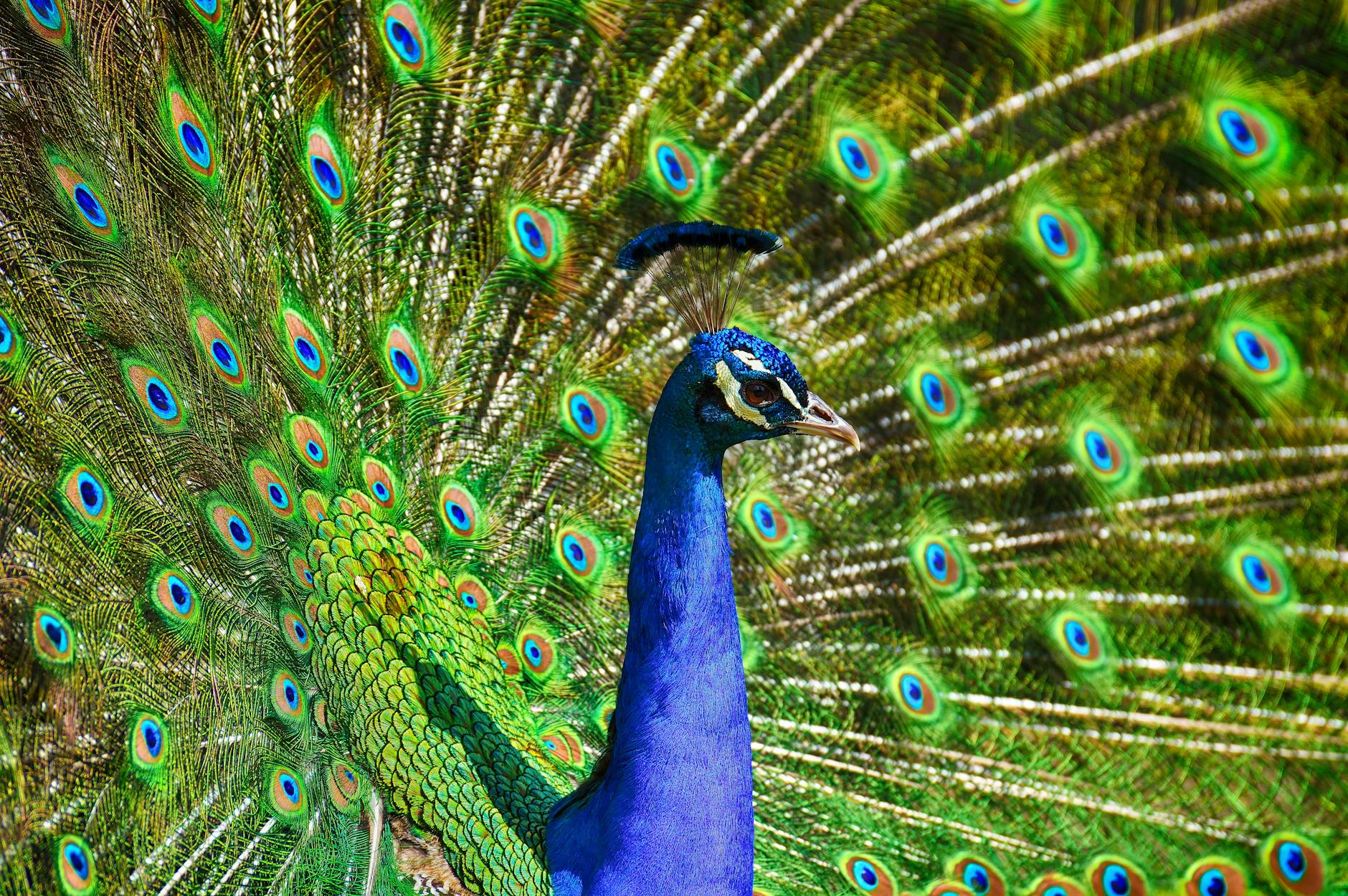
In Greek legend, Hera, the Goddess of marriage, family, and women, took the peacock as her sacred animal. She’s also the one responsible for the male peafowl’s beautiful, unusual plumage.
When Zeus seduced Io, he knew his wife would be jealous. He either turned Io into a white cow (another one of Hera’s sacred animals) to protect her from his wife, or Hera transformed her herself. Either way, Hera set the many-eyed giant, Argus Panoptes, to watch over her new prized cow. Having many eyes, he only needed to close a few at a time in order to sleep. This made him the perfect watchman… until Hermes came along.
Zeus asked Hermes to free Io. Hermes, in turn, disguised himself as a shepherd and used charms to put all of Argus’ many eyes to sleep at once, then killed him. Having lost her watchman, Hera immortalized him by placing his many eyes on the tailfeathers of the peacock.

A male peacock, tailfeathers spread to show their distinctive eye-spots.
Photo by Alexas Fotos on Pexels.com

In North America, Indigenous people have also attached significance to feathers for ages. Eagle feathers, in particular. (I remember being at a Powwow where another dancer I knew had dropped an eagle feather. It was retrieved from the ground with ceremony, treated as a fallen warrior. It was a very emotional experience, especially for her.)
Indigenous textile artists have also woven feathers into warm blankets and beautiful garments (sometimes called match-coats).

In modern witchcraft, feathers are commonly used as representations of the East or element of Air.

In addition to representing the East, Air, multiple deities, and various concepts of the Otherworld, feathers are also considered an “angel sign.” These “angel signs” are a collection of circumstances that are said to indicate that one’s guardian angels, spirit guides, or ancestor spirits are nearby. They include finding white feathers or shiny coins, hearing mysterious music, or smelling sweet, unexplainable smells.
It’s important to be careful with angel signs, however, since so many of them have mundane explanations. It’s very easy to get caught up in looking for signs, start interpreting everything as some kind of “angel sign,” and end up in spiritual psychosis, where the desire for significance blurs the line between reality and delusion.
Sometimes, an angel number is an angel number. Sometimes, it means you spend too much time looking at the clock. Similarly, sometimes, finding a feather is an “angel sign.” Sometimes, it means your neighborhood has stray cats.

Feathers are also subject to color symbolism. Finding a feather of a specific color is said to have a specific meaning. For example:

  • White feathers are positive omens, or indicate the presence of benevolent beings.
  • Black feathers symbolize protection.
  • Red feathers can represent protection, passion, or good fortune.
  • Blue feathers represent peace.
  • Green feathers symbolize abundance or fertility.
  • Yellow feathers represent joy.
  • Orange feathers symbolize creativity.
  • Ground feathers are omens of stability and groundedness.
  • Gray feathers, like blue ones, represent peace.

Of course, all of this is highly contextual. If you’re at a duck pond, the presence of white or gray feathers is unremarkable and not likely to represent anything but the presence of ducks.
On the other hand, finding a bright green feather in your yard, when you don’t have an abundance of green birds in your area, may be a bit more significant.

Feathers represent all kinds of things, but their primary association is with the fine line between this world and the others. They are tools of shapeshifters and symbols of creatures capable of traveling between worlds. If you find a feather outside, appreciate it for its beauty, see if you can identify what species it came from, and leave it be to return to the soil. If you work with feathers in your practice, source them from pets or well-treated backyard fowl.

animals

The Return of Boink!

Remember Boink? The weird little scrunglemuppet who spent an entire summer living on top of my shed?

He’s back. At least, I’m pretty certain sure it’s him, though he appears able to fly now. This crow has a distinctive appearance and a set of behaviors I had previously only observed in Boink, so I am somewhat confident in my assertion that The Shed-Dwelling Scrunglemuppet Has Returned.

Last year, he spent evenings roosting in the big apple tree, and mornings and afternoons sitting on top of the shed. When I went outside, he’d run to the far side to “hide.” If he heard the back door close, his little head would pop up over the shed’s roofline to see if I was still there. If not, he’d hop his way over to the feeders to grab some food before the other crows came.

Now, he appears with the rest of the family. He still appears to be pushed away from the food and scolded, and he still does the same goofy little run, but he’s at least better able to get away from predators. I don’t think there are many animals who would go out of their way to eat a Boink, but there are certainly creatures who would take the opportunity to hunt a land-locked crow.

Two crows at perched on a deck railing near a feeder. One is larger and sleeker. The other is smaller and distinctly scrungy.

Boink still has to be a bit opportunistic when he eats. He’s still scrungy. His tail is still kind of karked up, and I don’t think he’s capable of not looking bedraggled, but his flight feathers are back and that’s what’s important.

Good job, scrunglemuppet.

Plants and Herbs

Angelica Root Folklore and Magical Uses

Recently, my Handsome Assistant experienced a minor vehicular mishap. He was on a motorcycle, so things could’ve been a lot worse, but his injuries weren’t too serious and he’s recovering well.

When he first got his bike, I made him a safe travel charm that he’s kept with him everywhere he rides. He’s dodged the “serious motorcycle accident” bullet, and it could use a refresh. This got me thinking about protective charms in general, which, naturally, led me to what’s probably one of the strongest of them all: angelica root.

Seriously. It’s probably a little too good at what it does, but more on that below.

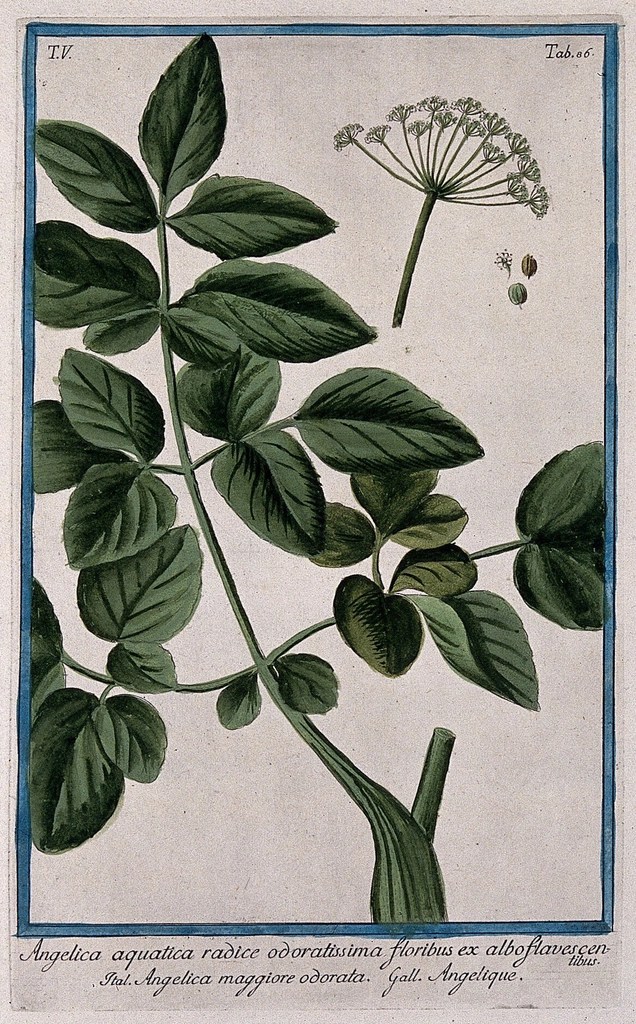
An old botanical illustration of angelica. The caption at the bottom reads, "Angelica aquatica radice odoratissima floribus ex alboflavescentibus. Ital. Angelica maggiore odorata. Gall. Angelique."

Also known as wild celery, masterwort, and archangel, angelica (Angelica archangelica) and celery are related as members of the family Apiaceae. Angelica archangelica is native to far northern Europe and Russia. Another species known as angelica, masterwort, or purple-stemmed angelica (Angelica atropurpurea) is native to wet areas in the eastern US.

The name angelica derives from the plant’s blooming period. Its flowers typically appear around Michaelmas, the feast of the Christian Archangel Michael.

In both Western European folklore and the Hoodoo tradition, angelica is associated with protection, particularly from evil spirits. It’s also occasionally used to break hexes, jinxes, or curses, depending on their nature.

Purple-stemmed angelica (A. atropurpurea) has a long history of use as both a sacred and medicinal plant by Indigenous people of the southeastern US. It could calm anxiety, ease back pains, soothe stomach trouble, and treat parasites in children. It’s also used in healing ceremonies and as a purification herb. This puts purple-stemmed angelica in the same group as many other purification herbs the world over — namely, herbs that both drive off evil or unwanted energy, and get rid of physical parasites or pests.

Angelica is also sometimes associated with luck, love, and psychic abilities. This may be because it’s so good at keeping unwanted interference at bay — combined with other herbs more directly suited to these purposes, it can keep one’s magical path clear.

On the other hand, angelica also has a reputation for being a bit too good at what it does. According to the (no longer extant) Pooka Pages’ “Concerning the Magical Properties of Herbs & Oils,” angelica may also keep away some things that you do want. If you’re attempting to use it to help you attract something into your life, it’s a good idea to keep this in mind — sometimes, those things aren’t without risk, so angelica may not be the best choice.

An angelica relative, A. sinensis, is also known as lady ginseng or dong quai. It grows in cool, mountainous areas of east Asia, and has a long history of use in Chinese medicine.

Honestly, there are few protective charms more convenient than a whole angelica root. They’re sort of lumpy and oblong, but firm, compact, and easy to stash in a pocket, bag, sachet, or any other container. I’ve never had one that was crumbly or messy, either.

Hold it in your dominant hand, tell it what you’d like it to do, project this thought, request, or energy into the root, thank it for its help, and you’re good to go. You can also anoint it with an oil, if you’d like.

You can hang a whole angelica root over your front and back doors to keep unwanted forces out or bury a root at each corner of your property.

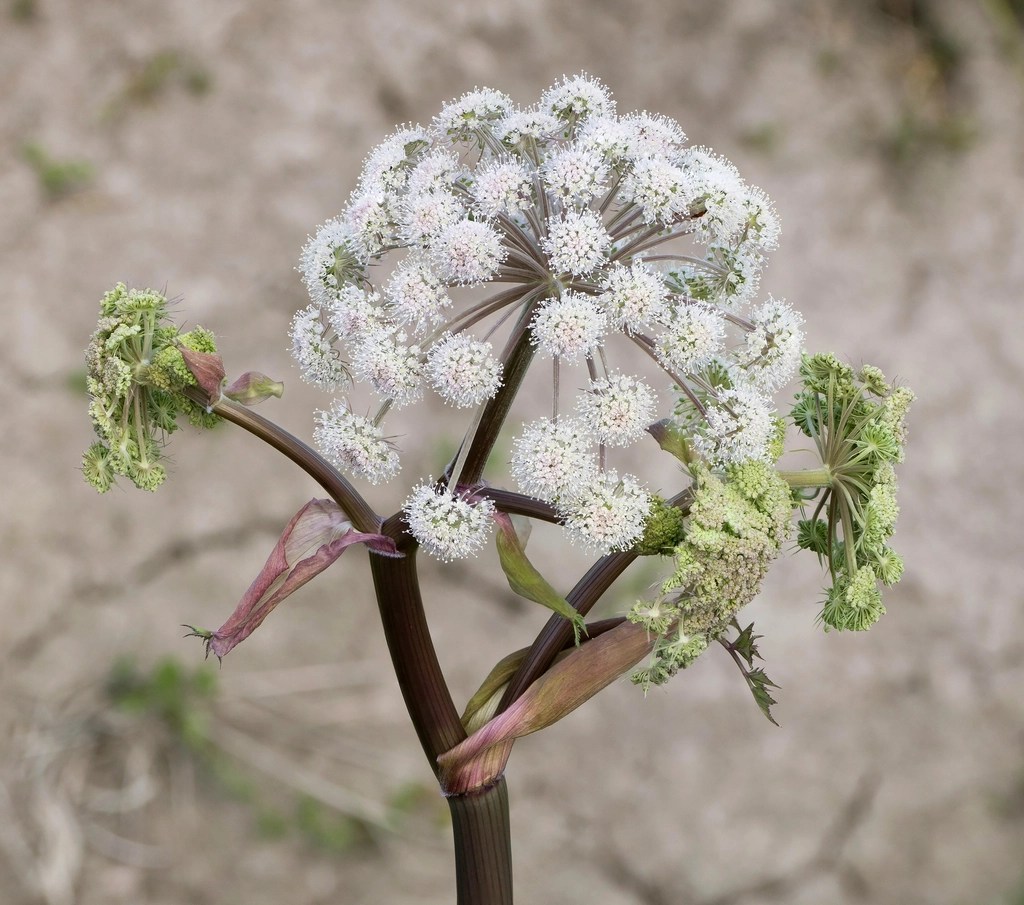
A budding wild angelica plant (Angelica sylvestris).

Soak an angelica root in water, then add the water to a floor or door wash, sprinkle it in corners of a room, or pour it along the borders of your property to ward off evil and strengthen magical boundaries.

Angelica roots also make lovely additions to protective oils themselves. Put it in a neutral carrier oil and let it infuse in a cool, dark, dry area, shaking it regularly. If you want a stronger fragrance, add essential oils just before you bottle the finished product. For this, you might want angelica root pieces rather than the whole root — it’ll have an easier time transferring its fragrance to the oil if it has more surface area.

Since the roots are fragrant themselves, and hold other fragrances well, they’re great additions to potpourri or other scented herb mixtures.

You can also eat A. archangelica stems and roots. However, you may not be able to find them in your local grocery store, and they can be challenging to identify in the wild. They have several poisonous lookalikes, so you should never consume anything that you’ve only tentatively identified as angelica. Unless you’re an expert forager yourself, get an expert forager’s opinion first. As the saying goes, you should be as confident identifying a wild edible as you would be identifying it in a grocery store. Otherwise, don’t eat it.

Angelica may not be the most versatile magical plant, but it’s one worth knowing. It’s one of the best at what it does, sometimes to the point of being too effective. It’s one of those herbs that I find it’s better to have on hand and not need, than to need and not have on hand. Whole roots aren’t too expensive, and you can use them to steep in water for magical baths, washes, or asperging, infuse them in oil, or use them whole as protective talismans.

Neodruidry · Plants and Herbs · Witchcraft

Mushroom Folklore and Magical Uses

I like mushrooms. Not so much culinarily, but aesthetically and conceptually.

There are thousands of identified mushroom species, but experts estimate that the number of actual species out there is anywhere from two to three times what we’ve managed to identify. Others say it could be in the millions.

Mushrooms have a long history of use in spiritual and magical practices around the world. Giving the folklore and uses of every known species is outside of the scope of this post, but I thought it’d be interesting to give an overview of some of the most unique, recognizable, and significant kinds.

People typically consider mushrooms and toadstools two different things, but there isn’t really a hard line between them since these are folk names. According to various sources, mushrooms are edible, and toadstools are inedible. Or else mushrooms are edible and umbrella-shaped, while toadstools are inedible and have round caps. Or toadstools are inedible and large-capped, etc.
This can be particularly confusing because there are several species of variable edibility — some are considered edible only when cooked. Some need to be leached with water to be edible. Some are only poisonous if consumed with alcohol. Some aren’t considered edible, but aren’t really poisonous either.

Amanita muscaria, the iconic red- (or tan- or yellow-) capped, white-spotted mushroom, is also called “fly agaric.” This is because it was sprinkled in milk and used as a poisonous bait for flies and gnats.

A small Amanita muscaria growing in some leaf litter.
Photo by Guy Dwelly on Pexels.com

Sami shamans traditionally have a unique way of processing A. muscaria. The mushrooms are fed to reindeer, and the psychoactive components are passed in their urine. Instead of the potentially dangerous mushrooms, the shamans use the urine to access fly agaric’s powerful qualities.

While it’s natural to associate psychoactive fungi with the spirit world, they aren’t the only mushrooms said to serve as a gateway. The famous fairy rings of Western European stories are circles or arcs of fungi (with or without visible mushrooms) that, were you to enter one, could bring you either good luck or incredible danger.

In Egypt, mushrooms were associated with immortality. In Japan and China, they have similar connotations due to their use as medicinal foods for increasing strength and longevity.

In Slavic mythology, the guardian deity of forests, Leshy, can appear as a fully vegetation-based entity. He may appear as anything from a sacred tree to a mushroom. Mushrooms are also associated with the earth, water, cattle, and underworld deity, Veles.

In Lithuania, mushrooms were said to be the fingers of Velnias, a deity of the dead. He would reach up from the underworld, beneath the soil, to feed the poor.

This isn’t the only association of mushrooms with charity, either. In one Christian myth, God and Saint Peter walk in a rye field. Peter takes a handful of rye and begins to eat it, but God scolds him for taking food that isn’t meant for him. Peter spits the chewed rye out, and God says that a mushroom will grow there as food for the poor.

Interestingly, the dead and the underworld seem to have the strongest connection to mushrooms around the world. The Sidhe of the Celts and the Alfar of the Germanic people were both associated with burial sites, and the beliefs surrounding them may be the last vestiges of ancient, indigenous ancestor worship. This would immediately associate fungal phenomena like fairy rings with the dead.

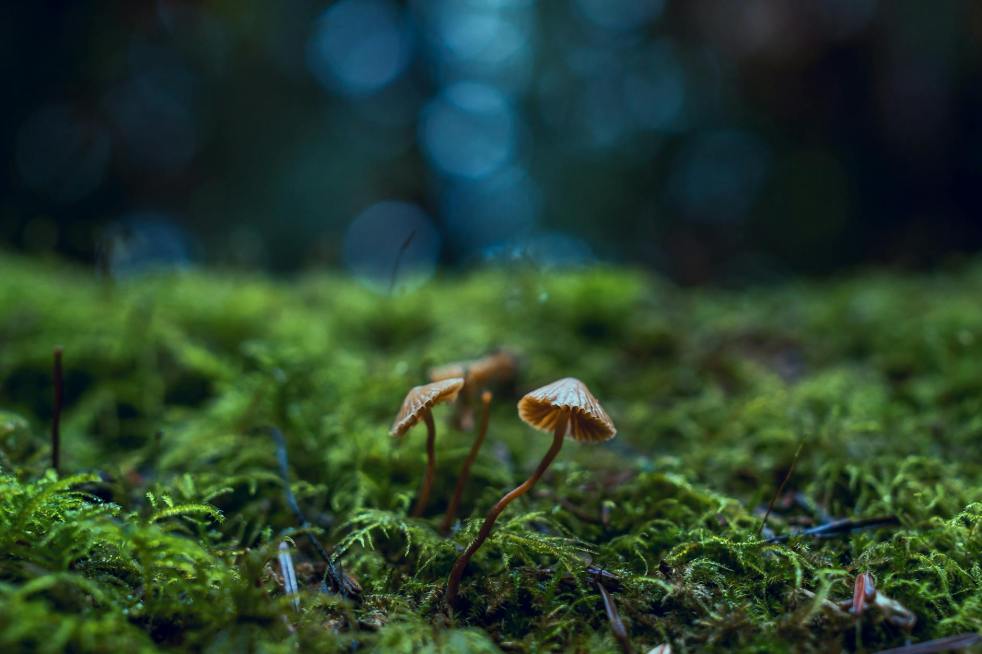
A trio of small brown mushrooms growing from a tuft of moss.
Photo by Johannes Havn on Pexels.com

So, on one hand, edible mushrooms are gifts from the dead to feed the living. On the other, the inedible ones will allow you to meet the dead!

This connection continues with the crane bag of Manannán mac Lir. In addition to being a God of the Sea, Manannán is also a guardian of the underworld. The crane bag is a bag he fashioned from a crane skin that contains several magical tools. According to many Ogham readers, these tools are indicated in the forfeda — the four additional letters at the end of the Ogham alphabet. Iphin (ᚘ) is the crossed “bones of Assail’s swine.” These were pigs that could be slaughtered and eaten and would regenerate again.
Robert Graves theorized that these swine were metaphorical, and the bones were not bones at all — they were the stems of mushrooms, discarded once the caps had been eaten or used in ritual. Since mushrooms are just fungal fruiting bodies, and picking them doesn’t harm the actual organism in the soil, it made perfect sense that they would “regenerate” so they could be consumed again.

Because mushrooms seem to spring up out of nowhere after a rain, they’re also thought to represent fertility.

Mushrooms in general are associated with the element of Earth. Planetarily, they’re associated with the Moon. The fly agaric, specifically, is associated with the element of Air and the planet Mercury.

First, I want to say that “there are old mushroom foragers, and there are bold mushroom foragers, but there are no old, bold mushroom foragers.”

If you aren’t an experienced mushroom hunter yourself, and don’t have access to one willing to take you in the field and help you positively ID mushrooms, do not attempt to harvest them yourself. There are way too many poisonous lookalikes out there, some of which can only be differentiated by spore prints or tiny, easily missed differences in appearance.

A cluster of small, thin, white mushrooms of uncertain type.
Photo by Chris G on Pexels.com

That said, simply touching a poisonous mushroom is unlikely to elicit a toxic response. However, it can still give you an allergic reaction, so you should still probably not do that.

Now, with that out of the way…

Unless you have access to a reindeer or a shaman, you should probably stick to the non-entheogenic varieties. I would also avoid commercially produced edibles intended for microdosing muscimol (a psychoactive compound). While not all brands are suspect, it seems some haven’t quite got the science figured out yet and several people have become extremely ill (and possibly even died) from using them. I wouldn’t use them myself and I don’t want bad things to happen to people, so I can’t recommend you do, either.

Also, if you drink alcohol, be careful which mushroom species you work with. Some are considered edible — delicious, even — but contain a compound that reacts with alcohol to cause some very unpleasant symptoms.

Otherwise, mushrooms are a suitable offering for deities of the dead and of forests. They’re also a good ritual food for workings relating to these deities or concepts.

You can place dried mushrooms in objects like charm bags, sachets, or spell jars, but with a bit of caution — they’re basically like sponges and will pretty readily absorb moisture and get gross if you aren’t careful to keep them dry. Other than that, go to town.

Whether you enjoy eating fungi or not, they’re fascinating organisms that form the foundation of life on Earth. Without them, other plants couldn’t grow. They’re a gift to the living from dead and decayed things, and, as such, are deserving of reverence.

animals · life

The Magical Meaning of Grackles

The first time I saw a grackle, I mistook it for a crow for a split second. It was only when I noticed its long tail and absolutely furious facial expression that I was like, “Oh.”

While grackles are typically pretty gregarious birds, we have a single male boat-tailed grackle (Quiscalus major) that visits the back yard here. He’s very pretty — black at first blush, but iridescent shades of peacock blue, bronze, and violet when the sun hits just right. Unlike crows, he also has light eyes. (Which, I think, lends to the whole expression thing.)

A grackle, with a classic irritated expression.
A male grackle. Photo by Gabriel Espinoza on Pexels.com

He’s usually very difficult to get a picture of, since he’s nothing if not wary and easy to startle. Lately, he’s been coming closer to the kitchen window and displaying more curiosity. I thought it might be a good time to write a post dedicated to these beautiful, interesting birds.

Most grackles move in large groups, called “plagues” or “annoyances.” This might seem unfair — worse than a murder of crows, even, or an unkindness of ravens — but it likely comes from their ability to decimate corn harvests. They’ll show up to follow behind plows in order to grab the turned-up worms, insects, and mice that wind up in the furrows (which isn’t really a bad thing, if you’re a farmer) but they’ll also descend on ripe corn to feast on the grain.

Grackles can be a bit of a problem for bird feeders, too. Smaller than crows, they’re quite happy to avoid the work of digging up worms and bugs and instead go for the nice, nutritious seed in a feeder. Where a crow or other, larger bird will ignore things like thistle and millet, grackles will dive right in. This can end up leaving nothing for seed-eating songbirds, so many people aren’t too stoked about seeing a crowd of grackles turn up in their yards.

Nonetheless, these birds have an important role. Unlike many small songbirds, which primarily feed on seeds and don’t dig up burrowing insects, grackles help control pests like invasive grubs and worms. During the time of year when seeds are the most abundant and make up a larger portion of their diet, they also help propagate them in their feces.

Not everyone finds these birds to be nuisances, either. In the late 1400s to early 1500s, the Aztec Emperor Ahuitztol purposefully introduced great-tailed grackles (Quiscalus mexicanus) into the capital Tenochtitlan and the Valley of Mexico. These birds were taken from the Aztec provinces of Totonacapan and Cuextlan in the Totonac and Huastec regions of Mexico, and received plenty of human intervention to help them establish themselves and grow their numbers in their new home. They were well protected and well fed, which allowed their population to take root.
These birds were named teotzanatl, which roughly translates to “divine” or “marvelous grackle.” Certainly a far cry from calling them a plague or annoyance!

(This is far from the only case of something like this happening. Aztec emperors kind of had a thing for bringing in exotic plant and bird species, and even importing special gardening staff to help their new acquisitions thrive.)

Interestingly, these grackles were protected — not only by guards, but also by public shaming. It’s uncertain why this was so necessary, unless attempts to hunt the birds were legitimately an issue. This could have been because they’d become pests, or because their feathers were considered very valuable. Probably both.

A grackle, showing its light yellow eyes and brilliantly iridescent feathers. Its mouth is open and it looks genuinely offended.
A male grackle. Photo by Tina Nord on Pexels.com

Grackles are also the subject of an ancient legend. In it, Zapate the great-tailed grackle was unable to sing. Being a very clever, tricky bird, he stole songs from the sea turtle. This left the turtle without a voice, and the grackle filled with… well, all kinds of noises.

While they aren’t members of the corvid family, they share crow, raven, and magpie’s intelligence. They’re able to solve puzzles, catch fish, and will even clean the grills of cars in order to get at the tasty, tasty smushed bugs.

Grackles also seem to be uniquely equipped to detect the Earth’s magnetic field due to natural deposits of magnetite in their little heads. This may be helpful for navigation and migration.

In general, these birds are said to represent caution, resourcefulness, and community support. Be cautious, however — the appearance of a grackle is also considered a symbol of misfortune.

As with a lot of birds, you often have to pay attention to what they’re doing when you see them since their behavior can color their meaning.

For example, a bunch of grackles can represent friendship, community, and support. A single grackle, not so much.

A grackle foraging or stealing food can be a sign that you need to be resourceful. You may be entering a time when you’ll have to survive by your wits.

These birds also engage in a behavior called “anting.” There, they crouch and spread their wings over anthills. As the tiny insects scurry over them, they pick off mites and release formic acid, which helps repel pests. These birds will also fumigate themselves with everything from stolen moth balls to discarded cigarette butts — whatever keeps the feather mites away.
If you see a grackle anting or fumigating themselves, it may be a sign that it’s time for some reflection, spiritual cleansing, or actual decluttering. You might need to schedule some time to take inventory, clear some of the chaos from yourself or your environment, and make a fresh start.

A female grackle, displaying soft reddish brown plumage.
A female grackle. They lack the dark, iridescent feathers of the males, instead displaying beautiful shades of a rich brown. Photo by Connor kane on Pexels.com

No matter whether grackles are a welcome sight to you or not, these are brilliant, beautiful birds with a fascinating history. From dumpster scavengers to the protected birds of an imperial house, they have lived closely with humans and fulfilled many roles for ages.