art

Inspiration in Unplaces

Have you ever felt out of place in a familiar spot? I don’t mean socially awkward or anxious, just given the sense that you’re in a place that shouldn’t be — like a shopping mall before the stores open, inside of a school at night, or somewhere else divorced from its usual context by some small, important detail. They are a familiar place, easily made into a strange-seeming unplace.

There are two times of year in this area, one in spring and one in autumn, where the light around four PM turns everything a lovely orange-gold, but the angle of the sun creates stark shadows of a particularly surreal length and sharpness. With a clear blue sky, it reminds me of Dali’s “Landscape with Butterflies” — colors too bright to be real, shadows too long and forbidding to be welcome.

Salvador Dali's Landscape with Butterflies.
Salvador Dali’s Landscape with Butterflies.

The idea of unplaces fascinates me, the way something so minor can make the familiar so strange. I think part of it comes from when I was a little kid, in an area where we largely had to make our own fun. I spent a lot of time in an abandoned school behind the house I grew up in, and, once I was a little older and could hop a fence, sneaking around storm water basins and drainage culverts. It’s a bizarre feeling, ducking under a pulled-up bit of chain link and stepping into a wet, wild world where the spongy turf and overgrown trees suddenly and strangely block the sights and sounds of traffic. There are no more sidewalks, no more streetlights, just murky ponds of massive snapping turtles and every quietly resentful goldfish that’s ever been loosed down a toilet. It is a small shift, just a chain link fence and a few strides, but it’s an important one.

I remember riding the train across the country a couple of years ago. I lived in Delaware at the time and, having saved up enough for a seat on Amtrak, decided to give it a go. As we passed through the million shades of the desert, from persimmon orange to the blinding, glittering white of Utah’s salt flats, I could see occasional islands of abandoned humanity. There were no towns around them, no yards, fields, or fences — as if some capricious and malevolent giant had plucked them from their foundations and left them there like forgotten toys. Just the occasional roofless husk of a deserted homestead, sometimes with a scrap of dry-rotted cardboard abortively tacked over a window, even less occasionally with the rusted corpse of an ancient car sinking slowly into the sand around it. Even in the safety of the train, sitting in a cushy seat just wide enough for me curl up to sleep in for the four-day journey, they gave me goosebumps.

In Mark Danielewski’s House of Leaves, there’s discussion of a place being uncanny, or, in German, unheimlich. But unheimlich isn’t used there in the passive sense of being merely unfamiliar, where an observer can gain understanding with time and effort. Instead, it’s used in the sense of a place being “full of not-knowing,” where gaining understanding may not be possible, helpful, or even safe.

It’s surprising how little it takes to make a place unheimlich, into what feels like something you were never meant to see. Sometimes it takes strange geography, like an average, suburban-looking house seemingly transplanted to the middle of the desert at random. Sometimes, it’s something as minor as a shift in schedule or a change in weather that turns the familiar into the uncanny, or even the unsettling. It’s this that can help us see a place with new eyes.

There’s a lot of strange magic in the places you don’t belong.

Find the unheimlich.

crystals · Environment

Unethically Mined Crystals: What can you do?

Last Friday, I posted about some of the ethical concerns surrounding the use of crystals. If that has you feeling a way about your own collection, you aren’t alone. The stones are already dug up, so there’s no putting that horse back in the barn — so what can you do to help remedy the situation?

It’s important to look at this from a few angles. On one side, there’s the human cost of bringing crystals to market. On the other, there’s the environmental impact. On the other other, there’s the energetic impact on the stones themselves.

The Human Side

Mining is difficult, hazardous work. Sometimes, it’s even done by children whose families have limited options for survival — you don’t put your kids to work like that unless the danger of starving is bigger than the danger of a mine collapse. Contributing to humanitarian causes to help lift families out of poverty is one way to reduce child labor, by eliminating the need for kids to have jobs in the first place.

Supporting ethical crystal suppliers is another key. As I touched on in last Friday’s post, altering market pressures to disincentivize unethical gemstones is one thing we can all begin to do on an individual level. If people don’t buy crystals from questionable suppliers, it won’t be worth it for them to stay in business. It takes a long time to do, but it’s currently the best weapon we have against the unethical gemstone trade. (There are other, very complex issues tied up in supporting exploitative businesses, but those are outside of the scope of this post.)

The first step to correcting any problem is being willing to surrender the benefits that came with it. In this case, that’s an abundance of inexpensive and readily-available crystals. From an energetic standpoint, look at things like donation as a sacrifice — you give up your time or money (a tangible representation of the energy it took to earn) to try to bring balance back to the world.

The Environmental Side

Healing the environmental scars left behind by crystal mining is similar to working on the human side — removing the incentive for environmentally-destructive practices. Businesses are run by humans, and humans respond pretty predictably to the removal of extrinsic motivation. So, by refusing to buy from high-impact mining operations, it’s possible to (eventually) disincentivize environmental destruction.

Sun rising over mountains.

In some cases, doing this may limit the kind of crystals you have available to you, but that’s not really a bad thing. There are even mines that allow you to visit and gather your own crystals, which is a brilliant means of fostering a connection to them in a low-impact, ethical way.

There are also environmental initiatives and conservation efforts that work to combat some of the destruction caused by mining. Though these are less direct at addressing the problem itself, they are no less integral to helping mining-affected areas recover.

The Crystal Side

Lastly, you have the stones themselves. Sure, you can cleanse them, but is some incense smoke or running water enough to heal the wounds of their origins?

Sometimes, stones take more than a one-off cleansing to prepare them. It can take months of regular cleansing and handling to bring them back to equilibrium. I don’t necessarily recommend going through this before you ever work with a crystal, though. If your work and intentions are pure and focused, just using the stone is a form of recalibration in itself. Magic has a residual effect on the things it touches. Just like other tools are affected by regular work, stones are the same.

heart-3243179_1280

I have known witches and lightworkers who obtained crystals from people who got in over their heads, magically speaking — jumping into baneful things and spiritwork they weren’t prepared for, and leaving all kinds of energetic dross behind in the process. The crystals’ new owners ended up doing things from rolling them in wet leaves, to stashing them in the forks of trees, to singing or playing music to them every day. Feel out the energy of your stones, and do whatever calls to you. This is a pretty heavy energetic burden to bear, so work on lightening it, even if it feels a little (or very) silly. A lot of magic involves being playful, uninhibited, and occasionally ridiculous. Get weird, if that’s what resonates. Be the airbrushed t-shirt unicorn you want to see in the world. 

In a perfect world, all of this would never be an issue. There would be no incentive for child labor, unsafe working conditions, or environmental harm, and we’d all know exactly where everything we buy comes from. Unfortunately, that isn’t the world we live in right now, but there are ways we can try to offset the impact of crystal mining and begin to heal some of the scars it leaves behind.

divination · life

The Two of Cups

Can I complain about stomachs for a bit?

My life has been pretty limited by health issues for awhile — I don’t just mean intracranial hypertension, either. I try not to dwell on it, because that’s not really helpful for me. If anything, it just keeps me from being useful when and where I can.

Sometimes, though? I just want to be a gigantic baby about it, dammit.

Part of my problem is a digestive issue that, to date, three different ERs, five doctors, a barium swallow, three ultrasounds, four x-rays, and countless dietary adjustments have not solved. There’s still a lot of diagnoses to rule out (I’ve never been scoped, or tested for H. pylori, Celiac disease, or SIBO, for example), but it’s been a long slog finding a doctor willing to pursue things and not just shrug and hand me a PPI . I’ve been told to “come back if it still isn’t better in a week” when it hasn’t been better in years, and, when I do, it’s another shrug and a recommendation to try fasting for a day.

If I fasted every time I felt sick, I’d be dead.

Getting insurance was a pain. Finding a doctor who I felt confident would actually help me continues to be a pain. Some won’t do anything for me because they have no experience with idiopathic IH (statistically speaking, I’m one of 7 people in this entire city who has it. I guess I can’t be too surprised). It’s frustrating. It’s disheartening. It’s very… physically unpleasant.

Through it, my S.O. has been a huge help. He calls doctors for me, sends in paperwork, deals with the ongoing, complicated mess of adding me to his insurance. Sometimes, I feel powerless not only because I’m physically unwell, but because that illness makes me less able to advocate for myself. I don’t like having him do this, so part of my contribution was hunting down a doctor I thought would be willing to do more than order another ultrasound and ask me, for the nth time, if I’m really, absolutely sure this isn’t all just anxiety. I even found one!

Unfortunately, they don’t answer the phone.

“I can get you an appointment with my doctor,” my S.O. texted me, but I didn’t want to get another five minute visit with someone who’d just order the same tests that were no help the first seventeen times. I didn’t want to go through trying the same handful of acid reducers, only to end up anemic, covered in bruises, and feeling no better. I’d gone through a lot of trouble to find a doctor whose approach seemed like one that would actually help me, who my insurance would cover. We’d already filled out the new patient paperwork and sent it in, why wasn’t this office answering their damn phone? 

I was having a low point when I decided to pull out one of my tarot decks. What could I do to help myself heal? It feels like I’ve tried everything I can, physically speaking. Taking more Mylanta probably isn’t going to help at this point. I had my doubts about eating nothing but banana smoothies for a(nother) month. FODMAPs was already a flop. What else was there for me to do?

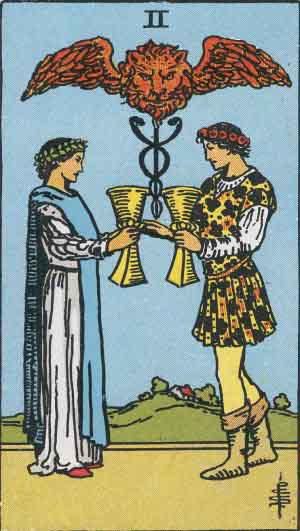
2ofcupsThe Two of Cups.

The Cups are the cards of emotions, and the Two of Cups is full of partnership imagery — a pair of figures, the twining snakes of the staff of Hermes. While it doesn’t always mean a romantic partnership, it does point to one where both people are very emotionally invested in the same endeavor.

Right now, my goal is getting well (or, if not well, then at least less awful). I know my S.O. is invested in it, too, or he wouldn’t be filing paperwork and making calls. My approach obviously isn’t working, or I’d have an appointment by now. It seems like I need to defer to the other person in this partnership — he cares about my well-being just as much as I do, just as I care about his. If I’m going to listen to anybody right now, it should probably be the other person with a vested interest on keeping me on the right side of the dirt, you know?

I asked him to call his doctor.

Fingers crossed.


Environment

Deepening Resilience: Ecological grief.

Learn more about Deepening Resilience here, or read my previous post in this series here

How do you respond to the news that another oil spill happened? That yet another oil company has been given permission to drill in yet another “protected area?” That plants in your neighborhood have decided to burn recyclables instead of recycling them domestically? How do you keep going after blow after blow?

Ecological grief is a profoundly helpless feeling. You can rage, but you’re only one person pitted against an entity with the (questionable) backing of lawyers and law enforcement. You can point out how bad an idea this all is, but it won’t matter to those who refuse to listen.

Individuals don’t have the police force’s arsenal, or the legal budget of Nestlé. We’re discouraged from organizing at every turn, as protesters are shot with water cannons and workers are forced to sit through propaganda to keep us from marshaling our numbers and the power of our labor. It keeps us willing to accept less and less — less money, less security, poorer health, dirtier air and water, fewer rights, less workplace safety — while we’re also bombarded with encouragement to seek relief through coping mechanisms like retail therapy. In other words, the things that grind us down also keep us supporting the entities behind the grinding.

As communities, our options for responding to environmental trauma expand beyond what we’re able to do as individuals. A single-person boycott, or protest, or letter writing campaign, or even a single thrown fist doesn’t amount to much. Together, we’re stronger, and strong communities can persist in the face of environmental trauma. Identifying the strengths of each member, organizing ways to distribute resources outside of the systems that profit off of environmental destruction, and creating strategies for protecting the local environment may not seem like much in the face of a global problem, but they are. Every community is different, every local environment is different, and it’s on a neighborhood scale that we’ll be able to look out for each other.

I am, perhaps, fortunate to live in a place that’s a nexus for policy and corporate lobbying. My community has options that others often don’t. On a daily basis, our neighborhoods and local businesses see the people who make the decisions that lead to environmental trauma. We know their names. We recognize them. And we can make them know they are unwelcome.

The faces behind the decisions that harm people and the environment are not gods, and they all have names and pictures.

art

Automatic Asemic

Note: This post contains affiliate links to the book(s) I mention. These allow me to earn a small finder’s fee from Wordery.com, at no cost to you. Thank you for helping to support writers, publishers, and this site! 

Sometimes, writing can be a visual art form.

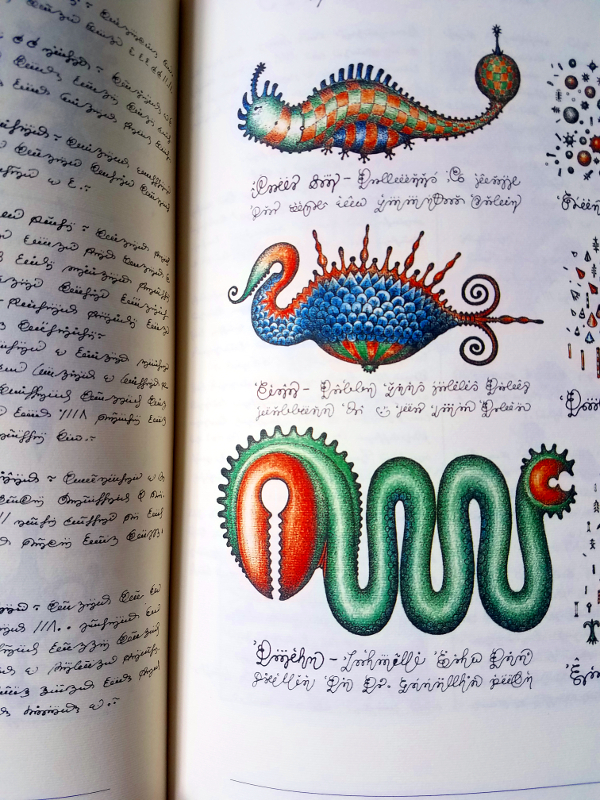
Not the same way logo design or typography are — just the shape and flow of text itself. The letters don’t have to spell anything, they don’t even have to be letters (just look at the beautifully evocative text of the Codex Seraphinianus) in order to have meaning.

A portion of a page from the Codex Seraphinianus.

In the Codex Seraphinianus, the artist chose to use an invented language that doesn’t map to an existing one — while he invented an alphabet to write in, these letters join together to form words that don’t mean anything. The overall feeling is of being a young child who has gotten a hold of some beautiful and inexplicable book. The child knows the words mean things to those who can read them, and it feels like there is a whole secret world of knowledge there for the unlocking. But, without that kernel of understanding — without some way to turn the jumble of shapes into something that makes sense — there is a perpetually tantalizing, mysterious feeling of knowledge kept just out of reach.

In its primary role, written language is bound by semantics. C with an A followed by a T spells “cat,” and you know the sounds each letter stands for and the small, furry animal to which they refer. Asemic writing is writing unbound by semantics. It has meaning, it can be interpreted, but these things are not subject to the rules and logic of reading. The shapes and repetition of letters are treated as a pattern, neither more nor less than the fronds of a fern or the shapes of Arabesque tile, and the feelings and images they evoke are what give them meaning. This necessarily varies from person to person — where one may read aggression in the slant of a garbled word, another may see exuberance — but this subjectivity does not mean asemic writing makes any less sense than language.

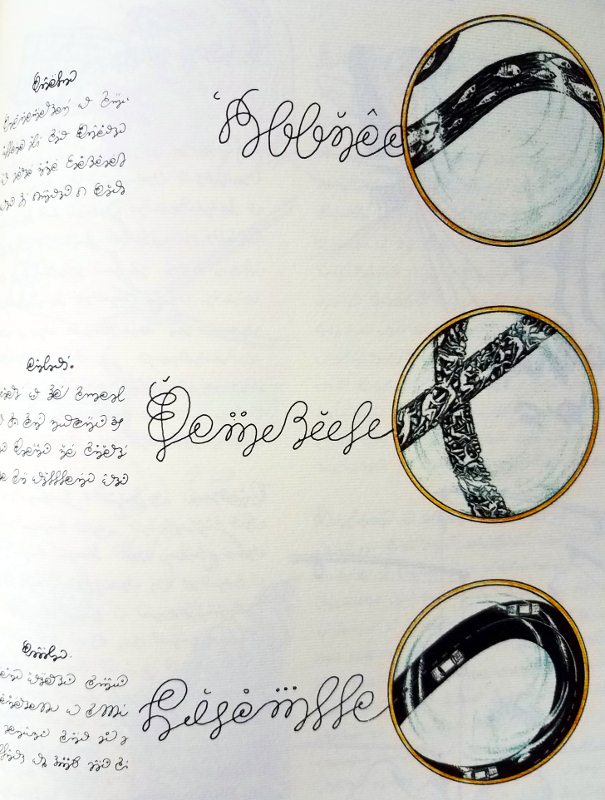
codex
A close up.

It’s just different. 

In some of the magical and spiritual disciplines I work with, language becomes more than its literal meaning, and asemic writing can be doubly so. You can take a sentence, strike out the vowels and repeating letters, then rearrange the remainder into a sigil used to focus energy and intention. A planchette can dash across a page, leaving the uncertain scrawls of a spirit in its wake, while a group of breathless observers try to find sense in the jumble of lines and shapes. Scrubbed of their literal meanings, freed from the restrictions of semantics, letters and words (or alien shapes that only suggest letters and words) can condense into something else.

There are whole areas of literature devoted to analyzing word choice. “Happy” may not always mean “joyful,” and “patience” may not always be virtuous, and its worthwhile to examine why someone chose the words that they did. Even when words no longer have meaning, this still applies. Asemic writing is still made up of the lines and arcs we associate with text, and their placement is never random — there are things to be read in the ascending slant of a line, or a ripe, bubblelike downward curve.

Even when you can’t read the words, there is meaning in them.


divination · Witchcraft

The Tom Waits Oracle

“When you are writing, you’re conjuring. It’s a ritual, and you need to be brave and respectful and sometimes get out of the way of whatever it is that you’re inviting into the room.” ― Tom Waits

Ever use shufflemancy? It’s a type of technomancy that relies on shuffling through a collection of music. It could be an album, it could be a playlist of your favorite songs, any sufficiently large number of tunes will do.

Tom Waits has been described as a lot of things: avant-garde, gravelly, whiskey-soaked, experimental, a raconteur. John Hodgman said that “[w]e all hear our own stories in our favorite songs (that is why Tom Waits sings in werewolf language—you can pretend it is about anything you want!),” and I’m inclined to agree.

And so, I tacked together a shufflemancy playlist made up entirely of Tom Waits tracks.

It’s pretty self-explanatory. Clear your head, ask your question, hit shuffle, and listen. (Or, if you’re not using the Spotify app, shut your eyes, scroll, click, and listen.) Do any lyrics leap out at you? What impressions do you get? Let the werewolf troubadour sing(/play/beat the bathroom door with a 2×4) you a divination.

divination · life

The King of Wands

Ever have a card that ends up showing up a bunch? Seemingly out of the blue, it starts showing up in every reading you receive or do for yourself.

Right now, I’ve got the Kind of Wands.

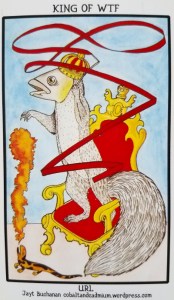
Across multiple decks (he’s been a crow, a man, and even a taxidermy fish in a squirrel suit), he keeps showing up. The first time was when I tried a very interesting three-card reading — how you see yourself and how others see you, versus how you really are. Ever since then, any time I have a question about feeling sure about my place in the world, or keeping up my confidence, he’s there. The funny thing is, I don’t think I’ve ever received the King of Wands in a reading before then. Not when I pulled cards for myself, not when I paid for a reading by someone else, not even when my ex’s stepmother was teaching me to read.

kingwandsIn truth, I could do a lot worse than the King of Wands. He’s a leader. In the Rider-Waite-Smith deck, he’s holding a blossoming branch that symbolizes verdant life and the energy of creativity. He’s surrounded by symbols of strength, nobility, and the element of fire. In the Crow Tarot, he is a sign that focus and energy will ensure a successful outcome. In the Deviant Moon Tarot, he’s a charismatic (if easily annoyed) leader or innovator. In the Regretsy Tarot, he is a fish in a squirrel suit.

The King of Wands is a determinator. If he wants to throw his weight behind something, it will blossom. If he doesn’t, it will wither. As a King, he is less impetuous than a Knight. Unfortunately, that also means that the success or failure of an opportunity rests entirely on the King’s willingness to act on it. No pressure, or anything.

I often feel like I’m spinning my wheels. Even during the times when I know exactly what I need to do to feel happy and successful, health challenges mean that I don’t always have the ability to do them. Here, at least, it seems like the King of Wands is a reassurance that all isn’t lost — I can still achieve what I want with energy and focus.


crystals · Environment

Choosing Crystals Consciously

So, I’ve made no secret of the fact that stones occupy a place of honor in my practice. When I first started learning, I was drawn to the magic of gemstones above anything else. I think I got it from my dad — he made jewelry, beautiful things of silver, bone, and stone. From a young age, I was surrounded by bright lapis lazuli, soothing rose quartz, and shimmering tiger’s eye.

I like gemstones because they resonate with me. I’ve learned how to choose stones that make me feel uplifted and energetic, pieces that are as functional as they are beautiful.

quartz

But not everything crystal-related is all sweetness and light.

Diamonds are notorious for their controversy — pulled out of the earth in places stricken by war, sold to finance warlords and dictators. Unfortunately, they aren’t the only stones that are sometimes paid for in blood.

Most witches and other magic practitioners know that, when you get a new tool — or bring anything into your home, really — it’s a good idea to cleanse it to remove the energy of everyone and everything it’s come in contact with before you. What cleansing is good enough to ease the pain of a nine year old child laborer?
(And all of that’s before you even consider the environmental impact of gemstones.)

The picture isn’t entirely bleak, though. For those who aren’t willing or able to give up gemstones entirely, there’s one easy way to fight back: Know where your crystals come from, and choose wisely.

When I collect a stone or make a wand, I make an effort to find out as much as I can about where the components came from and how they were gathered. I’m not at all against hunting (it beats factory farming), but I use naturally-shed antlers. I know the areas the crystals came from, and try to source as much as I can from mines within the U.S., since it makes transparency a little easier.

There’s only one problem — this really isn’t as easy as it sounds. Most metaphysical shops and gemstone suppliers don’t provide information on their stones’ origins, if they were ever even given it in the first place. The places that do may also charge a premium, because cheap stones come at the expense of things like environmental protections and worker safety. So, if you can find ethical sources of gemstones, support them! Money talks, and the best way individuals have to end the trade in unethical crystals is to create an economic disincentive. It’s a slow, imperfect process, but it’s what we’ve got right now.

heart-3243179_1280

Estate sales are another option for those who don’t want to directly contribute to the trade in unethical stones. While they may have been mined under poor conditions, there’s really no undoing that. Keeping estate sale stones in circulation is a way to help reduce our dependence on mining.

Using local stones is another option. Crystals are pretty, and their properties are helpful, but quartz is incredibly abundant. Some of my favorite stones to work with are simple river rocks I picked up on a vacation with my boyfriend, or holey stones found in a creek.

Mining is dangerous and labor-intensive for workers at the best of times, and stones are sensitive things. While crystals may be longer-lived and more durable than animals or plants, they are no less affected by their environment, and these effects are passed on. Take the time to know where your stones come from, appreciate the tremendous amount of energy, effort, and danger involved in mining them, and contribute to reducing the burden on the people and places that bring them to you.


art · crystals

5 Crystals for Creativity

Note: This post contains affiliate links to some of the stones I talk about. They allow me to earn a small finder’s fee, at no additional cost to you. Thank you for helping to support independent artists and artisans, as well as this site!

Creative blocks. We get ’em, we hate ’em. The feeling of grasping for an idea is never fun — words and images seem just out of reach, and we know that if we could just get something down, we’d be able to take it from there.

If you deal with the occasional block, or just want some help channeling your creative impulses, try keeping some of these stones in your work space:

Sodalite

sodalite-341397_640
Blue sodalite beads.

Sodalite is said to promote logic and rationality, but it has a ton of other properties that make it a useful tool in the artist’s arsenal. It’s ability to help balance emotions and soothe panicky feelings can help combat those times when a blank page feels too intimidating. Use it when you need to calm anxiety and trust yourself to create beautiful things.

Check out some beautiful, large sodalite specimens at RockParadise.

Golden Rutilated Quartz

rutilated-quartz-665262_640

Golden rutilated quartz is clear quartz filled with golden “hairs” of rutile. It’s an uplifting stone, and is said to help clear energetic blockages. As a form of clear quartz, it can be programmed with your intentions, while the golden rutile needles within it help to stimulate creativity and invite divine inspiration.

Check out some very pretty pieces of tumbled golden rutilated quartz, also at RockParadise.

Lodolite

Lodolite it my favorite stone, bar none. It, like golden rutilated quartz, is another form of quartz with inclusions of other minerals. However, while rutilated quartz contains characteristic needles of rutile, lodolite can contain any number of different minerals, often in patterns that resemble miniature landscapes. (Hence three of its other names — garden, landscape, or scenic quartz.)

Lodolite is a great stone for enhancing communication, and is especially helpful if a trance or trancelike state is part of your creative process. It’s powers of manifestation can combine here to help you achieve a creative trance, communicate the ideas that come to you, and manifest the creative works in your heart.

Check out some really stunning lodolite teardrops at MagiMinerals.

Citrine

citrine-1093454_640
A citrine cluster made of heat-treated amethyst.

Is any stone happier or more effervescent than citrine? I’ve never met one I didn’t like. Using citrine can help connect you to a very joyful energy. It also helps promote the easy flow of ideas, ideal for creative brainstorming sessions, and enhances clarity and visualization. It’s a very bright, energetic stone. Any form of citrine will do, but those that haven’t had their color artificially enhanced seem to work the best.

Check out some polished, natural citrine points at RockParadise.

Herkimer Diamonds

Fortunately for us, Herkimer diamonds are not diamonds — they’re actually a type of double-terminated quartz. While double-terminated quartz can be found anywhere, though, these are specifically from around Herkimer, New York.

These stones are potent. Like golden rutilated quartz, they help remove blockages to promote the free flow of energy. It’s considered a powerful stone for workplaces, attracting positive attention (and, with it, money). It’s also said to “boost” other stones, helping small stones to act like much larger ones. Most Herkimer diamonds are small, but they don’t need to be big to pack a wallop.

Check out some lovely Herkimer diamonds at BlissCrystals.
Creativity can be a fickle thing, but not all of us can work on its timetable. (Personally, I can’t tell you how many times I’ve been handed an order from a client on a day when the words just. Were. Not. Flowing.) With some discipline and a little help unblocking our energies and getting the creative juices flowing again, we can overcome blocks and keep the ideas coming.