Okay, so “fruit” is a bit of a misnomer. I felt like using the gorgeous Tarot de Maria-Celia deck this week, and it’s not so much about the fruit imagery. Still!
I gave myself a little three-card spread. I’ve been working on fine-tuning a spread of my own devising, but I didn’t feel like I needed quite that level of detail for a simple weekly reading, you know? For getting a general feel of things, three cards is usually plenty for me.
I drew Le Soleil, Neuf de Deniers, and Roy d’Epée. For the most part, these have the same meanings that they do in RWS-style decks. For the most part.
Le Soleil, believe it or not, has some surprising parallels with Le Diable. It, too, has two minions — both with red sashes like shackles around their necks. While the Devil is deception, manipulation, and control, the Sun is its opposite — the light banishes shadows, and brings everything into clarity. The Devil is entrapment, the Sun is freedom. The Devil is the addiction that saps your energy and your money, the Sun is vitality, growth, and prosperity.
It’s a great sign for new beginnings. Like the return of the sun heralds the new growth of spring, It’s regeneration.
The Neuf de Deniers follows this. Unlike other decks, Marseilles-style decks don’t really have a lot of imagery for the pips cards — just a graphic representation of their suit and numeric value. Deniers (Coins or Pentacles) is the suit of material wealth. Nine is the last number before ten, the ultimate culmination of the suit’s cycle.
It’s a sign of achievement. Material comfort and freedom are at hand, hard work is rewarded. It’s a sign to celebrate!
More than that, though, it points to a time of balance. You’ve achieved this success through hard work and staying in harmony with your surroundings. Prosperity doesn’t always come in the form of a paycheck — sometimes it’s the abundance of the land.
Lastly, there’s the Roy (Roi) d’Epée. He can be a significant person, or merely the qualities of the ruler of the suit of Swords. His power is of the intellect, he is logical and incisive. He can also be a bit of a prick — he’s cunning, but also scheming. He’s intelligent, but may be cold. He is an authority, but may be too detached. As advice, he says to turn away from the emotions for now, and trust in logic and reason.
Taken together, this is a good sign! Le Soleil indicates success, growth, vitality, and fulfillment. Le Neuf de Deniers indicates comfort, abundance, and autonomy. Le Roy d’Epée says that obtaining, enjoying, and maintaining this requires intelligence and discernment. As advice, they say to spread joy and celebrate, but keep a cool head and let intellect lead the way.
Personally, I’m excited. Even as the days become shorter and the nights lengthen, I can feel that solar energy. I feel relaxed, happy, and fruitful. I’m hydrated, moisturized, and well-rested. My vibes are high, my mind is clear, and I can’t wait to see what’s next.
I hope your omens are just as positive. We could all use a little good news.
P.S.: If you’d like a tarot reading, all of the readings in my shop are still 30% off! Place an order, and you’ll have your reading, my interpretation, and a pic of the cards I pulled for you within 48 hours.
October marks the best timing for one of my favorite hobbies: mushroom spotting.
(Not the fun ones. The regular ones.)
I usually have far more luck finding them in autumn than I do in spring or summer, so I was pretty excited when my partner and I drove out to Jug Bay to hike the trails around the wetlands. AND RIGHTLY SO.
Last time we went, I couldn’t walk as far as I’d’ve liked. This time, I was able to go a full 2.25 miles from the visitor’s center to… well, the visitor’s center, but the long way. (I’m also starting to get actual triceps, so all the recreational sledgehammer-swinging is paying off!)
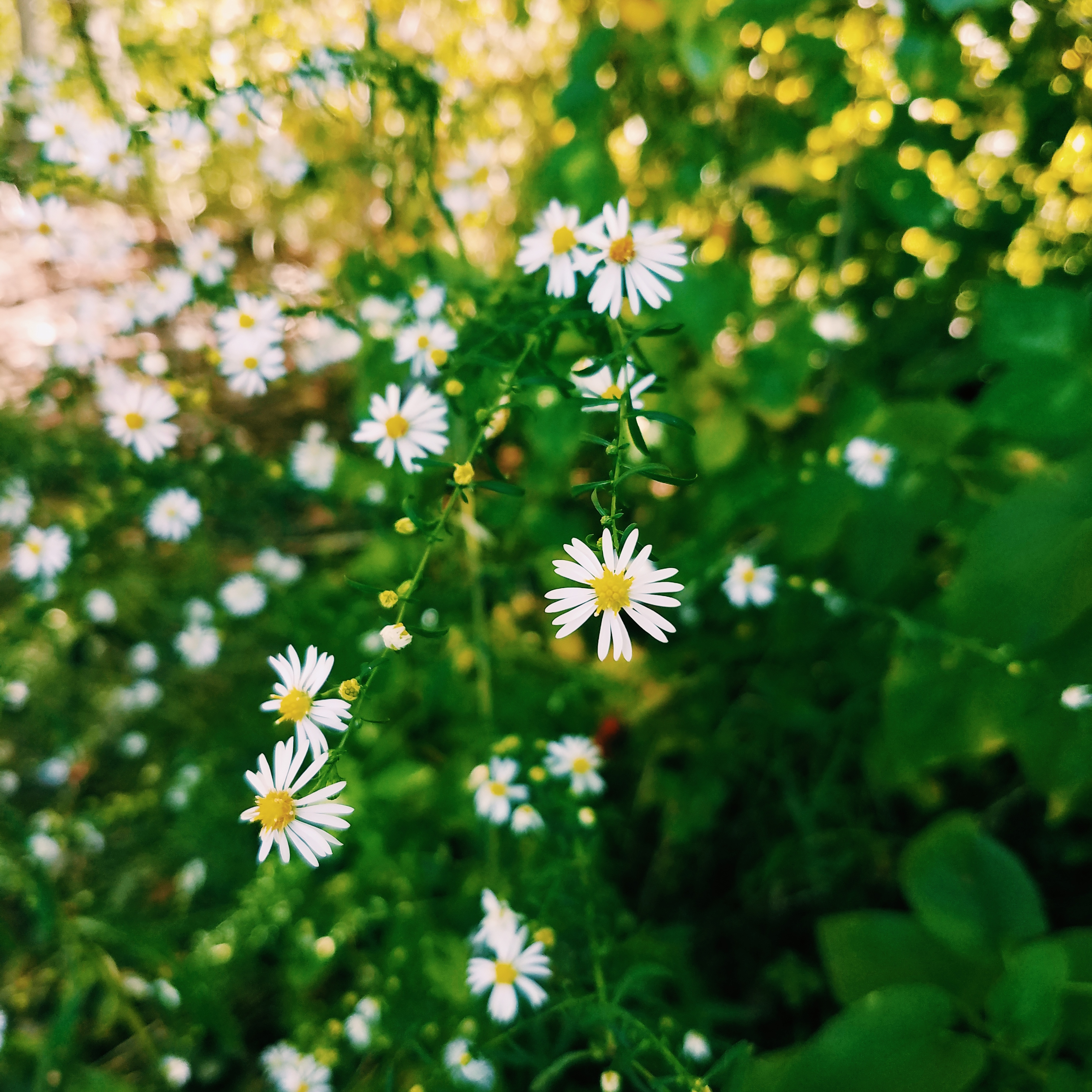
The weather was absolutely perfect — sunny, breezy, and cool, with nary a cloud in the sky. We rarely saw another soul on the trails, but we had our masks so we could pull them on by the ear loopies any time we passed near anyone. Most of the trees were still green, though there were a few splashes of scarlet, saffron, and gold. Winterberries were abundant, lining the boardwalk beside the marsh with bright yellow-green leaves and shining red fruit. Asters, their white faces like miniature daisies, looked up from the side of the trail. Long, hanging stalks of goldenrod, bent under the weight of their blooms, and tall sunchokes seemed to catch and hold the light in their yellow flowers.
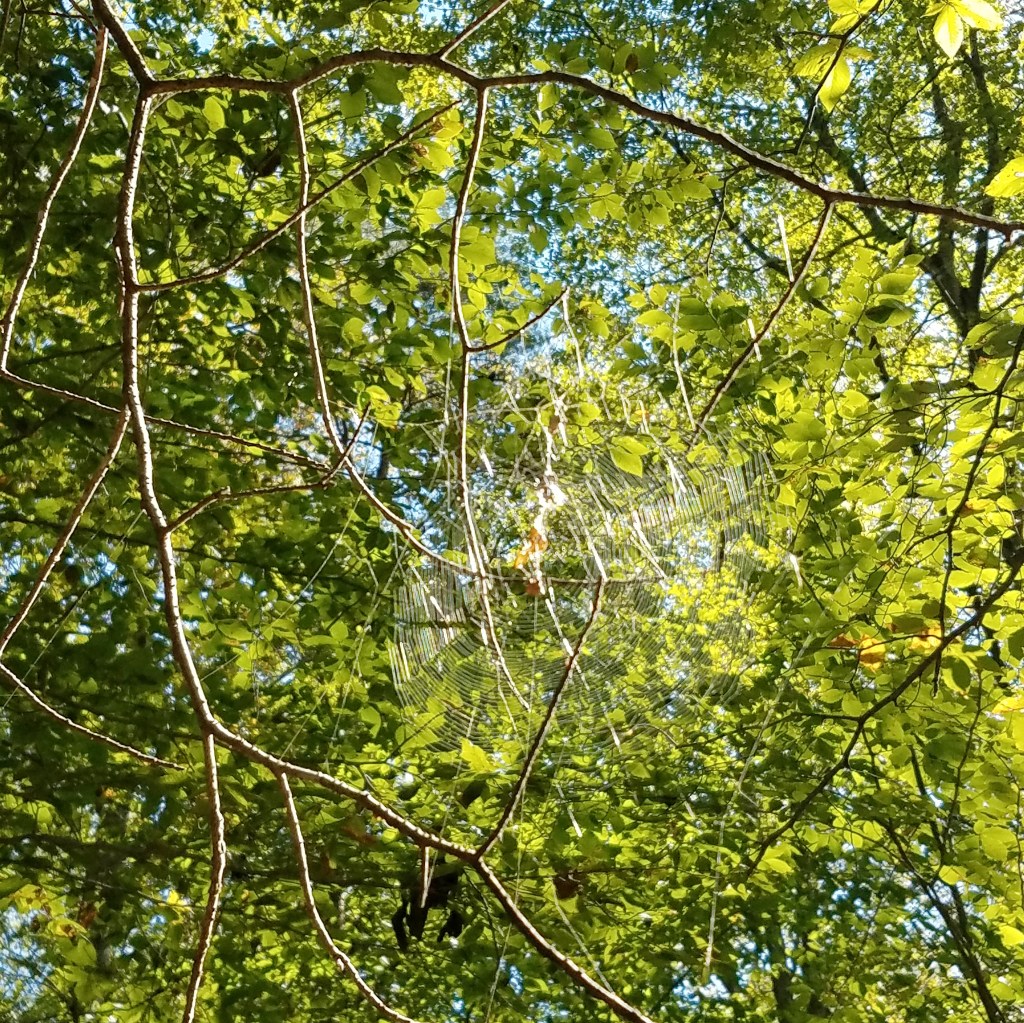
As we were walking along the trail, a butterfly fluttered up to say hello, made a loop around my legs, and passed back into the trees. It moved too fast to get a good look or a photo — judging by the color, I think it was either a red-spotted purple or a type of swallowtail. (And a late one, in either case!) I also spotted the most perfect spiderweb, threads intact and shimmering iridescently in the sunlight.
(Two crows hopped up on a parking sign in front of the car earlier that day, too, so this afternoon was just full of good omens!)
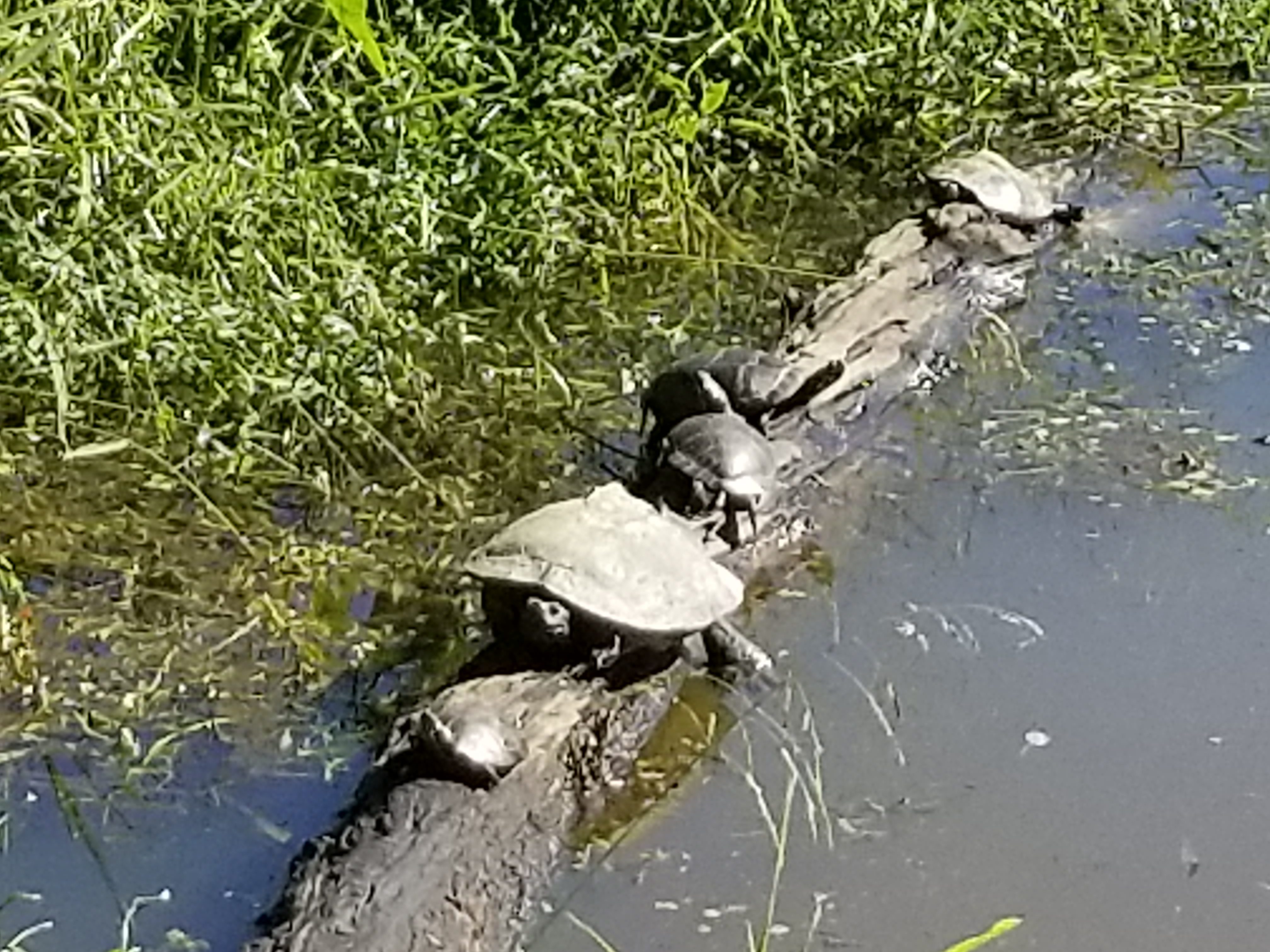
Turtles sunned themselves on logs, sleek heads occasionally poking up like curious periscopes. All around, you could hear the chorus of insects in the trees.
It was idyllic as fuck.
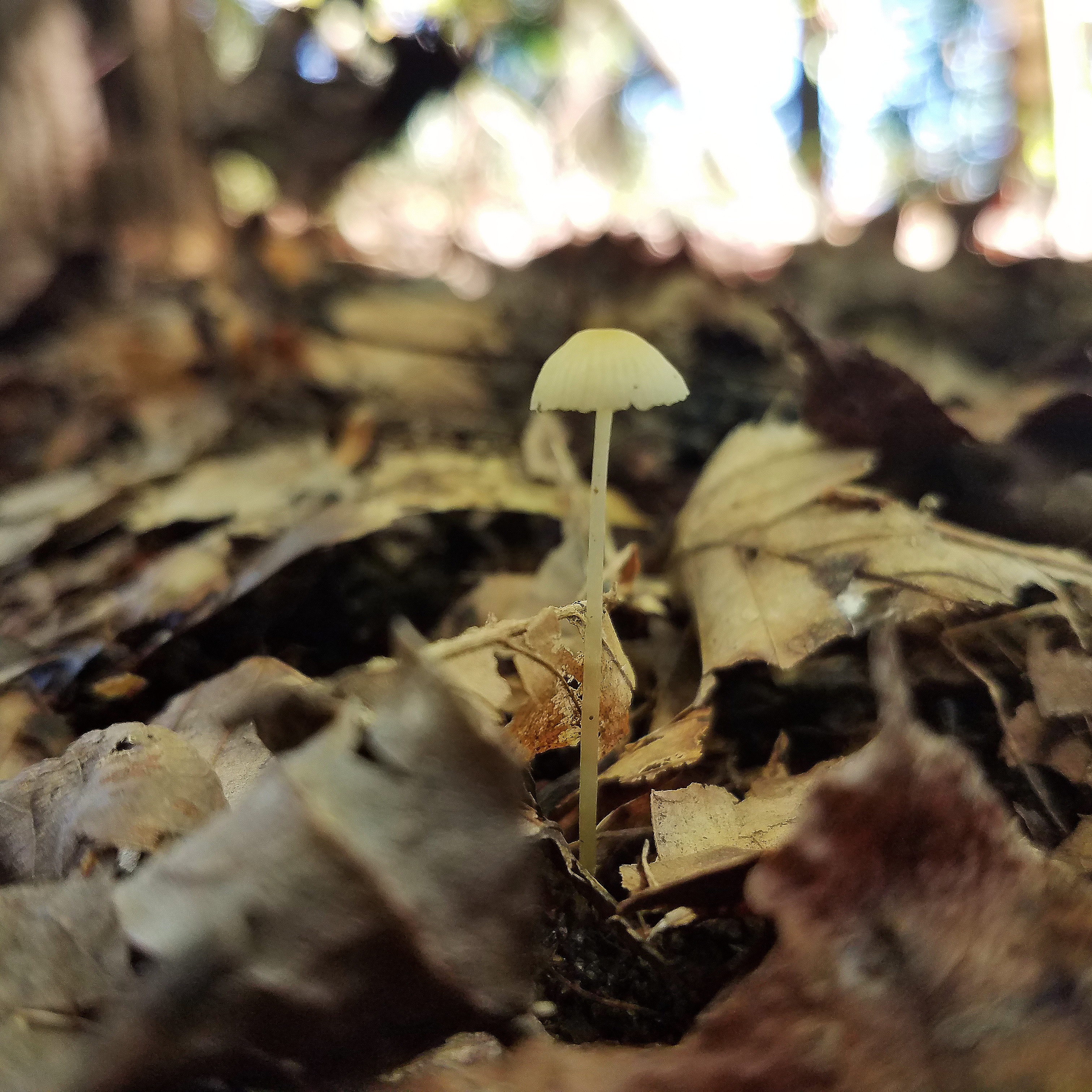
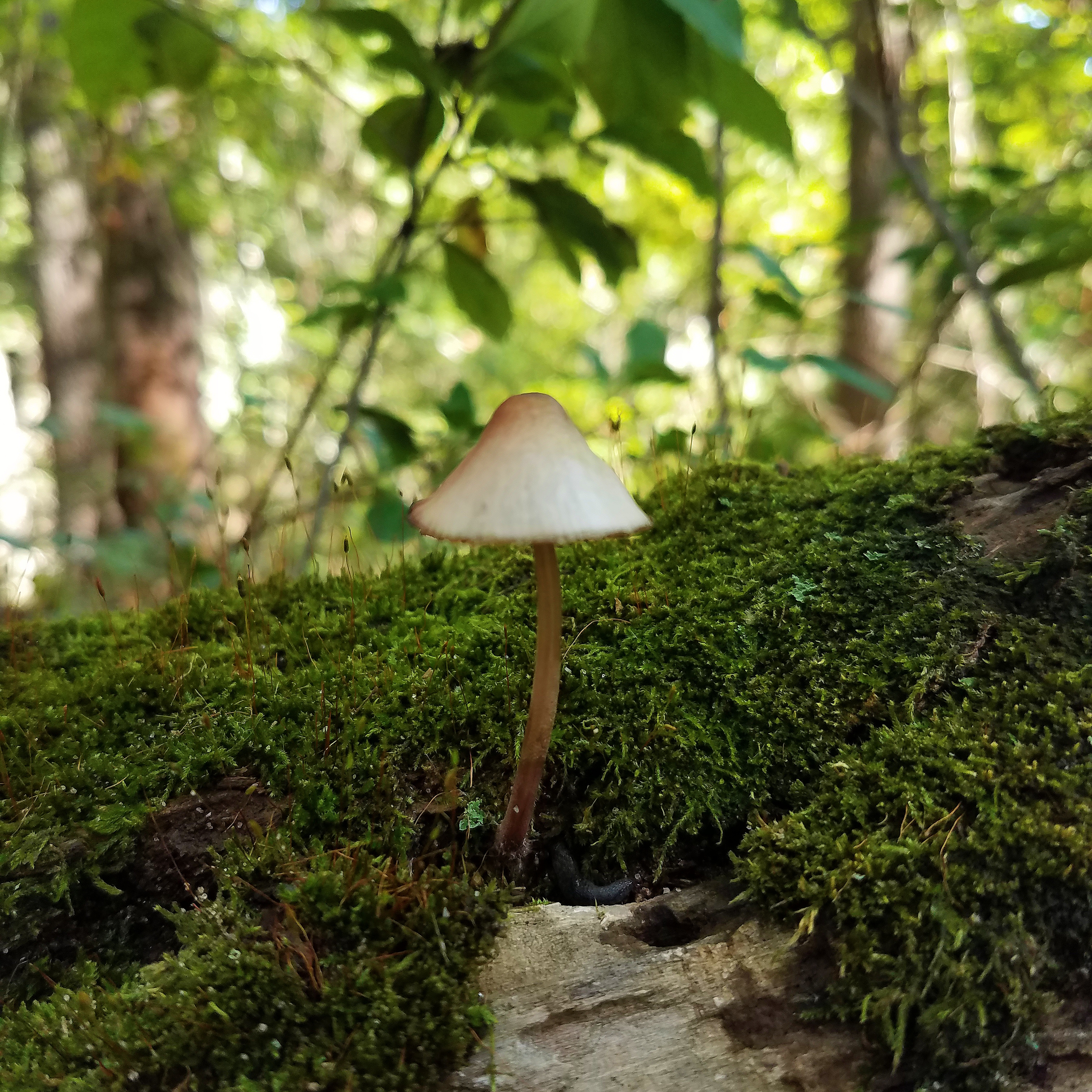
It wasn’t until we were close to the visitor’s center again that we spotted some mushy boys. Forest cryptid that I am, I got down on my knees and elbows on the trail, in the leaf litter, said a silent prayer to whatever deity’s in charge of urushiol, and crept as close as I could to get a few pictures. Identifying mushrooms is always dicey if you can’t check them for bruising, spore prints, and other signs that require more than a cursory examination, but they’re beautiful nonetheless!
(I believe the first is a kind of brittlegill, and the one at the top right is some type of gilled polypore. I’m not sure about the other two, but I really love the cream-and-brown one’s mossy home.)
I saw one mushroom that had been snapped off where it grew, so you could see its round butt and the little divot where it once sat nestled in the ground. Inside, the soil was lined with a silvery, cottony web of mycelium — the stuff that actually makes up the bulk of the fungus. I didn’t get a picture of it, but it was fascinating to see past the eye-catching fruiting bodies and into the “heart” of the mushroom.
We rounded the day off with crêpes from Coffy Café (I went with the Bootsy instead of my usual Mr. Steed — I think I might have a new favorite!), and a long, hot bath.
First thing’s first! All of the tarot readings available in my shop are 30% off(!) for the entire month. I’m also adding some new spreads, so, whether you’re looking for a simple three-card reading, an extended 22-card reading, or something geared toward a specific question or life situation, there’s a reading for you.
Did you remember to say “white rabbits” yesterday morning?
Yesterday was the first day of October, the month when the veil between worlds grows thin. I can feel the thinning, too — my dreams always get extra vivid and extra strange, and I very often smell the scents I associate with my grandmothers who’ve passed on. We’re lucky this year, since, in addition to yesterday’s full moon, we’ll be getting another full moon on October 31st.
I mean, I didn’t feel super lucky earlier this week, when I managed to pinch a nerve in my neck (which absolutely felt like part of my brain) and trigger a four-day headache. You probably know the kind. While daily headaches are pretty much part of intracranial hypertension, this was one of those bad boys that seems to radiate from a single, intensely painful spot right at the base of the skull, which seem like nothing short of a brick would cure. I was afraid I wouldn’t be able to do the usual preparations I do this time of year, but I was able to knock my various bones and fleshes into shape well enough to manage.
(A protip from a pain specialist I used to see regularly: Only use cold therapy on your neck, not heat. Also, bad spines go on the rolly tube.)
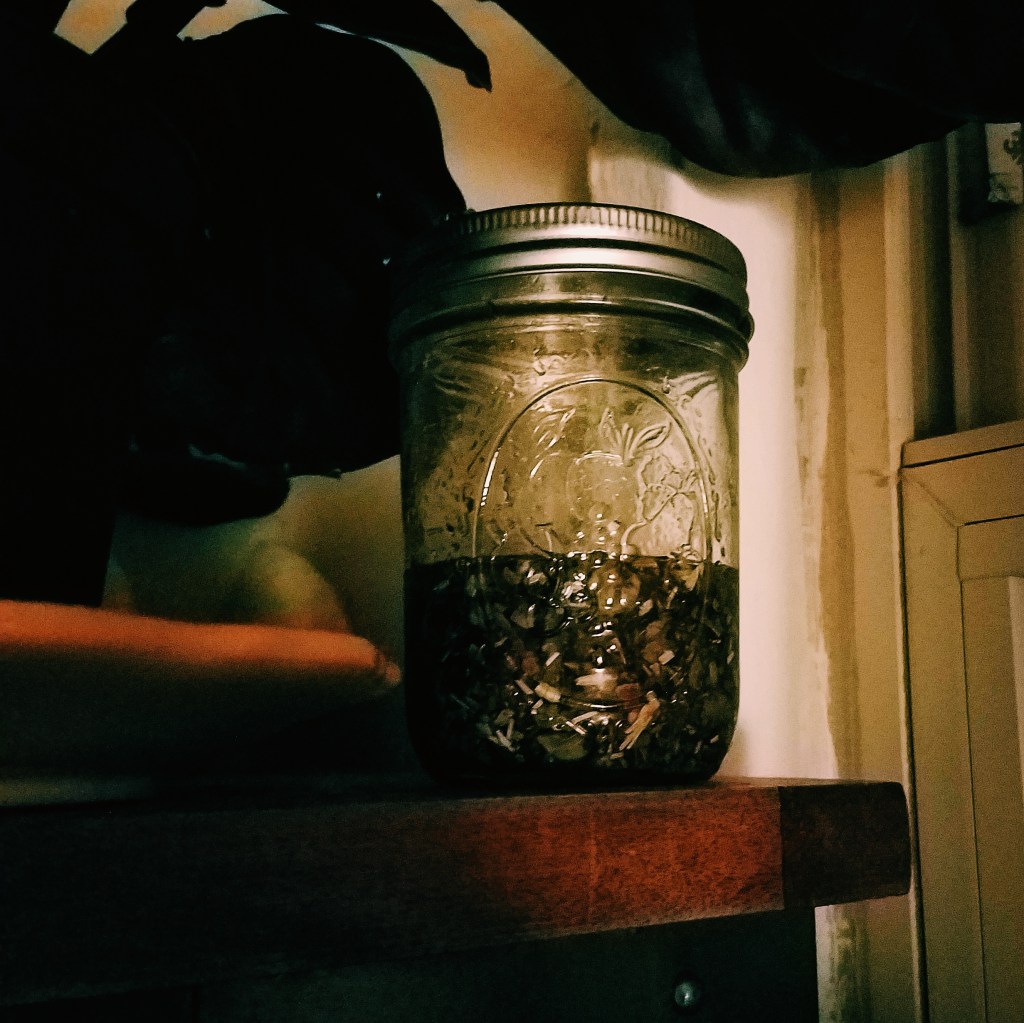
Seven days ago, I set up a working designed to run through the end of the waxing moon and culminate on the full. Everything went off without a hitch (and with some wonderful results, but more on that another time), and I decided to celebrate by setting up a batch of oil that I use for trance and dreamwork. From experience, it seems to work best when I set it up on the October full moon. Sometimes, I let it infuse from one October to the next. This year, I think I’ll try letting it go just until the blue moon later this month.
Infusing under the full moon (and the leaves of my big calathea).
It’s a special blend of dittany of Crete, mugwort, mullein, and cherry, among a few other secrets, and it’s wonderful for anything that involves crossing over into other realms. Not quite potent enough to be mind-altering, but it definitely helps the shift happen. Add a piece of black kyanite, and it’s *chef kiss*. I’m going to post the full recipe one of these days, but I’d like a few more rounds of experimenting with it before I do.
Whether you said anything about rabbits yesterday morning, or your relatives on the other side start hanging around more often, I hope this harvest moon is an abundant one for you.
I love ferns. If you want to feel like you live in some kind of magical woodland glade, get some ferns, a pack of Triloka Enchanted Forest, and cue up a couple tracks from The Moon and the Nightspirit. For real.
Ferns have a reputation for being fussy, and it’s not entirely undeserved. They’re not like most plants — their reproduction is weird, their lighting and humidity needs are weird, and some of them will die if you ever have the audacity to subject them to tap water, dirt, or a sidelong glance.
Still. Ferns.
One of my favorites is a little $4.99 “assorted fern” that makes frequent appearances on my Instagram. I put it the window, watered it often, and, to my surprise, it turned out to be a very robust staghorn fern. This was doubly astonishing to me, because a) I originally thought it was some kind of bird’s nest fern, and b) I once bought a staghorn on purpose, followed all of the care instructions to the letter, and it died within two weeks.
Ferns are weird. They’re also very magical plants that occupy a significant role in the folklore and esoteric practices of cultures everywhere they grow.
Fern Magical Uses and Folklore
In Slavic folklore, ferns produce a magic blossom once a year, on the eve of the Summer Solstice. Whoever is lucky enough to find a fern flower will receive good luck, prosperity, and the ability to understand the speech of animals. Baltic, Swedish, and Estonian culture has a similar tradition — in every case, the flower is believed to be protected by evil spirits. In some folklore, the Devil was said to appear and snatch the flowers for himself.
Unfortunately for the possessors of a fern flower, the story goes that any wealth granted to them would vanish if they ever shared it. To keep the riches of the fern flower, they would have to become cold-hearted, stingy, and isolated. In one tale, a boy who obtains the magical flower ends up losing all of his friends and loved ones because of it — eventually wishing for death to release him.
Ferns don’t actually flower, though. They have no need to. They are indescribably ancient plants, old enough to predate seeds. They do produce “fertile fronds,” which can appear as vaguely flowerlike clusters. These stories may refer to fertile fronds, a different flowering species that resembles a true fern, or the difficulty of attaining wealth and fortune.
Fern seeds were believed to be invisible, and only able to be found on Midsummer Eve. Possessing these seeds could make one invisible, help them understand birdsong, tell them where to find buried treasure, or grant them the strength of forty men.
In one Russian folktale, a farmer who lost his cattle was instantly granted knowledge of their whereabouts when a fern seed fell in his shoe.
In England, it was believed that you could catch the elusive fern seed by placing a stack of twelve pewter plates in a field of ferns. When the seeds appeared, they would fall through the first eleven plates and come to rest on the last.
Nicolas Culpepper claimed that, if a horse were to step on moonwort, it would cause them to throw a shoe. This could be because of its purported effect on iron — stuffing it into a lock was said to cause it to open.
In Hawai’ian folklore, the deity Kamapuaʻa occasionally took the form of a fern. The earth goddess Haumea also had a species of tree fern as a kino lau (body form).
Ferns are tied to weather magic. Burning them was said to cause a storm, as could pulling one up by the roots. On the Devonshire Moors, it’s still customary to burn growing bracken to bring rain.
I can see where the rain thing comes from, tbh.
Tying fern fronds to the ears of horses was said to protect them from the Devil.
In modern magic, ferns are used for rain-making, money spells, and protection. Adding the fronds to spells or arrangements of fresh flowers helps boost the magical properties of whatever they are placed with.
Last, but certainly not least, there’s the delightfully weird tale of the vegetable lamb of Tartary.
Using Ferns
There are so many species of fern with so many different medical uses, I can’t possibly cover them all here. While not all ferns (or all life stages of fern) are medicinal or edible, different fern species have been used for everything from stomach aches to snakebite. From what I have read and observed, they are most often used for skin afflictions — spores are said to reduce pain from stinging nettle, and ointments or pastes made of various fern species are used to tread cuts, bruises, and skin ulcers. In Scottish lore, ferns were mixed with egg and used as an ointment to restore sight or reduce redness in bloodshot eyes! (Please don’t do this just because you read it here, though. I don’t want anybody getting some kind of raw egg eye infection.)
For protection, plant or place potted ferns near windows and doors. (Just make sure they have the right levels of sunlight and humidity!) Llewellyn has a spell using ferns to banish evil, which may piggyback on its use for rain-bringing. Rain is cleansing, ferns are protective, so these two properties could drive evil out of a place.
If you’re lucky enough to come across fern spores (those black dots along the backs of fronds), carry them when you want to go unnoticed.
In hoodoo, ferns seem to be largely for protective magic. Among other uses, sprinkling crushed fern leaves along windowsills is said to keep intruders away, and adding it to a floor wash with black snake root clears away jinxes.
That said, some spells may refer to specific ferns using secret names. Maiden’s hair is the maidenhair fern, for example, while horse’s tongue is the hart’s tongue.
Magically, your best bet is one of two things: purchasing fern fronds, or growing some of the easier-care varieties in pots. While older sources cited specific plants in their folklore, the modern herbals I consulted for this post didn’t — they just said “ferns.” In my opinion, I don’t think it matters much what type of fern you choose to work with. When it comes to spending my time tending a growing plant versus tracking down the exact species used in a spell, I’ve found I’m pretty much always better off using a plant I’ve developed a relationship with (or, at the very least, one that’s abundant where I live). They have an affinity for water, which explains their use in rain magic. They all have spores, not seeds, which explains their use in invisibility (and, to a lesser extent, protection) spells. Find a fern that will grow happily for you, and see what magical secrets it holds.
I wasn’t aware of it until recently, but one of the side effects of sertraline is bruising. This was never really a major issue, but, with the recent increase in leg days, I’ve been noticing that my lower extremities look like hobbits have been beating me with cricket bats in my sleep. This probably isn’t helped by the fact that I’ve had knee surgery, and any amount of physical activity makes my legs look like I fell down the stairs even under the best of circumstances. I’m planning to talk to my doctor about this, but I’m not in a bunch of pain, and my medication is working out well enough that I don’t want to change it if I don’t absolutely, positively need to. C’est la guerre.
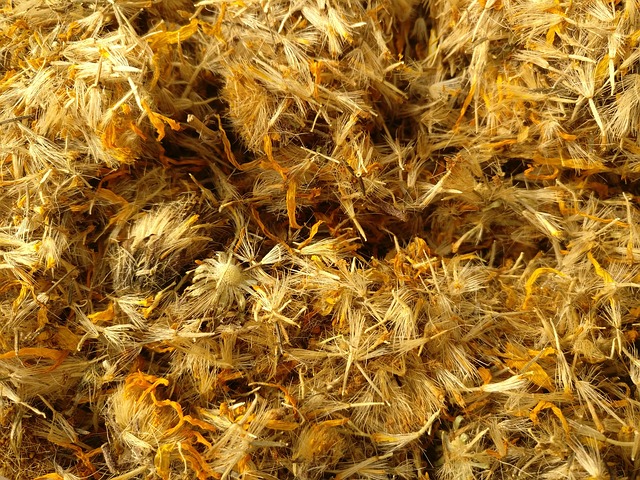
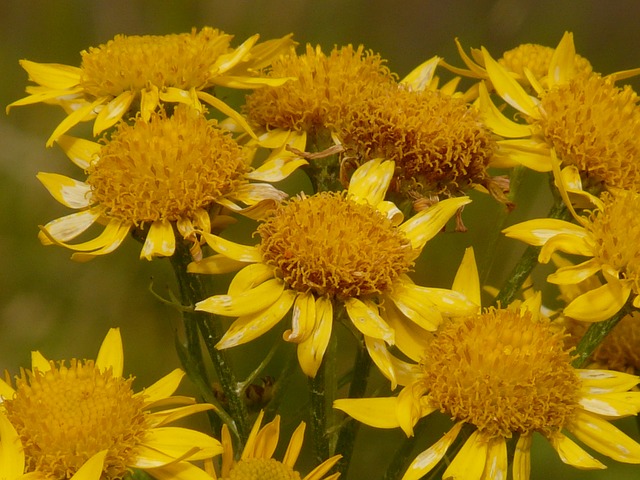
For now, it’s lots of iron- and vitamin K-rich vegetables, and arnica. At the moment, I’m pretty much only using arnica to help my shins look less corpse-y, but that’s not all it can do.
It could also keep corn demons away from my knees.
Arnica Magical Uses and Folklore
Arnica is one of the best-known and most-used herbal remedies in much of Europe. The American variety was no slouch, either — both indigenous people and pioneers used it in abundance. (I don’t really want to go into all of its historical medical uses here, because there are a ton of them and not all of them were great ideas. It’s the kind of plant where it could either lower your fever, or make you bleed internally a bunch.)
The word “arnica” is derived from the Greek “arni,” meaning “lamb.” This could be in reference to any number of the plant’s parts — it’s got fuzzy sepals, leaves, and looks almost dandelion-like when it goes to seed.
Two of its common names are “wolf’s-” and “leopard’s bane.” I haven’t been able to find any reason for this — these are also names for aconite, which is far, far more baneful than arnica. I mean, the two don’t even look alike.
In Norway, arnica was strewn in fields during Midsummer. This was to protect crops from a creature called Bilwis. In Germanic areas, Bilwis is identified as a kind of Feldgeister (field spirit) or Korndämonen (corn demon). In the Prose Edda, this creature was half of a brother-sister pair — Hjúki and Bil — that followed the Moon across the sky. There isn’t much written about Hjúki and Bil outside of the Prose Edda, but they are theorized to represent the craters visible from Earth, which are said to resemble a pair of children carrying a bucket on a pole. Over time, Bil’s image was distorted from a minor Norse deity to a malevolent spirit that cuts down corn. Bilwis has no set form, and its appearance varies across all of the folklore in which it appears.
Sprinkling arnica around your property is said to protect your home and bring fertility to your garden. This probably stems from its use to thwart corn demons, as, over time, its folk use expanded from keeping your crops from being cut down by spirits, to general protection and plant fertility.
Planting arnica around an area is said to keep a spirit penned there. This only works as long as the arnica lives, however — once it dies back, the magical boundary dies with it.
As a bright yellow Midsummer plant, it’s associated with the Sun and the element of Fire.
Some sources claim that arnica was burned as an incense, particularly in weather magic. This seems largely used to drive away violent storms, and may also be tied to its general “protective” aspect.
Using Arnica
Not gonna lie, I’ve gotten pretty fond of dabbing it on myself. But I digress.
Arnica contains a sesquiterpene lactone called Helenalin, which is said to help reduce inflammation and thereby soothe away bruising when it’s applied soon after an injury. Though it’s very healing when used topically, it is toxic when used internally and can cause sensitization over time. If you’re using arnica medically, it’s best to use it topically, over unbroken skin, for short periods of time.
That said, some people do use it internally. It’s even been used as a flavoring in foods and beverages. (I wouldn’t recommend doing so unless you’re under the guidance of an herbalist, though.) If you’re pregnant or on blood thinners, avoid it — it can stimulate contractions and interfere with blood clotting.
Harvest and the flowers when they’re at their best, around Midsummer. Scatter fresh flowers around an area you wish to protect, or brew dried ones into a tea and sprinkle the liquid. You could theoretically include dried flowers in protective sachets, jars, or other container magic, but the herb’s primary historical uses seem to largely depend on strewing, scattering, or planting arnica to create a boundary.
To turn back storms, burn arnica and say, “Arnica bright, arnica alight. Thunderstorm, turn and take flight.”
Arnica has been treated as a one-herb first aid kit, credited with any number of medical marvels. While it’s certainly good at what it does, the herb does have a tendency to cause problems if it’s used in high doses and for long periods of time. If you’ve got corn demons to thwart, thunderstorms to get rid of, or spirits you need to babysit, arnica can’t be beat.
It’s the Autumnal Equinox, and we’re heading into Libra season. All of the articles, posts, books, and assorted other things I’ve read say that this is a time of balance, of honoring one of only two days when day and night are of equal length. For some of us, it’s a time to prepare — to acknowledge that the dark, cold months are coming, and, while we may not like them, their quiet and rest is what gives us the brighter, warmer seasons ahead.
Mabon is also the second harvest. It’s enjoying the fruits of your labors, and gathering the seeds that will yield next year’s bounty.
It’s party time over here, though.
Sometimes, balance doesn’t look like you’d expect. If you’ve been going through a period of darkness or inactivity, balance can look more like a rush. Achieving balance and experiencing balance aren’t always the same thing — what it takes to reach equilibrium is not always what maintains that equilibrium.
That’s my balance right now. I’ve had an incredible, dramatic upswing over the past week or so — physically, mentally, and emotionally. I’m physically stronger than I’ve been since I was a teenager, I’ve reconnected with someone who was very important to me as a child. My mental health is stable enough for me to identify areas that need healing, and work to help them. I feel vital, creative, and validated.
All of which are pretty weird things to associate with the day that marks the Earth’s gradual descent into winter darkness, but I’m not going to knock it.
Even my plants don’t seem to have gotten the message. With this uptick in my own energy, it seems like everything else in my home is being swept along with it. My violets are blooming. My nepenthes is packed with tiny new pitchers. The asst. fern $4.99 is apparently a staghorn that is putting out new fronds faster than I can keep up with — including a very formidable set of shield fronds. My parlor palm is outgrowing everything. My calathea has taken over an entire shelf with leaves like salad plates. My cats are shiny, sassy, and extra playful.
(Kiko found a tomato somewhere, and decided this was her New Favorite Toy. I had very mixed feelings about her smacking an entire-ass tomato around my living room most of the evening, but I also didn’t have the heart to take it from her. This is how badly she has me wrapped around her little pink toebeans.)
Today, I’ll make offerings of honey, tea, flowers, and incense. I’ll play music, and let the autumnal sunlight in. I’ll give thanks to all of the things that have contributed to this feeling, this harvest, and I’ll find the seeds and hold them safely for next year.
Blessed Mabon, everybody. (Unless it’s Ostara where you are, then have a blessed that instead.)
So, if you missed the livestream on Canvisi, I went on around 1 PM.
Well, I was supposed to go on at 1 PM, but, having never done a livestream before ever in my life, I had no idea how they work. This was absolutely no fault of the person running the stream, either — he was very helpful, professional, understanding, and kind. I, on the other hand, barreled in at 1 and immediately launched into my introduction with the vocal cadence of a hyacinth macaw on PCP.
“HI, I’MJANDTODAYI’D-“
I saw him gesturing toward his ears, and I realized that, despite the amount of Zoom calls I’ve been on, I have no idea what I’m doing. Also my phone was muted.
Fortunately, there was some intermission music to cover for me while I figured out why my setup wasn’t relaying sound properly and tried to get my heart rate somewhere below “hummingbird.” Eventually, everything was good to go.
Honestly, streaming was kind of fun. My lighting was less than ideal, because my studio’s set up to have great light for painting — video, not so much. I managed to cover most of what I wanted to in the time I was allotted, and I didn’t forget to plug my various sites and social media. Score!
I’m actually considering getting back into making time-lapse painting videos. Maybe streaming on YouTube. That’s something for another day.
If not, I’m going to be part of Canvisi‘s artists stream! I’ll be talking a bit about how I got into my particular artistic niche, then giving a few demonstrations on incorporating gold leaf and other metallic elements into artwork, and showing a few new, never-before-seen pieces. It’ll be fun and — if you’re a chemistry nerd like me — hopefully pretty interesting!
I also have a ton of new stuff up on my shop. There are original paintings, jewelry, and a selection of wands made of Arkansas quartz and naturally-shed deer antler. They’re all pretty cool, if I do say so myself.
So, come join me and the other artists on Canvisi’s livestream, and maybe check out some new art.
Jewelweed, Impatiens capensis, is one of the most beautiful parts of watery places out here. Though the plant has bright yellow-orange flowers, they aren’t what give it its name — rather, it’s the curious property of the leaves. Since it grows near water, and excess moisture has a nasty tendency to support the growth of all kinds of pathogens, the leaves repel it. If you take one and drop water on it, it will bead up and glisten like jewels. If you take a leaf and hold it underwater, it looks like it’s covered in pavé-set diamonds.
They have a very clever reproductive strategy, too. Their showy flowers encourage sexual reproduction by attracting hummingbirds and other pollinators. They also have much smaller, more discreet flowers, which don’t open up the way their other blossoms do — they self-pollinate. This gives jewelweed the ability to produce two different sets of seeds: one that costs more energy and has a wider gene pool, and one that’s much cheaper, but lacks genetic diversity.
The seed capsules are pretty cool, too. One of the plant’s other common names is touch-me-not, because of the way it disperses its seeds. Plant jewelweed once, and it’ll keep self-seeding and coming back. After pollination, the seed capsules hang out and wait for something — anything — to touch them. Brush up against one, and the valves on the pods will quickly coil back and fire the seeds in a tiny explosion. (This all sounds perfectly normal, until you picture what it would look like if every pregnant person was also basically a baby confetti cannon.)
Jewelweed Magical Uses and Folklore
These plants are well known to people indigenous to where they grow. Their virtues are largely medicinal, so I didn’t have very much luck finding explicitly-stated magical properties or associations. Peer-reviewed research supports its use for itchy skin conditions, including tinea (the fungus responsible for ringworm, athlete’s foot, and jock itch).
Jewelweed contains compounds that act as antagonists to the urushiol found in poison ivy. Most people are sensitive to urushiol, and end up with a telltale itchy, blistered rash from it. Applying jewelweed sap immediately after coming in contact with poison ivy can help stop the rash in its tracks.
I’m reminded of a rhyming couplet I read once, though I fail to remember where:
Jewelweed, starve ivy’s greed
Touch-me-not, stay ivy’s rot
(I have no idea. If you know the origin, let me know!)
The elemental and planetary associations for jewelweed are pretty much what you’d expect: water and Venus.
The flowers are a bright yellow-orange. Following the elemental correspondences, color attributes, and medicinal uses, I would use jewelweed in workings to bring joy and prevent or alleviate suffering. Water is the element of the emotions. Orange is for joy and positivity. It can keep you from spending a long, miserable time dealing with poison ivy blisters. The leaves repel what they don’t want on them. It makes sense to me!
As mentioned above, jewelweed makes a nice flower essence. It also appears to be provisionally edible, but you need to cook it thoroughly to denature its toxic compounds.
Most uses of jewelweed involve either applying the crushed, raw plant to the skin, or adding it to salves, washes, or witch hazel.
Magically, I would dry some of the flowers and add them to sachets or witch’s bottles for creativity, joy, and the prevention of sorrow. Use the seeds in spells to increase the flow of inspiration. Since the plant depends on its flowers for genetic diversity, avoid taking more than a third of them. (Unless you’re in the Pacific Northwest, where it’s considered invasive. In that case, go to town.)
Jewelweed is a really unique plant. Sew it once, and it’ll keep coming back. It has an admirable tenacity, and can be a real friend to anyone who’s ever touched poison ivy on the trail. While traditional magical lore seems to be a bit thin on the ground, it has enough special qualities that it’s easy to extrapolate. Work with jewelweed, and see what it tells you.
I feel like I draw the Page of Wands more than any other card. Honestly.
I’m not surprised that he’s appeared again, though. He’s all creativity, adventure, and youthful enthusiasm. He’s good news and fast messages. In career readings, he might mean a work trip. In love readings, he’s playfulness and vacations.
So, considering this past weekend’s adventures, I kind of figured he’d turn up soon.
My partner and I want to go kayaking one of these days, by which I mean “he wants to go kayaking, and I am figuring out ways to cover every tragedy that can possibly happen while kayaking.” I don’t do super well with the sun beating down on me, so summer isn’t my ideal time for outdoor sports. The couple of weeks between the beginning of September and the end of October are perfect for me. There’s only one problem: htf do you kayak?
I mean, I get it. Sit in the boaty part, do the paddles, motion happens. I have had to row things before. Still, there’s something about the thought of taking a kayak out on a river that makes my throat tense up. (That thing is anxiety disorder. Even with medication and a great therapist, some of it sticks around.)
I feel like kayaking would be fun, on a conceptual level. Neither of us have ever done it before, so I have automatically adopted the position of Learning Everything That Can Go Wrong and Preemptively Thwarting It.
(Incidentally, while this is doubtless one of my more annoying traits, it also makes me fantastic on road trips. Need Benadryl? A tampon? A snake venom extraction kit? A small fire extinguisher? Emergency backup water? A convenient source of potassium? I’ve got you. I prepare for everything like it’s the first ten minutes of an action movie where we end up on an island infested with crocodiles.)
My partner says, “Let’s go price kayaks this w-,” and before he can even say “-eekend,” my brain’s off to the races. We’ll need life vests, for one. That’s obvious. Swimsuits — no, wetsuits, since the water won’t be as warm as it would be in July. Water shoes. A waterproof bag to hold stuff. Lessons. What if I lose my ID? I’ll write my identifying information on myself in case I drown. What if we accidentally go over a dam and one of us breaks something? I’ll have to bring a bandana I can use to make a sling. Do I remember how to give first aid for a spine or neck injury? What if I fall in the water and the cold knocks the wind out of me? It happened at summer camp once, and I wasn’t allowed to swim after that. (Fortunately, what I lacked in ability-to-breathe-in-cold-water, I made up for in ability-to-spot-and-subsequently-escape-from-bears-that-got-to-the-blueberry-patch-before-I-did.)
When I was five, my grandparents took me to the beach. I splashed and played happily, but, when my grandma noticed that I’d gone a little too far out and called me back, I couldn’t return. Caught in the undertow, I floundered and sputtered until someone had to come drag me out and do whatever they do to kids they’re afraid will dry drown. As clearly as I remember the helpless feeling of being caught in the current, everything after that is like someone smeared my memories with Vaseline.
Years later, my grandpa was careful to keep me out of the waves. He always fished a lot, and I used to love sitting by the buckets of fish he brought home, seeing what kind of hitchhikers had snuck into the water. Sometimes I’d find a tiny crab, or a snail, or even a sea urchin.
Finally, one day, he decided he’d teach my siblings and me to fish and set crab traps. The other kids were too young to sit and wait for a bite, so they mostly spent the day running around and dropping bait down each other’s shirts. While they did that, I felt a bite on one of the bamboo poles. My tiny heart pounding with excitement, I reeled in my catch. Was it a flounder? A salmon? A tuna? Maybe it was a shark.
It was not a shark.
To this day, I’m not sure. Nobody was able to definitively identify what I pulled up from the depths.
I’m reminded of Eddie Izzard’s bit about the Biblical flood. If it was supposed to cleanse the Earth of evil, there must have been a lot of evil fish and ducks left over.
This fish was silvery. It had spiny fins that flared out like claws, and a long, undershot jaw full of pointed, mean-looking teeth. It thrashed with the strength of something several times its size and, when we put it in the bucket with the rest of our catch, the results were… bad. It didn’t seem like it had much meat on it, either — whatever biological real estate it possessed seemed to be taken up entirely by teeth, spines, and hate.
While it churned the water in the bucket and snapped at the air in fury, Grandpa suggested throwing it back. My tiny child eyes immediately welled up with tears.
“But… I caught it. It’s my fishy.”
I was formulating plans for filling my kiddie pool with table salt and hose water so I could keep it, maybe befriend it through some kind of piscine Stockholm Syndrome. Unfortunately, it died on the way home (as fish in plastic Home Depot buckets are wont to do). I kept it in the freezer for several months afterward, like some kind of incredibly creepy trophy. Sometimes, I’d chase my brother around the house with it. Every so often, I’d take it out to look at it and feel a tiny, bone-deep, neanderthal thrill of survival, as if this dead fish was an assurance that I’d be able to live on a deserted island for a really long time if I needed to.
I have not been fishing again.
It would probably surprise you to find out that I’m a devotee of Manannán mac Lir. It surprised the shit out of me when I finally came to that realization, I’ll tell you that much.
The Page of Wands means news and adventures. And now we’re going kayaking. Hopefully the devotee thing counts for something, because, after surviving almost drowning and whatever the hell I put in that fish bucket, I would not want to explain to my seafaring ancestors that I died in three feet of water because I kayaked wrong.












 Marble Crow