
crystals

Howlite, Magnesite, and White Buffalo Turquoise: Are you being scammed?

Sometimes I feel like howlite and magnesite have a bit of a bad rap. They’re kind of like the flour of the gemstone world — pretty basic, of no offense to anyone, and able to be turned into all kinds of things that most people think are much more interesting. White howlite and magnesite get dyed and turned into imitation “turquoise,” “sodalite,” “lapis,” and just about any other opaque stone you can imagine.

It’s particularly good at imitating turquoise, to the point that there are standard operating procedures used for telling genuine turquoise from the faked howlite and magnesite stuff.

Unfortunately, that’s what makes it easy to pass off as rare, beautiful white buffalo turquoise to an unwary observer.

When a Turquoise Isn’t a Turquoise

This part might get a little confusing but hear me out: Howlite isn’t the same as white buffalo turquoise. Neither is magnesite. However, white buffalo turquoise also isn’t actually turquoise. For this reason, people prefer the term “white buffalo stone.”

A necklace made of blue-green turquoise nuggets.
Photo by Mahmoud Alaydi on Pexels.com

Turquoise is a phosphate of copper and aluminum (CuAl6(PO4)4(OH)8·4H2O). It’s usually a robin’s egg blue to blue green, but can also tend toward a more yellowish green color. Many specimens also exhibit spots, flecks, or spider web-like patterns of black, gray, or brown matrix material.

True turquoise has a pale bluish- or greenish-white streak when subjected to a streak test. It’s also about a 5-6 on the Mohs hardness scale, but it’s a fairly porous stone. Expensive, high-quality specimens are usually at the harder end of the scale, but softer, cheaper specimens are typically stabilized to improve durability. This stone has some other unique physical characteristics, but these are the ones that are most relevant to this subject.

A polished howlite stone showing gray veining.
Ra’ike (see also: de:Benutzer:Ra’ike), CC BY 3.0 https://creativecommons.org/licenses/by/3.0, via Wikimedia Commons

Howlite is a borate mineral, specifically a calcium borosilicate hydroxide (Ca2B5SiO9(OH)5). It’s a white, cream, or pale gray color, with dark gray to black veins that somewhat resemble matrix inclusions in turquoise. Rarely, howlite forms beautiful flowerlike formations of translucent crystals.

Howlite produces a white streak. It’s about a 3.5 on the Mohs scale, so it’s much softer than turquoise.

A dyed magnesite heart surrounded by a string of dyed magnesite beads.
Becritical, CC BY-SA 3.0 https://creativecommons.org/licenses/by-sa/3.0, via Wikimedia Commons

Magnesite is a magnesium carbonate mineral (MgCO3). It’s typically white, grayish, yellowish, or brownish, with gray veining.

Magnesite produces a white streak. It has a hardness of 3.5-5.0 on the Mohs scale.

White buffalo stone is a calcite mineral, akin to dolomite, with quartz. It’s found near turquoise and forms under similar conditions. The term “white buffalo” is actually a trade name and refers specifically to stones sourced from the Tonopah, Nevada mine owned by the Otteson family. This type of stone is also sometimes sold as white turquoise or sacred buffalo stone.

This stone is a cream to white color with black or brown veins of chert. Some specimens may show faint hints of blue or green from the iron and copper content of the surrounding rock. It’s a pretty soft stone at about 3.5 on the Mohs scale, and also exhibits a white streak.

How Do You Tell Them Apart?

So, we’ve got three white minerals that all exhibit a white streak when you rub them on an unglazed ceramic plate. How do you tell which is which?

It’s not easy, especially since white buffalo stone is pretty rare. The trade name refers to stone that’s found in only one mine in the world, so it’s not like a lot of samples have undergone the kind of testing that would simplify the identification process. (Honestly, I had a hard time even finding images of it because looking for “white buffalo stone” or “white turquoise” tends to return either nothing, or page after page of howlite!) In most cases, you’ll probably have to use a process of elimination.

The most reliable way is to go by hardness. While all of these stones are pretty soft, white buffalo stone is generally the softest.

You can also perform a visual comparison. Howlite and magnesite usually don’t polish up as well as turquoise or white buffalo stone, so they won’t look as shiny.

Magnesite also tends to have more diffuse veining that makes it resemble marble. The veining in howlite and white buffalo stone is more distinct.

If you have a black light, you can look at the stone’s fluorescence. Howlite gives off a sort of brownish yellow color, while magnesite gives off a bluish green.

If you’re willing to invest in a bit of equipment, you may want to pick up a refractometer. Refractive index testing is a reliable way to tell the difference between very similar minerals. Magnesite has a refractive index of 1.509 to 1.700, while howlite is 1.586 to 1.605. Turquoise falls between 1.610 – 1.650, but I have not found any measurements for white buffalo stone itself.

For most people, the easiest way to tell if they’ve duped is the price and location of the stone they’re buying. The cheaper it is, and the farther it is from Nevada, the more likely it is to be howlite or magnesite instead of genuine white buffalo stone. I always recommend that people buy mine- or miner-direct if at all possible, because it reduces the likelihood that you’ll be stuck dealing with unscrupulous middlemen and mislabeled stones.

Plants and Herbs · Witchcraft

Nutmeg Folklore & Magical Uses

It’s the time of year when Trader Joes brings out their Wassail Punch. I don’t really drink fruit juices straight, but I like ’em for flavoring water kefir. This one’s blend of fruit and spices makes the end result taste like cola, which is pretty neat.

(Cola is one of those flavors that isn’t really meant to taste like anything in particular. It’s spices. It’s citrus. It’s all kinds of things that add up to one immediately recognizable taste.)

Anyhow, one of the key flavors in Wassail Punch (and probably cola, to be honest), is nutmeg. It’s one of those things that I can immediately recognize when I taste it but am completely unable to remember on its own. It’s like… a clove- and cinnamon-less pumpkin pie? I guess?

It was also one of those most precious substances in the world for a while, and a nearly invaluable magical ingredient.

Nutmeg Magical Properties and Folklore

Nutmeg is a spice that comes from an evergreen tree, Myristica fragrans, native to Indonesia. It’s a weird seed, too — it grows inside of a fruit similar to an apricot, surrounded by an aril that looks kind of like a flat, fleshy spider or extremely underachieving facehugger. The dried aril is the source of the spice mace. The seed itself is the nutmeg.

An image of a ripe nutmeg fruit. The outside resembles an apricot, which has split to reveal the mace-covered nutmeg inside.

It takes a long time for nutmeg trees to bear fruit, though they can do so for several decades after that. Since the spice is native to such a small geographic area, an absolutely horrific amount of bloodshed happened in the name of obtaining it, farming it, and keeping anyone else from getting a hold of it. The Dutch tortured and killed the native people of Indonesia in order to control the nutmeg trade. They also tried their damnedest to keep the English and French from sneaking any viable seeds out of the country, by dipping the nutmegs in lime to keep them from sprouting.

People used to joke (inaccurately) about Manhattan being traded for glass beads. The Dutch really did trade Manhattan to the English for some sugar and nutmeg. For real, nutmegs were so valuable that traders would mix a handful of wooden replica nutmegs in with the real ones in order to dupe their customers.

A whole nutmeg, hollowed and filled with mercury, sealed with wax, and wrapped in a green cloth, is considered a powerful charm for luck in games of chance. (You can skip the mercury poisoning by just carrying a whole nutmeg. It’s fine. Really.)

Wrap a whole nutmeg in purple cloth, and it’s said to help you win court cases.

All forms of nutmeg are considered useful for money magic. Nutmeg oil is a common ingredient in money oils, while the powdered stuff is helpful in sachet and sprinkling powders.

Money and luck aren’t nutmeg’s only properties, however. An old spell from Louisiana involves sprinkling nutmeg in a woman’s shoe to get her to fall for you. Food and drinks flavored with nutmeg were also used as love potions.

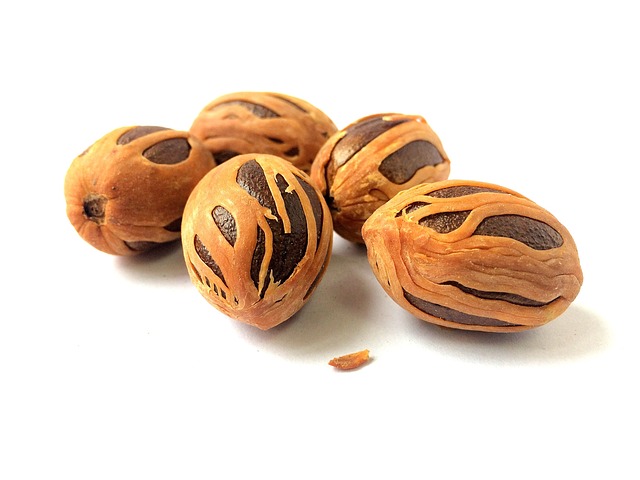
Whole nutmegs covered in mace.

Ground nutmeg was used as incense in ancient Rome.

One old remedy for rheumatism involved boiling nutmegs and cooling the resulting liquid. The nutmegs’ natural fats rise to the surface and cool, forming a solid layer. This is skimmed off and used as a topical balm. Nutmeg is a warming spice, so this would help encourage circulation and relieve some of the pain caused by cold weather aches.

Nutmeg can make you trip balls. This is not code language.
This spice is a hallucinogen, courtesy of a compound known as myristicin. Unfortunately, you have to consume a lot to feel the effects, at which point you’re putting yourself at risk of nutmeg poisoning. “A lot” is relative here — about 10 grams (two or so teaspoons) of ground nutmeg is about to trigger symptoms of toxicity. It’s not that much, but still way more than you’d typically use in cooking. Nutmeg poisoning is pretty awful, too. While I wasn’t able to find any stories of nutmeg-based fatalities, the cases I did find mentioned nausea, dizziness, heart palpitations, fatigue, confusion, and seizures. Yikes.

Nutmeg is associated with the element of Air, the suit of Swords in tarot, and the planets Jupiter and Mercury.

Using Nutmeg

The easiest way to use nutmeg is to make your favorite autumn or winter recipe that uses this spice for flavoring. Use a wooden or metal spoon to prepare it and stir it with your dominant hand. As you do this, picture energy coming up from the Earth, down from the sky, and running through your arm, down your hand, into the spoon, and finally into the food or beverage itself. Ask the nutmeg for help with whatever you want it to do, whether that’s getting laid or making some money. Pretty easy, bog-standard kitchen witchery, really.

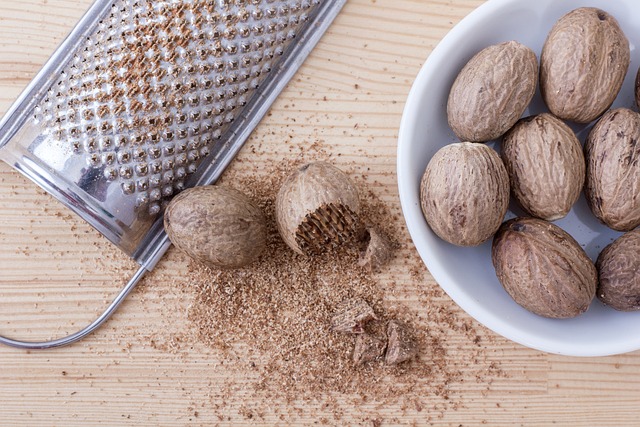
Whole nutmeg seeds, a nutmeg grater, and a little pile of ground nutmeg.

You can also use nutmeg by just… carrying it. As mentioned previously, whole nutmegs are a charm for luck and money. Wrap them in an appropriately colored cloth, anoint them with a suitable magical oil, ask them for their assistance, then keep them on you. When they get old and lose their potency, retire them by burying them in the soil and make a new charm with a fresh nutmeg.

You can also use nutmeg for meditation. I wouldn’t rely on it to induce a trance state, but drinking some warm milk flavored with honey and nutmeg can be a pleasant way to begin some meditative or journeying work. Just don’t use too much — the vast majority of nutmeg poisonings are from kids who eat it to get high and end up spending the night dizzy and throwing up instead.

Nutmegs are also good additions to charm bags or jar spells for money or luck. They’re very nice, potent, self-contained magical ingredients. If you have an assemblage of herbs, curios, and other tools, why not throw in a nutmeg? If you can’t afford a whole one, sprinkle in some of the ground stuff instead.

Nutmeg is a spice with a dark history (I mean, most of them have dark histories. Thanks, colonialism!). It’s preciousness as an incense and culinary ingredient has tied it to the concepts of luck and money, so you’ll most commonly see it in spells for financial abundance and good fortune. If you’re not a kitchen witch, a sprinkle of nutmeg can be a good place to start. If you need to practice magic discreetly, you really can’t go wrong with tucking a whole nutmeg in your bag or pocket.

Uncategorized

Time to prune the @#$% out of this apple tree.

I am not many things. An arborist is among them.

Unfortunately(?), with this house, I have become responsible for a smallish apple tree. I was excited to discover that it was a fruit tree when we first toured the place — there were a few sour greenish apples clinging to the scraggly branches. I didn’t know anything about apple trees, but this still seemed like a positive development.

I have since learned that apple trees are basically livestock.

I bought it a friend, a little Chehalis apple tree, so it could produce more fruit. I watered and fed it.

Like sheep, apple trees also need to be trimmed. Branches cross, or grow from weird, narrow angles, or jut straight up in the air. They weaken the tree, which sends its energy reserves to put leaves and buds on these branches that will inevitably snap in the wind and never bear fruit. They’re a source of illness, insects, and injury. In the event of some kind of apocalypse, it won’t take very long before it’s no longer fruitful — fruit trees as we know them have developed alongside humans, and we rely on each other for survival.

So that’s how I ended up on the internet looking up how to beneficially injure a small tree.

Narrow branch angles. Crossed branches. Watersprouts. I memorized what each one looked like, and how to best cut them. (At an angle, as close to the branch collars as possible.) Then, armed with a set of hedge clippers and a pair of saws, I trudged out to go sort shit out.

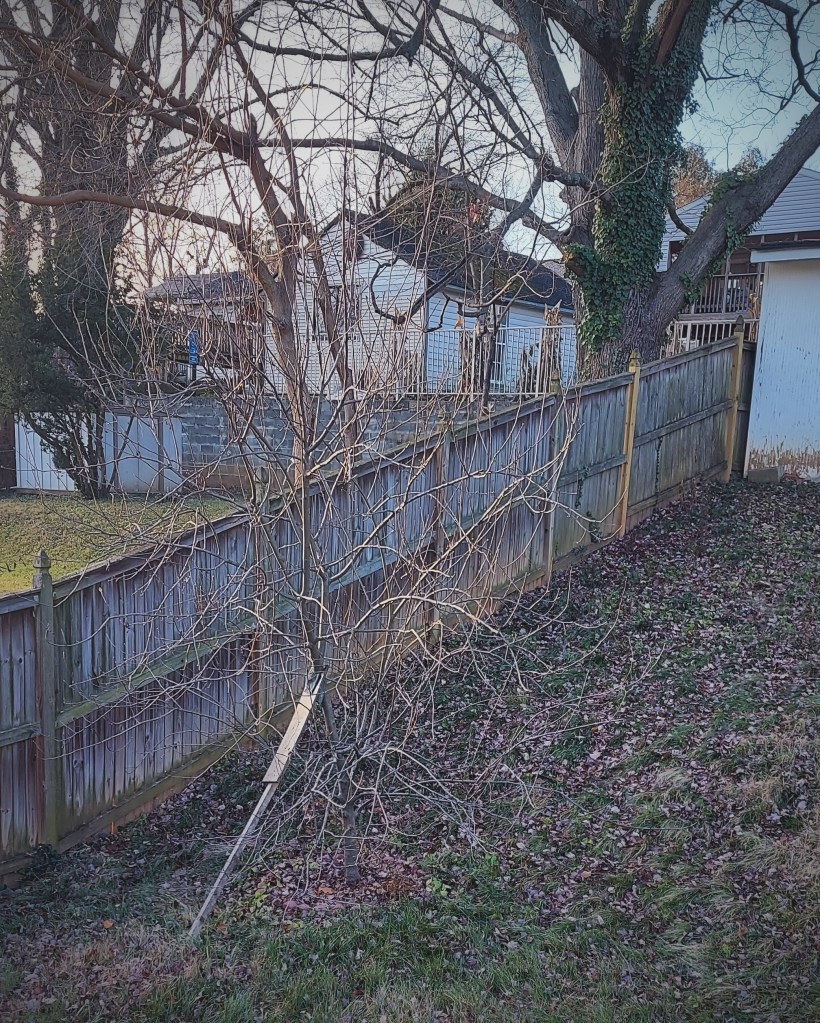
A dwarf apple tree that hasn't been pruned in years. It's winter, so the branches are bare.
Depicted: Fruit chaos.

I should note that I was not prepared for how much work it’d be. I figured it was cold out, so I dressed warmly — winter boots, my wedding sweatpants, a flannel, et cetera. Within minutes, I was stripping down.

The actual pruning process wasn’t too intimidating. The tree’s a dwarf, so it was easy enough to navigate the branches. I left some that I know I shouldn’t’ve, just because they were providing support for a wild grape vine that I’m hoping will return next year. Others, I either snipped with the clippers, or carefully sawed through while muttering apologies through clenched teeth.

If anything, the toughest part of the process was the anxiety. What if I cut something wrong, or that’d make it grow all weird? What if my tools weren’t clean enough, and I introduced some kind of disease into the soft, green wood? What if I was doing more harm than good?

When you’re climbing around under a tree and trying not to get cracked in the skull or speared through the eye with falling branches, it’s not the best time to start losing your nerve. I was projecting a lot of my own anxiety on the tree — I’ve been in a position where someone held me down and injured me, insisting it was for my own good, I know exactly how that feels — but maybe this wasn’t it. So, I did the tree-hugger thing.

I put my non-dominant hand on a robust branch and let myself fall into the xylem and phloem, breathing with the slow, wintry pace of the circulating sap. What I felt surprised me. There wasn’t really fear, though there was some pain. If I really had to describe it, it felt like what I imagine the cows in those hoof-trimming videos feel like. (If you haven’t fallen down that rabbit hole yet, you’re welcome.) Tension and relief. The acknowledgement that something is wrong, and fixing it won’t be fun, but the result will be worth it.

I’ll probably have to go back and do some more pruning, but I’ve got the bulk of it done. The problematic parts have been removed, so now everything else is just shaping and ensuring that the branches have enough space around them.

The end result remains to be seen. Hopefully, there’ll be plenty of apples next year!

life · Uncategorized

Sharpies, Spicy Crab Crepes, and Gratitude.

It is Thanksgiving.

I am on the landing of my stairs, stomach full of spicy crab crepes, mind whirling from xylene fumes, drawing esoteric symbols on the walls and wondering if I am half an orphan or just going to be expected to front bail money in the near future.

I’ve never really been big on Thanksgiving. Aside from its history as a holiday, I mostly associate it with being screamed at, having my hair yanked into shapes it was never meant to have, and dressed in stiff, uncomfortable clothing so I could go all of twenty feet downstairs to eat green bean casserole in my grandparents’ living room. The food was good, don’t get me wrong, and I love my grandparents, but I could’ve done without the rest of it.

As a result, my partner and I don’t really sweat it much. We have no big plans — if I’m feeling ambitious, I might make a turkey breast, stuffing, cranberry sauce, baked potatoes, and the like. This year, we figured it made more sense to just make a bunch of whatever we had in the freezer.
Mashed potatoes? Sure!
Peas? Okay!
Chocolate chip cookies? You bet!
Taco pizza, a thing I suggested when I realized I didn’t have mozzarella and only had shredded “Mexican blend” and figured I could also top a hot pizza with fresh tomatoes, peppers, lettuce, and salsa? Absolutely!

In the end, we said, “screw it” and had crepes delivered. They were open, it was early in the day, and neither of us were feeling hungry or energetic enough to go through the motions of putting together a Thanksgiving dinner. We didn’t have a turkey anyway, so nothing about dinner was going to be traditional.
Besides, crepes filled with spinach, avocado, and spicy shredded crab sounded incredible.

I did do my other annual traditions: I made a donation to the Mashpee Wampanoag people, and I called my grandpa.

“You talk to your mom lately?” He asked.

“No. I don’t. I haven’t in ten years or so,” I replied. It’s a conversation we have every time we speak. I don’t think it’s that he forgets — he just hopes the answer will be different each time. It isn’t. It won’t be.

That’s when he told me something strange. Every year, he’d sent her a check. Even though she doesn’t ever talk to him, she always cashed them. Except for the last two.

That tugged on my memory. A few months ago, I’d gotten a message from a distant relation. They’d talked to her for a while, then she’d just dropped off the map. Did I happen to know if she was okay? I didn’t.

Still on the phone, I messaged my ex-boyfriend. He was still friends with her on social media, chiefly due to a combination of morbid curiosity and a love of cringe comedy. No, he explained, she went from regularly posting her usual weird shit to dead silence since last February.

“Maybe she died,” my grandpa replied.

“I don’t know. Jail’s probably more likely,” I figured. She had a well-earned reputation for getting loud and shove-y when she drank, including punching her adult son in the face one evening after a funeral and slapping both of us around when we were small. After decades of not being either arrested or punched back, I wouldn’t be surprised if the world had finally gotten around to making her experience some consequences.

I’d like to say that I was concerned. That it gave me something to think about. Really, my mind could only go one of three ways: 1) She’d passed away or ended up jailed somewhere, and it was sad that she’d ostracized so many people and wasn’t able to pull her head out of her ass before that. 2) She’d gone silent in the hope that the people still in her orbit would feed her ego by vocally and publicly worrying about her. Or 3), she just didn’t give enough of a damn about anyone asking after her to bother to tell them that she was still alive.

It did put me back in the Thanksgiving spirit, though. I’m thankful that I’m not there. I’m thankful that I don’t have to deal with this in any but the most indirect of fashions. I’m thankful that my partner and I, despite not coming from the healthiest dynamics, have chosen and worked on having a loving, supportive, functional relationship. I’m thankful that JJ has finished her round of antibiotics and is experiencing a little stray kitten glow-up. I’m thankful that there will be taco pizza tomorrow.

And then I climbed to the top of my stairs, busted out a magnum Sharpie, and drew on my wall.

Uncategorized

Preseli Bluestone Folklore & Magical Properties

The minerals that I’m drawn to shift over time. For a long time, it was smoky quartz. I read all I could about it and discovered that the properties that it’s said to possess were exactly what I’d needed at that time. Next it was Herkimer diamonds, especially the black ones. Same thing. Recently, I’ve been exploring the stones that come from the areas that a significant portion of my ancestors hailed from, which is how I came upon Preseli bluestone.

Preseli bluestone is best known as the stone used to make the inner ring of Stonehenge.

To be fair, the Druids didn’t actually make Stonehenge — it’s way older than that. While the did use Stonehenge, they didn’t drag the stones there. Stonehenge was actually an evolving project, contributed to by various tribes over a very long period of time until it became what we see today.

Preseli bluestone originates in a specific area of Wales, a staggering 160 miles from Stonehenge itself. Now imagine doing it by walking, and also you’re pushing gigantic rocks. There had to be something special about these stones for them to be considered worth the trouble.

Stonehenge and Preseli Bluestone Lore

One theory is that people indigenous to the Preseli area migrated, taking the stones with them due to their religious or cultural significance or as a means of establishing an ancestral authority over their new homeland.

The ages of Stonehenge’s stones vary widely. One is over two and a half billion years old, while another is a relative youngster at only 800 million. If we were to shorten these years to mere seconds, the younger stone would be about 25 years old. The older would be over 79.

Parts of Stonehenge have been standing since roughly 2500 BCE. The site itself seems to have been abandoned around 1000 BCE.

Some of the stones have carvings on the surface — these are only visible using either lasers, or sunlight at a very specific angle.

The techniques used to create Stonehenge are pretty sophisticated. The lintels (the long stones on top) are locked to their supporting stones with a mortice and tenon joints, slightly smoothed, and connected to their neighbors with tongue and groove joints. Their supporting stones were leveled on the top to account for the changes in elevation of the ground, so everything sits very evenly. When all of the stones were intact, they would have looked like a continuous ring.

A close-up image of Stonehenge, showing two lintel stones balanced on four sarsen stones. The end of one of the lintels demonstrates the "tongue" portion of a tongue and groove joint. Some of the sarsens in the rear of the photo show nubby projections, which would've helped to lock their lintels in place.
If you look carefully at the end of the lintel on the left, you can see the tongue end of a tongue and groove joint. Look at the sarsens in the back, and you can see the nubby bits that would’ve held their lintels in place.
Photo by Kris Schulze on Pexels.com

One stone, the Slaughter Stone, probably wasn’t actually used to kill anything. It gets its name from the bloody appearance of water that collects on its surface — the water reacts with iron compounds in the stone, oxidizing them and turning the water a rusty color.

Preseli bluestone was said to be transported by Merlin, using magic.

The Ethicality of Preseli Bluestone

The original place where bluestone is found is Carn Meyne. This is a protected area, and is off limits to mining and rock collecting alike.

The Preseli bluestone on the market today ostensibly comes from a nearby farm, where a deposit of the stone was found. Others may come from specimens collected from Carn Meyne before it was legally protected.

With this in mind, there’s some concern that Preseli bluestone trafficking might be a thing. If the Pagan and new age communities’ demand for bluestone outstrips the supply, then it could incentivize the smuggling of bluestone or other unethical practices. It can already be challenging to find genuine bluestone, since green dolerite is sometimes re-labeled and sold as bluestone for a higher price.

As always, it’s up to you to decide whether or not to acquire bluestone. If you do, do so from a reputable dealer. If you find that you may be succumbing to some of the consumerist habits that lurk in aspects of the new age movement, consider whether a different, ethically sourced, local stone will better meet your needs.

Preseli Bluestone Magical Properties

The significance of bluestone to Stonehenge’s creators has been lost with time. The most we have now is what modern crystal users have deduced. For the most part, it’s used to tap into one’s ancient origins — connecting with the spirit of the peoples for whom bluestone was important. Some authorities believe that the bluestones of Stonehenge may have been used as healing tools. While the larger, outer sandstones marked a boundary, the smaller interior ring of bluestone may have been used to heal the sick and injured.

It’s also sometimes used in variants of shamanism to strengthen one’s connection to the spirits of the lower world, those of plants, animals, and the elements.

Some use bluestone as a kind of spiritual anchor. This may be due to its connection to ancestral workings. When you feel unfocused or adrift in life, working with Preseli bluestone is said to help re-instill feelings of connection and direction.

It’s important to note that Stonehenge also, at least at once point, served as a burial site. I feel this gives Preseli bluestone a connection to death and the dead, not necessarily in a purely ancestral way. Stonehenge was also designed to align with the movement of the sun. This, plus Preseli bluestone’s green color (when polished — the rough stone is blue) further connect it to the energy of growth and abundance. When you combine these concepts, it’s a stone for understanding the cycles of life, death, and the recycling of energy and nutrients.

I find Preseli bluestone to be uniquely beautiful, even beyond its magical and historical pedigree. It’s a beautiful mottled green and white, almost like a dendritic agate without the branching. As someone who will likely never get to experience Stonehenge in person, I love that it’s still possible to forge a connection to the ancient people who created it.

Just for fun · life

“Get in, loser. We’re going shopping… For DEATH.”

The Dadlands.

A barren, scorched landscape populated solely by… dads. There are different tribes of dads, from the grill dads and their seared meats to the travel dads and their ability to leave early and make good time.

Sunday night, we heard their story.

The Dadlands is a one-page tabletop RPG, something like Dungeons & Dragons. Unlike Dungeons & Dragons, you don’t really have to have a character sheet, dice, or desire to be a part time volunteer accountant. No. Instead, you make your own dad and strap on a fanny pack with red and green tokens. Red ones represent chaos, like the chaos of setting off illegal fireworks or jury-rigging something with electrical tape. Green ones are order, like going the speed limit or setting an early bedtime.

Every action is decided by pulling a token at random, without looking. If you pull the correct corresponding token(s), the action is success-

Honestly, you can probably just read the rules right here.

Anyhow, we went to go see The Dadlands live one-off at the DAR Constitution Hall in DC. (It’s a lovely venue but get a ride there — trying to park would be a nightmare.) Brennan Lee Mulligan was the DM, while the McElroy brothers and dad were the Dads. I won’t give away the story here, but I will say that they introduced a mechanic that required the players to play cornhole, and it was the most suspense I think I’ve ever felt in my life.

(There was also a rousing chant of “CORNHOLE FOR YOUR SOUL” at one point.)

It got me thinking, too. I have access to a yard now. I have power tools. I could make a cornhole board.

I could print the Dadlands rules.

I could rustle up a handful of fanny packs and some tokens.

… I’m going to have a Dadlands party.

Cosplay would be optional, of course, but recommended.
It’s also pretty easy to Get the Look:

A pair of white New Balance sneakers, white athletic socks, a pink floral Hawaiian button-down shirt, a white tank top, a pair of khaki shorts, and a black fanny pack.

Refreshments would be barbecue and a variety of canned beverages. Crispy Stellas, Buds, Coke Classic, Liquid Death, the works.

Now I just need to figure out who in my social circle has a secret Dadliness in their heart. Gender doesn’t matter — it isn’t the Dad on the outside, it’s the Dad on the inside that counts. As Rory Powers once said,

You don’t need kids

To be a Dad

You don’t have to have a penis,

Or even be a man,

You just need Levi jeans

And to be a little drunk, yeah!

It’s a Dad Squad, it’s a Dad Squad!”

This Paranormal Life, episode #271: The Legend of Momo – The Monster that Terrorised Missouri

I’m gonna find a Dad Squad and make them play cornhole to survive a post-apocalyptic hellscape, and it’s going to be amazing.

life

JJ’s Bizarre Adventure.

My partner and I have been looking at getting a third cat.

This is partially due to the very particular ways in which Kiko and Pye can’t stand each other — he’s a gigantic, friendly doofus who is simultaneously desperate for Kiko’s approval, and incapable of understanding that she does not want to play with him. Kiko is intimidated by Pye’s size, and also obsessed with baby cats of any description. So, we figured a young cat would help by either being a buddy to Pye (or at least redirect some of his misplaced desperation for buddyship) or be a companion for Kiko. We figured a young cat would be best, because then they’d have an easier time fitting into Kiko and Pye’s profoundly weird dynamic.

I’d even done a few tarot readings on the subject. Everything seemed to look good from that end, though the cards warned me that it’d involve a flurry of activity and very rapidly-changing situations before a happy ending.

Our search started with DC’s humane association. They had (and still have!) a good selection of kittens right now, even though summer is generally considered the “height” of kitten season. We picked out one boy, a little orange and white tabby, and put in an application. Everything sounded good — he’s friendly, affectionate, playful, and unlikely to bogart Pye and Kiko’s shared braincell. Perfect!

His fosterer emailed us back promptly. She was happy to schedule an online meeting to talk about him, but, she warned us, he has a 50/50 chance of having megacolon. While not fatal, megacolon can be a somewhat difficult condition to manage. It often requires expensive prescription diets, or even surgery to remove the affected portions of the colon. No problem, we figured.

The meeting had to be rescheduled when the fosterer got sick. Communication fell by the wayside for a little bit. We thought he might be a “foster fail” — he sounded like such a sweet little guy, and his fosterer obviously wrote about him with great affection. We figured we’d wait a little longer before emailing again.

That’s when I got a message from my ex. We’re still on very good terms; we split up because he wanted to settle down and have kids, and I didn’t. He’s married a great lady and had two adorable children, and I’m living the lifestyle and pursuing the goals that I want, too. Most of our messages consist of shitposts, which is why I was kind of surprised when he said he’d found a kitten.

A tiny kitten. A sick, skinny kitten. Wandering the street.

“Are you going to keep it?” I asked.

“I can’t!” He replied. He’d adopted a second cat not long before — adding a third, sick cat would be too much. They were going to take her to their local human association.

“dogg i will legit drive up there and adopt this tiny cat,” I immediately typed back.

And that’s how my partner and I found ourselves driving for three hours round-trip to go pick up a tiny, sneezy laploaf.

A small gray tabby kitten sits on the lap of a person in gray jeans and a green hoodie. They are in the back seat of a car.

She’d wandered up to the family while they were walking outside. She was cold, wet, and meowing for food. Her eyes and nose ran with discharge, and her belly was round and swollen. Once they got her indoors, she seemed to be equal parts ravenous and exhausted.

Taking her home was an adventure. She sat on my lap, teething on my ring in between curious looks at my partner and me. It was a long trip for such a little nugget, but she handled it well. She watched the wet trees go by through the window, gazed wide-eyed at the taillights of cars disappearing down the highway, and kneaded my knees with her paws.

My ex’s son called her JJ, and they initially thought she was a he. We still call her JJ, though that’s been the jumping off point for a constellation of ludicrous nicknames. She has what are probably worms and an upper respiratory infection (and what will probably be an expensive vet visit this afternoon), but she’s friendly, playful, and very curious. She hates when you go in the bath without her, hurls herself into laps with wild abandon, snoozes happily in my arms, and is enraptured by YouTube cooking videos. I call her “JJ Jetplane,” because she purrs like the engine of a 747. We haven’t introduced her to the other cats yet, though they’ve had a few sniffs and glimpses of each other. We’ll see what the vet says about her (specifically, how contagious she is) and go from there.

She’s a sweet, precious baby, and she has already learned how to have me wrapped around her tiny black beans. She taps my leg to be picked up and cuddled and argues with me with the smallest meows — more like a nearly soundless “keh” than an actual meow. I’ve lit candles, petitioned gods, and crossed my fingers that everything goes well on Monday, but we’re going to do the absolute best we can for her no matter what.

Environment · life · Neodruidry · Plants and Herbs

Persimmon Foraging Quest

Hello! If you’ve been reading here for a while now, you may have come across the Persimmon Quest.

This is an annual quest my partner and I go on every autumn. We call around or visit grocery stores in order to find out who actually has persimmons (preferably the astringent kind, but non-astringent will also do). Then, we purchase and eat massive quantities of persimmons.

The first time I had one was when I still lived in California. It was a Fuyu persimmon (Diospyros kaki), crunchy and sweet, and I was sold. When I had my first perfectly ripe Hachiya, like a water balloon filled with sweet, flavorful jelly, I was smitten. When I realized that one of the trees planted here by one of the former occupants was probably a persimmon, I was ecstatic.

A Druidry group I belong to recently offered a small foraging expedition. One of our members is a biologist, and he’s kind and generous enough with his time to lead seasonal foraging walks. Last spring, we hunted for ramps. Now that it’s persimmon season, we went to track down some trees.

And oh, did we ever.

Three bags of soft, bright orange American persimmons, along with a sprig of coralberry and some dried mountain mint.

Several of them were already bare, picked over by wildlife and wind. Some were still laden with fruit that fell at the slightest touch. We picked only the ripest, squishiest ones, leaving the rest to soften in the sun and feed other things.

My partner and I came away with several pounds, which I cleaned and froze for future use. They’re very different from Japanese persimmons — we snacked on a few as we foraged, and it was striking just how much the flavor seemed to vary from tree to tree. American persimmons (Diospyros virginiana) are most similar to Hachiya-type Japanese persimmons, in that they’re very astringent before they’re ripe. When they look like they’re nearly rotten, they’re at their best.

Most of the ones I tasted were almost floral when compared to a Hachiya. Still very sweet and soft (with a slight astringent bite in a few places), but floral like lavender lemonade is floral. The comparatively large seeds got in the way a bit, but I’ve read some interesting recipes for roasting and grinding them to make a coffee substitute. As someone who doesn’t drink coffee, I’m intrigued! If I can get a foraged equivalent for Dandy Blend that isn’t dandelion root, I’ll be excited.

I haven’t yet decided what to do with the persimmons themselves. I might separate the seeds and pulp, then freeze the pulp again in an ice cube tray. I figure, if I want to add them to smoothies, sauces, or desserts, I can just thaw out some cubes of prepared persimmon mush fairly quickly and easily. I could even pop a cube or two in a jar for making persimmon kefir. (One member of the group was considering doing fruit leather but based on my experiences trying to make strawberry leather in the oven, I don’t think I want to tackle that without a dehydrator.)

There was a lot more to see than just persimmons, too. Dogbane (Apocynum cannabinum) with its stringy bark (good for stripping and braiding into twine). Horsenettle (Solanum carolinense) with its bright yellow, tomato-like, deceptively delicious-looking poisonous fruits. Fragrant tufts of mountain mint (Pycnanthemum muticum), gray and brittle with age. The most striking were the coralberries (Symphoricarpos orbiculatus), their tiny, bright magenta fruits standing in vibrant contrast to their bright green leaves.

I found these berries particularly intriguing. As it turns out, they’re a valuable native food plant for birds, grow in shade, can stabilize banks, don’t have any major pest or disease vulnerabilities, and thrive on neglect. I’m still looking for native/non-invasive plants to help feed the yard’s hard clay soil and reverse some of the damage from supporting a lawn, and coralberry fills a very important niche here. From what I have read, coralberries aren’t of much value as food for humans. That’s okay, though. Not everything in the yard has to — or should — be for me to eat.

Plus they are so pretty.

I’m considering growing some mountain mint, too. Like other mints, they can take over a yard. Since they’re a native plant, I think it’ll be easier to keep them at a reasonable level than, say, the old peppermint that’s slowly eating part of the back yard. Interestingly, it’s closer to bee balm (monarda) than it is to peppermint, and there’s a faint bee balm-ness to its scent that gives that away. Mountain mint also attracts an incredible variety of native pollinators and predatory wasps, and is both edible and medicinal. Medicinally, it’s treated almost as a panacea — it’s considered a digestive, carminative, emmenagogue, expectorant, and more, though I haven’t thoroughly researched the active constituents myself yet. If it can serve as a home-grown, native substitute for peppermint tea, I’ll be all for it. The flavor does lead me to think that it’d be great for seasoning poultry or wild game, and I’m eager to try.

That’s what I love about foraging trips. Not only do I come away with tasty food, but I also get a better idea of ways to try to heal the land I’m now responsible for. Seeing a wide variety of native plants shows me what this patch of grass could be and tells me how I can help it get there. I’m excited!

life · Neodruidry · Plants and Herbs

So I says to the maple tree, I says…

A big part of permaculture is observation.

You don’t just test your soil, see where the sun hits, then plant a bunch of things. It’s a slow progression during which you watch the land to see what grows where, how it thrives, and who visits it. You let the dirt tell you what it wants and meet it in the middle, so everyone gets to eat and thrive.

I figured one way to help this process would be to just… well, ask. I took myself, an offering, and some incense, and climbed up the hill to the big red maple in the back yard. There’s a perfectly butt-shaped arrangement of some of its roots near its base, so I settled myself in, rested my back against the trunk, and let myself kind of fall into it.

It’s a process that’s hard to describe — if pressed, I’d say I “breathe” along with the tree. This is probably a bit hard to conceptualize since trees don’t breathe the way we do, but gentle breathing and just feeling things out for a while seems to put me into a very comfortable looping sensation. I feel the water moving up the xylem, sap flowing through the phloem, waste moving back down to excrete into the soil through the roots. I feel a sympathetic flow from my feet to my head, then back down and into the soil. Sometimes, this is just a way to relax and get out of my own head (and into a consciousness that’s very alien to my own). Sometimes, it’s a helpful way to get information.

In this case, I got a lot of messages about water.

I wasn’t really surprised — red maples have shallow, spreading root systems and produce “dry shade” under their canopies. The soil here is heavy clay, and there’s a fairly steep hill. There’s also a ton of non-native grass and not much biodiversity. The angle, hard, slick soil, a tree that blocks rainfall to the ground, and thirsty, high-maintenance grass made the water messages make sense. It doesn’t look like a desert, but it’s a place that just feels subtly thirsty.

I left the experience resolved to put in more ways to catch rainwater — barrels, a stock tank, something. I wasn’t sure what else to do. What else could this water-hunger mean?

Flash forward to Pagan Pride Day. At one point, I sat for a tarot reading. It was full of “wild hares” — cards that seem to leap from the deck unbidden, as if demanding to be part of the reading, without anyone having to draw them. The resulting message was one of herbs, plants, and a figure that would help me realize my vision.

“Neato,” I figured, and didn’t think much of it.

Flash forward a bit further. My partner and I are at a hardware store to return a defective trowel and buy more mulch with which to murder the front yard. While he gets it, I browse the shrubs outside. There’s a triangular gap between the house, porch, potted rose bush, and rue plant that I’d like to fill with something tall and fairly thin. A voice asks me how I’m doing, and if I need help with anything. I look up to see an older man in a purple shirt. He’s the plant supplier for the stores in this area, he says. We end up having a long conversation about plants, soil, pH, sunlight, tattoos, and taxes. He tells me that the heavy clay is trouble. Without organic matter, it’s too compact for roots to penetrate and doesn’t absorb water well.

What I need, he says, is leaf compost.

And there it was again. The way to get more water isn’t just to trap it, it’s to undo years of raked leaves and monoculture. Layers of compost (good thing I have a big tumbler), paper, yard waste, and shredded wood. Part of the reason the red maple’s roots jut up through the grass is because the clay makes it difficult to exist otherwise. There’s no softness, no air space, no absorbency, no acid.

We’re layering rotted leaves and shredded wood over the clay now. Sprinkling it with mushroom spores and seeds that will sleep in the cold until spring. Eventually, we’ll get there.

Uncategorized

Delicious. Finally some good f***ing direct action.

Following the controversial decision to throw foodstuffs on artwork, it looks like Just Stop Oil’s stepped up their game.

Good!

I was critical of the action that involved throwing soup on a Van Gogh, and I stand by my initial impression. Fortunately, Just Stop Oil’s more recent actions seem to be more efficient and on-target.

Protests that block traffic are enraging to motorists, but they should be. Inconveniencing people is an effective way to cause change — if nothing else, someone may think twice about taking their car if they’re going to be stuck in a protest-triggered gridlock for hours. There are other advantages to this kind of action over the museum stuff, too. For one, you don’t have security seconds away, so you have more time to get your message across. Second, there’s a direct connection to cars, car-centric city planning, and the fossil fuel industry, so it makes it easier to get your point across efficiently. The medium does at least a little bit of communicating for you.

One article pointed out that a woman with a sick child screamed at the protesters to let her through, and I can’t imagine how scared and angry she and her child must have been. I wish I had a better solution that would get people the care they need during an emergency, while still allowing protesters to demonstrate effectively. The truth is that the protesters probably aren’t the root of the problem here — protesters blocking roads get out of the way for ambulances and emergencies. The primary issue is all of the other cars creating the traffic that’s being blocked in the first place.

Two members of Uprising of the Last Generation also staged an interesting protest that, in my opinion, seems to bridge the gap between effective communication and attention-getting. They glued themselves to the metal poles supporting a dinosaur skeleton (don’t worry — most of the skeletons actually on display in museums are plaster models made to look like fossilized bone. Actual fossils are delicate, heavy, and usually incomplete). The message was that dinosaurs didn’t survive a climate catastrophe, and neither would humanity. It still runs into some of the same issues as other museum-based protests, but there aren’t a ton of layers between their target and their objective that could cause parts of their message to be lost.

This isn’t to say that I necessarily trust some of the financial backers of these efforts. While it’s true that a rich person can inherit a large sum of money and use that in order to fight against the thing that gave them the money in the first place, this feels disingenuous when they choose to, for example, retain enough to “buy and sell high-end properties the way the rest of us buy shoes.” This isn’t to say that oil heirs should have their wealth confiscated and automatically be consigned to cardboard boxes, but maybe living in one, regular house and throwing more monetary weight behind the causes they purport to care about would be a good start. Go big or go home.

The news cares about the wealthy and recognizable0. Hunger strike until you get to talk to a head of state. Handcuff yourself to something. Spraypaint the facade of an oil company’s corporate office. The rich and famous could attract more attention through direct action than a hundred members of the general public. If you’re gonna go to town, might as well go in style. As long as members of hoi polloi are the ones sacrificing their safety and freedom, it’s too easy for the media and social networks to paint them as melodramatic and delusional.