life · Neodruidry · Plants and Herbs

Increasing Landscape Resilience with Native-ish Plants

Hello! It’s April, it’s going to be almost 90° F this weekend, and winter skipped us.

Well, we had like one cold week, but that was it.

Honestly, it’s had me worried. A number of plant species that are native to this area require cold stratification — in other words, they need a period of cold and some pretty big temperature swings in order to trigger them to germinate at the correct time. This includes a tree that’s very important to me, the bald cypress. They’ve evolved to need cold stratification because without it, their seeds could germinate far too early and die off in the middle of winter.

I have packets of seeds that I want to plant, too, that need to be sown within a narrow window of time. I’m talking when temperatures are cool (but not too cool), usually right around the last frost date. The trouble is… like I said, it’s going to be in the high 80s this weekend. Our official last frost date was a few days ago.

Now that I’ve gotten my complaining out of the way, there’s an idea I’ve been exploring.

I first ran into it when I was researching native hydrangeas. I love hydrangeas in general (my grandfather had a big hydrangea next to the house I grew up in, alongside a strangely persistent and hardy opuntia cactus), but they’re not really known for their heat tolerance. They are, by far, not the only plants that are going to suffer as temperatures increase either.

A hand touches a cluster of purple Hydrangea macrophylla flowers.

Smooth hydrangea (Hydrangea arborescens) is native to this area. They also prefer daytime temperatures in the 70s and require supplemental irrigation when it gets too hot and dry.

Oakleaf hydrangeas (Hydrangea quercifolia) are native to the Southeastern United States. In other words, they’re from the US, just a bit lower than where I live. Changes in average temperatures are expanding the range of some southern plants and animals, while driving others further north.

Unfortunately, there’s not much that a single person can do to keep their cool temperature-loving plants from suffering from this effect. It’s also debatable whether we should — landscapes are ever-changing and evolving, and state borders are artificial constructs that plants and animals don’t recognize. It may increase the resilience of the landscape to work with this shift, rather than against it.

For this reason, I’m experimenting with oakleaf and smooth hydrangeas. Experts point out that this area’s climate is slowly aligning with species that used to be relegated to more southern states. Blending some Southern species with Midatlantic species could help create a plant, animal, and fungal community that’s more resilient to climate change, and decrease the need for supplemental irrigation or treatment for diseases related to heat stress.

Saving seeds from the individual native plants that seem to struggle less with the heat can help their species adapt over time, which will feed and protect the native animal species that depend on them. Adding in native-ish species from a bit further south can help the land adapt. It also ensures sources of food and nesting sites for the animals that are also being driven north as temperatures rise.
crystals

Andara Crystals — What are they, and what’s their deal?

There are a number of stones in the gemstone trade that are referred to as crystals, when they really aren’t. Some, like art glass, don’t have a crystalline structure. Others might be mineraloids, which also lack a crystalline structure. All of this is to say that a fair amount of “crystals” aren’t really crystals at all.

With that out of the way, let’s look at Andara crystals. These are often brightly colored, very fancy-looking clear stones that are purported to have a ton of healing and metaphysical properties (and fetch correspondingly high prices). But what are they, and why are they controversial?

What are Andara crystals?

Andara crystals are said to be natural glass which comes from a handful of specific sites in northern California and Nevada, which are the foci of particularly high-energy vortices. These crystals come in every shade of the rainbow, and fans say that they can heal, balance the chakras, raise vibrations, and more. Some even claim that they’re the philosopher’s stone of legend, or an ancient healing tool used in Atlantis.

These stones are said to contain etherium, which is a blend of 70 different minerals. Some are listed as monatomic, which refers to substances made up of elements that naturally exist as a single atom.

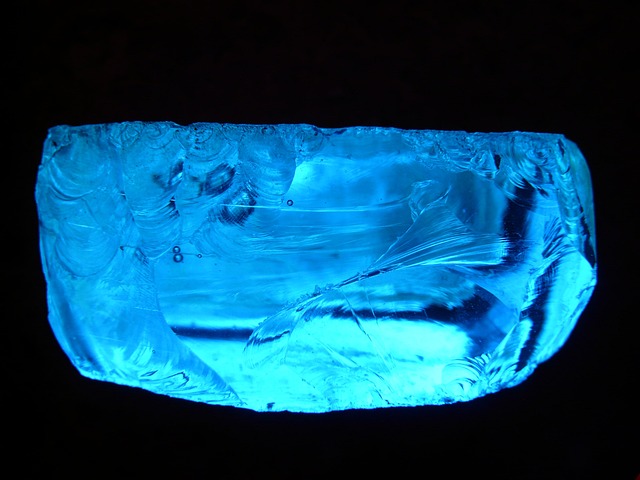
A chunk of blue glass on a black background.

Okay, so why are they controversial?

Andara crystals are controversial for a few reasons. For one, they’re not crystals. They’re a type of glass.

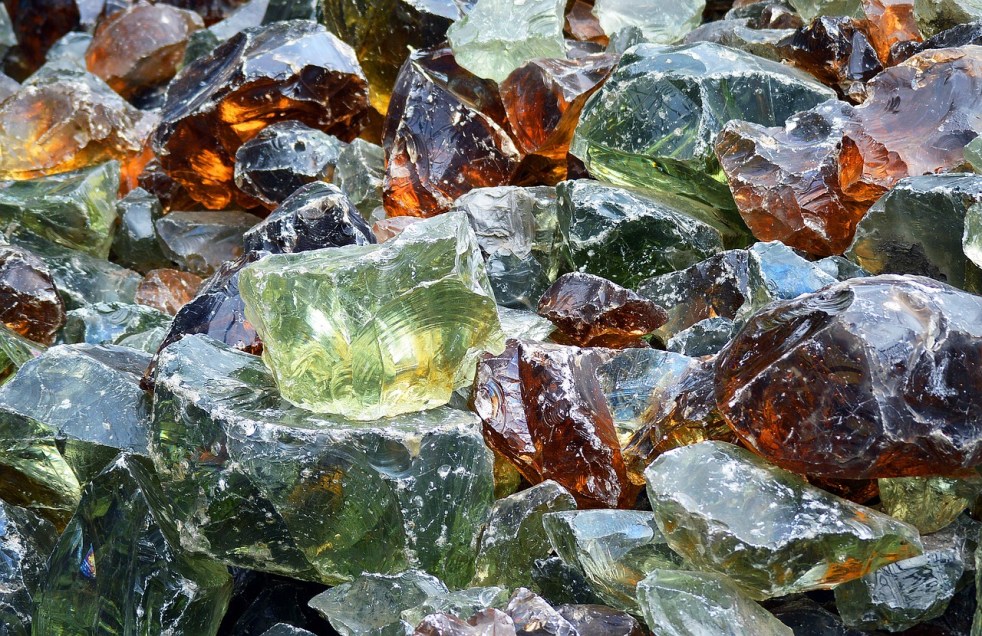
For two, they’re not natural (as in, formed by nature). Andara crystal deposits correspond to land dumps of slag glass from manufacturing. They look like slag, and their chemical composition correlates to soda lime glass, of the type used to make bottles. It doesn’t resemble other forms of natural glass, like obsidian or moldavite. The chart in this post gives a pretty thorough breakdown.

The funny thing is that some sellers extol the virtues of Andara crystal and claim that part of its specialness lies in its dissimilarity to other natural glasses. Yes, of course it’s not similar to them — because it’s soda lime glass.

Selling Andara crystals as a natural product is a bit like selling beach glass and claiming it was formed by nature. It may have been shaped and influenced by it, but it’s a man-made material at its heart.

The controversy doesn’t like in Andara crystal’s man-made origins, however — it’s because it’s literally a manufacturing byproduct. Chunks of slag glass get dug up, cleaned off, labeled with a lot of healing and metaphysical properties, then sold for sometimes hundreds to thousands of dollars.

This has caused trouble with not only buyers, but also dealers. When you’re selling something indistinguishable from a chunk of broken bottle, it becomes a race against “counterfeiters.” (I use “counterfeiters” here because the counterfeits are, again, indistinguishable from the alleged genuine articles.) This has led to dealers claiming that their glass is the only true Andara crystal, and dealers selling specimens back and forth to each other — accompanied by certificates of authenticity.

The Emperor’s New Crystal

Is it bad to use a man-made material for metaphysical, spiritual, or even energetic healing purposes? Not necessarily. I honestly love the idea of using slag glass this way, because it removes manufacturing waste from the environment and gives it a second life.

(A crystal — any crystal — isn’t going to take the place of the services of a competent medical professional. If you need insulin or to have a tumor removed, there is no stone that will make that not be the case anymore. I’ve used crystals to get relief alongside conventional treatment and complementary therapies, but I’m not out here trying to cure pseudotumor cerebri by rubbing rocks on my head.)

But here’s where we get into what I think of as the Barmicide Feast of crystals — or, if you prefer, the Emperor’s New Crystal.

It’s true that developing your own personal associations is important for any magical or spiritual tool. I have stones I work with that I love, but other people don’t get anything from. Other people have crystals or herbs that they love, but I get nothing from. These relationships shift and evolve over time, and that’s good and fine.

Unfortunately, some proponents of Andara crystal have used this as a selling point in a way that’s, frankly, kind of gross. They attach long lists of metaphysical attributes to this glass, then claim that only the special and spiritually evolved can feel or access them. If you see the slag for what it is — slag — then you need to get on their level.
See? Nasty.

The biggest problem here is that they’re exploiting a grain of truth to build up the cachet of a manufacturing byproduct in order to charge exorbitant amounts of money for it. They’re not wrong when they say that not everyone can experience the energy of a stone — even glass. The shitty part comes from using this exclusionary tactic to get money from people who want to be part of the in-group. Vulnerable people who want to feel that special energy, to feel elevated and included, and are willing to pay for it.

The underlying message is that when you compliment the Emperor’s gorgeous robes and rave about Barmicide’s pistachio-fed lamb cutlets, you, too, can be spiritually evolved.

Again, the shady part isn’t using (or even selling) soda lime glass as a magical or spiritual tool. The shady part is overcharging for a common, inexpensive material.

If you have and use Andara glass, that’s wonderful. My only advice here is, if you feel drawn to it, use this as a starting point to unpack your relationship with crystals. What’s different about that soda glass versus other materials that are around you? If it’s its place of origin, consider visiting this energy vortex and experiencing it for yourself — you might find a piece of regular quartz or some other mineral that gives you just as much, but you won’t have to overpay for it. If it’s the metaphysical claims and the experience of buying the stone from a dealer, then that may be something worth exploring further.

Environment · Plants and Herbs

Dead Nettle Folklore and Magical Properties

’tis the season for deadnettles!

If you have any semi-neglected patches of ground in your life, you may have seen them — short plants with heart-shaped leaves, arranged like low towers accented by tiny flowers. Though they’re not native to this area, they’re pretty abundant. If you’re into controlling invasive plants, you’ll probably be happy to know that they’re also delicious edibles!

Don’t let the name fool you. Dead nettles aren’t poisonous, and they’re not nettles. They’re called “dead nettle” because they look an awful lot like stinging nettle, but their leaves are stingless. In reality, they’re part of the mint family (which probably explains their prolific growth and ability to thrive pretty much anywhere).

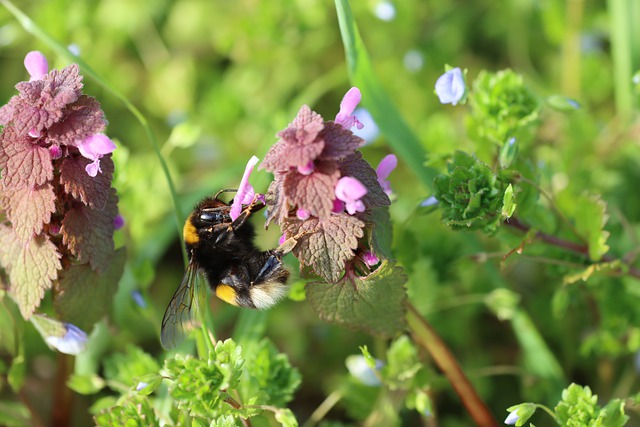
A bee enjoying some soft pink dead nettle flowers.

One of the best things about these nutritious plants? They’re easy to identify and don’t have any poisonous lookalikes. They’re also useful in all kinds of other ways.

Dead Nettle Folklore

Medically, purple dead nettle is used for allergies. It’s rich in quercetin, and has anti-inflammatory properties that make it useful for people with spring hay fever.

Some areas call it purple archangel, because it appears there around the Feast of the Apparition (May 8th). This was when the archangel Michael was said to have appeared on Mount Gargano, Italy, in the sixth century.

White dead nettle is sometimes called bee nettle. This is because it provides an early source of pollen and nectar, so it’s very popular with bees (and children! Kids sometimes suck the nectar from white dead nettle flowers, kind of like how kids used to suck the honeysuckle flowers that grew on the elementary school’s fence when I was little).

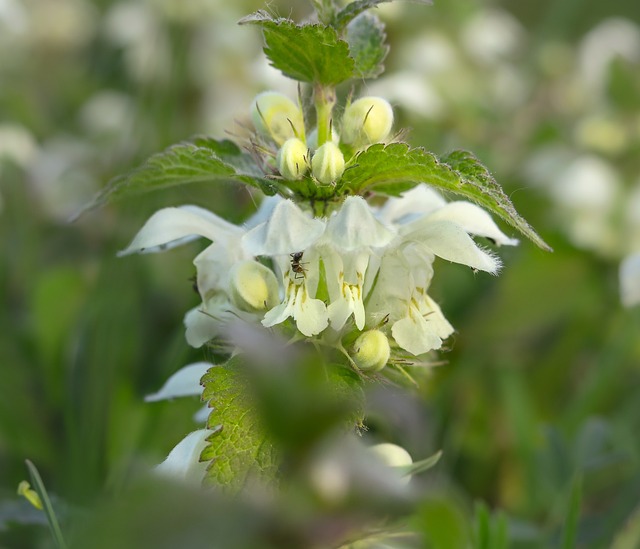
Some white dead nettle flowers. A small ant is crawling inside of one of them.

In Lancashire, it was said that white dead nettle flowers always come in twos, because they’re actually pixie shoes that have been left outside. These flowers also have two black spots inside, which are sometimes called “Cinderella’s slippers.”

White, spotted, and purple dead nettles are all used to treat stings from actual nettles. Mash the plant, squeeze out the juice, and apply it to the stung area. You can also chew some of the leaves and apply the resulting paste.

Magical Properties of Dead Nettle

Dead nettle is associated with determination, due to its ability to grow pretty much anywhere. (I’ve been harvesting it from cracks in the concrete, here.) It’s also connected to happiness, optimism, and relief.

Bright pink dead nettle flowers.

Like other members of the mint family, it dries well. Harvest some, hang it upside-down, and put a paper bag around it to keep off dust and catch any dropped leaves or flowers. Once you have some dried dead nettle, you can use it in teas, incense blends, sachets, poppets, jar spells, or pretty much anything else. This small, unassuming herb is fantastic any time you need a hit of joy and motivation.

Dead nettle is also useful in kitchen witchery. Add it to soups, salads, or even pesto to benefit from its magical and anti-inflammatory properties.

This plant also works wonderfully in tinctures, salves, and oils. This is a great way to preserve it well beyond its season.

For now, I’m pulling it out of my raised beds to prepare them for other things. Some will be left for the birds (chickens, especially, seem to love the stuff), and the rest will be brewed into tea, blended into smoothies, eaten fresh, dried, and pureed and frozen in ice cube trays to add to soup or fill out pesto!

Blog · crystals · life

“Fine, but I’m not getting any more rocks.”

I knew it was probably a lie the moment the words left his lips.
Still, I didn’t really intend to buy anything, I just wanted to go to the local mineralogical society’s mineral and gem show for kicks. We didn’t have any other plans, it was close by, and tickets were like six bucks. Why not?

I’ve also wanted to learn more about our local geology. Maryland has an interesting state mineral called Patuxent River stone, which is a form of agate that I think is a lovely, almost luminous color. I really want to find some in the wild, but the minerals I’m most likely to encounter where I am are white quartz, mica, beryl, and serpentine.

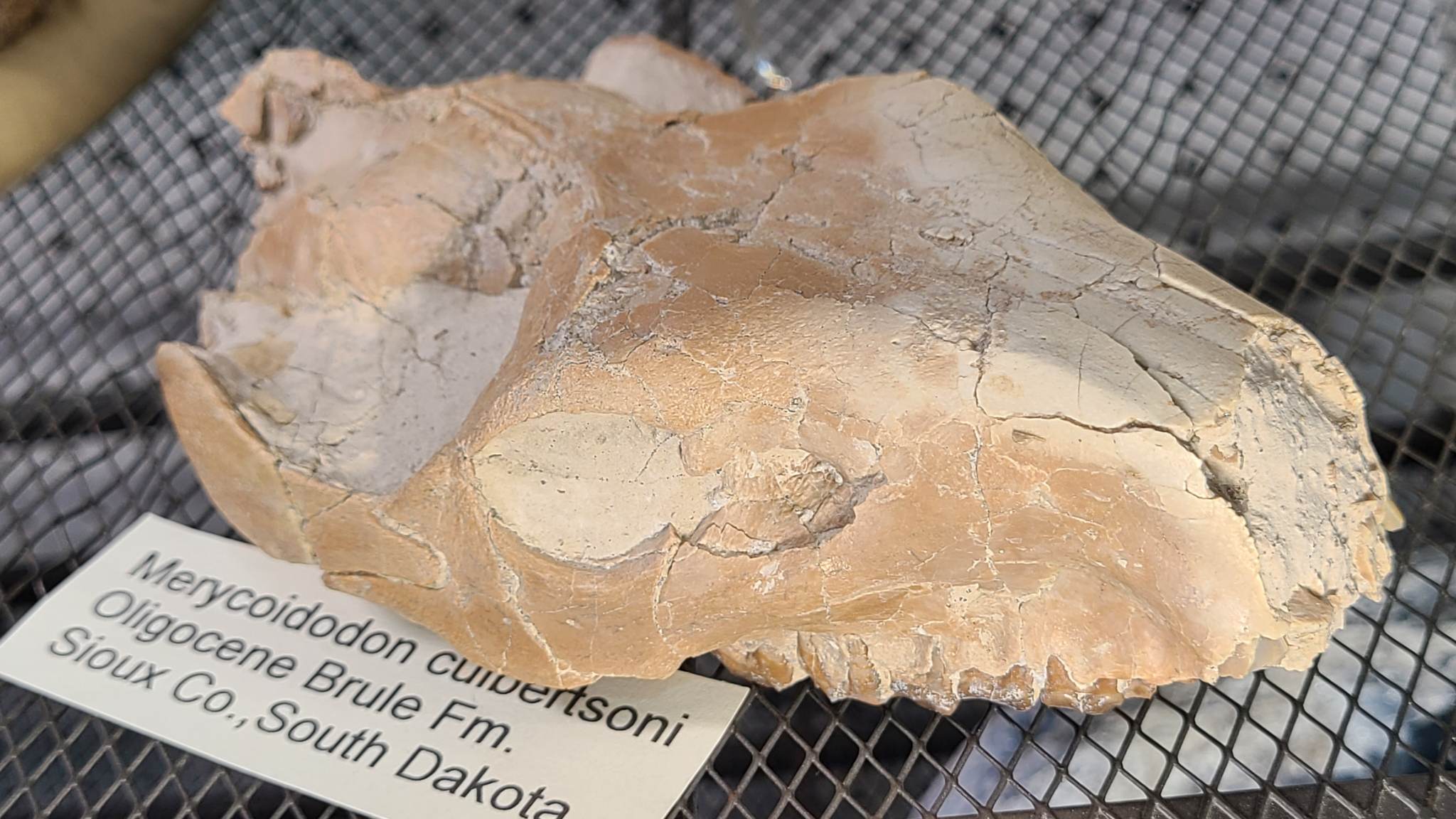
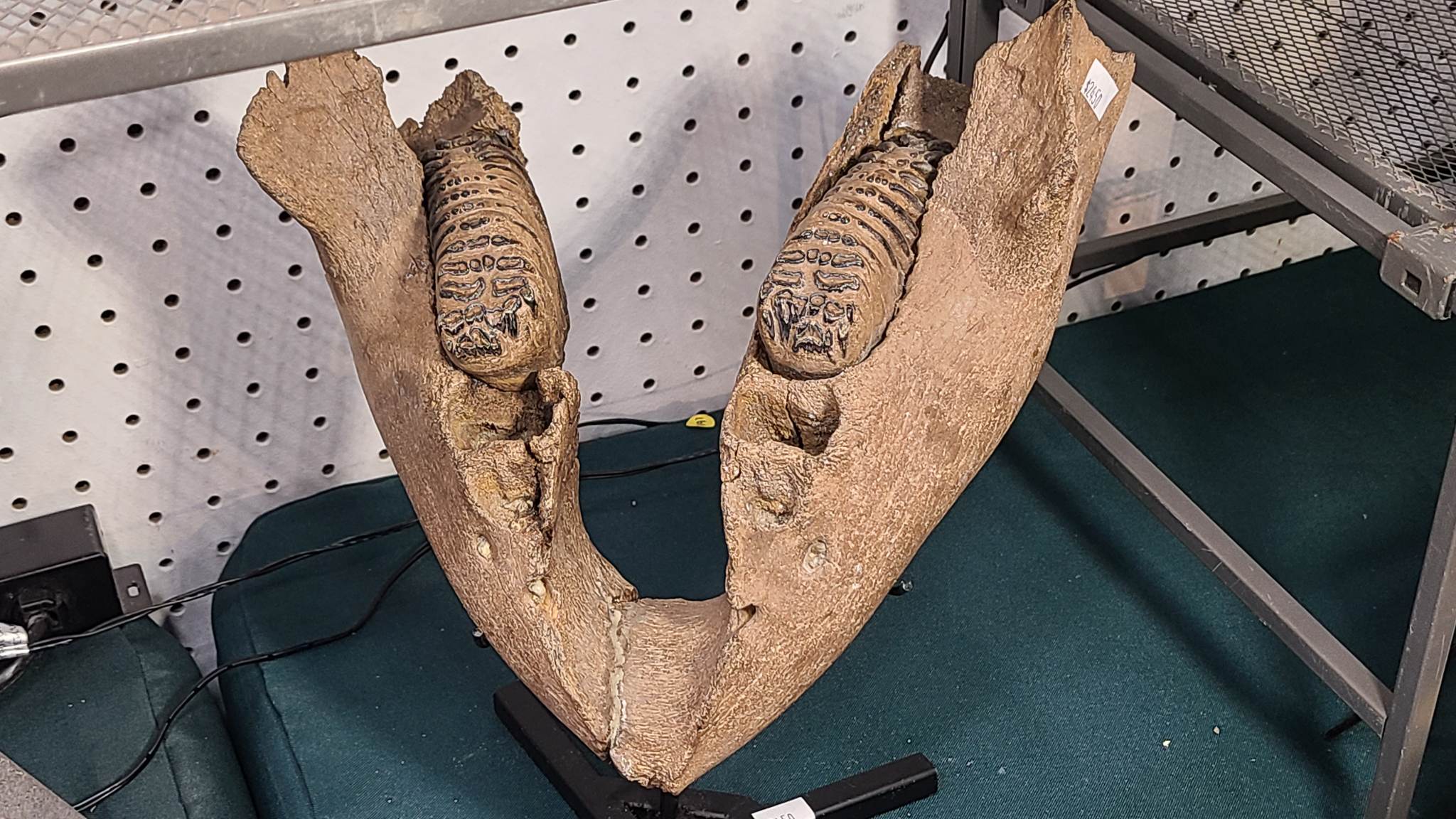
With all of this in mind, spending an hour or so at a local rock show seemed like a nice way to pass some of the afternoon. Also, sometimes there are interesting bony boys to look at.

This was before my partner saw the big geode cracking machine. I also think they’re very cool — I was used to getting tiny geodes as a kid and cracking them open with hammers like a tiny caveman, but all I’d get from that is a lot of small, shattered pieces. These machines use a large metal chain, shaped like a bike chain, that applies even pressure to a small area around the geode. They’re similar to soil pipe cutters but have a wheel that allows you to tighten the chain a bit more easily. The end result is a geode that cracks much more cleanly, usually in two halves that follow the natural features of the stone, so you preserve a lot more of that beautiful internal structure.

We talked to the owners of the machine for a bit, asking about the origins of their geodes (remember, always know where your crystals come from) and their mineral composition. That’s the nice thing about shows like this: The people there are super stoked to talk about crystals.

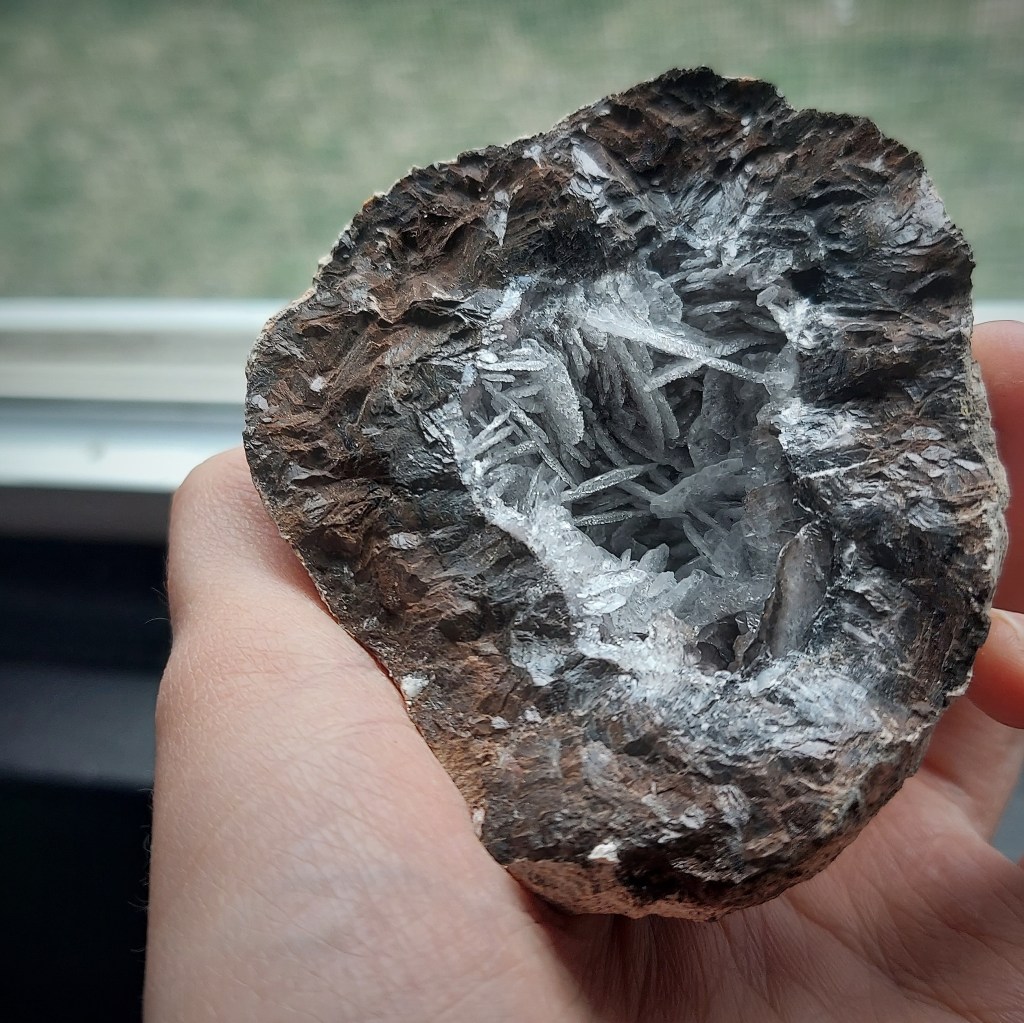
In the end, we decided on two geodes — one large one that was filled with tiny, sparkly, sugary-looking white quartz crystals (and a few double-terminated ones, too!) and a smaller one that seemed to be smoky quartz and blades of either calcite or selenite. They’re gorgeous!

A geode made of layers of opaque brown and transparent black crystal. In the very center, there are flat blades of clear, sparkling crystal.

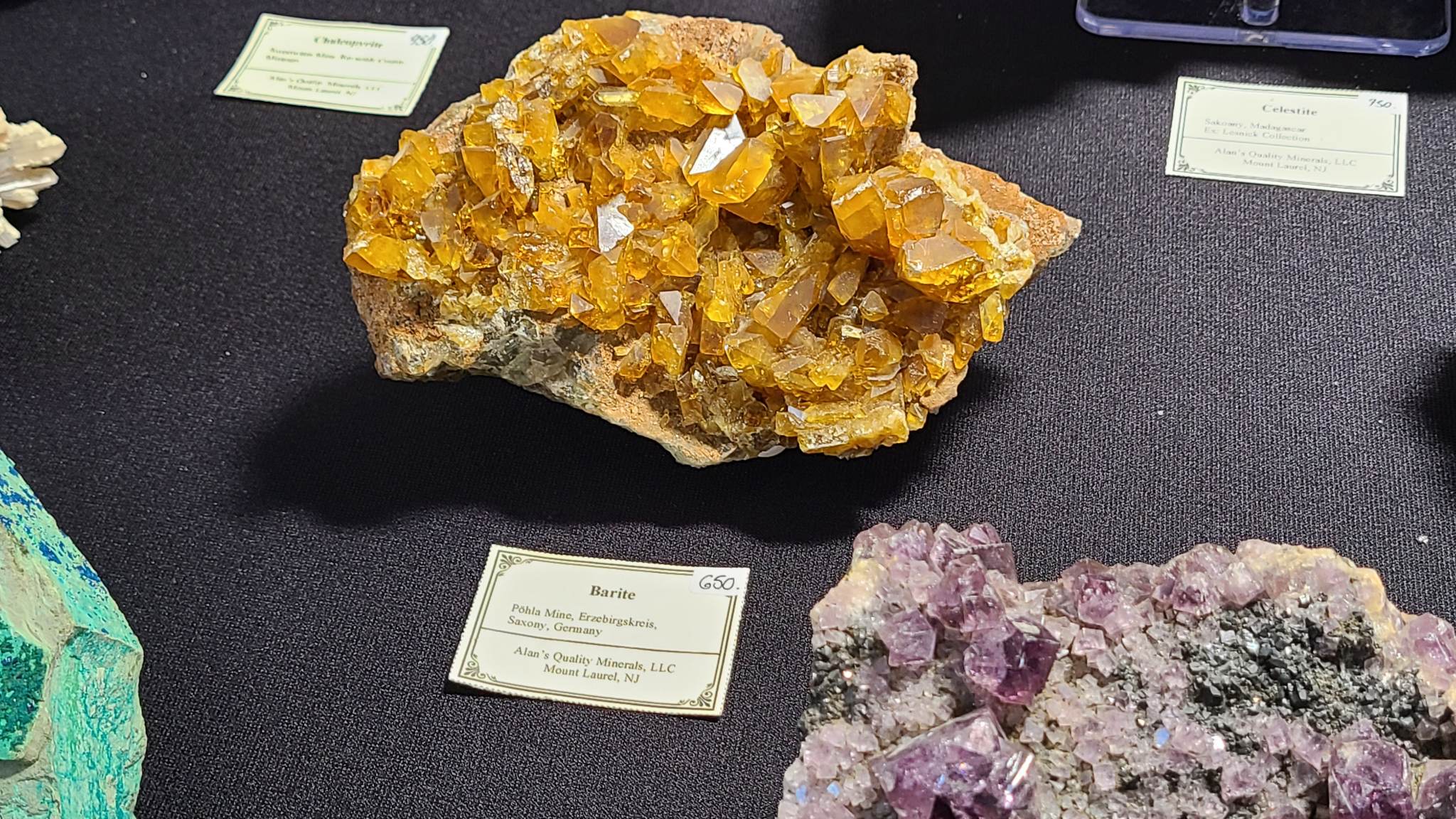
The show also had some fascinating displays of fluorescent minerals, insects, fossils, and really nice specimens of minerals that had been collected locally (or semi-locally, within a few states or so). Upstairs, where the dealer’s tables were, there were beads, handmade jewelry, carvings, and several gorgeous and very high-end specimens for sale.

A wooden case of preserved moths. They're shades of brown, cream, and orange, and many of them have large spots on their wings that look eerily like eyes.

In addition to the two geodes, we came away with a trilobite from Ohio. I have named him Tobie.

If you’re into geology, like fossils or minerals, or are even into crystal healing, I can’t recommend local gem shows enough. In Michael Gienger’s book Crystal Power, Crystal Healing, he talks about the role that your local geology can play. For example, the effect that living in areas with specific minerals can have. If you’re not learning about what’s around you, you’re doing yourself a disservice.

It’s also just really nice to talk rocks with people who are super into it. Even if you’re not necessarily so, it’s just cool to listen to someone who’s both knowledgeable and passionate about something.

If you’re a collector or crystal enthusiast who’s concerned about the environmental and ethical considerations of your hobby, then local shows are also a huge help. Most of the specimens we saw were clearly labeled with their place of origin. A lot of them were domestically collected, usually by the people selling them. There was a transparency that’s hard to get in a lot of (though certainly not all) conventional crystal shops. Some of the people there have brick-and-mortar stores, too.

These events also often support local hobbyist groups, and are a great way to meet other people in your community. Now that we’re actually setting down some roots here, it just feels good to be involved in stuff like this, even if it’s just as a spectator.

So yes. Support your local mineral people. They rock.

Uncategorized

A Happy and Blessed Alban Eilir

This past Saturday, my partner attended his first full-on ritual. A Druidry group that I’m part of collaborated with a pretty big, local Wiccan-inspired group to have an Ostara/Equinox celebration — there was a meditative walk through the forest, chanting, singing, dancing, and a big potluck full of tasty food.

And we almost completely missed all of it.

See, we’d offered to give a ride to a group member who doesn’t drive. “No biggie,” I thought, “Twenty minutes to go scoop him up, avoid the marathon, then we get out of the city and we’re good.” There was only one problem: The half-marathon pretty much bisected the entire city, to the point that getting out was very time-consuming and complicated. In the end, we almost had to drive back home and start over from there, because completely leaving the city and driving around it would’ve been faster and simpler than trying to go through it. Yuck.

This wouldn’t have been too bad, but we hit some navigation issues the rest of the way down. What was, “It’s okay, we’ll just miss the walk and make it in time for the ritual” then became, “Okay, so we’re going to miss the ritual, but we’ll be there for the potluck at least.”

Fortunately, fate smiled on us and we managed to roll up exactly when everyone was going from the pavilion to the ritual circle. The three of us ducked into the back of the line and picked up the lyrics and intonation of the chant on the fly.

(Fun fact: Mouthing the words “watermelon, carrots, peas, and bubblegum” can help you get through any lip-synching that you’re not sufficiently prepared for.)

A small patch of purple crocus flowers.

We sang, we clapped and drummed, we spiral danced. Day and Night did a dance to illustrate the victory of light over the darkness and gave a short speech on how Night entrusted the world to Day, and Day would return it to Night during the darker, colder months of the year.

Then it was time to eat!

The food was amazing — I think I ate my weight in lemon bars and curried chickpea salad. (We brought some cases of sparkling water, because the potluck sign-up sheet only had one other person bringing beverages and extra fizzy water always seems to go over pretty well.) There was quiche, a whole chicken, very spicy-sweet beans, curried chickpeas, banana bread, lemon cake, lemon bars, artichoke and crab dip, crackers, cheese, fruit, jam, you name it.

The conversation was great, too. We met some very cool new people, and talk seemed to flow easily. We talked about brewing mead and making water kefir and why wasps are actually great. Despite the stress of trying to get there on time, the vibe was extremely chill and comfortable.

I also have possibly made friends? This is both delightful and terrifying because I’ve moved around a lot, I’ve always been socially anxious, and the pandemic has made things weird.

Anyhow, despite being trapped in a car with us for three hours, the person we’d given a ride too suggested taking a walk through the woods after we ate. Since the walk was the one part we’d ended up missing, the forest seemed lovely this time of year, and I was sincerely shocked that he wasn’t completely sick of us already, I was down for it.

We ended up posing for photos as part of an effort to Save Lake Accotink (which is a pretty complex issue — it’s a man-made body of water, and maintaining it requires regular dredging. This has become expensive and complicated. Opponents cite the cost and some environmental concerns, but the alternative to dredging is turning it into a managed wetland. I haven’t seen estimates for what kind of environmental and monetary impact this would have over time, so my concern is that the managed wetland would eventually become a neglected area and the silt that it now captures could negatively affect waterways downstream.

It also seems like a lot of the issue is development and poor stormwater management in the area, which creates water-impervious surfaces that allow more runoff into the lake. Lake Accotink has been around since the 40’s, so it’s been a watery habitat for a while now and I don’t know what kind of impact it would have to try to put that genie back in its bottle. In some of the articles I’ve read, the social and environmental concerns also seem tacked-on and secondary to the monetary cost. All of this is why I haven’t really formed an opinion on whether the lake should still be dredged or not — it seems like it’s going to be a very difficult, disruptive, kind of sucky situation for everyone and everything involved either way.)

We also saw… Well, we weren’t entirely sure what we saw.

What are those?”

We tried to creep closer down the bank without startling them. They were all standing in a row on a partially-submerged log, long, sleek black bodies pointed toward the sun like arrows, beaks tilted to the sky. My partner snapped a few blurry pictures of them, like cryptids, while we tried to guess at what kind of (bird? low-stakes chupacabra?) creature we were looking at. The bank was a bit treacherous, so we couldn’t get very close.

(They were cormorants, which I had never seen before because we don’t really hang out in the same kind of places. Standing there, they looked like something between a heron, a goose, and a loon.)

A dark colored water bird stands on the bank of a lake. They have a thin beak with a hook on the end, and bright orange patches near the edge of their mouth.
We weren’t able to get close enough to snap pics this clearly with our phone cameras, but here’s a better pic courtesy of SamuelStone on Pixabay.

The only real damper was the sheer number of beech trees that were carved over with graffiti. I’m not very good at identifying trees by their bark, but it seems like carving is almost an identifying characteristic for these guys. Their bark is a silky medium gray, which appears to make it almost an ideal canvas for thoughtless dipshits people who want to carve their name in something.

After a long day of car rides, dancing, singing, eating, talking, and walking, we made it back home in a decent amount of time. (Fortunately, the marathon was over and the city didn’t require any vehicular shenanigans.) I’m feeling energized and can’t wait for our last frost date to pass — I really want to get my hands back into the dirt!

Hoping you all had a lovely equinox,
J.

life · Neodruidry · Plants and Herbs

A Little Late Wassail.

This weekend, my partner and I had the pleasure of wassailing some baby trees.

Traditionally, this was something that was done December-ish, but this particular wassail was for some very young trees that’ll be going in the ground soon. Consider it a kind of baby tree blessing.

Wassailing is a ritual to bless fruit trees, drive away unwelcome spirits, and ensure a bountiful harvest. It involved drinking cider, singing, making noise, and giving offerings of drinks and cider-soaked toast to the trees.

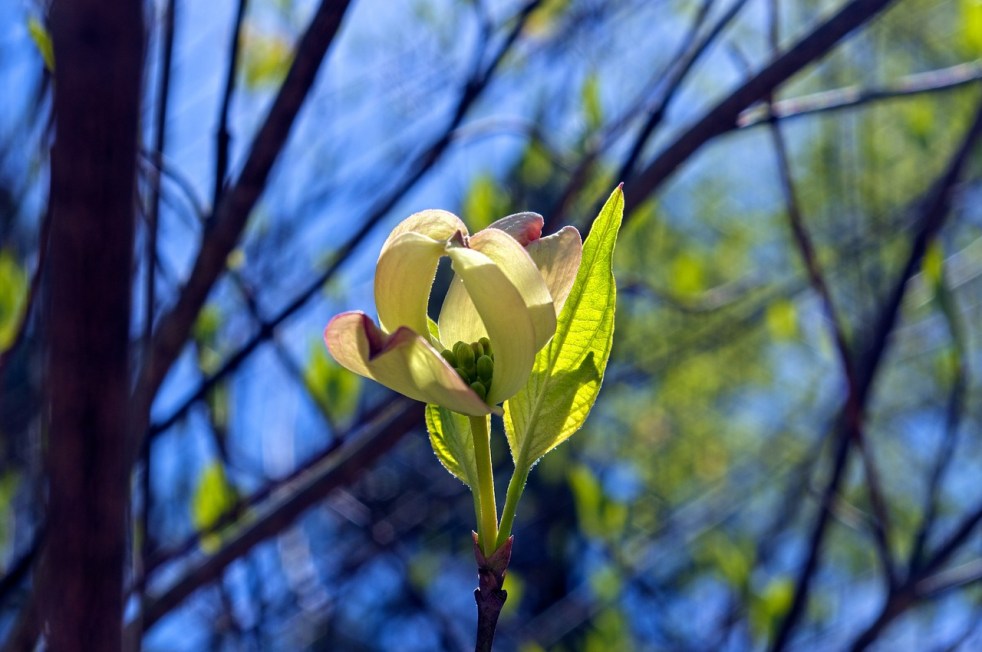
This wassail was hosted by someone in a Druidry group to which I belong. Another member put together songs and blessings, and all of the attendees gave their own blessings to a little sour cherry, a baby fig, and a small (somewhat struggling) dogwood.

A red squirrel in the branches of a fruit-laden cherry tree.

(I wished that the fruit trees would produce lots of flowers and nectar for the insect community, and tons of fruit for the birds, squirrels, and human community. To the dogwood, I just said, “Good luck, buddy.”)

The food was incredible. There was wassail cake flavored with lots of bright orange zest, homemade root beer, chocolate-Guinness cake, meat and vegetarian hand pies, tiny apple hand pies, fresh vegetables, ginger snaps, cheese, fruit, and so much more. We’re still without a decent oven, so we brought some extra sparkling water, graham crackers, fancy chocolate, and vegan marshmallows for fire pit s’mores. In lieu of hanging cider-soaked toast on the trees, there were bits of cider-splashed graham cracker.

The singing was fun, the yelling and cheering was fun, and the blessings were heartwarming. There was an adorable dog who did happy zoomies all around the yard, with deep, happy “doggy laughs.” I can’t tell you the last time I went to any kind of house party, so the feeling of gathering with a bunch of kind, warm, intelligent, funny people was almost indescribable. (It also set off my brain’s own personal social anxiety afterparty, during which I questioned every interaction I had all afternoon for several hours.)

It was also really nice to see someone else working on turning their yard into a source of food for their family and the local fauna. It gave me some inspiration for things that might work well in this yard. The warming weather has me absolutely raring to go out and do more to keep my promise to the spirits of this spot, and now I’ve got images of redbuds and sour cherries dancing in my head.

Be in good health!

Blog · life

“I mean, I’m neutered. I don’t understand how this happened.”

It’s often said that orange cats all share custody of a single braincell. This isn’t meant disparagingly; they just have a certain dopey je ne sais quoi.

Nowhere is this more apparent than in Pye’s reaction to JJ.

Sure, he started out with the standard territorial huffiness when she first got here. Once she’d gotten her first round of baby shots, some antibiotics, dewormer, flea drops, and ear drops (she really had basically every parasite and minor problem a stray kitten could have), we decided it was time to test the waters of actual introduction.

Kiko wants nothing to do with her, but she doesn’t seem to want anything to do with anyone who isn’t my partner or me. So, no surprise there.

Pye seemed… baffled? Like here is this tiny creature, who appeared out of the ether, and holy crap is this where kittens come from? I can see the wheel wobble-spinning in his head. He’s neutered. How did this happen? How did he accidentally a baby??? help

Well, no matter. What’s done is done. If there’s one thing this magnificent himbo fool apparently doesn’t want to be, it’s a deadbeat dad.

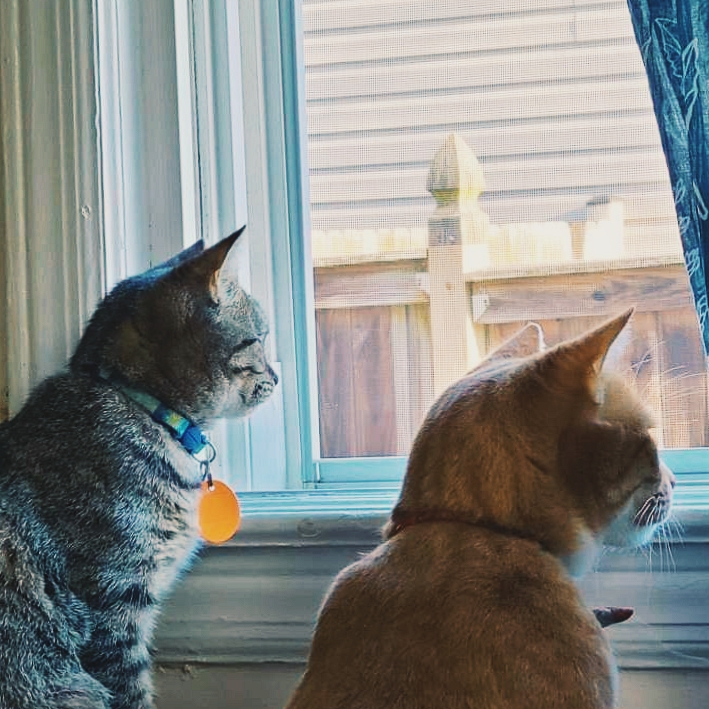
A small gray cat and much larger orange cat look out of a window together.
He teaches her the ways.

I’ve read that it takes on average eight months to a year for cats to become friends. I think he managed it in three days. They play together, and it’s genuine play. If there’s ever a growl, a whine, or a hiss, it’s quickly sorted out and they go back to playing. My partner was nervous about this — the first time one of them hissed, he wanted to separate them again. I stopped him with the reassurance that this was not only okay, it was a positive development. They’re new playmates, and they need to discover each other’s boundaries and learn how to navigate them. The only way for them to do that is to communicate between themselves and interfering would only hamper the process. JJ needs to learn to play nicely, and Pye needs to learn how to play with someone so much tinier than he is. Sure enough, half a second later they were back to chasing each other.

He’s also tried to groom her, though he seemed to very quickly discover that ear drops taste awful. Nonetheless, he is a dutiful boy and persisted in cleaning this small, weird, somewhat gross child.

The cutest part is when he gets tired. He’ll lope away, go lay down somewhere, and trill at her to follow him. JJ, being a font of infinite chaos energy, does not do this. Instead, she watches him and decides that what she should actually be doing is chewing on his face.
He puts up with a lot.

A close-up of a pair of cats. A small gray kitten lays on her back, paws pushing on the fluffy cheeks of a much larger orange cat.
Like, a lot-lot.

It’s also really cute to see the ways that he accommodates her. He lays down to be at her level, rolls on his back, and bats at her slowly. He chases her into the closet, and, as soon as she emerges, he trills and goofily bounds away so she’ll chase him. Seeing the give and take between this 20 pound orange dumbass and this cheeseburger-sized stripéd hellion is honestly really heartwarming.

Now, we just have to work on Kiko.

art · Just for fun

With My Sincerest Apologies to Dolly Parton.

I mean it.

Jolene, Part Two.

Jolene, Jolene, Jolene,
Jolene,
You gotta help me with this lying man.
Jolene, Jolene, Jolene,
Jolene,
Things went so wrong and now we need a plan.

I only meant to frighten him,
I never meant to do him in,
Now I don’t know what we should do,
Jolene.
You know he had us seeing red,
The rest’s a blur, but now he’s dead,
It was a crime of passion, this I swear to you,
Jolene.

He got upset when we accused
Him of two timing me and you,
And I think the neighbors heard it all,
Jolene.
Philanderers should get their due,
But now it’s up to me and you,
And we’re gonna need a lot more bleach,
Jolene.

Jolene, Jolene, Jolene,
Jolene,
We gotta find a place to put this man.
Jolene, Jolene, Jolene,
Jolene,
You grab those sheets, I’ll go get the gas can.

As long as we don’t drive to slow,
We’ll make it down to Mexico,
We’ll be in Tijuana by the break of day,
Jolene.
We’ll dye our hair, we’ll change our names,
Nothing will ever be the same,
But maybe it’s all for the best, Jolene.

Jolene, Jolene, Jolene,
Jolene,
You gotta help me with this lying man.
Jolene, Jolene, Jolene,
Jolene,
We’ll make a brand new start in a new land.
Jolene, Jolene.

I guess I technically wrote this unasked-for sequel to Dolly Parton’s song, but the fact is that I woke up with it in my head more or less fully formed. I do love a good murder ballad. This feels a bit like what would happen if “Jolene” met The Pierces “I Shot my Lover in the Head” and slightly ramps up some of the lesbian overtones many people have read in the original song.

Perhaps unsurprisingly, my partner was less than stoked that this fell out of my head. He was pretty good-natured about it, though.

Plants and Herbs · Witchcraft

Crocus Folklore & Magical Uses

It’s spring (kind of)!

At least, it’s getting spring-y here. Granted, I think we maybe had about four days of actual “winter,” but it’s been t-shirt weather for the past few days, and looks like it’s going to stay that way for at least another week.

Since things were warming up, I stepped out back to take a look at the yard. The elderberry bushed that I planted last year have some new leaves coming in, the bulbs I planted are starting to poke up through the mulch, and the apples are both looking good.

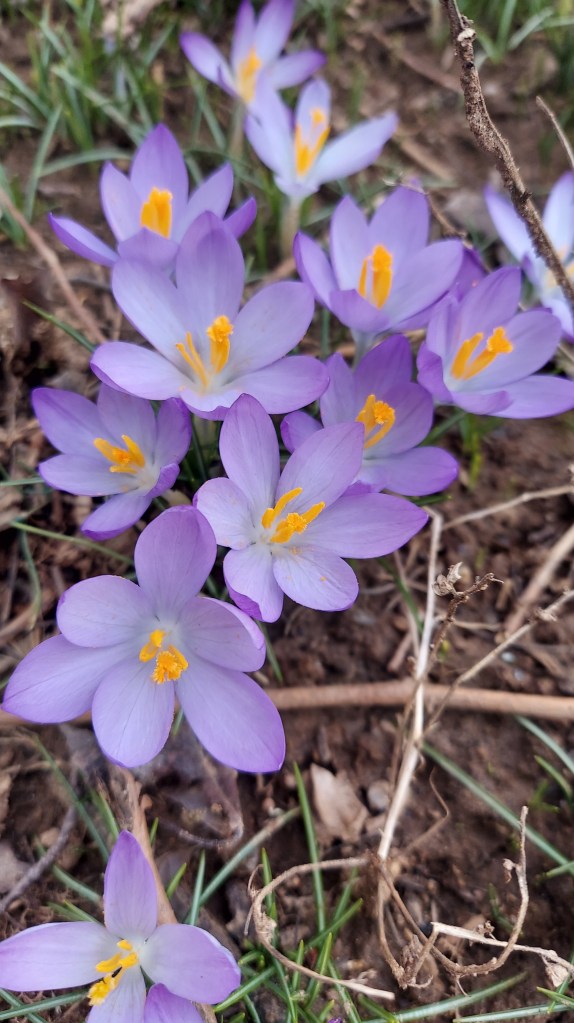
There’s also a large patch of surprise crocuses that seem to have popped up overnight next to my shed.

These are either Crocus vernus, the spring crocus, or Crocus tommasinianus, the woodland crocus. They’re beautiful, but decidedly not native to this area. (Crocus vernus and C. tommasinianus are related to C. sativus, the saffron crocus. However, these crocuses are definitely not a way to make rice more delicious.) Still, I am determined to enjoy them before it’s time to remove the bulbs and put in some native coralberry bushes. I’ll probably keep the bulbs and move them to somewhere where they’re less likely to spread.

If you’re also experiencing a flush of these tiny colorful flowers, here’s some old folklore and a few ways to make them magically useful.

Crocus Folklore

In ancient Greek legend, Crocus was a human man. The nymph Smilax was in love with him, but, ever the fuckboy, Crocus was dissatisfied with the affair. The gods turned him into a saffron crocus.

Another version of this story claims that Crocus was a companion of Hermes. Unfortunately, he stood up at an inopportune time during a discus throwing match, and Hermes accidentally killed him. As Crocus’ blood fell on the soil, saffron crocuses sprang up.

Spring crocuses are associated with Persephone, Aphrodite, and Venus. Mythology would also appear to tie this flower to Hermes.

A London source claimed that picking crocuses tended to “draw away the strength.” Therefore, only strong men or healthy young women should attempt to.

A field of purple and white crocuses at the base of a mountain.

According to Pliny, wearing crocus around the neck would prevent drunkenness. Interestingly, Swiss parents would place saffron around their children’s necks as a protective charm (presumably not against drunkenness, or else they’ve got some explaining to do).

In the Victorian language of flowers, crocuses represented cheer and youthful gladness.

This flower is associated with the planets Venus and Mercury, and the element of Water.

Crocus Magical Properties

Historic mentions of crocus as a protective charm typically refer to saffron crocus, not the spring crocuses. It can be hard to tease out folklore and uses attributed to spring crocuses, since the autumn-blooming saffron crocuses were generally considered more useful. For our purposes, I’m going to focus on spring crocuses here.

Spring blooming crocuses are used in charms for love, including platonic love or love of the self.

As an early spring-blooming flower, spring crocuses are also useful for spells for new beginnings.

These flowers are common altar decorations for Imbolc and Ostara. However, use caution if you bring spring crocuses indoors — all varieties of crocus other than C. sativus are toxic. Spring-blooming crocuses can cause diarrhea, vomiting, and digestive upset, while autumn-blooming crocuses can cause liver and kidney damage.

Simple Crocus Spells

You can include crocuses in charm bags for love. Add the dried flowers to a pink or red pouch along with rose petals, lavender flowers, and a bit of cinnamon bark. If you like, add a piece of rose quartz. Dress it with your favorite love-drawing oil (in a pinch, infuse some cinnamon, basil, and rose in grapeseed or sunflower seed oil, and use that) and keep it on you.

You can also use crocuses as a form of sympathetic magic. Plant a bulb along with a slip of paper with your name, and the name of your partner. Declare that as the plant grows, your love will flourish with it. When the flower is at its peak, pick it and save it for a love charm.

Neodruidry · Plants and Herbs · Witchcraft

It’s Imbolc season. Get the bucket.

I think a big part of what kept me from really connecting with a lot of Wiccan-based Paganism when I was younger was that, at the time, the available source material was pretty prescriptive. Sabbats were on specific days, with specific traditions attached, and there was an onus the follower to do things “right.”

Having lived in a pretty big range of climates, I can say that that’s had an impact, too. It’s hard to feel in the harvest or growing seasons when they just don’t line up with the harvest and growing seasons where these traditions were based. If the wheel of the year is supposed to reconnect humanity to nature and its cycles, a strict interpretation is the opposite of helpful. When I lived in California, for example, it felt like observing the traditional sacred days was sometimes counterproductive — spring didn’t look like it did in Europe, or even in the Eastern US. Neither did winter. It made things feel rote, which robbed them of meaning.

That’s why I’m a big proponent of celebrating the High Days when and how it makes sense to do so. If your growing zone means that you’re not going to see the first signs of spring until March, or won’t ever experience cold and snowfall, then so be it.

All of this is to say that the vast majority of my High Day traditions are pragmatic (perhaps to a fault).

Imbolc passed recently, amid surgeries (one for me, one for the Certified Lap Loaf. We’re both doing well!), falling down the stairs (just me. That part of me is not doing well.), and probably other stuff that I’m forgetting because of the first two things. A lot of ADF members celebrate the High Days on the nearest weekend, which is nice. Less pressure that way when your most-of-you isn’t working correctly.

A picture of the face of a small gray tabby cat. She looks very angry, probably about the blue nylon cone surrounding her head like some kind of fucked-up satellite dish.
Don’t let the barely concealed rage fool you. She’s purring here.

To me, Imbolc is refreshment. It’s deep cleaning, washing my front door, doing repairs, and making food. (This year, it’s also starting plans for home improvements that we won’t be able to do until later spring and early summer, like replacing the roof.) It’s also almost never actually on the first of February.

I don’t set up an Imbolc altar. I follow the same basic ritual structure that I do for any other day. For me, the main difference is the feeling of lightness and renewal that I carry through doing things like scrubbing grout, cleaning out garden beds, de-scaling the dishwasher, and chucking Affresh tablets down the garbage disposal.

When you’re re-learning lost, buried, or reinvented cultural traditions, it’s easy to get caught up in the need for accuracy and correctness. It’s also easy to forget why the High Days existed in the first place — to mark significant occasions throughout the year, largely based on what people who grew crops and raised animals considered significant.
When you get too invested in following the letter of a tradition, you can lose the spirit of it.

From my house to yours, here’s a small thing that I like to do each spring. It works equally well whenever you need to feel that sense of newness and freshness that only spring can bring.

Imbolc Home Cleansing

You’ll want to have:

  • A white candle. (The golden beige of natural beeswax is fine, too.)
  • Dried vervain.
  • Water.
  • A bowl.

First, steep the vervain in some hot water, as if you were going to make a tea. (I like to put vervain and water in a clear jar, then stick it in the sun for a while to infuse. If it’s cloudy where you are, a kettle of boiling water is fine.)

Vervain flowers.

Once the infusion cools, strain out the leaves and pour the resulting liquid into the bowl.

Next, light the candle. Declare, either out loud or to yourself, that this flame represents the return of the sun — whether that’s the literal return of longer daylight hours, or a metaphorical return of warmth and light is up to you.

Carry the bowl and candle to each room of your home, moving in a clockwise direction. Set the candle down in a safe spot and use your fingers to flick the vervain infusion around the perimeter of the room (be sure to get the corners). If you have prayers or chants that feel appropriate here, use them. I usually fall into a kind of stream-of-consciousness monologue about the objective of the working. It’s less important that your words sound nice than it is that they mean something to you and help you focus on what you’re doing.

When you’re through cleansing your entire home, offer the rest of the vervain infusion to your yard, garden, or nearest patch of green stuff. If your candle is small, you can let it burn completely and dispose of the remnants. If it’s a big one, snuff it and re-use it for a cleansing or purification ritual another day.