So, my spouse and I went to an out-of-town family shindig the weekend before July 4th. It was a lot of fun — there was a ton of food, live music, and a huge crowd of interesting people to talk to (many of whom are also Garden People like me).
When I came back, the yard was silent. My heart dropped into my stomach.
Was it because I wasn’t there to keep the food and water replenished? Was it the fireworks? Had someone gotten injured or killed, scaring the whole murder away? Did something happen to Boink?
I put fresh water and the usual mix of food (peanut butter cereal, cat kibble, dried bugs, and berries) out, but all I got was a clamorous mob of starlings.
(Apparently a group of starlings can be called an “affliction,” which sounds about right. I love all of the birds that come to my home, but most of these are, to put it bluntly, invasive shrieking dickheads who throw things.)
A day went by, then another. I lost sleep and felt my urge to write or paint completely sapped. So much of my art is inspired by these magnificent little weirdos, I hated the idea of working on a painted bird when the real ones had disappeared.
Then this happened.
“hey, you there? you guys back n- oh, you poopin?”
The crows returned by having this guy rock up to the bathroom window (please ignore the spots on the glass — the rain and pollen have fingerpainted everything) and stare inside. They twisted their head from one side to the other, very deliberately peering in. If they had hands, they probably would’ve cupped them around their eyes to see better.
It was funny, but, in retrospect, also somewhat concerning. Did they watch us leave? Did they send someone to stare into our house every day to see if we were back yet? There are so many windows, you guys, why did they pick the bathroom?!
Anyhow, the big maple tree is once again filled with raucous caws and shiny black birds. I’ve seen Magni and Muse, and even Boink has once again taken up his position on top of the shed. (I have no idea where — or how, for that matter — he went for several days at a time. I’m just glad he’s back.)
It does my heart good to see them. I just kind of wish they’d maybe peeked in the kitchen instead.
One of the benefits of encouraging wildlife to hang out is that, if things go right, it’ll basically do your gardening for you. I’ve had so many volunteer plants courtesy of the birds and squirrels, it’s bonkers. Since I’m still working on re-wilding things, I’m grateful for whatever additions the local creatures want to make — I get to see what grows well and what doesn’t, and it’s all for free.
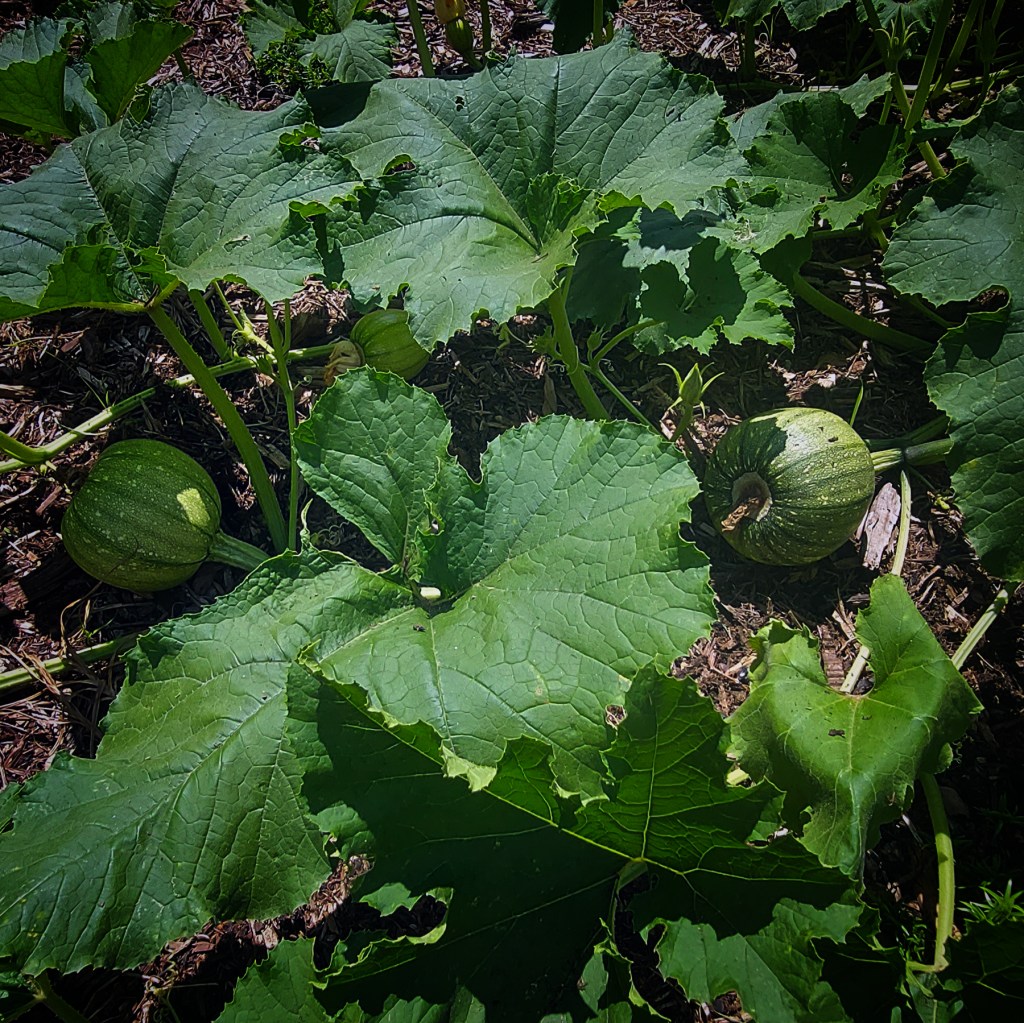
This is all just preamble to explain that I’ve been watching the progress of some kind of plant in the front plot. The front yard is divided into two squarish plots by a walkway. In one, we’ve finally managed to kill off the grass and replace it with a redbud tree, oakleaf hydrangea, coreopsis, strawberries, moss phlox, and echinacea. Then this thing happened.
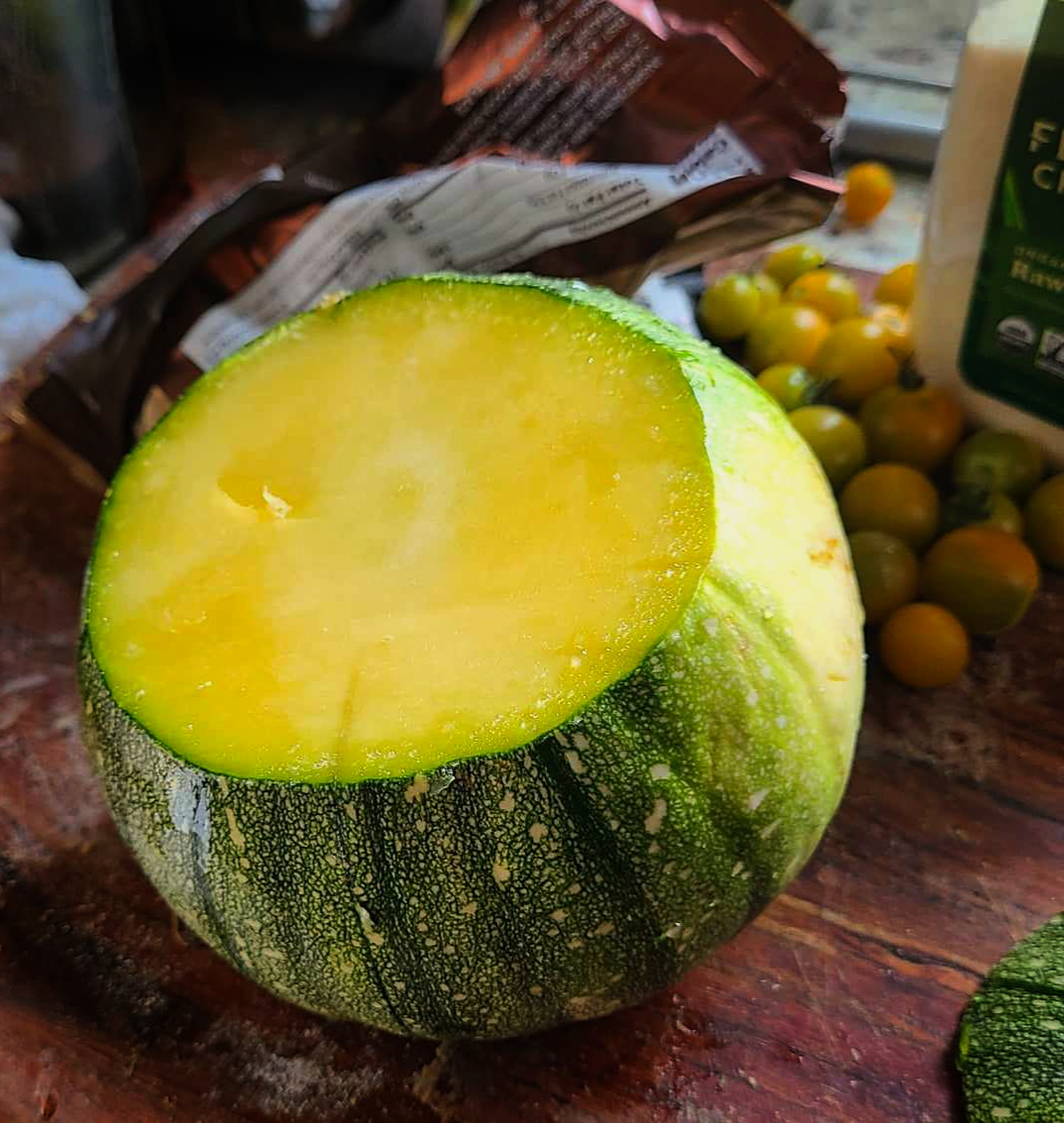
Cute, right? It seemed to appear overnight, springing up out of the ground without warning. No sprout, nothing. Just bam! This.
Out of curiosity, I left it. It was in a bare spot, and I was honestly pretty excited to see what it’d turn out to be. I tried identifying it to make sure it wasn’t something invasive or poisonous, but plant apps were stumped. It was almost definitely a member of Cucurbitaceae, but what? Pumpkin? Melon? Squash? Cucumber? Even Reddit’s gardening subs were mostly baffled. Some posters who recognized it even admitted that it looked like “some kind of weird hybrid.”
Anyhow, I figured it’d probably end up being some kind of vegetable, so I left well enough alone. I didn’t even bother watering it. I figured that it was a volunteer, it was doing fine without my interference, so it was just sink or swim from h-
Like something out of a weird fairytale (or Annihilation, or The Color Out of Space), it… expanded. It didn’t get any taller, but it sent out yards of thick, powerful vines across the ground. By the time you read this, it’ll probably have doubled in size.
It also started putting out flowers. Big, bright yellow ones. Each one had a firm, round base. Before long, we had a ton of these.
So, not cucumbers. Not melons. Some kind of pumpkin? A squash?
This guy who sometimes cuts the (remaining) grass for us said he recognized it as an ayote. He said it’s tasty when cut up and stewed with beef ribs and vegetables. I don’t do beef ribs, but I have some lovely brisket-style tempeh that could maybe work.
The trouble with volunteer Cucurbits is that there’s a risk of poisoning. If you find a wild squash in your yard, or grow one from seeds that you’ve saved yourself, taste a little bit of the raw fruit before you cook it or serve it to anyone else. Some wild Cucurbits have a lot of a toxic compound called cucurbitacin. It tastes very, very bitter, and enough of it can absolutely kill you. Tl;dr: Do not eat bitter squash, or any other members of Cucurbitaceae that taste weirdly bad.
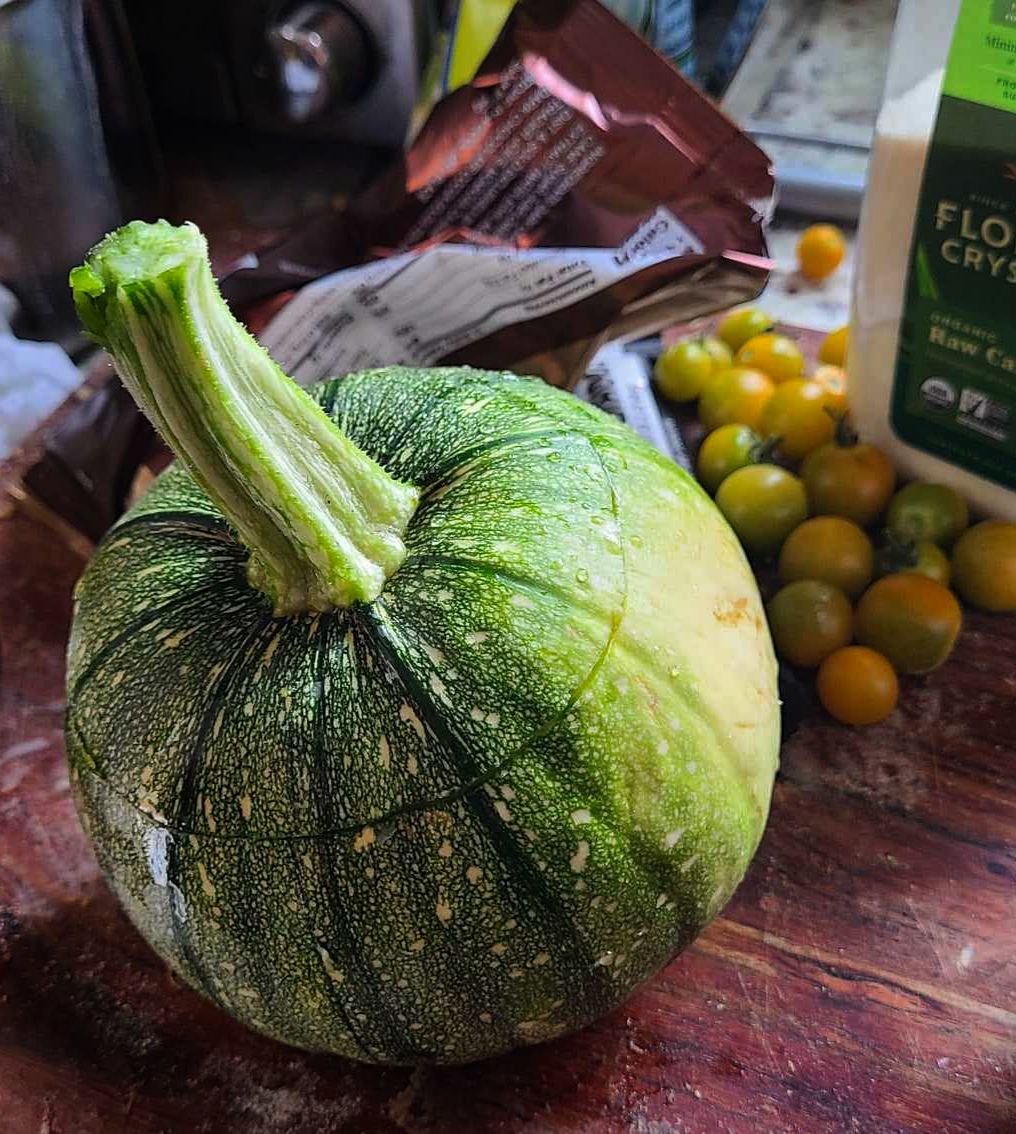
They’re nowhere near ripe yet, but I noticed that the stem of one had broken. I brough it inside for Experiments.
It looked inoffensive enough. I took a little taste.
Surprisingly, it was pretty good! There was no trace of bitterness, just a mild, sweetish flavor. It’s not as strongly flavored as it’ll probably be once it’s completely mature, but definitely not bad.
I haven’t decided what to do with this specific one just yet. Ayote en miel? Squash soup? Roasted squash?
Whatever I decide to make from this squash, I hope I like it. I’ll definitely have plenty.
Crows are sleek, beautiful, intelligent creatures.
And then there’s Boink.
Boink looks like he was made by Jim Henson with spare parts and a strict time limit. He looks like what birds would look like in the Fraggle universe.
Boink is not injured, but has somehow managed to damage all of the flight feathers on one wing and half of his tail. He can fly, but it’s the flight a bird whose wings have been clipped — just enough to keep from falling, until his flight feathers grow back in. His main means of locomotion is to hop and scramble in a way that even the best foley artist would have difficult putting a sound to.
Boink having a small philosophical moment.
He spends most of the day hanging out on the railing by my back door. When I open it, he jumps up and… well, boinks his way across the deck to the shed. He hops on the roof, bops his way to the other side, and ducks down with his little head sticking up like a periscope.
If I look at him, he ducks.
If I pretend to close the door, he pokes his head up again.
If I go back inside, he moves back to the railing to sit.
Boink is the scruffiest wild animal that I’ve ever seen. He is the prime specimen of scrunginess. An absolute scrunglemuppet. He is Mother Nature’s silliest fool and I love him very much.
He doesn’t seem to have trouble avoiding predators, somehow — when he needs to hide, he hides behind the other shed, or climbs up the big apple tree. It makes me grateful that I didn’t prune it as much as I should have, because the lowermost branches give Boink something to hop onto and make his way up.
(I don’t even really know if he’s a he. In my defense, I don’t think Boink does either.)
I think that Boink may have a criminal record. He doesn’t seem to have a mate to help take care of him, and the other crows push him away from the feeders. I sneak extra portions of food into places I know he can reach easily and put extra fruit and dried bugs to make up for the things he may not be able to forage for himself.
“Hoh. Kibble for Boink? No! Cereals for Boink? No! Every time, they bully Boink.”
The other crows also don’t seem to have a problem with leaving Boink behind, too. Is he Outlaw Boink? Has he been ostracized for crimes, or do they just leave him because they know he’s safe, with his water dish and his food stashes and his shed roof?
I don’t know what Boink did, or what happened to him. He sits on my deck like a tiny, questionably useful gargoyle. He is my very special boy and his presence is delightful.
Not long ago, I mentioned that the crows in the yard bartered me for a small rock painted to look like a strawberry. Now, the whole reason I had a rock painted to look like a strawberry was to keep birds from eating my actual strawberries. The idea behind it is that you put out strawberry decoys before the plants set fruit, and the birds will investigate them, decide they’re inedible, and assume that the rest of your strawberries are similar levels of bullshit. Seems legit, right?
These rocks aren’t the only things the crows have been interested in. When my spouse’s mom came for a visit, she remarked that she’d seen the crows playing with some of those little black plastic pots you get from plant nurseries. (I have a few on a shelf on my deck. They’re useful for starting plants, and I’d rather re-use them as much as possible and keep them out of the landfill.) I thought this was funny, but didn’t really put much more thought into it. I had a thing, the crows thought this thing was amusing and interesting, and that was that.
Then I noticed that I had lost all of the strawberry rocks in the back yard and one of the raised beds in the front. Just up and vanished.
Then my spouse mentioned seeing a crow flying away with an empty plant pot in its beak. He’d tried to snap a picture, but only managed to get a blur of tail feathers as the thief absconded.
Putting two and two together, I can only assume one thing: They’re developing agriculture.
Maybe it isn’t aliens or artificial intelligence that we need to worry about. Maybe humanity’ll be overthrown by a race of swiftly advancing, hyperintelligent birds. People remark on the intelligence of corvids, and they’re correct. Crows, ravens, and their kin are very smart. They’re also coming for your horticultural supplies.
If you’re reading this at some point in the future, when the human race is relegated to the annals of bird history as some kind of combination of amusing pets and manual labor force, and our bird overlords have ushered in a new era of art nouveau solarpunk luxury forest communism, I apologize for not being at all sorry because that actually sounds awesome.
Monarda species, also known as bee balm, Oswego tea, and wild bergamot, is one of my favorite native flowers. The blooms themselves are striking, the leaves are fragrant, they spread very easily, and they thrive where other plants falter. They’re fantastic additions to permaculture guilds, since they’re good at attracting oft-neglected native US pollinators like the raspberry pyrausta moth. It’s also tolerant of juglone, a natural herbicide produced by black walnut trees.
Some bright pink Monarda didyma flowers in my garden, planted along with some deep maroon-pink lance leaf Coreopsis.
The name “wild bergamot” is a bit misleading — these plants aren’t related to bergamot at all. Monarda is part of the mint family, while actual bergamot is a citrus fruit. I haven’t been able to find an explanation for why this group of plants is called wild bergamot, so I can only venture that it’s because of the fragrance of the leaves. They’ve a sort of minty-citrusy-herbal scent, very reminiscent of Earl Grey tea.
Wild Bergamot Magical Properties and Folklore
Monarda plants are native to the US and have a very important place in the medicinal lore of indigenous American people. The leaves soothe stomach aches when used internally, treat wounds externally, and ease headaches when used as a poultice. The name “bee balm” comes from the plants ability to calm bee stings.
After the Townshend Revenue Act of 1767, colonist American people began boycotting imported British tea. Instead, Monarda leaves provided a suitable substitute.
Since Monarda is native to the US, you won’t find it in ancient herb lore or medieval European grimoires. It still has a pretty long history of use as a magical ingredient, however, as people have adapted to using what’s around them over the centuries.
Some magical resources claim that lemon balm and bee balm are synonymous. Though they’re both members of Lamiaceae, the mint family, they aren’t the same plants. Lemon balm is Melissa officinalis, native to Europe, and pretty sedating when drunk as a tea. Bee balms are Monarda species, native to the US, and gently stimulating.
Due to its associations with medicine, it’s considered a healing herb.
Monarda can also be used as a purifying and cleansing herb.
It is generally considered to be ruled by Mercury and the element of Air. Due to these planetary associations, it’s sometimes used in spells for money or success in business/academic endeavors.
Using Wild Bergamot
You’ll be pleased to know that, unlike a lot of the magical herbs I talk about, wild bergamot is edible. The whole thing. Stems, flowers, and leaves. The flowers can be used to add color and interest to salads, and the leaves make a wonderful tea. You can also use the leaves to flavor pork or poultry dishes. If you do want to eat your Monarda leaves, treat them like most other herbs: Harvest the leaves before the plant flowers, when they’re sweeter and more tender. They tend to get a bit tough and bitter after the plant matures and flowers appear.
Personally, I find wild bergamot leaves and flowers to be a very nice addition to drinkable/edible brews. Use it in place of Camellia sinensis leaves as a base for magical teas. Historically, it has been drunk to ease flatulence and as a gentle, general stimulant.
One thing I enjoy doing is making simple sugar cookies and decorating the tops with magical sigils. Candied flowers, chosen for their properties, can both decorate and empower these edible spells.
For purifying, pack some fresh leaves into a large muslin tea bag and place it under your bath faucet. You can also brew Monarda leaves into a tea, strain out the plant matter, add the liquid to a bath, and fully submerge yourself.
To purify spaces or groups of people, bundle fresh Monarda stems together, dip them in salt water, and use them to asperge.
Monarda is known to attract bees, as well as ease their stings. Since it’s connected to Mercury and Air, it’s also used as a success herb. Brew a strong tea from the leaves and use it to wash your front door and steps to attract success to your door like bees to a flower. You can also add this tea to floor washes, if you wish.
A Monarda seed head. Each of those little “tubes” houses a single loose seed, which will be picked up by birds or scattered by the wind.
In general, Monarda is a very nice herb that plays well with others. In my experience, it acts as a general attractant — magically drawing in your desires the same way that the flowers call to hummingbirds, moths, and bees. Its flavor and scent are delicious and intriguing without being overpowering, so it’s an excellent addition to brews, kitchen witchery, and spell jars. (Most members of the mint family smell pretty acrid when burned, however, so I’d avoid putting it in incense.)
If you’re in the US, Monarda is a delightful addition to the garden. It’s easy to grow, thrives on neglect, and produces an abundance of seeds and rhizomes. You’ll have plenty to harvest and share, but, unlike non-native mints, it’s not considered invasive.
So the local murder has been particularly active lately. The backyard is a playpen for their babies, the roof of the old shed and the big red maple are their vantage points, and it does my heart good to hear their excited clamoring when they see me step outside to leave them crow salad. Though I know almost nobody is as excited about these developments as I am, I still talk about them way too much.
Anyway, I’m also pretty sure they straight-up performed an execution in my front yard.
(If you’re sensitive about the deaths of animals, maybe skip this post and come back tomorrow. There’s a fun bit about bee balm that I think you might like.)
Where there are crows, there are almost always squirrels. This is unfortunate, because the two aren’t friends. Squirrels compete for resources and eat crow eggs. Crows eat baby squirrels. It’s a whole Thing.
The ones here have managed to coexist to the point where they seem to take turns raiding the feeders, and the crows have felt secure enough to tend to their families in the back yard despite the presence of a squirrel or two.
Unfortunately, some furry interloper has been wreaking havoc lately. They dug up my comfrey starts, tore up my baby watermelons, and threw the pink dahlia onto the concrete. The latest round of destruction, apparently, was enough for the crows to decide to send a message — in the form of a furry corpse, completely unmarked save for strategically placed, beak-sized puncture wounds. The injuries tell of a crow’s nature, since it looks like something landed on the squirrel and proceeded to do the dark deed. What’s very odd, though, is that the squirrel was otherwise untouched. Crows are nothing if not opportunistic, and they’re scavengers. Even if this squirrel was killed by a stray cat or ill-timed BB, they probably would’ve eaten it some of it.
This raises one question: Why merk a squirrel and then leave it right in my path, untouched?
Do they consider the front yard their territory enough to be invested in the landscaping? Did they think this was a favor? All, “Hey, we took care of that guy. You’re welcome.”
“Thanks for all of the meals! Here is a meal for you, on us. It is: One dead squirrel. Bon appétit!”
My spouse remarked that he’d never seen this much action in the suburban area around the house he grew up in. I reminded him that we were actively trying to cultivate more biodiversity and a closer existence with nature. The thing is, when you try to see more nature, it’s only too happy to show you all of it. Even the red and toothy parts.
We buried the squirrel in the back yard, in the shade of the big red maple tree. I feel bad for the little guy, but at least it seems his death was swift.
I do feel like an extremely goth Snow White, though.
I love bardic circles. There’s something that’s so much fun about finding a song, poem, or story to share, and listening to the things that others have brought to share with you. Hearing these things can tell you more about a person than hours of conversation can — what they find beautiful or moving. What they want others to hear. What they hold as important.
There are few feelings as good as finding your feelings, crystallized and stated by someone more eloquent than you. Bardic circles are a chance to find those things and show them to others.
This year’s was busier than last year’s, which was nice. There were plenty of old and new friends, tons of food, and lots of things for the goods and gear swap.
I shared two poems from Jarod K. Anderson‘s “Love Notes from the Hollow Tree,” ate a ton of black raspberries, watermelon, homemade pickles, and (veggie) hot dogs, and traded books and crystals for more books, homemade incense, peach preserves, pickled watermelon, camping supplies, and a beautiful card of the Druid’s Prayer for Peace done in purple watercolor.
We sang together, laughed, and talked about things. The crows in my yard. Gardens. Where the wild berries were ripening, and when to gather to forage for them. Next month’s camping trip. History, legends, and prayers. Too much to enumerate here, and even trying to do so would just make the words flatten like toothpaste.
As usual, I went home to immediately agonize over everything I said and did (and everything I didn’t), but the social anxiety is worth it. I’m grateful for having a community of such generous, creative, intelligent, and warm people. I’m grateful that we’re welcoming to anyone who wants to come along to learn and share as well.
Deep within the still center of my being, may I find peace.
Silently within the quiet of the grove, may I share peace.
Gently within the greater circle of human kinds, may I radiate peace.”
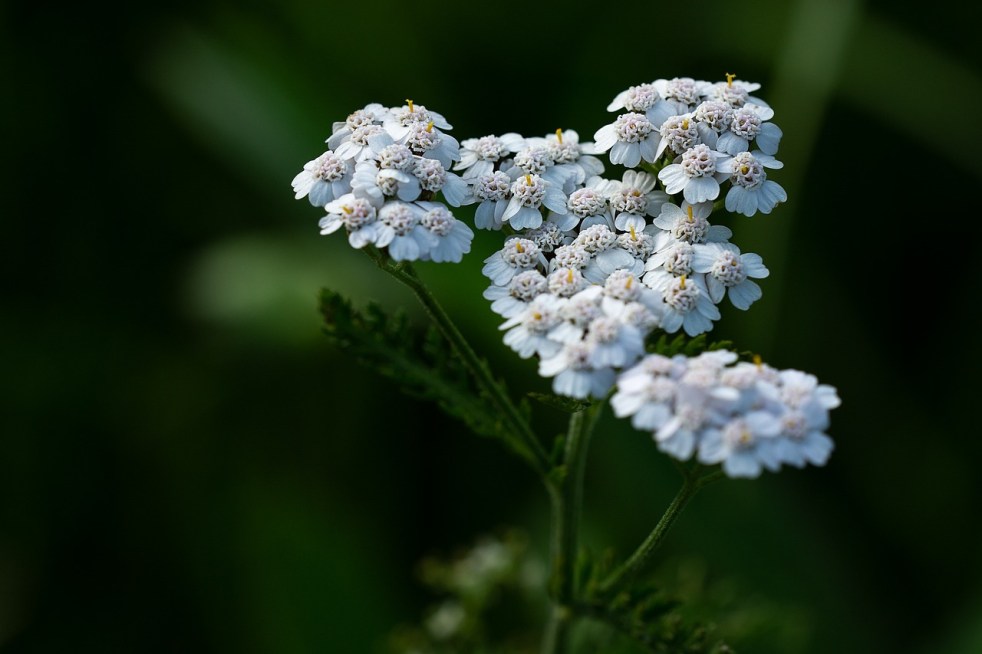
You know, I never really connected with yarrow. I know it’s kind of a magical herb staple, but I was always more into mugwort and its ilk. For some reason, yarrow just didn’t quite grab me the way that certain other herbs did.
All of that aside, I have lots of it now. When I embarked on my crusade to murder the grass and replace it with useful things (my rules are that they must either feed me or the local fauna, and preferably both), yarrow was a natural fit. It’s a lovely plant that gets tall enough to fill the space in my flower beds, and it’s very aromatic. Working with it in a gardening capacity has given me a new appreciation for it as a magical and medicinal herb, and the bees really seem to enjoy it.
Yarrow Folklore and Magical Uses
Yarrow is one of the oldest medicinal herbs. Like, pre-pre-history old. Archaeologists have identified yarrow among the belongings of a 65,000 year old Neanderthal.
Achillea specimens are found pretty much everywhere, with the exception of Africa and Antarctica. There are Achillea millefolium subspecies found in Europe, Asia, the Arctic, the Himalayas, the Alps, the Carpathians, the western US, Alaska, the US in general, and one particular that’s endemic solely to California. It’s probably not surprising that it’s often considered an aggressive weed, and may be best confined to areas that you either don’t mind having it take over, or allow you to control its spread.
Interestingly, all of these subspecies seem to have different medicinal effects. There’s some overlap, of course, but each subspecies appears to have different ratios of medicinal compounds.
The genus Achillea is named for the Greek hero Achilles. Chiron taught him the plant’s medicinal properties (specifically using it to treat wounds — hence its other common name, woundwort) and carried it into battle. It’s anti-inflammatory and antibacterial, so it’s a good plant to reach for to treat minor cuts, scrapes, and bruises.
Chiron was half-man, half-horse, and a great healer. That makes him the Centaur for Disease Control.
This connection with battle may be why yarrow is also used as an herb for courage.
Yarrow is a protective and purifying herb. Like many herbs used to cleanse and protect, this action is borne out by its ability to repel pests. Experiments with birds using yarrow as a nest lining found that it inhibits the growth of parasites. The connection between repelling pests and magical protection is seen pretty often, as with pennyroyal, or fennel, for example.
In Europe, scattering yarrow across the threshold of a home was believed to keep evil from entering.
Yarrow is historically a divination herb. In China, one way to cast the I Ching involved counting stalks of yarrow. In Europe, it was used for love divination. You’d take a yarrow leaf and stick it up your nose, tickling yourself with it as you said,
Yarroway, yarroway
Bear a white blow.
If my love love me,
Let my nose bleed now.”
Traditional
Another method for love-divination involved placing yarrow under your pillow. If you dreamt of your love, it was a positive omen. If you had a bad dream, or dreamt of other people, it wasn’t.
An old Gaelic incantation for yarrow-picking went thus:
I pluck the smooth yarrow,
That my finger be sweeter,
That my lips be warmer,
That my voice be gladder.”
Yarrow was said to be a sacred plant to the ancient Druids, used for weather divination.
In the Victorian language of flowers, yarrow represented everlasting love.
Yarrow is connected to Venus and the element of Water.
Using Yarrow
Since so many practitioners of witchcraft and Druidry have pets and small children, I probably wouldn’t recommend just strewing your threshold with yarrow. Instead, scatter some of the dried herb under your front doormat, where curious hands or snouts can’t get into it. You can also grow yarrow near your front door — it’ll feed your local pollinators and help keep evil away.
Yarrow hydrosol is another useful way to work with this herb. It’s good for your skin. (For real, an ointment containing yarrow was researched for its ability to help heal episiotomies. Ouch!) It can also have a purifying effect, so it’s a nice way to prepare yourself for rituals. The leaves and hydrosol are also fragrant, so the scent is a nice for getting into a magical mindset.
For divination, you could either learn to cast the I Ching with traditional yarrow stalks, or include it in a spray or sachet to use while reading tarot, runes, or Ogham staves. Including it in a dream pillow is said to lead to prophetic dreams.
As a Venus-ruled herb, it’s also a good choice to include in love jars or sachets. Traditionally, its power was to help the user find their true love, and keep lovers together. That makes it a worthwhile addition to spell to draw in true love and help it last.
Medicinally, yarrow hydrosols, infusions, and ointments are great for topical conditions like stings, bug bites, scrapes, burns, scratches, cuts, and bruises. (Never put anything ointment-y over deep wounds, puncture wounds, or animal bites, however.) Teabags or poultices of yarrow are also nice for easing sore eyes — just be careful not to get yarrow in them! If you’re allergic to yarrow or other members of the Asteraceae family, skip yarrow and use something else.
This herb is also used for treating a ton of internal conditions, from digestive trouble to colds and flu. But, like I mentioned previously, each subspecies seems to have its specialties. Before using yarrow internally, you should consult with a qualified herbal practitioner to choose the safest and most effective herbs for your condition.
I don’t know why this surprises me. I knew — or at the very least hoped — that developing a relationship with the birds here would mean lots of baby birds.
I just didn’t really count on their parents dropping them off on my doorstep.
This is not code language. After dealing with deadbeat cabbage butterflies last year, I thought my need to concern myself with the reproduction of the local wildlife had more or less come to an end. However, I was incorrect. Like, really incorrect.
The crows (there are seven or eight of them now) dropped off a fledgling in the back yard. He hops and makes a few bold (if futile) attempts at flying, then ends up hiding behind my shed most of the time. Magni and the others post up on the roof of the shed most of the day, and I’ve seen Magni carrying peanut butter puffs to the baby, so at least the little one’s parents are aware of what their kid is doing.
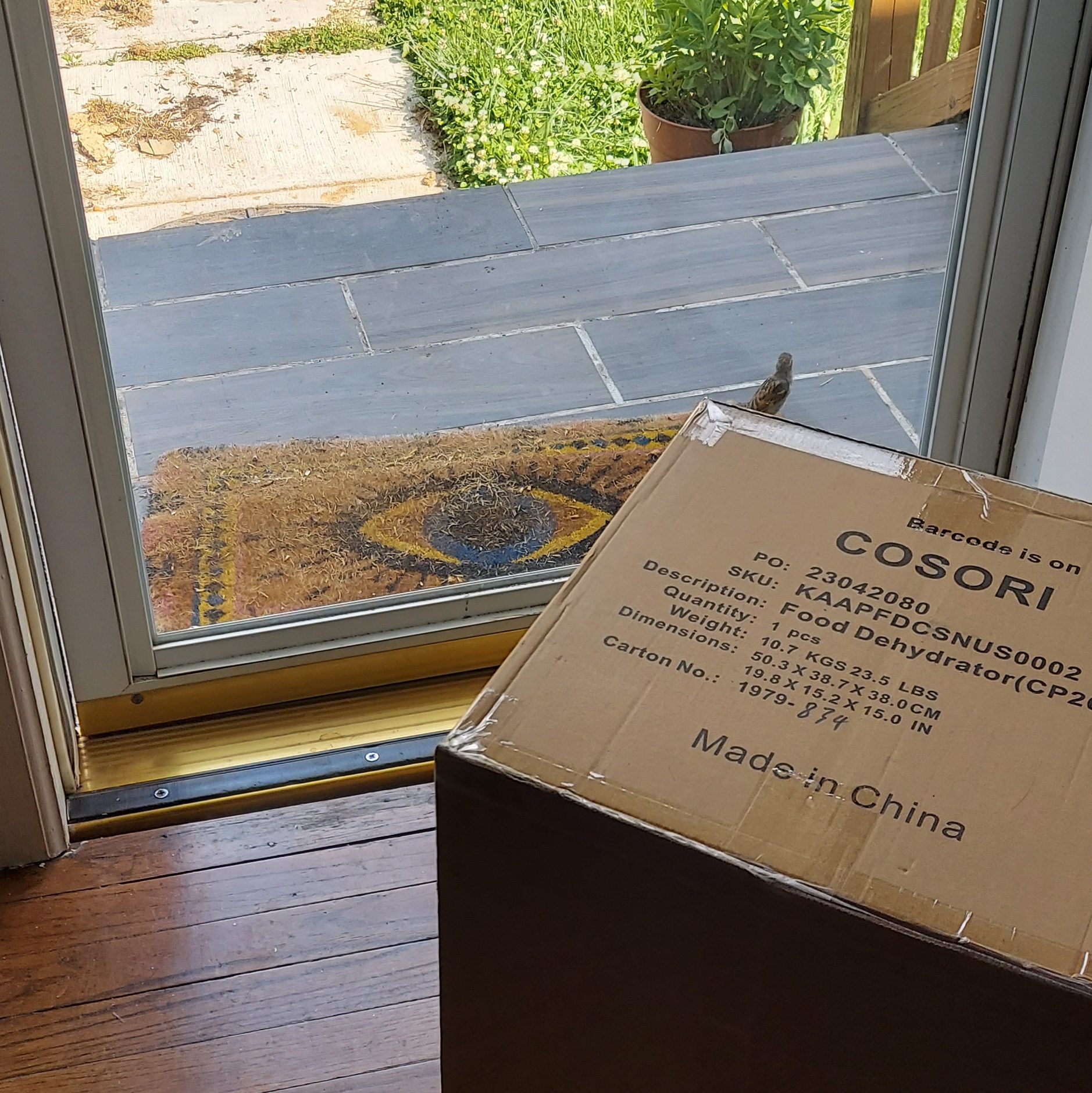
The house sparrows dropped one of their kids off on my porch. It came up and kind of scratched at the door, much to the confusion of myself and the cats.
Kid, where are your parents?!
All of this means that I spend a not-insignificant portion of the day treating the yard like some kind of avian daycare center. I keep the bowls topped up with fresh, cool water, leave fruit and dried bugs where they can forage without going into the road or where neighborhood cats can get them, make sure there aren’t any confrontations, and make sure there are shady spots for them to hide out during the sunniest part of the day. It’s been kind of hot, and the wildfire smoke hasn’t done anyone any favors, so I’ve tried to make things easy on everybody involved. I don’t want the babies to become too used to just scooping up snacks from the bird feeders, though, so I toss them berries and bugs on the grass.
We have a pair of cardinals here, too, but I don’t know what they’re up to just yet. There’s still the side yard and the driveway, so who knows where they’ll unload their brood.
I have to admit, as much as I worry about the babies (are they learning to find food well? Are they staying hydrated? Are they away from cats and snakes?), it’s kind of nice knowing that their parents seem to consider this a safe spot. They’ve even stopped flying far when I go out to refill the feeders and water dishes — the sparrows stay in the apple trees, and the crows hop to the fence and roof until I’m finished. Sometimes, when I sit out there to meditate and get some sunlight, they’ll land on the deck and go about their business anyhow. It’s nice. Being ignored never felt so good.
Pardon the blurriness. I looked up and spied this one watching me and had a fraction of a second to snap a pic before they hopped down to the water dish.
I’ve always had a love-hate relationship with no-poo.
If you’re not familiar, “no-poo” is a hair care method that involves shunning shampoo. This doesn’t mean that you don’t clean your hair, you just do it a little differently. An initial baking soda scrub gets rid of oil, and a vinegar rinse afterward neutralizes it and makes your hair soft and shiny.
Theoretically.
My custodial parent had very different hair from mine, and they weren’t interested in learning the difference or teaching me how to properly care for myself. As someone who was raised to believe that I was just cursed with oily hair and the only cure was copious amounts of shampoo, I’ve always been curious about how people with other hair types take care of theirs. Do they have to shampoo so often, their scalp turns tight and itchy? If not, was it just good luck on their side?
When I still lived in California, I tried no-poo. We had well water, and the water quality was way better than what I’d had before. (This is not a high bar. When I was a kid on Long Island, we had to have our pipes “flushed” yearly or so, and periodically had our water chlorine-shocked. We’d get notices about a week beforehand to warn us that our water was about to get gray, gritty, and nasty for a while. When I lived in Delaware, all the water was just… hard. Really hard.)
The trouble is, no-poo turned my hair into sticky, uncombable clumps glued together with a generous deposit of stearic acid. As it turns out, the water had way more minerals than I anticipated. It took a week for me to get things back to normal again.
I don’t know what made me consider doing no-poo again. Curiosity, perhaps. A sensitivity to a lot of shampoos, maybe. A desire to see if it’d make having trichotillomania easier to deal with.
When I experienced problems before, the prevailing advice was to just use distilled water instead of tap. Since a major part of my initial desire to go no-poo was to avoid plastic, this was counterproductive. Sure, it’s less plastic, but less plastic + a less-than-stellar experience wasn’t really a compelling reason to stick with it.
This time around, I made a solution of baking soda and sea salt for cleaning my hair, then a large jar full of one part vinegar to three parts water to rinse. I’ve also:
Made a rinse potion out of ginger tea and apple cider vinegar. It felt and smelled nice, but I didn’t notice much of a difference between using that versus tap water and vinegar.
Made a rinse potion out of chamomile tea and apple cider vinegar. This was soothing and smelled like apples and bubblegum. Not a huge difference otherwise, though.
Added three drops of cedar oil to the rinse potion. This was overkill and I smelled like hamsters for two days.
Added a drop of frankincense oil to the rinse potion. This was better.
I don’t want to jinx myself, since it’s only been three weeks, but I’m finally enjoying this. My hair is fluffier and softer than it would be with shampoo alone, and much less weighted down than it gets with shampoo and conditioner. Even my partner commented that my hair had a lot more volume than usual.
(I wanted to provide a before-and-after photo here, but all of my “before” photos are of me in various bandanas and other sundry headwear, so they’re of very limited utility. Whoops.)
The most important thing, I think, is that I didn’t wet my hair before applying the baking soda solution. I also didn’t allow the tap water to touch my hair between cleaning and rinsing. That means that the baking soda was neutralized without coming in contact with the high-mineral tap water, so I didn’t turn my hair into sticky clumps of wax. Once everything was neutralized, I had no problem with giving my hair a rinse or two with cool tap water. No distilled water necessary.
My scalp also feels much better. Like, a lot better.
I’m going to stick with it for as long as it continues to work out as well as it has so far. We’ll see how it goes!
If you want to give it a shot, the entire process goes a bit like this. I don’t really measure anything, so all quantities are estimates:
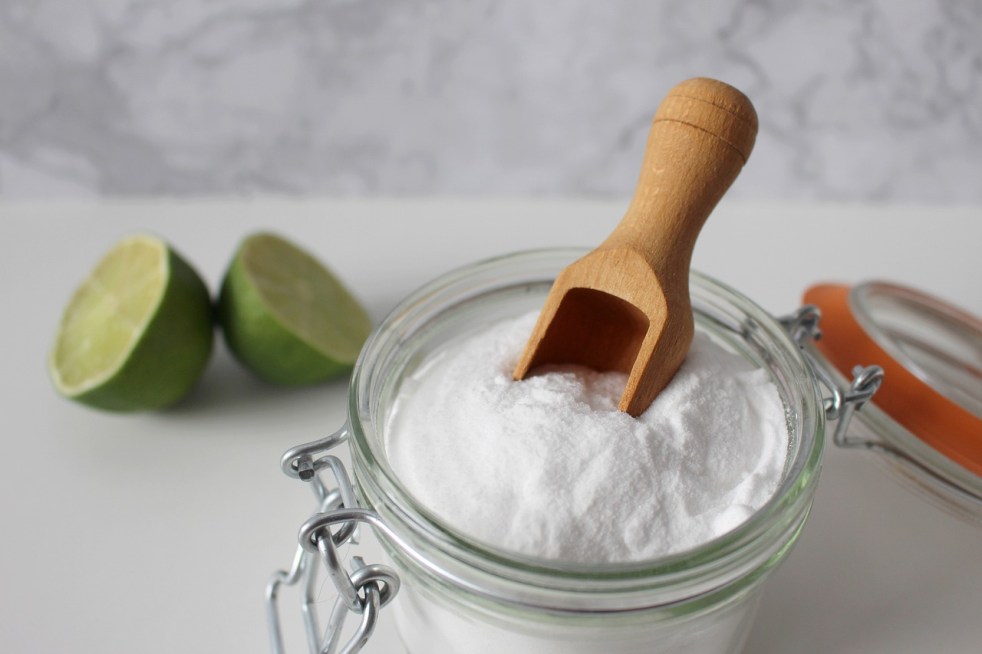
I toss a handful or two (so about two tablespoons) of plain baking soda into a container filled with approximately a cup and a half of warm tap water. Not all of the baking soda will dissolve, and that’s okay.
I pour this over dry hair. Once my hair is saturated, I thoroughly scrub my scalp and work it through the length of my hair.
Now, without allowing any more tap water to touch my hair, I mix roughly a quarter to a third of a cup of vinegar to a cup and a half of warm tap water.
I pour this over my hair to neutralize and rinse out the baking soda.
If I feel like it’s necessary, I can rinse my hair with cool water at this point. I don’t always, since the scent of the vinegar dissipates pretty quickly.
That’s it! The most important part of not getting a head full of sticky residue seems to be carefully avoiding the addition of any more hard water than strictly necessary. This lets the baking soda handle the emulsification and saponification processes (while not as strong a base as lye, baking soda does produce a low enough pH to react with oil) and be neutralized by the vinegar without producing a ton of residue. Mixing the baking soda in tap water appears to be fine, as long as it’s applied to dry hair. Rinsing with vinegar in tap water is also fine, as long as I haven’t wet my hair with plain tap water beforehand.








 Marble Crow