Books

Let’s Read: “Psychic Witch”

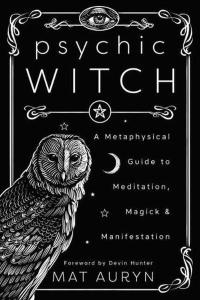
This week, I wanted to devote some time to Mat Auryn‘s Psychic Witch: A Metaphysical Guide to Meditation, Magick & Manifestation.

I went into this book with few expectations — it had come highly recommended, but I didn’t really know what it was. I hadn’t read Mat Auryn’s other works before, a lot of people seemed to think that this one was worth reading, so I figured it’d be a suitable introduction to this author. (Admittedly, I’ve also been working on something myself for the past year or two and I knew it’d be helpful to read more examples of genuinely helpful, well-regarded metaphysical guides.)

Psychic Witch is essentially a collection of meditative and visualization exercises. The ones that lay the groundwork reminded me a lot of high school drama class, in the best way — the first few classes were always spent doing silly things, like playing Duck Duck Goose, to help us overcome the fears that would keep us from immersing ourselves in our roles. (Because let me tell you, it’s legitimately difficult to be embarrassed in front of people you’ve chased around during Duck Duck Goose.)

This kind of exercise has precedent in sacred rituals around the world. Laughter is often the gateway to the divine. Some ceremonies even feature comedy in the beginning, in order to help everyone loosen up, laugh, and shed the inhibitions that might keep them from fully participating. Just like a rousing game of Duck Duck Goose. Psychic Witch introduces the exercise of pretending to be an omniscient witch and seer, behaving as though all of your predictions are absolutely true. This might feel a little silly, at first, but I feel like it’s a fun and necessary way to get out of one’s own way so deeper work can begin.

Later exercises involve ways to trigger different brain states that are more conducive to magical practice than our usual waking state. (I still use a number of them for inducing trances, myself). The book then goes on to build on these, introducing concepts like working with the lower and higher selves, casting circles, and the elements. Even though these are somewhat elementary concepts in magical practice, Psychic Witch introduces and discusses them in a novel enough way that I feel like even seasoned practitioners would get something out of it.

Whether you’re just embarking on a magical path, or you’ve been practicing for ages, Psychic Witch is worth a read. As mentioned above, it discusses foundational concepts in an interesting way. If you’ve ever had trouble connecting to certain aspects of magic, then this book may help you reframe them in a way that makes it easier. I found that it also helped reignite my enthusiasm for aspects of magic that I often find tedious.

crystals · Neodruidry · Plants and Herbs · Witchcraft

Working with the elements (when everything’s been paved).

They paved paradise, and put up a parking lot.
Or office blocks, apartments, and retail space, as it were.

A lot of, though certainly not all, magic involves working with all of the elements. Some people do this in absolutely every spell, some only invoke them in longer, more formalized rituals. Some keep representations of all of them on their altars, some have specific, strategically placed altars dedicated to each. Point being, Earth, Air, Fire, and Water will probably come into play at some point.

But what do you do if your daily contact with nature is limited to a window box, a weedy alley, or a grassy strip of median?

For a lot of people in urban areas, working with the elements takes a little ingenuity. You have to branch out from the idea of the sea as crashing waves and be able to see it in the azure blue of a stone, or the briny scent of a vial of seawater. You probably can’t build a bonfire, but you can smell its power in the warm spice of cinnamon incense.

Every element has its own correspondences. Each has its respective colors, crystals, herbs, and symbols. Bringing them into your home or your altar space is as good a beginning as any when it comes to working with natural energies you may not fully experience in your usual environment. You can follow your intuition here, or use some herbs, stones, or other objects usually associated with each element:

Earth

Herbs: Vetiver, potato, turnip, ivy, mushrooms, alfalfa, myrrh, patchouli, sandalwood.
Crystals: Jade, onyx, salt.
Tools: Dishes of salt, crystals or other stones.
Animals: Turtles, bulls, wolves, bears.

Generally, brown, black, or green things, root vegetables, and autumnal herbs are associated with Earth.

Air

Herbs: Anise, fennel, lavender, mint, lemon.
Crystals: Celestite, citrine.
Tools: Incense, wands, fans, feathers.
Animals: Eagles and other birds.

Generally, yellow or blue things, pastel colors, and “bright” flavors are associated with Air.

A person holds a handful of lit incense sticks. Smoke wafts from their glowing, ash-covered tips.

Fire

Herbs: Ginger, rosemary, chili pepper, sunflower, dragon’s blood, cinnamon, clove.
Crystals: Amber, citrine, carnelian, ruby, fire agate, fire opal, red tourmaline, sunstone.
Tools: Blades, wands, candles, burned things.
Animals: Deer, dragons, salamanders.

Generally, red or orange things, things that thrive in sunlight, stinging things, and things that are warm or spicy correspond to the element of Fire.

Water

Herbs: Benzoin, clary sage, Irish moss, water lily, buckthorn, lotus, aloe vera, cacti.
Crystals: Aquamarine, coral, pearl, opal.
Tools: Cups or chalices, cauldrons.
Animals: Salmons and other fish, sea mammals, frogs.

Generally, blue, green, or black things, things that grow in water, things with a high water content, and things that are cool and moist correspond to the element of Water.

A big part of Druidry is the idea of reciprocity. It’s the idea that building a relationship with something — anything, whether it’s a person, a community, or the spirits of the land — requires a conscious effort to give back. Nobody waters dead flowers, and relationships that are one-sided quickly fade.

Cities provide ample opportunities to engage in reciprocity. I remember laying in bed once, in a studio apartment in Washington DC, and seeing a black and white hummingbird hover just outside the window. It was a wonderful little surprise, and a reminder that, once natural sources of food, water, and shelter are taken away, it’s up to us to make up for the loss.
Pavement and metal don’t kill the spirits of the land, just muffle them for a while.

If you work with plants, cities can provide a surprisingly diverse biome. Bricks are a substrate for multiple species of moss. Concrete is no match for the plants that push themselves up through the cracks. Climbing vines, native and otherwise, cling on to rain gutters and windowsills with an admirable tenacity.

Moss growing on and around pavement at the base of a brick wall.

Urban areas are really good for some elemental work, though. The element of Earth is present in the bones of a city, from the steel beams of buildings to the ubiquitous concrete underfoot. Tall buildings give great access to working with Air — few things are as invigorating as a good energy cleanse by standing on a balcony in a strong breeze.

Living in an urban environment doesn’t always make it more difficult to work with the elements. It just takes a little digging.

Uncategorized

Ginger Folklore and Magical Properties

Hot spices have a certain reputation in magic. On one hand, they’re catalysts — helping to speed things along and bring results more quickly. On the other, many of them are baneful or strongly protective. (Chili peppers, for example, are found in many a banishment and protection recipe.)

Then there are what I call the “sweet heat” spices. These are catalysts that don’t show the powerful banishing or repelling properties of other hot spices. They have heat, but their heat is more geared toward attracting things than driving or keeping them away. This is where things like cinnamon and ginger fall.

Since it’s December, I figured a post on ginger would be timely. After all, it’ll be time for ginger cryptids soon!

Ginger (Zingiber officinale) is related to turmeric, galangal, and cardamom. It originated in Southeast Asia, but there are a number of other plants that bear the name “wild ginger.” American wild ginger species are members of the family Aristolochiaceae, making them related to Dutchman’s pipe. While American wild ginger tastes and smells similarly to Z. officinale, they are not closely related. American wild ginger also contains Aristolochic acids which, while they have some medicinal properties, can also damage kidneys and trigger particular types of liver and urinary cancer. (Exposure to Aristolochic acid also correlates with a poor prognosis for liver cancer.) In short, anything that wild ginger can do, there are other remedies that can do it better and more safely. So, for all purposes that suggest ingesting ginger, please assume that this post refers to Z. officinale, and not members of Aristolochiaceae.

In ancient Greece, it was said that ginger flowers grew where Demeter’s tears had fallen after Persephone’s abduction.

In China, ginger was associated with the Monkey King Sun Wukong. He is a fiery-tempered trickster figure who first appeared in the novel Journey to the West published during the 16th century.

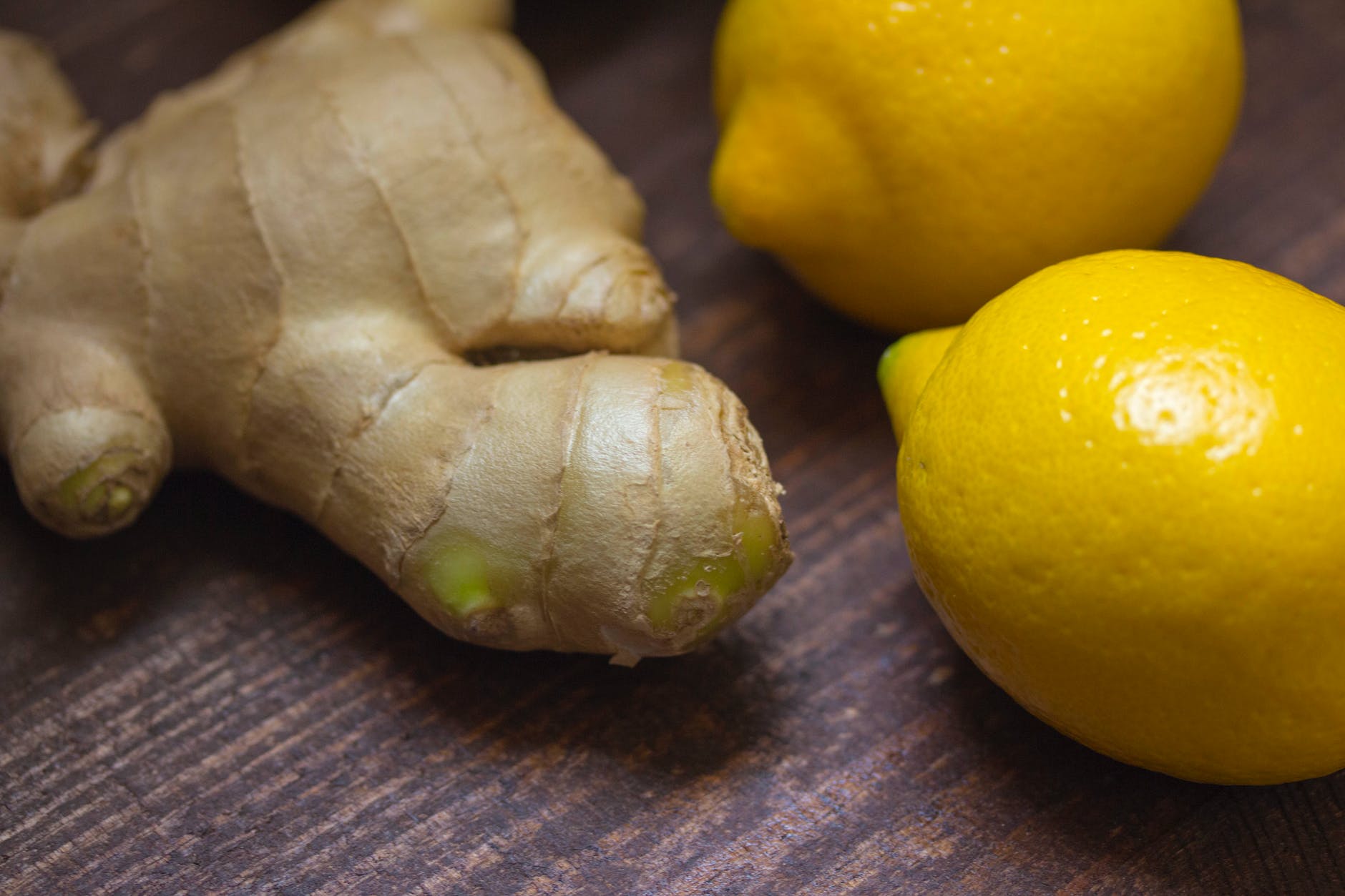
A knobby root of fresh ginger, alongside some whole lemons.

According to Hindu folklore, the first ginger plant arose when Lakshmi tossed a piece of ginger into the ocean.

Pretty much every culture that used ginger recognized it for its warming properties. In ancient Greek, traditional Chinese, and Ayurvedic medicine, ginger is regarded as a spice to ease respiratory ailments and improve digestion. Even today, ginger is used as a natural remedy to reduce nausea. It has shown remarkable efficacy for nausea triggered by pregnancy and chemotherapy.

One old healing ritual involves chewing a bit of fresh ginger root, spitting it out, and rubbing it either on a sick person, or on a photograph or poppet of the sick person.

Overall, ginger is a magical catalyst. This means that it helps achieve results more quickly. It’s also said to increase one’s “inner fire.”

Ginger is often used in romantic formulas to induce passionate feelings.

It’s said that the most powerful ginger roots are those that are shaped like humans, with a knobbly “head,” two arms, and two legs.

This root is associated with the element of Fire, as well as the Sun. As a solar herb, it’s frequently used in rituals and formulas for success and prosperity.

Just as a reminder, Z. officinale should be used for preparations that are intended to be ingested. Members of Aristolochiaceae should not be used internally.

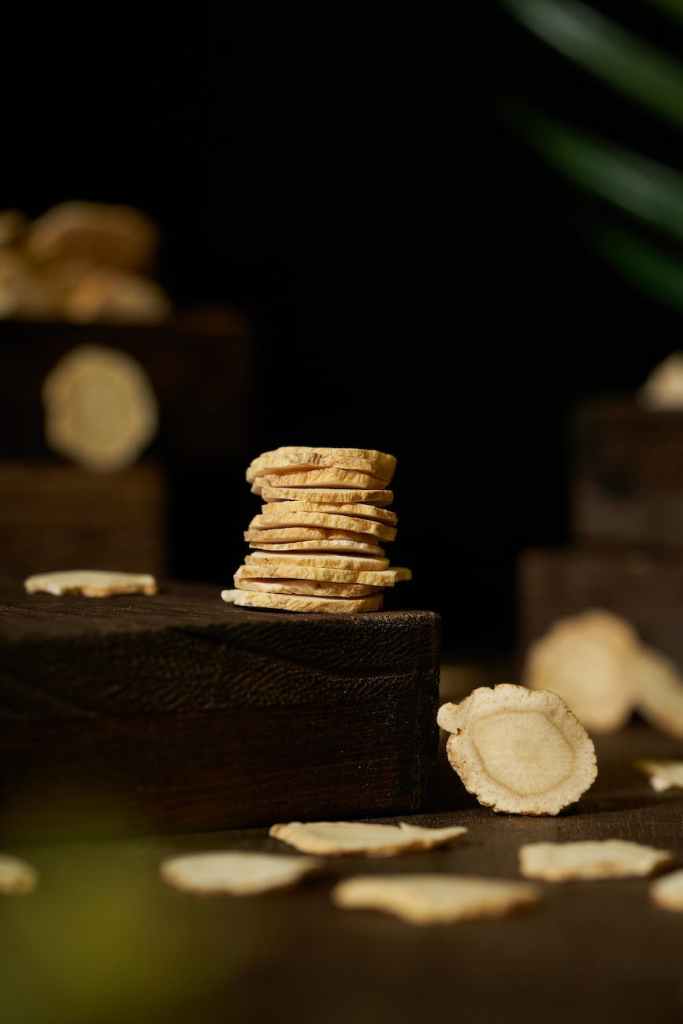
Coin-sized slices disks of ginger root.

Since ginger is a catalyst used in formulas for romantic love, it’s an excellent ingredient in “date night” recipes. Use it alone or with other love- and passion-inducing ingredients, like rose petals or cinnamon, in food or beverages to share with a lover.

A simple money spell involves sprinkling a bit of powdered ginger in your wallet. (You can also tuck a few disks of dried ginger in there, instead.)

As ginger is also considered a physically empowering, warming herb that increases heat and vitality, drinking a cup of ginger tea before a ritual may help facilitate power raising. You can also brew some ginger tea, enchant it for strength, and drink it before playing sports or doing anything physically demanding or competitive.

It’s the Yuletide season here, so ginger is very easy to come by. You can find it in tea, cookies, cakes, and savory dishes alike. With so much delicious ginger at your fingertips, why not use some in your spellcraft?

life

Faces are more like dirt than you’d think, to be honest.

Let me preface this by saying that I’m not a doctor, and, more importantly, I am not your doctor. The approach I put in here is something I cobbled together by gathering skincare advice from multiple sources, and one that I think is kind of difficult to misuse to the point of doing real harm. That said, don’t use any of the recommended products if you’re allergic to them or they’re otherwise contraindicated for you. Be safe!

I don’t want to get into a long macrocosm vs microcosm preamble here, but it really is remarkable how much our own personal microbiologies resemble dirt.

I mean it. When land is cultivated, the soil appears to be mostly fine particles, like silt, sand, and clay. Its biology is bacteria-dominant, and there aren’t a lot of fungi around. If the land is left alone, annual weeds will give way to larger perennials, shrubs, trees, and eventually old growth forests. These drop layers of branches and leaves, fungal spores move in to break them down, and you get a rich layer of organic matter with its own diverse microbiome.
It’s fascinating stuff, if you’re a fan of dirt.
(I am.)

All of this is to say that the ground and the things growing in it are healthier when they can benefit from a variety of microorganisms, and so is your face. This is something I knew on a logical level, but seeing it play out is kind of another animal entirely.
Follow me here for a minute.

Just before Thanksgiving, I had a very minor surgery. It really wasn’t a problem — I was in and out in an hour, and all I needed was a local anesthetic. Afterward, I got a much-needed prescription for 300 mg clindamycin and was sent on my happy (if achy and puffy) way.

Though I am a huge proponent of herbal and traditional medicines, I also know that a lot of not-even-that ancient people died of things that are easily treatable today. Clindamycin is a lifesaver. If you’re like me, and members of the -cillin family are verboten to you, or you have an infection that’s resistant to other first line antibiotics, it may also be the only thing standing between you and a very bad outcome.

Despite its usefulness, clindamycin has always caused problems for me about a week or so after taking it. I feel a heat in my cheeks, which turns into a prolific, itchy, bumpy rash of tiny pimples. After this happened enough times for me, I attempted a tentative self-diagnosis: Malassezia folliculitis, also known as Pityrosporum folliculitis or fungal acne.

Malassezia is a genus of fungi that colonizes the skin of animals. It’s usually the opposite of a problem — under normal conditions, you don’t want your skin to be sterile. Like the microorganisms that live in your intestines, it’s part of a (hopefully) diverse biome where everyone serves their own tiny function.

A painting of several stern looking men in ruffled collars, dissecting a cadaver. Someone put a microscope in front of it for some reason.
I tried to find a picture of yeast, but Pixabay just kept showing me bread. This came up when I looked for “microorganisms,” though, so here you go.

Alas, problems arise when antibiotic therapy kills off the other microorganisms that compete with Malassezia. Since fungi aren’t affected by antibiotics, this leaves your skin completely at the fungus’ mercy. It’s the same reason why antibiotics often cause diarrhea. When they kill off your healthy gut biome, whatever pathogens that aren’t affected get to have a field day. The same thing that happens to your intestines can happen to your skin.

In the past, I used to just tank it. I’d deal with having a rash for a few weeks, and things would eventually get back to normal. I didn’t know why this happened, and nobody could really give me a good answer, but since it was self-limiting and I don’t often need antibiotics, I figured the itching rash was just a thing I had to deal with on rare occasions.

But not this time. If there was a way to keep from looking like the Toxic Avenger and feeling like I wanted to tear my own face off, I was all for it.

Turns out, there is a simple treatment for it: Fluconazole. Yay!

One of the potential side-effects of fluconazole is liver damage. Shit!

It can take care of a fungal skin rash pretty quickly. Yay!

It can also cause a skin rash. Shit!

Anyway. In the interest of not resigning myself to having to alternate an antibiotic and fluconazole every time I got an infection, I figured I’d try to take matters into my own hands. Luckily, I was successful.

So, how can you get rid of Malassezia/Pityrosporum folliculitis following treatment with oral clindamycin? With these:

  • A bottle of Nizoral shampoo.
  • A bottle of sulfur-based anti-dandruff shampoo.
  • A bottle of The Ordinary’s Niacinamide 10% + Zinc 1% serum. Don’t get it from Amazon — there are reports of people getting counterfeit or expired product, and it’s pretty fast and cheap to get from Ulta, Sephora, or The Ordinary as it is.
  • Fresh garlic.
  • Water kefir.
  • Turmeric and ginger tea.
  • The ability to tolerate a boring diet for a while.

I also had a bottle of Hibiclens left over for Reasons, so I figured I’d give it a try. I cannot recommend this, since a) Hibiclens isn’t meant to clear up fungal acne or b) be used as a facial cleanser, and c) you will feel like you’re huffing several dozen ruptured cans of Lysol if you ignore those two things and use it anyway.

Nizoral contains ketoconazole, an antifungal. Anti-dandruff shampoos contain a variety of other antifungals. Both of these are used in the treatment of Tinea versicolor, which is caused by Malassezia globus. Niacinamide helps regulate sebum production and is effective at inhibiting Candida albicans, a skin-colonizing yeast similar to Malassezia. (It hasn’t been tested against Malassezia specifically from what I gather, but I figured it couldn’t hurt.) Similarly, turmeric has been shown to inhibit the growth of 22 fungi species, also including Candida.

You can use Selsun Blue or Head & Shoulders instead of the sulfur shampoo, if that’s what’s available to you. Selsun Blue and clinical strength Head & Shoulders contain selenium sulfide, which is an effective antifungal. Selenium sulfide has been found to be carcinogenic in rodents, but this was after it was administered orally. Since selenium sulfide isn’t absorbed through healthy skin, shampoos containing this ingredient are considered safe. However, if you have broken skin, you can end up absorbing some selenium sulfide because your skin’s barrier is compromised.

So, armed with an array of shampoos and assorted other things, I started a multi-pronged approach that focused on reducing the level of Malassezia topically and internally, and repopulating me with competitive beneficial bacteria. Kind of like removing noxious weeds before seeding a healthy, diverse garden.
Here’s what I did:

  1. In the morning, I washed my face with either the Nizoral or the sulfur shampoo. I followed this immediately with the niacinamide serum.
  2. In the evening, I’d wash my face again with whatever shampoo I hadn’t used in the morning. I’d let it stay on my face, like a mask, for about three minutes before rinsing. I’d follow this with more niacinamide.
  3. I severely reduced the amount of sugar I was eating. Microorganisms can’t get enough of the stuff.
  4. I ate raw garlic. This was probably not strictly necessary, but I felt like it couldn’t hurt.
  5. I drank water kefir. This is a probiotic. If you make it yourself, and don’t back sweeten it, it can also be very low in sugar. (About 3g a serving.)
  6. I drank two to three cups of turmeric and ginger tea a day.
  7. I didn’t load my skin up with other products. Some moisturizers and serums contain ingredients that fungi can feed on, so I wanted to avoid them.
  8. I slept on my back. This kept my skin away from my pillow. Even with changing the case every day, I felt like this offered some added safety.

Now, neither Nizoral nor other dandruff shampoos are intended to be used as face washes. They do contain ingredients like fragrance that aren’t great for your skin, but, as someone with incredibly sensitive skin, I can also offer the opinion that Malassezia is worse. They’re also designed not to be actively harmful to your skin, since they end up there anyway if you use them to wash your hair.

Since I’d already started a breakout when I began this treatment, I couldn’t avoid dealing with Malassezia entirely. Nonetheless, this did make it a lot shorter and less severe. (Like, three to four days of a mild rash instead of two weeks of looking like I’d fallen into some kind of TMNT-style mutagenic ooze.) Also, no liver damage.

As much as I wish I didn’t have to do this, there’s sometimes no other choice. If I didn’t use clindamycin, I was at risk of death. This meant that I had to try to control the microorganisms it didn’t kill off, and bring myself back into balance. This approach helps reduce the number of pathogenic Malassezia and repopulate my body with all the little guys that’re supposed to be there.

animals · life

Puppies, Pies, and Paranormal Problems.

You know, a lot of people go outside and play a game on Thanksgiving. Parents of younger kids might take them out for a rousing game of catch. Teens and adults might play a little touch football in the back yard. It’s pretty common.

It is less common to spend what feels like several hours pursuing a small, self-propelled football, while everyone involved is about a picosecond away from a collective panic attack.

I don’t have any family in the area. For a long time, neither of us did. Holiday meals were either made up of whatever we felt like cobbling together, whatever delivery place was open, or a smorgasbord of unrelated snacks, straight-up goblin-style.

My Handsome Assistant’s awesome aunt and uncle moved just a few hours away not long ago, so we’ve been spending more holidays there. They have a lovely house with a big yard and plenty of spare bedrooms, on a small, peaceful road surrounded by farms. Inside this house is a pair of adorable and very sweet Yorkie/toy fox terrier mixes, as well as a rather petulant ghost. Almost two petulant ghosts, but I’ll get to that in a minute.

This Thanksgiving, we made the drive up with a gallon of homemade meadowfoam mead and a vegan pumpkin pie (made using this recipe from Chocolate Covered Katie and some of our mysterious yard pumpkins).

Now, the older of the two dogs has a habit of running off. They’re both small enough that using an Invisible Fence would be problematic, so they’re carefully supervised and let outside in a movable pen.

All of this is a long way to explain that, through a convoluted set of circumstances involving a basement, a grill, and the Maryland Renaissance Festival, the older dog snuck out. He saw this as the opposite of a problem, since he had a house full of people (and eventually several neighbors and neighbors’ dogs) to play tag with. However, everyone else involved had… mixed feelings about the situation.

I don’t know how long I spent chasing that dog down, calling his name, running through strangers’ yards in hot pursuit of a football-sized creature in a little blue sweatshirt. The cold squeezed my wheezing lungs until the edges of my vision got gray and fuzzy. Eventually, everything looked like tiny dogs: gas meters, squirrels, shrubs. A few people offered me rides as they drove around looking for him, but I turned them down — it seemed like it’d be helpful to have someone on foot who could duck into even more strangers’ yards if need be.

He made it all the way down to the nearest main road and disappeared from view, so I ended up walking down the middle of the street just in case he darted out again. This seemed like a perfectly reasonable thing to do at the time, because my oxygen-deprived brain figured that speeding drivers would a) notice me sooner than they’d notice a tiny dog, and b) would probably slow down to avoid committing vehicular manslaughter. At that point, I was rapidly coming to the conclusion that Doc Martens are less than ideal as a running shoe, so I also figured that being hit by a car would likely hurt less and I’d get to lie down for a little bit. Having been hit by a car before, this seemed sound to me.

Through some miracle, we all managed to tire him out. (Hey, humans are pursuit predators, right?) Four people formed a kind of pincer attack, and my Handsome Assistant performed some kind of acrobatic tackle and swoop maneuver that resulted in my Assistant on his back, one arm upraised, and a very upset tiny dog in his hand. Like a meatball sub with opinions.

Dog snared, we went back to the house. My lungs eventually calmed down enough for me to get a full breath again. There was ham, turkey, sausage, smoked vegetables, mashed potatoes, macaroni and cheese, green bean casserole, cranberry sauce, candied yams, and biscuits. There were also four kinds of pie and a cake.

We played a guessing game that was half charades, half “Name that Thing.” It involves writing down random words, putting them in a bowl, and drawing them out one by one. In the first round, the person reading can describe a word, but not say it, while their teammates guess. In the second round, the reader can only use gestures. In the third, the reader can only use one word.

In our defense, my Handsome Assistant and I didn’t originally know how this game worked when we were coming up with words. The game itself was hilarious, but you don’t know pressure until you have to figure out how to convey “imbroglio,” “Steven Seagal,” or “Azerbaijan” purely through interpretive dance.

A long, unanticipated aerobic session and eating my weight in potatoes and pumpkin pie made me sleepy, so after the Macy’s parade and Dolly Parton’s halftime show, I was ready for bed.

The bedroom, however, was not.

I’ll be honest with you; I’m used to being woken up multiple times a night. Kiko needs to eat special food and refuses to do so until and unless she has received tiny kisses on the forehead. Having my sleep interrupted is pretty much whatever at this point.

Nonetheless, there’s an enormous difference between being woken up by a tiny paw gently tapping my forehead, and the repeated crashes of something absolutely flinging the shit out of everything on the nightstand. It’s not like I placed a valuable and unsecured antique marble collection up there, either. There was no reason for anything to just… roll off. There was especially no reason for it to hit the floor like Tom Brady crawled out from under the bed just to spike it. Half of the time, I hadn’t even fallen back to sleep yet.

I wasn’t in the mood. I’d already missed seeing the Snoopy float, the absolutely bonkers amount of pie I’d eaten was giving me indigestion, and I had a blister on the back of my heel that was big enough to need its own social security number.

“Knock it the fuck off,” I grumbled, unaware of the irony of this statement. A mostly empty tube of lotion slammed down like… I don’t know. A thing that’s extremely extra affected by gravity. I pulled the pillow over my head.

Next year, I’m bringing my ghost box and a pair of jogging shoes.
I’m not getting caught out again.

Plants and Herbs

Cypress Folklore and Magical Properties

I first started this post in January… of 2020.

A bald cypress in autumn. The needles are a vibrant read and very close to falling.

The reason it took so long was because I wanted to do the subject justice. Cypress trees are my favorite trees. I feel closer to them, and more power from them, than I do other trees. They’re sacred to me. I even have a glass pendant filled with slivers of lightning-struck bald cypress wood, and a pendulum made of a naturally fallen bald cypress’ knee.

Since the local bald cypresses have lived up to their names and done their trademark needle-shedding, I thought now would be a good time to dust this post off and finally finish it.

To the ancient Greeks, cypress trees had a tragic origin. Kyparissos was a youth who was beloved by Apollo. Apollo gave Kyparissos a beautiful tamed stag who accompanied the boy everywhere. Unfortunately, the stag was slumbering in the forest when the boy was out hunting, and he accidentally killed his stag with a hunting spear. Heartbroken, Kyparissos grieved so deeply that he transformed into a cypress tree.

The staff of Asklepios, the Greek God of Healing, was made of cypress wood. Though cypress does have some medicinal qualities, it’s likely that his staff used cypress less for its healing attributes, and more for its connections to immortality.

Sacrifices to Hades and Persephone were made under groves of cypress trees. Asklepios’ staff may have been a symbolic placation of the deities of the Underworld, so that they would not take his patients.

One of Athena’s names was “Lady of the Cypress.”

Bald cypresses are so named because they are deciduous. Every year, they shed their needles during the winter months.

Bald cypresses (Taxodium distichum, in the Cupressaceae family) are also unique in that they form “knees” — tall, knobbly growths that spring straight up from the trees’ roots. Nobody’s really sure why this happens, as the knees don’t appear to serve a particular purpose and removing them doesn’t seem to affect the trees negatively. They just kind of… happen. Some theories for cypress knees describe them as an adaptation for living in very wet environments, by helping to aerate the roots, provide an additional means of preventing erosion, or helping to stiffen and strengthen the root system.

Some cypress knees get pretty big. While they’re mostly conical in shape, they can be really irregular and knobby. It wasn’t uncommon for travelers, particularly those walking at night, to mistake them for other people or even monsters.

In general, cypresses are guardians of boundaries. Members of Cupressaceae are symbols of death, immortality, the afterlife, and liminal spaces. Their typically upright growth habit connects the earth to the sky, and they’re commonly planted on the borders of cemeteries. Kyparissos’ legend further associates these trees with death and grieving. Since these trees are evergreen, they are identified with the concepts of immortality and the afterlife as well.

I wasn’t able to find much information about Chinese cypress species, but the bit I did find suggests that cypress seeds were eaten to preserve longevity. In Japan, hinoki cypresses have a prominent place in Shinto rituals. Hinoki wood is used to start ritual fires, as well as to make the priests’ scepters.

A close up of a cluster of green cypress cones.

Though bald cypresses are native to America, they still connect to similar concepts as their Middle Eastern, European, and Asian counterparts. Though they resemble evergreen conifers, they shed their needles every year — a symbolic death and rebirth. They also grow where the water meets the land, which is another liminal space.

According to Persian legend, a cypress tree was the first tree to grow in Paradise. It’s evergreen leaves and extremely durable and rot-resistant wood made it a fitting symbol for immortality.

Cypress motifs are frequently used to decorate graves and tombs. You can see this on Christian graves, and in abstract depictions on Turkish Muslim tombs as well.

Some sources claim that Indigenous American peoples believed that cypress trees had a connection to the spirit world. This claim is vague, however, and since I couldn’t find any specific references to which tribes and nations believed this, it should be taken with a grain of salt.

Cypress wood, when used in wands, is said to have a calm and soothing energy. This follows cypress’ use as a symbol of, and remedy for, grief.

Medicinally, cypress oil is used to soothe coughs, treat warts, ease hemorrhoids, treat cuts and broken skin, relieve pain from muscle aches and varicose veins, and ease symptoms of anxiety and depression.

Personally, I love cypress and get a lot out of its connection to the other worlds. Bald cypresses, in particular, are excellent emblems of the thin border between the material plane and the spirit worlds. I’ve used cypress to ease thanatophobia, and as part of an excellent oil for trancework.

If you don’t have access to cypress trees or wood, the easiest way to work with them is probably through their oil. Cypress trees are fragrant and produce a lovely essential oil. If you avoid using essential oils due to safety or sustainability concerns, you can also try purchasing some cypress needles and infusing your own oils. I’m fortunate that bald cypresses are native to this area, so there are plenty around when I need to gather twigs, needles, or cones.

If you work with grief, or as part of the counseling or deathcare industries, it may be worthwhile to explore the properties of cypress wood or oil. Even if you don’t choose to use incorporate this into your work, the aromatherapeutic and energetic properties may help ease the stress of confronting death and grief on a daily basis.

A close up of the base of a bald cypress trunk, showing four distinct knees. A pond and more trees are visible right behind them.

I have several bald cypress knees around my house. Some are altar pieces, some are floor sculptures, some are cabinet specimens. It doesn’t hurt bald cypress trees to have their knees removed, and many homeowners do so in order to make their yards a little safer and easier to maintain. You can often find cypress knees for sale on Etsy or eBay.

Cypress trees are great. If you live in an area with a native cypress species, plant one. They’re beautiful, they’re useful, and they’re powerful.

Uncategorized

Let’s Read: “Hound”

A baby, stolen from his mother by a bloodthirsty goddess.

Human populations driven to war by an ancient entity.

If these don’t sound like the mythological Irish hero Cú Chulainn‘s story, you’re not wrong exactly, but they are what opens the action in Paul J. Bolger, Barry Devlin, and Dee Cunniffe’s Hound.

This is a retelling of the life of Cú Chulainn, but reframed to suit the constraints of a graphic novel. The artwork is gorgeous and heavily stylized, and the story does a very good job of hitting the high points. Some artistic liberties were taken, which the book acknowledges — the story is framed as told by the Morrígan, who outright says that there are many versions. “But remember… I was there. They were not.”

Hound is ultimately a tale about destiny. Who controls it? Do we, or are the wheels set in motion long before we’re able to make our own decisions? How do we win against the whims of forces beyond us? Can we overcome our innermost nature? How do you struggle against a god?

First, the art style. The book is illustrated entirely in black, white, and blood red. The linework is sharp, evocative of danger and madness. The characters also all have visually distinct appearances — there’s no “same facing” here. Not only do they have distinct faces, they have unique hair, tattoos, and jewelry, too. This is important, because the story moves quickly and people can come and go in a blur.

A man kneels beside the corpse of a large, savage looking dog. A text bubble says "Who will protect my family now?"
Below that, a young, not-yet-Cú Chulainn says "I will... be your dog."

Many characters were blended or altered in order to make a smoother, more cohesive story. Some of the mysterious elements of the original (like Deichtine giving birth to Cú Chulainn, who has multiple foster parents) are greatly simplified (Cú Chulainn is kidnapped and raised by the Morrígan, who uses this time to plant the seed of his madness). This isn’t entirely a bad thing — Cú Chulainn’s story is long and complex, with many figures who come and go and have their own, branching stories. Condensing it into a graphic novel requires a bit of ingenuity.

As a graphic novel, it’s excellent. The story is ancient, but it feels fresh. The artwork suits the material. The artistic liberties that were taken with the story help to make it a cohesive, self-contained novel.

From a mythological perspective, it also seemed like some liberties were taken in places where they didn’t quite make sense. Aífe (Eva in the book) is an entirely different character. Rather than being a woman warrior who nearly bests Cú Chulainn in single combat before he creates a diversion, she’s Scáthach’s rebellious — and kind of whiny — daughter. Rather than Cú Chulainn demanding she bear him a son after he defeats her, the two of them get hot and heavy during a hunting montage. Rather than Cú Chulainn giving her a gold ring and telling her to send his son to find him in seven years, she’s butthurt that Cú Chulainn left her for Emer and sends the boy to hunt him down herself.

It’s understandable that a modern telling of Cú Chulainn’s story, where he’s the hero, wouldn’t want to include him demanding Aífe sleep with him in exchange for her life. Nonetheless, I don’t feel like this telling of the story really did her justice. She’s Scáthach’s rival. A legitimate threat, to the point where Scáthach drugs Cú to keep him safely out of the battle. A woman warrior capable of defeating Cú Chulainn. A lot of that was lost, I feel.

King Conchobar is also very different. By all accounts, he was a good king. In Hound, he’s portrayed as almost peevish. This worsens as the story progresses and he develops a grudge against Cú over Emer. Here, it’s the king who sends Cú to Scáthach as punishment.

A significant part of Emer‘s character was lost, as well. In the original, she tells Cú that she’ll only marry him when he proves himself worthy. She isn’t engaged to a king — in fact, kings turn down her father’s offer of her hand, because they know Cú wants her and know better than to get on his bad side. In Hound, it seems that Emer is flattened and her agency taken away. There, she’s engaged to the king against her will, who rejects her when she falls in love with Cú. This takes place over a couple panels’ worth of a travel montage. Why do they fall in love when she’s shown doing nothing but complaining and apparently has complete disdain for Cú? Your guess is as good as mine.

Perhaps my biggest character gripe is the Morrígan. In Hound, she is decidedly one-note. Almost more cryptid than deity, she is a shapeshifting entity who is dissatisfied with the lasting peace among humans. She kidnaps Cú in order to make him her warrior, to stir things up. She instigates the cattle raid to cause war. She has no motivation here other than to cause bloodshed. Alas, every story like this needs a villain, and she’s set up to fit that particular bill.
(She’s also portrayed as a single entity, rather than a triple goddess, but that’s not really an issue.)

I do like how Hound treats Scáthach (simplified to Skye), however. She isn’t portrayed as “comic book hot.” There are no spine-snapping poses, skintight outfits, or fight-inhibiting titties here. Her strength is not an informed characteristic — she exudes it. She is a powerful figure. She has a wild, animal sensuality that is far removed from standard comic heroines. This is a woman who can and will use her thighs to crush a skull like a watermelon. (And she’ll put you through a training montage until you can do the same.)

A tall, powerfully muscled woman stands over Cú. She holds a blade to his head and says, "So you are the great Cú Cullan..."
A nude Scáthach, body painted with bold swirling designs, reclines on carved stones. She says, "Let the sleeping stones seep this world from your bones and the steam steer your dreams in the other..."

As for the other characters, I wish I had more to say. At one point, we’re introduced to a five-man band of Scáthach’s students, but they don’t end up being as significant as I expected. (The only exception is Ferdia.) The story, as dense as it is, moves much too quickly to really become invested in many of Cú’s relationships. People die left and right, but in a way that’s hard to care about.

Ferdia, on the other hand, is treated well. He’s portrayed as a boisterous bruiser, a fitting blood brother for Cú, who is capable of holding his own even without the divine favor Cú has. He’s Medb’s champion, but he’s not a villain. He’s strong, handsome, honorable, and his final meeting with Cú is appropriately upsetting. He’s given weight in a way that the other characters — even some very important ones — are not.

This is not to complain about the story itself, however. Like I said, there are limits to portraying a tale like this in a graphic novel format. Some characters need to be simplified, and others removed. That said, I do think there are some places where this simplification wasn’t strictly necessary or could have been handled differently. (Cú having to leave Emer would’ve been more impactful if she were closer to her original portrayal, for example.) It’s likely that the only way around this would be to split Hound into multiple volumes so everyone could get some more page time and character/relationship development.

I know what you’re probably thinking, though.

“Okay, so this is Cú Chulainn in a visual medium… What about the warp spasm?!”

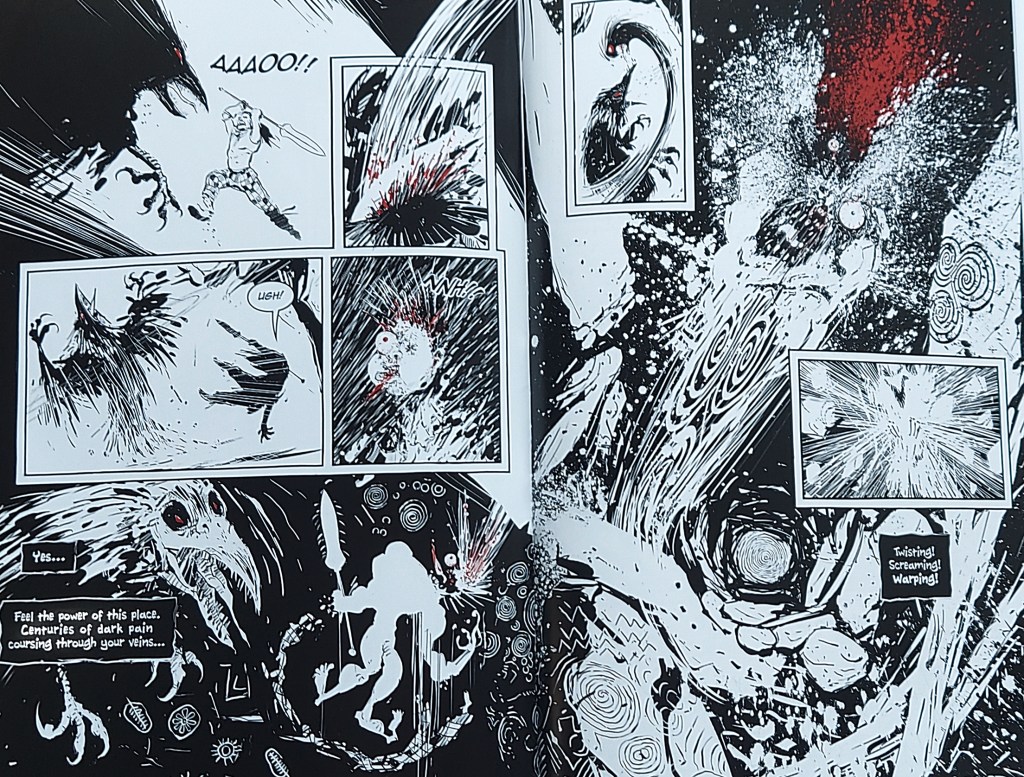
Don’t worry. It doesn’t disappoint. You know how horror stories are always scarier before you actually see the monster? In Hound, the artwork does a great job of suggesting and evoking without fully showing. Your imagination can fill in the details, and that’s always scarier than anything anyone can draw for you.

I'mma be honest, I'm not really sure how to describe what's even happening here. It's a depiction of Cú's warp spasm, where his body distorts as he enters a rage.

I absolutely recommend this book to readers who are interested in Irish legends, or for whom the story of Cú Chulainn resonates. I wouldn’t, however, recommend it to people looking for a historically faithful representation of the tale. It’s a beautiful book and, as long as it is respected as a dark fantasy adaptation of an ancient story, it’s extremely enjoyable.

Witchcraft

The Wheel of the Moon

I’ve mentioned before that I’m a big fan of the Wheel of Life exercise. I was introduced to it by my psychologist, and I found that it was a) really helpful and b) fun. I like lists. I like charts. I like ways to visualize data, and that’s pretty much exactly what this exercise does. It’s also really flexible and customizable.

This last bit is why I’ve made it part of my full moon observations. I light a candle (a handmade full moon candle from the wonderful 13 Magickal Moons in Occoquan, VA) and some incense. I draw the wheel. I section it off and label it however is most fitting. I make the assessments, I draw the lines, and I compare the shape with the shape of the previous month.

The full moon rising behind some pines.

It’s a meditative exercise that helps me to acknowledge the changes I’ve made from month to month, because I can see them right in front of me. It highlights areas that need help, so I can use the power of the full moon to change them. By doing the wheel monthly, instead of every few months, it makes it easier for me to make incremental changes (and keep tabs on things like The Ennui).

It’s also useful for relating to the cycle of the moon. Even at the height of its power, the full moon heralds its own decrease. By that same token, the waning moon promises future growth. Looking at the Wheel of Life shows what has grown, what hasn’t, and, if need be, what should be pruned.

Below is a simple ritual outline that just about anyone can use to help better their physical and mental health, improve their relationships, and generally pull off a whole-life glow up.

You will need:

  • A pen or pencil.
  • A piece of paper with a circle drawn on it.
  • A candle, preferably in white or silver.
  • Incense. Ethically harvested sandalwood, myrrh, white rose, bay leaf, or lemon balm work well here.
  • If this isn’t your first time performing the ritual, you may also want to have a fireproof bowl.

First, consider the areas of your life that you wish to focus on. This could be your physical health, mental health, physical environment, friendships, family, love life, career, spirituality, creativity, or anything else you desire. Count up how many areas you want to work on, and divide the circle up into that many sections — like a pie chart. Alternatively, you can use an online Wheel of Life creator.

Think of each area carefully. If you had to rate that area of your life from 1 to 10, what would you rate it? Pretend the center of the circle is zero, and the very edge of each slice is 10. Draw a dot roughly corresponding to the numerical rating you choose for each section. Connect these dots with lines, and you should have a kind of asymmetrical star shape.

Here’s an example from Wheeloflife.io’s generator.

This is your Wheel of Life. It’s a visual representation of how you feel about things right now. Look at the areas where the shape is most lopsided — this is where you feel your life needs the most help at this moment. For example, if you rated “family relationships” at a 7, and “career” at a 3, “career” would be the area to focus on.

Now, light the candle and the incense. If you can, place the Wheel of Life in a spot where the full moon’s light can fall on it. If not, observe it under the candle’s glow.

White candles, burning.

Say,

“See the moon’s glow, charging the Wheel.
My life is unfolding, with each turn I feel.
Full moon energy, guide me this night.
Transform me, renew me,
With your radiant light.”

As you meditate on your Wheel, consider what changes you can make to the areas of your life that need the most help. What can you do within the next week? The next two or three weeks? The next month?

Come up with three simple actions you can do over the next week. They can follow the energy of the waning moon, but they don’t necessarily have to.

Come up with three more that you can do over the next two to three weeks.

Finish by coming up with three more that you can complete by the next full moon.

Save this Wheel. Place it somewhere where you’ll see it often. Refer to it as many times as you need to in order to keep yourself motivated and on track.

(If you like, you can turn your actions into statements of intent, and use your preferred method to further empower them. Turn them into sigils, shorten them to symbols and inscribe them on candles, and so forth.)

If this isn’t your first time performing this ritual, then take out the last full moon’s Wheel.

Take a moment to compare this full moon’s Wheel to the last one. What progress have you made? What seeds have you sown, and what have you reaped? Give thanks for any advancements you’ve made, no matter how small.

A crackled clay firebowl filled with burning herbs. A small pile of herbs sits in the foreground.

If you wish, you can light the last full moon’s Wheel in the candle’s flame and drop it into the fireproof bowl. Scatter the ashes on the wind.

Plants and Herbs

Holly Folklore and Magical Properties

I’m lucky to live not too far from an arboretum, which means that I have the ability to observe all kinds of incredible trees. A Druid group that I’m part of regularly visits it, too, in order to learn more about native trees and the traditional trees of the ogham. This season, we’re focusing on holly.

The US boasts multiple species of native holly. While these are all of the same genus as the European holly (Ilex aquafolium) of the ogham, they’re not really the same. Nonetheless, if you’re studying the ogham’s history, significance, and usage, making friends with your local trees certainly helps.

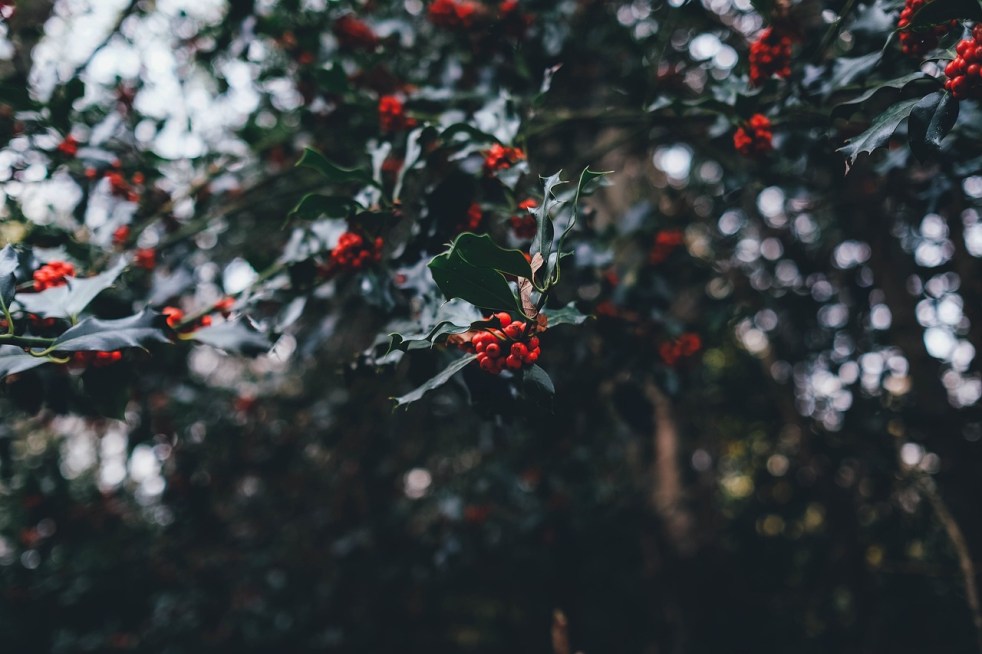
Red holly berries nestled among dark green, prickly leaves.

Holly is good for far more than its significance in the ogham. It has a long history the world over as a medicinal and magical plant.

The ogam letter “tinne” didn’t always mean holly. (There’s strong evidence that it wasn’t originally a tree alphabet, but that’s a subject for another time.) Kennings indicate that “tinne” originally referred to a metal bar or ingot.

An ogham kenning is known as a Bríatharogam. These were used to explain the meaning of each symbol, as well as to help scholars memorize them. The three Bríatharogam for tinne are “trian roith,” “trian n-airm,” and “smiur gúaile.” These translate to “one of three parts of a wheel,” “one of three parts of a weapon,” and “marrow of coal.”

In European folklore, holly was considered a highly protective plant. (If you’ve ever felt it’s hard, prickly, waxy leaves, this probably isn’t too surprising!) It was also regarded as unlucky to cut down an entire holly tree — probably because you’d be removing its ability to protect you. Instead, there was a tradition of coppicing holly trees. This let farmers use the leaves as fodder, and gave artisans access to the highly valued holly wood.

This connects interestingly to the concept of holly as “one of three parts of a wheel/weapon.” All trees and woods have their own magical properties, and holly was considered useful for controlling. That made it useful for crafting horsewhips.

Also interestingly, holly’s ability as a protective plant has some mundane basis. Holly trees often exhibit a phenomenon known as “heterophylly,” where multiple types of leaves are present on a single plant. It’s not at all uncommon to see holly trees and bushes with both smooth and prickly leaves. Researchers have found that the appearance of prickly leaves correlates to recent browsing by herbivores. After a holly tree’s smooth leaves get eaten, it replaces them with prickly leaves to defend itself!

Ilex aquifolium, exhibiting heterophylly. Many of the leaves on this branch are spiny, but some are smoother and more oval in appearance.

Holly was also believed to protect against lightning strikes. There’s evidence that the prickly shape of holly leaves helps conduct lightning, protecting the plant itself and neighboring trees and structures from damage. Somewhat ironically, certain holly species are also extremely flammable. Please thoroughly research specific species of holly before choosing to plant one near your home.

Celtic legend speaks of the Oak King and the Holly King. Each one ruled over one half of the year — the Oak King over the warm months, and the Holly King over the cold. They would do battle each solstice, and the loser would have to submit to the victor. The Holly King wins each summer solstice and rules until the winter solstice, when he’s once again defeated by the Oak King.

In the Victorian language of flowers, holly represented defense and domestic happiness.

While some species of holly have been used medicinally for inflammation, fevers, and skin problems, it isn’t commonly seen in modern herbalism. There are generally safer alternatives that are equally as effective.

In addition to protection, holly is associated with beauty, prosperity, good luck, and vengeance.

Holly makes for good, strong wands. The wood is also really white in color, so it can take decoration well. Wands made of holly wood are said to be powerful for working with and commanding spirits.

Planting a holly bush near your house is useful for protecting against malevolent entities and energies, as well as lightning. Please note that some hollies are really flammable, however, so make sure you choose the right variety for this purpose. Alternatively, bring some fresh holly boughs into your home instead.

Place some prickly holly leaves in a glass bowl of fresh water, and let it stand in the morning sunlight. Bring it in before noon, remove the leaves, and use the water to asperge rooms or objects that you wish to protect.

Holly boughs, when brought into the home, are said to protect from mischievous fairies. It’s believed that fairies come into the home with the holly boughs, so bringing them in gives the fairies a place to stay peacefully during the winter months so they don’t cause trouble. However, the fairies must be shooed away and the boughs burned by Imbolc, or the fairies may decide to stick around and become a problem. In some cultures, it’s considered unlucky to ever burn holly, so it may be better to bring the boughs outside and leave them there instead.

Hollies are also valuable food plants for birds, even though they’re poisonous to other animals. If you’re trying to cultivate a better relationship with the local fauna and spirits of the land, it may be worth planting a native holly species. The berries are hard and unpalatable for birds during the warm months, but the last a long time and grow softer and sweeter after being frozen. This means that they’re one of the last sources of food in areas that experience cold winters.

Snow on a holly branch. The bright red berries are still clearly visible and vibrant.

In my area, we have native inkberry holly (Ilex glabra). These are a bit different from the usual hollies you see on cards and decorations, since it has smooth, oval leaves and small black berries. Even if you’re like me, and the traditional spiny, red-berried holly is in short supply, native hollies are just as valuable, powerful, and interesting to meet.

life · Plants and Herbs · Witchcraft

Relieving Pain by Means Magical and Mundane

Hello! The inside of my face has been replaced with centipedes.

… Okay, fine, but that’s what it feels like.

Friday, I had a minor surgery (which, depending on how things go, may end up being the first of several. Sigh). This would not be a deal for most people, let alone a big deal, but things get complicated afterward when you have a very limited list of pain relievers that you can safely use. So, I figured I’d write this handy-dandy guide for other people in this position.

Why might someone have trouble getting pain relief? A lot of reasons. Some people avoid them because of a personal or family history of addiction. Some medical conditions, like breathing problems, preclude the use of specific types of pain killers. Some medications don’t combine well with them, either. In my case, too many pain meds manage to raise cerebrospinal fluid pressure, have a reduced effect when combined with an SSRI, and increase the risk of serotonin syndrome. This underlines the importance of disclosing everything to your doctors — your past and current medical conditions, every medication you’re taking, the whole lot. They’re not there to judge you, they’re just there to make sure you don’t die.

Anyhow, there are herbal, mineral, and magical means of coping with physical pain when everything else is contraindicated. These shouldn’t take the place of appropriate pharmaceutical pain management when that’s a) available and b) necessary, but can definitely help take the edge off when that isn’t an option. As with any herbs, don’t use them if you’re allergic to other plants in the same family, or if you’re on other medications that might interact with them. A lot of plants that relieve pain are also relaxants, so be mindful that they may make you drowsy or slower than normal. If you have an upcoming surgery, ask your doctor if these herbs are safe to use in the days running up to your operation.

Ah, chamomile. My number one solution to so many of life’s problems. It’s relaxing, it helps me sleep, and it’s surprisingly good at helping with pain.

Here, we’re talking about both German (Matricaria chamomilla, also known as M. recutita) and Roman chamomile (Chamaemelum nobile). One study found that a topical gel of 3% chamomile extract helped with pain from oral mucositis induced by chemotherapy. A clinical trial quoted in this same study showed that chamomile, when inhaled, reduced cesarian pain. Other quoted trials demonstrated a very helpful anti-inflammatory effect, as well.

Chamomile flowers floating in a cup of tea.

When I need chamomile to do more than help me relax, I prefer to use a tincture. It seems to work faster and provide more relief than tea alone (though a nice cup of iced, double-strength chamomile tea certainly has its place). A few drops of chamomile tincture are also great at soothing toothaches and mouth sores.

Chamomile essential oil is also helpful in an aromatherapeutic context (the way it was used in the cesarian surgery pain trial), but isn’t absorbed all that great. Topical applications of chamomile oil were much more effective when they were blended in a nanogel to aid absorption.

Lemon balm, Melissa officinalis, is best known as a relaxant and digestive herb. Some people use it for pain relief, but structured research is limited in this area. Still, if you’ve experienced pain that has kept you up at night, you probably know the value of something that can help you get to sleep.

Lemon balm, like chamomile, is also anti-inflammatory.

As a word of caution, lemon balm can be powerful. I don’t really get sleepy from chamomile, but a cup of lemon balm tea can knock me out. Be cautious when using it with other herbs or medicines, and don’t use it when you need to be alert.

Turmeric is an anti-inflammatory herb that I initially started using for joint pain. Combining it with black pepper, specifically the compound piperine, helps to make turmeric more effective. Piperine isn’t very soluble in water, though, so preparations made with isolated piperine usually involve extraction using solvents like dichloromethane.

Personally, I use turmeric and ginger tea all of the time. I feel a difference when I don’t. (If I’m having a rougher day than usual, it’s often because I’ve been skipping my tea by accident.) These plants are actually related, and they have some overlap in their medicinal effects.

A wooden spoon and glass jar of turmeric powder.

Turmeric and ginger are the kind of herbs that are better for chronic pain, not acute pain. Think of it like this: If you deal with joint pain on the regular, turmeric and ginger may be a big help. If you currently have a headache, you’re better off reaching for something else.

Got a toothache? Clove oil (Syzygium aromaticum) is your buddy… at least, if you’re an adult.

A drop or two of this stuff, diluted in a carrier oil, placed on a cotton bud, and swabbed on the affected tooth, can help halt tooth pain in its tracks with amazing efficiency. It’s effective for making cavities and broken teeth less agonizing until you can get to a dentist. One of the compounds in clove oil, eugenol, is even used to help manage the pain from alveolar osteitis (dry socket).

As a note of caution, clove oil is potent medicine. Use it straight, and it can burn the absolute tits out of your mouth. It can also be toxic in large doses. For children, a “large dose” is not a whole lot, so it should never be used to sooth teething babies. Clove oil can also be bad for people with liver disorders, unstable blood sugar, or who are taking anticoagulants. While a drop or two isn’t going to harm a healthy adult when used properly, it’s worth knowing this stuff and treating cloves with respect.

It’s also important to use real clove oil. Make sure the bottle says that it’s 100% essential oil from the appropriate species of tree. (Don’t worry about qualifiers like “therapeutic grade” — there are no regulatory bodies that determine this, it’s just a marketing term). Avoid products labeled “fragrance oil.”

No clove oil? Mash a little ground clove spice with warm water and apply the paste instead.

If you have a toothache and clove oil isn’t an option, biting down on a piece of raw garlic can help. Chew it until it’s soft, and let it sit on the affected tooth. If you don’t want to chew on raw garlic, mush it into a paste with a spoon or mortar and pestle, or grate it first. The important thing is to let it sit on the aching tooth.

From my experience, garlic doesn’t relieve tooth pain quite as effectively as clove oil, but it can be safer for some people. If you’re really struggling, you’re about at your limit with swabbing clove oil in your mouth, and you don’t have any chamomile tincture, garlic is definitely a solid runner up.

This is all purely anecdotal, but I’d feel remiss not to include it. I have a satin spar wand — nothing fancy, just an unpolished, rectangular hunk of gypsum — which has come in handy time and time again for pain related to intracranial hypertension. As it turns out, a number of pain relievers are associated with increased cerebrospinal fluid pressure, so there’s often not much you can do to deal with the crushing pain.

I get it the worst right at the base of my skull, as do a lot of people. I’ve found that lightly pressing a piece of satin spar to that spot really helps. Oddly enough, other massage wands don’t. Neither do other crystals. Honestly, even ice packs are a bit hit-or-miss.

Should you throw out all of your NSAIDs and stock up on satin spar? No, I don’t think so. But satin spar wands are common enough that, if you’re reading this, it’s likely that you already have one. If so, it may be worth giving a shot. It certainly has been for me!

I have a lovely bit of chlorite quartz that came from Ireland. It’s very clear, save for a bloom of deep green in its heart– like a cluster of fluffy moss.

A lot of guides attribute healing properties to chlorite quartz, but these are pretty vague. “Healing.” “Emotional healing.” “Detoxification.” Interestingly, I haven’t seen it used for relieving pain, though I have seen more than one site make the wildly irresponsible claim that it’s good against serious, potentially lethal health conditions like cancer and heart disease.

I discovered by accident that the particular specimen I mentioned is helpful for headaches. Holding it in my dominant hand has stopped one in its tracks on multiple occasions, to my delighted surprise. As someone who has headaches of varying severity on a daily basis, anything that can put the brakes on one is nothing short of miraculous.

One old remedy for tension headaches involves taking a knife (preferably one with a broad, pointed blade, like a chef’s knife) and holding it against the head. The user is then instructed to take the knife outdoors and stab it into the ground, while declaring that the headache is now sent into the dirt for the Earth to deal with. Even if you don’t necessarily believe in the power of sympathetic magic, the coolness of a piece of metal can help ease a mild headache, and the psychological benefits of this exercise shouldn’t be overlooked.

Other remedies involve transferring illness to objects like candles, then burning them. These are just as valid, but take a bit too long for my taste. If I’m having too much pain to sleep, the last thing I want to do is babysit a burning candle for several hours!

Pretty much everyone knows about using ice and heat to help relieve inflammation and pain, but setting up the right temperature gradient can turn that relief up to eleven.

When it comes to headaches, warming your feet while cooling your head can be a huge help. This helps increase blood flow to your lower extremities, while narrowing vessels in your head. If you have the kind of throbbing headaches that are triggered or made worse by heat, this can really improve things by a surprising amount. A warm footbath and an ice pack on the back of my neck can be an absolute lifesaver sometimes.

It’s really not uncommon for people to end up in a situation where their pain relief options are limited. This list isn’t to suggest that herbs and crystals can substitute for, say, a morphine drip for a terminally ill person, but to hopefully offer some ideas for people who, like me, don’t really have safe, effective options available.