
life · Neodruidry · Witchcraft

The Many Implications of a Jacket

Guess who’s got two thumbs and a jacket she got a pretty rad deal on!

(Me. I did.)

Everything we touch, we leave a little of ourselves in. Maybe you handled a book when you were having a terrible day, or picked up a crystal when you were feeling particularly elated. By that same token, everything we bring into our spaces comes with its own energetic history. This is why it’s always a good idea to cleanse your stones, bowls, wands, or any other tools before you use them — you don’t necessarily want someone else’s bad day screwing with your whole jam, you know?

So you rinse them in clean water, if you can. Maybe you hold them in incense smoke, or the fumes of cleansing herbs. Maybe you place them in sunlight.

All of this is to say that this jacket is very pre-owned, and I don’t know any of its history. Was it owned by a nice little old lady who only wore it on Sundays? Did it narrowly escape being labeled “Exhibit B” in a trial? It’s a mystery!

Even though a jacket isn’t a magical tool, I still don’t really want any bad vibes hanging around. I mean, if nothing else, that is other people’s energy and should be returned to them. This can go beyond sending energy back to its previous owner, too — not only was this jacket previously owned by someone, it was sewn, cut, dyed, and tanned by someone, the cow was raised by someone, and the cow gave its life for it. (I prefer not to mess with plastic leather substitutes for a variety of reasons. Unfortunately, plant-based alternatives like hemp were not going to meet my needs here.)

A lot of living things sacrificed their time, energy, and even lives to keep me warm and dry. That deserves appreciation.

When I cleanse secondhand objects, it’s important to me to not only remove the residual energy from the object itself, but to return it to its source and express thanks and understanding of how it got there in the first place. The choice to purchase or wear anything shouldn’t be made lightly, and it should be done with a full view of what it took to get it into a shop, and what’s going to become of it once its working life is through.

Even the choice to send gratitude and positive energy to whoever previously owned, made, or died for a thing isn’t without controversy. Let’s be real — most of the people involved in this jacket’s creation are probably still alive. There’s something to be said for never performing magic for someone without their consent (though this is often considered a limit to love spells and things of that nature). If the previous owner is a devout Christian, how would they feel about a Pagan doing a working for them?
Granted, my experience with this is limited to watching a family member (and, to be fair, Pat Robertson devotee) set AzureGreen catalogs on fire in our kitchen sink while ranting about Satan, but I am inclined to think the answer is: not super great.

On the other hand, nobody says that this hypothetical person has to accept any intentions they don’t want. I ain’t over here trying to force anyone to have a good day. Ultimately, it’s enough that their vibes make it back to them, where they belong.

So, I light my herbs. I sprinkle my salt. And I send the energy back with the intention that it finds its targets happy and well.

divination · Witchcraft

Ogham Staves from WillowsPaganShop.

Note: This post contains affiliate links to the sellers and products I mention. These allow me to earn a small “finder’s fee,” at no additional cost to you. Thank you for helping to support artists, artisans, and this site!

So, I’ve been working on learning a new system of divination — Ogham staves. I used them for this week’s divination, and I’ve been trying to see where else I can incorporate them into my practice.

Many types of wood have their own specific magical and spiritual properties, so choosing a set took me awhile. I also prefer to find tools that are “neutral,” in an energetic sense; I don’t like using wood that’s been cut down, if I can help it. Windfall and reclaimed woods are more my jam.

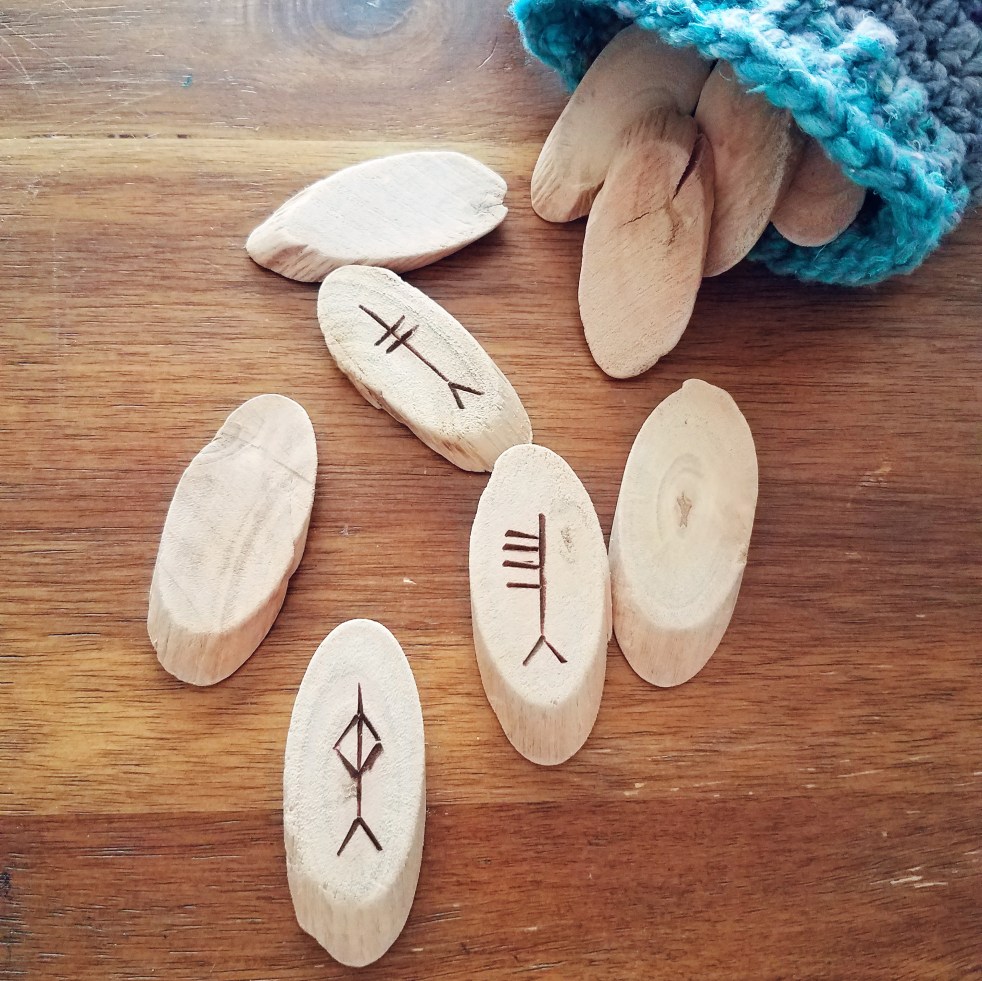
That’s why I was so happy to find these driftwood Ogham staves by WillowsPaganShop.

A set of driftwood Ogham staves spilling from a turquoise and grey pouch.

I love the size and shape — a lot of the other staves I looked at were thinner and more rounded, which I thought might make it more difficult for me to draw them the way I’d like to. The texture is nice, too, with the velvety-softness of sea-tumbled wood. They’re also a very good weight, neither too light to keep from blowing away outdoors, nor too heavy to carry comfortably in a purse or crane bag.

I keep them in a lovely crocheted pouch by Neeedles. It’s just the right size, and gorgeous colors. The crochet is nice and tight, too, so I’m not worried about the staves stretching holes in the stitches and slipping out. At about $15, it was a very reasonable price for a handmade bag, and the craftspersonship is really, really nice. I’m considering getting more of them for my other supplies, they’d be great for carrying a few stones, vials of herbs, and tealights for mobile ritual-doing.

Now I just have to learn the meanings. Fortunately, I have a lot of opportunity to practice!

Plants and Herbs · Witchcraft

Elderberry Folklore and Magical Uses

With colds, the flu, and COVID-19, elderberry syrup has made a lot of appearances in various “crunchy” and DIY blogs. Elderberry is touted as an herbal “medicine chest” — even Hippocrates and Pliny the Elder had a hard time overstating the herb’s value. It’s said to improve allergies, inflammation, sinus problems, and pain, and, with prompt use, shorten the duration of cold and flu symptoms.

Elderberries and syrup.

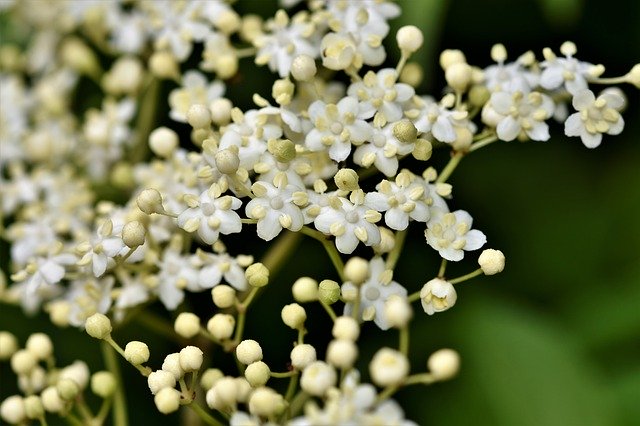
That’s not all elderberry is used for, though. This tree, with its white flowers and dark, shiny berries, has a lot of folklore and a long history of magical use behind it.

Elder Magical Uses and Folklore

The elder tree is believed to house a spirit with the power to help or harm. In Denmark, it is Hylde Moer. Elsewhere, it was dryads, or simply the Old Lady of the Elder tree.

Taking any of the tree’s gifts has to be done with permission. If permission is granted, they have the power to heal and protect. If it isn’t, they have the power to harm. One charm for cutting elder wood goes:

“Old Lady of the Elder Tree,
Let me have some of your wood,
And, when I am a tree,
You may have some of mine.”

In southern Italy, the wood is used to drive out evil, and protect against thieves and serpents.

In Germany, hanging elder branches in a home on Walpurgisnacht protects from evil.

The spongy centers of elder branches are soaked in oil and used as a kind of lamp wick to reveal all of the witches in an area.

In England, carrying an elder stick or cross made of elder wood was said to protect from rheumatism.

Building a cradle from elder wood is a bad idea, for spirits with pinch and poke any child that sleeps in it.

It’s considered a very bad idea to burn elder wood. In Ireland, it was believed that burning elder would would make you see the devil in the flames. Part of the Wiccan Rede goes as follows:

“Elder be the Lady’s tree. Burn it not, or cursed be.”

(Considering the cyanide content of uncured fruitwoods, and the fact that hydrogen cyanide is liberated by heat, this is probably very good advice!)

elder-4246132_640

The scent of elder flowers is said to be narcotic in nature. Sleeping under an elder tree would cause the sleeper to dream of the fairy realm, or else not wake up at all.

Magically, carrying elder wood, leaves, twigs, or berries is said to protect you from harm, while hanging elder branches over doors and windows of a building protects its occupants.

Elder is associated with death and rebirth — all parts of the plant are toxic (except the ripe, cooked berries), and elder grows quickly from cuttings.

Elder wood is used for wands, and for making instruments whose music is said to be favored by spirits.

In some situations, elder is used as a commanding herb.

Using Elder

All parts of the plant produce cyanogenic glycosides, hence all of the old admonitions against the improper use of elder. The berries are used medicinally, but that’s only after proper preparation.

Magically, elder is a powerful tree — which stands to reason, since the plant itself contains the power to heal and kill. Any tree should be asked for permission before gathering its products, but that goes double for elder. From what I have read, elder wood should be avoided for mundane purposes, and its use should be restricted to magical tools.


Elder has gotten a lot of press lately because of its use as a remedy for respiratory illness, but there’s only so much it can do. It can help with sinus problems, inflammation, and shorten cold and flu symptoms, but the best way to keep from getting sick is still to eat well, rest well, stay hydrated, and stay away from people.

divination · life · Neodruidry · Witchcraft

Ruis and Saille.

ADF-structured rituals have an oracle portion that gives us an opportunity to know how our offerings were received, know which blessings we are receiving in turn, and get messages from the spirits we work with. I’ve always used tarot for this, but I’ve been curious about branching out into journeying, geomancy, and other means of divination.

All of this is to say that, for my reading this week, I didn’t pull a card at all.

I’ve been trying to learn to divine using Ogham staves. It’s more than a little challenging for me — memorization isn’t my strong suit (to put it mildly), and the Ogham alphabet is visually very simple. That means that, somewhat like my experience with the Tarot of Marseilles, there isn’t a whole lot for me to go on. Unlike the ToM, however, Ogham letters don’t have suits or numerical cycles on their side, which makes it even more difficult.

My best bet? Lots of practice. There are far fewer Ogham letters than there are tarot cards, so I’m bound to absorb some of it eventually.

This week, I drew two staves. Since I can’t exactly shuffle wood, I placed them face down, mixed them up, and drew them the way I would a tarot card: I moved my receptive hand over the pieces, and waited for the little energetic “tug” that led me to the right ones.

An orange cat paws at a set of driftwood Ogham staves,
Kiko attempting to draw staves for me, featuring hazel and elder.

I drew Elder (Ruis) and Willow (Saille).

Elder stands for the passing of an old cycle. This can be something that is due to pass, or something that we want to hold onto. The elder tree has a lot of connections to death and rebirth, so it’s a reminder that the only constant is change.

Willow stands for balance and equilibrium. In some sources I’ve read, it also stands for cycles, learning, and taking time to accumulate knowledge before acting.

I’ve experienced a lot of synchronicity with regards to both of these things, just in the past two or three days alone. It’s a supermoon in Virgo. This afternoon, I was listening to a webinar about living as a highly sensitive person (which, for me, is pretty much shorthand for “on the verge of a nervous meltdown basically always”), and Dr. Christine Page was giving a talk about inviting change in order to quit burning yourself out and making yourself sick. I mean, as I was typing this, I had to pause because I got an alert on my phone. It was an email: “Tips for Working With Change,” from Sharon Ramel.

It’s spring, the birds are singing, the weather’s warming, the sap is starting to run. The trees are still bare, but there are plenty of little signs that the soil’s beginning to wake up. I can’t say that I know exactly what changes the willow and the elder and pointing to, but I can’t help but look forward to them.


Plants and Herbs · Witchcraft

Chamomile Folklore and Magical Uses

I love chamomile.

No, I mean it. I have a devotion to the stuff that borders on fanatical. I am a chamomile evangelist. Spiritual, physical, or mental problem? Chamomile tea will probably at least help. Even if it doesn’t, it might make you take a nap, and those make everything at least a little less crappy. (Unless you’re allergic to it, but I digress.)

Chamomile Magical Properties and Folklore

In Hoodoo, gamblers wash their hands in an infusion of chamomile for luck.

Burning chamomile is said to help bring more money into the household.

The daisy-like flowers with their bright yellow centers are strongly associated with the Sun. Because of this, it’s used to bring positive energy into people and places. Sprinkling a room or washing windows and doorways with an infusion of chamomile chases away negative energy, while inviting in the good stuff.

Chamomile’s relaxant properties make it useful as an herb for dream magic and meditation.

Growing chamomile plants near windows and doors keeps away evil spirits.

Using Chamomile

The easiest way to buy and use the herb is in the form of a teabag — you can steep it in hot or cold water for tea, alcohol for a tincture, oil for an infused oil, or treat the bag itself as a simple herb sachet.

Steeping chamomile in hot bath water, or pouring a fresh cup of tea into bath water, is a fast and easy way to create a spiritual bath for removing negativity.

In medieval times, when strewing floors with fragrant herbs was common, chamomile was a favorite. When crushed, the flowers release a sweet, fruity aroma. With chamomile’s fragrance, coupled with the very solar appearance of the flowers, and its relaxing properties, it’s easy to see where its associations with the Sun and positivity come from.

The fragrance of chamomile might be part of why it’s considered effective against evil spirits. When the miasma theory was still popular, pomanders and pleasant-smelling herbs were credited with keeping disease at bay. It’s not a long jump between foul odors and disease to evil spirits — many of the most powerful negativity-banishing herbs are also the most pungent.

Chamomile is a pretty versatile herb. It keeps bad things at bay, and attracts good. While it’s often used to help gamblers, it can easily be adapted to any situation where you could use a little luck — enchant a tablespoon of chamomile and brew it into a tea before setting out to do anything that could benefit from a helping hand from fate.

crystals · Witchcraft

“Fake” Crystals — Opalite, Goldstone, and More.

So, fake crystals.

Some materials that make it into the gem trade pretend to be something they aren’t. They might even come complete with a list of healing and metaphysical properties, leaving buyers none the wiser.

Wait, fake crystals?

There’s a whole spectrum of things covered by the term “fake crystal.” On one hand, it can mean a gem where the trade name doesn’t reflect the mineral itself (e.g. various types of crackled or dyed quartz). It can also mean a material that’s treated like a gem when it isn’t. It might be made into towers, molded into points, tumbled into nuggets, or even shaped into palm stones and spheres.

How can you tell if a gem is actually a crystal vs a man-made material?

Honestly, the best way I’ve found is to know the various types of art glass that end up in the gem trade. If you’re trying to suss out a man-made crystal masquerading as a natural one, there are certain tells you can look for. That’s a better subject for another post, however, so let’s look at art glass that’s frequently sold as and mistaken for natural gemstones.

Opalite

640px-10-20MM_Tumble_Polished_Opalite
Photo from Albion Fire and Ice. CC BY-SA 4.0.

Opalite is a type of opalescent glass, sometimes sold as sea opal or opal moonstone. There is a natural stone called “opalite,” but you’re more likely to come across it under the name “common opal” since synthetic opalite is much more prevalent.

Some unscrupulous sellers will try to pass off opalite glass as natural opal or moonstone. Fortunately, opalite is pretty recognizable — it’s smooth, evenly colored, doesn’t exhibit any cracks or inclusions, and may occasionally contain air bubbles.

Crystal healers sometimes credit opalite with the ability to shift energy blockages, improve one’s ability to communicate, and stimulate creativity.

Goldstone

551px-Goldfluss_(Aventuringlas)
Goldstone photo by GDK. CC BY-SA 3.0. No changes were made.

Goldstone, or aventurine glass (no relation to aventurine), is a stunningly sparkly type of glass made in a low-oxygen environment. It has to be produced in a specific type of environment to allow the copper ions in the mixture to reduce to pure, elemental copper, and within a very narrow temperature range to allow the glass to stay liquid while the copper precipitates out, creating the evenly-distributed gold glitter throughout the glass.

I have seen goldstone marketed as sunstone, as well as sold in ways that obscure the fact that it’s a man-made glass. Goldstone doesn’t really look like natural sunstone, however — the color and distribution of metallic crystals is too even.

Some crystal healers say goldstone promotes energy, confidence, vitality, and ambition.

Blue Goldstone

Blue goldstone looks very similar to regular goldstone, the only difference is the color. Blue or purple goldstones use different metallic elements in their formulations, giving the stones a deep blue or purple color (hence the name) with silver glitter.

Blue goldstone doesn’t really resemble any natural stone, but I have seen it sold as “blue sunstone.”

Like goldstone, blue goldstone is said to help with vitality. It’s also credited with the ability to soothe anxiety and communication.

Fake Quartz

With a cursory visual inspection, molded glass can pass for quartz. There are a few key things to look for to be able to tell regular glass from the real McCoy:

  • Quartz is probably going to be cold to the touch, colder than glass.
  • Quartz will probably be slightly heavier — it generally (not accounting for differences in composition of the matrix, inclusions, etc) has a density of 2.65 g/cm3 while borosilicate glass is about 2.2 g/cm3.
  • Glass is likely to contain air bubbles, and probably won’t have the natural imperfections of quartz.
  • Glass is softer than quartz — it won’t be able to scratch a glass plate, but quartz will.

Some low-quality quartz crystals are ground up, melted down, and used to create reconstituted quartz. This is frequently used for scrying spheres, since it offers perfect clarity along with the other properties of quartz. The best way to tell reconstituted quartz from naturally-formed quartz is its lack of imperfections, and its price tag. A reconstituted crystal sphere of a given size and clarity is much less expensive than its natural counterpart.

natural-4596205_640
Reconstituted quartz spheres can be as transparent and flawless as glass, but natural quartz very rarely is.

Does it matter?

Eh, maybe.

If you have a piece of opalite, goldstone, or even resin or glass that you get something out of, I’m definitely not going to tell you you’re wrong. I’ll be the first to tell you that something’s origins or how natural it is don’t necessarily dictate its usefulness; I’ve used literal, actual garbage in spellwork before.

That said, it royally sucks to get mislead by an unscrupulous seller. If you enjoy opalite and find that it’s useful for you on your spiritual path, that’s awesome! Just please make sure you know what you’re buying, and don’t let someone overcharge you for their “super rare sea opal.”

It can also be important when you’re looking into making things like gem elixirs. While glass is pretty much inert, you really, really want to make absolutely certain that you’re not working with something that’s going to leach harmful compounds into your elixir. For that reason alone, you absolutely want to make sure that you know exactly what kind of minerals — natural or man-made — you’ve got.

Of course, no man-made material is going to have the exact same physical or metaphysical properties as the gemstone it’s imitating. But (as I mentioned in my post about identifying natural citrine) goldstone, blue goldstone, and opalite can have a legitimate use, even in a very traditional magical system. Color magic is a viable aspect of witchcraft, and goldstone being made in a factory instead of underground doesn’t make it any less orange and sparkly.


If you try to use nature-derived material in your spellwork, you might want to familiarize yourself with the man-made stones that occasionally make their way into the crystal and gemstone market. If you don’t really care, or feel drawn to these stones for their own sake, there’s no reason to avoid them. Opalite, goldstone, blue goldstone, and reconstituted quartz are all beautiful and useful in their own ways. If you find a piece that resonates with you, enjoy it and treasure it — no matter whether it came from the earth, or from a laboratory.

life · Neodruidry · Witchcraft

I passed! … Now what?

It took me some time, but I submitted my ADF Dedicant Path work, received some feedback, elaborated where I was asked to elaborate, and… I passed!

It’s an enormous relief — perhaps unsurprisingly, some of the feedback I received involved me being “too hard on [myself]” when rituals didn’t go perfectly to plan. I don’t consider myself a type A personality, I don’t really think I’m a perfectionist (well, most of the time), but I can see it. Completing this path work was very important to me. Upholding the virtues and things I’ve learned in the course of doing it is still important to me.

There’s only one problem: where do I go from here?

I’ve considered trying to pursue ordainment. There are also other paths of study within each of the Druidry guilds. With how long it took me to finish my Dedicant Path work to my satisfaction, I’m a little hesitant to jump into another round of studying and writing so soon. I’d be lying if I said it wasn’t calling to me, though.

Do I explore other Druid groups alongside ADF, and see what knowledge they have to offer? Do I choose a guild or two to concentrate on?

I’m giving myself until February 8th. By then, I will have looked at my options and picked a course of action.

Fingers crossed that it’s a good one!

Witchcraft

Energy Cleansing Your Apartment (When You Can’t Burn Anything)

If you’ve been following the saga of the gas leaks, you can probably guess why I put off doing a full-on apartment cleanse. It’s a good idea to do this as soon as — if not right before — you move in. It is a less-good idea to do this if you plan on burning things, and your kitchen smells like mercaptan.

Anyway! Now that the fire hazards are dealt with, I wanted to talk about apartment cleansing.

You should cleanse anything that’s been used by another person, and any time that thing has seen arguments, illness, death, or other struggles. You also want to cleanse your space whenever things just start to feel gross, heavy, or tense. I don’t support “good vibes only” culture, but it’s definitely important to wipe the energetic slate clean once you’ve experienced something bad and allowed yourself to process the trauma. This is especially true if you perform other spells or rituals in your home — there are some energies you don’t really want to keep around if you don’t have to.

Most house cleansing rituals involve things like candles and incense. These rituals are great, and extremely effective, but not always the best choice — what if your lease prohibits burning things? What if you have artwork, or other special objects that would be damaged by repeated exposure to incense smoke or soot? What if you’re asthmatic and shouldn’t be breathing in burning particulates? What if you might explode your entire block, because your building is very very old and literally everything is leaky?
You get my drift.

So, what does house or apartment cleansing do?

Ideally, cleansing a space gets rid of negative or stagnant energy, and brings in fresh energy. Psychologically, it can help give you closure after you’ve had a rough time, and create a sense of optimism and enthusiasm for the time ahead. It can also mentally prepare you to be the new steward of the place you’re cleansing.

What does it entail?

From my experience, house cleansing and house blessing are usually part of the same ritual. You cleanse the space, then you bless it. Some people roll them into one action by asking their guardian spirits, ancestors, and/or deities to both cleanse and bless.

Generally, cleansing a space involves walking around the area either clockwise or counterclockwise (depending on tradition), performing a cleansing act, and asking that the space be cleared of any bad vibes. A cleansing act can be wafting the smoke of burning herbs or incense over the walls, asperging them with water, sprinkling a perimeter of salt, carrying a white candle dressed with cleansing oil, or even just touching the walls and floor and declaring the intention that they be cleansed.

Incense and candles figure prominently in many popular energy clearing rituals, but they aren’t a necessity. There are plenty of other things you can do if burning things isn’t possible or desirable for you.

1. Lemons. Everywhere.

Lemons have a well-deserved reputation for busting up stagnant or negative energy. Even the scent of lemons is uplifting, and lemon juice is very helpful when it comes to actually physically cleaning your place.

You can use lemons in a variety of ways, from adding sliced lemons or lemon juice to your mop water, to leaving whole lemons in places where people tend to gather. I prefer to use them like this:

  1. Take a whole, fresh lemon, and slice it into rounds.
  2. Take a generous quantity of sea salt, and sprinkle it over the rounds. (Make sure to cover both sides!)
  3. Place them in a dish, and set it wherever you feel needs some cleansing.
  4. Keep an eye on the lemon slices — if they begin to get moldy, discolored, or mushy, discard them and try again with fresh ones. It might take a couple of lemons before everything’s thoroughly cleared up.

lemon-slices-232210_640

2. Asperge with water.

Asperging with blessed or holy water is probably my favorite way to cleanse a space. Depending on your tradition, “blessed” or “holy” might vary. In mine, water gathered from three natural sources is used in ritual. Alternatives include:

  • Water left to charge in sun- or moonlight.
  • Water to which has been added a pinch each of frankincense ash and sea salt.
  • A hydrosol made of a cleansing herb, like rosemary or sage.
  • Water you have asked your deities to bless.

Asperging involves dipping a bundle of herbs (or your fingers) into the water, and sprinkling it on the object to be cleansed. Sprinkle it on your walls, floor, and ceiling (if you can reach it) as you declare your intention to cleanse the space. Make sure to get the corners!

3. Use your own energy.

You don’t really need anything other than yourself, if you don’t have other tools at your disposal. You can stand in the middle of each room in your home, raise power however you customarily do, and release it into the walls, floors, ceilings, and corners of your space. Visualize it as a bright light that touches every surface of your home, absorbing and disappearing into them, leaving no trace of negativity behind.

4. Make some noise.

I feel like a lot of practitioners underestimate the power of noise (but, I admit, I might just be inordinately fond of raising a ruckus). Coupled with light and fresh air, there are few things as helpful for clearing the energy of a place. Open the windows, get a nice breeze going, let the sunlight in, and turn up the volume — at least, as long as your neighbors won’t complain.

There are a few different ways that you can use sound to help the energy of a place:

  • Play a set of chimes. Ascending scales are said to purify, and descending scales banish.
  • Play uplifting music.
  • Play Solfeggio tones. Each one is said to have a different effect, so it’s best to experiment and find the one that works for you.
  • Play nature sounds. Running water, insect chirps, and birdsong have their own, special effects. There’s a reason they’re part of so many meditation tracks!

color-1405478_640

5. Salt.

Sea salt is a quick and easy way to cleanse pretty much anything that won’t be damaged by salt. Personally, I don’t use it that often because I try to do most of my cleansing-of-things outside, and I don’t want it to leach into the soil — but I can vouch that it works.

To use it, sprinkle sea salt in the corners of your rooms while declaring your intention to clear the space. You don’t need very much — just a pinch will do just fine.

Every tradition has their own ways of preparing a home, from cleansing, to blessing, to protecting it and inviting in prosperity for its occupants. If you’re in a place where you can’t turn to candle or incense magic, you still have plenty of tools at your disposal.

Witchcraft

The Magical Properties of Wax

Candles are a cornerstone of some of the most simple — and powerful — magic there is. Pretty much everyone’s first spell is some form of candle spell, because they’re inexpensive, easy to come by, and effective (once you know how to use them). A lot of care and thought goes into the selection of a candle’s size, color, and even shape. This got me thinking… What about the wax?

candle-397965_640.jpgCandles made from the wax of the bayberry plant are traditionally burned on new year’s in order to bring prosperity into the home. We’re also way past the days when all we had were bulk paraffin chime candles. There’s some history behind using specific wax candles for specific purposes, and a lot of options out there. It made me to do some experimenting.
Bayberry wax is typically, but not always, green. I’ve also seen plenty of bayberry candles that have turned out beige, brown, or even a grayish color. So, assuming that it isn’t the color of the wax alone that gives it its associations with prosperity, that gives me a jumping off point.


Looking at the metaphysical properties of the origins of each wax and my own experience, here’s what I’ve found:

Palm wood is said to be associated with transformation and transitions, but also peace and relaxation. Wands made of palm conduct energies around them and stimulate intuition. While not at all analogous to the living wood, petrified palm wood is protective and grounding. While those are typical traits of petrified wood in general, they seem to go hand-in-hand with palm’s ability to help us navigate transitions and upheaval.

Palm is one of the waxes I don’t have much experience with, in a magical sense. Based on its other properties, I’d use candles made of palm wax for stability and protection, particularly when it comes to weathering major life changes.

Beeswax is a bit different. Honey is frequently used in sweetening jars, to anoint other candles, and so on, because it’s sweet and sticky. It’s an attraction ingredient par excellence, and its inviting golden color certainly doesn’t hurt.

I predominantly use beeswax candles in my practice, but they’re especially good for spells that involve drawing things to you — like love, money, friendship, and so on. Good beeswax even has a warm honey smell that’s absolutely wonderful while it burns.

Another nice thing about beeswax is that it’s fairly firm. So, if you use it in a spell to bring something to you, and you want to dispose of the candle’s remains, it’s really easy to melt the candle stub down and form it into a love-, money-, or whatever-drawing amulet. Soften the wax, flatten it, and inscribe it with a rune, symbol, sigil, or even just a word expressing your intent, then use it however you please.

Paraffin is where things get a little strange. It’s a byproduct of the petroleum industry, which leads a lot of people to view it as less natural than the alternatives out there. It does release compounds like toluene into the air, which keeps it from being the best choice for anywhere that isn’t well-ventilated. I haven’t found any sources for magical properties of paraffin itself, other than as a base for candles. I was able to find a few for petroleum jelly, which is often used as a base for herbal salves, but they primarily touted its ease of use as an ointment.

Some sources cite petroleum’s origins as a good basis for ancestor magic — even going back to our non-human ancestors.

It seems that few people have really delved into the magical properties of paraffin, which I can understand. If your practice relies on using materials that are as close to nature as possible, it’s hardly going to be your first choice! Paraffin’s history of use seems to indicate that it’s like a white candle — while it might have properties of its own, it’s also a neutral, all-purpose stand-in for other waxes. Its associations with the ancient dead also make it useful for death-related or ancestor work.

candles-2681068_640.jpg

Soy is another option for candle wax. Traditionally, soybeans are associated with prosperity and luck. Soy milk is used in recipes for employment and business success. In magical cooking, soy ingredients are said to promote psychic awareness and spirituality. As the seed of the soy plant, soybeans also have obvious connotations of growth.

Soy wax is a great choice for spells and rituals for financial gain and abundance of any kind. (I like it when I’m looking to grow my bank account!) I have a fantastic soy-based candle by Enchanted Botanicals that I light before spells to establish a sacred space — that soy-seed-growth energy is an excellent foundation for spellwork.

Tallow is a bit hard to come by now, because it’s made from rendered animal fat, sticky, and not quite as appealing as other waxes for candle crafting. Since it’s sticky, it made for an excellent vehicle for magical herbs — all you had to do was roll it in fresh or dried herbs, and you were good to go. Raymond Buckland recommends against using tallow for candle magic in Advanced Candle Magic, but this seems to be a purely practical concern (tallow can be smelly and messy).

As animal fat, tallow has connotations of wealth and sacrifice. It’s a food, so, by burning it, you’re giving up something you could use for your own sustenance. This would make it a worthwhile choice for an offertory candle — as long as who- or whatever you’re offering it to doesn’t have any taboos against the animals used in making it!

For more specific magical properties, you’d have to look at its origins. Pigs are associated with abundance, prosperity, and fertility. Cows are associated with nurturing, protection, and fertility. Sheep are associated with peace, harmony, and tranquility.

There are other options for candle wax out there, including clear gel (which is probably closest to paraffin). I’d like to experiment with them and see how I can expand this list.


art · Witchcraft

Spiders, Sea Perch Eyes, and Salvador Dalí

I’ve been writing a thing about sleep, which has resulted in a not-insignificant amount of research into everything from sleep apnea statistics, to what kind of effects certain sounds have on the body’s cortisol level, to what Salvador Dalí used to do with sturgeon eyes.

Let me back up.

I once read a paper on Academia.edu (which I highly recommend if you’re at all interested in Semitic mysticism, lecanomancy, ancient Greek magical texts, or Egyptian magic). Ever since, I regularly get emails about some incredibly interesting subjects. For example, I have a pretty good handle on how to get a skull to talk for divination purposes, as well as how to punish it if it only tells lies and refuses to stop yelling. I don’t recall the exact search string that led to me getting a link to a copy of Dalí’s 50 Secrets of Magic Craftsmanship, but I did.

In it, he describes an ideal meal of sea urchins (“three dozen sea urchins,” to be exact, “gathered on one of the last two days that precede the full moon, choosing only those whose star is coral red and discarding the yellow ones”) and beans à la Catalane, after which you are to sit in front of a blank canvas without any light, until it’s become too dark to see it.

“It will become more and more dim until, when night has submerged you, you will completely have ceased to see it, or at most will only be vaguely aware of the space it occupies. Continue still to look at it, without remorse, for another good fifteen minutes, for it is under these circumstances that your spirit will work best and most decisively, and do not worry about making the maid wait when she calls you and says that the soup is on the table, for after what you have eaten at noon, your long afternoon sleep and everything that you are in the midst of painting in the dark, without yet even suspecting it, you have already in a sense had your supper, and more.”

After this, he recommends dining on sea perch, specifically the eyes. After consuming all but the hard kernels inside, you are to keep them in your mouth. Then, after getting into bed:

“[T]ake these eyes out again. Keep one in your hand, and put the other two on a small book or on a black box which you will rest on your knees, placing them at a certain distance from each other in such a way that, when you hold your forefinger in front of the two super-white balls and focus on your forefinger, the eyes of the sea perch will join, thanks to the precious distance between your own eyes, the grace and the mystery of your binocular vision, and the two eyes of the sea perch will become one single ball. This ball will seem to exert a hypnotic effect on you, and it is very desirable that on that night you should go to sleep while looking at it. But at the same time that you are staring at these two balls which have become one, it is furthermore necessary that, holding the third sea perch eye — the one which your wife has smilingly yielded to you — between the crossed forefinger and middle-finger of your right hand, you should gently caress it. You will then have the striking and unbelievable sensation of having contact with two sea perch eyes, and not merely with the one which is really between your fingers.”

This is “the secret of the sleep with three sea-perch eyes,” and, ideally, will make your sleep start off on the “right, good, and wise path!”

Later, he talks about the importance of constructing an aranearium — that is, a place to keep a spider. Granted, his ideal setup is strikingly different from mine. When I kept tarantulas, a small glass or acrylic aquarium with a suitable substrate and a very firmly-locking lid was enough to keep everything from a docile rose hair to a tetchy cobalt blue. He explains:

“The best aranearium is constructed with a slender olive branch, which you shape as nearly as possible into a perfectly round hoop, leaving four or five olive leaves clinging to the outer part of the circle, on which the spider will enjoy placing himself on various occasions. This hoop of olive wood you will secure on a four-foot pine pole provided with a solid base. At the bottom of the hoop place a small box in the shape of a perfect cube, of very green pine, provided with two holes, one in the top, and the other in one of the sides. This empty cube will serve as the spider’s nest. Within the previously moistened box, introduce a little earth and allow it to dry well in the sun. Since amber is very sympathetic to the spider — and how much more to the painter! — you must always keep a little ball of it on the cube, which you will use to magnetize the tip of your wand, with which you will manipulate and train your spider, so to speak, and with which you will reach to it its feasts of flies, of which you must always have several in reserve, which you may keep in a little bowl beside the ball of amber — for between amber and dead flies there also exist numerous affinities.

I’m interested in his ideas about the affinities between dead flies and amber. We know fossilized insects are often found inside of it, and that amber exhibits an interesting  triboelectric effect. Could that be adjacent to what he’s referring to? Or is it something closer to Remedios Varo’s exercises in effecting extraordinary change through the arrangement of shoes and stuffed hummingbirds?

He goes on to explain that a good artist’s studio needs five of these araneariums, for a particular purpose. You must place a crystal bowl full of water so that it reflects the landscape, and arrange the five araneariums in a line between you and it. Then, looking at the reflection in the water through the webs in the hoops of the araneariums, you can see the land adorned with a “glorious rainbow aureole produced by the irisation of your araneariums[.]” Ideally, you’ll do this around age twenty, and avoid ever looking at that sight again. This sight with therefore move you so much, it will have the effect of “set[ting] traps when we are young for our future adult emotions[.]” In other words, create a kind of a snare for nostalgia, so we can be moved by a smell, a postcard, or something equally small and mundane.

I admit, I’m not much of a fan of Dalí as a personality — while his work was undoubtedly brilliant, he was also arguably the first “celebrity artist.” While there were plenty of other famous artists before him, he arguably treated self-promotion as just as much of an art form as painting. Was he really building spider-homes and caressing sea perch eyes? I can’t say. I do find some interesting parallels between his writing and Remedios Varo’s letters and journals, though, as well as other occult practices.

Maybe I should build a spider box or five. For now, I’ll content myself with Rigoberta’s company.

Rigoberta, the orb weaver.