My Handsome Assistant and I were originally intending to go on a camping trip with a local Druid group that we’re part of, but with him still recovering from his accident, we decided (at the last minute) that it might be better to focus on getting him to 100% before we try tent camping.
So, rather than having singing, dancing, feasting, and ritual in a group, we had a smaller, homey version: fresh baked breads, homebrewed peach mead, music, ritual, and a spirit feast.
What’s a spirit feast? Exactly what it sounds like — a feast conducted for deities, ancestors, spirits of the land, guardian and guiding spirits, and any spirits to whom we may owe a debt (for example, spirits of the land affronted by new construction, tree felling, and so forth).
Unlike the “dumb suppers” of Samhain, this is not just for ancestors and the beloved dead, and it’s more like a party. Offerings are carefully chosen and high quality. Incense. Flowers. Candles. Fresh bread. Wine. Fruit. Good food, well prepared. Is it a traditional part of Lughnasadh celebrations? Not really. But Lughnasadh is a time to offer the “first fruits,” and so, in the absence of being able to party with friends, it seemed an appropriate way to offer the first fruits. It felt right. It was equal parts fun and moving. I’ll probably make it part of my celebrations from now on. Lughnasadh, after all, may have its origins as a funerary feast for the mother of Lugh, Tailtiu. She died of exhaustion after preparing the land for agriculture, and represents the Earth that feeds us and the plants that are harvested and die back in the high summer heat. It seemed a good idea to pay back this sacrifice and invite the spirits of the land to a feast.
This year, the fruits of our garden are particularly abundant. The Virginia roses (Rosa virginiana) are all but bowed over with fruit. The passionflower (Passiflora incarnata) vines are thick and lush and heavy with their strange purple flowers and egg-like fruit. The pumpkins are pumpkining. The beautyberry (Callicarpa americana) is both beautiful and extremely berried.
It’s very good. I hope things are very good with you, too.
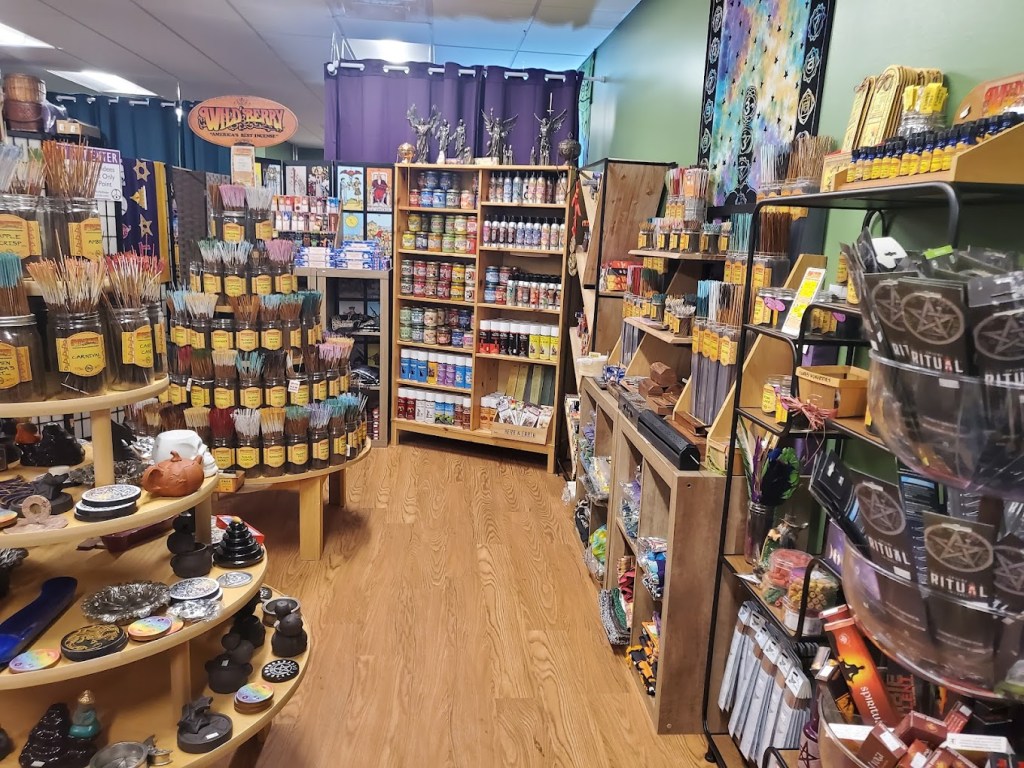
There’s a delightful metaphysical shop called Sticks & Stones Circle in Fairfax, Virginia, that my Handsome Assistant and I visit occasionally. They moved locations about a year ago, so we figured we were due for another trip. Neither of us have been out of the house much lately — him, because he’s still recovering, and I, because I’ve been busy with various tiny projects. A gentle walk around a metaphysical shop, however? Yes, please.
They used to be located in the same building, but around the back by the larger parking lot. Now, they’re out in front, by a Sherwin Williams. They don’t have a sign yet, but their distinctive front window display makes them pretty unmistakable.
Photo by the owner of Sticks & Stones Circle.
We weren’t here for anything in particular — in fact, I’ve been on a mission to destash and declutter things. If I haven’t worn it, used it, or at least remembered it fondly for a year, out it goes.
So, this was pretty much a trip to restock some herbs and incenses that are challenging to find in our regular herb shop (Smile Herb Shop, which stocks a wonderful variety of medicinal and culinary herbs).
If you are on the lookout for other supplies, however, they have them in abundance — candles, sprays, oils, statuary, books, crystals, jewelry, pouches, pendulums, and altar cloths galore.
Photo by the owner of Sticks & Stones Circle.
We left with two packs of incense (Soul Sticks Celtic Summer and Wild Wood, a very inexpensive but decent-quality natural incense), some copal resin, a small tiger’s eye owl, and a piece of golden healer quartz. I’m a bit of a sucker for golden healers, but more on that another time.
After that, we stopped at a place called Midnight Treats. Neither of us were familiar with it but were delighted to find out that it’s a vegan bakery with the most massive (seriously, they’re 1/3 of a pound and feed two people each) cookies we’d ever seen. They have all kinds of flavors, so we picked up a small assortment: Oreo cake, cinnamon roll, birthday cake, and chocolate brownie. They didn’t disappoint either — they were warm, chewy, delicious, and have satisfied my cookie cravings for a good long while.
They also have new flavors every week. This week, they’ve added iced red velvet and blueberry lemon (and I’d be lying if I said I wasn’t tempted to order some).
All in all, it was a nice little shopping date. In the face of so many metaphysical shops closing, it’s nice to see one that seems to be thriving. If you’re ever up in that area, give Sticks & Stones Circle a visit. Like many other shops of this nature, they’re more than a store — they’re also a hub of classes, celebrations, and other Pagan and witchy activities.
Right about now, several species of birds have turned the area around my house into a kind of avian daycare. Again.
There are birds of every distinction turning up, kids in tow. Most of these kids look almost exactly like the adults — the starlings, for example, are fully the size of their parents and the only difference is that some still have their brown feathers. The baby crows look just like their parents, save for being a little smaller and still having pink corners on their beaks.
Since these babies are rapidly transitioning from their juvenile plumage to their full adult feathers, that means that they’re molting. You can find feathers everywhere — mostly fluffy white down, but the occasional primary feather, too. That’s why I thought that it might be a good idea to write a bit about the magical meaning of feathers.
Before I do, though, there’s one important caveat: All parts of native birds, including shed feathers, are protected by the Migratory Bird Treaty Act of 1918. This is to protect them from poaching by ensuring that there isn’t a legal market for their feathers, bones, etc. If you see a shed feather outside and you aren’t sure if it’s from a native species, invasive species, or domesticated species, leave it right where it is.
Feather Folklore
Feather pillows can also be a source of ominous omens. In Appalachia, death crowns or angel crowns are complex, crownlike whorls of feathers found in the pillows of the deceased. Usually, they’re only found after the person has died — it’s unlikely that anyone would go probing their pillow for death crowns otherwise. However, it is said that, if you find and break up a death crown in someone’s pillow, you can prevent their death.
In Celtic legend, feathers are commonly associated with the Otherworld. Some fairies are said to wear cloaks trimmed with red feathers, and The Morrigan wears a cloak of black ones.
The Morrigan isn’t the only goddess to have a feather cloak. Freyja, the Norse Goddess of love, war, sex, and magic, is said to have a cloak of gray falcon feathers (fjaðrhamr). This cloak grants her the ability to shape-shift into a falcon at will.
In Egyptian legend, Ma’at is associated with the Feather of Truth. She is the personification of truth, justice, and balance, and this feather is a representation of her. When a person dies, their heart is placed on a scale and weighed against this feather. The hearts of virtuous people are lighter than this feather, and they are allowed to pass on to Aaru, the Field of Reeds. The hearts of the wicked are heavy, and they are devoured by the goddess Ammit.
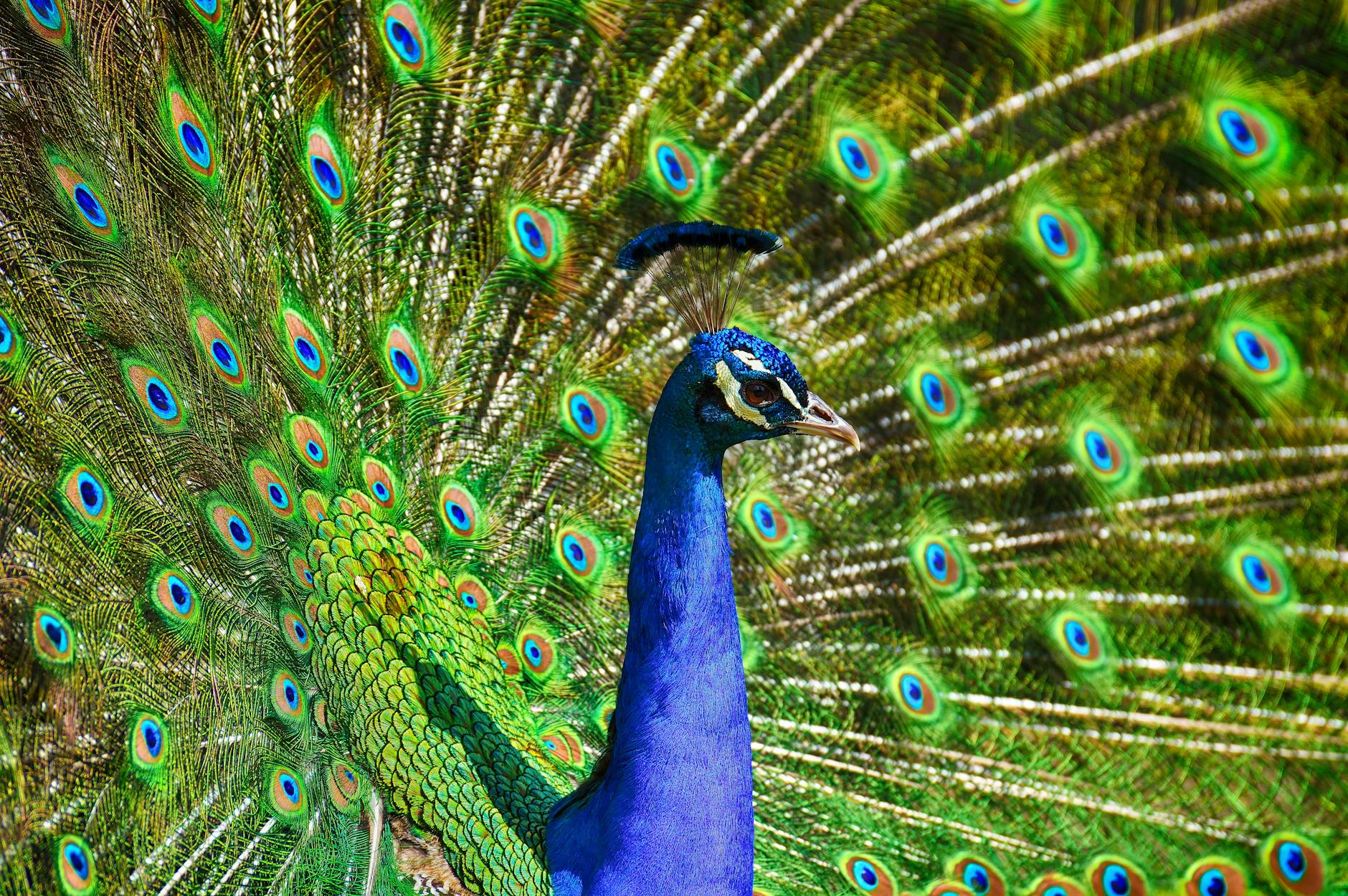
In Greek legend, Hera, the Goddess of marriage, family, and women, took the peacock as her sacred animal. She’s also the one responsible for the male peafowl’s beautiful, unusual plumage. When Zeus seduced Io, he knew his wife would be jealous. He either turned Io into a white cow (another one of Hera’s sacred animals) to protect her from his wife, or Hera transformed her herself. Either way, Hera set the many-eyed giant, Argus Panoptes, to watch over her new prized cow. Having many eyes, he only needed to close a few at a time in order to sleep. This made him the perfect watchman… until Hermes came along. Zeus asked Hermes to free Io. Hermes, in turn, disguised himself as a shepherd and used charms to put all of Argus’ many eyes to sleep at once, then killed him. Having lost her watchman, Hera immortalized him by placing his many eyes on the tailfeathers of the peacock.
In North America, Indigenous people have also attached significance to feathers for ages. Eagle feathers, in particular. (I remember being at a Powwow where another dancer I knew had dropped an eagle feather. It was retrieved from the ground with ceremony, treated as a fallen warrior. It was a very emotional experience, especially for her.) Indigenous textile artists have also woven feathers into warm blankets and beautiful garments (sometimes called match-coats).
In modern witchcraft, feathers are commonly used as representations of the East or element of Air.
The Symbolism of Feathers
In addition to representing the East, Air, multiple deities, and various concepts of the Otherworld, feathers are also considered an “angel sign.” These “angel signs” are a collection of circumstances that are said to indicate that one’s guardian angels, spirit guides, or ancestor spirits are nearby. They include finding white feathers or shiny coins, hearing mysterious music, or smelling sweet, unexplainable smells. It’s important to be careful with angel signs, however, since so many of them have mundane explanations. It’s very easy to get caught up in looking for signs, start interpreting everything as some kind of “angel sign,” and end up in spiritual psychosis, where the desire for significance blurs the line between reality and delusion. Sometimes, an angel number is an angel number. Sometimes, it means you spend too much time looking at the clock. Similarly, sometimes, finding a feather is an “angel sign.” Sometimes, it means your neighborhood has stray cats.
Feathers are also subject to color symbolism. Finding a feather of a specific color is said to have a specific meaning. For example:
White feathers are positive omens, or indicate the presence of benevolent beings.
Black feathers symbolize protection.
Red feathers can represent protection, passion, or good fortune.
Blue feathers represent peace.
Green feathers symbolize abundance or fertility.
Yellow feathers represent joy.
Orange feathers symbolize creativity.
Ground feathers are omens of stability and groundedness.
Gray feathers, like blue ones, represent peace.
Of course, all of this is highly contextual. If you’re at a duck pond, the presence of white or gray feathers is unremarkable and not likely to represent anything but the presence of ducks. On the other hand, finding a bright green feather in your yard, when you don’t have an abundance of green birds in your area, may be a bit more significant.
Feathers represent all kinds of things, but their primary association is with the fine line between this world and the others. They are tools of shapeshifters and symbols of creatures capable of traveling between worlds. If you find a feather outside, appreciate it for its beauty, see if you can identify what species it came from, and leave it be to return to the soil. If you work with feathers in your practice, source them from pets or well-treated backyard fowl.
I like mushrooms. Not so much culinarily, but aesthetically and conceptually.
There are thousands of identified mushroom species, but experts estimate that the number of actual species out there is anywhere from two to three times what we’ve managed to identify. Others say it could be in the millions.
Mushrooms have a long history of use in spiritual and magical practices around the world. Giving the folklore and uses of every known species is outside of the scope of this post, but I thought it’d be interesting to give an overview of some of the most unique, recognizable, and significant kinds.
Mushroom Magical Properties and Folklore
People typically consider mushrooms and toadstools two different things, but there isn’t really a hard line between them since these are folk names. According to various sources, mushrooms are edible, and toadstools are inedible. Or else mushrooms are edible and umbrella-shaped, while toadstools are inedible and have round caps. Or toadstools are inedible and large-capped, etc. This can be particularly confusing because there are several species of variable edibility — some are considered edible only when cooked. Some need to be leached with water to be edible. Some are only poisonous if consumed with alcohol. Some aren’t considered edible, but aren’t really poisonous either.
Amanita muscaria, the iconic red- (or tan- or yellow-) capped, white-spotted mushroom, is also called “fly agaric.” This is because it was sprinkled in milk and used as a poisonous bait for flies and gnats.
Sami shamans traditionally have a unique way of processing A. muscaria. The mushrooms are fed to reindeer, and the psychoactive components are passed in their urine. Instead of the potentially dangerous mushrooms, the shamans use the urine to access fly agaric’s powerful qualities.
While it’s natural to associate psychoactive fungi with the spirit world, they aren’t the only mushrooms said to serve as a gateway. The famous fairy rings of Western European stories are circles or arcs of fungi (with or without visible mushrooms) that, were you to enter one, could bring you either good luck or incredible danger.
In Egypt, mushrooms were associated with immortality. In Japan and China, they have similar connotations due to their use as medicinal foods for increasing strength and longevity.
In Slavic mythology, the guardian deity of forests, Leshy, can appear as a fully vegetation-based entity. He may appear as anything from a sacred tree to a mushroom. Mushrooms are also associated with the earth, water, cattle, and underworld deity, Veles.
In Lithuania, mushrooms were said to be the fingers of Velnias, a deity of the dead. He would reach up from the underworld, beneath the soil, to feed the poor.
This isn’t the only association of mushrooms with charity, either. In one Christian myth, God and Saint Peter walk in a rye field. Peter takes a handful of rye and begins to eat it, but God scolds him for taking food that isn’t meant for him. Peter spits the chewed rye out, and God says that a mushroom will grow there as food for the poor.
Interestingly, the dead and the underworld seem to have the strongest connection to mushrooms around the world. The Sidhe of the Celts and the Alfar of the Germanic people were both associated with burial sites, and the beliefs surrounding them may be the last vestiges of ancient, indigenous ancestor worship. This would immediately associate fungal phenomena like fairy rings with the dead.
So, on one hand, edible mushrooms are gifts from the dead to feed the living. On the other, the inedible ones will allow you to meet the dead!
This connection continues with the crane bag of Manannán mac Lir. In addition to being a God of the Sea, Manannán is also a guardian of the underworld. The crane bag is a bag he fashioned from a crane skin that contains several magical tools. According to many Ogham readers, these tools are indicated in the forfeda — the four additional letters at the end of the Ogham alphabet. Iphin (ᚘ) is the crossed “bones of Assail’s swine.” These were pigs that could be slaughtered and eaten and would regenerate again. Robert Graves theorized that these swine were metaphorical, and the bones were not bones at all — they were the stems of mushrooms, discarded once the caps had been eaten or used in ritual. Since mushrooms are just fungal fruiting bodies, and picking them doesn’t harm the actual organism in the soil, it made perfect sense that they would “regenerate” so they could be consumed again.
Because mushrooms seem to spring up out of nowhere after a rain, they’re also thought to represent fertility.
Mushrooms in general are associated with the element of Earth. Planetarily, they’re associated with the Moon. The fly agaric, specifically, is associated with the element of Air and the planet Mercury.
Using Mushrooms
First, I want to say that “there are old mushroom foragers, and there are bold mushroom foragers, but there are no old, bold mushroom foragers.”
If you aren’t an experienced mushroom hunter yourself, and don’t have access to one willing to take you in the field and help you positively ID mushrooms, do not attempt to harvest them yourself. There are way too many poisonous lookalikes out there, some of which can only be differentiated by spore prints or tiny, easily missed differences in appearance.
That said, simply touching a poisonous mushroom is unlikely to elicit a toxic response. However, it can still give you an allergic reaction, so you should still probably not do that.
Now, with that out of the way…
Unless you have access to a reindeer or a shaman, you should probably stick to the non-entheogenic varieties. I would also avoid commercially produced edibles intended for microdosing muscimol (a psychoactive compound). While not all brands are suspect, it seems some haven’t quite got the science figured out yet and several people have become extremely ill (and possibly even died) from using them. I wouldn’t use them myself and I don’t want bad things to happen to people, so I can’t recommend you do, either.
Also, if you drink alcohol, be careful which mushroom species you work with. Some are considered edible — delicious, even — but contain a compound that reacts with alcohol to cause some very unpleasant symptoms.
Otherwise, mushrooms are a suitable offering for deities of the dead and of forests. They’re also a good ritual food for workings relating to these deities or concepts.
You can place dried mushrooms in objects like charm bags, sachets, or spell jars, but with a bit of caution — they’re basically like sponges and will pretty readily absorb moisture and get gross if you aren’t careful to keep them dry. Other than that, go to town.
Whether you enjoy eating fungi or not, they’re fascinating organisms that form the foundation of life on Earth. Without them, other plants couldn’t grow. They’re a gift to the living from dead and decayed things, and, as such, are deserving of reverence.
Vervain (Verbena officinalis) is a prominent herb in European folk and ceremonial magic. Its roots also extend to American Hoodoo.
Though most old grimoires mean V. officinalis when they refer to vervain, there are actually about 80 species in the genus Verbena. In my area (and all of the continental US, and fair bit of Canada) we have Verbena hastata, also known as blue vervain. While it’s not the same plant, you’ll often find V. hastata labeled simply as “vervain” in metaphysical contexts.
Lemon verbena, Aloysia citrodora, is also a member of the Verbenaceae family. However, since it’s a somewhat more distant relative, I wanted to limit this post to V. officinalis and V. hastata.
Vervain Magical Properties and Folklore
Vervain is sometimes called “the enchanter’s plant,” since it’s one of the most versatile herbs in European magic. Even outside of Europe, it was (and continues to be) considered a plant of considerable medicinal and spiritual significance.
Many odd old wives’ tales are written of Vervain tending to witchcraft and sorcery, which you may read elsewhere, for I am not willing to trouble your ears with supporting such trifles as honest ears abhor to hear.
Magically, it’s used for purification, protection, divination, peace, luck, love, and wealth. It’s a pretty solid all-purpose herb that is often added to formulas to increase their power.
The name vervain comes from the Latin “verbena,” which refers to leaves or twigs of plants used in religious ceremonies. This, in turn, came from the Proto-Indo-European root “werbh,” meaning to turn or bend. I have also seen the origins of the word vervain given as a Celtic word “ferfaen,” meaning to drive stones away. However, I haven’t found strong evidence for this origin — all attempts to look up “ferfaen” only yield articles claiming it as the word origin of “vervain,” and most of them only give “Celtic” as the language of origin. One source did cite the Cymric words “ferri” and “maen” as a possible origin, with the word “maen” mutating over time into “faen” to eventually yield “ferfaen.” (Upon further searching, I was not able to find the word “ferri,” though I did find “fferi,” meaning “ferry.” This would give the word “ferfaen” a meaning closer to “ferry away stone(s).”) Nonetheless, the etymological sources I looked at gave “verbena” as the origin of vervain, not “ferfaen.”
Pliny the Elder credited vervain with quite a lot of magical properties. According to him, it was used to cleanse and purify homes and altars. He claimed the Gaulish people used it in a form of divination, and that Magi said that people rubbed with vervain would have their wishes granted, fevers cooled, friends won, and diseases cured. Interestingly, he also pointed out that vervain was considered a bit of a party plant, for when dining-couches were sprinkled with water infused with vervain “the entertainment becomes merrier.”
While vervain is strongly associated with the Druids, they didn’t leave a whole lot of records of their activities behind. What we do know is largely through sources like Pliny, and it’s likely because of writers like him that vervain became strongly connected to the ancient Druids.
For the best potency, vervain should be gathered in a specific fashion. It’s best cut between the hours of sunset and sunrise, during the dark moon. Like many other herbs harvested for their leaves, it’s best to cut the leaves before the flowers open. After cutting, it’s best to offer some fresh milk or honey to the plant.
Vervain is thought to be the origin of the name “Van van oil.” While the van van oil recipes I’ve seen don’t include vervain or vervain oil, it’s possible that the Verbena family loaned its name, nonetheless. (In that case, it was most likely lemon verbena, vervain’s citrus-scented South American cousin.)
Vervain is also one of those contradictory herbs that is simultaneously said to be used by witches, but also effective against witchcraft.
In the very distant past, bards would use brews of vervain to enhance their creativity and draw inspiration.
Medicinally, vervain is an emetic, diuretic, astringent, alterative, diaphoretic, nervine, and antispasmodic. According to Hildegard of Bingen, a poultice of vervain tea was good for drawing out “putridness” from flesh.
Using Vervain
Soak some vervain in water, then use the stems to asperge an area, person, or object that you wish to cleanse. It’s also an excellent addition to ritual baths for this purpose.
Sprigs of vervain are also worn as protective amulets, specifically against malevolent magic. Tie a bit with some string, put it in a sachet, and carry it with you. Tuck a sprig of it in the band of a hat. Use a small bud vase necklace and wear a bit of vervain like jewelry.
Planting vervain around your property is said to ward off evil and guard against damage from bad weather. If you choose to do this, please select a variety of vervain native to your area — in most of the US, V. hastata is a safe bet.
V. officinalis is often used medicinally, V. hastata is considered both medicinal and edible, but avoid consuming it if you’re pregnant, trying to become pregnant, or are breastfeeding. Talk to a qualified herbalist if you have any chronic conditions, or routinely take any medications. Avoid consuming a lot of it, since it is an emetic. It’s also important to be sure that the herb you’re working with is really V. hastata or V. officinalis — there are plenty of Verbena species that don’t offer the same benefits.
Vervain is a powerful plant, as long as you know which member of Verbenaceae you’re looking at. If you have the ability to grow a native vervain, by all means do so — these plants are tall, with interesting-looking flower spikes. They’re also easy to dry and store, ensuring that you’ll always have a stockpile of this powerfully magical plant.
To be upfront, I do not have a snake. I have had snakes in the past, and I live in in an area frequented by them, and I do have a large male bearded dragon I adopted from a classified ad.
Being a healthy, full-grown bearded dragon, he occasionally goes through periods of shedding skin while being a very sulky boy. A lot of the time, he eats it in order to reclaim the protein and minerals that would otherwise be lost. Sometimes, I find pieces just kind of around, like tiny laundry.
The skins of animals have been used in ceremonies for… about as long as humans have existed, most likely, and they’re still used today. Each animal has its own power and domain, including lizards and snakes. To be honest, serpents alone have so much symbolism and mythology behind them that it’s far too much to get into here. Instead, I want to focus specifically on the folklore and magical properties of shed reptile skin.
Reptile Skin Magical Properties and Folklore
Perhaps one of the most prevalent and enduring qualities attached to snakes is the concept of renewal or rebirth. It makes sense — unlike a lot of lizards, snakes shed their skin all at once. In a pretty short span of time, they go from appearing dull and milky-eyed, to bright, smooth, and rejuvenated. By extension, this has also made snakes a symbol of fertility, healing, and transformation.
Snakes are also associated with protection. This is particularly true of venomous snakes.
In the Danish tale King Lindworm, an infertile queen wishes to bear a child. She follows the advice of a crone and eventually gives birth to twins: one healthy boy, and one boy who’s a half-human, half-serpent lindworm. When the time comes for the lindworm to marry, his bride is horrified on their wedding night. The lindworm eats her. This continues over and over, until a shepherd’s daughter is brought to marry him. The clever girl wears every dress she owns on their wedding night and, when her lindworm husband insists she get undressed, she demands that he shed a layer of skin for every dress she removes. Finally, as he removes his last skin, he reveals his fully human body and is cured. By mimicking layers of snakeskin with her clothing, the girl tricks the lindworm-prince into shedding until he is effectively “reborn” as his human self.
In some forms of American folk magic, snakeskin is carried for luck. Some people also rub it on their hands to help them “hold onto” things.
If you find a shed snakeskin on your property, it’s said to be a sign of spiritual protection. This can also be interpreted quite literally — snakes are vulnerable mid- and post-shed, so they try to do it in places where they feel safe. If a snake feels safe on your property, rats, mice, and other potential pests won’t.
Leopard geckos frequently eat their sheds. Before they do, though, they can end up wearing them like little lizard hoodies. Photo by Pixabay on Pexels.com
Snakes are also sometimes used as a symbol of initiation, as an extension of them as a metaphor for rebirth. In this context, they represent the death of the old self, and birth of the new. This may be part of why they’re considered symbols of wisdom — with each shed, a snake metaphorically moves into a new incarnation of itself. It’s certainly a potent metaphor for becoming wise enough to realize how little we know!
Lizards carry many of the same connections and magical associations as snakes, since they go through the same shedding and renewal process. However, since reptiles very often “recycle” their sheds while snakes don’t, there isn’t as much lore on using shed lizard skin. (After all, even if you find an uneaten one, it’s unlikely to be a very large piece.)
In general, snakes and reptiles are associated with the element of Earth.
Using Reptile Skin
Reptile skin is pretty delicate (and becomes more so the more it dries out), which is good to keep in mind. A freshly shed skin may seem like great material for a poppet or spell bag, but you’re likely to be disappointed once it’s fully dry and crumbly!
Shed skin from prickly, aggressive, or venomous reptiles is good for enemy work. Grind it into dust, combine it with banishing or protective herbs, and sprinkle it around the border of your home, in front of your front door, or in the footprints of an enemy in order to keep unwanted people or entities from darkening your doorstep.
A very handsome boy.
You can also put shed reptile skin in spell jars, bottles, or sachets for protection. I prefer jars or bottles for spells that you want to keep at home (for example, keeping a protection spell bottle near your front door), and sachets for carrying. Since they’re made of fabric, they’re soft. If you’ve got a protection sachet stuck in a purse or backpack, it’s unlikely to break and get herb dust and bits of skin on things.
You don’t have to use an entire shed skin per working. If you have access to a full snake or lizard shed, you can use pieces. Consider ways to incorporate them in workings for change (like finding a new job or home), renewal, initiation, or healing spells.
Shed reptile skins also make for powerful altar pieces. Place them in a fancy bottle, make sure they’re completely dry, cork or cap them to keep the contents protected, and place them on your altar when you have need to tap into snake or lizard energy or work with deities associated with snakes.
Avoid putting shed reptile skin in anything that’s intended to be ingested. While the risk of danger is small, reptiles can carry zoonotic pathogens like Salmonella or E. coli. If any fecal matter remains on the shed, there could be a risk of infection.
Reptiles shed their skins naturally and, if all goes well, safely and painlessly. If they aren’t eaten, these shed skins are a powerful and ethical way to work with the energies of these powerful animals.
This past Saturday, my Handsome Assistant and I went to celebrate the first of the fire festivals with the Congregation of Unitarian Universalist Pagans. It was a bit rainy, so outdoor bonfires were out, but they managed to make even an indoor-only Beltane a ton of fun!
There was lots of food, drumming, dancing, and a maypole. When we arrived, we were asked to write a message on two pieces of ribbon — one was a wish for ourselves, the wider community, or the world. The other was a specific wish for an anonymous person in the community.
The first ribbon was tied to the longer ribbons streaming down the maypole. The as the dancers dipped and wove around each other, these ribbons were all beautifully interwoven together in a powerful representation of community, togetherness, and cooperation.
A different maypole, pre-dancing. Photo by Sandeep u2736 on Pexels.com
The second ribbon was placed in a basket, for another attendee to select at random. (The one I picked simply said “joy,” which is a succinct and delightful thing to wish for another person. I tied it to my backpack, and it makes me smile every time I see it. Sure, the person who wrote it doesn’t know me, and the wish wasn’t for me in particular, but the idea that someone out there hopes that a stranger is happy is still a sweet notion.)
I also brought my big tongue drum. I wasn’t sure how it’d fit with the rest of the percussion, but it was fine. A bit challenging to keep up the tempo of the drumming, since tongue drum notes are meant to be sustained, and not very loud, but still lots of fun to play — and my first time playing it at a public event.
I danced a little in the beginning but couldn’t really take part in the maypole dancing. I’m still coming off of spraining my ankle, and, with everything else this weekend held, I knew I had to pick my battles. So, drumming and socializing it was!
After the ritual, I was carrying my drum back to the car when I was sidetracked by an adorable tiny child in a skeleton costume. Said tiny child came up and began bapping at the top of the drum, in the absolutely fearless and unselfconscious way of tiny childs, so I set it down on the floor, sat next to them, and let them play. I showed them how the small metal tongues make the high notes, and the larger ones make the low, and they seemed to have a blast making all kinds of sounds.
The ritual was beautiful, the drumming was high-energy and exciting, and everyone there was delightful and welcoming. It was great to see friends I hadn’t seen in some time (some since the Mabon camping trip) and make new ones. 🧡
I sprained my ankle a little bit ago when I made the foolhardy error of trying to get my mail. This has, as you can imagine, somewhat curtailed my adventures. (Well, with the exception of going to see Whose Live Anyway at Warner Theater. Shoutout to the lady who let us go in through the lounge so I wouldn’t have to walk as much! I hope you experience a series of small, comfortable miracles.)
Fortunately, I’ve got plenty to get up to at home. For example, right now, the yard is filled with flowers. Many, I planted — moss phlox, strawberries, blueberries, apple blossoms, pear blossoms — and many I didn’t. I expected to see the same violets, dandelions, and stars of Bethlehem that I saw last year. What I did not expect was all of the bluebells.
We didn’t have bluebells last year.
I didn’t plant bluebells.
Whycome bluebells?
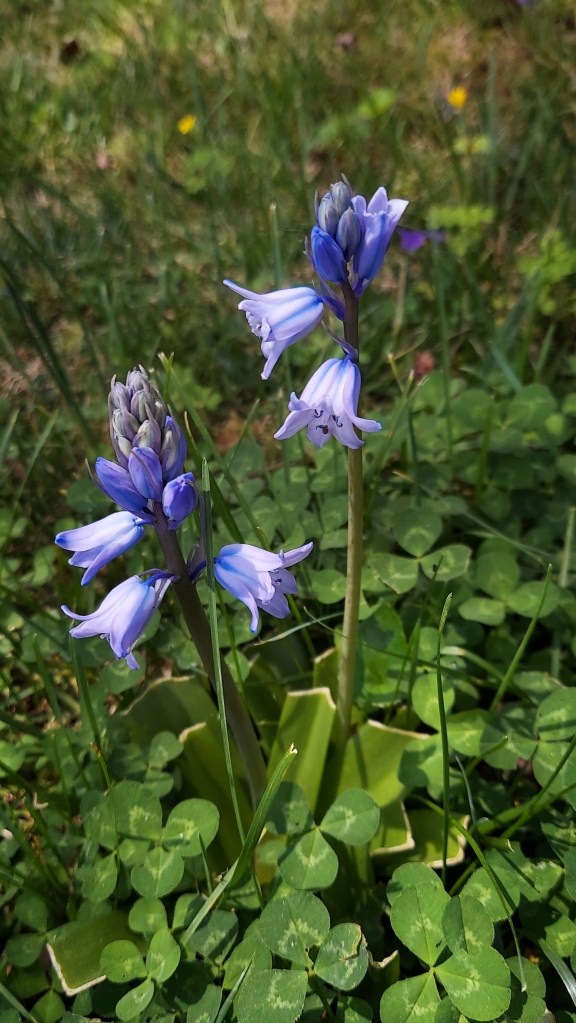
The particular species we have right now seems to be Spanish bluebell (Hyacinthoides hispanica). I know it probably isn’t English bluebell (H. non-scripta) and definitely isn’t native Virginia bluebell (Mertensia virginica). Nonetheless, they’re delightful little flowers and I’m enjoying them. They don’t seem to be stealing space or resources from anything but the grass that I’m systematically attempting to assassinate anyway at the moment, so they can stay for now.
(Spanish bluebells are a bigger issue in the UK, where they’re more likely to be invasive and can hybridize easily with — and eventually displace — native H. non-scripta. The bluebells we have here won’t hybridize, however, as they’re not closely related at all.)
Either way, I’m always in search of new plants to study and write about, so the appearance of these guys is pretty fortunate — I haven’t really looked into bluebells before this, and I like that they’re demanding my attention now.
Bluebell Magical Properties and Folklore
Bluebells are strongly associated with faeries. The fae were believed to ring them, just like you would a metal bell, in order to call other faeries.
However, should you hear the soft tinkling of bells when you’re near bluebells, watch out — anyone who hears the bluebells ring was said to experience the death of a loved one soon after.
This connection to faerie magic is also why it was considered unwise to pick a bluebell. Anyone foolish enough to do so put themselves at risk of being cursed or led astray by the faeries.
A similar, but unrelated, plant is known as the harebell, witch’s bell, or Scottish bluebell (Campanula rotundifolia). These flowers get their name because hares frequent fields of them. It was even said that witches would disguise themselves as hares and conceal themselves amidst the harebells.
It has been a frequent complaint, from old times, as well as in the present, that certain hags in Wales, as well as in Ireland and Scotland, changed themselves into the shape of hares, that sucking teats under this counterfeit form, they might stealthily rob other people’s milk.”
(It’s weird how much traditional witchcraft reportedly revolved around stealing milk. Case in point, the tilberi.)
These bluebells were also known as “the aul’ man’s bell,” where the “old man” in question is the Christian Devil.
English bluebells, photo by Suzy Hazelwood on Pexels.com
Bluebells are also connected to love magic. This seems to be largely due to the fact that they’re tenacious, bulb-growing plants. They even send out contractile roots that allow them to sort of “burrow” into the soil where there’s more moisture and protection. As a result, they come back year after year and are considered a symbol of enduring love.
They’re also used for a kind of love magic. Should you be able to brave the faeries’ wrath, pick a single bluebell flower, and turn it inside out without tearing it, you could ensure that your true love returned your affections.
Bluebells are related to hyacinths, and, like hyacinths, they actually can come in a variety of colors — pale to deep blue, violet, and pink. As with other flowers that come in many colors, their colors do, to an extent, dictate their potential magical uses. Pink flowers, as a rule, are useful for love magic. This can be attracting new love, strengthening an existing love, or even just helping with emotional healing and self-love. Purple flowers, crystals, and such are commonly used for more mystical, psychic, or divinatory pursuits, as well as ambition and success. Blue flowers and the like are helpful in rituals for healing, peace, truth, and emotional understanding.
Speaking of which, putting a wreath of bluebells around a person’s neck was said to compel them to speak only the truth.
While bluebells produce a wide range of compounds with potential medical uses, this is one of those situations where there’s a fine line between “medicine” and “poison.” Some of these compounds may be the next line of anticancer drugs, if they’re properly standardized. If you just straight-up eat bluebells, however, you’re setting yourself up for an evening of nausea, pain, and heart rhythm disturbances. Possibly even a long nap on the wrong side of the grass.
Today, bluebells are considered an ancient woodland indicator. This means that they’re commonly found thriving on the floors of old growth forests.
In Victorian floriography, the “language of flowers,” bluebells represented kindness.
Bluebells are associated with the planet Saturn and the Moon, as well as the element of Air.
Using Bluebells
Overall, the message of the bluebells seems to be pretty clear: They’re beautiful, they can represent things like kindness, resilience, and everlasting love… and if you pick them, you’re screwed.
I’ve found several references to drying bluebells and keeping them in the bedroom, but not any definitive reason to do this. Presumably, this may tie into bluebell’s association with peace or love magic. It definitely seems to be either a peaceful dream thing, a romantic love thing, or a “do this to dream of your lover” thing.
Bluebells could theoretically be offered to faeries or other nature spirits. However, since this would involve picking the bluebells first, they might interpret it more like the horse head scene in The Godfather. A much safer bet would be to designate an area of your garden for the faeries and keep an offering of potted bluebells there instead.
If you’re in the United States, you may want to consider planting native bluebells in your garden. Should you choose to work with English or Spanish bluebells, do so conscientiously — avoid planting them directly in the soil, as their sheer resiliency means that they can become invasive under the right circumstances.
All told, I’d recommend enjoying bluebells as they are, as harbingers of faeries, reservoirs of nectar for pollinators, and indicators of ancient forests. These are one plant that is best worked with in situ, rather than picked, dried, and added to a spell.
Hello! If you’re in the US, hopefully you enjoyed the eclipse on Monday. I spent most of it enjoying the lovely weather, painting my porch, and experiencing the very surreal feeling of an eclipse-dimmed sun.
The family of crows who hangs out here all came to rest in the maple tree in the backyard. (I read that zoos had noted that the eclipse affected animal behavior, and some birds seemed to be agitated by this bit of celestial disruption. I’m guessing these guys figured it wouldn’t be a terrible idea to spend the eclipse in a place they knew came with food, water, and safety.) So, once the porch was finished, I spent the rest of the time relaxing, reflecting, and feeding them hardboiled eggs.
This, and the recent Spring Equinox, got me thinking about the folklore and magical properties of eggs. I don’t eat them, myself, but they’re rich with symbolism and certainly deserve a look.
Egg Magical Properties and Folklore
In ancient Greek Orphism, there was the Orphic Egg. This was an egg, usually depicted with a serpent coiled around it, from which hatched the primordial deity Phanes.
Ancient Egypt had their own concept of a cosmic egg not unlike the Orphic Egg. There was a cosmic goose called the Great Honker (Gengen-Wer) who laid a world egg, from which the Sun and Earth hatched.
In Hinduism, there are multiple mentions of eggs. The Hiranyagarbha is similar in concept the world/cosmic egg. In one tradition, the creator deity Brahma emerged from the egg and created the world. The Shatapatha Brahmana mentions another creation story, in which the Prajapati reproduces himself, releases the waters of the world, transforms into an egg to enter the waters, then emerges from the egg to make the Earth, sky, and middle regions. In Garuda Purana, Vishnu was born from a golden egg.
Eggs are a strong recurring theme and metaphor for creation across cultures, and they’re also associated with the Sun. In Egypt, the Sun was sometimes conceptualized as an egg. In Australia, some Indigenous Australian peoples held that the Sun was produced during a fight between birds. Brolga the dancing crane and Dinewan the emu quarreled, and Brolga grabbed one of Dinewan’s eggs and tossed it from its nest. The egg struck a piece of wood, freeing the yolk from the shell and catching it aflame. This flaming yolk stayed in the heavens as the Sun.
In Europe, eggs were also a symbol of creation, birth, and fertility. French brides would break eggs to ensure a swift pregnancy. German farmers would rub egg yolks on their ploughs to transfer the egg’s fertility to their fields.
As in Australia and Egypt, eggs were also associated with the Sun in much of Europe. This, however, seems largely to do with the fact that both return at the same time. Most of Australia and Egypt have milder winters, but winters in much of Europe can be pretty harsh. The Spring Equinox marks the beginning of spring and longer, warmer days, which is also when birds start laying again. Even modern chickens, who’ve been selectively bred to produce far more eggs far more often, will take a break in winter if they aren’t “tricked” with supplemental lighting. Chickens literally need the Sun or eggs don’t happen!
Slavic egg decorating further connects eggs with the Sun, and is the source of modern Easter egg traditions. Slavic Paganism has a Sun deity named Dabog (or Dazibogu, Dazhbog, Dazhboh, Daždźboh…). Birds were his chosen creatures, for only they could get close to him. Eggs, therefore, are intimately connected to both the Sun deity, and the return of warmer weather and the fertility of animals and the land in spring. Decorating eggs was a way to honor this. The simplest form of decorated eggs, a single solid color, are to be blessed and eaten, conferring the blessing to the consumer. More elaborate designs are for ritual or amuletic purposes.
Eggs are frequently used for cleansing. In Brujeria, they’re a key component of huevo limpia — egg cleansing. Egg cleanses are also a part of Hoodoo. Sometimes, these eggs have certain restrictions imposed on them by the practitioner. For example, the egg may need to come from a specific color of hen, and be laid before noon.
Using Eggs
Using eggs can be as simple as boiling, blessing, and eating them. They’re a traditional food for spring festivals. Though I don’t eat them myself, when I end up with some, I offer them to the birds during their breeding season. The extra protein and calcium seem to be very much appreciated.
Eggs can also be a vehicle for container magic, albeit a delicate one. To do this, make a small hole at both ends of the eggshell without shattering it. Blow through the hole to push the yolk and albumen into a separate container. Use the now-hollow egg to hold dried herbs, petition papers, or other spell materials. Hang the egg from a tree branch with a bit of twine or ribbon. When the egg eventually breaks, the spell will be released.
As with Slavic decorated eggs, you can also decorate egg shells for ritual or amuletic purposes. (For this, you may actually want to use a ceramic or wooden egg instead of a real one — whole eggs will rot, and hollowed-out eggs are very fragile.) Decorate it with wax and dye, decoupage, beadwork, painting, or, if you use wood eggs, pyrography. Choose symbols that relate to the egg’s significance to your practice — creation, fertility, birth, abundance, and so forth. Carry one with you as an amulet, or use them as altar decorations or ritual power objects.
You don’t need to buy or eat eggs to be able to work with their powerful symbolism. Purchase ones made of ceramic or wood, or you can make your own using air-dry clay or papier-mâché. They represent the earliest, oldest magic — the creation of the world, the cosmos, and everything that is. Eggs are the infinite seed of creation, and a very worthy addition to any spiritual path.
Picture it. A group of early humans look up to the sky as it grows dark. A black orb moves into view, blocking the light of the light-giving Sun. The people shout in fear — will the Sun return? Will it be able to fight off the invader? After a few moments, the light returns. The Sun is safe.
If this sounds like a case of cavepeople being foolish and unadvanced, imagine this instead:
You walk outside to your car, travel mug of cold brew in hand. Your eyes are still bleary from sleep. You pat your pockets — wallet, phone, keys. Suddenly, the sky flares into an indescribable bright green color. Angry clouds of magenta move in, obscuring everything from view. It seems as if the heavens themselves overturn, pouring down a rain of tiny, glowing meteors. Confused, and probably afraid your skin is going to be stripped from your bones, you duck back into the house to wait out this bizarre phenomenon. Then, about three minutes later, the glowing meteor shower stops, the clouds part, the meteors sublimate into vapor, and it’s as if nothing ever happened.
And, lightyears away, peering through some kind of very advanced telescope, a bunch of aliens laugh their multiple asses off at the primitive Earth people who don’t even understand that glowing tiny meteor season is a perfectly normal and harmless phenomenon that happens naturally every twenty thousand years.
Sure, eclipses aren’t that rare. Eclipse season happens every six months or so, after all, and even total solar eclipses occur somewhere about every year and a half. But total solar eclipses are also a whole other animal when compared to a partial solar eclipse.
Things need to line up just right (pun only slightly intended) for a total solar eclipse to happen. When they do, the total obscuration of the Sun is only visible across a narrow band of the planet. This very rarely happens in the same place twice. Like, you’re looking at about every 360-410 years or so, or a one-in-every-fourteen-generations kind of thing. You’ll most likely experience several partial eclipses in your lifetime, but what’re the odds you’ll ever be in the path of a total solar eclipse?
Back when people didn’t travel with the kind of swiftness and ease with which they do now, a total solar eclipse was a Very Big Deal. As a result, this phenomenon has accumulated a lot of folklore and metaphysical connections over time. Since we’re about to have one in the US on April 8th, I thought now might be a good time to look at some of the folktales, traditions, and magical practices surrounding solar eclipses of all forms.
Solar Eclipse Folklore and Traditions
In Chinese, the word for eclipse is 日食 (Rì Shí). It includes the word 食 (Shí), meaning edible, food, or to eat. It was once thought that a solar eclipse occurred when sun-eating dogs (in some interpretations, dragons or demons) would attack the Sun. People would fire arrows and bang pots and pans to drive them off and ensure the Sun’s survival.
The Choctaw people saw eclipses in a similar way. Instead of dogs or dragons, greedy squirrels would come to eat the sun. And, just like in China, people would make noise and fire arrows to shoo them away.
The belief that an eclipse was the Sun being eaten (or nearly being eaten) is or was very common all around the world. In Vietnam, it was a giant frog. In the Andes, a puma. In Java, the God of Darkness. In Indonesia, it’s Rahu… but the Sun burns his tongue, so he spits it out.
In ancient Greece, a lot of things were omens. A bolt of lightning flashed from left to right? Omen. You saw a bird flying a bit weird? Omen. Bad dream? Omen. Solar eclipse? Omen. Eclipses were thought to happen as a punishment when mortals displeased the Gods in some way. This is actually reflected in the English word “eclipse,” which comes from the Greek ekleipsis, meaning “abandonment,” or “to forsake a usual place.”
This is somewhat akin to Transylvanian folklore. There, it was said that solar eclipses happened because the Sun, displeased by people’s actions, turned away from the Earth.
The idea of a solar eclipse as a bad omen took a rather funny angle in ancient Babylon. There, kings would hire a temp to stand-in for them for the day. This way, they reasoned, any harm or bad luck that might come to them as a result of the eclipse would happen to the other guy instead.
In Australia, things are a bit different. Australian Aboriginal culture has a long tradition of astronomy, passed down orally, through artwork, and in ceremony, and many different tales about the Sun and the Moon. The Warlpiri and Wirangu people say that eclipses happen when the Sun-woman and Moon-man make love — his body covers hers from view, darkening the sky.
The Diné people of North America also see eclipses differently. Rather than a thing to be feared, they’re a time for peace and reflection. People still observe traditional eclipse ceremonies, and schools and businesses close for the day.
While nobody knows what the people of ancient Ireland thought about eclipses, we do know that they recorded them. The oldest known marking of an eclipse was made over 5,000 years ago. Images of it were carved into a stone cairn at Loughcrew, in Meath. (This doesn’t mean that other cultures didn’t bother recording eclipses, but these recordings either may not have survived, or were done in a symbolic form that has since been interpreted as something else by modern eyes.)
Some harmful solar eclipse superstitions are weirdly persistent. One bit of very stubborn folklore warns that, if you’re pregnant, you should stay indoors during an eclipse. This belief holds that eclipses create radiation which can harm a developing fetus. The thing is, the Sun’s solar radiation doesn’t change during an eclipse. The sometimes weirdly colored corona you see around the Moon’s silhouette during a total solar eclipse is an optical illusion. It’s caused by the interaction between the light at the sun’s edge, the atmosphere, and your perception, not unlike the green flash you can sometimes see on the beach at sunset.
This idea also sounds an awful lot like the idea of maternal impression, an obsolete theory that holds that certain mental or physical influences can affect a developing fetus. It’s the same school of thought that claimed that Joseph Carey Merrick, the “Elephant Man,” developed Proteus syndrome because his mother was frightened by an elephant while she was pregnant, or that pregnancy cravings will give a baby a birthmark in the shape of that specific food.
Speaking of food, another bit of modern-ish folklore holds that food prepared or left out during an eclipse will be poisoned by the same mysterious baby-mutating radiation mentioned above. The thing is, were this true, all of the food growing in the fields or being picked or transported during the eclipse would need to be thrown away. Also, what kind of radiation are we talking, here? Is aluminum foil enough to keep it out? A cabinet door? A fridge? The vague mention of “radiation” is like the vague mention of “toxins” — if it doesn’t ever get more specific than that, it’s probably a fake idea.
(I’ll be real with you, we’re probably better off believing that eclipses are the Sun being eaten. At least nobody wastes food that way, and pregnancy’s stressful enough as it is without having to worry about baby-mutating sky radiation. Besides, then you get to make some noise and have a party afterward to celebrate the Sun not becoming a snack!)
In general, eclipses were (and still are) very often viewed as an omen of some kind. One persistent belief holds that an eclipse within six months of your birthday foretells bad health. Many cultures, like the ancient Greeks mentioned above, saw eclipses as a bad omen and sign of divine disfavor. In the Czech Republic, on the other hand, Bohemian miners saw solar eclipses as a good omen for finding gold.
The Magical Meaning of a Solar Eclipse
So, with such a long history of folklore and mythology behind it, what does the solar eclipse mean for magical practitioners today? That depends on a couple of things.
For one, many people still observe ancient eclipse traditions. If your cultural, religious, or magical tradition has a particular way of observing the eclipse, that can give it meaning for you.
For two, there isn’t really a guide for more modern traditions. In very modern magical circles, particularly those that are heavily shaped by astrology, eclipses are sometimes viewed as a very chaotic time during which people absolutely should not use magic. Others see it as an ideal time for manifestation, during which people definitelyshould use magic. Social media has made everything weird and confusing.
For people whose traditions don’t have a specific eclipse ceremony or belief, solar eclipses are often viewed as times of change, transformation, and renewal. This is closest to my personal feelings. My path is largely informed by what information I’ve been able to find on ancient Celtic practices. Objects like the carvings at Loughcrew seem to indicate that solar eclipses were important events, but not a thing to be feared or hidden from. Seeing it as a quiet (literally quiet — in the path of totality, the darkness causes birds and insects to fall silent and its super eerie) time of renewal makes the most sense to me. I may use this time to charge some water, and I’ll celebrate once the Sun’s back doing its thing again, but that’s about it.
No matter what you decide to do, do it safely. Does this mean shielding yourself from negative energy? I guess, if you feel that it’s appropriate to do so. I mainly mean following NASA safety guidelines so you don’t burn your retinas out, though. Retinas are really important.











 Marble Crow