
animals · life · Neodruidry · Witchcraft

Beltane!

This past weekend, some friends, my Handsome Assistant, and I went to the woods to celebrate Beltane.

What is Beltane? It’s a celebration of the coming summer and occurs roughly halfway between the vernal equinox and the summer solstice. Traditionally, in Ireland, it was when cattle were sent to their summer pastures. There’d be bonfires, rituals to protect the cattle, people, and homes, and lots of food.

We, lacking both cattle and pastures to which to send them, did stuff a little differently.

Really, there wasn’t a firm plan when we met up. We knew we would do something, but what it was was very much up in the air. One friend was firm about building an effigy. I was firm about there being drums and partying. Other than that…

There’s a saying that getting a group of Pagans to do anything is like herding cats. The larger the group, the harder the herding.

Nonetheless, with less than a full day to plan, write, and perform a ritual, we prevailed.

Friday night, a friend and I went to go look for a ritual site. This was pretty easy, or would have been were it not a) the woods, b) midnight, and c) Beltane.

There’s a fun bit of Beltane lore that goes thus: Samhain is the time of year when the veil between this world and the world of the dead is at its thinnest. Beltane, being pretty much the opposite of Samhain, is said to be the time of year when the veil between this world and the world of other beings is at its thinnest. These other beings are typically referred to as the fae, the Good People, etc. Depending on how you define nature spirits, this could include some cryptids. This is also the beginning of the season when UAP/UFO sightings tick upward.

What I’m saying is that it is either the best or worst time to go walk around a forest at night, depending entirely on what kind of night/rest of your life you’re trying to have.

We managed to end up in places that didn’t quite make sense. At one point, we were convinced that some of the features of the trail had switched places. When I tried to take a pic of the proposed ritual site to show everyone else, all I got were bizarre, blurry, lightleaked pictures that looked like someone ran a Holga through a dishwasher.

A black image with a large, hazy blue shape in the lower half.
Surprisingly, this image was less than helpful for logistical purposes.

(Interestingly, all of my pictures of other areas were totally normal. Even ones taken that same night. However, I did discover a couple of videos I don’t remember taking, complete with music.)

All told, we ended up walking about a mile and a half (2.5 km) and taking way longer than anticipated. I texted my Handsome Assistant at one point to let him know I was still alive, but I figured “I’m still alive” and “We might be lost” were too ominous, so I tried to text him “We have entered a temporal anomaly” but what I actually sent was “we have entered temporal snomaly.” Fortunately, his phone was dead, so he wasn’t subjected to my dumbassery until much later.

Saturday morning, some of us discussed exactly what to do, while others began building. They harvested deadfall, shaped it, and fastened it together with jute. Mid-afternoon, we had lunch (and subsequently collapsed into a small food coma). Later, we played beat-the-clock against a thunderstorm as we wrote the ritual’s speaking roles, assembled the effigy, and put everything else into place.

As soon as everything was ready, we began.

And it. Was. Awesome.

There was a slow procession to the ritual circle. A soft stream of incense smoke to lift the senses and purify the space as people walked in. Two friends asperged us all with sprigs of fresh, wildcrafted mugwort and sacred water.

The circle itself was marked by colorful candle torches at each cardinal direction. We said a prayer, lighting a candle with each line. There were two short, beautiful speeches about why we were assembled today, and the significance of what we were doing. As we started a melodic chant, one friend lit the effigy.

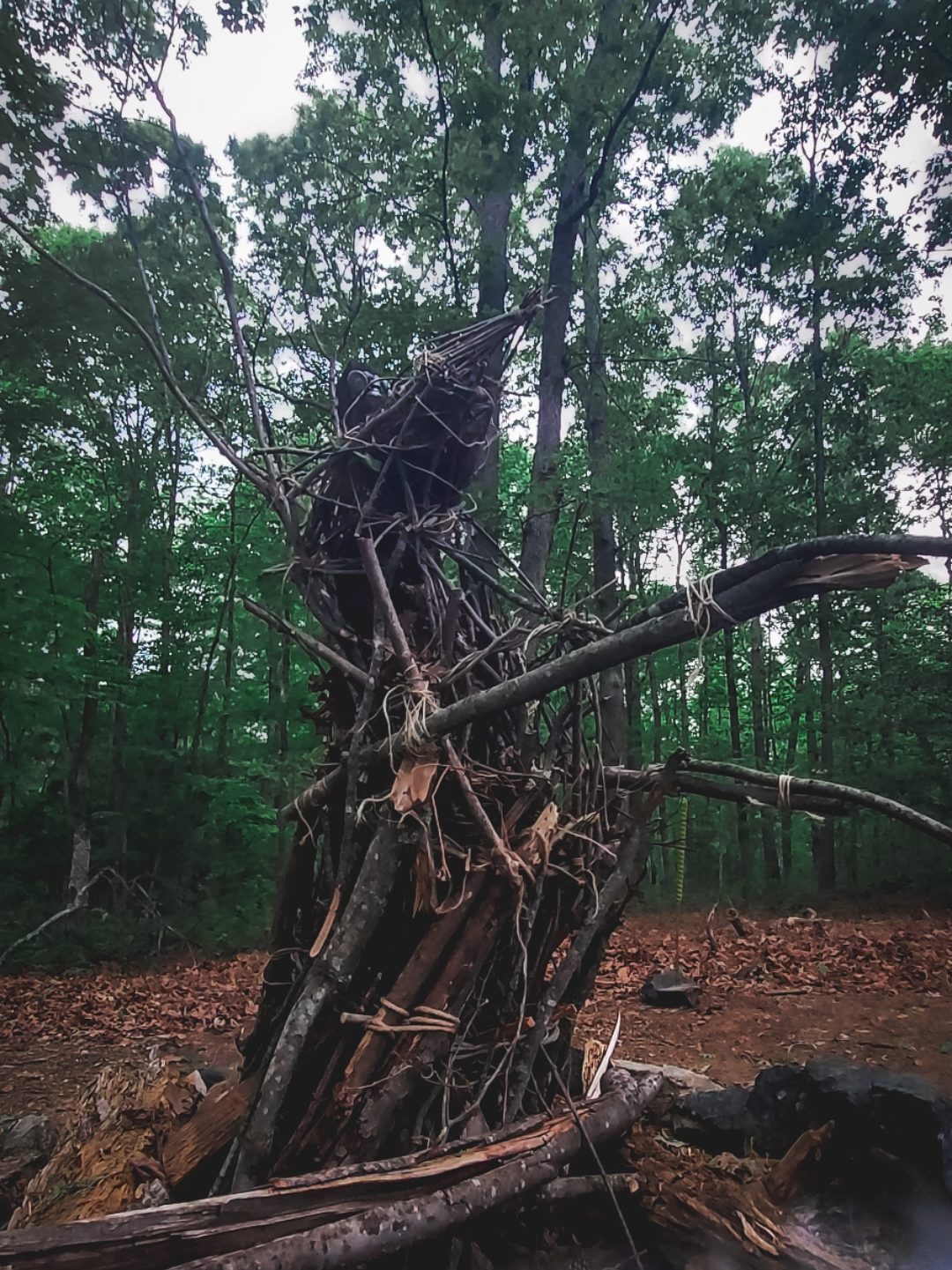
Also, the effigy was an eight-foot-tall rearing stag…

A tall stag made of woven deadfall. It appears to be springing forth from the ground.

… that rapidly turned into an enormous bonfire*.

*It was a very controlled bonfire. It was in a fire pit, and there were fire extinguishers and buckets of water at the ready. I’ve had fire safety ingrained in me literally from the blastocyst stage and most of us have lots of bonfire experience, so everything was pretty locked down.

A very large bonfire in a clearing in a forest.

The stag is a representation of the south and the element of Fire. He’s the figurehead of summer, and this one, in particular, represented the energy ramping up toward midsummer. He’s virility, high energy, and the crouch before the leap into action.

Each of us took a dried corn husk — a physical representation of a gift we wanted to offer the group — and lit it with a candle’s flame. Then, we each added our burning cornhusks, our tiny fires, to the massive fire of the burning stag.

Once the flames reached their peak, it was party time. People drummed, rattled, danced, and sang. I played my mouth harp. We had about five or six different rhythms going at the same time, and it was delightful and excellent. There was beauty and poetry and joy and chaos and fun and even a bonus group of concerned/confused citizens.

(We tried to remember songs about fire to sing, but the only one I could think of was “Fire Water Burn” by Bloodhound Gang and it didn’t exactly fit the vibe, YKWIM.)

When the fire died down, we started the return to camp. One friend doused the remains of the fire, while another attempted to harvest a tiny flame from it. They lit a candle with this flame, and a third friend carefully carried it all the way back. My Handsome Assistant and I accompanied them, watching in nothing short of astonishment as the candle managed to burn steadily the whole way. (It had sputtered and gone out mid-ritual, so the fact that it lit and stayed lit at all was nothing short of miraculous.)

Once there, we lit a new fire with the tiny flame taken from the ritual bonfire. With that, we could still sit comfortably around the sacred fire long into the night, ’til a thunderstorm came and sent us all to bed. (As much as it’s no fun camping in the rain, there was something truly delightful about going to bed tired and happy, lulled to sleep by the sound of thunder and the tapping of raindrops.)

There’s a really big sense of accomplishment that comes with making a large thing, even especially when you get to set that thing on fire and then party around it.

Some of the friends there were brand new friends. Others have known each other for years. All of us come from incredibly diverse backgrounds, belief systems, and skillsets. Each person contributed what they could — food, ideas, tools, a pair of hands — to make this ritual a rousing success and an absolute blast.

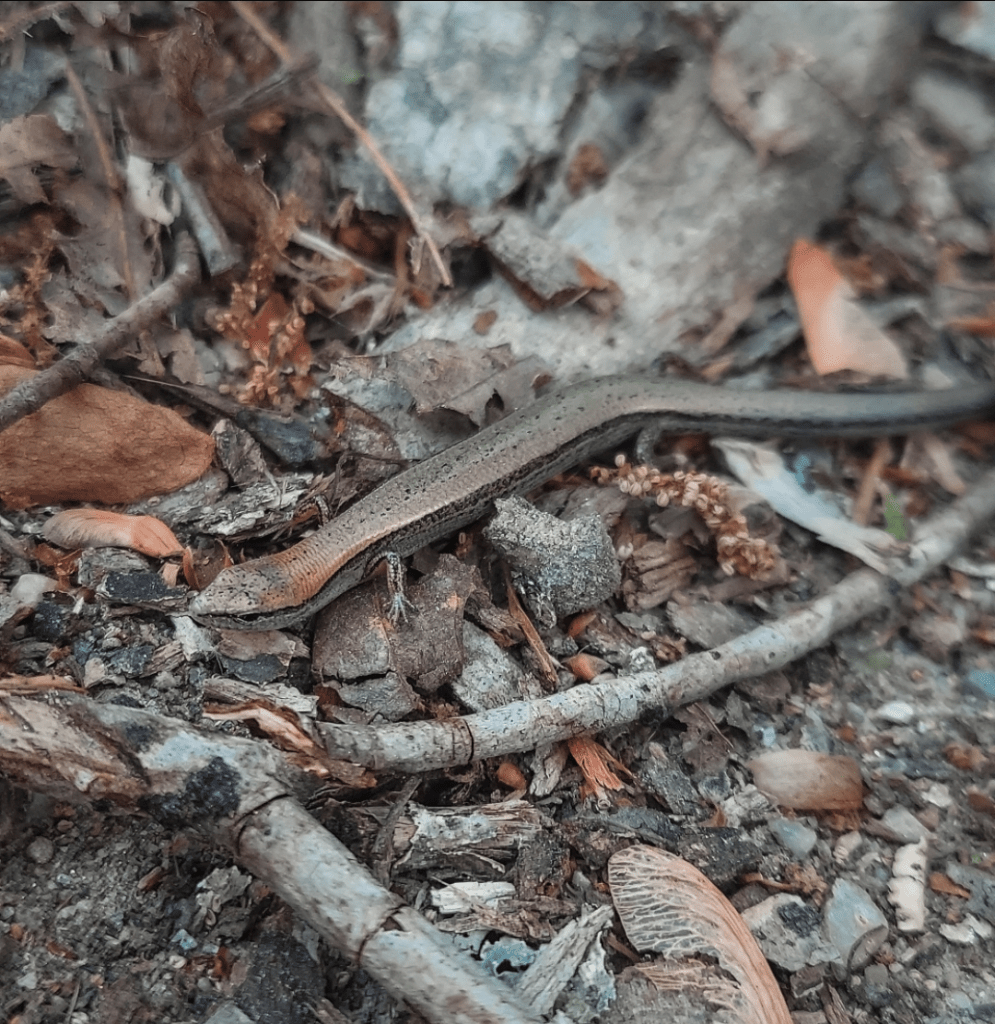
Also, I saw a coal skink (Plestiodon anthracinus, which was awesome because they’re considered endangered here), a little brown skink (Scincella lateralis), a luna moth (Actias luna), an awesome American giant millipede (Narceus americanus), and a huge and gorgeous eastern eyed click beetle (Alaus oculatus). So this was kind of a big weekend for me all around.

It’s a testament to what you can accomplish with a diverse group and a shared goal, and I still haven’t stopped smiling about it. I left with a container of the ashes from the sacred fire, a bag of apples, and what’s most likely some kind of fae curse on my cellphone. I think back on saying goodbye to everyone, and all of the hugs, and smiles, and jokes, and excitement that we managed to pull off something this cool, and it gives me the warm fuzzies. Like a tiny sacred fire that never goes out.

Neodruidry · Witchcraft

Does AI have a place in witchcraft?

I discovered a YouTuber fairly recently, GrumpyOldCrone. I find her videos delightful — she’s talented and funny, and it’s refreshing to hear someone else complain about the same minor things that I find annoying, but don’t really have anyone else with which to gripe about them. She’s fun. I like her. You might, too.

Two months ago, she posted a video about AI’s increasing presence in witchcraft circles:

I watched it when it first came out, I agreed with it, and it recently popped up again for me. So, I thought I’d reiterate it here: I wholeheartedly agree that artificial intelligence doesn’t have a place in witchcraft.

Like, literally anywhere.

When it comes to spellcraft, why would the Universe heed something that nobody could be bothered to actually make? The process of performing a spell starts long before you’ve lit the candles, said the chants, et cetera. On top of that, a lot of thought, research, and history goes into developing a good magical working. A generative AI that pulls concepts from various internet spells (some of which are already highly questionable on their own) and mashes them together isn’t doing that. If it has any results at all, they’re likely to be unpredictable at best.

When it comes to herb lore, it’s a bad idea to trust a web-based hallucination machine to give advice. There are already problems with computer-generated foraging guides allegedly “written” by authors that have never existed. Of course, human error is also a thing. (As evidenced by that crystal worker who put an ore of mercury in a fire, and that lifestyle blogger who put out a cookbook that included a recipe for raw, chocolate-dipped morels.) This is why it’s important to read multiple sources, and to both vet and question what you read. This is getting increasingly difficult as it is as AI models begin to poison the well of their own information — if kludging together flawed information was a problem to begin with, it’s one that’s only getting worse as more computer-generated “guides” enter the info pool.
Have you ever seen the movie Multiplicity?
It’s like that, but with more poison.

Obtaining this information doesn’t have to be expensive or challenging, either. There are tons of Pagan, witchcraft, foraging, and nature crafting communities online, and in real life via Meetup groups. A library card and an app like Libby can give you access to tons of e-books. Scribd offers a free trial, during which you can straight-up download your choice of 3 books in PDF form. I have read some fascinating research on historical magical artifacts and techniques through Academia, for free. If you’re looking for instruction in a specific technique, Udemy often has sales where their courses are as low as $10 a pop.
The only challenge is that the seeker actually has to consume it and absorb this information themselves. It isn’t as easy as asking ChatGPT for instructions, then following them. Few worthwhile pursuits are.

I also want to take a second to bitch about the uptick in AI generated Pagan “art.” My objections here are twofold: For one, I hate that artists are having their actual work taken, mashed up, and squirted out of the digital equivalent of a Play-Doh Fun Factory as something with too many fingers and its legs on backward. I also hate that so much of it is legitimately ugly and bad. I’ve gone to marketplaces and seen a lot of Pagan-flavored AI slop, and it’s honestly really disheartening. I’m not exactly stoked about the proliferation of the same handful of resin mold and 3D printed designs either, but at least they require a modicum of effort (and have the right number of limbs).

Some things take time and work, and there isn’t really a way around that. The “industry disruption” phenomenon doesn’t work in every context, and this is one of them. AI is not making witchcraft more accessible; it’s providing something that poorly apes it. Even if it were to improve, it isn’t a substitute for learning from a human, or for community, or tradition, or genuine artfulness.

While there are some things that modern AI models can do and do much better than humans (accurately diagnosing certain medical conditions, for one, or processing phenomenally large amounts of data into a useful form and suggesting a course of action), witchcraft isn’t it.

Neodruidry · Witchcraft

Can you use birthday candles for magic?

I love candle magic, but I don’t do it quite as often as I’d like for one simple reason: It usually requires letting a candle burn completely, ideally uninterrupted, and who’s got that kind of time? There are options for getting around this, of course, but a lot of them are less than ideal. If only there was something smaller, that could burn more quickly. Something like… oh, I don’t know. A birthday candle.
There’s gotta be some kind of birthday candle witchcraft out there, right?

Burning candles against white textile.
Photo by Jill Burrow on Pexels.com

So, you’ve got a candle spell to work, and one big problem — you can’t just leave it burning while you go on about life. There are some suggestions in old books, things like placing the candle in a cauldron or bathtub with an inch or two of water in it, so it’ll be immediately doused if it falls over. As someone who grew up with a firefighter, however, these suggestions make my teeth itch.

Fortunately, there’re better options out there than “stick a candle in your bathtub and hope for the best.” If you absolutely have to, you can snuff a candle and re-light it when you’re able to pay more attention to it. You might even be able to work this into your spell itself, by performing it every night for a series of nights and only burning a little of the candle at a time.

The other option, of course, is to use a really tiny candle.

There’s nothing wrong with using birthday candles in spells. They pack much of the same characteristics of full-sized candles (the element of Fire, the act of burning, the presence of a flame, the wax and wick being consumed) in a tiny package. There are a couple of things to consider before swapping all of your pillars, jars, and chime candles for a package of birthday candles, though.

Birthday candles are little and don’t take long to burn completely. When time is of the essence, or you can’t afford to take your eyes off of a candle for even a second (hello, friends with children or pets), then you need something that can work quickly.

That aside, there’s another reason why you might want to try using birthday candles: portability.

I have a crane bag. For Druids/Neodruids, this is a container of tools for field work, power objects, and/or everything that you might need for performing a ritual at any time, in any place. I’ve got tiny incense sticks, small statues, stones, bits of wood, airline-sized bottles of whiskey, a small bowl, a tiny bell, a rattle, etc. Birthday candles fit nicely here, and I don’t have to worry about disposing of a plastic or aluminum cup like I would with a tea light.

They’re inexpensive

Birthday candles are cheap and plentiful. You can find them in any grocery store, in decently sized packs that should last you for a while. Honestly, you’ve probably already got some in a junk drawer or the back of a cabinet in your kitchen right now.

In cultures that celebrate birthdays with cake and candles, there’s a tiny ritual associated with their use. The candles are placed on the cake, one for every year of the recipient’s age, and lit. The recipient closes their eyes, makes a wish, and tries to blow out all of the candles in one breath.

Cupcakes on a table with lighted candles and balloons.
Photo by Cup of Couple on Pexels.com

Honestly, if you mention birthday candles to anyone in the US, it’s likely that one of the first things they’ll think of is making a wish. Sure, it’s a cute little ritual primarily targeted at kids. It’s still a ritual, though. It’s still a positive association between birthday candles and wishes.

This is something that other candles don’t really have. Can you imagine parking an eight-inch-tall pillar candle in the middle of a sheet cake? Eleven or twelve tea lights? A massive jar of something labeled “Sun Dried Cotton”?

Depending on your particular birthday candle witchcraft goals, that connection with wishes is something you can tap into.

They’re easy to clean up

As a candle burns, the wax turns to liquid and is carried up the wick to be used as fuel for the flame. This process is more efficient for some candles and some types of wax than it is for others. Scented candles, for example, produce a lot of liquid wax to let the fragrance dissipate. Taper candles are used primarily for light, not scent, so they have a different shape and generally don’t produce much messy liquid wax. Birthday candles are only supposed to burn as long as it takes to blow them out, so they burn pretty neatly. Maybe a drop or two of dripped wax, if that.

If you’re not a fan of either cleaning old wax out of your candle holders, or digging holes to bury the remains of spell candles, birthday candles offer easy clean up and disposal.

The small size of a birthday candle doesn’t give you a whole lot of real estate for inscribing sigils, words, etc. If you have a particularly steady hand, you may be able to do something with the tip of a straight pin or sewing needle. Otherwise, if your spell calls for inscribing a candle with something, skip the birthday candle witchcraft and go for a chime, votive, or even pillar instead.

Unlike other candles, birthday candles are meant to go out easily. This can be a pain if you’ve got a situation that makes it tough to keep a candle lit. A stray breeze, whether from the outdoors or sudden movement, can leave you scrambling to re-light your candle mid-spell. It’s a major concentration breaker, if nothing else.

Some spells call for snuffing a re-lighting a candle, generally over a period of several days. Taper, knob, or pillar candles are good for this. Birthday candles, not so much. Can you imagine having to mark a tiny birthday candle into seven equal segments, and burn one single segment each night for a week? By the time you got it lit, you’d need to immediately snuff it again.

Birthday candle holders usually come in the form of either those little plastic or metal cups with a spike on the bottom, or an entire cake. Neither of these are particularly ideal when you only need to burn one candle, on a flat surface.

If you have trouble figuring out how to securely set up a birthday candle, get yourself a basic glass votive or tealight cup, and a handful or two of sand. Poke the birthday candle into the sand, and you should be good to go. If any of the melted wax gets on the sand, it’s easy to scoop it out and bury or otherwise dispose of it along with any other remains of your birthday candle witchcraft.

Like I said, I love candle magic. I also have three cats and the attention span of a brine shrimp, and I need candles that I can easily travel with. For me, birthday candles are a valuable and useful magical tool.

Witchcraft

The Magical Meaning of String

When I was a tiny child (very tiny, maybe six or seven), my grandma taught me to crochet. I didn’t learn much — my clumsy little hands weren’t able to do more than work a piece of string into a basic chain — but it was something I’ve wanted to get back into. So, as part of my desire to continue reskilling this year, I picked up some merino yarn and a basic #5 hook and got to it.

(So far, I’ve managed to make one tiddy portion of a bikini top in single crochet, and most of a scarf that I accidentally did entirely in slip stitch. This is okay, though. Even if you do crochet wrong, as long as you do it wrong enough and consistently enough, you’ll most likely end up with a useable item once you’re done anyway.)

Close up photo of teal yarn and a copper colored crochet hook.
Photo by Castorly Stock on Pexels.com

So, since I’ve ended up with a number of odds and ends of string, I thought it’d be a good idea to point out its many magical virtues and uses.

Witches and Pagans — at least, the ones I know — are nothing if not resourceful. Every weed, seed, stick, stone, empty jar, scrap of paper, and bit of string has potential. Sure, supplies from a local metaphysical shop are beautiful and fun, but you’d be amazed at what you can get up to with the contents of your trash.

(Literally. One of my most successful workings involved nothing more than a Sharpie, some toilet paper, and about ten seconds a day for a week.)

Anyway. String.

One of the most recognizable uses of string/yarn/floss/twine/thread/etc is the witch’s ladder. This is a length of cord knotted at intervals, often with feathers, leaves, stones, or other curios placed within the knots. Ultimately, the ladder is a talisman — as it’s made, the creator imbues each knot and curio with their intention for the ladder.

Wikipedia describes a specific instance known as the Wellington Witch Ladder, the first recorded instance of someone finding a witch’s ladder in an old house. Charles Godfrey Leland discovered that it was remarkably similar the description of a kind of folk charm used in Italy. Witches would utter a baneful spell as they braided the cord (along with locks of the victim’s hair and feathers from a black hen) and place the finished piece under a victim’s bed, in order to cause them pain, illness, and misfortune.

(As a magical device, a witch’s ladder isn’t solely for baneful magic. The inclusion of different curios and chanting a different spell would, by necessity, give the finished product a different effect.)

String, envelopes, and a pocket knife.
Photo by Fotografia Eles Dois on Pexels.com

A more stripped-down version if the witch’s ladder is basic knot magic. This involves taking a length of string and tying knots (usually nine) at intervals, starting with the center, then both ends, then working back toward the center. Each knot is accompanied by a chant.

This is useful as a kind of magic “bank” — each knot holds a portion of the spell and, when the knots are undone, the spell is released. One way to use this involves untying a knot once a day for nine days. I’ve also used them to tie around my wrist or ankle. Once the string breaks, the spell is released.

Strings also have the more mundane use of securing magical sachets and pouches. In Hoodoo, the traditional knot for this is the miller’s knot. Other traditions may have their own methods that call for a particular knot (or number of knots), or none in particular. Here, the string is mostly just intended to keep the contents of the pouch from falling out, but it’s easy to apply basic techniques like color magic if you so choose.

If you know how to embroider, it’s easy to apply this skill to creating sigils or other magical images. Embroider them onto pouches, clothing, altar cloths, or any other fabric items sturdy enough to handle them. This is a great method for magic you wish to keep with you — think workings for protection, prosperity, or attraction.

Lastly, strings have a powerful symbolic component. Take the photographs of two would-be lovers, for example, place them face-to-face, and tie them together with red or pink string for a love spell. Or, use a string as a component of cord cutting magic, to help you visualize and act directly on the “etheric tethers” that hold you to old relationships, situations, or other undesirable things. Strings represent the “ties that bind,” for good or ill, and you can use them to either strengthen or sever these ties as you wish.

Okay, so. Like I said, I’ve been crocheting. I’ve ended up with a lot of odds and ends of yarn as a result. I probably don’t need all of these bits of yarn, so it pays to be a bit selective in what I decide to keep. If you hold on to odds and ends of string for magical purposes, you’re likely to end up in the same boat.

So, how do you decide?

First, I recommend against using synthetic fibers for magical purposes. This isn’t because I feel like they’ll necessarily have a bad impact on the magic itself — they’re just not practical. They don’t break down like cotton, hemp, linen, silk, or wool do, so they’re not great for spell cords that need to fall apart eventually. They also don’t burn well (and, when they do, tend to melt and produce awful, migraine-inducing fumes), so they’re not great for any spells that involve burning cords.

Close up shot of blue yarn in a wicker basket.
Photo by Miriam Alonso on Pexels.com

Second, you don’t necessarily need a ton of strings of the same length and color. You probably know what spells you tend to work the most, and what it makes sense to hold onto. (For example, if you’ve been focusing a lot on money magic, you probably don’t need an ever-increasing stash of red strings.) If you don’t, that’s fine — shoot for white or black strings, and one or two in other basic colors. Develop your preferences from there.

Third, destash periodically. There are a ton of posts and vlogs about people who fall out of practice, or struggle to find the motivation to continue regularly doing magical workings. Let decluttering your magical supplies be a reason to use them. With knot magic, this is especially practical — knot your cords, recite your chants, and put what you’ve made to good use. (Or gift them to your witchcraft-inclined friends.)

Often times, working magic means seeing the potential in what would otherwise be discarded. A plain piece of string can be everything from a curse to a love spell, from a healing charm to a magical battery.

Plants and Herbs · Witchcraft

Soap Folklore and Magical Properties

I came across a rather strange argument the other day. One person mentioned “solid body wash,” which prompted another to go “so, soap?” This was followed by several people who either a) vehemently swore up and down that it was a marketing gimmick and there was no difference, or b) vehemently swore up and down that there was an enormous difference, but both c) could not explain why.

Focus photography of a bubble.
Photo by Pixabay on Pexels.com

I didn’t want to Kool-Aid Man in, all, “HELLO YES LET ME TELL YOU SOAP,” so I didn’t. Nonetheless, it gave me the idea to write this post — soap is a very important part of many magical traditions, and something most readers of this blog probably come in contact with every day. Sacred bathing, magical housekeeping, magical soap-making, herb craft, it all ties in together to create a vibrant, powerful, and useful set of magical techniques.

Okay, so. Just to get this out of the way — there’s an enormous difference between “soap” and “body wash.” Soap is specifically made of saponified fat. This is oil (or another fat) that has reacted with lye to produce salts that act to reduce the surface tension of water or reduce the tension where two substances interface. Like, for example, dirt or oil on your skin. Its molecules have a polar end that binds to water, and a non-polar end binds to other stuff.
Body wash is a detergent. Detergents are also made of surfactant salts, but their chemistry is very different. Detergents may be made of petroleum byproducts but are also often plant-based. While the polar end of soap is usually tipped with a carboxyl group, the polar end of detergent molecules is tipped with sulfonates.
Ultimately, as the end user, the biggest difference is this: If you have hard water, soap sucks. It reacts with the minerals in your water to produce soap scum (stearates) a waxy residue that sits on your tiles, your clothes, and your skin.
Detergents don’t produce soap scum the way soap does because they don’t react as readily with hard water minerals and have a higher pH than soap, so they tend to work better and have fewer issues in water that has a high mineral content.
Body wash isn’t really a chemical term — a body wash can be soap based but is usually a detergent because soap tends to strip and dry out skin. They also often contain ingredients designed to benefit the skin beyond cleansing, like moisturizers or exfoliants.
Does this make a difference in a magical sense? Not really, though the ingredients that make up a soap or detergent can be invoked for their own properties. Olive trees, sunflowers, and so forth all have their own energy to contribute.

A close-up of rows of wrapped bars of soap.
Photo by Polina Tankilevitch on Pexels.com

(Also, it should be noted that you can make soap less reactive in hard water. The addition of chelating agents or various forms of vitamin C can help prevent some of the formation of soap scum. It just requires some recipe tinkering.)

One bit of folklore surrounds the origins of the word “soap.” “Soap” is said to come from Mount Sapo, in Italy. In ancient Rome, there was a bend in a river at the base of the mountain. People would gather to do their laundry there because their clothes got cleaner than they did elsewhere.
Interestingly, this mountain is also where people conducted animal sacrifices. The liquefied fat, combined with the pyre ashes, reacted and ran/was washed by the rain down into the Tiber River. This fresh water, combined with unintentional soap, led to much cleaner togas.

This wasn’t the first soap, however. There are recorded mentions of using soap to wash wool going back as far as 2800-2500 BCE. Some Sumerian cylinders from 2200 BCE specifically mentions “fats boiled with ashes” — an old recipe for soap.

Bath with lemon slices in water and lit pillar candles on the floor.
Photo by Monstera Production on Pexels.com

Magically, bathing is used to both banish and attract. There are magical bath recipes for everything from breaking curses to getting a raise. They usually involve making a decoction of herbs in water, straining out the herbs, and adding the liquid to the bathwater.
Magical soaps are formulated with herbs and oils that align with specific intentions. They provide a somewhat more portable and less labor-intensive way to take a magical bath. A shop owner or salesperson, for example, may carry a bar of soap formulated to attract prosperity so they can wash their hands with it throughout the day.

This idea carries through to housekeeping. Floor, window, and door washes work the same way — by using a decoction of herbs or dilution of oils to either bring something into or get something out of a home. Back in the day, people in various cultures had other ways of achieving this goal. For example, smoke cleansing a house with juniper in order to banish sickness, or bringing in fresh sweet-smelling strewing herbs to cover a floor. Now, there are hard floors and glass windows that get washed.

Soap isn’t always associated with positive things, though. Soap Sally, an Appalachian and Southern villain figure, is said to wait with her basket for children who try to slack off when doing chores. She shapeshifts and convinces the children to follow her back to her cottage, where they gorge on candy and fall asleep.
Once asleep, Soap Sally would render the children in her stewpot. Their melted fat would be formed into hand-shaped candles or soaps, which she’d send back to their families. The families would end up burning or washing up with the remains of their own children.
Soap Sally appears to have roots in stories like Baba Yaga or Hansel and Gretel, as well as being a kind of “morality villain” to put the fear in children who’d rather play and goof off than do household chores.

Yes, yes, I know.
Who needs to be told how to use soap?
But this isn’t about just washing up — it’s about using soap for a specific purpose.

In the section above, I mention sacred bathing to attract or banish things. The process usually goes something like this:

  1. Take a regular bath or shower to physically clean yourself.
  2. Drain the tub or basin, and refill with fresh water.
  3. Add a decoction of herbs that match your intention.
  4. Declare your intention as you add the strained decoction. (Some traditions add that you should stir it into the bathwater in a clockwise direction, using your dominant hand.)
  5. Get into the bath and fully immerse yourself.
  6. Remain in the bath until you feel it’s had the intended effects.
  7. Get out of the bath. In some cases, you may be instructed to allow yourself to air dry so you don’t “wipe off” the effects.
  8. Dispose of the bathwater. In some traditions, this means taking a basin outside and throwing it over your left shoulder, toward the rising sun.

Whether the washing is “attracting” or “banishing” depends on your intention and the ingredients you add. Want to attract a lover? Rose petals, vanilla, basil, and jasmine are nice. As you bathe, you’ll be absorbing the sweet scents and loving energies from these plants. Want to banish unwanted things? Salt, rosemary, rue, and hyssop. As you bathe, you’ll be washing away whatever you don’t want.

Small bars of natural soap on linen dishcloths
Photo by Vie Studio on Pexels.com

Having a specially formulated magical soap can make this process easier. You still take a regular bath first, in order to clean yourself, but from there you just have to get into a fresh tub of water, soap yourself thoroughly with the magical soap, then rinse off.

Add a bit of magical soap to a bucket of mop water, then wash your doors, windowsills (maybe not the glass, if you’re hoping for a streak-free shine), and floors. Go from front to back to bring things into your home, and back to front to banish or push things out.
Specially compounded magical floor washes and soaps are largely found in the Hoodoo tradition, but just adding decoctions of herbs (or acids, like vinegar or lemon) is a bit more widespread.

The most basic “washing up” recipe I know of involves adding salt and lemon juice to a bucket of water, then mopping/washing walls, doors, and windows with it to help clear out old, unwanted, or stagnant energy. Pretty simple.

Whether soap originated from the accidental combination of animal sacrifices and a river, or the work of ancient Sumerian scientists, the idea of washing with soap or detergent has become ubiquitous in modern societies. When you couple the act of washing with herb lore and magical techniques, it can become much more than the sum of its parts.

(Also! I’ve gotten a few messages through the site’s Contact form lately, but they don’t include valid email addresses. If you’d like a reply, please, please double-check and make sure that your email address is correct. I’m not going to save it or sell it or put you on an email list or anything, it’s just important if you’d like me to email you back. Thank you!)

life · Neodruidry · Witchcraft

A very happy Samhain!

Despite popular depictions of Samhain/Halloween, it’s not really a major holiday for me in a religious sense. It’s more or less New Year’s. There are some events here and there — workshops on ancestor veneration, dumb suppers, and such — but it’s not quite as big for me as the solstices and equinoxes are (especially Mabon).

This year, we had tentative plans to have dinner and watch movies with friends, but that fell through. Instead, it was handing out candy to trick-or-treaters, doing small, homey things, and holding a spirit feast.

Elegant dinner table with floral centerpiece
Photo by Alina Skazka on Pexels.com

Dumb suppers are a traditional way to celebrate Samhain and involve sharing a meal in silence with the ancestors. Spirit feasts are a bit different — they’re not necessarily silent, and there are a lot more invitations to go around.

Dumb suppers tap into a kind of sacred silence that’s part mourning, part veneration, part listening and being receptive. The intention is to pay attention to the spirits of the ancestors, rather than the noise of living beings. Sometimes, people use this as a time for divination by listening for the voices of the dead.

Close up photograph of two lit sticks of incense.
Photo by Abhas Jaiswal on Pexels.com

When I conduct a spirit feast, on the other hand, it’s more like a party. Deities, spirits of nature, spirits to whom I may owe a debt, and spirits of ancestors (blood-related or otherwise) are all invited. I may offer food (this year, for example was fresh-baked biscuits with peach honey butter). I usually also offer incense, candles, liquor, tea, flowers, honey, and/or perfume. I play music (usually the lyre or dulcimer guitar). I read poetry. I tell stories or jokes. I put new artwork on my altar.

The atmosphere and focus are a bit different. It’s less about communing with the dead, and more about offering the best of what I have to all of the people, animals, plants, elements, places, and gods that have made me who I am.

I do this year-round, but Samhain makes it a bit more special.
Plus, it’s easier for everyone to attend.

This year, I’m honestly looking forward to winter. I have a lot of small-scale stuff to do to prepare for spring and summer, and I’m excited to get to it. I have art to make, wood to prepare for wands, trees to prune, and areas of the garden to set up for vegetable and herb beds. Honestly, I’m almost more eager to do that than I am to see the payoff later on.

I’ve built up a pretty good stock of art, wands, and jewelry. I’m starting to study incense making and botanical perfumery. I’m super stoked to find actual markets to vend at next year, so I can expand beyond just selling things online. It’s a little scary, but even more exciting.

No matter whether you celebrate Samhain or not, here’s hoping all of you have had a peaceful, happy October 31st and are looking forward to the months ahead!

Plants and Herbs · Witchcraft

Wormwood Folklore and Magical Properties

Wormwood (Artemisia absinthum) is an African/Eurasian herb and relative of mugwort that’s widely grown in Canada and the US for its ornamental, medicinal, and even magical uses. It’s also a key ingredient in genuine absinthe, and is purportedly why the drink was rumored to cause hallucinations (but more on that in a bit). While the medicinal properties of A. absinthum have since been superseded by other herbs and pharmaceuticals, it’s still a powerful magical ingredient and a beautiful ornamental plant.

Wormwood is a very bitter herb, so much so that it’s been used over and over again in literature as a metaphor for bitterness. Shakespeare mentioned it. The Bible mentioned it.
This bitterness may, in part, be a source of its hepatoprotective properties: Bitter herbs are said to trigger the release of gastric juices, including bile from the liver, which helps sort of flush things out. This is why herbal digestifs and digestive bitters became a thing. There’s not a lot of peer-reviewed research on the subject, but bitters have a very long history of safe use as digestive aids.

Wormwood is also one of those magical plants that doubles as a pest repellent. This is something we see pop up over and over. There’s a logical progression from “herb that keeps disease-carrying pests away,” to “herb that keeps all unwanted influences at bay.” This makes wormwood valuable for protection and purification.
Interestingly, I have also seen wormwood listed as an ingredient for spirit calling. I don’t know if I’d use wormwood alone for this, but it certainly seems like it’d be a useful ingredient to make sure you’re calling the right spirits.
(I see parsley mentioned with wormwood pretty frequently, which is funny because it’s another weird one for spirit work. It is listed both as a spirit attractant and repellent, go figure.)

Leaves of a wormwood plant in close up photography.
Photo by Veronica on Pexels.com

This herb also plays a protective role in Slavic lore. The rusalka is an entity, said to be the spirit of a young woman who died by drowning, who is associated with life-giving rain… and, after the 19th century, with madness, death, and trickery.
Carrying wormwood was a way to guard against rusalki. They are said to target young men, so guys were told to carry a sprig of wormwood with them wherever they went. A rusalka would inevitably ask if they were carrying wormwood, or parsley. Say “wormwood,” and she’ll scream and try to flee, at which point you must throw the herb at her eyes. Say “parsley,” and she’ll ensnare, drown, and/or tickle you to death.
(As someone who is a) ticklish, b) hates it, and c) was frequently tickled against my will as a child, I think I’d rather drown.)

Wormwood is also connected to divination. It’s a relative of mugwort and has many similar properties. The two aren’t entirely interchangeable, but you can often substitute one for the other in certain situations. Wormwood’s focus seems to be more connected to protection and purification, while mugwort is more psychic and divinatory.
This herb is sometimes used in love magic, but not as an attractant — its main virtue seems to lie in love divination. There are multiple recipes and instructions for tying wormwood leaves to one’s forehead, placing them under a pillow, or brewing them with other herbs and honey and anointing oneself in order to get a vision of one’s future spouse.

Wormwood is tenuously connected to the Greek goddess Artemis (and Roman goddess Diana) through its name. However, the genus name Artemisia may be a reference to Artemisia II of Caria, and not Artemis directly.
In practice, this herb is considered to be ruled by Mars and Mercury, while Artemis and Diana are Lunar deities.

Wormwood is associated with Fire (which I can certainly see, as it’s a Mars-ruled herb that likes sunny spots and dry ground), but I’ve also seen it listed as an Air plant.

Contrary to popular depictions, absinthe wasn’t some kind of magic hallucination juice. Genuine absinthe does use wormwood, which contains the compound thujone. Thujone can, in concentrated form and large doses, cause hallucinations, convulsions, and death, but is present in absinthe in such tiny amounts that it doesn’t really do a whole lot. (Ironically, the compound absinthin is an anti-inflammatory and doesn’t have much to do with any of that.)
Absinthe’s hallucinatory effects have more to do with its high alcohol content (the stuff is about 50-75% ABV), the power of suggestion, and the fact that unscrupulous absinthe makers started adding copper salts as an artificial green coloring around the late 19th century.

Assorted liquor bottles.
Photo by Chris F on Pexels.com

During its heyday, absinthe was also much enjoyed by counterculture movements. This led to it being vilified by social conservatives, who had every motivation to hype up its “dangerous, toxic, and hallucinatory properties.”
So, what do you get when you mix an herb that might, potentially be toxic in specific circumstances, a buttload of alcohol, a bunch of bohemians, cheap absinthe full of poisonous colorants, and a bunch of social conservatives? You get a liquor with a legendary reputation as a toxic hallucinogen, and an unfair ban.

You can grow Artemisia absinthum fairly easily. Like mugwort, it grows in bright, dry, disturbed soil. It also self-seeds readily, so be prepared to either keep it confined to an area where it can’t do that (like a pot on a patio), deadhead the flowers, or keep up with rigorously removing new baby wormwoods as they pop up.

While wormwood isn’t as dangerous as popular depictions would have you think, it’s still a plant with toxic components that should be treated with respect.

Close up of common wormwood.
Photo by Jeffry Surianto on Pexels.com

Wormwood has historically been used as a flavoring herb. If you want to use wormwood internally, do so under the guidance of a qualified herbalist. There are multiple health and pharmacological contraindications at play here, so it’s important to be careful.

Otherwise, dried wormwood makes a wonderful addition to protective bottles, sachets, and other charms. You can:

  • Grind it into a fine powder and sprinkle it on or around anything you wish to protect.
  • Burn it and waft the smoke around an object or area you wish to purify.
  • Keep some dried wormwood (perhaps with its cousin, mugwort) with divination tools to keep them cleansed and ready for use.
  • Soak it in water and asperge spaces, objects, or people to cleanse them.
  • Soak or steep it in water and use the resulting “tea” to wash your front and back doors for protection.
  • Grow wormwood near doors for protection against malevolent energies, entities, or bugs. (For real, a lot of what we consider pest insects really don’t seem to like it.)

These aren’t the only uses for this herb, of course, but they’re probably the ones most in wormwood’s wheelhouse. You can also use it for love divination or spirit work, but this may depend heavily on your specific tradition, techniques, and situation.

Wormwood is a beautiful, interesting, complex, and contradictory herb. It’s a poisonous healer, a repeller and attractor of spirits, and an invaluable addition to a magical herb collection.


life · Neodruidry · Witchcraft

Mabon 2024

This past weekend was the Mabon camping trip! My Handsome Assistant and I are part of a local Druidry group, and that group teams up with another Pagan group to go have a fantastic time in the woods.

(If you aren’t sure what Mabon is, here is a brief rundown.)

There’s food (lots of food), singing, stories, rituals, and catching up with friends, all set in a beautiful forest. Last year, things got a bit cold and damp. This year, the weather was better, and my Assistant and I knew what to expect. We were more thoroughly prepared (air mattress, extra blankets and sleeping bags, extra dishes, a solar powered fan), so it made for a much more comfortable trip.

The rain also stayed away just long enough for the weekend’s rituals, which was very important.

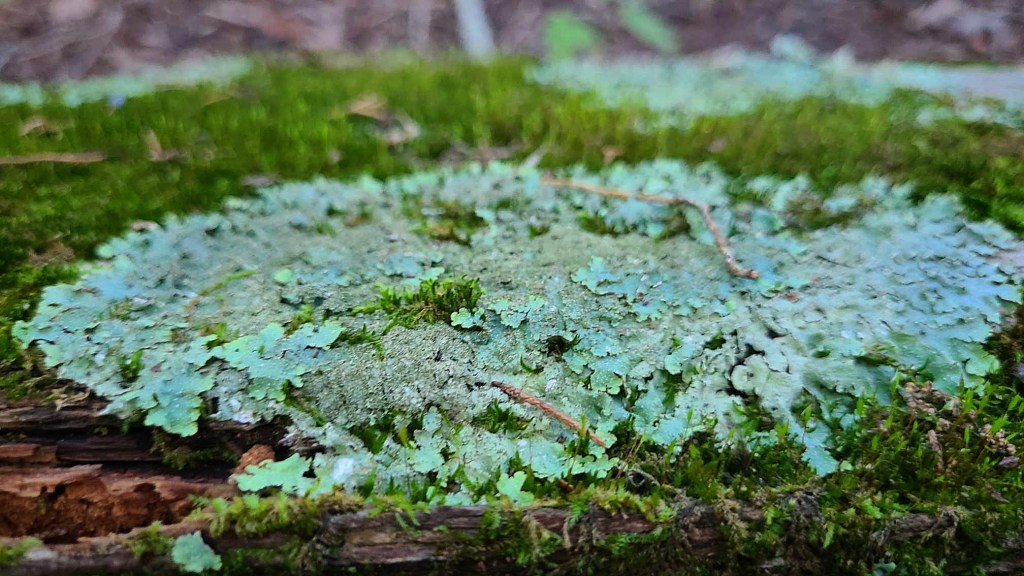
A close-up of some very pretty lichen, growing in a bed of moss.
Fortunately, there was just enough rain to make the mosses and lichens really pop.

Earlier, during the Midsummer goods and gear swap, a couple of us floated the idea of having a masquerade party. It wasn’t a serious plan at the time — mainly a “this would be really cool” kind of thing. Later, during a planning Zoom call, I mentioned that some of us thought a masquerade would be really neat. Maybe for Samhain?

One of the group’s Stewards knew of a ritual that involved masking — the Council of All Beings. Another person found chants that suited the occasion. Another wrote the transitions and spoken parts of the ritual structure. By the end, it was a beautiful, adaptable, and powerfully creative work.

Some people came to the trip prepared, already knowing which being they’d embody, having a mask or costume, and knowing exactly what they wanted to say. Others took time in the woods or labyrinth, waiting to see what reached out to them and asked to be represented. I’d gotten some inspiration a while before Mabon, so I was all set to go.

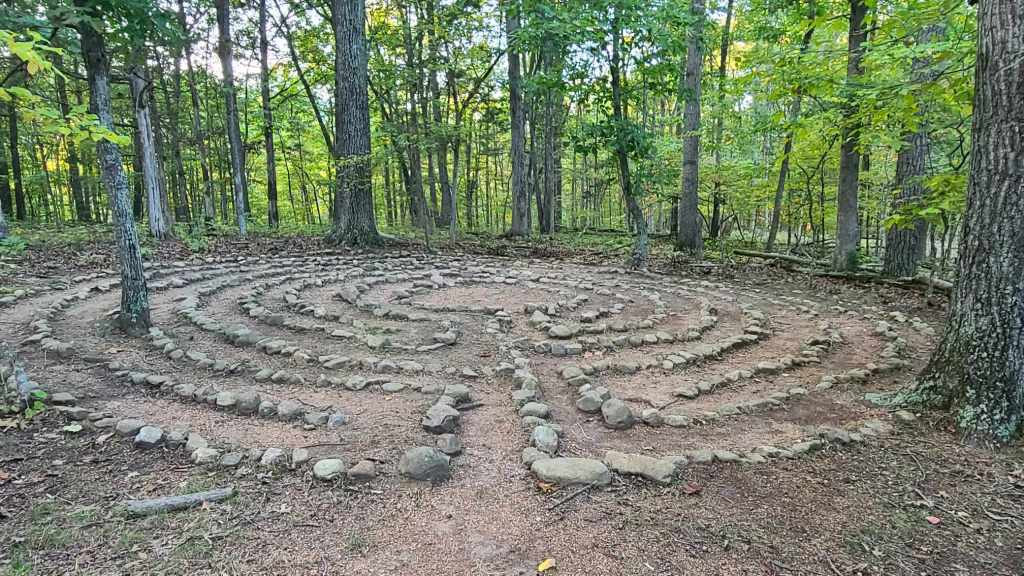
A photo of a labyrinth in a forest. The labyrinth is made up of stones, set in a spiraling pattern in a clearing.

The ritual itself was wonderful. The masks were gorgeous, and seeing what kind of entities inspired/spoke through people was fascinating. Some represented a specific organism — like the critically endangered regent honeyeater. Others represented a genus or type of being, like moths, small snakes, or coral. Others represented something broader, like smoke or the sun. Some were natural features, like the bedrock or an underground spring. There were representations from a variety of cultures and cosmologies, all brought together to express themselves through us. I loved it.

(I was the necrobiome, aka all of the little guys that dispose of trash and dead things. I had some trouble figuring out how to express “a tiny ecosystem of various bacteria, fungi, insects, and scavengers” through a mask, so I ended up settling on a skeletal deer mask instead. The presence of decomposition bacteria and fungi was somewhat implied.)

A humanoid figure in a forest. The figure is standing with their arms at their sides, staring directly at the camera. They are wearing gray boots, bandages around both hands, and a black shroud that covers them from their head down to their knees. They are also wearing a deer's skull as a mask, over the shroud. 
The photo also appears to be glitchy, with smeared areas and light leaks.
My Handsome Assistant took some photos of me all dressed up. I used them for some little analog horror-style photo manips, and I’ll be honest… this one really makes me want to go ominously photobomb strangers.

We also had an icebreaking and learning exercise called Birds of a Feather, where we wore small tags labeled with subjects we wanted to talk about — either things we found interesting and were well versed in already, or stuff we wanted to learn. It sparked a lot of very interesting conversations!

There was also a chants workshop, where a group of us got together to try various chanting techniques and see how they felt both through our own voices and hearing them in a group. (Some of the non-verbal chants, I thought, felt especially powerful. I love exploring and working with different sonic frequencies, so feeling and participating in chants that ran the gamut from “results in full-body tingles” to “surprisingly like the drone of a titanic beehive” was particularly fascinating.)

One group member also gave a talk about spiritual experiences at various megaliths in Ireland. Both my Assistant and I found it really interesting — enough to where he’s sincerely trying to figure out how to create some form of mobile hyperbaric compression chamber so I can get on a plane without Problems.

And then there was food.
(So much food.)
Every meal was a potluck, and there was something for everyone. Vegan, vegetarian, carnivore, gluten-free, nut-free. There was fresh fruit, Koren barbecue ribs, vegan fennel and garlic sausages, fresh bread, pudding made from foraged pawpaws, homebrewed peach mead, vegetable soup made from home-grown vegetables, curried chickpea salad, and a ton of other things I’m probably forgetting.
I ate like a combination of a Redwall character and some kind of Roman emperor all weekend, and it was delightful.
(My Handsome Assistant jokes that he puts on five pounds over Mabon, then spends the rest of the year losing it.)

I also stayed up way too late every night, mostly sitting around the fire hearing/telling stories, talking about things, and having the occasional smoke. This came back to bite me on Saturday, when I set an alarm to wake up, realized I had a terrible headache, and decided to sleep in. This would have meant that I’d miss the Equinox ritual Saturday morning, fortunately my Assistant and I had accidentally set up our tent right next to the ritual area.
I heard the drums going, bolted upright, wrapped myself in a blanket, and poked my head through the tent flap to watch.
It worked out okay until the calling of the quarters got to the South, which meant that everyone turned to face me, who was currently sitting due south and staring out of my tent like some kind of small cryptid. (I kind of slowly retreated behind my tent flap again until that part was over, Homer-Simpson-backing-into-a-bush style.)

So, while I am glad to be home again, I’m sad Mabon’s over. I’ll see (almost) everyone soon, but man do I miss that vibe.

Plants and Herbs · Witchcraft

Myrtle Folklore and Magical Properties

So, something funny happened.

Two years ago, I purchased a set of three elderberry starts. (Not quite saplings, since they were still very tiny.) I planted them, looked after them, and then pretty much let them do their thing once they got established. When I noticed buds on one, I was very excited — it was a little early for a baby elderberry to put out flowers, but so what? Elderberry flowers!

Except…

A close-up of a cluster of hot pink crepe myrtle/crape myrtle flowers.

Don’t get me wrong. They’re beautiful and vibrant. They’re just also extremely not elderberries.

Couldn’t be farther from elderberries, actually. This small tree is a stunning example of a Lagerstroemia — also known as the crape (or crepe, or crêpe) myrtle.

While I was looking forward to experiencing my first home-grown elderberries this year, I am willing to settle for a very pretty crape myrtle. This tree isn’t native to this area (in fact, there are no Lagerstroemia species native to the US), but it’s very common in the southeast and the seeds have become a food source for birds like goldfinches, cardinals, and dark-eyed juncos, among others. While I’m far more in favor of planting native plants, the fact that many native species of birds have shifted to using crape myrtle seeds as a winter food source is a very big (and legitimately fascinating) deal. If left unchecked, crape myrtles can produce a lot of seeds and will multiply prolifically. If native bird species are taking to crape myrtle seeds as a winter food source — and even seemingly preferring them to commercial bird seeds — that’s a good thing. It allows these birds to take the place of their natural predators and may keep volunteer crape myrtles from becoming a problem.

But enough about my myrtle problems. Here’s some more neat stuff about myrtles in general.

Crape myrtles (Lagerstroemia) are native to parts of Asia, Australia, and the Indian subcontinent, and they’re somewhat distantly related to what we usually consider myrtles (Myrtus). Same with lemon myrtles (Backhousia citriodora), which are found in Australia.
Myrtus species can be found in the Mediterranean, western Asia, India, and northern Africa. Lagerstroemia, Backhousia, and Myrtus are genera in the order Myrtales.

There are also bog myrtles (Myrica gale), which are found pretty much anywhere in the northern hemisphere where you can find bogs, and bayberries (like Myrica pensylvanica, M. carolinensis, M. californica, and a whole bunch of others). These are wax myrtles, part of the order Fagales, and are actually more closely related to beech trees.
(Vinca, also known as “creeping myrtle” or “lesser periwinkle,” is not related to myrtles. It’s also a bit of an invasive nightmare here.)

For the purpose of this post, I’m going to focus on members of Myrtaceae.
(Wax myrtles, you’ll get your turn. Promise.)

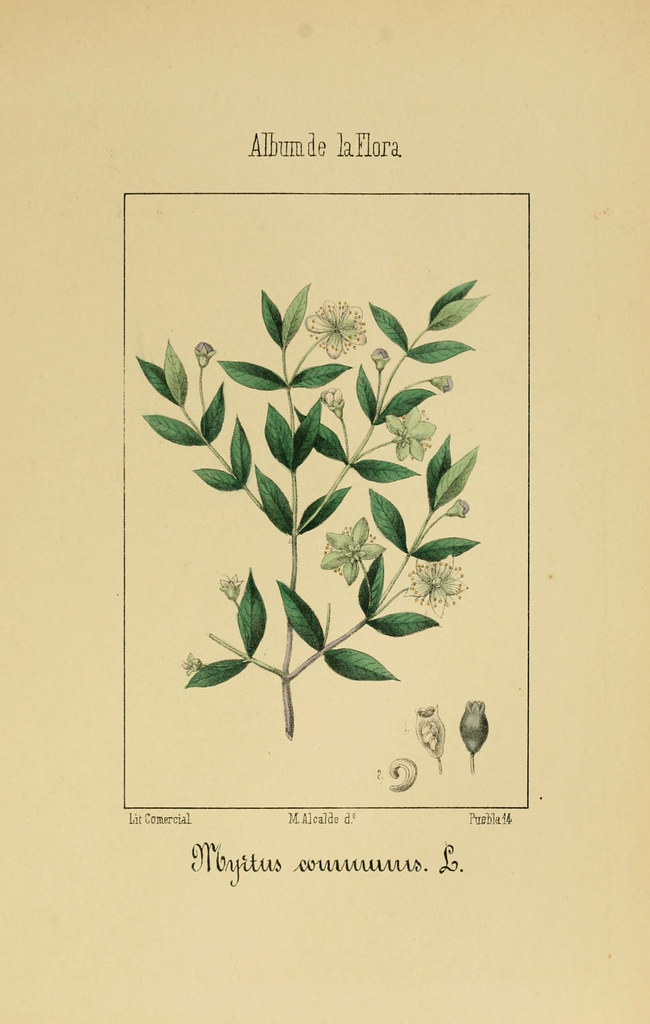
A botanical illustration of Myrtus communis, the common myrtle.
n208_w1150 by BioDivLibrary is licensed under CC-PDM 1.0

Common myrtle (Myrtus communis) is used as a culinary herb and medicinal plant. Figs, threated onto a myrtle skewer and roasted, acquire a unique flavor from the essential oils present in the wood. The seeds, dried and ground, have an interesting, peppery flavor often used in sausages. As a medicinal plant, it’s been used to treat scalp and skin conditions, to stop bleeding, and to treat sinus problems. (Unfortunately, there’s limited evidence that myrtle really does much for that last one.)

Lemon myrtle (Backhousia citriodora) is also a culinary and medicinal plant. As a culinary herb, it’s used to flavor any dish you might flavor with lemon: desserts, fish, poultry, or pasta. It’s especially useful for flavoring dairy-based dishes, since the acidity of actual lemon juice tends to ruin the texture of milk products.
Medicinally, the oil has some pretty significant antimicrobial activity. The leaves themselves are also very relaxing.
(I’ve had the dried leaves in tea, where I find it really shines — it’s got a delightful citrusy flavor with a bright, subtly sweet taste, and it absolutely knocks me out.)

In ancient Greece, the myrtle tree was a sacred tree for Aphrodite and Demeter. Seeing one in a dream or vision was considered good luck if you were either a farmer or a woman. It was also connected to the minor deity Iacchus, for whom there isn’t really much information — he was often syncretized with Dionysus, and Dionysus was all about wreaths and garlands. He could also have been a son of Dionysus, a son of Demeter, or a son of Persephone.

There are also three ancient Greek origin stories for the common myrtle. In one, an athlete named Myrsine outdid all of her rivals. In retaliation, they killed her and the goddess Athena turned her into a beautiful myrtle tree. In another, a priestess of Aphrodite broke her vows to get married (either willingly or unwillingly, depending on the version). Aphrodite then turned her into a myrtle tree, either as a punishment (for willingly breaking her vows) or as protection (against the husband who abducted her to marry). In the third version, a nymph turned herself into a myrtle tree in order to avoid Apollo’s unwanted advances.

Pink crape myrtle flowers on the branch.
Photo by Griffin Wooldridge on Pexels.com

In Japan, crape myrtles are known as sarusuberi (百日紅). Their striking flowers are often found in traditional artwork and make very striking bonsai.

Crape myrtles don’t have much history in old grimoires or European magical systems, purely because they weren’t really around centuries ago. When you’re reading about largely European folk magic, ceremonial magic, mythologies, or herbal medicine, they’re going to be talking about Myrtus species, not Lagerstroemia. That said, crape myrtle flowers are associated with general positivity, love, and romance.

Lemon myrtles don’t have much history in European magical systems, either. Like crape myrtles, this doesn’t mean that they don’t have value. In modern western magic, lemon myrtle is usually considered a solar herb and all of its attributes: purification, positivity, luck, and protection.

As a plant of Aphrodite and Demeter, common myrtle makes a good offering for either of these deities. (This isn’t always the case — sometimes, when a plant is sacred to a god, it means don’t touch that plant.) Since these goddesses are shown wearing wreaths of myrtle, it’s not a terrible idea to weave a myrtle wreath and either wear it while doing devotional work, or place it as an offering to one of them.

A hand holding a sprig of myrtle, showing the plant's leaves and berries.
Photo by Furkan Films on Pexels.com

Common myrtle is also very strongly associated with love and marriage. In Eastern Europe, myrtle wreaths were held over the heads of a marrying couple (now, people use crowns instead). All the way across the sea, in Appalachia, one method of love divination involves throwing a sprig of myrtle into a fire. If you watch the smoke closely, it’s said to form the shape of your true love’s face.

Myrtle is more than a love and marriage herb, however. It’s also considered protective. As mentioned in myrtle’s Greek origin stories, two of them describe women turning (or being turned) into myrtle trees in order to escape men. In England, it was also thought that blackbirds used myrtle trees to protect themselves against malevolent sorcery.

Common myrtle is associated with Venus and the Moon. Lemon myrtle is associated with the Sun.

If you have access to dried common or lemon myrtle as a culinary spice, you’re in luck — these are ideal ingredients for kitchen witchery. Combine them with other ingredients that match your intention (for example, make a delectable chamomile and lemon myrtle tea for luck, just be ready for a nap first), ask the herbs for their help, and you’re good to go.

Lemon and common myrtles have a high concentration of essential oils, so they’re good for infusing. Place some of the dried leaves in a carrier oil, like sweet almond or jojoba, and allow them to sit in a warm, dark area. Shake them regularly, and decant or strain the oil after a month or so. You’ve made an oil you can use for anointing, dressing candles, you name it.

If you want to use common myrtle for love divination, brew a cup of myrtle tea and read the leaves. You can also toss a branch of fresh myrtle into a fire and read the smoke.

I wouldn’t recommend planting myrtle trees if you live outside of their native range, but, if you’re in the southeastern US like me, you probably have access to loads of them anyway. You can find lemon myrtle in tea and spice shops. Same with common myrtle. Crape myrtle grows by the roadsides here as a landscaping plant. (If you’re me, you might even think you’re planting an elderberry start and end up with a crape myrtle instead!)

Even if you can’t grow myrtles yourself, I recommend experiencing their delightful colors, flavors, and aromas at least once. Each myrtle species and relative has their own fascinating folklore and history of use,

Neodruidry · Witchcraft

A happy and fruitful Lughnasadh!

My Handsome Assistant and I were originally intending to go on a camping trip with a local Druid group that we’re part of, but with him still recovering from his accident, we decided (at the last minute) that it might be better to focus on getting him to 100% before we try tent camping.

So, rather than having singing, dancing, feasting, and ritual in a group, we had a smaller, homey version: fresh baked breads, homebrewed peach mead, music, ritual, and a spirit feast.

An image of a feast, featuring charcuterie, fresh fruit, big strawberries, sliced carrots and cucumbers, and lots of other delicious, seasonal food.
Photo by cottonbro studio on Pexels.com

What’s a spirit feast? Exactly what it sounds like — a feast conducted for deities, ancestors, spirits of the land, guardian and guiding spirits, and any spirits to whom we may owe a debt (for example, spirits of the land affronted by new construction, tree felling, and so forth).

Unlike the “dumb suppers” of Samhain, this is not just for ancestors and the beloved dead, and it’s more like a party. Offerings are carefully chosen and high quality. Incense. Flowers. Candles. Fresh bread. Wine. Fruit. Good food, well prepared. Is it a traditional part of Lughnasadh celebrations? Not really. But Lughnasadh is a time to offer the “first fruits,” and so, in the absence of being able to party with friends, it seemed an appropriate way to offer the first fruits.
It felt right. It was equal parts fun and moving. I’ll probably make it part of my celebrations from now on.
Lughnasadh, after all, may have its origins as a funerary feast for the mother of Lugh, Tailtiu. She died of exhaustion after preparing the land for agriculture, and represents the Earth that feeds us and the plants that are harvested and die back in the high summer heat. It seemed a good idea to pay back this sacrifice and invite the spirits of the land to a feast.

This year, the fruits of our garden are particularly abundant. The Virginia roses (Rosa virginiana) are all but bowed over with fruit. The passionflower (Passiflora incarnata) vines are thick and lush and heavy with their strange purple flowers and egg-like fruit. The pumpkins are pumpkining. The beautyberry (Callicarpa americana) is both beautiful and extremely berried.

It’s very good. I hope things are very good with you, too.