One of the benefits of encouraging wildlife to hang out is that, if things go right, it’ll basically do your gardening for you. I’ve had so many volunteer plants courtesy of the birds and squirrels, it’s bonkers. Since I’m still working on re-wilding things, I’m grateful for whatever additions the local creatures want to make — I get to see what grows well and what doesn’t, and it’s all for free.
This is all just preamble to explain that I’ve been watching the progress of some kind of plant in the front plot. The front yard is divided into two squarish plots by a walkway. In one, we’ve finally managed to kill off the grass and replace it with a redbud tree, oakleaf hydrangea, coreopsis, strawberries, moss phlox, and echinacea. Then this thing happened.
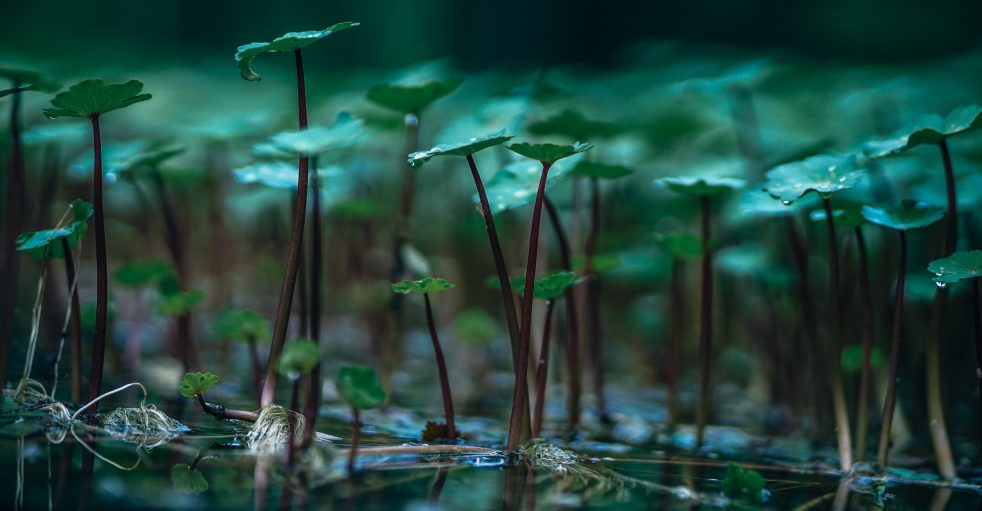
Cute, right? It seemed to appear overnight, springing up out of the ground without warning. No sprout, nothing. Just bam! This.
Out of curiosity, I left it. It was in a bare spot, and I was honestly pretty excited to see what it’d turn out to be. I tried identifying it to make sure it wasn’t something invasive or poisonous, but plant apps were stumped. It was almost definitely a member of Cucurbitaceae, but what? Pumpkin? Melon? Squash? Cucumber? Even Reddit’s gardening subs were mostly baffled. Some posters who recognized it even admitted that it looked like “some kind of weird hybrid.”
Anyhow, I figured it’d probably end up being some kind of vegetable, so I left well enough alone. I didn’t even bother watering it. I figured that it was a volunteer, it was doing fine without my interference, so it was just sink or swim from h-
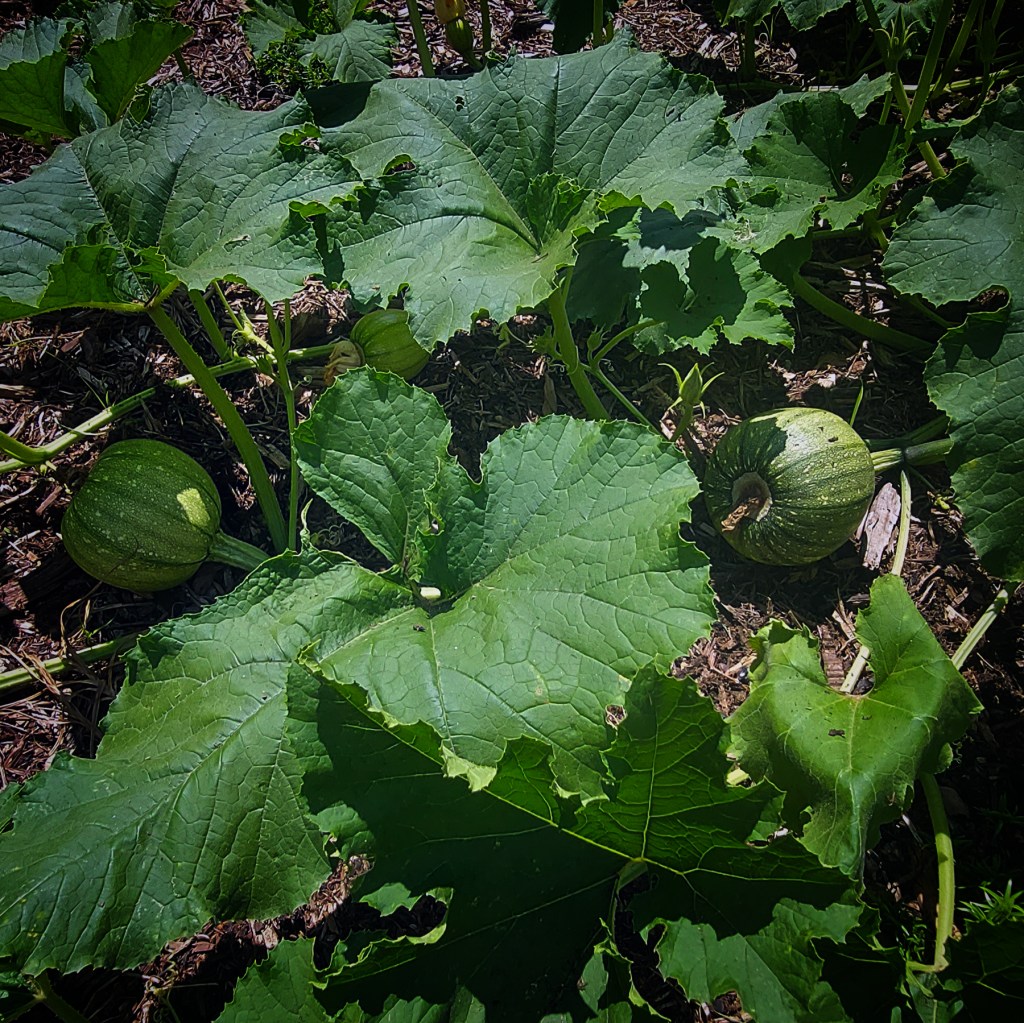
Like something out of a weird fairytale (or Annihilation, or The Color Out of Space), it… expanded. It didn’t get any taller, but it sent out yards of thick, powerful vines across the ground. By the time you read this, it’ll probably have doubled in size.
It also started putting out flowers. Big, bright yellow ones. Each one had a firm, round base. Before long, we had a ton of these.
So, not cucumbers. Not melons. Some kind of pumpkin? A squash?
This guy who sometimes cuts the (remaining) grass for us said he recognized it as an ayote. He said it’s tasty when cut up and stewed with beef ribs and vegetables. I don’t do beef ribs, but I have some lovely brisket-style tempeh that could maybe work.
The trouble with volunteer Cucurbits is that there’s a risk of poisoning. If you find a wild squash in your yard, or grow one from seeds that you’ve saved yourself, taste a little bit of the raw fruit before you cook it or serve it to anyone else. Some wild Cucurbits have a lot of a toxic compound called cucurbitacin. It tastes very, very bitter, and enough of it can absolutely kill you. Tl;dr: Do not eat bitter squash, or any other members of Cucurbitaceae that taste weirdly bad.
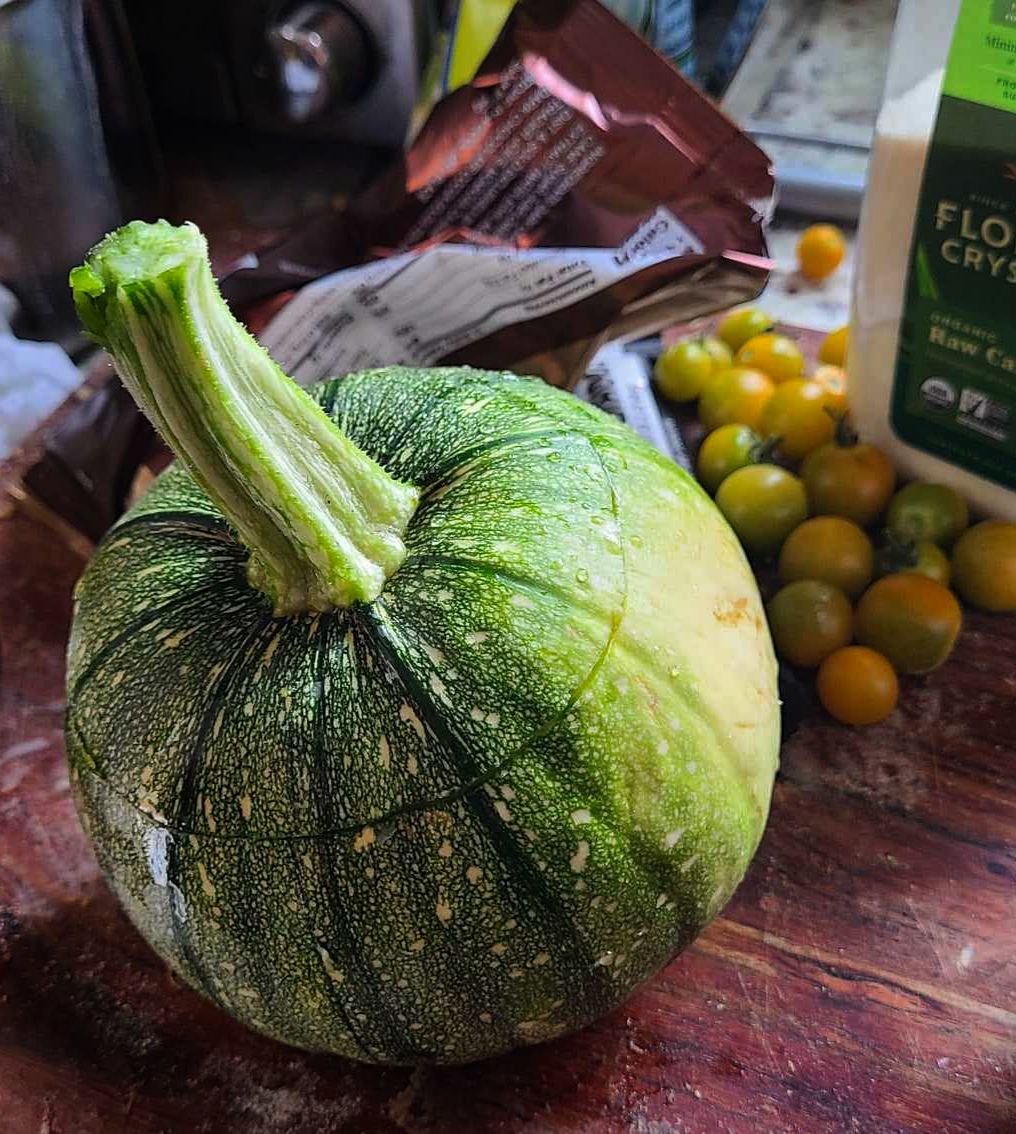
They’re nowhere near ripe yet, but I noticed that the stem of one had broken. I brough it inside for Experiments.
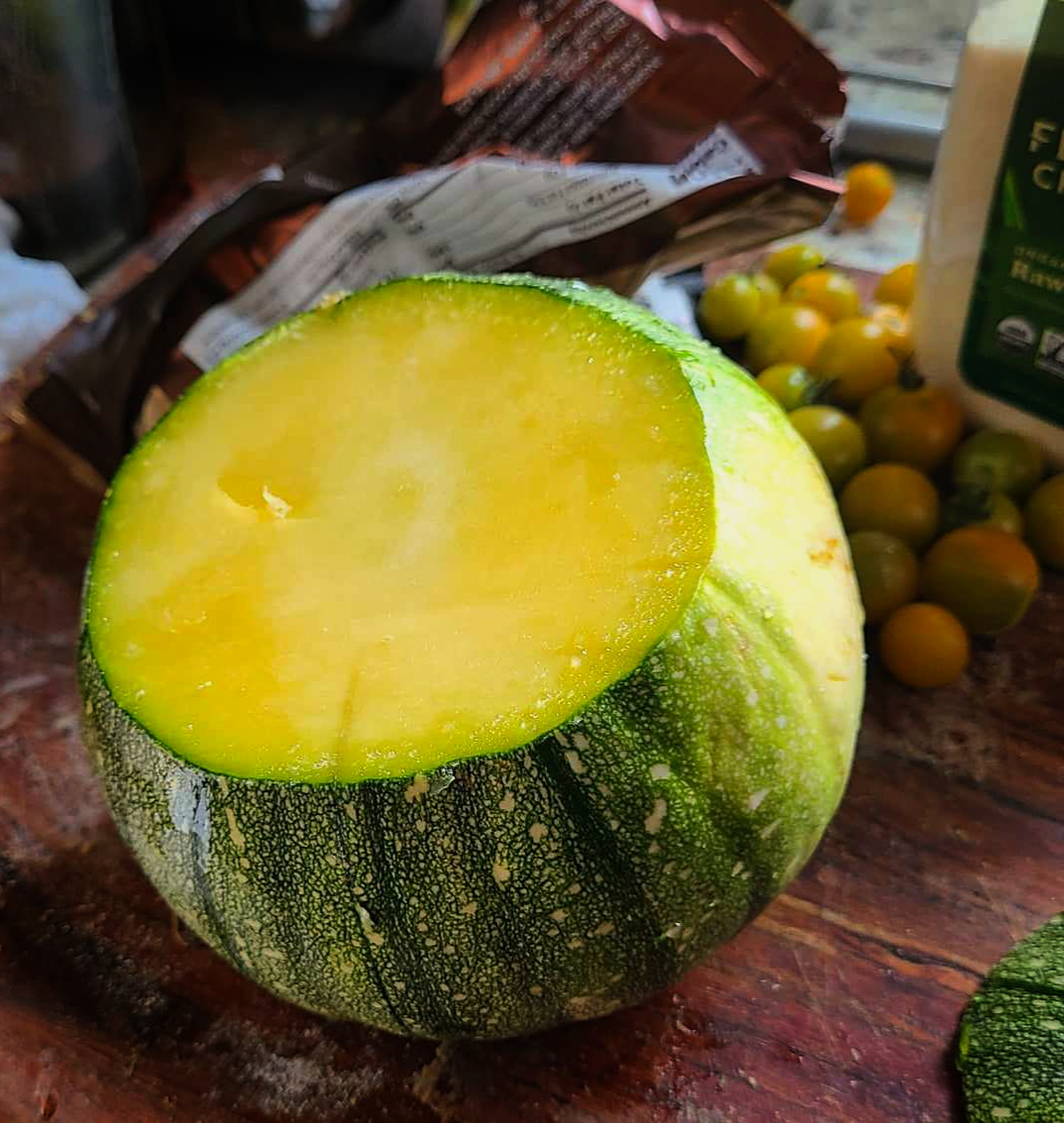
It looked inoffensive enough. I took a little taste.
Surprisingly, it was pretty good! There was no trace of bitterness, just a mild, sweetish flavor. It’s not as strongly flavored as it’ll probably be once it’s completely mature, but definitely not bad.
I haven’t decided what to do with this specific one just yet. Ayote en miel? Squash soup? Roasted squash?
Whatever I decide to make from this squash, I hope I like it. I’ll definitely have plenty.
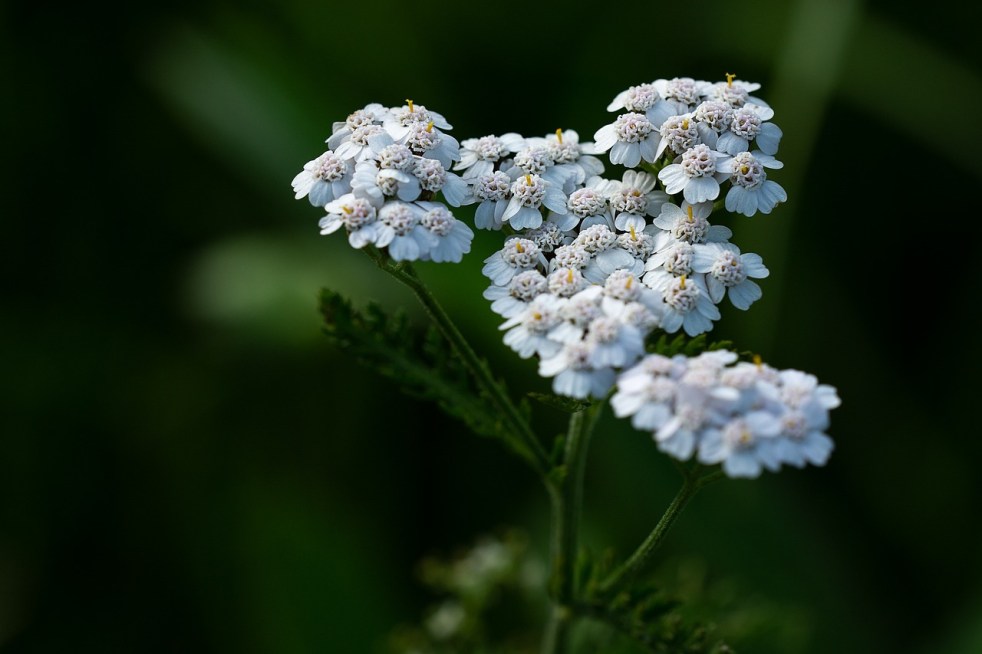
You know, I never really connected with yarrow. I know it’s kind of a magical herb staple, but I was always more into mugwort and its ilk. For some reason, yarrow just didn’t quite grab me the way that certain other herbs did.
All of that aside, I have lots of it now. When I embarked on my crusade to murder the grass and replace it with useful things (my rules are that they must either feed me or the local fauna, and preferably both), yarrow was a natural fit. It’s a lovely plant that gets tall enough to fill the space in my flower beds, and it’s very aromatic. Working with it in a gardening capacity has given me a new appreciation for it as a magical and medicinal herb, and the bees really seem to enjoy it.
Yarrow Folklore and Magical Uses
Yarrow is one of the oldest medicinal herbs. Like, pre-pre-history old. Archaeologists have identified yarrow among the belongings of a 65,000 year old Neanderthal.
Achillea specimens are found pretty much everywhere, with the exception of Africa and Antarctica. There are Achillea millefolium subspecies found in Europe, Asia, the Arctic, the Himalayas, the Alps, the Carpathians, the western US, Alaska, the US in general, and one particular that’s endemic solely to California. It’s probably not surprising that it’s often considered an aggressive weed, and may be best confined to areas that you either don’t mind having it take over, or allow you to control its spread.
Interestingly, all of these subspecies seem to have different medicinal effects. There’s some overlap, of course, but each subspecies appears to have different ratios of medicinal compounds.
The genus Achillea is named for the Greek hero Achilles. Chiron taught him the plant’s medicinal properties (specifically using it to treat wounds — hence its other common name, woundwort) and carried it into battle. It’s anti-inflammatory and antibacterial, so it’s a good plant to reach for to treat minor cuts, scrapes, and bruises.
Chiron was half-man, half-horse, and a great healer. That makes him the Centaur for Disease Control.
This connection with battle may be why yarrow is also used as an herb for courage.
Yarrow is a protective and purifying herb. Like many herbs used to cleanse and protect, this action is borne out by its ability to repel pests. Experiments with birds using yarrow as a nest lining found that it inhibits the growth of parasites. The connection between repelling pests and magical protection is seen pretty often, as with pennyroyal, or fennel, for example.
In Europe, scattering yarrow across the threshold of a home was believed to keep evil from entering.
Yarrow is historically a divination herb. In China, one way to cast the I Ching involved counting stalks of yarrow. In Europe, it was used for love divination. You’d take a yarrow leaf and stick it up your nose, tickling yourself with it as you said,
Yarroway, yarroway
Bear a white blow.
If my love love me,
Let my nose bleed now.”
Traditional
Another method for love-divination involved placing yarrow under your pillow. If you dreamt of your love, it was a positive omen. If you had a bad dream, or dreamt of other people, it wasn’t.
An old Gaelic incantation for yarrow-picking went thus:
I pluck the smooth yarrow,
That my finger be sweeter,
That my lips be warmer,
That my voice be gladder.”
Yarrow was said to be a sacred plant to the ancient Druids, used for weather divination.
In the Victorian language of flowers, yarrow represented everlasting love.
Yarrow is connected to Venus and the element of Water.
Using Yarrow
Since so many practitioners of witchcraft and Druidry have pets and small children, I probably wouldn’t recommend just strewing your threshold with yarrow. Instead, scatter some of the dried herb under your front doormat, where curious hands or snouts can’t get into it. You can also grow yarrow near your front door — it’ll feed your local pollinators and help keep evil away.
Yarrow hydrosol is another useful way to work with this herb. It’s good for your skin. (For real, an ointment containing yarrow was researched for its ability to help heal episiotomies. Ouch!) It can also have a purifying effect, so it’s a nice way to prepare yourself for rituals. The leaves and hydrosol are also fragrant, so the scent is a nice for getting into a magical mindset.
For divination, you could either learn to cast the I Ching with traditional yarrow stalks, or include it in a spray or sachet to use while reading tarot, runes, or Ogham staves. Including it in a dream pillow is said to lead to prophetic dreams.
As a Venus-ruled herb, it’s also a good choice to include in love jars or sachets. Traditionally, its power was to help the user find their true love, and keep lovers together. That makes it a worthwhile addition to spell to draw in true love and help it last.
Medicinally, yarrow hydrosols, infusions, and ointments are great for topical conditions like stings, bug bites, scrapes, burns, scratches, cuts, and bruises. (Never put anything ointment-y over deep wounds, puncture wounds, or animal bites, however.) Teabags or poultices of yarrow are also nice for easing sore eyes — just be careful not to get yarrow in them! If you’re allergic to yarrow or other members of the Asteraceae family, skip yarrow and use something else.
This herb is also used for treating a ton of internal conditions, from digestive trouble to colds and flu. But, like I mentioned previously, each subspecies seems to have its specialties. Before using yarrow internally, you should consult with a qualified herbal practitioner to choose the safest and most effective herbs for your condition.
Well, “borderline high,” according to the internet.
My doctor gave me the disheartening news that it’s genetic. I think it’s more likely to be a product of falling too easily into the temptation of getting takeout in a place with so many awesome places to eat.
Either way, I’m avoiding statins if I can. For now, I’m trying a different protocol:
Taking vitamin K2, on my doctor’s recommendation.
Taking vitamin D, because I tested low.
Eating 35+ grams of fiber per day. Oat fiber is supposed to be the best for maintaining a healthy blood lipid ratio, but I can’t have oats. So, psyllium, chia, and other fibers it is.
Going plant-based.
Eating more avocado. The thing is, I already cook almost exclusively with avocado oil because it has a higher smoke point than other oils, so I’m not sure how much of an impact this’ll have.
Increasing my physical activity. I’ve started with a round of sun salutations each morning, and a set minimum of any kind of other physical activity throughout the day. I get bored easily, so I won’t stick to a routine. Telling myself that it doesn’t matter what I do, as long as I do a half hour of it, seems to be the best way to ensure that it actually happens.
I was vegan years ago, but I say “plant-based” now. This is mostly because veganism isn’t really a possibility — I wear vintage leather, because it is better and less harmful than either new leather or vinyl alternatives. I use collagen to keep my joints functioning, and there is no vegan equivalent. I eat honey, because bees are unionized. I feed my kefir grains with plain sugar, which is sometimes whitened with bone char. There are some things for which there is either no less destructive alternative, or no actual replacement.
I’m also using complementary measures. This is mostly because fixing my blood lipids is mostly a matter of changing things and waiting — there isn’t really a whole lot to do. I have an aventurine and serpentine bracelet that I wear on my left wrist, so putting it on and noticing it throughout the day helps me a) feel like I’m actively doing something, and b) draw my attention back to getting my blood back out of whack.
I’ve also been using meditation. I meditate routinely as it is, but I’ve shifted my focus to very specific imagery, sounds, et cetera. Even if this doesn’t lower my cholesterol, meditation has enough other cardiovascular and general health benefits to make it worthwhile.
It’s going to take a bit for these things to have an effect. My cholesterol didn’t raise itself overnight, and it won’t lower itself that quickly either. Hopefully, in a few months, I’ll be able to have my blood drawn again and see that I’m back in a healthy range.
Have you lowered your cholesterol without statins? If so, what’d you do?
Take a look at your lawn. Unless you maintain it to putting-green smoothness, you’re likely to see some yellow flowers.
Not the dandelions — look closer.
You might mistake them for buttercups at first, but they’re really quite different. These little yellow five-petaled flowers are yellow wood sorrel (Oxalis stricta). They’re a native wildflower where I live, and vastly superior to the grass that still attempts to poke its way up through their heart-shaped leaves and small yellow flowers.
A tuft of yellow wood sorrel.
As a native herb here, it doesn’t have a long history of use in old European grimoires. There are, however, many other varieties of wood sorrel — some native, some not, and some of questionable origins.
I’m a big proponent of using native alternatives to exotic herbs whenever possible, so I figured I’d give some background on wood sorrel and a few ways to use its magical (and delicious) American cousins.
Wood Sorrel Folklore
The species name Oxalis comes from the Greek word oxus, meaning “acidic” or “sharp.” The leaves of wood sorrel have a very tart flavor which makes them a tasty addition to salads. When dried, wood sorrel can be used to curdle milk for cheesemaking.
These plants are connected to fairies and woodland spirits. In Wales, wood sorrel is called fairy-bells.
The white flowers of Oxalis acetosella show why this plant’s sometimes known as “fairy bells.”
In herbal medicine, a decoction of the leaves was used for thirst and fever. Applied externally, the crushed leaves have an astringent effect which helps with abscesses, boils, and wounds.
Dried leaves are said to attract luck and, due to the doctrine of signatures, be healing and protective to the heart.
It’s also said that the dried leaf will allow the user to see fairies.
There’s some debate about shamrocks (an Anglicization of the Gaelic seamróg, meaning “little or young clover”). Shamrocks are associated with Saint Patrick, who used a three-leafed plant to explain the idea of the Christian Holy Trinity. Most depictions of the shamrock show it with three heart-shaped leaves. Since clovers have rounded leaves, this indicates that the shamrock may actually be a species of Oxalis and not a clover at all.
The ancient Druids were said to have regarded the shamrock as a sacred plant with the power to drive off evil spirits.
In the Victorian language of flowers, wood sorrel represented joy and motherly affection.
Wood Sorrel Magical Uses
Magically, wood sorrel is used in spells for luck, healing, protection from evil and misfortune, and love.
These plants can also be useful for working with three-part deities, like the Triple Goddess or Brighid. They make good offerings, or even natural representations of the deities themselves in a pinch.
Using Wood Sorrel
Wood sorrel isn’t a substitute for a visit to a doctor, but it can be a helpful herb for minor problems. Be sure you can reliably identify sorrel before attempting to consume it or use it topically.
If you live where wood sorrel naturally grows, you may want to cultivate a native species in your yard or garden space. This is especially true if you have an altar or dedicated space for nature spirits — wood sorrel is strongly connected to these entities. I’m planning to put an offering bowl and some large bull quartz crystals on the edge of the patch of yellow wood sorrel here, for example.
Using wood sorrel as a protective plant is an interesting idea. This protection may stem from the plant’s three-leaved appearance, which is reminiscent of various triple deities. The number three is also regarded as sacred in itself, since it reflects the past, present, and future; youth, adulthood, and old age; birth, life, and death; and the upper, middle, and lower worlds. Wood sorrel may also be considered protective because it’s very sour. Sour things, like lemons and vinegar, are often used to ward off or cleanse away negative energy.
This picture shows the heart-shaped leaves and small yellow buds of yellow wood sorrel.
With all of this in mind, I’d brew a tea of wood sorrel and use it to wash doors, windows, and thresholds. Growing wood sorrel could also have a protective and luck-drawing quality.
The dried leaves and flowers would make a very nice addition to jar spells and sachets for love magic. I’d probably combine the flowers with roses, apple blossoms, and other seasonal blooms associated with love-drawing, then use this mixture in a magical bath.
If you’ve never tasted wood sorrel, I highly recommend it. The tart leaves and flowers are a very interesting addition to salads, soups, and sauces. If you’re into kitchen witchery, these edible wildflowers can be a powerful way to work with your local landscape to bring love, protection, and luck into your life.
They’re versatile, inexpensive, and delicious. You can use them to carve stamps, prepare stuffing, or make a pie. Got an apple core? Feed it to worms or toss it in compost. They’re a delightful package of deliciousness, nutrition, and fiber.
They’re also pretty prominent in the religions of the areas from which they come. Eris tossed a golden apple and started the Trojan war. Iðunn’s golden apples give the gods youth, immortality, and vigor. Manannán mac Lir tempted Cormac mac Airt with a branch covered in nine apples of red gold. Emain, the otherworldly Plain of White Silver, had silver boughs with white apple blossoms.
We don’t have magic apples here, though I feel like Chehalis apples come close. I was drawn to their colors, ranging from emerald green, to golden yellow, to a pale, almost ethereal shade somewhere between the two. (I’ll just be happy if I get to eat one of these apples without the birds and wasps getting to them first!)
One of the little Chehalis apples on the tree in the back yard.
But apples are more than just magical symbols of the Otherworld, anyway. They’re also an indispensable ingredient in kitchen witchery, and even herbal healing.
Apple Folklore
Teasing out the folkloric significance of apples is more challenging than it might seem. Up until the 1800s, the word “apple” was used not just for apples, but also for as a generic term for fruits other than berries. This is why we have “oak apples” (a plant deformity caused by gall wasps), “earth apples” (cucumbers or potatoes, depending on who you ask), “love apples” (tomatoes), or “May apples” (a low-growing relative of barberry).
Ethnobotanists have made some compelling arguments for apples being used as a symbolic substitution for fly agaric mushrooms (Amanita muscaria), an entheogenic fungus. This is an interesting bit of information to keep in mind as you read through the rest of the folkloric and symbolic significance of apples.
The fruit eaten by Adam and Eve in the garden of Eden in Christian mythology is often said to be an apple. This is particularly interesting when you consider the effect of that apple and Terence McKenna’s “Stoned Ape” theory of humanity’s development. This widely-criticized theory holds that entheogens (specifically Psilocybe cubensis) are responsible for much of the progress of humankind. If Adam and Eve’s apple could be viewed as an entheogenic fungi, then the Christian story of the fall of man would be an allegory for entheogens leading to the development of clothing, agriculture, and more.
The larynx, which is usually (though certainly not always) more prominent in male humans, is called an “Adam’s apple” because of a bit of folklore that claimed that the prominence was created by the fruit sticking in Adam’s throat.
In later Christian mythology, Jesus Christ is portrayed as holding an apple. Here, the apple transforms from a sign of the fall of humanity, into a sign of redemption. Considering that this redemption leads to eternal life, this apple is somewhat akin to the apples of Iðunn.
In the Norse Prose Edda, the goddess Iðunn is said to carry an ash wood box in which she keeps golden apples. When the Norse gods begin to grow old, they eat her apples and become young again. The gods, then, depend very heavily on Iðunn’s presence and good will in order to maintain their youth and strength.
Apples weren’t always associated with youth and life, however. In the Heiðarvíga saga, the poet speaks of the “apples of Hel.” These appear to be the antithesis of Iðunn’s apples — the food of the dead.
In Greek mythology, Eris felt insulted when she wasn’t invited to the wedding of Peleus and Thetis like the other gods were. As revenge, she tossed a golden apple inscribed with the words “to the fairest” in between Hera, Athena, and Aphrodite. They immediately began arguing over who deserved it, and asked Paris to mediate. Aphrodite promised him the hand of the most beautiful woman in the world if he chose her, so he did. Unfortunately for everyone, that woman was Helen of Troy, and Paris’ decision kicked off the Trojan War.
The island of Avalon, the mythical, mystical place of Arthurian legend, is the Island of Apples. The name “Avalon” is thought to stem from the Welsh word “afal.”
In Cornwall, Kalan Gwav (Allentide) is a time for giving shiny, bright red apples to friends and family as tokens of luck.
In the Irish EchtraThe Voyage of Bran, Bran mac Febail sets out on his adventure when he receives a silver apple bough brought from Emain, the Plain of White Silver.
The Irish sea god Manannán mac Lir’s golden apples emitted a kind of magic lullaby. This could soothe people afflicted with injuries or illnesses to a healing sleep. The name of his paradisical home, Emain Abhlach, comes from the Old Irish “Ablach” (“of the fruits” or “of the apples”).
In the mythology of the people from the North Caucasus, there is a tree that groows magic apples capable of guaranteeing a child to whoever eats them.
During the Jewish holiday Rosh Hashanah, people dip apples in honey and eat them to bring in a sweet year ahead.
Wiccan lore views apples as a sacred symbol. This is because, when cut in half horizontally, their seeds and core form a pentagram.
An old bit of boat builder’s lore holds that it’s bad luck to make a boat from apple wood, since apple wood was used to make coffins. Doing so was believed to doom the sailors to an early grave.
A common bit of marriage folklore says that, if an unmarried woman peels an apple in one long, continuous piece, then throws it over her shoulder, the peel will fall in the shape of the first letter of her future spouse’s name.
Wassailing is an old English folk practice performed to bless the trees and bring in a big crop in the next harvest season. (I went to a wassail ceremony earlier this year, and it was a ton of fun!)
The Magical Uses of Apples
Apples are a common autumn food and addition to altars for autumn and winter holidays. This is because they’re in season during autumn, and tend to keep very well if they’re stored properly. Apple sauce, apple cider, dried apples, and carefully-stored fresh apples were vital additions to the western European diet during the cold months.
An apple bough with buds, flowers, ripe fruit, and unripe fruit is said to mark a door to the Otherworld.
In general, apples are magically associated with love, fertility, protection, and prosperity. The flowers are excellent additions to charm bags, the fruit is great for kitchen witchery, and the leaves can bring fertility and prosperity to one’s home or garden.
Using Apples in Magic
Apples are possibly one of the easiest and most convenient magical ingredients. Since apples are pretty sturdy and edible when raw, they’re often used as a kind of edible “package” for magical intentions. Hold an apple in your hands, visualize it filling with your intention, whisper your intention to it, and eat.
If you have access to apple leaves (either pruned or fallen — please don’t pick fresh leaves from the tree), bury thirteen of them in your garden. This is said to increase its productivity for the next year. I’d argue that you could also add these leaves to compost, or bury pruned or fallen apple wood in your hügelkultur mounds.
Apple blossoms are great ingredient for love magic. Their action is said to be gently seductive. They are also used for peace, contentment, and success. This suggests that they’d be a useful addition to any spell for attracting happiness into one’s life.
Apples are also said to be protective. Apple cider vinegar can be a useful (and pungent) addition to jars and bottle spells for protection against both one’s enemies and malevolent energy.
Another little Chehalis apple.
I can’t tell you how excited I am for apples this year. The springtime apple blossoms were incredible, and I check on the ripening fruits with excitement every day. Here’s hoping you can find ways to incorporate these magical fruits into your meals, rituals, and daily practices.
Hello! It’s April, it’s going to be almost 90° F this weekend, and winter skipped us.
Well, we had like one cold week, but that was it.
Honestly, it’s had me worried. A number of plant species that are native to this area require cold stratification — in other words, they need a period of cold and some pretty big temperature swings in order to trigger them to germinate at the correct time. This includes a tree that’s very important to me, the bald cypress. They’ve evolved to need cold stratification because without it, their seeds could germinate far too early and die off in the middle of winter.
I have packets of seeds that I want to plant, too, that need to be sown within a narrow window of time. I’m talking when temperatures are cool (but not too cool), usually right around the last frost date. The trouble is… like I said, it’s going to be in the high 80s this weekend. Our official last frost date was a few days ago.
Now that I’ve gotten my complaining out of the way, there’s an idea I’ve been exploring.
I first ran into it when I was researching native hydrangeas. I love hydrangeas in general (my grandfather had a big hydrangea next to the house I grew up in, alongside a strangely persistent and hardy opuntia cactus), but they’re not really known for their heat tolerance. They are, by far, not the only plants that are going to suffer as temperatures increase either.
Smooth hydrangea (Hydrangea arborescens) is native to this area. They also prefer daytime temperatures in the 70s and require supplemental irrigation when it gets too hot and dry.
Oakleaf hydrangeas (Hydrangea quercifolia) are native to the Southeastern United States. In other words, they’re from the US, just a bit lower than where I live. Changes in average temperatures are expanding the range of some southern plants and animals, while driving others further north.
Unfortunately, there’s not much that a single person can do to keep their cool temperature-loving plants from suffering from this effect. It’s also debatable whether we should — landscapes are ever-changing and evolving, and state borders are artificial constructs that plants and animals don’t recognize. It may increase the resilience of the landscape to work with this shift, rather than against it.
For this reason, I’m experimenting with oakleaf and smooth hydrangeas. Experts point out that this area’s climate is slowly aligning with species that used to be relegated to more southern states. Blending some Southern species with Midatlantic species could help create a plant, animal, and fungal community that’s more resilient to climate change, and decrease the need for supplemental irrigation or treatment for diseases related to heat stress.
Saving seeds from the individual native plants that seem to struggle less with the heat can help their species adapt over time, which will feed and protect the native animal species that depend on them. Adding in native-ish species from a bit further south can help the land adapt. It also ensures sources of food and nesting sites for the animals that are also being driven north as temperatures rise.
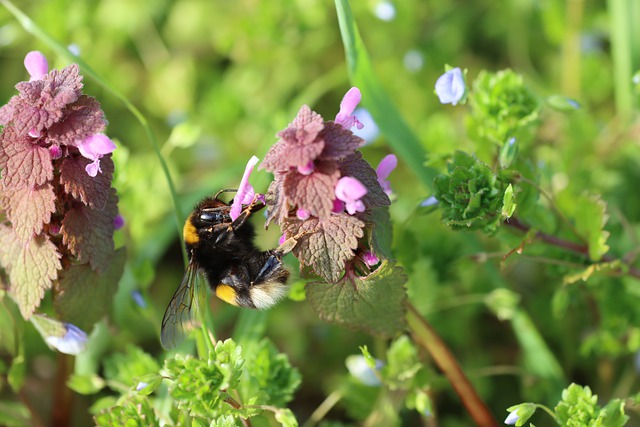
If you have any semi-neglected patches of ground in your life, you may have seen them — short plants with heart-shaped leaves, arranged like low towers accented by tiny flowers. Though they’re not native to this area, they’re pretty abundant. If you’re into controlling invasive plants, you’ll probably be happy to know that they’re also delicious edibles!
Don’t let the name fool you. Dead nettles aren’t poisonous, and they’re not nettles. They’re called “dead nettle” because they look an awful lot like stinging nettle, but their leaves are stingless. In reality, they’re part of the mint family (which probably explains their prolific growth and ability to thrive pretty much anywhere).
One of the best things about these nutritious plants? They’re easy to identify and don’t have any poisonous lookalikes. They’re also useful in all kinds of other ways.
Dead Nettle Folklore
Medically, purple dead nettle is used for allergies. It’s rich in quercetin, and has anti-inflammatory properties that make it useful for people with spring hay fever.
Some areas call it purple archangel, because it appears there around the Feast of the Apparition (May 8th). This was when the archangel Michael was said to have appeared on Mount Gargano, Italy, in the sixth century.
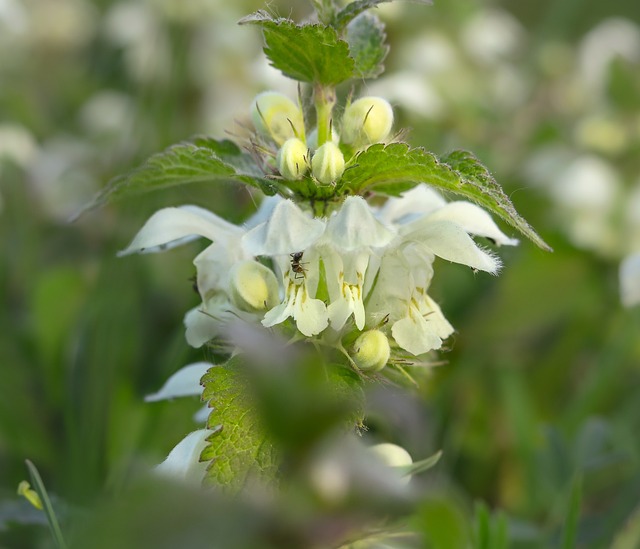
White dead nettle is sometimes called bee nettle. This is because it provides an early source of pollen and nectar, so it’s very popular with bees (and children! Kids sometimes suck the nectar from white dead nettle flowers, kind of like how kids used to suck the honeysuckle flowers that grew on the elementary school’s fence when I was little).
In Lancashire, it was said that white dead nettle flowers always come in twos, because they’re actually pixie shoes that have been left outside. These flowers also have two black spots inside, which are sometimes called “Cinderella’s slippers.”
White, spotted, and purple dead nettles are all used to treat stings from actual nettles. Mash the plant, squeeze out the juice, and apply it to the stung area. You can also chew some of the leaves and apply the resulting paste.
Magical Properties of Dead Nettle
Dead nettle is associated with determination, due to its ability to grow pretty much anywhere. (I’ve been harvesting it from cracks in the concrete, here.) It’s also connected to happiness, optimism, and relief.
Like other members of the mint family, it dries well. Harvest some, hang it upside-down, and put a paper bag around it to keep off dust and catch any dropped leaves or flowers. Once you have some dried dead nettle, you can use it in teas, incense blends, sachets, poppets, jar spells, or pretty much anything else. This small, unassuming herb is fantastic any time you need a hit of joy and motivation.
Dead nettle is also useful in kitchen witchery. Add it to soups, salads, or even pesto to benefit from its magical and anti-inflammatory properties.
This plant also works wonderfully in tinctures, salves, and oils. This is a great way to preserve it well beyond its season.
For now, I’m pulling it out of my raised beds to prepare them for other things. Some will be left for the birds (chickens, especially, seem to love the stuff), and the rest will be brewed into tea, blended into smoothies, eaten fresh, dried, and pureed and frozen in ice cube trays to add to soup or fill out pesto!
This weekend, my partner and I had the pleasure of wassailing some baby trees.
Traditionally, this was something that was done December-ish, but this particular wassail was for some very young trees that’ll be going in the ground soon. Consider it a kind of baby tree blessing.
Wassailing is a ritual to bless fruit trees, drive away unwelcome spirits, and ensure a bountiful harvest. It involved drinking cider, singing, making noise, and giving offerings of drinks and cider-soaked toast to the trees.
This wassail was hosted by someone in a Druidry group to which I belong. Another member put together songs and blessings, and all of the attendees gave their own blessings to a little sour cherry, a baby fig, and a small (somewhat struggling) dogwood.
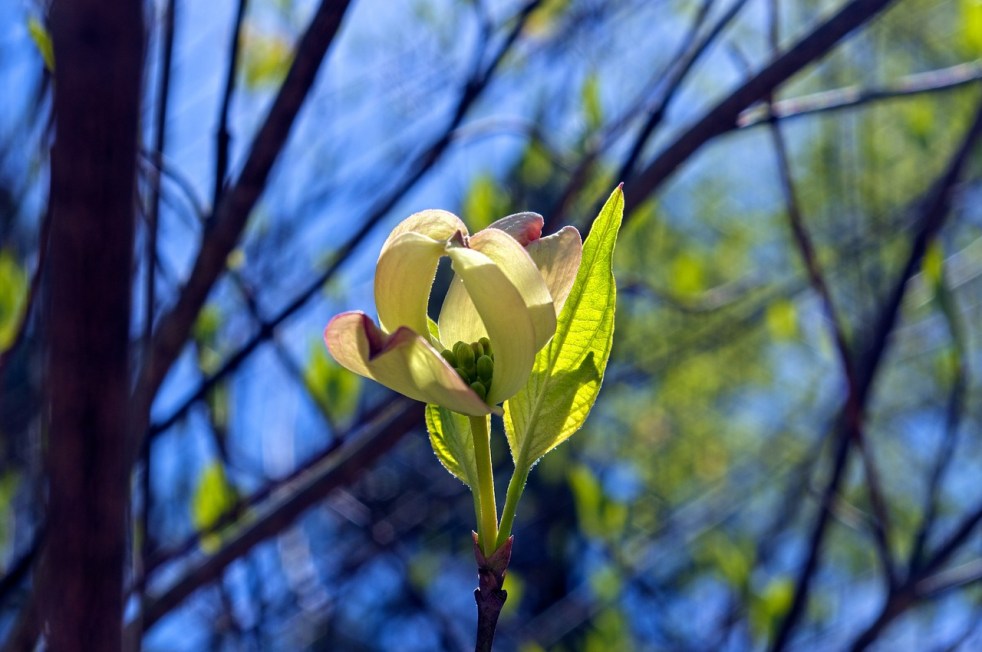
(I wished that the fruit trees would produce lots of flowers and nectar for the insect community, and tons of fruit for the birds, squirrels, and human community. To the dogwood, I just said, “Good luck, buddy.”)
The food was incredible. There was wassail cake flavored with lots of bright orange zest, homemade root beer, chocolate-Guinness cake, meat and vegetarian hand pies, tiny apple hand pies, fresh vegetables, ginger snaps, cheese, fruit, and so much more. We’re still without a decent oven, so we brought some extra sparkling water, graham crackers, fancy chocolate, and vegan marshmallows for fire pit s’mores. In lieu of hanging cider-soaked toast on the trees, there were bits of cider-splashed graham cracker.
The singing was fun, the yelling and cheering was fun, and the blessings were heartwarming. There was an adorable dog who did happy zoomies all around the yard, with deep, happy “doggy laughs.” I can’t tell you the last time I went to any kind of house party, so the feeling of gathering with a bunch of kind, warm, intelligent, funny people was almost indescribable. (It also set off my brain’s own personal social anxiety afterparty, during which I questioned every interaction I had all afternoon for several hours.)
It was also really nice to see someone else working on turning their yard into a source of food for their family and the local fauna. It gave me some inspiration for things that might work well in this yard. The warming weather has me absolutely raring to go out and do more to keep my promise to the spirits of this spot, and now I’ve got images of redbuds and sour cherries dancing in my head.
At least, it’s getting spring-y here. Granted, I think we maybe had about four days of actual “winter,” but it’s been t-shirt weather for the past few days, and looks like it’s going to stay that way for at least another week.
Since things were warming up, I stepped out back to take a look at the yard. The elderberry bushed that I planted last year have some new leaves coming in, the bulbs I planted are starting to poke up through the mulch, and the apples are both looking good.
There’s also a large patch of surprise crocuses that seem to have popped up overnight next to my shed.
These are either Crocusvernus, the spring crocus, or Crocustommasinianus, the woodland crocus. They’re beautiful, but decidedly not native to this area. (Crocus vernus and C. tommasinianus are related to C. sativus, the saffron crocus. However, these crocuses are definitely not a way to make rice more delicious.) Still, I am determined to enjoy them before it’s time to remove the bulbs and put in some native coralberry bushes. I’ll probably keep the bulbs and move them to somewhere where they’re less likely to spread.
If you’re also experiencing a flush of these tiny colorful flowers, here’s some old folklore and a few ways to make them magically useful.
Crocus Folklore
In ancient Greek legend, Crocus was a human man. The nymph Smilax was in love with him, but, ever the fuckboy, Crocus was dissatisfied with the affair. The gods turned him into a saffron crocus.
Another version of this story claims that Crocus was a companion of Hermes. Unfortunately, he stood up at an inopportune time during a discus throwing match, and Hermes accidentally killed him. As Crocus’ blood fell on the soil, saffron crocuses sprang up.
Spring crocuses are associated with Persephone, Aphrodite, and Venus. Mythology would also appear to tie this flower to Hermes.
A London source claimed that picking crocuses tended to “draw away the strength.” Therefore, only strong men or healthy young women should attempt to.
According to Pliny, wearing crocus around the neck would prevent drunkenness. Interestingly, Swiss parents would place saffron around their children’s necks as a protective charm (presumably not against drunkenness, or else they’ve got some explaining to do).
In the Victorian language of flowers, crocuses represented cheer and youthful gladness.
This flower is associated with the planets Venus and Mercury, and the element of Water.
Crocus Magical Properties
Historic mentions of crocus as a protective charm typically refer to saffron crocus, not the spring crocuses. It can be hard to tease out folklore and uses attributed to spring crocuses, since the autumn-blooming saffron crocuses were generally considered more useful. For our purposes, I’m going to focus on spring crocuses here.
Spring blooming crocuses are used in charms for love, including platonic love or love of the self.
As an early spring-blooming flower, spring crocuses are also useful for spells for new beginnings.
These flowers are common altar decorations for Imbolc and Ostara. However, use caution if you bring spring crocuses indoors — all varieties of crocus other than C. sativus are toxic. Spring-blooming crocuses can cause diarrhea, vomiting, and digestive upset, while autumn-blooming crocuses can cause liver and kidney damage.
Simple Crocus Spells
You can include crocuses in charm bags for love. Add the dried flowers to a pink or red pouch along with rose petals, lavender flowers, and a bit of cinnamon bark. If you like, add a piece of rose quartz. Dress it with your favorite love-drawing oil (in a pinch, infuse some cinnamon, basil, and rose in grapeseed or sunflower seed oil, and use that) and keep it on you.
You can also use crocuses as a form of sympathetic magic. Plant a bulb along with a slip of paper with your name, and the name of your partner. Declare that as the plant grows, your love will flourish with it. When the flower is at its peak, pick it and save it for a love charm.
I think a big part of what kept me from really connecting with a lot of Wiccan-based Paganism when I was younger was that, at the time, the available source material was pretty prescriptive. Sabbats were on specific days, with specific traditions attached, and there was an onus the follower to do things “right.”
Having lived in a pretty big range of climates, I can say that that’s had an impact, too. It’s hard to feel in the harvest or growing seasons when they just don’t line up with the harvest and growing seasons where these traditions were based. If the wheel of the year is supposed to reconnect humanity to nature and its cycles, a strict interpretation is the opposite of helpful. When I lived in California, for example, it felt like observing the traditional sacred days was sometimes counterproductive — spring didn’t look like it did in Europe, or even in the Eastern US. Neither did winter. It made things feel rote, which robbed them of meaning.
That’s why I’m a big proponent of celebrating the High Days when and how it makes sense to do so. If your growing zone means that you’re not going to see the first signs of spring until March, or won’t ever experience cold and snowfall, then so be it.
All of this is to say that the vast majority of my High Day traditions are pragmatic (perhaps to a fault).
Imbolc passed recently, amid surgeries (one for me, one for the Certified Lap Loaf. We’re both doing well!), falling down the stairs (just me. That part of me is not doing well.), and probably other stuff that I’m forgetting because of the first two things. A lot of ADF members celebrate the High Days on the nearest weekend, which is nice. Less pressure that way when your most-of-you isn’t working correctly.
Don’t let the barely concealed rage fool you. She’s purring here.
To me, Imbolc is refreshment. It’s deep cleaning, washing my front door, doing repairs, and making food. (This year, it’s also starting plans for home improvements that we won’t be able to do until later spring and early summer, like replacing the roof.) It’s also almost never actually on the first of February.
I don’t set up an Imbolc altar. I follow the same basic ritual structure that I do for any other day. For me, the main difference is the feeling of lightness and renewal that I carry through doing things like scrubbing grout, cleaning out garden beds, de-scaling the dishwasher, and chucking Affresh tablets down the garbage disposal.
When you’re re-learning lost, buried, or reinvented cultural traditions, it’s easy to get caught up in the need for accuracy and correctness. It’s also easy to forget why the High Days existed in the first place — to mark significant occasions throughout the year, largely based on what people who grew crops and raised animals considered significant. When you get too invested in following the letter of a tradition, you can lose the spirit of it.
From my house to yours, here’s a small thing that I like to do each spring. It works equally well whenever you need to feel that sense of newness and freshness that only spring can bring.
Imbolc Home Cleansing
You’ll want to have:
A white candle. (The golden beige of natural beeswax is fine, too.)
Dried vervain.
Water.
A bowl.
First, steep the vervain in some hot water, as if you were going to make a tea. (I like to put vervain and water in a clear jar, then stick it in the sun for a while to infuse. If it’s cloudy where you are, a kettle of boiling water is fine.)
Once the infusion cools, strain out the leaves and pour the resulting liquid into the bowl.
Next, light the candle. Declare, either out loud or to yourself, that this flame represents the return of the sun — whether that’s the literal return of longer daylight hours, or a metaphorical return of warmth and light is up to you.
Carry the bowl and candle to each room of your home, moving in a clockwise direction. Set the candle down in a safe spot and use your fingers to flick the vervain infusion around the perimeter of the room (be sure to get the corners). If you have prayers or chants that feel appropriate here, use them. I usually fall into a kind of stream-of-consciousness monologue about the objective of the working. It’s less important that your words sound nice than it is that they mean something to you and help you focus on what you’re doing.
When you’re through cleansing your entire home, offer the rest of the vervain infusion to your yard, garden, or nearest patch of green stuff. If your candle is small, you can let it burn completely and dispose of the remnants. If it’s a big one, snuff it and re-use it for a cleansing or purification ritual another day.










 Marble Crow