Neodruidry · Witchcraft

Snake and Lizard Skin Folklore and Magical Uses

To be upfront, I do not have a snake. I have had snakes in the past, and I live in in an area frequented by them, and I do have a large male bearded dragon I adopted from a classified ad.

Being a healthy, full-grown bearded dragon, he occasionally goes through periods of shedding skin while being a very sulky boy. A lot of the time, he eats it in order to reclaim the protein and minerals that would otherwise be lost. Sometimes, I find pieces just kind of around, like tiny laundry.

The skins of animals have been used in ceremonies for… about as long as humans have existed, most likely, and they’re still used today. Each animal has its own power and domain, including lizards and snakes. To be honest, serpents alone have so much symbolism and mythology behind them that it’s far too much to get into here. Instead, I want to focus specifically on the folklore and magical properties of shed reptile skin.

Perhaps one of the most prevalent and enduring qualities attached to snakes is the concept of renewal or rebirth. It makes sense — unlike a lot of lizards, snakes shed their skin all at once. In a pretty short span of time, they go from appearing dull and milky-eyed, to bright, smooth, and rejuvenated.
By extension, this has also made snakes a symbol of fertility, healing, and transformation.

Snakes are also associated with protection. This is particularly true of venomous snakes.

In the Danish tale King Lindworm, an infertile queen wishes to bear a child. She follows the advice of a crone and eventually gives birth to twins: one healthy boy, and one boy who’s a half-human, half-serpent lindworm.
When the time comes for the lindworm to marry, his bride is horrified on their wedding night. The lindworm eats her. This continues over and over, until a shepherd’s daughter is brought to marry him. The clever girl wears every dress she owns on their wedding night and, when her lindworm husband insists she get undressed, she demands that he shed a layer of skin for every dress she removes. Finally, as he removes his last skin, he reveals his fully human body and is cured.
By mimicking layers of snakeskin with her clothing, the girl tricks the lindworm-prince into shedding until he is effectively “reborn” as his human self.

In some forms of American folk magic, snakeskin is carried for luck. Some people also rub it on their hands to help them “hold onto” things.

If you find a shed snakeskin on your property, it’s said to be a sign of spiritual protection. This can also be interpreted quite literally — snakes are vulnerable mid- and post-shed, so they try to do it in places where they feel safe. If a snake feels safe on your property, rats, mice, and other potential pests won’t.

A leopard gecko eyeing a mealworm.
Leopard geckos frequently eat their sheds. Before they do, though, they can end up wearing them like little lizard hoodies. Photo by Pixabay on Pexels.com

Snakes are also sometimes used as a symbol of initiation, as an extension of them as a metaphor for rebirth. In this context, they represent the death of the old self, and birth of the new. This may be part of why they’re considered symbols of wisdom — with each shed, a snake metaphorically moves into a new incarnation of itself. It’s certainly a potent metaphor for becoming wise enough to realize how little we know!

Lizards carry many of the same connections and magical associations as snakes, since they go through the same shedding and renewal process. However, since reptiles very often “recycle” their sheds while snakes don’t, there isn’t as much lore on using shed lizard skin. (After all, even if you find an uneaten one, it’s unlikely to be a very large piece.)

In general, snakes and reptiles are associated with the element of Earth.

Reptile skin is pretty delicate (and becomes more so the more it dries out), which is good to keep in mind. A freshly shed skin may seem like great material for a poppet or spell bag, but you’re likely to be disappointed once it’s fully dry and crumbly!

Shed skin from prickly, aggressive, or venomous reptiles is good for enemy work. Grind it into dust, combine it with banishing or protective herbs, and sprinkle it around the border of your home, in front of your front door, or in the footprints of an enemy in order to keep unwanted people or entities from darkening your doorstep.

A very handsome bearded dragon on a moss pole in the middle of a Monstera deliciosa.
A very handsome boy.

You can also put shed reptile skin in spell jars, bottles, or sachets for protection. I prefer jars or bottles for spells that you want to keep at home (for example, keeping a protection spell bottle near your front door), and sachets for carrying. Since they’re made of fabric, they’re soft. If you’ve got a protection sachet stuck in a purse or backpack, it’s unlikely to break and get herb dust and bits of skin on things.

You don’t have to use an entire shed skin per working. If you have access to a full snake or lizard shed, you can use pieces. Consider ways to incorporate them in workings for change (like finding a new job or home), renewal, initiation, or healing spells.

Shed reptile skins also make for powerful altar pieces. Place them in a fancy bottle, make sure they’re completely dry, cork or cap them to keep the contents protected, and place them on your altar when you have need to tap into snake or lizard energy or work with deities associated with snakes.

Avoid putting shed reptile skin in anything that’s intended to be ingested. While the risk of danger is small, reptiles can carry zoonotic pathogens like Salmonella or E. coli. If any fecal matter remains on the shed, there could be a risk of infection.

Reptiles shed their skins naturally and, if all goes well, safely and painlessly. If they aren’t eaten, these shed skins are a powerful and ethical way to work with the energies of these powerful animals.

life · Neodruidry

How is everyone so good and cool?

This past weekend was the yearly Goods and Gear Swap. The Druidry group that I’m part of does one every June — we get together, bring songs, poems, stories, and food to share, and find new homes for things. Every year, I come back with plants, books, you name it.

It’s also a lovely way to connect with people in a not-strictly-ritual setting. Sure, this gathering has some ritual elements since it’s Midsummer, like the opening of the bardic circle, but it’s mostly a way to catch up and eat excellent food.

I admit, lately I’ve been having an antisocial streak. Maybe it’s from doomscrolling, maybe it’s the beginnings of an ennui, I don’t know. I just know that I’ve been feeling more and more at home when I eat breakfast with the crows in the yard, and more and more on edge around other human beings. This year’s Goods and Gear Swap did a lot to help pull me out of it.

It made me realize just how fortunate I am to know such talented, smart, funny, genuinely cool people. Every conversation I had was interesting and validating, from stuff about gardening, to stuff about spiritual practices. People sang. Read poems (either ones by other authors, or ones they wrote themselves). Told stories. Played instruments. We shared food. We swapped books, plants we’d grown, things we’d made. It was an excellent antidote to the doomscrolling and general people fatigue I’d been feeling.

I came away with several fascinating books, two dragonfruit plants, some camping supplies, and a ukulele. Though it was only one afternoon, I feel recharged, in a way — inspired, energized, full of ideas for my art and my garden.

Here’s hoping this season is treating you well, too.

Neodruidry · Witchcraft

Beltane with Frederick CUUPs

This past Saturday, my Handsome Assistant and I went to celebrate the first of the fire festivals with the Congregation of Unitarian Universalist Pagans. It was a bit rainy, so outdoor bonfires were out, but they managed to make even an indoor-only Beltane a ton of fun!

There was lots of food, drumming, dancing, and a maypole. When we arrived, we were asked to write a message on two pieces of ribbon — one was a wish for ourselves, the wider community, or the world. The other was a specific wish for an anonymous person in the community.

The first ribbon was tied to the longer ribbons streaming down the maypole. The as the dancers dipped and wove around each other, these ribbons were all beautifully interwoven together in a powerful representation of community, togetherness, and cooperation.

A different maypole, pre-dancing. Photo by Sandeep u2736 on Pexels.com

The second ribbon was placed in a basket, for another attendee to select at random. (The one I picked simply said “joy,” which is a succinct and delightful thing to wish for another person. I tied it to my backpack, and it makes me smile every time I see it. Sure, the person who wrote it doesn’t know me, and the wish wasn’t for me in particular, but the idea that someone out there hopes that a stranger is happy is still a sweet notion.)

I also brought my big tongue drum. I wasn’t sure how it’d fit with the rest of the percussion, but it was fine. A bit challenging to keep up the tempo of the drumming, since tongue drum notes are meant to be sustained, and not very loud, but still lots of fun to play — and my first time playing it at a public event.

I danced a little in the beginning but couldn’t really take part in the maypole dancing. I’m still coming off of spraining my ankle, and, with everything else this weekend held, I knew I had to pick my battles. So, drumming and socializing it was!

After the ritual, I was carrying my drum back to the car when I was sidetracked by an adorable tiny child in a skeleton costume. Said tiny child came up and began bapping at the top of the drum, in the absolutely fearless and unselfconscious way of tiny childs, so I set it down on the floor, sat next to them, and let them play. I showed them how the small metal tongues make the high notes, and the larger ones make the low, and they seemed to have a blast making all kinds of sounds.

The ritual was beautiful, the drumming was high-energy and exciting, and everyone there was delightful and welcoming. It was great to see friends I hadn’t seen in some time (some since the Mabon camping trip) and make new ones. 🧡

animals · Neodruidry · Witchcraft

Egg Folklore and Magical Uses

Hello! If you’re in the US, hopefully you enjoyed the eclipse on Monday. I spent most of it enjoying the lovely weather, painting my porch, and experiencing the very surreal feeling of an eclipse-dimmed sun.

The family of crows who hangs out here all came to rest in the maple tree in the backyard. (I read that zoos had noted that the eclipse affected animal behavior, and some birds seemed to be agitated by this bit of celestial disruption. I’m guessing these guys figured it wouldn’t be a terrible idea to spend the eclipse in a place they knew came with food, water, and safety.) So, once the porch was finished, I spent the rest of the time relaxing, reflecting, and feeding them hardboiled eggs.

This, and the recent Spring Equinox, got me thinking about the folklore and magical properties of eggs. I don’t eat them, myself, but they’re rich with symbolism and certainly deserve a look.

In ancient Greek Orphism, there was the Orphic Egg. This was an egg, usually depicted with a serpent coiled around it, from which hatched the primordial deity Phanes.

Ancient Egypt had their own concept of a cosmic egg not unlike the Orphic Egg. There was a cosmic goose called the Great Honker (Gengen-Wer) who laid a world egg, from which the Sun and Earth hatched.

In Hinduism, there are multiple mentions of eggs. The Hiranyagarbha is similar in concept the world/cosmic egg. In one tradition, the creator deity Brahma emerged from the egg and created the world. The Shatapatha Brahmana mentions another creation story, in which the Prajapati reproduces himself, releases the waters of the world, transforms into an egg to enter the waters, then emerges from the egg to make the Earth, sky, and middle regions. In Garuda Purana, Vishnu was born from a golden egg.

A small dish of spotted quail eggs on a checkered tablecloth.
Photo by Mikhail Nilov on Pexels.com

Eggs are a strong recurring theme and metaphor for creation across cultures, and they’re also associated with the Sun. In Egypt, the Sun was sometimes conceptualized as an egg. In Australia, some Indigenous Australian peoples held that the Sun was produced during a fight between birds. Brolga the dancing crane and Dinewan the emu quarreled, and Brolga grabbed one of Dinewan’s eggs and tossed it from its nest. The egg struck a piece of wood, freeing the yolk from the shell and catching it aflame. This flaming yolk stayed in the heavens as the Sun.

In Europe, eggs were also a symbol of creation, birth, and fertility. French brides would break eggs to ensure a swift pregnancy. German farmers would rub egg yolks on their ploughs to transfer the egg’s fertility to their fields.

As in Australia and Egypt, eggs were also associated with the Sun in much of Europe. This, however, seems largely to do with the fact that both return at the same time. Most of Australia and Egypt have milder winters, but winters in much of Europe can be pretty harsh. The Spring Equinox marks the beginning of spring and longer, warmer days, which is also when birds start laying again. Even modern chickens, who’ve been selectively bred to produce far more eggs far more often, will take a break in winter if they aren’t “tricked” with supplemental lighting. Chickens literally need the Sun or eggs don’t happen!

A paperboard container of pastel-colored eggs.
Photo by ROMAN ODINTSOV on Pexels.com

Slavic egg decorating further connects eggs with the Sun, and is the source of modern Easter egg traditions. Slavic Paganism has a Sun deity named Dabog (or Dazibogu, Dazhbog, Dazhboh, Daždźboh…). Birds were his chosen creatures, for only they could get close to him. Eggs, therefore, are intimately connected to both the Sun deity, and the return of warmer weather and the fertility of animals and the land in spring. Decorating eggs was a way to honor this. The simplest form of decorated eggs, a single solid color, are to be blessed and eaten, conferring the blessing to the consumer. More elaborate designs are for ritual or amuletic purposes.

Eggs are frequently used for cleansing. In Brujeria, they’re a key component of huevo limpia — egg cleansing. Egg cleanses are also a part of Hoodoo. Sometimes, these eggs have certain restrictions imposed on them by the practitioner. For example, the egg may need to come from a specific color of hen, and be laid before noon.

Using eggs can be as simple as boiling, blessing, and eating them. They’re a traditional food for spring festivals. Though I don’t eat them myself, when I end up with some, I offer them to the birds during their breeding season. The extra protein and calcium seem to be very much appreciated.

Eggs can also be a vehicle for container magic, albeit a delicate one. To do this, make a small hole at both ends of the eggshell without shattering it. Blow through the hole to push the yolk and albumen into a separate container. Use the now-hollow egg to hold dried herbs, petition papers, or other spell materials. Hang the egg from a tree branch with a bit of twine or ribbon. When the egg eventually breaks, the spell will be released.

As with Slavic decorated eggs, you can also decorate egg shells for ritual or amuletic purposes. (For this, you may actually want to use a ceramic or wooden egg instead of a real one — whole eggs will rot, and hollowed-out eggs are very fragile.) Decorate it with wax and dye, decoupage, beadwork, painting, or, if you use wood eggs, pyrography. Choose symbols that relate to the egg’s significance to your practice — creation, fertility, birth, abundance, and so forth. Carry one with you as an amulet, or use them as altar decorations or ritual power objects.

You don’t need to buy or eat eggs to be able to work with their powerful symbolism. Purchase ones made of ceramic or wood, or you can make your own using air-dry clay or papier-mâché. They represent the earliest, oldest magic — the creation of the world, the cosmos, and everything that is. Eggs are the infinite seed of creation, and a very worthy addition to any spiritual path.

Neodruidry · Witchcraft

The Magical Meaning of a Solar Eclipse

Picture it. A group of early humans look up to the sky as it grows dark. A black orb moves into view, blocking the light of the light-giving Sun. The people shout in fear — will the Sun return? Will it be able to fight off the invader? After a few moments, the light returns. The Sun is safe.

If this sounds like a case of cavepeople being foolish and unadvanced, imagine this instead:

You walk outside to your car, travel mug of cold brew in hand. Your eyes are still bleary from sleep. You pat your pockets — wallet, phone, keys.
Suddenly, the sky flares into an indescribable bright green color. Angry clouds of magenta move in, obscuring everything from view. It seems as if the heavens themselves overturn, pouring down a rain of tiny, glowing meteors. Confused, and probably afraid your skin is going to be stripped from your bones, you duck back into the house to wait out this bizarre phenomenon.
Then, about three minutes later, the glowing meteor shower stops, the clouds part, the meteors sublimate into vapor, and it’s as if nothing ever happened.

And, lightyears away, peering through some kind of very advanced telescope, a bunch of aliens laugh their multiple asses off at the primitive Earth people who don’t even understand that glowing tiny meteor season is a perfectly normal and harmless phenomenon that happens naturally every twenty thousand years.

An image of Grogu, "Baby Yoda," pointing. He's wearing a brown robe and blue sneakers.
“lol, newbs.”
Photo by Erik Mclean on Pexels.com

Sure, eclipses aren’t that rare. Eclipse season happens every six months or so, after all, and even total solar eclipses occur somewhere about every year and a half. But total solar eclipses are also a whole other animal when compared to a partial solar eclipse.

Things need to line up just right (pun only slightly intended) for a total solar eclipse to happen. When they do, the total obscuration of the Sun is only visible across a narrow band of the planet. This very rarely happens in the same place twice. Like, you’re looking at about every 360-410 years or so, or a one-in-every-fourteen-generations kind of thing. You’ll most likely experience several partial eclipses in your lifetime, but what’re the odds you’ll ever be in the path of a total solar eclipse?

Back when people didn’t travel with the kind of swiftness and ease with which they do now, a total solar eclipse was a Very Big Deal. As a result, this phenomenon has accumulated a lot of folklore and metaphysical connections over time. Since we’re about to have one in the US on April 8th, I thought now might be a good time to look at some of the folktales, traditions, and magical practices surrounding solar eclipses of all forms.

In Chinese, the word for eclipse is 日食 (Rì Shí). It includes the word 食 (Shí), meaning edible, food, or to eat. It was once thought that a solar eclipse occurred when sun-eating dogs (in some interpretations, dragons or demons) would attack the Sun. People would fire arrows and bang pots and pans to drive them off and ensure the Sun’s survival.

The Choctaw people saw eclipses in a similar way. Instead of dogs or dragons, greedy squirrels would come to eat the sun. And, just like in China, people would make noise and fire arrows to shoo them away.

The belief that an eclipse was the Sun being eaten (or nearly being eaten) is or was very common all around the world. In Vietnam, it was a giant frog. In the Andes, a puma. In Java, the God of Darkness. In Indonesia, it’s Rahu… but the Sun burns his tongue, so he spits it out.

In ancient Greece, a lot of things were omens. A bolt of lightning flashed from left to right? Omen. You saw a bird flying a bit weird? Omen. Bad dream? Omen. Solar eclipse? Omen. Eclipses were thought to happen as a punishment when mortals displeased the Gods in some way. This is actually reflected in the English word “eclipse,” which comes from the Greek ekleipsis, meaning “abandonment,” or “to forsake a usual place.”

This is somewhat akin to Transylvanian folklore. There, it was said that solar eclipses happened because the Sun, displeased by people’s actions, turned away from the Earth.

The corona around a total solar eclipse.
Photo by melissa mayes on Pexels.com

The idea of a solar eclipse as a bad omen took a rather funny angle in ancient Babylon. There, kings would hire a temp to stand-in for them for the day. This way, they reasoned, any harm or bad luck that might come to them as a result of the eclipse would happen to the other guy instead.

In Australia, things are a bit different. Australian Aboriginal culture has a long tradition of astronomy, passed down orally, through artwork, and in ceremony, and many different tales about the Sun and the Moon. The Warlpiri and Wirangu people say that eclipses happen when the Sun-woman and Moon-man make love — his body covers hers from view, darkening the sky.

The Diné people of North America also see eclipses differently. Rather than a thing to be feared, they’re a time for peace and reflection. People still observe traditional eclipse ceremonies, and schools and businesses close for the day.

While nobody knows what the people of ancient Ireland thought about eclipses, we do know that they recorded them. The oldest known marking of an eclipse was made over 5,000 years ago. Images of it were carved into a stone cairn at Loughcrew, in Meath. (This doesn’t mean that other cultures didn’t bother recording eclipses, but these recordings either may not have survived, or were done in a symbolic form that has since been interpreted as something else by modern eyes.)

Some harmful solar eclipse superstitions are weirdly persistent. One bit of very stubborn folklore warns that, if you’re pregnant, you should stay indoors during an eclipse. This belief holds that eclipses create radiation which can harm a developing fetus. The thing is, the Sun’s solar radiation doesn’t change during an eclipse. The sometimes weirdly colored corona you see around the Moon’s silhouette during a total solar eclipse is an optical illusion. It’s caused by the interaction between the light at the sun’s edge, the atmosphere, and your perception, not unlike the green flash you can sometimes see on the beach at sunset.

This idea also sounds an awful lot like the idea of maternal impression, an obsolete theory that holds that certain mental or physical influences can affect a developing fetus. It’s the same school of thought that claimed that Joseph Carey Merrick, the “Elephant Man,” developed Proteus syndrome because his mother was frightened by an elephant while she was pregnant, or that pregnancy cravings will give a baby a birthmark in the shape of that specific food.

Speaking of food, another bit of modern-ish folklore holds that food prepared or left out during an eclipse will be poisoned by the same mysterious baby-mutating radiation mentioned above. The thing is, were this true, all of the food growing in the fields or being picked or transported during the eclipse would need to be thrown away. Also, what kind of radiation are we talking, here? Is aluminum foil enough to keep it out? A cabinet door? A fridge? The vague mention of “radiation” is like the vague mention of “toxins” — if it doesn’t ever get more specific than that, it’s probably a fake idea.

(I’ll be real with you, we’re probably better off believing that eclipses are the Sun being eaten. At least nobody wastes food that way, and pregnancy’s stressful enough as it is without having to worry about baby-mutating sky radiation. Besides, then you get to make some noise and have a party afterward to celebrate the Sun not becoming a snack!)

In general, eclipses were (and still are) very often viewed as an omen of some kind. One persistent belief holds that an eclipse within six months of your birthday foretells bad health. Many cultures, like the ancient Greeks mentioned above, saw eclipses as a bad omen and sign of divine disfavor. In the Czech Republic, on the other hand, Bohemian miners saw solar eclipses as a good omen for finding gold.

So, with such a long history of folklore and mythology behind it, what does the solar eclipse mean for magical practitioners today? That depends on a couple of things.

For one, many people still observe ancient eclipse traditions. If your cultural, religious, or magical tradition has a particular way of observing the eclipse, that can give it meaning for you.

For two, there isn’t really a guide for more modern traditions. In very modern magical circles, particularly those that are heavily shaped by astrology, eclipses are sometimes viewed as a very chaotic time during which people absolutely should not use magic. Others see it as an ideal time for manifestation, during which people definitely should use magic.
Social media has made everything weird and confusing.

For people whose traditions don’t have a specific eclipse ceremony or belief, solar eclipses are often viewed as times of change, transformation, and renewal. This is closest to my personal feelings. My path is largely informed by what information I’ve been able to find on ancient Celtic practices. Objects like the carvings at Loughcrew seem to indicate that solar eclipses were important events, but not a thing to be feared or hidden from. Seeing it as a quiet (literally quiet — in the path of totality, the darkness causes birds and insects to fall silent and its super eerie) time of renewal makes the most sense to me. I may use this time to charge some water, and I’ll celebrate once the Sun’s back doing its thing again, but that’s about it.

No matter what you decide to do, do it safely. Does this mean shielding yourself from negative energy? I guess, if you feel that it’s appropriate to do so. I mainly mean following NASA safety guidelines so you don’t burn your retinas out, though. Retinas are really important.

animals · life · Neodruidry

We have a spy.

As the weather warms up, the crows come back in force. They distribute themselves around the perimeter of their territory, sending a single “caw” in a kind of relay. As far as I can tell, it seems to mean, “Hi, I’m a bird! Status update: Still a bird!”

This single “caw” is passed from sentry to sentry until something happens to disrupt it. That could be a cat, an owl, a snake, or the sudden appearance of a quantity of snacks.

One of these sentries is positioned in the big maple tree in the back yard. As far as I can tell, he has exactly one mission: Keep tabs on my comings and goings.

I know this because I hear his single cries throughout the day, echoed by the equally single cries of his family group. As soon as I show up on the back deck, that single “caw” turns into a rapid series of calls. If I start putting out the crow salad, the shouts get even faster and more high-pitched. By the time I turn around to go back inside, the apple trees and the roof are full of black shapes.

A pair of crows investigate a platform filled with crow food.
Pardon the raindrops on the window pane.

Sometimes, they don’t even wait for me to go all the way inside before they swoop in and start eating. If they’re particularly feisty, they’ll barely hop away when I go out to refill. This seems to be out of a sense of avian practicality, rather than fear — it really seems like they fly up to the roofs to wait in order to be out of the way, not because they’re genuinely wary of me anymore.

I’ve found a mix of food that doesn’t seem to appeal much to other bird species, so this family can feed safely without concerns about being hassled or coming into contact with pathogens from unrelated birds that might otherwise swarm the feeder.

I can’t be positive, but I’m also reasonably certain that this sentry is the same li’l nerd who came and stared in my bathroom window after my Handsome Assistant and I returned from being out of town for a few days.

I can’t overstate how helpful they’ve been to have around — they deal with nuisance animals, and I’ve gotten a ton of free garden plants from them (and one small bouncy ball). I love this band of weirdos so much. It always makes me so happy to see them.

life · Neodruidry

Happy Spring Equinox!

Hello! It’s Tuesday. It’s also the Equinox, Alban Eilir, or, in some traditions, Ostara. (Unless you’re in the southern hemisphere, in which case: Happy Mabon!) This is essentially the second part of the celebrations of spring: Imbolc, the Equinox, and Beltane. If Imbolc is when spring wakes up, the Equinox is when it really gets going, and Beltane is the height of its strength.

Since it’s Tuesday, our celebrations this year are small. There’s a bigger ritual and feast planned for this weekend, but this weekend’s also likely to be very cold and rainy. Appropriate for early spring, but it does nonetheless put a damper on being outside. (⍩)

Many different colors and varieties of daffodils and tulips.
Photo by Vural Yavas on Pexels.com

As you read this, my Handsome Assistant and I will be replanting a rose bush. It’s a lovely bush with bright pink flowers, and I pruned it quite a bit to get rid of the crossed branches and dead wood. We’re moving it to the back yard, between the raspberries and the Carolina allspice sapling. That area gets tons of sun and, since the yard is essentially a hill, could use more plants to help absorb rainfall and keep everything in place.

I’m also planting some arugula and extra peas in the raised vegetable bed. I planted plenty of peas in containers, and they’re growing well already, but I’ve still got lots to use! The arugula came as a gift from an Etsy seller, secreted away inside a package with a beautiful vintage linen shirt. (This is part of why I love Etsy and indie sellers in general — I can’t tell you how many times I’ve gotten vegetable seeds, small crystals, stickers, or other fun things with orders.)

We’re also sifting through compost. Our tumbler is black and in a sunny area, so, between the solar radiation outside and the heat of biological activity inside, it fortunately manages to stay plenty warm all year round. It’s a good time to sort through, separate the finished compost from the still-composting scraps, and put it away for use in the near future.

A close up of a branch covered in pink cherry blossoms.
Photo by Anelia on Pexels.com

Otherwise, it’s time to air out the house some more, bring in fresh spring flowers, give all of the windows and linens a good wash, and use up the last of the food that was stored for winter.

This year, I’d like to honor Fliodhais. She’s an Irish Goddess of cattle and fertility, though, in the recent past, she was mistaken for a forest deity as well. I don’t have cattle, and I don’t drink milk, but some fertility could certainly help my garden right now. I’d also love to see the crows and other birds bring their babies back! There’s whiskey in the chalice, seeds for new growth, and blessed incense to release into the air.

Whether you celebrate this High Day or not, it’s hard not to see the way that the land is really reviving herself. Yards are full of spring ephemerals, there are red-breasted robins everywhere, and the shifting angle of the sun brings renewed light and warmth. Happy Equinox!

May the song of this, my blessing, be joined by the chorus of the birds in the sky,
May the spring breezes bring peace and balance.

Excerpt of AODA Air Blessing prayer
Neodruidry · Plants and Herbs · Witchcraft

Hydrangea Folklore and Magical Uses

I’ve written a bit about the hydrangeas we planted here. We’ve got two oakleaf and one bigleaf hydrangea, all of whom did pretty well after planting. (Well, until an incident with some botanical mosquito control, but that’s another story and everyone is fine.) It was interesting to see how the sunlight and shade seemed to affect them — the oakleaf hydrangea who got the most sun exhibited some signs of stress in the beginning, where the one planted in partial shade seemed to settle right in. Once it had time to acclimate, however, the sunny oakleaf hydrangea rapidly outgrew its compatriot!

It’s going to be a little while before I can see how my guys fared through the winter, but I’m confident that they’ll do okay and very excited to see them put out new flowers this year. In the meantime, I thought I’d soothe some of my impatience by writing about the various traditions, folklore, magical uses, and fun sciency things surrounding hydrangea.

(Also, as you read this, my Handsome Assistant is obtaining the Replacement Car. It has more cargo space than the Hyundai did, so you know what that means: I can convince him to haul home even more bushes, because I’ve got coupons to American Plant and a head full of weird ideas.)

The name “hydrangea” translates almost perfectly into “water jar.” It comes from the Greek words angeion, for vessel or capsule, and hydr-, for water. It makes sense, too — the seeds look like little amphorae, and these plants like water.

A blue cluster of hydrangea flowers against a backdrop of dark green leaves.
Photo by Rifqi Ramadhan on Pexels.com

In Victorian floriography, the cryptic language of flowers, hydrangeas have a somewhat contradictory meaning. On one hand, they represent gratitude. On the other, they represent heartlessness. This kind of makes sense if you consider them as a response to a would-be suitor. Very “thanks… but nah.”

In China, hydrangeas are associated with heartfelt apologies. These flowers are sometimes poetically called “the flowers of the Eight Immortals.” The Eight Immortals are legendary figures revered in Taoism. In one tale, the forces of the Immortals and the Dragon King clash. To apologize, the Dragon King offers seven of the Immortals beautiful hydrangea flowers.

Different colored hydrangeas can represent different things. Blue hydrangeas are the ones most commonly associated with regret and apology. White ones represent grace, purity, and vanity. Pink are for appreciation and gratitude. Yellow are for joy and friendship. Green hydrangeas are for rebirth, prosperity, abundance, and renewal. (This rather closely follows the meanings attributed to different colored roses, with the notable exception of blue. Roses do not produce blue pigment, so any “blue” roses are either actually lilac in color, artificially colored, or photo edited.)

It should be noted that a hydrangea’s colors can be variable. Unlike other plants, the things that give them their colors aren’t different pigments. Pink hydrangeas, for example, aren’t actually any different from blue ones. Hydrangeas act as giant, living masses of litmus paper. When they grow in acidic soil, their growing conditions cause their pigment to exhibit a blue color. If the soil is more basic, then it will exhibit a pinker color.

Here’s where it gets a bit more complicated. The soil pH itself isn’t actually what influences the hydrangeas’ color. It’s the naturally occurring aluminum ions in the soil. When soil is acidic, these aluminum ions are free to do their thing, hook up with other ions, have a gap year, go clubbing, get tiny little asymmetric haircuts, etc. They’re also easily taken up by the hydrangea plant, where they get all up in the hydrangea’s reddish pigment and turn it blue. In basic soil, aluminum ions connect with hydroxide ions, settle down, buy property, and get tiny little purse dogs. Aluminum hydroxide isn’t easily taken up by hydrangea plants, so the blooms stay pink. You can force a hydrangea’s blooms to change color, but it’s a whole Thing involving a lot of chemistry, soil amendments, and time.

Also, hydrangea flowers aren’t flowers at all — like flowering dogwoods, their “petals” are really modified leaves. The actual flowery bits (the tiny fertile parts in the center) aren’t super noticeable, so these jazzed-up leaves provide support and protection for the flowers, and help pollinators figure out what’s what.

Pink hydrangeas, the product of basic soil.
If you look closely at the center of each “flower,” you can see the actual hydrangea flower. You can also see the leafy veining pattern in each “petal.” Photo by Alena Yanovich on Pexels.com

From what I’ve seen, at least three online sources indicate that hydrangeas were once used to break curses. If a malevolent witch put a curse on someone, hydrangea flowers could get rid of it. However, I haven’t seen this attributed to any specific culture or tradition, nor have I found exactly how to use hydrangeas as hex-breakers.

A great many herbs with magical and folkloric significance have also historically been known for their medicinal properties. Hydrangeas are poisonous overall, but their roots and rhizomes do have some medicinal virtues. Both traditional medicine and modern research demonstrate some potential effectiveness against inflammation and problems with the bladder and kidneys, as well as a diuretic effect.

Hydrangeas aren’t just a little poisonous, either. They contain amygdalin, the same cyanide-producing compound in bitter almonds. It’s also related to the one that was rebranded as “laetrile” and “vitamin B17” and sold to unsuspecting and desperate cancer patients. That said, a completely different compound called hydrangenol may inhibit bladder cancer, and that’s neat!

Astrologically, hydrangeas are connected to Libra. Elementally, they’re associated with Water. (Which makes a lot of sense, considering their preferred growing conditions and the whole diuretic thing.)

Though I wasn’t able to find a source for breaking curses with hydrangeas, they can be useful to grow as boundary plants. In most cases, a plant’s magical function follows its mundane form and use. Hydrangeas are dense, lush, and also poisonous. () A nice, healthy hedge of hydrangeas is a wonderful boundary. Just shoot for native varieties — they’ll thrive more easily, require less intervention, and you’ll be helping out your local pollinators and combating habitat loss!

A cluster of light blue hydrangea flowers against a dark background.
Photo by Sonny Sixteen on Pexels.com

Hydrangeas also make beautiful, very easy bouquets, offerings, and altar decorations. Each head is pretty much a bouquet on its own. Choose a bloom that’s the right color for your intention — for money or fertility spells, for example, choose green ones. For purification, pick white. Just make sure to keep them away from children and pets.

Hydrangeas also dry beautifully, though they lose some of their color in the process. Still, the “flowers” have a structural beauty. They’re good for wreaths and basket arrangements. Consider making a dried hydrangea wreath and empowering it to energetically protect your home’s entryway.

I still have some time before these hydrangeas bloom, but I can hardly wait. Here’s hoping they’ve settled in enough to fill out and flower abundantly this year!

Neodruidry · Witchcraft

Thundersnow — a rare (and powerful) phenomenon.

The other day, my area was witness to a very rare weather phenomenon: thundersnow. This occurs as a thunderstorm where snow falls instead of rain. This happens for the same reason that regular thunderstorms happen but is rare because very cold air is dense and not as likely to rise as warm air. For this reason, you need some special circumstances for it to be cold enough to snow and allow air to rise.

Gray stormclouds.
Photo by Pixabay on Pexels.com

Previously, I’ve written about using rain and other forms of precipitation. Winter storm water (or snow) is used to make oneself outshine competitors. From my experience, stronger storms produce stronger water. For this reason, thundersnow is some of the best water for working magic to outdo rivals, or even just for success in general. It has the traditional properties of winter storm water, coupled with the added oomph of a thunderstorm.

Catching thundersnow is just like catching other forms of precipitation. Let some snow fall first, because this will help clear out some of the particulates in the air. Then, put out a bowl, baking tray, or other container. Wide containers work best for this, because you’ll be able to catch much more in a broad, relatively shallow container than you will in a narrow, deep one. Finally, scoop your thundersnow into a jar or bowl, allow it to melt, and either keep it as-is or decant it into a bottle. Keep it away from sunlight, preferably in your refrigerator. Use melted snow for washing magical tools, anointing objects or yourself, brewing magical baths, or whatever else you’d use water for.

A white flower floating peacefully on water.
Photo by NEOSiAM 2024+ on Pexels.com

For safety’s sake, avoid drinking it — even if you’re very careful to catch clean snow and filter it afterward, an awful lot of snow contains various types of bacteria. This is because crystals (including snow) form around a nucleation site. These nucleation sites are usually specks of dust or grains of pollen, but, at certain temperatures, bacterial structures are more abundant and easier for snowflakes to crystallize around. So, while not all of these bacteria are pathogenic to humans, and catching the occasional snowflake on your tongue won’t kill you, please take the appropriate precautions when using melted snow.

life · Neodruidry

An Imbolc Hike (and Tree Divination) at Patuxent Research Refuge

One of the nice things about having other Pagans around is that it makes the High Days a lot more fun. On my own, Imbolc is mostly divination and spring cleaning (or, in this year’s case, divination, deep cleaning, and rearranging my entire house). Traditionally, it’d involve pilgrimages to sacred wells, asking for healing, and leaving offerings and clooties.

This past Saturday, my Handsome Assistant and I met with a local group that we’re a part of for a hike around a lake at Patuxent Research Refuge. It was a nice, flat loop, mostly on a gravel or mulch trail, so it wasn’t too challenging. It left a lot of mental and breathing space for conversation, catching up with friends we hadn’t seen in a while, and contemplation. (One group member who’d moved away was back for a visit, and it was really nice to have the chance to talk to them again!)

We covered about a mile and a half before pausing for tree branch divination. Admittedly, as much as I enjoy divination, this was something I hadn’t tried before. The group split up to find places to sit — fortunately, it seemed like every tree near the path has spread out a welcoming pillow of moss at its roots. From there, we thought of the questions we wanted answered, or the problems we needed guidance on. After relaxing our gazes and letting them rest on the bare, outstretched tree branches above us, shapes began to emerge.

The experience was very different for each of us. My Handsome Assistant experienced it almost like a story, with images coming and going in an evolving plot that gave him a hopeful look into his questions. I had a little more trouble — I just wanted to know whether I’d achieve the goals I set for myself this spring. The trouble is, divination methods like this aren’t often conducive to “yes” or “no” answers. What would the trees even do? Give me a check mark for “yes” and an X for “no?” Spell out “Yup” in their branches? It was a little frustrating.

Finally, I kind of gave up. If the trees had something to say to me, I wasn’t going to constrain them to a “yes” or “no.” As soon as I did, my eyes came to rest on a spot that was only visible from the angle I was looking from. The branches of multiple trees came together to form a pentagon, and their twigs radiated outward into an almost perfect spiderweb shape. In the second when it all came together, it made perfect sense — I’d only be successful if I could keep from sabotaging myself. Catastrophizing is a snare. Worrying over inconsequential details is a web I build to trap myself. Even the expectations I had around this divination yielded only frustration, not answers.

I also found a really neat little clump of moss.

A small clump of bright green moss nestled amid some leaf litter.

After the divination, we all walked silently to the lake. On the shore, we meditated on what we wanted to be cleansed and healed of, made an offering of water gathered from different sacred sites, and dipped strips of cotton cloth into the water of the lake. One would traditionally tie a clootie to a tree near the sacred spring itself, as a type of sympathetic magic (as the clootie breaks down, so too would the issue to be cleansed/healed). In this case, we all brought ours back with us to be tied to our own fences or trees, composted, or burnt and scattered. I’m planning to tie mine to the branches of the little redbud tree in the front yard, myself.

A single bright red holly berry among spiky green leaves.

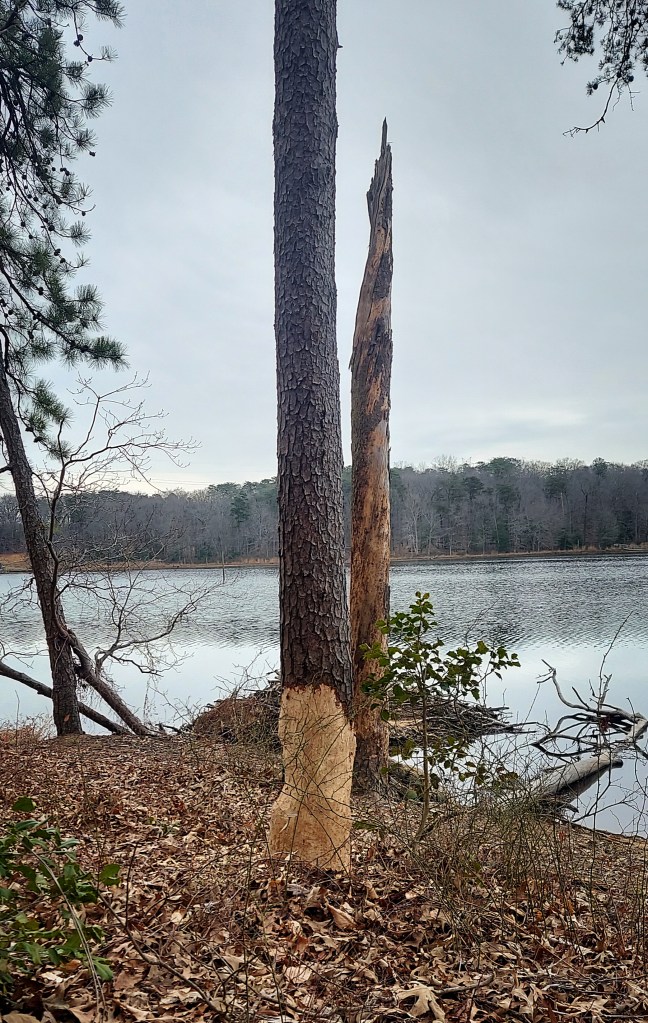
Things haven’t really “greened up” yet, but there’s a beauty in that. You could see the tiny sprouts and buds of things just starting to awaken from dormancy. The green needles of pine trees and spongy carpets of emerald moss were bright splashes against all of the shades of silver, gold, brown, and gray leaves. The sunlight was thin and silvery, shining through an even blanket of clouds. Even though it’s late in the cold season, some bright, jewel-like fruits still lingered — like yellow horsenettle and ruby red holly berries. The seedheads of dried mountain mint stuck up here and there, ashen gray, fluffy, and smelling strongly of mint, oregano, and bergamot. A few trees showed signs of beavers, and we even passed near the entry way to a beaver lodge.

A conifer, girdled by beavers. Though the bark's stripped away, the wood itself isn't gnawed on very deeply.
(I’m guessing conifer wood didn’t agree with this beaver.)

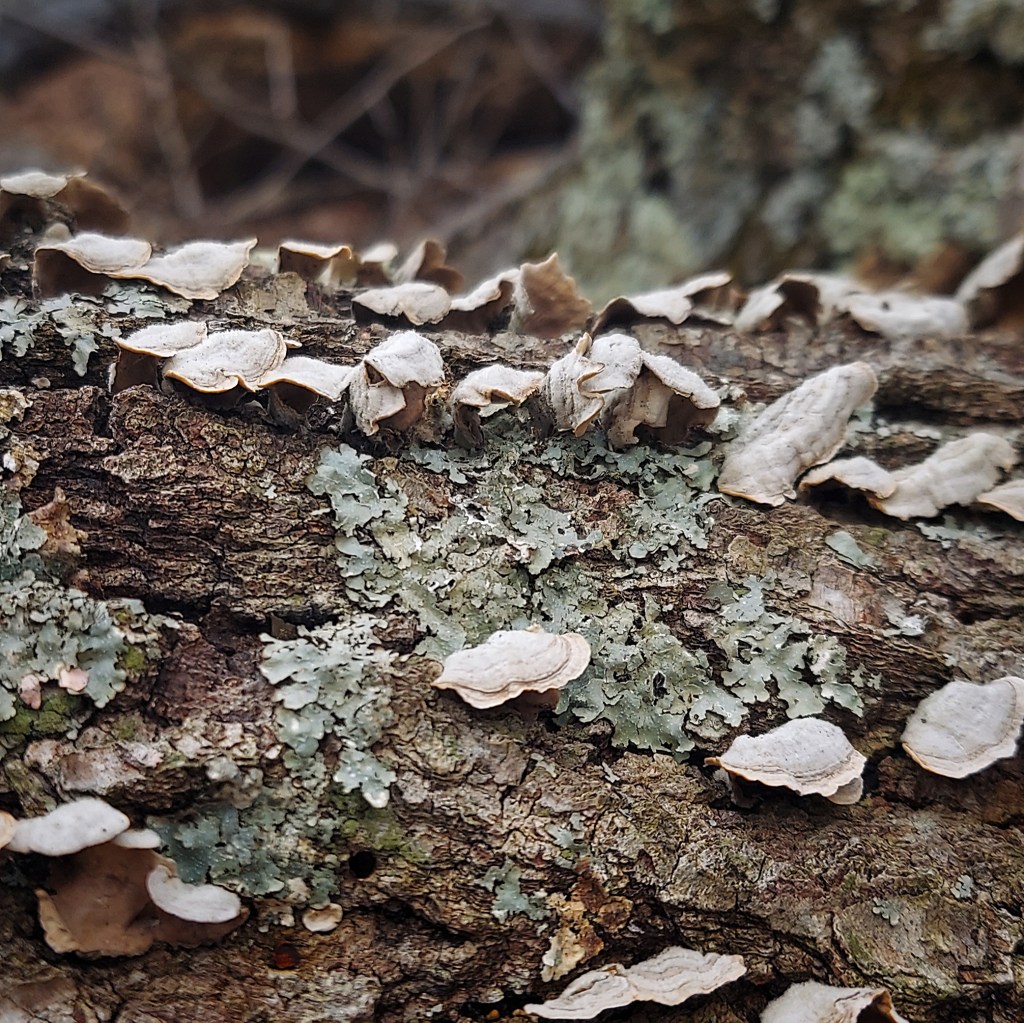
I’d hoped to see some mushrooms since it’s been so damp and warm, but it’s still a bit too early for that. There was plenty of bracket fungus on fallen tree trunks, clinging to the bark like oysters to a stone. One tree even had really interesting lichen on its bark, forming shapes like rivers.

A closeup of a fallen tree trunk, with lichen and tiny bracket mushrooms.

By the time we were finished, three hours and several miles had passed. Now, I’m back feeling a little bit lighter, a little reassured. Here’s hoping that Imbolc has treated you well, too!