I’m not really a fan of pranks, chiefly because most of what the internet has come to consider “pranks” aren’t actually funny.
But oh man, did fate line up some extremely perfect timing yesterday.
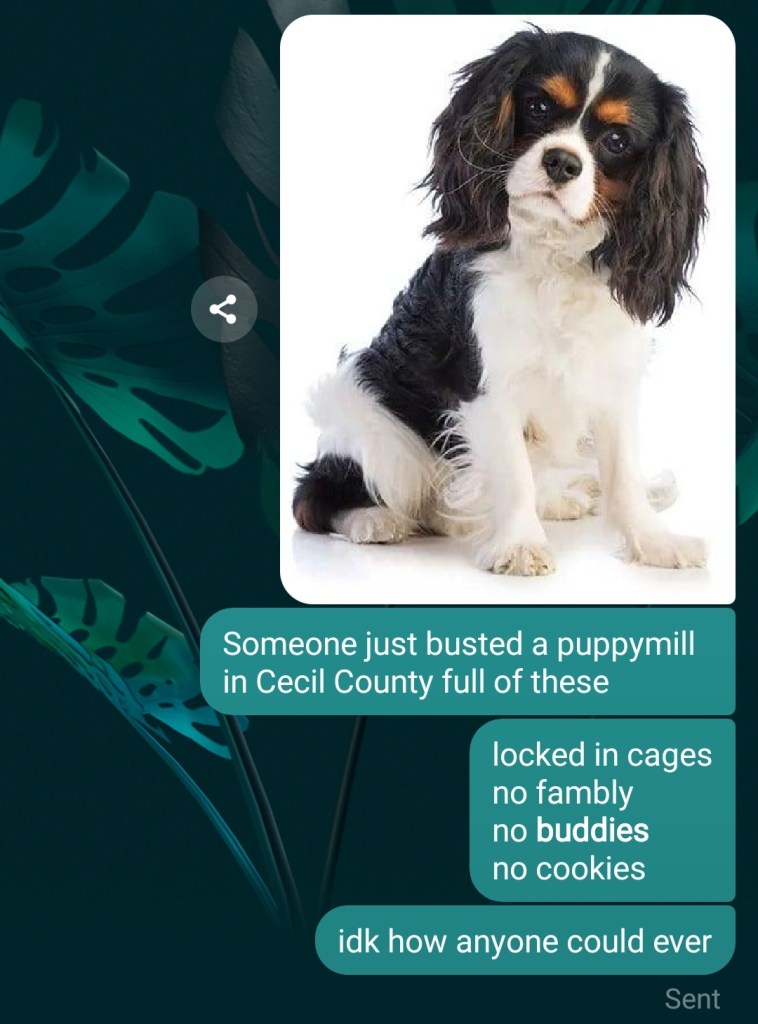
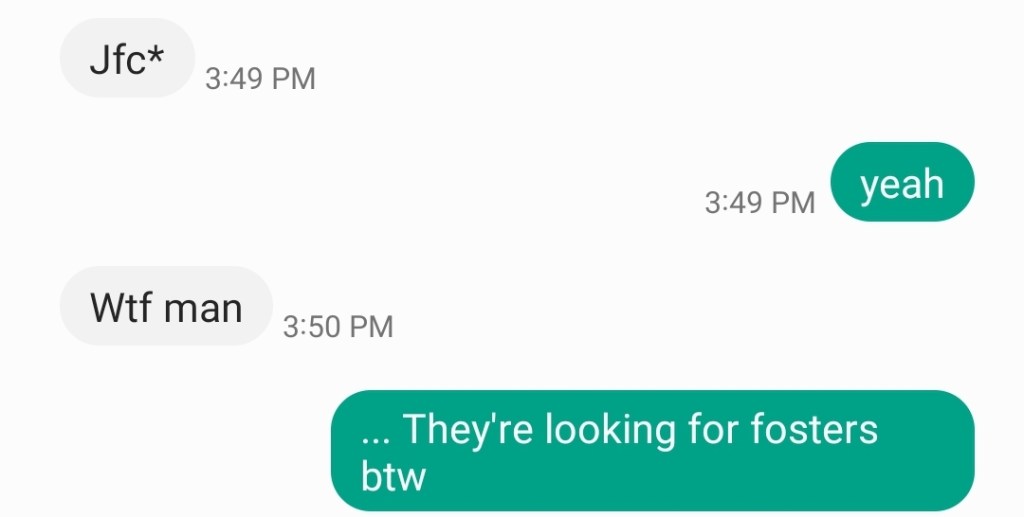
My Handsome Assistant was in office. I message him frequently — usually not anything of consequence, just what the cats did, pictures of cool bugs I found, etc. Earlier in the day, I saw a notice about a puppy mill bust in Cecil County. 23 dogs, mostly Cavalier King Charles Spaniels, bichons, and shih tzu, are currently looking for foster homes while rescues sort through their assorted health problems, issues due to neglect, and so forth. Animal neglect and abuse upset me, so I vented to him about it for a bit.
(Also, I was maybe kind of hoping I could tug on a few heartstrings and get him to agree to try to foster.)
Anyhow, a half hour later, my phone buzzed. The camera system detected “a pet” in the front yard. I do not have pets in the front yard.
Nonetheless, there, on the camera, was an adorable little fluffy white dog snuffling around the front porch. I dropped my phone and hurried outside to get a better look — was he alone? Lost? Were his people close by? Was he at risk of getting stuck in the fence? Running into the street? Being captured by owls? There’s a nest of ground wasps — what if he got stung?
Sure enough, there was a little white dog hustling around the yard. I called to him and he happily trotted over, wagging his tail. He seemed outgoing and relaxed, so I let him sniff my hand and gave him an ear scratch. He also had a collar and tag, so finding his family should’ve been no problem.
And it wouldn’t have been, had I not left my phone inside.
Dilemma.
Not wanting to lose track of him or have him run into the street/be captured by owls/eat a bunch of wasps, I was torn for a moment. There was only one thing to do. I didn’t have a leash or a way to secure him in the meantime, so I gingerly scooped that little dog up and carried him inside to hang out while I figured out where the #$%& I left my phone.
He seemed perfectly okay with this. I set him down, he sniffed around a bit and wagged his tail, all, “Hello! Yes! Okay!”
That was when I had a brilliant idea.
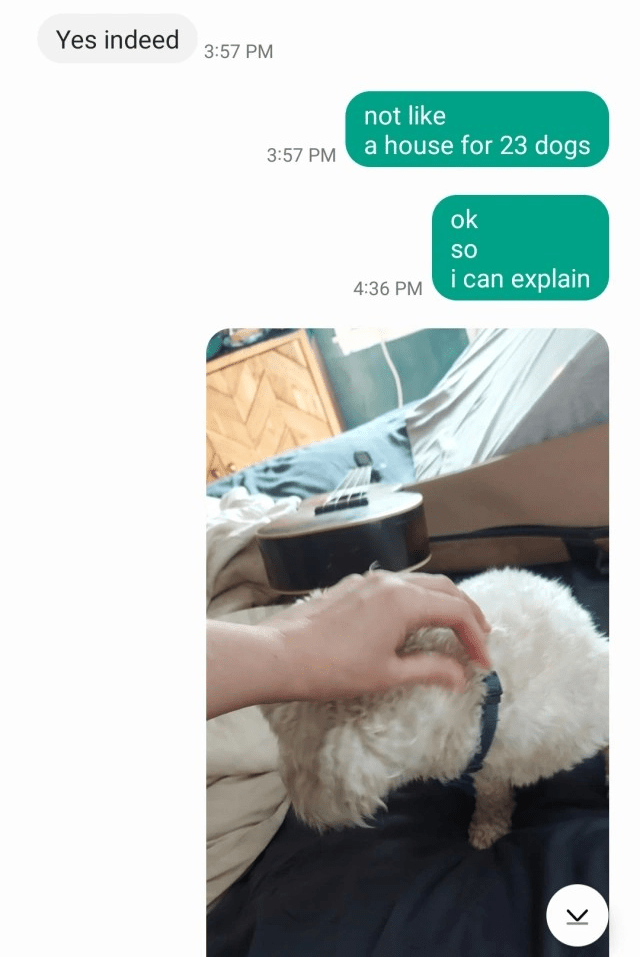
Phone in hand, I snapped a few pics, sent them to my Handsome Assistant along with an “I can explain,” and brought the little guy back outside to call his family. They came over to pick him up not long after and were very nice. He hung out on the porch with me until then, getting pets and being extremely chill and good-natured about everything.
Honestly, as far as ways to meet your neighbors go, this is definitely one of the better ones.
It’s also a great way to confuse and startle your spouse when they know you have a soft spot for animals and are given to hypomanic states.
Seriously. I couldn’t’ve planned it better.
If you live in the Maryland or Delaware area, there are still several dogs looking for foster homes. They’re coming from a puppy mill, where they’ve been confined, underfed, overbred, and never offered the opportunity to be part of a family and just be dogs. If you have the ability to open your home to one of them (or one of any number of other dogs currently awaiting adoption), please consider filling out Renee’s Rescues’ foster application.
Even if you’re not in MD or DE, there are always animal rescues looking for help with fostering. If you have the time and love to give, reach out to your local organizations to find out how you can help!
My YouTube recommendations are often… eclectic. A while back, I got into Chinese historical dramas due to a handful of YouTube shorts about Ruyi’s Royal Love in the Palace. From there, I started getting recommendations for The Great and The Serpent Queen.
Then I started getting clips of Muhteşem Yüzyıl, or Magnificent Century.
From left to right: Ibrahim, Hatice, Valide Sultan Hafsa, Sultan Suleiman, Hürrem, and Mahidevran.
It’s ostensibly the story of Sultan Suleiman the Magnificent and Hürrem Sultan. In reality, it goes quite a bit deeper… But more on that in a moment.
It’s not historically accurate, by any means — I would by no means look to this for an accurate representation of… well, much of anything. Characters have been added, removed, and combined as needed, and timelines have been fudged almost beyond recognition — but it’s entertaining. Some characters have been scrubbed clean, others have been demonized. In the search for a good villain and heightened drama, some characters are brought together that never actually met in real life.
The costumes are gorgeous, albeit woefully inaccurate. They’ve been very The Tudors-ified — they have a “historic” feel, but the colors, embroidery, adornment, and amount of skin they show are all very modern.
Still, it’s a dramatic bit of fiction set against the backdrop of actual historical events. Everyone is gorgeous, the clothing and jewelry are stunning, and there’s loads of political maneuvering and fancy ladies staring daggers at each other at parties.
I have some distant Turkish and Armenian ancestry, but I never really had much of an interest in Ottoman history. While I wouldn’t say Magnificent Century has really taught me anything, it has at least piqued an interest in something I didn’t dedicate much thought to before.
But the most fascinating aspect of Magnificent Century may not be in the show itself at all.
On the surface, “Magnificent Century” looks like a quintessential product of the Erdoğan years. Thanks to Erdoğan’s economic policies, Turkey has a thriving television industry, capable of staging elaborate period dramas, and a prosperous family-oriented middle class of observant Muslims eager to watch their own values reflected in a historical imperial setting. And, much as Erdoğan’s foreign policy has promoted relations with former Ottoman lands, the show has conquered large audiences in Balkan, Caucasian, and Arab countries not known for their fond memory of Ottoman rule. Broadcast to more than two hundred million viewers in fifty-two countries, “Magnificent Century” has accomplished one of Erdoğan’s main goals: making a powerful, non-secularist, globally involved version of Turkey seem both plausible and appealing.
(This isn’t unique to Türkiye, either. Exporting TV series, movies, and music is a huge part of nation branding.)
However, it goes on to point out that Erdoğan and is ilk are not fans. In an attempt to make this slice of history palatable and suitable for prime time viewing, conservative viewers claim that the show sullies Suleiman’s memory.
Conservative viewers had already objected to the amount of time Süleyman spent in the harem; to a chalice from which he occasionally drank some unknown, potentially alcoholic beverage; and to the low-cut gowns of the harem women. When “Magnificent Century” first aired, Islamist demonstrators marched to the television-station offices and threw eggs at the building, while a man dressed as Süleyman read out an “imperial edict” denouncing the show.
Outside of Turkey, critics have denounced the show as an attempt to whitewash Ottoman history. Other critics argue that it wasn’t scrubbed clean enough in the right ways. For the show’s creators, Durul and Yağmur Taylan, the important thing was to depict the Ottoman empire mostly from the perspective of the enslaved women who lived in it. The script was written by a woman. The shifting protagonists and antagonists are women. While Ottoman history provides the backdrop, Suleiman is less a character than he is a vehicle for narrative tension between the members of the harem.
No one is a clear hero — everyone is morally gray. Everyone does questionable things in their pursuit of power, wealth, love, and safety. In a world where the Sultan’s favor can absolutely make or break the fate of you and your entire lineage, things get weird. Alliances shift. Loyalties form and dissolve like sugar crystals. Friendship is a facade, and love is a lie.
Despite the controversy, Magnificent Century became (and honestly still is) wildly popular. Its fanbase is also extremely divided: Is Hürrem the heroine, or a villain? Is Suleiman a hero or villain? What about Mahidevran? Do the other characters deserve the fates they get at their hands? How far is too far?
Is it even possible to come to truly love someone when you’re considered their property?
I would no more watch Magnificent Century for historical accuracy than I would watch The Tudors, The Great, or The Serpent Queen for the same. However, if you like complex intrigue and dramatic tension between people in fabulous gowns, it’s certainly worth watching. Best of all, you can find it on YouTube for free.
So, my handsome assistant and I recently went to a small psychic fair. I’d never been to one before, so I figured a little, local one was the way to go. When I say “little,” I do mean little — there were only a few vendors and not many guests, so we had the opportunity to really browse and take in all of the artwork, mineral specimens, and assorted other good stuff without having to maneuver around crowds or budget our limited time between dozens of booths.
One booth offered aura photography. This isn’t something I’ve ever put stock in, but it was something I’ve nevertheless been curious about. Getting an aura photograph also feels almost like a rite of passage — if you’re inclined to go to psychic fairs and such in the first place, then you’re probably going to end up getting an aura photograph at some point.
The process was simple: Sit, breathe, relax, put your hand on a set of sensors, and get your photo taken. Quick, simple, and totally non-denominational and non-invasive. It’s like getting your birth chart done, but with more technology.
Auras are luminous fields of often-colorful energy around every living thing. According to some, the colors of these fields correspond to one’s personality, outlook, mood, and even physical health. The brightness, shape, and colors of auras are generally invisible to the majority of people, though some practitioners of various new age arts claim to be able to see them and there are several different techniques to train one’s eyes and mind to pick up on auras. Aura photography purports to capture this energy field and create a visual representation that anyone can see.
Once your aura photo’s done, you get a breakdown of the colors, their significance, and, depending on the photographer and their respective setup, a breakdown of your various other energetic characteristics. I got a very detailed report of my different energy centers, balance of yin/yang energy, and energy fluctuations.
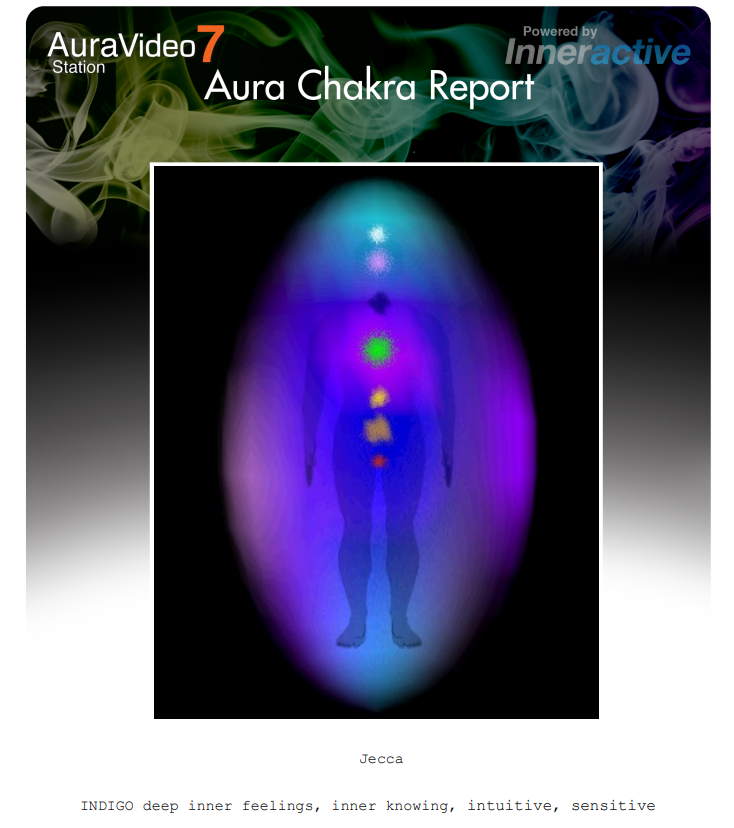
In my case, my aura was primarily indigo, with some neat blue-greens at my head and feet, and pinks/purples at either side.
It would probably be a bit navel-gazey and not super helpful to do a deep dive into my own specific energy stuff, so I’ll refrain from doing so here. Suffice to say, it was intriguing enough for me to give it a deeper look. Not only did I read the full report (which was honestly eerily accurate), I also went looking for more answers.
Mainly answers to one question in particular:
So how does aura photography even work?
The “photography” bit is somewhat of a misnomer. The photograph of you isn’t where the information comes from — it’s mostly an aid for visualization. Instead, the actual info comes from the hand sensors.
This is in contrast to Kirlian photography, which is something completely else (and something I haven’t tried yet).
The hand sensors themselves pick up multiple different things. They’re essentially biofeedback electrodes, picking up on things like temperature, heart rate, and skin conductivity. The idea behind aura photography is that these factors are impacted by one’s energy meridians and flow, so the machine can extrapolate information about your aura from the data the sensors collect.
Once the hand sensors have picked up the information they need, the accompanying software renders it into a colorful image as seen above. These colors are superimposed on the photograph of you, and there you have it — your aura photograph.
(I did not include the actual photo of me and my aura, because it was humid and I was a sweaty mess. You get a rainbow egg and human silhouette instead.)
Is it real?
I mean, auras are very subjective. I’m not one to engage in solipsism, but you can never know if other people are seeing the same things you do. Even looking at something that should be objective, like a painted wall, can yield dramatically different interpretations. What you see as blue, someone else may see as aqua, cerulean, or cobalt. Someone else may only see a shade of gray or interpret it as a completely different color.
Skeptics say that auras are a fake idea. Believers say that’s wrong, and auras are absolutely real. There’s no way to completely, objectively prove either, so it’s kind of a choose-your-own-adventure thing.
Go to two aura readers, and you’re very, very likely to hear two different interpretations. People’s auras are also in flux. Even the most accurate reading or photo, therefore, will only be able to tell you how things look right now.
Would I plan my life around the results of an aura photograph? No. Did I nonetheless find the experience valuable? Yes.
How are aura photographs useful?
To me, aura photographs are useful just like many forms of divination are useful: They give you another angle from which to consider things. Since the information they present has a degree of randomness (or, at the very least, is based on input you can’t really control), they’re unlikely to present you with information that you’ve already thought of yourself.
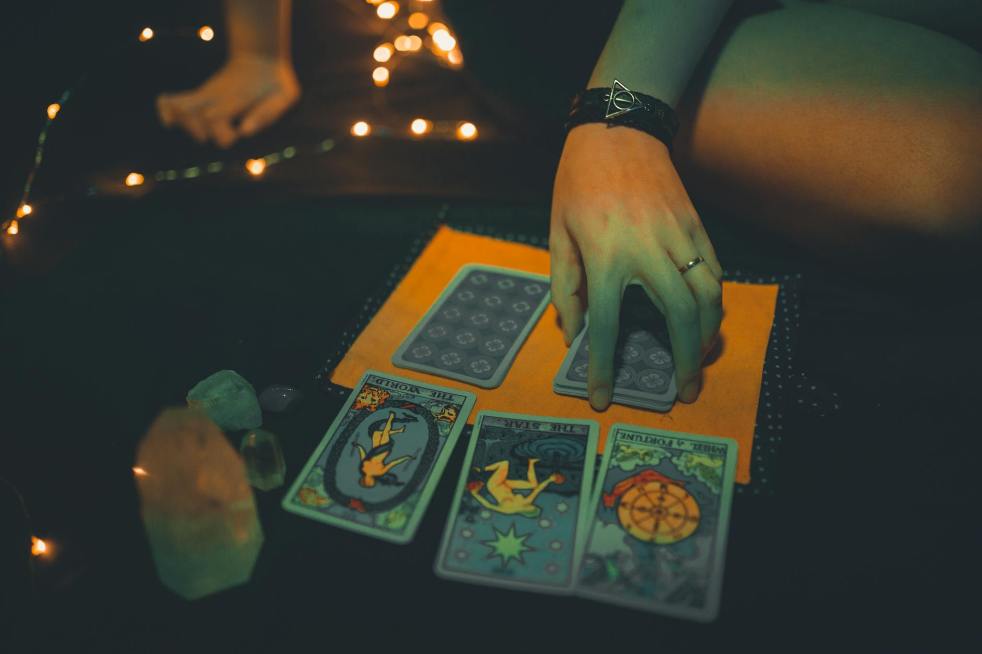
It’s like when life coaches, counselors, and such started introducing tarot readings into their practices. This isn’t because tarot is necessarily a diagnostic or treatment tool. It’s because it’s a great way to get a new, unbiased angle from which to look at a situation. For example, if you’re having career problems and you keep pulling cards from the suit of Cups, you may start to recognize emotional or relationship aspects of your problems that you never considered before. It’s something that takes in a bit of chaos and spits out a new way to look at things.
This is what aura photography did for me. Seeing alleged weak spots led me to read about traditional methods for remedying these things. If nothing else, it has me adding more variety to my diet, trying new exercises, exploring different methods of meditation, and checking out different perfumes and colognes. Worst case scenario, I come out of this experience with some new recipes and activities that I enjoy.
That said, this shouldn’t be used to diagnose or monitor physical or mental illnesses. Some people claim that they can do so using various aura reading techniques, but these claims are dubious at best. By all means, combine energy healing with more conventional treatments, just don’t expect aura reading or photography to give you an accurate diagnosis. Get a second (and maybe a third or fourth) opinion from a doctor.
Would I do this again? Almost definitely! It was interesting and, like I said, surprisingly accurate at times. It’s something I could see doing every few years or so, as a way to mix things up and discover new angles to explore.
Every Saturday, Smile Herb Shop hosts drumming lessons taught by musician Nana Frimpong. It’s something that I’ve wanted to go to ever since I first found out about it, but never had the opportunity — Smile is pretty far from where we live now, and Saturdays are often one of the few opportunities that we have to take care of things that need attention. So, when we realized we wouldn’t be able to go camping like we originally hoped to, it seemed like a good time to finally sign up.
Initially, I felt self-conscious — my Handsome Assistant and I were the first to show up to the class, so it was only Nana and us for some time. Fortunately, Nana is a very welcoming, friendly, and engaging teacher. In between teaching drumming, he played songs for us while we did hand stretches, told us about his family and childhood in Ghana, and showed us how music had shaped his life to make him the person he is today. His message was radically inclusive, using drumming and music as a uniting force across all people and all cultures. Not only was the class really enjoyable, it was deeply moving.
Being there brought up a lot of memories for me, too. Being a little kid at Powwows, listening to the heartbeat drum and dancing with my friends. Being older, going to local burns, learning to fire spin and dancing around the burning wicker man to the sound of drums. Even this past Beltane, when I sat with a group of very welcoming strangers and drummed for the maypole dancers. Drums have been integral to so many unifying, joyful experiences in my life. As it turns out, I really, really missed that.
Gradually, more people filtered into the class. They brought their own drums. One person very generously offered snacks. Another, equally generous, recorded the music we were making on his phone. I had never met any of these people, some didn’t even live in the same state as I do. But there’s something really unifying about playing together. Making the same motions at the same time. Hearing the voices of each different drum come together in one song.
Most of all, it’s fun. “Fun” seems like a silly way to put it, but I don’t have a better word. It’s fun to make something beautiful with strangers, in a way that cuts to the bone through all the pretenses we dress ourselves in. It’s fun in a way that makes those other things not matter.
Next weekend, Nana will be hosting an outdoor concert as part of his drumming classes at Smile to celebrate his birthday. Slots in his classes are very inexpensive on Eventbrite — only about $11. If you’re interested in drumming for fun, to increase your musical abilities, or for healing, I definitely recommend attending.
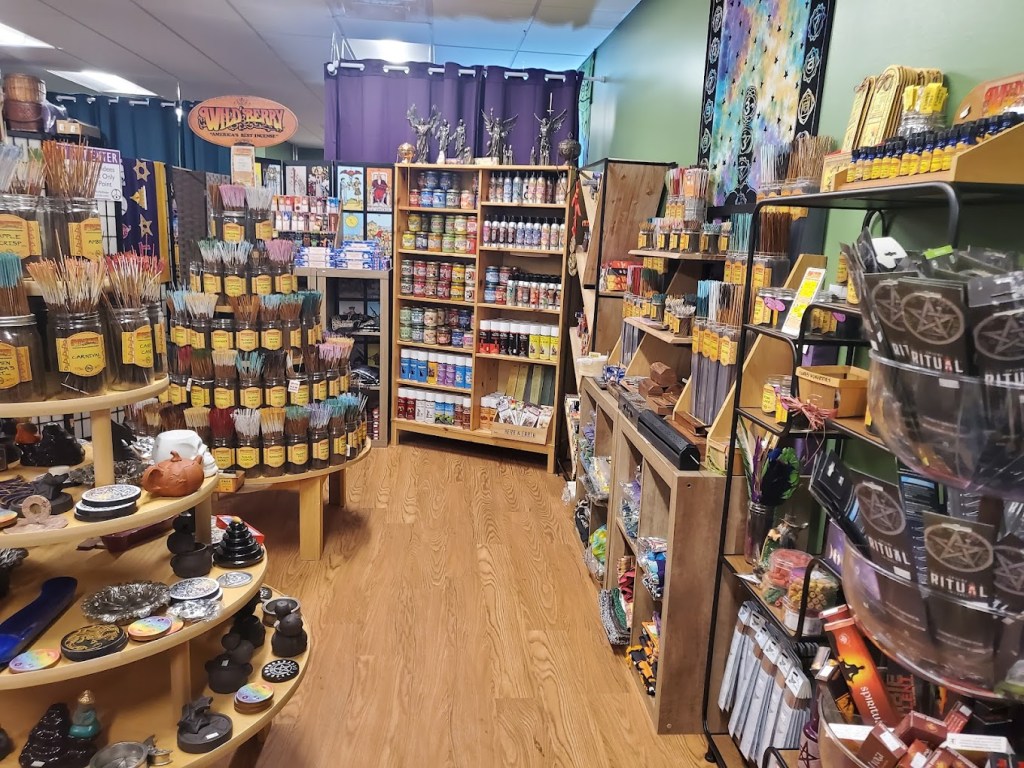
There’s a delightful metaphysical shop called Sticks & Stones Circle in Fairfax, Virginia, that my Handsome Assistant and I visit occasionally. They moved locations about a year ago, so we figured we were due for another trip. Neither of us have been out of the house much lately — him, because he’s still recovering, and I, because I’ve been busy with various tiny projects. A gentle walk around a metaphysical shop, however? Yes, please.
They used to be located in the same building, but around the back by the larger parking lot. Now, they’re out in front, by a Sherwin Williams. They don’t have a sign yet, but their distinctive front window display makes them pretty unmistakable.
Photo by the owner of Sticks & Stones Circle.
We weren’t here for anything in particular — in fact, I’ve been on a mission to destash and declutter things. If I haven’t worn it, used it, or at least remembered it fondly for a year, out it goes.
So, this was pretty much a trip to restock some herbs and incenses that are challenging to find in our regular herb shop (Smile Herb Shop, which stocks a wonderful variety of medicinal and culinary herbs).
If you are on the lookout for other supplies, however, they have them in abundance — candles, sprays, oils, statuary, books, crystals, jewelry, pouches, pendulums, and altar cloths galore.
Photo by the owner of Sticks & Stones Circle.
We left with two packs of incense (Soul Sticks Celtic Summer and Wild Wood, a very inexpensive but decent-quality natural incense), some copal resin, a small tiger’s eye owl, and a piece of golden healer quartz. I’m a bit of a sucker for golden healers, but more on that another time.
After that, we stopped at a place called Midnight Treats. Neither of us were familiar with it but were delighted to find out that it’s a vegan bakery with the most massive (seriously, they’re 1/3 of a pound and feed two people each) cookies we’d ever seen. They have all kinds of flavors, so we picked up a small assortment: Oreo cake, cinnamon roll, birthday cake, and chocolate brownie. They didn’t disappoint either — they were warm, chewy, delicious, and have satisfied my cookie cravings for a good long while.
They also have new flavors every week. This week, they’ve added iced red velvet and blueberry lemon (and I’d be lying if I said I wasn’t tempted to order some).
All in all, it was a nice little shopping date. In the face of so many metaphysical shops closing, it’s nice to see one that seems to be thriving. If you’re ever up in that area, give Sticks & Stones Circle a visit. Like many other shops of this nature, they’re more than a store — they’re also a hub of classes, celebrations, and other Pagan and witchy activities.
The first time I saw a grackle, I mistook it for a crow for a split second. It was only when I noticed its long tail and absolutely furious facial expression that I was like, “Oh.”
While grackles are typically pretty gregarious birds, we have a single male boat-tailed grackle (Quiscalus major) that visits the back yard here. He’s very pretty — black at first blush, but iridescent shades of peacock blue, bronze, and violet when the sun hits just right. Unlike crows, he also has light eyes. (Which, I think, lends to the whole expression thing.)
A male grackle. Photo by Gabriel Espinoza on Pexels.com
He’s usually very difficult to get a picture of, since he’s nothing if not wary and easy to startle. Lately, he’s been coming closer to the kitchen window and displaying more curiosity. I thought it might be a good time to write a post dedicated to these beautiful, interesting birds.
Grackle Folklore
Most grackles move in large groups, called “plagues” or “annoyances.” This might seem unfair — worse than a murder of crows, even, or an unkindness of ravens — but it likely comes from their ability to decimate corn harvests. They’ll show up to follow behind plows in order to grab the turned-up worms, insects, and mice that wind up in the furrows (which isn’t really a bad thing, if you’re a farmer) but they’ll also descend on ripe corn to feast on the grain.
Grackles can be a bit of a problem for bird feeders, too. Smaller than crows, they’re quite happy to avoid the work of digging up worms and bugs and instead go for the nice, nutritious seed in a feeder. Where a crow or other, larger bird will ignore things like thistle and millet, grackles will dive right in. This can end up leaving nothing for seed-eating songbirds, so many people aren’t too stoked about seeing a crowd of grackles turn up in their yards.
Nonetheless, these birds have an important role. Unlike many small songbirds, which primarily feed on seeds and don’t dig up burrowing insects, grackles help control pests like invasive grubs and worms. During the time of year when seeds are the most abundant and make up a larger portion of their diet, they also help propagate them in their feces.
Not everyone finds these birds to be nuisances, either. In the late 1400s to early 1500s, the Aztec Emperor Ahuitztol purposefully introduced great-tailed grackles (Quiscalus mexicanus) into the capital Tenochtitlan and the Valley of Mexico. These birds were taken from the Aztec provinces of Totonacapan and Cuextlan in the Totonac and Huastec regions of Mexico, and received plenty of human intervention to help them establish themselves and grow their numbers in their new home. They were well protected and well fed, which allowed their population to take root. These birds were named teotzanatl, which roughly translates to “divine” or “marvelous grackle.” Certainly a far cry from calling them a plague or annoyance!
(This is far from the only case of something like this happening. Aztec emperors kind of had a thing for bringing in exotic plant and bird species, and even importing special gardening staff to help their new acquisitions thrive.)
Interestingly, these grackles were protected — not only by guards, but also by public shaming. It’s uncertain why this was so necessary, unless attempts to hunt the birds were legitimately an issue. This could have been because they’d become pests, or because their feathers were considered very valuable. Probably both.
Grackles are also the subject of an ancient legend. In it, Zapate the great-tailed grackle was unable to sing. Being a very clever, tricky bird, he stole songs from the sea turtle. This left the turtle without a voice, and the grackle filled with… well, all kinds of noises.
While they aren’t members of the corvid family, they share crow, raven, and magpie’s intelligence. They’re able to solve puzzles, catch fish, and will even clean the grills of cars in order to get at the tasty, tasty smushed bugs.
Grackles also seem to be uniquely equipped to detect the Earth’s magnetic field due to natural deposits of magnetite in their little heads. This may be helpful for navigation and migration.
The Symbolism of Grackles
In general, these birds are said to represent caution, resourcefulness, and community support. Be cautious, however — the appearance of a grackle is also considered a symbol of misfortune.
As with a lot of birds, you often have to pay attention to what they’re doing when you see them since their behavior can color their meaning.
For example, a bunch of grackles can represent friendship, community, and support. A single grackle, not so much.
A grackle foraging or stealing food can be a sign that you need to be resourceful. You may be entering a time when you’ll have to survive by your wits.
These birds also engage in a behavior called “anting.” There, they crouch and spread their wings over anthills. As the tiny insects scurry over them, they pick off mites and release formic acid, which helps repel pests. These birds will also fumigate themselves with everything from stolen moth balls to discarded cigarette butts — whatever keeps the feather mites away. If you see a grackle anting or fumigating themselves, it may be a sign that it’s time for some reflection, spiritual cleansing, or actual decluttering. You might need to schedule some time to take inventory, clear some of the chaos from yourself or your environment, and make a fresh start.
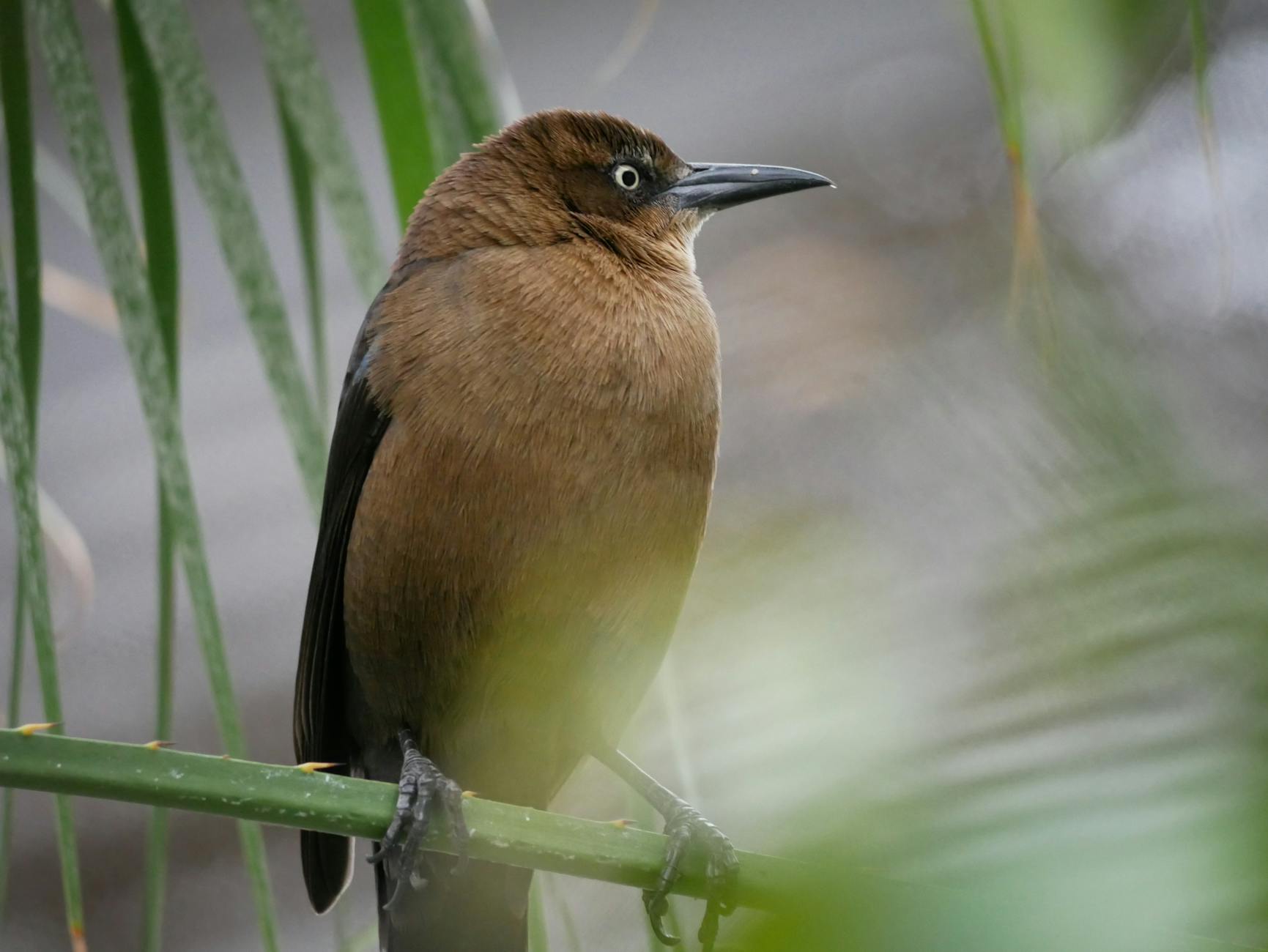
A female grackle. They lack the dark, iridescent feathers of the males, instead displaying beautiful shades of a rich brown. Photo by Connor kane on Pexels.com
No matter whether grackles are a welcome sight to you or not, these are brilliant, beautiful birds with a fascinating history. From dumpster scavengers to the protected birds of an imperial house, they have lived closely with humans and fulfilled many roles for ages.
Crows (and corvids in general) can be pretty divisive. I don’t think I’ve met someone who can just take or leave them — it’s always either a fervent love, or a deep dislike.
And I get it, honestly. They’re noisy. They’ve been known to eat nestlings, eggs, and small mammals. To many, they’re a nuisance and they don’t understand why anyone would go out of their way to make their yard more attractive to these birds.
Ever since we moved here, I’ve been feeding a small family of crows whom I’ve come to love dearly. I’ve hesitated to feed other species, because I don’t want to encourage them to congregate (and potentially spread avian flu) when that isn’t their normal feeding pattern. While the debate about feeding birds and crow/raven behavior will likely never come to an end, here are a couple of things I’ve personally observed when making an effort to coexist with crows:
They’re very smart. (Like, really smart.)
With most members of corvidae, you’re dealing with a very intelligent animal. With crows specifically, something on the level of a toddler or a very bright dog.
I wanted to mention this right off the bat because it heavily impacts a lot of my other points.
They’re also opportunistic.
In general, crows aren’t really hunter hunters. They do eat meat, and they will eat young, weak, or sick animals, but they’re opportunistic feeders. If the opportunity isn’t there, or there’s an easier source of high-value food somewhere else, they’ll go elsewhere.
Crows are also a prey species for larger carnivores. When they’re eating, they’re vulnerable because their attention is directed toward that and not toward looking for threats. This is why groups typically have a sentry or two, to keep an eye on things while the others feed.
A blue jay, one of the more colorful members of the corvid family. Photo by Pixabay on Pexels.com
They’re also still wild animals, no matter how closely they may coexist with humans. Wild animals will go for easier-to-get food sources whenever possible, because more challenging ones a) aren’t guaranteed, and b) require more effort (read: calories) and attention to access. The exception to this seems to be when there’s a particularly appealing, usually calorie-dense food item available that’ll make up for the potential danger and extra effort expended to get it.
You can direct their behavior.
With the above things in mind, you can direct their behavior to a degree.
I’ll give you an example. When I worked in pet retail, I had customers that’d come in and complain that squirrels and large birds that kept getting into their bird feeders. We had tons of anti-squirrel technology available — baffles, special lubricants for poles, specially shaped feeders, and even battery powered ones that vibrated, spun, or did all kinds of other gymnastics. I’d gently try to guide these customers to dedicated platform feeders and bags of corn, but they always turned it down. No matter what they bought, they’d be back in a few weeks for something else. A greased pole was no longer enough, because the squirrel learned how to jump from a tree at just the right angle to defeat it. A specially shaped feeder wasn’t enough, because the crows would team up to work around it. The cycle would inevitably repeat, until they finally just gave up and bought the platform feeder and the bag of corn. After that, the squirrels and large birds would eat the easy to access food, and the smaller birds had their own.
Since this crow population was already established here (and has since grown due to habitat destruction caused by some recent construction), giving them high-value, easy to access food has ensured that I get to keep more of the fruit and vegetables from my garden. This isn’t just because the crows don’t take as much, either — they’ve also done quite a bit to keep various garden pests away.
I don’t leave their food unattended — I usually feed them items I know they like, then sit out there just a few feet away with my own lunch. I have never once been harassed for my food. I’m pretty sure it’s because, like other intelligent animals, they’re able to distinguish between what food is given to them and what food is mine. Why bother me to eat off of my plate, when their plates are right over there? Why run the risk of a potential conflict with a human when they have accessible, desirable food already?
They might not impact songbird populations in the way most people think.
This study covers the relationship between various predator and prey species. One of its findings is that, as prey species numbers increase, so do predator species numbers, and there isn’t strong evidence that native (non-invasive) predators alone drive species decline.
A single predator, or small group of predators, can impact local numbers of prey animals, but don’t appear to correlate with a decline in overall numbers. The thing here is that crows are, like I said, opportunistic. They take prey from nests, where other predators are more likely to be less discriminating and take reproductively mature animals (since those are the ones they’re most likely to encounter out and about). Many corvids are also very territorial — an established family of crows will actively drive off other, larger, less opportunistic predators. They appear to exert both a predatory and protective influence on local prey species.
While I offer food for the local birds and squirrels, I’m careful not to do it every day. (Water, on the other hand, is always available.) Nobody goes hungry, and there seems to be less impetus for them to eat what I’m growing or trying to protect, but they still need to engage in natural foraging behavior.
This works in my case because this crow family had already established this area as their territory. If you listen to their calls, you can hear them relaying from one tree to the next. While they’ll cover a lot of ground in order to find food and water, a sentry alerts the others when there are snacks available. They can go about their business and stop by when there’s food.
(One funny thing I’ve noticed is that their vocalizations change when I’m on the deck, whether I’m putting food out or not, like they’re telling everyone that it’s almost time to eat. Once, I was only watering a few plants and went right back inside, and I got to hear a very excited crow call trail off into something that sounded unmistakably like disappointment.)
They’re not just garbage birds.
Crows (and many other members of corvidae) will get into dumpsters if there’s an opportunity, somewhat rightly earning them the nickname of “garbage chickens.” Stories abound of people feeding them fries, chips, and other very palatable, salty, oily, and largely carbohydrate-based foods. These really aren’t optimal dietary contributions for them, though, and having a positive relationship with your local corvids should mean taking their actual nutritional needs into account.
I explored the foraging habits of crows, plus the diets fed to pet pied crows in captivity as well as crows and ravens at rehabilitation centers. In the end, I came up with a mixture of cat or puppy kibble, cracked corn, raisins, and a low sodium, unfortified cereal as a base. To that, I add hardboiled eggs (cut into quarters, shell attached), dried mealworms or black soldier fly larvae, peanuts (in the shell), and fruit, depending on what I have on hand. Sometimes, if I have the leftover tail end of a loaf of homemade bread, I’ll cut that into cubes and toss it in too. This all seems to work out pretty well — they appear to enjoy it, and they’ve got some of the darkest, shiniest feathers I’ve ever seen on an urban crow.
They may not really react to humans like you might expect.
One thing people bring up often is that crows will get used to humans, which will cause problems.
There are definitely cases of birds, including corvids, losing their fear in areas with frequent, close contact with a variety of people. Anyone who’s ever tried to eat French fries on a boardwalk can probably give you several examples. (I was almost eaten by a pelican when I was little. It was a defining experience.)
I can’t speak to this in general, but I can point out my own observations as someone dealing with an urban crow population that already has a lot of incidental contact with humans. Like I mentioned above, I also stay out there by the feeders after I fill them. While the family of crows has certainly grown bolder with time, this change in behavior seems to be limited to me. If I’m out there and my Handsome Assistant joins me, their behavior switches gears immediately. They keep their distance, and even make some unique vocalizations. If I’m there with a stranger, the difference is even more stark. As intelligent animals with the capacity to recognize individuals, they seem to have drawn some very firm lines between “human what puts the food,” “other human,” and “some guy, idk.”
One interesting experiment with ravens kind of highlights this. A researcher was teaching a raven to trade, by offering the bird a small piece of cheese (a high-value food item) in exchange for a piece of bread (a lower-value one). At one point, the researcher accepted the raven’s bread, then had the audacity to eat the cheese right in front of them. The raven, understandably pissed, refused to engage in any more trading exercises… but only with that particular researcher.
Sometimes, they just leave (and that can be a good thing).
Animals have their own agenda, though it’s often tempting to see them through a humanized lens. I’ve seen a lot of posts from people asking why their local population of crows just left — do the birds not like them anymore? Did they offend them somehow???
The truth is, wild animals have their own schedule. They likely won’t, don’t need to, and shouldn’t come hang out every day. During summer, when a lot of fruits ripen and grains are harvested, crows are likely to go off to agricultural areas to eat the dropped grain. They also have babies, so they’ll be off doing parent activities. In winter, they may need to go to a more desirable climate or more abundant food and water source. If the larger murder of crows is going off to do something, a given crow family will go with them.
If they stop showing up for a while, it can honestly be a good sign because it means they’re still being wild birds. It might suck if larger carnivores move in and start causing trouble in their absence, but that’s nature for you.
A magpie. Photo by Manuel Torres Garcia on Pexels.com
On top of all of this stuff, I’ve also noticed some interesting impacts on my hyper-local environment since I began putting food out for these birds:
There actually seems to be more biodiversity now.
In the beginning, I was lucky to get some house sparrows, starlings, and the occasional mourning dove. As time goes on, I’ve begun to see more species. Like, a lot more. Blue jays, cardinals, finches, dark-eyed juncos, woodpeckers, and grackles, to name a few. (Even a mockingbird that has absolutely given the crows a run for their money when it comes to territoriality.)
Part of this may be because there’s more food available, but most of the food I put out consists of things that would appeal to crows and jays, not necessarily other species. I have, however, noticed that the local crows do a lot to keep the smaller birds safe, because…
They will not tolerate nonsense.
I’ve written before about how this family of crows have effectively become my unpaid, unasked-for yard bouncers. In addition to dispatching particularly chaotic squirrels, I’ve seen them bounce bigger predators, too. They’ll get together and mob a hawk (which is honestly fascinating to watch). They’ll chase away stray and feral animals. They’ll even warn me if there’s a particularly suspicious snake in the vicinity. They’ve kept rats, mice, and grubs away, too. They have very definite ideas about Who Belongs and Who Does Not.
These crows seem like a protection racket. Like a dragon that demands an occasional sacrifice from a local village, or a rat snake that keeps mice and rats out of a chicken coop in exchange for the occasional egg. It’s weird, but I’ve seen them on my deck, coexisting perfectly fine with the smaller birds and other squirrels… So, I guess it’s all chill?
I’ve actually gotten a ton of free food out of the deal.
Granted, a lot of this is because I’m not particularly fussy about garden borders. If something neat springs up, isn’t a noxious weed, and won’t run the risk of poisoning me, I’m inclined to let it be and see what happens.
As it turns out, “what happens” is a ton of volunteer tomatoes, corn, grapes, and berries. (The smaller birds even planted a bunch of millet and broccoli.)
They’ve also brought me occasional small gifts, but I can’t eat those.
When it comes to coexisting with these incredible animals, the important thing to remember is that a) they’re very smart, b) they have the capacity to remember and distinguish between individuals, and c) they’re wild. While it might seem flattering to feel needed and loved like you would with, say, a dog, that’s counterproductive to a wild animal’s survival both physically and mentally. It is possible to interact positively with them without harming their ability to live without you, and this should be the goal of anyone who really loves these birds.
Note: Some of these links may be affiliate links. They allow me to earn a small finder’s fee for stuff I would share with you anyhow, at no additional cost to you. It helps me keep the servers firing and the crows fed, so thank you for supporting these sellers and this site!
For the past few years, ever since reading Dana O’Driscoll’s Sacred Actions: Living the Wheel of the Year through Earth-Centered Sustainable Practices, I have been on a reskilling bent. To be honest, it’s also one of the things that helps ease my climate anxiety (and anxiety in general) — increasing my ability to be self-sufficient, gaining skills I can use to help others, and learning how to do things that I can potentially barter with if everything goes pear shaped.
Honestly, Etsy has been a huge help when it comes to this kind of thing. I’ve learned so much about fermentation, soapmaking, pottery, and so much more from kits and patterns that I’ve picked up there. (It’s also been a huge help for hard-to-find supplies, but more on that at another time.)
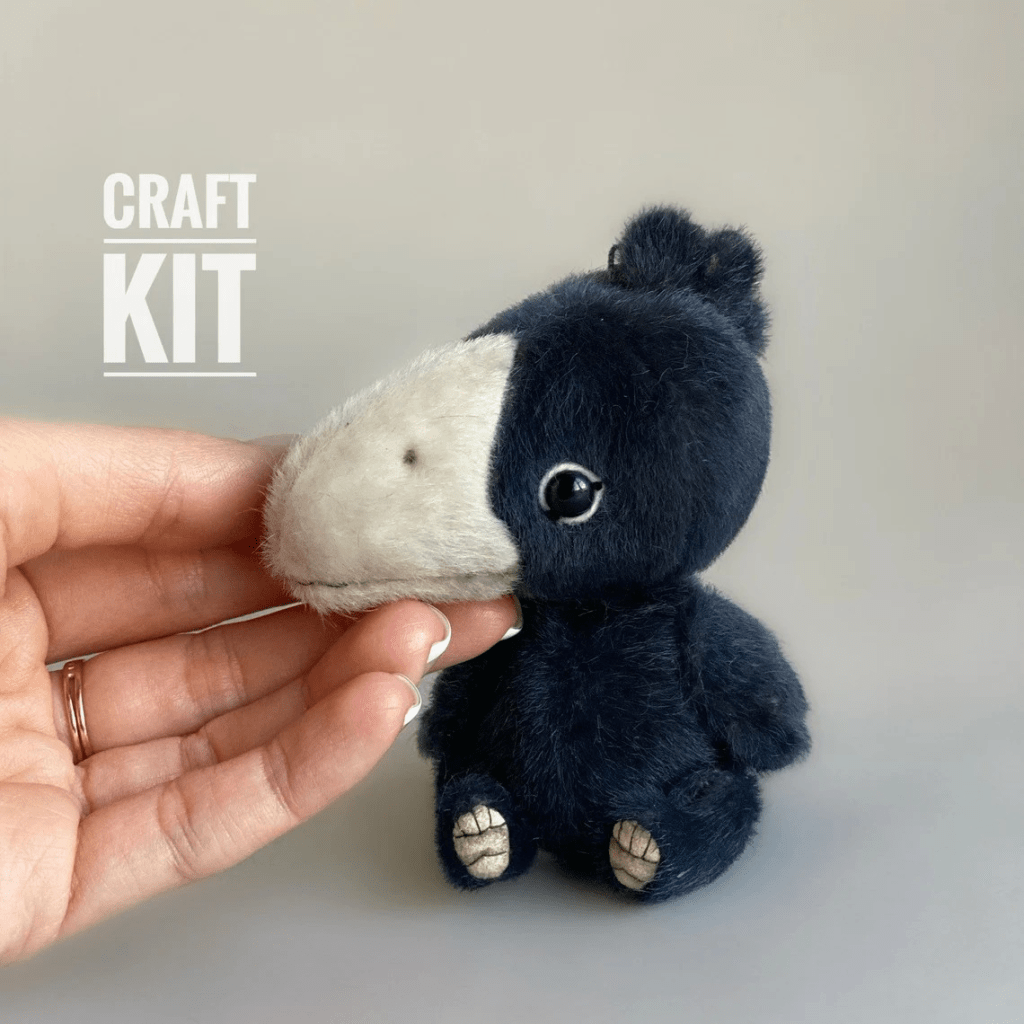
All of this is to say that I made a cool little guy, and I am going to take him on Adventures.
Image taken from the shop listing, by Tatiana Skalozub.
My Handsome Assistant bought me this kit from an Etsy shop called TSminibears. I’d had it favorited for a while, and he surprised me with it over winter. I was initially a bit intimidated — the finished doll is only a few inches tall, which means lots of tiny, fiddly bits to cut out (while maintaining the proper seam allowances, natch), sew, turn out, stuff, attach, et cetera. So, I put off starting it.
Finally, I got over my initial inertia, traced the pattern, and got to work. As is so often the case, actually starting to do the thing was the hard part. Once I did that, the process seemed to fly by.
The written instructions of this kit are fairly sparse, but that’s okay. The bulk of what you need to know is in the form of a YouTube video, where the creator walks you through the entire process of assembling the pieces, stuffing the crow, adding details, and so forth. As someone who’s had to both write and follow written instructions before, I know it can sometimes be difficult to describe exactly what steps you need to do, and what the desired result should be. This is especially true when it’s an art project, where so many things can influence the outcome and there’s a pretty broad tolerance for minor errors or stylistic choices.
I found myself choosing to skip a few of the steps, myself. I knew I’d probably want to make him some tiny clothes at some point, so I left off the bits that I thought might interfere with this. (For example, the feathers on his head. That might make wearing tiny hats or hoodies difficult. Also, not gonna lie, I kind of fell in love with his very spherically domed, Charlie Brown look and didn’t want to change it.) I stuffed him with a bit of wool with a tiny Herkimer diamond for a heart and, even with some steps skipped, I think he turned out awesome.
I mean, look at him. He’s adorable.
I can’t wait to make him many tiny scarves.
If crows aren’t your thing (which, how dare), there are a ton of other kits for elephants, dragons, bunnies, a triceratops, and even a bizarrely cute cobra and weirdly endearing mussel. If you’d like to learn more about making stuffed toys and aren’t sure where to start, this is definitely a good place. Take your time, make sure you know which direction the faux fur lays, and follow the instructions on Skalozub’s videos, and you will also make a cool little guy.
This past weekend was the yearly Goods and Gear Swap. The Druidry group that I’m part of does one every June — we get together, bring songs, poems, stories, and food to share, and find new homes for things. Every year, I come back with plants, books, you name it.
It’s also a lovely way to connect with people in a not-strictly-ritual setting. Sure, this gathering has some ritual elements since it’s Midsummer, like the opening of the bardic circle, but it’s mostly a way to catch up and eat excellent food.
I admit, lately I’ve been having an antisocial streak. Maybe it’s from doomscrolling, maybe it’s the beginnings of an ennui, I don’t know. I just know that I’ve been feeling more and more at home when I eat breakfast with the crows in the yard, and more and more on edge around other human beings. This year’s Goods and Gear Swap did a lot to help pull me out of it.
It made me realize just how fortunate I am to know such talented, smart, funny, genuinely cool people. Every conversation I had was interesting and validating, from stuff about gardening, to stuff about spiritual practices. People sang. Read poems (either ones by other authors, or ones they wrote themselves). Told stories. Played instruments. We shared food. We swapped books, plants we’d grown, things we’d made. It was an excellent antidote to the doomscrolling and general people fatigue I’d been feeling.
I came away with several fascinating books, two dragonfruit plants, some camping supplies, and a ukulele. Though it was only one afternoon, I feel recharged, in a way — inspired, energized, full of ideas for my art and my garden.
Here’s hoping this season is treating you well, too.
This is a place where people congregate, distinct from their homes and workplaces (first and second place, respectively). This can be a pub, or a community center, or a church, or salons and barber shops.
For much of the Pagan community, metaphysical shops hold the distinction of “third place.” They’re more than a place to buy candles and incense. They’re where you attend events. Classes. Opportunities to socialize with and learn from other people like you. A place to find community.
I’m fortunate in that, as part of a group of Druids, many of my community meeting spaces are forests. Even so, natural meeting spaces can be taken away, too. Photo by Ian Turnell on Pexels.com
Not long ago, I found out about the closing of a metaphysical shop near me which I loved dearly. A week or two ago, I found out about the closing of another. The owners had been looking to retire and sell their business, but the ownership of their location changed hands. The new owner opted not to renew their lease, leaving them without much choice other than to close the business.
A lot of metaphysical business owners and event coordinators are older, and there haven’t yet been enough people to take their place. I wish I could, but money is often the obstacle to doing so. I’ve donated money to ongoing efforts, supported businesses, reached out to figure out what I could do as far as vending, teaching, or anything else, but the problem is usually much, much bigger than I am. Every time we lose a shop, a group, or a festival, it’s like losing a friend.
Whether you’re Pagan or not, the third place is important. For many people, it’s life- and mental health-sustaining. Don’t take your third place for granted — there are a lot of things that can take it from you. Support the local businesses that matter to you, even if they’re more expensive than big box stores. Attend community events. If you have a skill or craft to share, see what you can do to become a part of things. If you have the means, consider creating or contributing to a third place for your people.
Sacred Circle, in Alexandria, VA, will be closing at the end of the month. In the meantime, they’re having a sale with deep discounts on everything. Books, journals, candles, herbs, crystals, musical instruments, you name it.













 Marble Crow