
divination · life · Plants and Herbs

The Rowan and the Heather

This week, I wanted to dive back into Ogham divination. I’ve been practicing working with a pendulum made of a fallen cypress root, and the set I have is probably the most conducive to using it.

When I first learned pendulum divination as a preteen, I did it a simple way: hanging a ring or pendant from a piece of string into an empty glass, and asking it to show me “yes” and “no.” Usually, an even number of taps on the glass was a “yes,” while an odd one was a “no.” I’ve always enjoyed using pendulums, and I’ve been having a really interesting time devising ways to mix different types of divination together. Driftwood Ogham fews and a wood pendulum seemed a natural match!

I didn’t ask a specific question this time. So far, this set seems pretty good at telling me what I need to know. It isn’t much like tarot or Lenormand, in this respect. It’s less about answering questions than providing a different, more nebulous kind of insight. If Lenormand describes actions and situations, and tarot describes the energies and emotions surrounding those situations, Ogham is another layer entirely.

The pendulum was still over every oval of driftwood, except for two that made it swing in swift, ever-widening circles: Rowan and Heather.

Heather came up for me last week, when I asked specifically about working through some old patterns. These are things that are going to take more than a week to get past, so I’m not surprised to see this friend appear again.

Rowan is Luis. In Ogham divination, it represents protection from every kind of danger — physical, emotional, and spiritual. It’s defense, precaution, and care. Bind two rowan twigs into an equal-armed cross with red thread, and you have a protective charm. This points to either having protection, or needing it. In either case, it’s time to look to the things that make us feel safe.

rowan-berries-in-tetons-4054016_640

Honestly, it reassures me. If Heather points to needing to metaphorically “burn down” old protective patterns so new growth can emerge, Rowan tells me that they aren’t necessary. I am protected, I am safe. I don’t need them. There are healthy behaviors and mechanisms there, better ways to protect myself that don’t involve self-sabotage.

I can keep doing the work without fear, and I’ll be better for it.


divination · life

The Alder and the Heather

For this week’s divination, I went back to my driftwood Ogham set. I asked the question that, probably unsurprisingly, has been plaguing my mind lately:

How do I heal my self-confidence and get used to self-promotion?

I drew Alder and Heather.

Alder is Fearn, the fourth consonant of the Ogham alphabet. Symbolically, alder is a battle-tree. Magically, it’s said to help us face the things we fear. Alder likes to grow in areas that give it “wet feet” — this creates an association with the liminal space between earth and water, between the logical and the emotional, between the body and the heart. It’s wood is also naturally water-resistant, a useful characteristic for creating structures designed to last underwater! It’s a supportive, protective tree spirit, with strong connotations of defense in battle, whether that’s against others or oneself.

Alder tells us to create strong boundaries and defenses, so we don’t undermine ourselves with negative emotions and self-doubt. Any decisions made right now should be carefully considered, so your emotions don’t lead us to burn the bridges we should be building instead. Seeking guidance from the spiritual realm will be helpful here — the roots of the alder help us resist being eroded by our negative emotions, the way they help the earth resist erosion by the water, but, despite this assurance, it’s a mysterious tree that isn’t always forthcoming with how it’s going to do this.

Nice. I can see it. It matches the tarot reading I received the other night, when I was told that not only am I not self-promoting, I don’t always necessarily make the right decisions when it comes to things of that nature. So… Way to call me out, alder tree!

Next is Heather, Ur, the third vowel of the Ogham alphabet. Symbolically, it’s a plant of contrasts — it’s passion and enthusiasm, and the consequences of both. Magically, it’s said to open portal to the realm of the fae. (And fairies associated with heather are said to be particularly attracted to shy people, to boot.) Burning it brings rain, sleeping on it brings prophetic dreams of good luck, and carrying it is protective. Heather tops can be brewed into alcohol, and heather honey is particularly dark and thick. It’s a flowery, sensual, intoxicating plant.

heather-4783673_640

Unfortunately, heather also doesn’t produce terribly well. At least, not if it isn’t periodically burned to the ground! The word-Ogham kennings refer to cycles of growth, or the earth. It’s said to be connected to death and fate through its connection to the soil (a connection which is somewhat reinforced by its magical use for prophetic dreams).

Drawing Heather is often interpreted as enjoying a sweetness and time of repose, but the lesson here is clear: There’s time for drinking heather beer and eating heather honey, and a time for burning the heather to the ground. There’s a time for sweetness, and a time for death. Don’t worry, though, because the burning of the heather brings it back with renewed vigor.

Taken together, I can see a path emerge. I have behaviors in place that are protective for me, but paralyzing. (If you can’t handle positive attention, hiding most of yourself away is a great way to avoid it!) Alder’s protection can help me weather my own negative emotions. Heather shows me that, while destroying my deep-seated protective mechanisms won’t be pleasant, I’ll grow stronger and better than before if I do it. Doing what feels good, avoiding my fears, needs to be balanced out by burning the whole damn thing to the ground if I want to enjoy the sweetness of new growth.

It’s going to suck, but it’ll be okay.

Now I’ve just gotta make that list my therapist told me to. Sigh.

divination · life

Getting closer, card by card.

Learning Lenormand divination has been immensely practical, especially now. It’s a lot more tangible than tarot — where tarot deals with emotions and energies, Lenormand cards deal with actions and circumstances. Both tarot and Lenormand readings give you a glimpse of the situation as it stands now, if nothing were to change, but having both at my disposal has been very helpful.

I’ve been doing small, two-card daily Lenormand readings for myself. Every day, I ask the same question: What can I do right now to bring me closer to the life that I want?

And I get an answer: Write something, deal with unresolved relationships, make something, focus my energy and attention on a specific area.

It’s nice.

Sometimes, it’s funny — since the readings are very straightforward and practical, the advice isn’t always profound. For example, for this week’s reading, I asked what I should focus on for the week to get me closer to my ideal life.

I drew the Tower and the Anchor. The Tower can represent authority, in a governmental sense. It can be the company you work for (or, in my case, my self-employment). It can be protection and isolation. The Anchor can be achieving your goals — as in, dropping anchor once you’ve reached your destination. It can be stability, or settling down. Most sources interpret this combination as a safe harbor, long-term protection, or a stable isolation.

fantasy-782001_640
This image showed up when I was looking for a public domain image of a tower. Not gonna lie, social distancing would be a lot more fun there, I think.

In other words, “You want to know what you should do to achieve your goals? Really? Maybe stay home and don’t die first, nerd.” 

Which… Okay, I get that. The world isn’t likely to be substantially different over the course of the next week. Safe harbors and isolation it is.

I asked my copy of the Crow Tarot deck the same question. In response, I drew The Heirophant.

The Heirophant is a religious leader. He’s an authority. He is tradition, convention, conformity, and a mentor in The Way Things Have Always Been Done. In a spiritual sense, he is ritual, routine, and ceremony. When he shows up, it’s often a sign not to rock the boat — if you want to succeed, it’s time to listen to people who have gone before you. Reinventing the wheel won’t get you any closer to your goal.

Taken together, I should stay home and take this opportunity to study and build more routine into my day. Structure and good advice will bring me closer to the life I aspire to, now’s not the time to take chances.
I agree.


divination · life

Heart-Anchor-Birds.

You know that meme that’s been going around, about how if you don’t come out of social distancing with a new hobby, hustle, etc., you never lacked the time, you lacked the discipline? That’s absolute hot trash, but I am trying to use the time I have between bouts of ennui, existential despair, and anxiety to learn new things. It’s a small thing, but it helps me keep sane.

Right now, I’m trying to teach myself Lenormand readings.

It’s a very useful kind of divination. I don’t think it really replaces tarot, but, when used in combination with it, it can give you a really complete picture of a situation. Tarot’s great for giving you an energetic, mental, and emotional snapshot, while Lenormand focuses more on actions. If tarot is the “what,” Lenormand is the “how.”

It’s a bit outside of the scope of this post to dive into the history of divination using the Petit Lenormand, but there’re already a number of very good posts out there on the subject. Instead, I wanted to see how well this kind of divination would work for my usual weekly readings.

Recently, my therapist recommended doing something to add some joy to every day. It’s harder to do with everything that’s going on, but that’s exactly why it’s so important — in the absence of taking pictures of moss and mushrooms, birding, and identifying wildflowers, I have to make more of an effort to find and do things that bring me joy at home.

I asked a simple question: How?

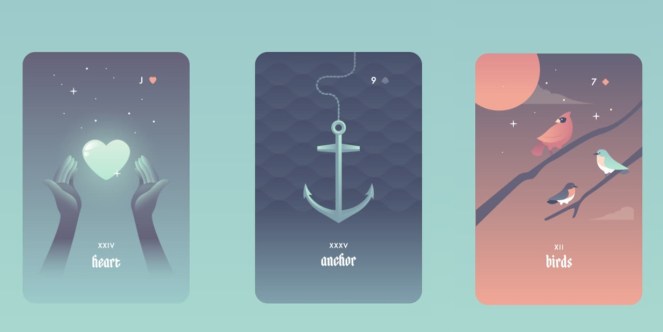
I drew the Heart, Anchor, and Bird using the Seventh Sphere Lenormand app.

I can’t pretend to be an expert at this, since I’ve only just started. What was interesting here is how neatly the advice overlapped with what I’ve been told via tarot: One of the biggest helps for easing my anxiety is to lean more on my relationship. It provides care, stability, and happiness, but, like I talked about yesterday, I’ve also had some trouble with the reciprocal aspect of being a disabled person in a long-term relationship.

petitjeu_heartanchorbirds

In this kind of divination, the meanings of the cards are read literally, the way one might read a sentence. Each symbol has a meaning, akin to a pictogram. The Heart, unsurprisingly, stands for love and relationships. The anchor is stability and resiliency. Birds are chatter, according to some sources, and nervousness according to others. Cards are read in pairs, with the first card acting as the subject of the “sentence,” and the second as the modifier.

Read this way, heart and anchor are a long-term relationship. Anchor and birds are life=long partners, or deep discussions. It’s a deep discussion with a long-term romantic partner.

Admittedly, I don’t really like talking about what’s going on in my brain with my partner. I feel like I create enough of a burden by existing, like I don’t have a “right” to his emotional labor. We don’t really have any friction in our relationship, but there are definitely times when I have too much going on in my mind to be really present. I encourage him to be open with me, though I have trouble doing the same with him. I know that’s something that I need to get past — it looks like doing so is the best way for me to figure out how to be happy on a day-to-day basis.

Sometimes the only way out is through.

divination · life

Le Pendu

Hanging is a lot of things, but it’s not always a punishment.

Part of me wanted to skip this week’s card, because… Well, there’s not much going on, is there? I’ve been keeping busy here, but interactions with the outside world that alter the shape of my internal landscape have been, shall we say, lacking.

Still, I did the thing.

I had to laugh when I drew Le Pendu, The Hanged Man.

Like the man in the Rider-Waite-Smith tarot deck, Le Pendu of the Tarot de Maria-Celia dangles by one foot. His hands are free, though, and he appears to be sticking his tongue out — almost a “Look, Ma! No hands!” face. Nobody tied him there. He isn’t being punished. He is there of his own volition, for his own reasons.

He is waiting. Resting. Delayed. Hanging upside-down certainly gives him a new view of the world, but this comes at the price of his mobility. He is sacrifice.

I had to order a few things today. I would’ve preferred not to, but there are some supplies that are no longer available locally here. I can’t really describe how nerve-wracking it was, scrolling through lists of products to find the things we needed, all while watching things sell out before I could act. Still, this anxiety comes from a fortunate place: We have the ability to order things, or I wouldn’t’ve been looking in the first place.

It’s a helpless feeling, like hanging upside down, but Le Pendu’s hands are free and I am fortunate to be in a position to feel this helplessness to begin with.

Waiting isn’t always a punishment. Right now, it’s the choice we make for our own safety, and the safety of others. The Hanged Man has to come down some time. The helplessness and delays will pass.

divination · life

The Ten of Swords Strikes Again

Last time I drew the Ten of Swords, it didn’t take long to manifest — by the next day, I was sicker than I think I’ve ever been in my life. I’m hoping that that isn’t the case here, for obvious reasons.

This week, I used the Tarot de Maria Celia again. I’m getting the hang of interpreting the pips cards and, to be honest, it’s become one of my favorite decks. In Rider-Waite-Smith-inspired decks, the Ten of Swords typically shows a dead or distressed figure, stabbed by ten swords.

Swords10
Image from the Rider-Waite-Smith deck, artwork by Pamela Coleman Smith.

The Tarot de Maria Celia offers no such imagery; it’s the culmination of the cycle of the suit of Épées, and that can mean a lot of different things.

Don’t get me wrong, none of them are really positive. It can still stand for a time of pain or betrayal. It’s still the end of this pain, though. It’s the last numerical card in the suit, which makes it’s the last low point.

As the suit of the logical mind, the Dix D’Épées can stand for a point where the thiking mind has matured, after a cycle of pain and difficulty. Like the Ten of Swords, it’s also a sudden, crushing loss — the kind I think most of us are feeling right now, in one form or another.

This card can also stand for exhaustion, physical and mental. The Tens of any suit are the ultimate end, after the whole cycle of the suit itself. This can mean enjoying the fruits of your labor, like the Ten of Pentacles. It can also mean collapsing, gasping, at the finish line after you’ve spent yourself going through a gauntlet. With how I’ve been feeling, I can understand that. Exhaustion is a trauma response, and I think we’ve all been going through the wringer.

If the Ten of Swords/Épées offers a hope spot, it’s that things won’t be this way forever. As I mentioned before, it’s the culmination. It’s a card of logic. It says that, if we can take a bird’s eye view of our pain and maintain perspective, we can take solace in the fact that we won’t be suffering forever, and use this opportunity to analyze the situation and figure out how to keep this from happening again.

I can brace myself for bad news, but at least the bad news won’t last.

divination · life

The Nine of Wands

I didn’t really want to draw a card today.

One thing I’ve learned from reading tarot is that you shouldn’t ask questions you don’t want the answers to. I wasn’t going to ask.

Still, I needed something to do with my hands, and I have more time and decks than I know what to do with, sometimes. I was waiting for the results of a well check — I’ve called and called my grandfather for days, and gotten no response. He’s very independent for his age, but I still worry (especially now). When another day passed with no answer, I bit the bullet and asked for someone to check on him.

(He’s okay. He was sick, but he’ll be home tomorrow.)

So, agitated and with shaky hands, I forced myself to put my phone down and shuffle a deck instead. I didn’t even really ask a question, I just wanted something to do.

I drew the Nine of Wands.

This card speaks of setbacks and obstacles. It’s the ninth in the cycle — the third card of the third card — the Penultimate End, but not the End End. It’s a conclusion, but not a culmination. It’s challenges, it’s exhaustion.

It kind of sucks.

The silver lining to the Nine of Wands is that, coming as it does at the end of the end, it means that you have a lot of knowledge and resources to draw on. Things are tough. You might be feeling mistrustful, worn out, ready to give it up. When you can leave the past behind and push onward, you can make it throught.

I hope we can.

divination · life

Le Cavalier d’Épée

I’ve got isolation zoomies.

To be honest, I can’t complain — there are people who have it a lot worse than I do. People who can’t work from home, people who can’t work from home and need to find childcare because schools are closed, people who are actually sick. I still feel it like an itchy shirt. There’s a world of difference between choosing not to go out, and not being able to for fear of getting sick or putting others in jeopardy.

If there’s a positive side to this, it’s given me time to write here, finish some paid writing, paint, pursue a few new ideas, and work on learning the Tarot of Marseilles and Ogham divination.

On the flip side, it’s tempting to do a lot of divination. As anyone who habitually reads tarot, runes, or other oracles can tell you, doing tarot spread after tarot spread is an easy way to trip yourself up.

Though I was very tempted to pull out all of the stops and do a full, complete-deck spread, I figured it was better to stick to just one card for this week. (After doing a success reading, and a career reading, and a creativity reading, and a love reading, and experimenting with a Lenormand spread, and…)

Using The Tarot de Maria Celia,  I drew the Cavalier d’Épée — the Knight of Swords.

Interestingly, the last time I drew him, it was a time that was fairly similar to this. Though the health challenges causing my isolation aren’t my own this time around, I can feel the same sense of waiting and agitation. In The Crow Tarot, the Knight of Swords points to an energetic start to a new project. In the Marseilles Tarot, the sentiment is similar — he is the feeling of obsession we get when we have a new idea, when we’re so fixated on the fresh and exciting that it seems like nothing can go wrong.

On the positive side, his energy, determination, and enthusiasm make it easy to succeed. On the negative side, they also make it very easy to ignore the challenges in the way of that success. It may even be tempting to ignore the protestations of other people who know better, and ignore the needs of others in the attempt to chase that success.

Sometimes, when I get wrapped up in a project, I do forget things. I might not eat, might not drink enough, might even forget to sleep until the middle of the night. These things aren’t just harmful for me, though — they’re also a sign of neglecting my relationship. If I’m too busy to eat, I’m too busy for meals with my partner. If I’m up too late, he’s up too late because he has trouble sleeping without me.

The Cavalier d’Épée is a warning — ride the tide of optimism, but don’t let it flatten everything else.


divination · Witchcraft

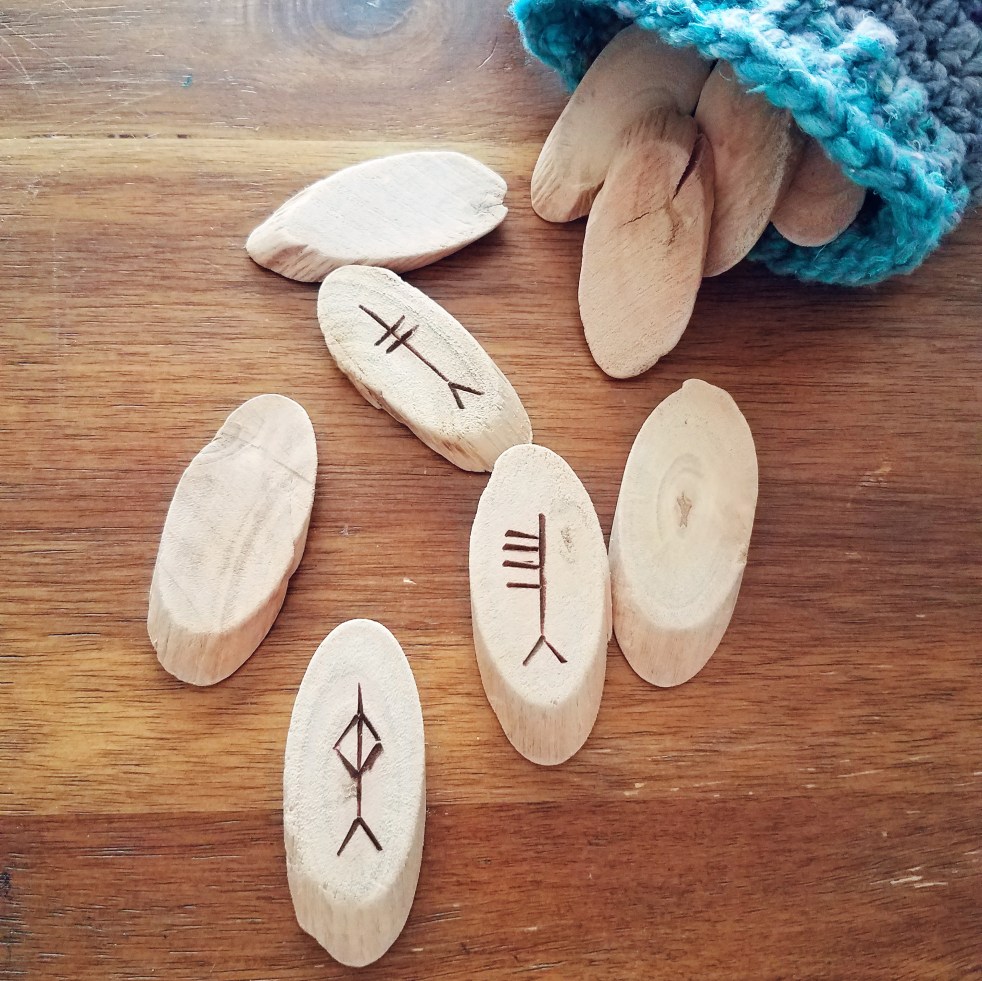
Ogham Staves from WillowsPaganShop.

Note: This post contains affiliate links to the sellers and products I mention. These allow me to earn a small “finder’s fee,” at no additional cost to you. Thank you for helping to support artists, artisans, and this site!

So, I’ve been working on learning a new system of divination — Ogham staves. I used them for this week’s divination, and I’ve been trying to see where else I can incorporate them into my practice.

Many types of wood have their own specific magical and spiritual properties, so choosing a set took me awhile. I also prefer to find tools that are “neutral,” in an energetic sense; I don’t like using wood that’s been cut down, if I can help it. Windfall and reclaimed woods are more my jam.

That’s why I was so happy to find these driftwood Ogham staves by WillowsPaganShop.

A set of driftwood Ogham staves spilling from a turquoise and grey pouch.

I love the size and shape — a lot of the other staves I looked at were thinner and more rounded, which I thought might make it more difficult for me to draw them the way I’d like to. The texture is nice, too, with the velvety-softness of sea-tumbled wood. They’re also a very good weight, neither too light to keep from blowing away outdoors, nor too heavy to carry comfortably in a purse or crane bag.

I keep them in a lovely crocheted pouch by Neeedles. It’s just the right size, and gorgeous colors. The crochet is nice and tight, too, so I’m not worried about the staves stretching holes in the stitches and slipping out. At about $15, it was a very reasonable price for a handmade bag, and the craftspersonship is really, really nice. I’m considering getting more of them for my other supplies, they’d be great for carrying a few stones, vials of herbs, and tealights for mobile ritual-doing.

Now I just have to learn the meanings. Fortunately, I have a lot of opportunity to practice!

divination · life · Neodruidry · Witchcraft

Ruis and Saille.

ADF-structured rituals have an oracle portion that gives us an opportunity to know how our offerings were received, know which blessings we are receiving in turn, and get messages from the spirits we work with. I’ve always used tarot for this, but I’ve been curious about branching out into journeying, geomancy, and other means of divination.

All of this is to say that, for my reading this week, I didn’t pull a card at all.

I’ve been trying to learn to divine using Ogham staves. It’s more than a little challenging for me — memorization isn’t my strong suit (to put it mildly), and the Ogham alphabet is visually very simple. That means that, somewhat like my experience with the Tarot of Marseilles, there isn’t a whole lot for me to go on. Unlike the ToM, however, Ogham letters don’t have suits or numerical cycles on their side, which makes it even more difficult.

My best bet? Lots of practice. There are far fewer Ogham letters than there are tarot cards, so I’m bound to absorb some of it eventually.

This week, I drew two staves. Since I can’t exactly shuffle wood, I placed them face down, mixed them up, and drew them the way I would a tarot card: I moved my receptive hand over the pieces, and waited for the little energetic “tug” that led me to the right ones.

An orange cat paws at a set of driftwood Ogham staves,
Kiko attempting to draw staves for me, featuring hazel and elder.

I drew Elder (Ruis) and Willow (Saille).

Elder stands for the passing of an old cycle. This can be something that is due to pass, or something that we want to hold onto. The elder tree has a lot of connections to death and rebirth, so it’s a reminder that the only constant is change.

Willow stands for balance and equilibrium. In some sources I’ve read, it also stands for cycles, learning, and taking time to accumulate knowledge before acting.

I’ve experienced a lot of synchronicity with regards to both of these things, just in the past two or three days alone. It’s a supermoon in Virgo. This afternoon, I was listening to a webinar about living as a highly sensitive person (which, for me, is pretty much shorthand for “on the verge of a nervous meltdown basically always”), and Dr. Christine Page was giving a talk about inviting change in order to quit burning yourself out and making yourself sick. I mean, as I was typing this, I had to pause because I got an alert on my phone. It was an email: “Tips for Working With Change,” from Sharon Ramel.

It’s spring, the birds are singing, the weather’s warming, the sap is starting to run. The trees are still bare, but there are plenty of little signs that the soil’s beginning to wake up. I can’t say that I know exactly what changes the willow and the elder and pointing to, but I can’t help but look forward to them.