

Note: This post contains affiliate links to the book(s) I mention. These allow me to earn a small finder’s fee from Wordery.com, at no cost to you. Thank you for helping to support writers, publishers, and this site!
 Even if I don’t currently include entheogens in my practice, the ideas and practices of the poison path fascinate me. It takes a tremendous amount of bravery, considerable knowledge, and a firm devotion to the idea of expanding consciousness over bodily safety. It relies on the concept that the dose makes the poison, and growth lies on the thin line between curative and deadly.
The concepts of the poisoner and the witch are inextricable. Just look at the reasons people fear “evil” witches: they were said to cause sickness in people and cattle, wither crops, and bewitch others into nonordinary states of consciousness. Just look at the Evil Queen who sends Snow White into a deep slumber with a poisoned apple, or the Sea Witch who glamours herself and tricks the Prince into falling in love with her. (And what is desire, if not an altered state of consciousness?)
Even in the Bible, the lines between magic and poison are blurred, at best. The words “Thou shalt not suffer a witch to live” (Exodus 22:18) appear, but may not mean what they seem to mean. The original Hebrew word, mekhashepha, is of uncertain meaning. Does its root, kashaph, mean “to cut” or “herb using”? A prohibition against magic in its entirety seems unlikely, given the historical context. Other sources later translated the word to mean those who used magic for evil — in other words, witches who “poisoned” by magical means. Could the Bible be warning its readers against poisoners here, instead?
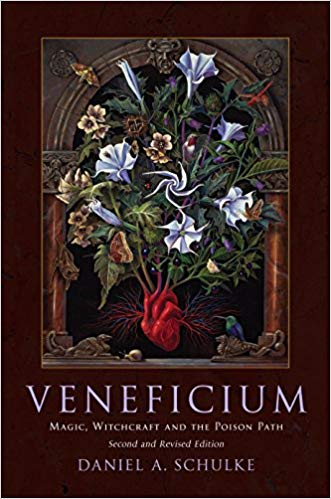
Daniel A. Schulke’s Veneficium: Magic, Witchcraft, and the Poison Path explores the use of mind-altering substances, but it’s emphatically not a “how to” guide. A History of Pagan Europe followed the development and spread of Pagan practices across Europe, and this is in a similar vein — a resource for the history and cultural spread of the spiritual use of entheogens.
One bit I found particularly interesting was the chapter on The Spirit Meadow, particularly the description of bread made of black millet. There’s a sort of folkloric figure called the Black Miller. He’s a powerful, fearsome, shape-changing sorcerer, who makes an appearance in a song by Faun (Die Wilde Jagd), and in “The Black Mill” by Jurij Brezan. It’s unclear exactly where the moniker “Black Miller” came from. In context, it’s unlikely to refer to his appearance or ethnicity — much like the “black” in “blacksmith” refers to the material, not the smith themselves. In Veneficium, some of the information presented by Schulke adds an interesting dimension here, in a section about darnel (Lolium temulentum):
Darnel may well have been present in the notorious ‘black breads’ served at the Sabbat, as documented by DeLancre*, either as a deliberate inclusion or in the bread for its deliriant qualities, or simply as a by-product of the agricultural practices of the time. It is plausible that a toxic stew of deliriant grains, serving as the component basis of the Sabbat-bread, had synergetic effects operating between psychoactive components, if indeed darnel formed a part of witchcraft rites. This idea has been proposed in relation to the everyday bread eaten in medieval Europe[.]
*According to DeLancre, “… their bread is some horrible black cake made of black millet and some other drug…” which ‘confuses the senses’ of those who eat it, and likewise binds them to Satan.
Die Wilde Jadg tells the story of a pair of shapeshifters: one pursuer, one pursued. Based on the connotations of black millet, bread, and hallucinogenic fungi, it’s pretty easy to picture the eponymous “Black Miller” grinding away at the psychoactive raw materials of the “speculative ‘Black Bread of the Sabbat'” — a pretty spot-on occupation for a shapeshifting sorceror.
It would be easy for a book like Veneficium to fall into the trap of being dry and tedious, but it never does. The language is as poetic and striking as it is informative, and the subject matter is absolutely fascinating. If you have any interest in the spiritual use of entheogens and aren’t looking for a guide book, I highly recommend it.

 Marble Crow