
animals · life

Puppies, Pies, and Paranormal Problems.

You know, a lot of people go outside and play a game on Thanksgiving. Parents of younger kids might take them out for a rousing game of catch. Teens and adults might play a little touch football in the back yard. It’s pretty common.

It is less common to spend what feels like several hours pursuing a small, self-propelled football, while everyone involved is about a picosecond away from a collective panic attack.

I don’t have any family in the area. For a long time, neither of us did. Holiday meals were either made up of whatever we felt like cobbling together, whatever delivery place was open, or a smorgasbord of unrelated snacks, straight-up goblin-style.

My Handsome Assistant’s awesome aunt and uncle moved just a few hours away not long ago, so we’ve been spending more holidays there. They have a lovely house with a big yard and plenty of spare bedrooms, on a small, peaceful road surrounded by farms. Inside this house is a pair of adorable and very sweet Yorkie/toy fox terrier mixes, as well as a rather petulant ghost. Almost two petulant ghosts, but I’ll get to that in a minute.

This Thanksgiving, we made the drive up with a gallon of homemade meadowfoam mead and a vegan pumpkin pie (made using this recipe from Chocolate Covered Katie and some of our mysterious yard pumpkins).

Now, the older of the two dogs has a habit of running off. They’re both small enough that using an Invisible Fence would be problematic, so they’re carefully supervised and let outside in a movable pen.

All of this is a long way to explain that, through a convoluted set of circumstances involving a basement, a grill, and the Maryland Renaissance Festival, the older dog snuck out. He saw this as the opposite of a problem, since he had a house full of people (and eventually several neighbors and neighbors’ dogs) to play tag with. However, everyone else involved had… mixed feelings about the situation.

I don’t know how long I spent chasing that dog down, calling his name, running through strangers’ yards in hot pursuit of a football-sized creature in a little blue sweatshirt. The cold squeezed my wheezing lungs until the edges of my vision got gray and fuzzy. Eventually, everything looked like tiny dogs: gas meters, squirrels, shrubs. A few people offered me rides as they drove around looking for him, but I turned them down — it seemed like it’d be helpful to have someone on foot who could duck into even more strangers’ yards if need be.

He made it all the way down to the nearest main road and disappeared from view, so I ended up walking down the middle of the street just in case he darted out again. This seemed like a perfectly reasonable thing to do at the time, because my oxygen-deprived brain figured that speeding drivers would a) notice me sooner than they’d notice a tiny dog, and b) would probably slow down to avoid committing vehicular manslaughter. At that point, I was rapidly coming to the conclusion that Doc Martens are less than ideal as a running shoe, so I also figured that being hit by a car would likely hurt less and I’d get to lie down for a little bit. Having been hit by a car before, this seemed sound to me.

Through some miracle, we all managed to tire him out. (Hey, humans are pursuit predators, right?) Four people formed a kind of pincer attack, and my Handsome Assistant performed some kind of acrobatic tackle and swoop maneuver that resulted in my Assistant on his back, one arm upraised, and a very upset tiny dog in his hand. Like a meatball sub with opinions.

Dog snared, we went back to the house. My lungs eventually calmed down enough for me to get a full breath again. There was ham, turkey, sausage, smoked vegetables, mashed potatoes, macaroni and cheese, green bean casserole, cranberry sauce, candied yams, and biscuits. There were also four kinds of pie and a cake.

We played a guessing game that was half charades, half “Name that Thing.” It involves writing down random words, putting them in a bowl, and drawing them out one by one. In the first round, the person reading can describe a word, but not say it, while their teammates guess. In the second round, the reader can only use gestures. In the third, the reader can only use one word.

In our defense, my Handsome Assistant and I didn’t originally know how this game worked when we were coming up with words. The game itself was hilarious, but you don’t know pressure until you have to figure out how to convey “imbroglio,” “Steven Seagal,” or “Azerbaijan” purely through interpretive dance.

A long, unanticipated aerobic session and eating my weight in potatoes and pumpkin pie made me sleepy, so after the Macy’s parade and Dolly Parton’s halftime show, I was ready for bed.

The bedroom, however, was not.

I’ll be honest with you; I’m used to being woken up multiple times a night. Kiko needs to eat special food and refuses to do so until and unless she has received tiny kisses on the forehead. Having my sleep interrupted is pretty much whatever at this point.

Nonetheless, there’s an enormous difference between being woken up by a tiny paw gently tapping my forehead, and the repeated crashes of something absolutely flinging the shit out of everything on the nightstand. It’s not like I placed a valuable and unsecured antique marble collection up there, either. There was no reason for anything to just… roll off. There was especially no reason for it to hit the floor like Tom Brady crawled out from under the bed just to spike it. Half of the time, I hadn’t even fallen back to sleep yet.

I wasn’t in the mood. I’d already missed seeing the Snoopy float, the absolutely bonkers amount of pie I’d eaten was giving me indigestion, and I had a blister on the back of my heel that was big enough to need its own social security number.

“Knock it the fuck off,” I grumbled, unaware of the irony of this statement. A mostly empty tube of lotion slammed down like… I don’t know. A thing that’s extremely extra affected by gravity. I pulled the pillow over my head.

Next year, I’m bringing my ghost box and a pair of jogging shoes.
I’m not getting caught out again.

animals · divination

The Magical Meaning and Symbolism of Starlings

Since there are still small, belligerent starlings all over the yard, I figured I’d make the best of a very noisy situation and write a bit on starling symbolism and magical significance. While I mostly know them as small weirdoes who periodically walk up to me and gape to be fed (which is almost admirable in its temerity, to be honest), they’re powerful, sacred animals in their own right.

Despite their ubiquity in my area, starlings aren’t native to the United States. The story is that they were brought here in the late 1800s in what is, perhaps, the silliest fashion imaginable. A German-American Shakespeare enthusiast named Eugene Schieffelin wanted the US to have all of the birds mentioned in Shakespeare’s plays, so he imported and released about sixty to eighty of them. (Invasive species who?) However entertaining this tale might be, it most likely isn’t actually true.

Shakespeare’s mention of starlings refers to their talent at mimicry:

Nay,

I’ll have a starling shall be taught to speak

Nothing but “Mortimer,” and give it him

To keep his anger still in motion.

spoken by Hotspur, in Act 1, Scene 3 of Henry IV
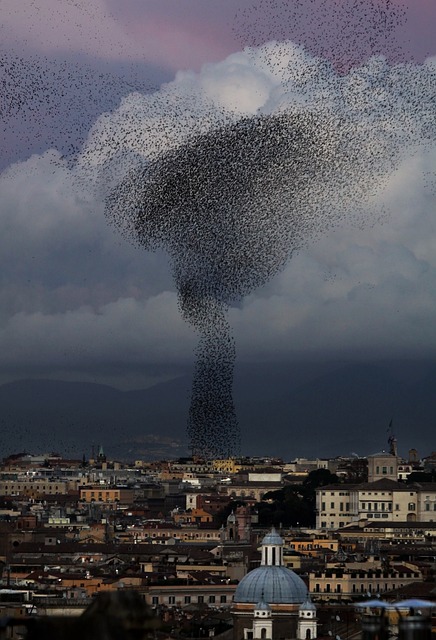
A murmuration of birds over a city, against a dark, cloudy sky.

In Rome, however, starlings were more than a curiosity or a passing note in a play, and starling symbolism was a important thing. Starlings form very large, elaborate migrating flocks called murmurations. These are exceptionally striking formations of thousands of individual birds who seem to cover the sky in a flowing, undulating mass. Augurs, diviners who read the movement of birds, would watch these murmurations to receive messages from their gods. Some forms and flows were very good omens. Others, not so much.

In the Welsh Mabinogion, Branwen is sent to Ireland to marry King Matholwch . Her marriage is far from happy, however, so she tames a starling and teaches it to speak. She sends the starling back to Wales, where it alerts her brother Bran to come and save her.

Starlings can mimic far more than words. Mozart kept one as a pet, and it learned to repeat portions of his compositions. When it died, he was heartbroken. He performed a funeral that his biographer (and wife’s second husband) described thus:

When a bird died, he arranged a funeral procession, in which everyone who could sing had to join in, heavily veiled – made a sort of requiem, epitaph in verse.

Georg Nikolaus von Nissen 

Starlings also seem to imprint readily on people. Personally, I have made every attempt to avoid them, however their babies still don’t seem to have any issue strolling up to me with their mouths open, expectantly. It’s kind of like walking up to a grizzly bear and demanding spaghetti.

In general, the starling’s place in folklore seems to have been secured by their ability to bond with people, and their talent at mimicking speech and other sounds they encounter. Just watch this one, who not only imitates a human, but flawlessly mimics an Alexa unit immediately afterward:

It’s almost eerie!

Starlings are said to represent everything from freedom, to prosperity, to love. Given their folklore, starling symbolism is most strongly connected to communication and divination.

To divine using a flock of starlings (or even just one, though they always seem to show up in groups!) involves noting their number and behavior. It can sometimes be hard to count starlings, particularly since they can number in the thousands within a single murmuration.

If you observe them in flight, like the ancient Romans, pay attention to the shapes they form. What do they evoke for you?

Note the direction in which they’re flying. This means both the cardinal direction, and their relative direction. The east represents beginnings, renewal, spring, and the dawn. The south represents a climax, an apex, summer, and high noon. The west represents a decline, a release, autumn, and twilight. The north represents endings, death, winter, and midnight.

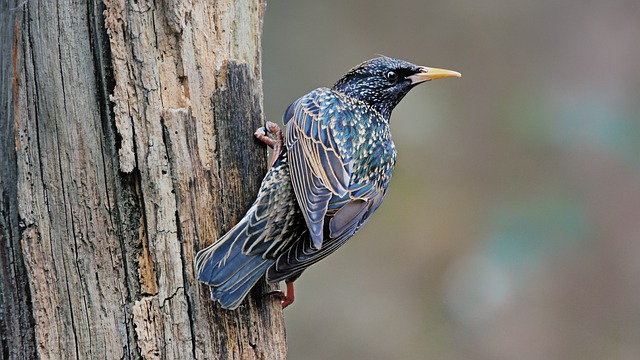
A starling clinging to the trunk of a tree.

In terms of relative directions, birds flying to the right generally indicates a positive or affirmative response. Birds flying to the left generally indicates a negative response.

As with any divination method, keep a journal of what you see and your interpretations. After some time has passed, revisit what you wrote and see how accurate it was. This can help you decode what the flight of birds means specifically to you.

Starlings are polarizing little guys. Some people absolutely love these noisy, funny little birds, while others hate them. I’ve come to be amused by their antics, though I’m also looking forward to when their fledglings are finally grown and it’s time for them to migrate!

animals · divination

The Magical Meaning of Starlings

Since there are still small, belligerent starlings all over the yard, I figured I’d make the best of a very noisy situation and write a bit on their magical significance. While I mostly know them as small weirdoes who periodically walk up to me and gape to be fed (which is almost admirable in its temerity, to be honest), they’re powerful, sacred animals in their own right.

Despite their ubiquity in my area, starlings aren’t native to the United States. The story is that they were brought here in the late 1800s in what is, perhaps, the silliest fashion imaginable. A German-American Shakespeare enthusiast named Eugene Schieffelin wanted the US to have all of the birds mentioned in Shakespeare’s plays, so he imported and released about sixty to eighty of them. (Invasive species who?) However entertaining this tale might be, it most likely isn’t actually true.

Shakespeare’s mention of starlings refers to their talent at mimicry:

Nay,

I’ll have a starling shall be taught to speak

Nothing but “Mortimer,” and give it him

To keep his anger still in motion.

spoken by Hotspur, in Act 1, Scene 3 of Henry IV
A murmuration of birds over a city, against a dark, cloudy sky.

In Rome, however, starlings were more than a curiosity or a passing note in a play. Starlings form very large, elaborate migrating flocks called murmurations. These are exceptionally striking formations of thousands of individual birds who seem to cover the sky in a flowing, undulating mass. Augurs, diviners who read the movement of birds, would watch these murmurations to receive messages from their gods. Some forms and flows were very good omens. Others, not so much.

In the Welsh Mabinogion, Branwen is sent to Ireland to marry King Matholwch . Her marriage is far from happy, however, so she tames a starling and teaches it to speak. She sends the starling back to Wales, where it alerts her brother Bran to come and save her.

Starlings can mimic far more than words. Mozart kept one as a pet, and it learned to repeat portions of his compositions. When it died, he was heartbroken. He performed a funeral that his biographer (and wife’s second husband) described thus:

When a bird died, he arranged a funeral procession, in which everyone who could sing had to join in, heavily veiled – made a sort of requiem, epitaph in verse.

Georg Nikolaus von Nissen 

Starlings also seem to imprint readily on people. Personally, I have made every attempt to avoid them, however their babies still don’t seem to have any issue strolling up to me with their mouths open, expectantly. It’s kind of like walking up to a grizzly bear and demanding spaghetti.

In general, the starling’s place in folklore seems to have been secured by their ability to bond with people, and their talent at mimicking speech and other sounds they encounter. Just watch this one, who not only imitates a human, but flawlessly mimics an Alexa unit immediately afterward:

It’s almost eerie!

Starlings are said to represent everything from freedom, to prosperity, to love. Given their folklore, they’re most strongly connected to communication and divination.

To divine using a flock of starlings (or even just one, though they always seem to show up in groups!) involves noting their number and behavior. It can sometimes be hard to count starlings, particularly since they can number in the thousands within a single murmuration.

If you observe them in flight, like the ancient Romans, pay attention to the shapes they form. What do they evoke for you?

Note the direction in which they’re flying. This means both the cardinal direction, and their relative direction. The east represents beginnings, renewal, spring, and the dawn. The south represents a climax, an apex, summer, and high noon. The west represents a decline, a release, autumn, and twilight. The north represents endings, death, winter, and midnight.

A starling clinging to the trunk of a tree.

In terms of relative directions, birds flying to the right generally indicates a positive or affirmative response. Birds flying to the left generally indicates a negative response.

As with any divination method, keep a journal of what you see and your interpretations. After some time has passed, revisit what you wrote and see how accurate it was. This can help you decode what the flight of birds means specifically to you.

Starlings are polarizing little guys. Some people absolutely love these noisy, funny little birds, while others hate them. I’ve come to be amused by their antics, though I’m also looking forward to when their fledglings are finally grown and it’s time for them to migrate!