There’s a path. It doesn’t look like a remarkable one from the entrance, but it’s one my Handsome Assistant and I return to time and again. At one end, it’s nice and flat and more or less perfect for me to try to help rebuild my endurance after the flu.
The unremarkable entrance hides a number of absolutely delightful things. A large overhanging rock that’s supposedly a paleolithic shelter. Verdant fields of alien-looking skunk cabbage. Interesting-looking lichen. Giant mushrooms.
It was sunny and warm. The trees’re still skeletal, so there wasn’t much shade from the early spring sun at all. My Handsome Assistant and I joked about huddling under the rock shelter for shade. He said after all these eons, it’d probably choose that exact moment to crack in half and fall down. I chuckled. So did he. So did a tree.
“Ha ha ha!” It said, in a woman’s voice. “Ha ha!”
“The fuck,” I replied. I followed the sound as best as I could and saw a dark shape perched on a bare branch.
A crow.
And the little shit was laughing. Not just a caw that sounded like a laugh, a full-on, almost disturbingly human imitation of a laugh, in context.
This is why forests get reputations for being haunted.
It’s not my first run in with an imitating crow, either. I have one buddy who hangs around the yard and whom I have dubbed “2014 Hyundai Elantra.” This is because his favored mode of communication is making the exact boop-boop sound of a car alarm disarming. I don’t know why. I don’t know what they are attempting to convey with this. But they seem to find it positively delightful, and I’m not gonna lie, I kind of love it too.
It also goes to show that birds will decide to imitate whatever they want. I accidentally ruined a friend’s Quaker parrot this way, because I have the kind of vocal tonality that small things seem to respond well to. He was acting up, so I jokingly called him a brat. On occasion when I’d see him after that, I’d greet him with a little, “Hi, Brat!” It wasn’t even that often! He had way more contact with the people he actually… you know, lived with. Nonetheless, this little bird would puff himself up very proudly, make himself tall, and proclaim, “Brat!” Then do a little head-bob dance because he was very pleased with himself. My friend tried to sort of morph it into him asking for “Bread,” but to no avail. Brat it was, and he’d be damned if he was going to change his ways.
(To be fair, he was a brat at times. I parrot sat him once and, despite being very sleepy, he refused to go back in his cage. Refused. Banging things. Throwing things. You name it. I’d take him out, and he’d snuggle up in the crook of my elbow and go right back to sleep. Lather, rinse, repeat.)
All of this is to say that birds are weird as hell. You never know what they’ll latch onto… A middle aged woman’s laugh. The sound of a car’s key fob. Self-identifying as a tiny agent of chaos. Being the reason forests get reputations and aliens don’t visit us.
The past few months have been pretty intense. I downgraded my WordPress hosting, because I found that I wasn’t using many of the benefits of my upgraded package. This sounds simple, but, in reality, required a lot of back-and-forth between three chat bots, some emails, and a discussion forum. Either way! It’s all sorted now and, if anything breaks in the near future, it’s entirely because I’m messing with themes and colors again.
Now, as for the rest… I vended at my first in-person event this year! It was a great experience, I sold a ton of artwork and sculptures, and I’m very happy.
Then, shortly afterward, my house caught on fire some. I was sitting in the bath when I smelled something like melting plastic. I checked the bathroom window, but it definitely wasn’t coming from outside. When the smell intensified, I asked my Handsome Assistant to see if he could track it down. He came running back with a fire extinguisher, there was smoke everywhere, cats were evacuated, fire department was called, and I sat in the driveway for a while chatting with friends on Discord because I’m pretty sure that was the one thing tethering my sanity in the midst of all of the chaos at that particular moment.
Anyhow! Everyone’s fine and the house is habitable. However, as a public service announcement: Do not leave your bathroom vent fans on when you’re not around, they are absolutely capable of subterfuge. As it turns out, our basement bathroom vent fan’s wiring blew out in a rather spectacular fashion. Like, flames. Melted insulation. A scorched gas line. If we hadn’t been home, or I hadn’t smelled it when I did, it would’ve been a catastrophe. As it is, it’s just been a very stressful series of inconveniences – including having no heat for several weeks.
Also, yellowjackets live in the walls now. This is totally unrelated to the fire. They just saw some gaps around the powerlines and decided it was free real estate, and now they live there. Sometimes they get into our bedroom. I woke up gently spooning one this morning.
If circumstances were different, these guys would’ve died off with the first frost as they usually do. Since they’re living in the walls, they’re here to stay. Or at least for way longer than my Handsome Assistant and I are comfortable with sharing a space with them. I don’t mind stinging insects, but as far as housemates go… I mean, they’re not great.
Lastly, we have ducks! We did not initially intend to get ducks. My Handsome Assistant likes the idea of having egg-producing pets, despite the fact that neither of us eat eggs. (It is his latent Ohio prepper sensibilities.) These are not egg-laying ducks.
What happened is a friend of ours rescued some ducklings from Tractor Supply. It was the end of the season, the store can’t return them to the breeder, so they just… had these unsexed ducklings. Friend took them, since friend already has necessary ducky infrastructure, and the ducklings grew into three handsome Rouen drakes and one lovely hen.
(Pause for sounds of dread from people who have kept drakes and hens before.)
Duck mating is… Let’s call it “hardcore.” It’s dangerous for the hens at the best of times, and that’s even with a good ratio of drakes to hens. Which is about 1:3-4 at minimum, not 3:1. So, friend needed to find a home for these drakes before the spring breeding season rolls around. If no one took them, they’d have to make the difficult decision to cull the drakes for the safety of the hen, which they really didn’t want to have to do.
So, bleeding heart that I am, I decided we were going to keep ducks.
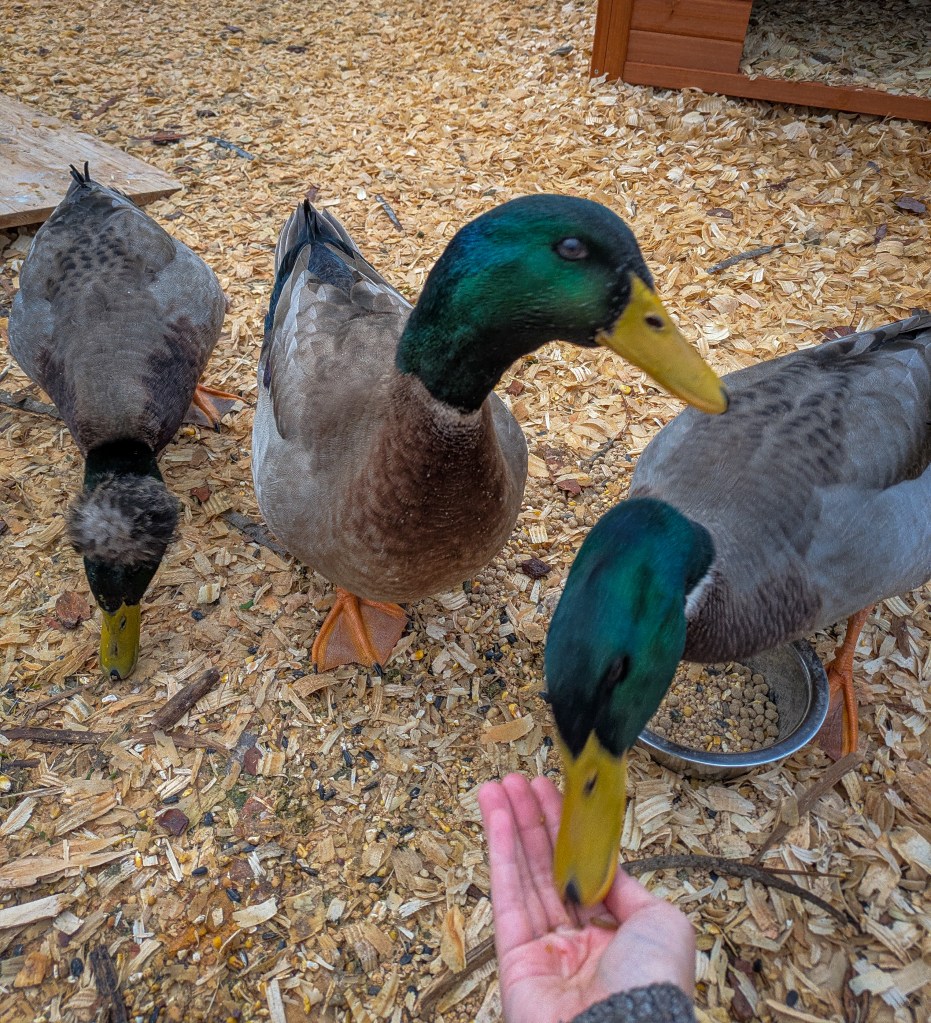
And honestly? It’s been great. We built them a run and a coop, set up a pool, gave them a separate water source, and feed them a variety of fresh foods alongside a healthful prepared diet. They’re three handsome Rouens, and they’re also a lot of fun. They get excited when I walk outside or talk to them through the window. They wag their tails and bob their heads. They’ll eat treats from my hand and listen very well when I tell them it’s time for bed.
Left to right, Marcus, Eddie, and Robert.
… Alright, they listen well when I walk in and say, “Alright handsome boys, it’s time to go eepy-sleepy’! Ready? Let’s go!” In high-pitched parentese like a demented Disney princess.
We’ve only had them for a little while, and I already love them. There’s Marcus, the crested one and the smallest of the three. There’s Robert, the second largest and boldest. And there’s Eddie, the largest and the unwitting target of Marcus’… affections.
Ducks, like many other animals, will mount each other in a display of dominance. So, much like a high school transfer student, Marcus has apparently decided that since he’s in a new place, it is time to try to be the Cool Important Duck. A strategy that would make more sense if he weren’t shy and less than half the size of Eddie. Eddie’s mostly just confused by the tiny hat-wearing maniac trying to climb on his back.
So, my time a way has mostly been dealing with housefire remediation logistics, rebuilding, setting up duck infrastructure, and finding a way to get the wasps out of the walls.
This past weekend, some friends, my Handsome Assistant, and I went to the woods to celebrate Beltane.
What is Beltane? It’s a celebration of the coming summer and occurs roughly halfway between the vernal equinox and the summer solstice. Traditionally, in Ireland, it was when cattle were sent to their summer pastures. There’d be bonfires, rituals to protect the cattle, people, and homes, and lots of food.
We, lacking both cattle and pastures to which to send them, did stuff a little differently.
Really, there wasn’t a firm plan when we met up. We knew we would do something, but what it was was very much up in the air. One friend was firm about building an effigy. I was firm about there being drums and partying. Other than that…
There’s a saying that getting a group of Pagans to do anything is like herding cats. The larger the group, the harder the herding.
Nonetheless, with less than a full day to plan, write, and perform a ritual, we prevailed.
Friday night, a friend and I went to go look for a ritual site. This was pretty easy, or would have been were it not a) the woods, b) midnight, and c) Beltane.
There’s a fun bit of Beltane lore that goes thus: Samhain is the time of year when the veil between this world and the world of the dead is at its thinnest. Beltane, being pretty much the opposite of Samhain, is said to be the time of year when the veil between this world and the world of other beings is at its thinnest. These other beings are typically referred to as the fae, the Good People, etc. Depending on how you define nature spirits, this could include some cryptids. This is also the beginning of the season when UAP/UFO sightings tick upward.
What I’m saying is that it is either the best or worst time to go walk around a forest at night, depending entirely on what kind of night/rest of your life you’re trying to have.
We managed to end up in places that didn’t quite make sense. At one point, we were convinced that some of the features of the trail had switched places. When I tried to take a pic of the proposed ritual site to show everyone else, all I got were bizarre, blurry, lightleaked pictures that looked like someone ran a Holga through a dishwasher.
Surprisingly, this image was less than helpful for logistical purposes.
(Interestingly, all of my pictures of other areas were totally normal. Even ones taken that same night. However, I did discover a couple of videos I don’t remember taking, complete with music.)
All told, we ended up walking about a mile and a half (2.5 km) and taking way longer than anticipated. I texted my Handsome Assistant at one point to let him know I was still alive, but I figured “I’m still alive” and “We might be lost” were too ominous, so I tried to text him “We have entered a temporal anomaly” but what I actually sent was “we have entered temporal snomaly.” Fortunately, his phone was dead, so he wasn’t subjected to my dumbassery until much later.
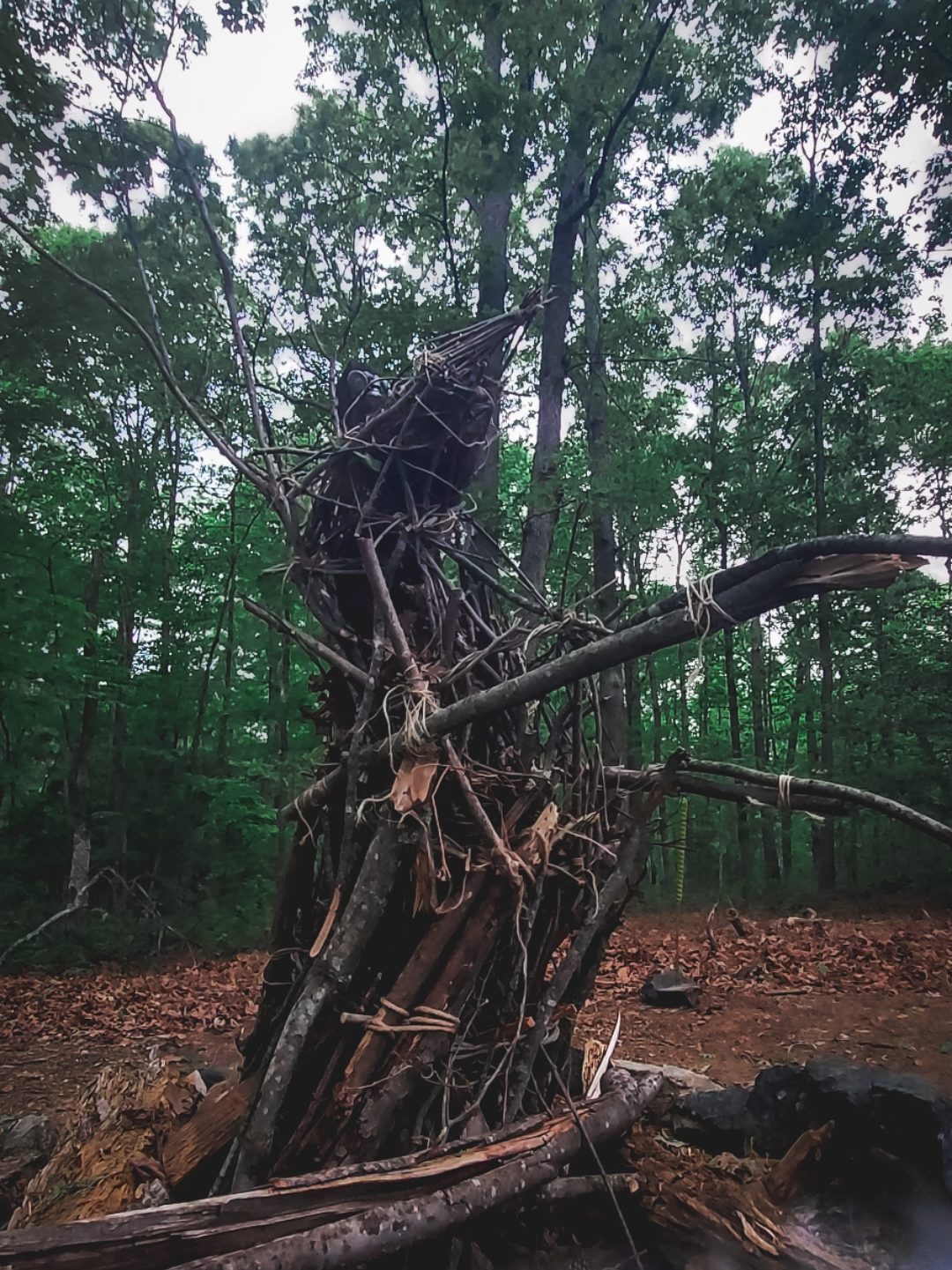
Saturday morning, some of us discussed exactly what to do, while others began building. They harvested deadfall, shaped it, and fastened it together with jute. Mid-afternoon, we had lunch (and subsequently collapsed into a small food coma). Later, we played beat-the-clock against a thunderstorm as we wrote the ritual’s speaking roles, assembled the effigy, and put everything else into place.
As soon as everything was ready, we began.
And it. Was. Awesome.
There was a slow procession to the ritual circle. A soft stream of incense smoke to lift the senses and purify the space as people walked in. Two friends asperged us all with sprigs of fresh, wildcrafted mugwort and sacred water.
The circle itself was marked by colorful candle torches at each cardinal direction. We said a prayer, lighting a candle with each line. There were two short, beautiful speeches about why we were assembled today, and the significance of what we were doing. As we started a melodic chant, one friend lit the effigy.
Also, the effigy was an eight-foot-tall rearing stag…
… that rapidly turned into an enormous bonfire*.
*It was a very controlled bonfire. It was in a fire pit, and there were fire extinguishers and buckets of water at the ready. I’ve had fire safety ingrained in me literally from the blastocyst stage and most of us have lots of bonfire experience, so everything was pretty locked down.
The stag is a representation of the south and the element of Fire. He’s the figurehead of summer, and this one, in particular, represented the energy ramping up toward midsummer. He’s virility, high energy, and the crouch before the leap into action.
Each of us took a dried corn husk — a physical representation of a gift we wanted to offer the group — and lit it with a candle’s flame. Then, we each added our burning cornhusks, our tiny fires, to the massive fire of the burning stag.
Once the flames reached their peak, it was party time. People drummed, rattled, danced, and sang. I played my mouth harp. We had about five or six different rhythms going at the same time, and it was delightful and excellent. There was beauty and poetry and joy and chaos and fun and even a bonus group of concerned/confused citizens.
(We tried to remember songs about fire to sing, but the only one I could think of was “Fire Water Burn” by Bloodhound Gang and it didn’t exactly fit the vibe, YKWIM.)
When the fire died down, we started the return to camp. One friend doused the remains of the fire, while another attempted to harvest a tiny flame from it. They lit a candle with this flame, and a third friend carefully carried it all the way back. My Handsome Assistant and I accompanied them, watching in nothing short of astonishment as the candle managed to burn steadily the whole way. (It had sputtered and gone out mid-ritual, so the fact that it lit and stayed lit at all was nothing short of miraculous.)
Once there, we lit a new fire with the tiny flame taken from the ritual bonfire. With that, we could still sit comfortably around the sacred fire long into the night, ’til a thunderstorm came and sent us all to bed. (As much as it’s no fun camping in the rain, there was something truly delightful about going to bed tired and happy, lulled to sleep by the sound of thunder and the tapping of raindrops.)
There’s a really big sense of accomplishment that comes with making a large thing, evenespecially when you get to set that thing on fire and then party around it.
Some of the friends there were brand new friends. Others have known each other for years. All of us come from incredibly diverse backgrounds, belief systems, and skillsets. Each person contributed what they could — food, ideas, tools, a pair of hands — to make this ritual a rousing success and an absolute blast.
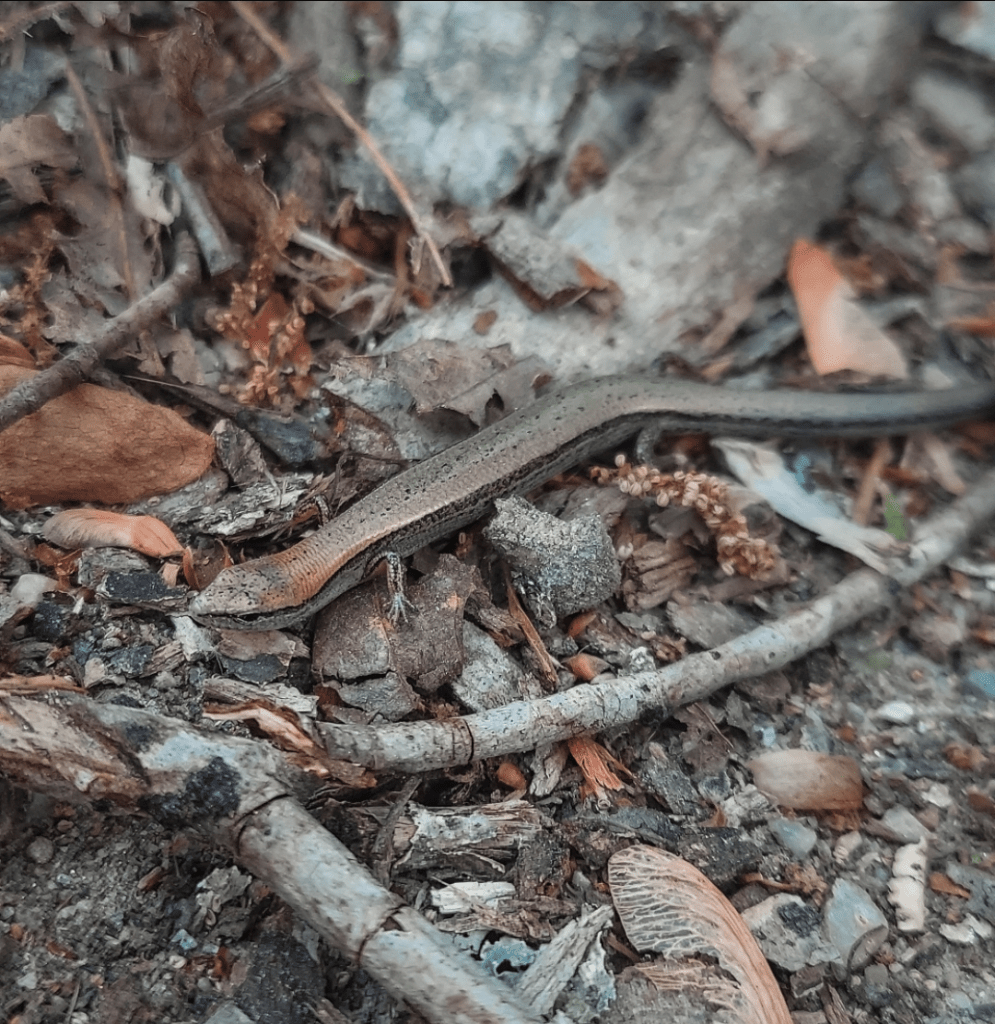
Also, I saw a coal skink (Plestiodon anthracinus, which was awesome because they’re considered endangered here), a little brown skink (Scincella lateralis), a luna moth (Actias luna), an awesome American giant millipede (Narceus americanus), and a huge and gorgeous eastern eyed click beetle (Alaus oculatus). So this was kind of a big weekend for me all around.
It’s a testament to what you can accomplish with a diverse group and a shared goal, and I still haven’t stopped smiling about it. I left with a container of the ashes from the sacred fire, a bag of apples, and what’s most likely some kind of fae curse on my cellphone. I think back on saying goodbye to everyone, and all of the hugs, and smiles, and jokes, and excitement that we managed to pull off something this cool, and it gives me the warm fuzzies. Like a tiny sacred fire that never goes out.
The other day, my Handsome Assistant and I had the chance to watch the movie Moon Garden. It’s a beautiful, strange, surreal, very dark fantasy about a (very parentified) little girl who suffers an injury and falls into a coma. While she’s comatose, she has to find her way through an industrial horror landscape to make it back to her family. The entire movie is done with practical effects, and it has some of the most striking imagery — and villains — I’ve ever seen. Particularly the main antagonist: Teeth.
(Admittedly, I was a bit disappointed that Teeth turned out to be the only villain. The Mud Witch looked extremely cool and I would very much have liked for her to have a bigger role.)
Teeth is a manifestation of emptiness. An anthropomorphization of a chattering teeth toy and her grandpa’s dentures. Human teeth can also be transient — the little girl is at the age when she’d start to lose her baby teeth, and Teeth’s decayed-looking maw is an embodiment of neglect.
Outside of Moon Garden, teeth still have meaning and symbolism. They’re useful, beyond their biological function. They’ve been at the root of myth, legend, and folklore for as long as humanity’s had any of those things (or teeth, for that matter).
Tooth Magical Uses and Folklore
In the US, western Europe, and other areas with a heavily European influence, there’s the Tooth Fairy. When children lose baby teeth, they’re told to put them under their pillows. Then, at night, the Tooth Fairy is said to come to trade a little bit of money for the lost tooth. (Traditionally, anyway. Today, some parents have moved away from giving money and give small toys, stickers, or other treats as “payment” instead.) In Italy, the Tooth Fairy is a little mouse named Topolino. In France, La Petite Souris. In Spain and other Spanish-speaking countries, El Ratoncito Perez. In Scotland, it’s a white rat.
Finland has a modern figure (or figures) known as Hammaspeikko, or “tooth troll.” The tooth troll isn’t a Tooth Fairy like figure, though. Instead, it’s an explanation for dental cavities that comes from a 1949 Norwegian children’s book. Eating candy lures in tooth trolls, and these trolls drill holes in teeth. Luckily, they can be scared away by brushing.
He’s grumpy because he’s got all them teeth and no toothbrush. Photo by RatuL CR♠️ on Pexels.com
Interestingly, the Tooth Fairy doesn’t really have direct parallels in European myth or folklore. Some folklorists say that the idea comes from an old Scandinavian practice of tand-fé, a “tooth fee,” but this is unlikely. In the Norse Eddas, tand-fé is described as ritual in which a child’s mother would give them a small amount of money for the loss of their first baby tooth — no fairies involved.
Ditto for other old practices for dealing with baby teeth. In England during the Middle Ages, children were told to throw their baby teeth in the fire. If they didn’t burn them, they’d spend their afterlife searching for all of their lost teeth.
For the most part, the Tooth Fairy, tooth-burning, and tooth-purchasing do seem connected to one core belief: The idea that those teeth need to be either accounted for or destroyed. There may be a good reason behind this (and it’s not as heartwarming as needing something to put in a baby book or keepsake box).
In spellcraft, there’s the idea of including some “personal concerns” (sometimes called taglocks) in order to help the spell reach and act on its target more effectively. These can be pretty much anything — a piece of jewelry worn by the target, a scrap of fabric cut from their clothing, a shoelace — but the best are physically connected to the target. That means nail clippings, hair, or teeth. These can be used to very good effect — like sending healing to someone through a poppet with a lock of hair inside, or creating a kind of protective magical decoy — but can also be used for ill. Hexes, curses, jinxes, and other attacks work a lot better when they have a good idea of who they’re going to!
In other words, if you didn’t want anyone to work malevolent magic on your offspring, you had better either keep hold of those baby teeth or make sure they’re totally unusable. Children were regarded as a common target of things like the evil eye or the jealousy of spirits, so it’s not a huge leap from “don’t compliment babies too much or they’ll be cursed,” to “better hide all those baby teeth from witches, just in case.”
Alternatively, children’s teeth were sometimes treated as a kind of talisman. In this case, you wanted to keep those teeth for good luck and success in battle.
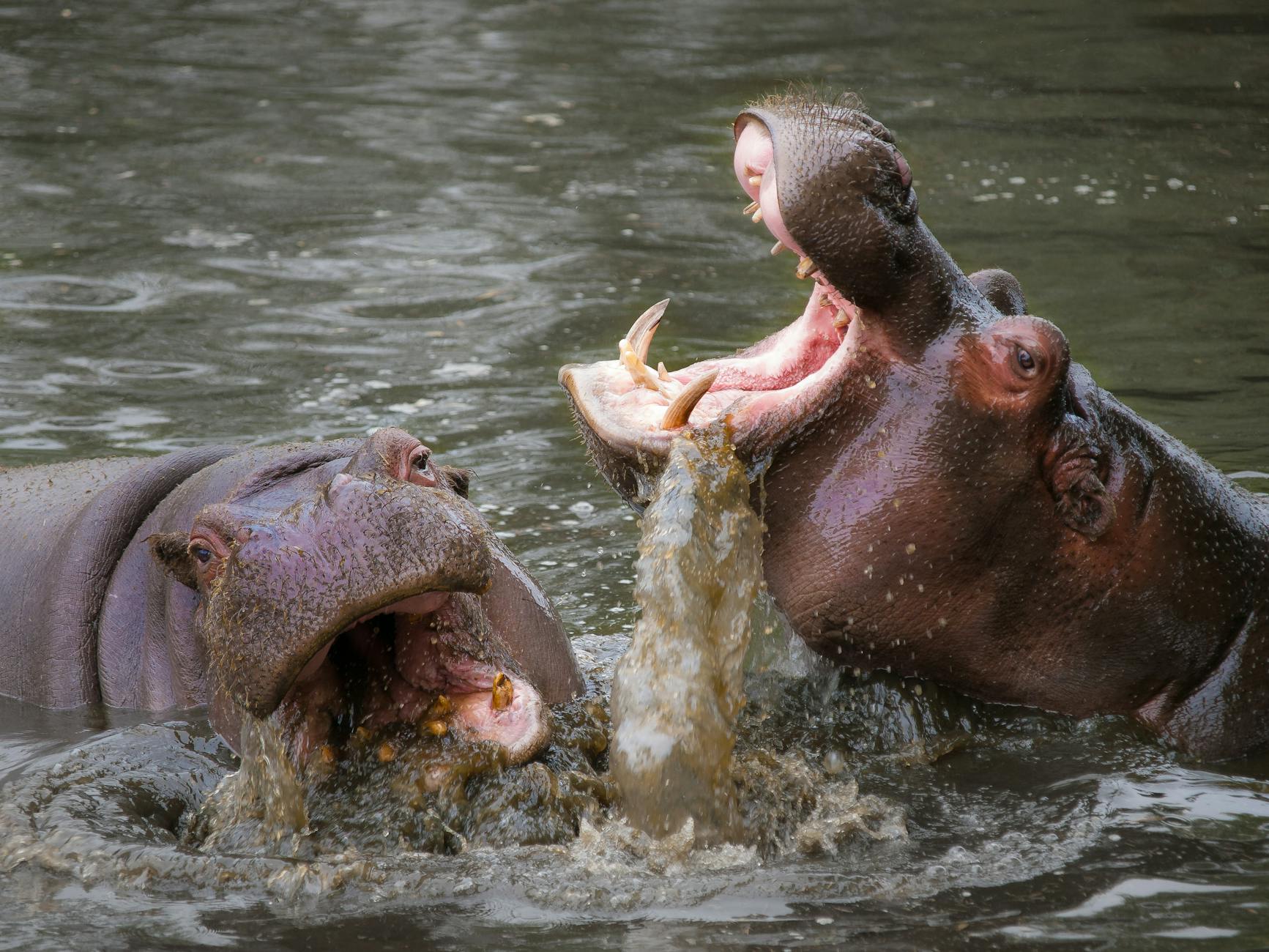
The “success in battle” bit might work better if the teeth in question come from a juvenile hippopotamus, just saying. Look at those things! Photo by William Warby on Pexels.com
Sometimes, mothers would even swallow lost baby teeth, or encourage their children to swallow them.
Another common ritual involved offering the lost tooth to an animal, typically a rodent or other animal with strong teeth. The idea was that, if the animal received the tooth along with the appropriate prayers, the child’s teeth would grow in as strong as the animal’s.
May your offspring have teeth as strong as those of the noble nutria. Photo by Petr Ganaj on Pexels.com
Teeth show up in more than just Tooth Fairy stories. In ancient Greek legend, the teeth of a dragon feature prominently in the story of the quest for the Golden Fleece and the tale of Cadmus. King Aeëtes of Colchis demanded that Jason sow dragon’s teeth given to him by Athena in order to get the Golden Fleece. His daughter, knowing what was up, told Jason that warriors would spring up where the teeth were planted and, if he didn’t want them to turn on him, he needed to throw a stone between them. He did so, and the warriors turned on each other and battled to the death. Cadmus, on the other hand, killed a dragon that served as the guardian of a spring dedicated to Ares, the God of War. Athena gave Cadmus half of the creature’s teeth and told him to sow them as he would seeds. He did so, and fierce warriors sprang up from the soil. He, like Jason, threw a stone into their midst and they all turned on each other. Only five remained standing, and they helped Cadmus found the city of Thebes.
In Chinese medicine, each tooth is said to be connected to a different organ through energy meridians. Pain in a tooth, then, indicates a problem or imbalance with that particular organ.
Using Teeth
Ideally, you have a source of baby teeth. Otherwise, I’d strongly recommend against trying to seek them out elsewhere for magical purposes because 1) it’d hurt, B) it’s likely to be wildly unethical, and III) desecrating corpses is against the law.
They might not be useful for biting, but those tusks are a defensive weapon nonetheless. Photo by Dario Fernandez Ruz on Pexels.com
That aside, human teeth are great taglocks for poppets, spell jars, and other workings. Still, all things considered, you’re probably better off sticking with a lock of hair or a few nail clippings.
Animal teeth are used for animal magic, or (in the case of canine teeth from predators) protection. They can be worn as amulets or talismans on their own or included in protective sachets.
Losing baby teeth is a rite of passage for most kids and parents alike. It’s a sign of growth and, depending on your culture, potentially a source of danger. Whether you still have your teeth saved in a keepsake box somewhere, or you’re creating ways to make visits from the Tooth Fairy special for your own kids, you’re partaking traditions with ancient roots. (No pun intended.)
In the US, this coming Thursday is Thanksgiving. This holiday has a fair amount of folklore and mythology itself — much of which doesn’t actually come anywhere near explaining the truth of the first Thanksgiving. Rather than recount this (especially when so many historians, Indigenous and non, have already done so) I figured I’d look into the creature that is symbolic of Thanksgiving for so many Americans.
The turkey.
I like turkeys (Meleagris species). I think they’re beautiful, for the most part, and I love the noises they make.
(Once, as a tiny child at a Powwow at Queens County Farm, I found a turkey egg. It was unfertilized, of course, but I didn’t know that. I made a small bed for it out of a sweatshirt because I thought sacrificing my hoodie would be enough to keep it warm until it hatched. What I was going to do with a turkey chick after that, nobody knows.)
Turkey Folklore
Turkeys came by their name via a very circuitous route. Originally, colonists thought that they were a kind of guineafowl, an African bird imported through Türkiye. Hence, the turkey.
An Akawaio story speaks of a terrible flood and explains how several animals got their unique traits — turkey included. Makunaima created a single tree that bore food. He also made all of the animals and placed Sigu, his son, in charge of them. While Makunaima was away, Sigu thought it best to cut the tree down and spread the seeds and cuttings so food would be more abundant. Unfortunately, upon felling the tree, Sigu and the animals discovered that the stump was hollow and filled with water and all kinds of freshwater fish. The water began to rise, and Sigu contained it under a magic basket. Unfortunately, Monkey lifted the basket and release the water again, so Sigu led the birds and climbing animals to tall trees for safety, and all of the terrestrial animals into a cave sealed up with wax to keep the water out. Sigu remained in the trees with the birds and climbing animals and, one day, he tried to make a fire. He rubbed two pieces of wood together until a spark appeared, but Bush-Turkey was so hungry that he mistook the spark for a firefly, tried to eat it, and burned himself. This is why turkeys have red throats to this day.
Many old tales portray turkeys as foolish or gullible figures, from some Indigenous American legends to children’s stories like Chicken Little. In fact, a lot of people still believe that turkeys are so unintelligent, they drown in the rain because they stare up at it. They do sometimes look up at the sky for no reason, but this is because of tetanic torticollar spasms — a genetic problem exacerbated by breeding for sizeee and rapid growth, not fitness.
Fortunately, not all stories depict turkeys as foolish. In one Zuni tale, a girl who tends turkeys longs to go to a dance with everyone else. The turkeys, knowing she’s taken such good care of them, promise to help her by dressing her so beautifully that nobody else would recognize her. They only have one condition: She must enjoy the dance but not forget the turkeys who helped her go. The turkeys keep their word, and the girl is able to enjoy the dance. She enjoys it so much, in fact, that she forgets about the turkeys. Annoyed to find that she clearly doesn’t care enough about them, the turkeys leave captivity and run off. The girl chases and chases them, to no avail. Not only can she not catch up to the turkeys, all of the dust and sweat from running has turned her beautiful clothes to rags again. This is why, when you look at Shoya-k’oskwi (Cañon Mesa), you can still see the tracks of the turkeys embedded in the stone. This story highlights the importance of remaining in balance with the animals that give so much to humanity. In it, the turkeys aren’t foolish or gullible — they’re grateful to the girl and trust her to do the right thing. She takes their gifts and forgets to return to care for them, so they leave. One version ends with, “if the poor be poor in heart and spirit as well as in appearance, how will they be aught but poor to the end of their days?”
The Aztec deity Chalchiuhtotolin (Nahuatl for ‘Jade Turkey,” also known as The Jeweled Fowl) is a disease and plague deity. Unfortunately, researchers don’t seem to have much more information about this figure.
In Hopi kachina ceremonies, there’s the Koyona (turkey) kachina. This figure is unique in that it only dances either at night, in the kiva with other birds, or during the Mixed Dances in the springtime.
A common bit of modern lore says that eating turkey makes you sleepy. While turkey does contain tryptophan (which the body converts to serotonin and melatonin) so do a ton of other foods. The urge to take a nap after eating turkey comes from eating a lot of food, not the turkey itself.
Ben Franklin also didn’t push to have the turkey made the United States bird. He wasn’t even part of the 1782 committee that finalized the design of the US seal. In 1784, he wrote a letter to his daughter in which he complained about the Society of the Cincinnati, a military fraternity. Part of his criticism was of the Society’s badge, which included an eagle.
As a birds from North America, turkeys aren’t represented in European, Asian, African, or Middle Eastern mythology. They don’t appear in the Bible, Greek or Roman legends, Celtic oral traditions, nada. (That said, people in Europe did start farming turkeys pretty much as soon as they got their hands on them in the mid-1500s. Ironically, turkey probably wasn’t present at the first Thanksgiving.)
Turkey Symbolism
Since turkeys don’t have a whole lot of representation in world mythology, they’ve been kind of shafted. Colonists, in general, didn’t really care about their place in Indigenous traditions or legends. They were big, dumb birds and it made economic sense to make them bigger and dumber because you get more meat that way. Enter: The Broad Breasted White, America’s most popular commercial turkey.
Turkeys are often symbolic of gullibility and a lack of intelligence.
It’s said that dreaming of a turkey means that you’re acting foolish. If you dream of a turkey flying, then it may represent a rise from obscurity to fame. Dreaming of a dead turkey may symbolize a bruised ego or attack on your pride.
Turkey feathers appear in various magical traditions as representations of birds, animals, and the element of Air. When you buy “imitation eagle feathers,” for example, these are usually actually dyed board breasted white turkey feathers.
Thanksgiving is celebrated as a day for feasting and gratitude, but it isn’t like that for everyone. This year, remember the Mashpee Wampanoag and Wampanoag Tribe of Gay Head who not only suffered the effects of colonization, but the continuing insult of having a false, sanitized version of their own history forced on them and their children. If you are able, please donate to help them continue to preserve their language and culture, as well as provide necessary services to their members.
Saturday, part of the Druidry group took a walk in the woods. It was a silent, contemplative walking meditation, initially meant to observe and enjoy the first frost. However, since this area hasn’t really had a legit frost yet, it was mostly about observing the changes that autumn has brought.
It was a little disheartening to have such good weather. It should be cooler this time of year. I shouldn’t be comfortable in a tank top and a thin jacket in November. I found a woolly bear caterpillar the other day, and its stripes forecast a mild winter, too. Winter precipitation is so important for avoiding droughts later in the year, and I worry about it. There was a serious drought when I lived in California, and I don’t want to go through that again.
Still, part of a walking meditation is about being present. Not to worry about next summer, but to appreciate this autumn as it is. There hasn’t been much rain, but the early evening sky is beautiful, and the bare, dark branches and golden leaves make it look like stained glass. There’s the sweet smell of decomposing leaves, and their satisfying rustle and crunch underfoot. The leaves aren’t all brown yet, so the entire trail is carpeted in gold, deep crimson, and salmon pink. Some of the leaves are multicolored, like they’ve been ice-dyed in shades of red and green.
Also, we found a bunch of little guys.
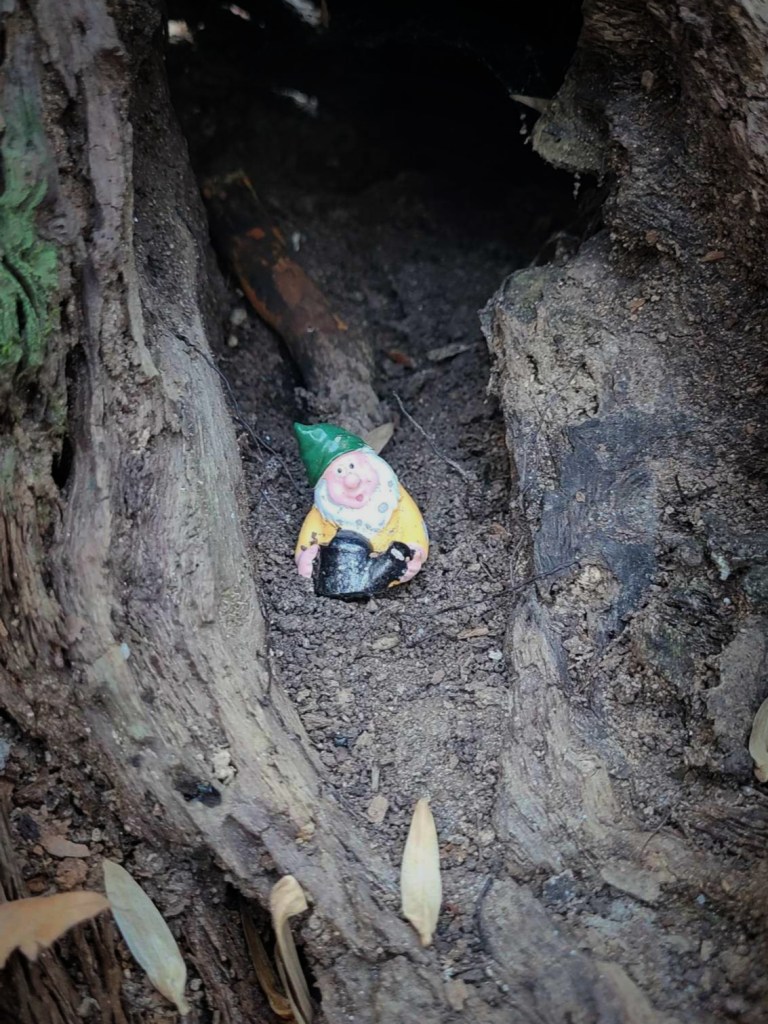
The first one, I found under a small pile of debris in a crevice of a fallen tree. (I always look in gaps and holes in trees — I found some really amazing eyelash mushrooms in one once, so now I check every time I see one.) It looked like a child’s discarded toy, covered in debris and with chipping paint. I felt bad about leaving him, so I picked him up.
Then I found a broken bottle. I didn’t have gloves or a bag for trash picking, so I initially left it where it was… but I only made it about twenty feet before I felt too badly and had to go back for it. I piled the pieces into a sort of avant-garde trash sculpture and continued on, gnome in one hand and broken bottle pile in the other.
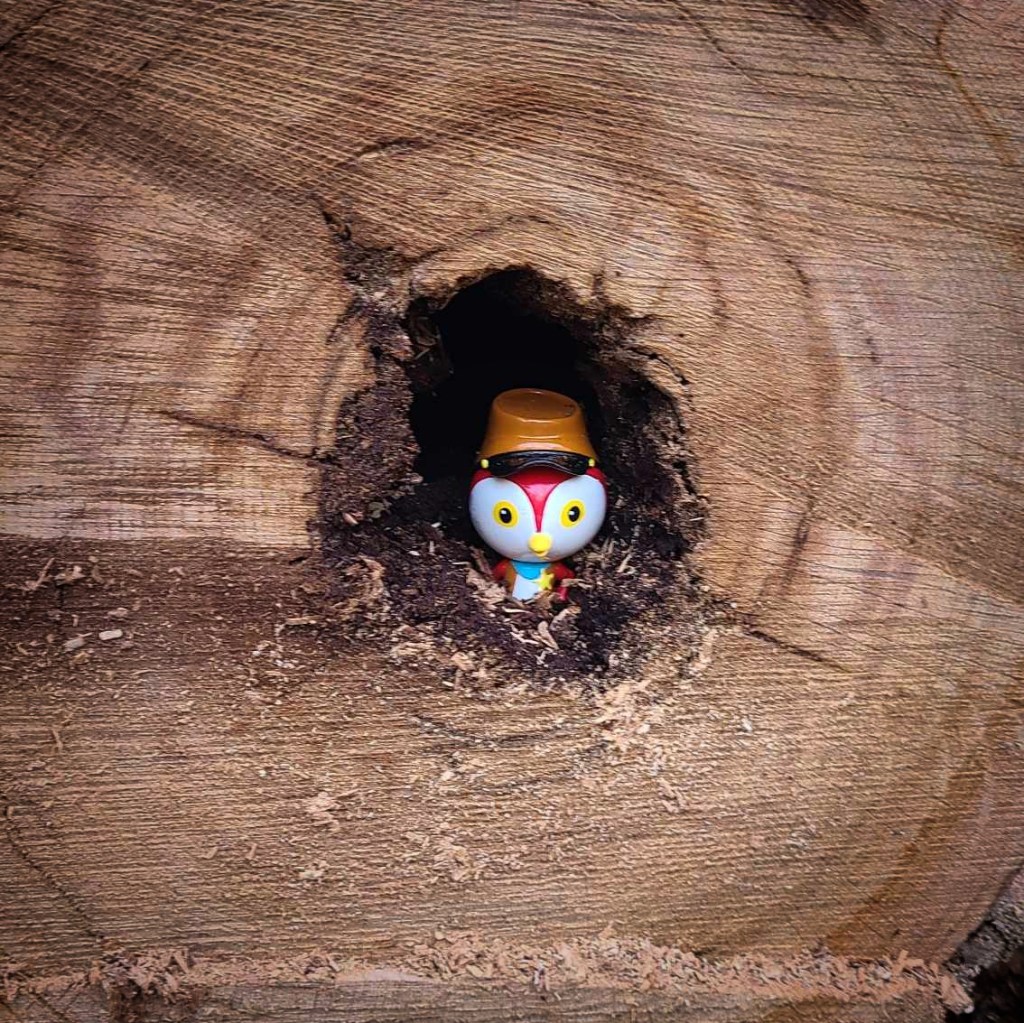
A little further onward, we found a red woodpecker with a sheriff’s badge. His placement was intentional and whimsical, so I left him where he was to be a surprise to another trail-goer. (And kept my eyes peeled for other little guys.)
Then there was a blue elephant. Since we were walking in silence, my Handsome Assistant and I have a series of hand gestures we use when we want to point out things to each other. Mushrooms, particularly interesting sticks, small blue elephants…
And then there was another gnome.
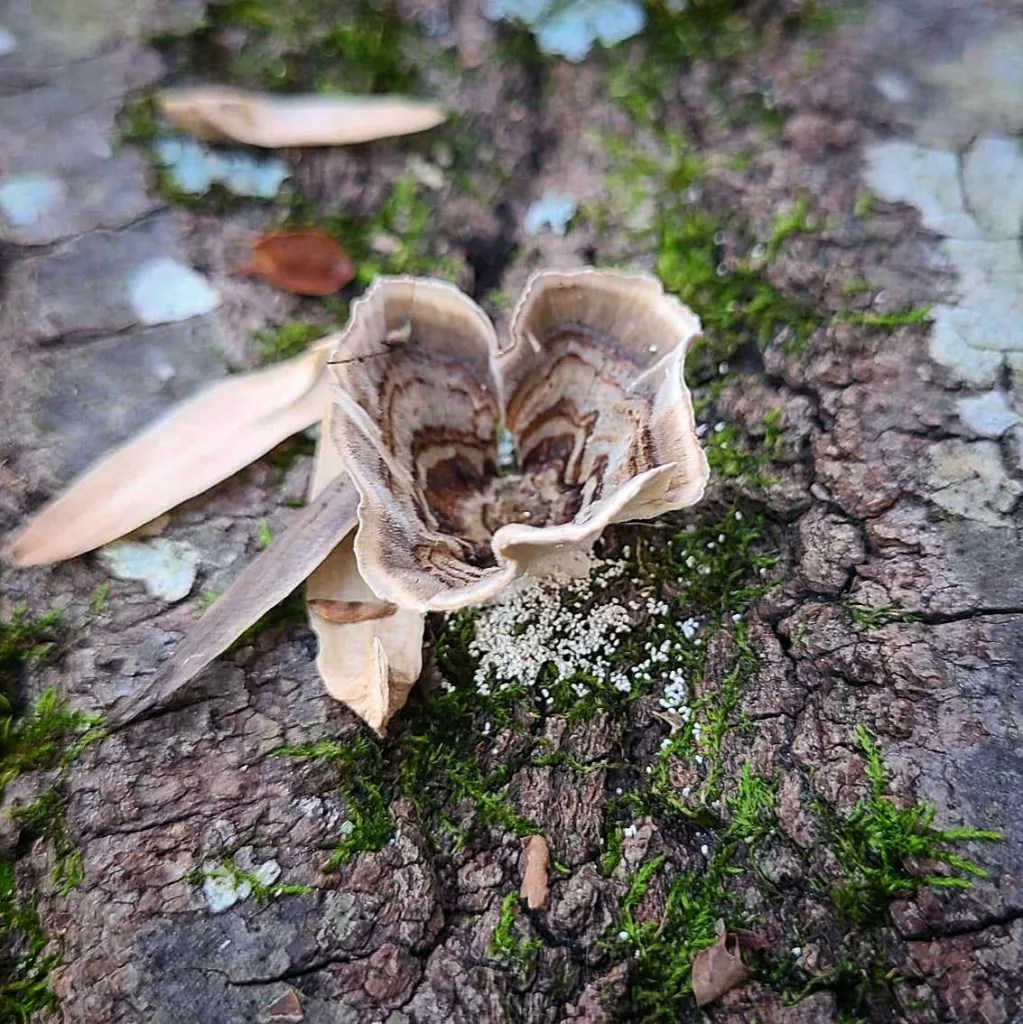
Despite the lack of rain, there were also loads of mushrooms. Striped turkey tails, unfolding like flower petals. Round puffballs like dollops of meringue. Clusters of other fungi, nestled amid fallen leaves, ferns, and small groundcover plants.
As we said our goodbyes to each other and left, we also spotted a chubbly little squirrel absolutely gruffling some gourds. Occasionally, he’d dart away from the sidewalk as people passed, but he’d always go back and resume snacking — thoroughly engrossed, thoroughly enjoying himself, absolutely without a fuck to give.
I could say I want to be more like this squirrel, but I don’t really. I don’t think I really can stop worrying about the future. I like to think this makes me conscientious, but maybe I’m just more anxious than I need to be. Either way, I hope the snow comes soon. In the meantime, I also hope all of the squirrels get their fill of gourds.
If you’re tired of bugs, you’re in luck! This week, we’re taking a look at frog symbolism.
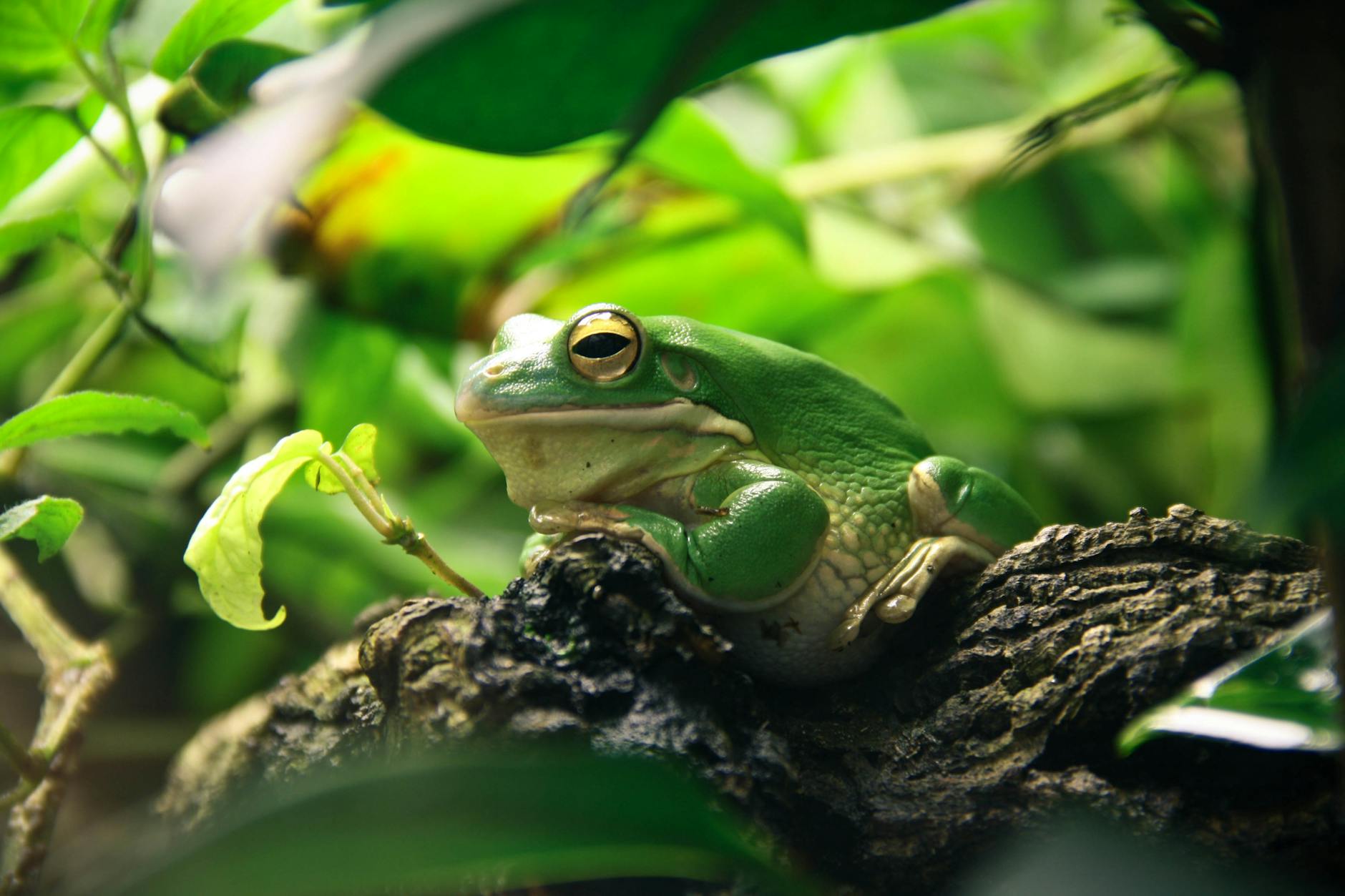
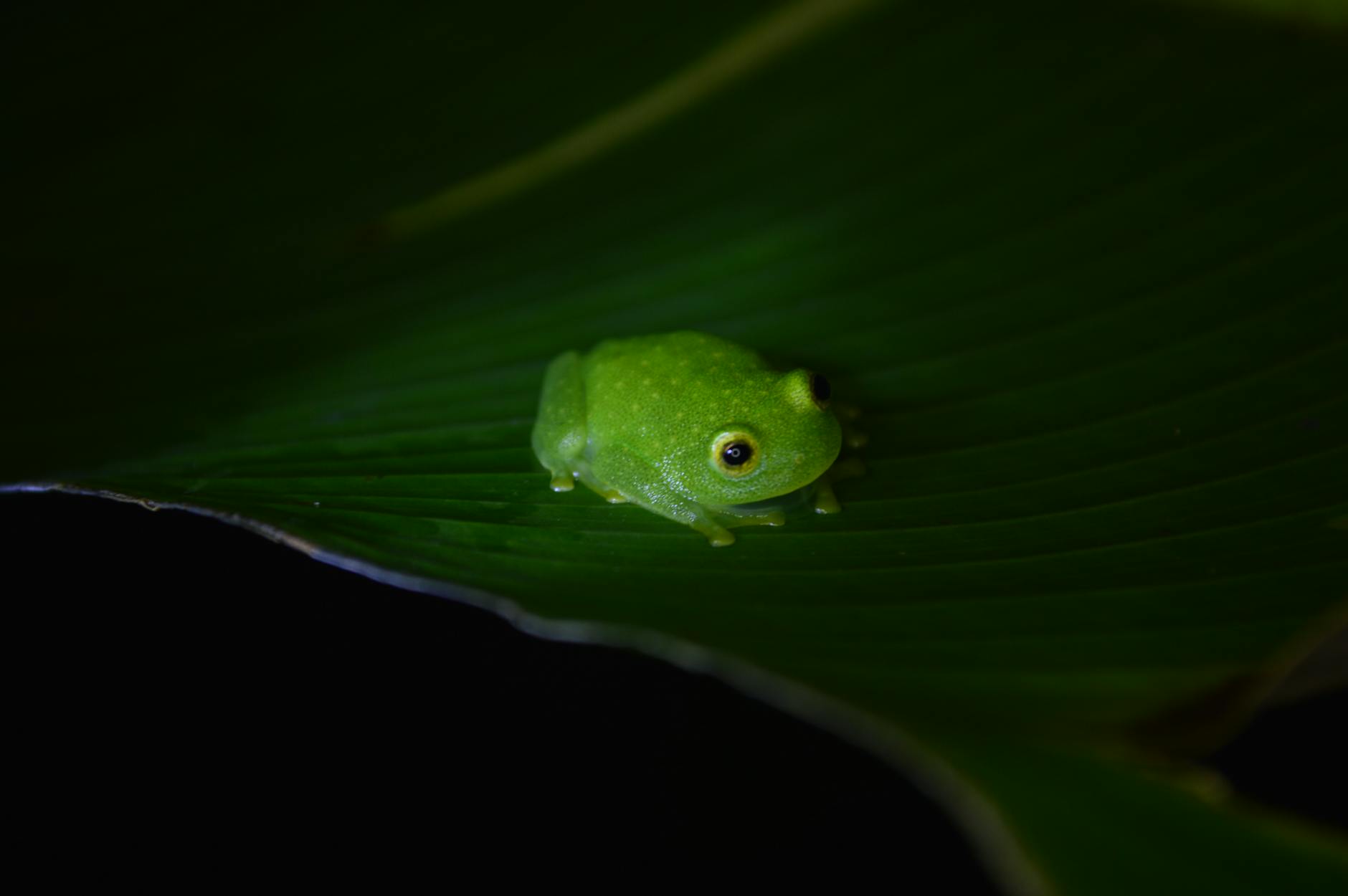
My Handsome Assistant and I went for a walk the other day. It was late in the afternoon, and the weather was perfect for a little stroll to see if the leaves had started changing in earnest yet. While we didn’t see much autumn color yet (which is to be expected, as leaves change a bit later year by year), we did see something else that was pretty cool — a little green tree frog!
He’d camped himself out just under the glow of a path light. It was an ingenious move, since it gave him a virtually all-you-can-eat buffet of bugs attracted to the glow. He held still while we did a little amphibian photoshoot, with a backdrop of asters.
Frog Folklore and Mythology
Frog symbolism is one of the most ancient and enduring features of civilizations around the world. According to The Book of Symbols, “[f]igures with a frog’s body and a woman’s face and genitalia have been found dating to as long ago as 6000 BCE, suggesting that the notion of a frog goddess is extremely ancient.” The book also notes that there are similarities in the posture of a human giving birth and a frog sitting.
The above similarity may be part of why frogs are sacred to the Egyptian goddess Heqet, a Goddess of Fertility. Frog symbolism is also rooted in the yearly flooding of the Nile, when the water (and nutrient-rich silt it brought with it) brought greater fertility to the land. Frogs also reproduce in water, depositing their eggs either in the water directly, or on leaves where their spawn can easily fall into water upon hatching. Interestingly, Heqet may be the origin of the name of the Greek Goddess of Witchcraft, Hecate.
Southward, in South Africa, the ǀXam-ka ǃʼē people had traditions surrounding frogs and menstrual seclusion. The frog deity !Kwah was said to watch over women and girls during this time. If any were to defy this deity and leave seclusion, they and their families would be turned into frogs.
In Mayan culture, frogs were rainmakers. They held an important role in the story of Kumix, a deity of maize, the sun, and rain. In some versions, they act as directional rain deities that reside on mountains. Here, again, is a connection between frogs and life-giving water — however, rather than the flooding of the Nile, the water comes from rain. In Diné legend, frog symbolism is also associated with the cardinal directions. In the story of the creation and destruction of the First World (which we mentioned in the post about wasps), Frog lived in the sea to the west. Frog was also one of the creatures who became upset when the world grew crowded and chaotic.
In Hindu legends, frogs are associated with the sun. Bheki is a frog that represents the sun on the horizon. It’s said that Bheki was originally a beautiful woman. A king fell in love with her, and she agreed to marry him on one condition: He must never, ever show her a single drop of water. One day, Bheki grew tired and asked for a drink. Her husband brought her water, and she sank out of sight like the sun beneath the water.
In feng shui, the Jin Chan (金蟾) is a charm for prosperity. Often translated as “money frog” or “money toad,” it is most commonly represented as a bullfrog with two forelegs and one hind leg, seated on a pile of coins with another coin in its mouth. This charm is said to protect against bad luck and help draw wealth into the household. For this reason, it shouldn’t be placed facing an exterior door, or in the bathroom or kitchen (where water flows out of the house). While the connection between frog symbolism and water isn’t really explicit here, there are connections between fertility and prosperity through the concept of multiplying one’s desires or good fortune. In Egypt, the Nile floods, and the land’s fertility brings prosperity. In Meso- and South America, rain brings fertility to the land, and the land’s abundance brings prosperity. In Chinese mythology, the Jin Chan is also connected to the moon — it’s said to appear on a full moon, near homes and businesses that are about to experience positive financial news. As the moon is also intimately connected to water through the tides, this may be another frog-to-water-to-prosperity connection.
Given the ubiquity of frog symbolism in myth and legend, it’s next to impossible to recount all of them here. Fortunately, a number of common threads arise with just a little bit of scrutiny. Frogs reproduce in water and are active where water is abundant. They’re thus connected to fresh, life-giving water, rain, and the fertility of the land. Through this, it’s also possible to see connections to abundance, prosperity, and fertility in general.
Sometimes, frogs also play key roles in the creation of people or civilization. This is particularly interesting, because it often involves a transformation in either direction. In Myanmar, the Va people believed that their ancient ancestors were two tadpoles that grew into frogs, and eventually into ogres. These ogres consumed all kinds of animals until, one day, they ate humans. From that day forth, they were able to reproduce and create human offspring — the ancestors of the Va. On the other hand, in Vietnam, Bahnar legend tells that a human became a frog and ascended to the heavens to become a God of Agriculture.
On the other hand, frog symbolism isn’t always positive or life-giving. In Christian mythology, frogs are one of the plagues of Egypt and spew forth from the mouths of monsters. Frogs are also common fodder for witchcraft folklore. How many times have you heard stories of witches turning someone into a frog or toad? Even children’s tales like The Frog Prince revolve around such a transformation. You can see this reflected in modern media, too — ask anyone who’s ever played one of the older Final Fantasy games. Getting turned into a frog in the middle of a battle sucks.
Frog Symbolism
Through their connection to water (and their own abundant procreation), frogs are tied to fertility. This isn’t just the fertility of animals and humans, but of the land itself.
Frog symbolism is also connected to cleansing, renewal, or purification. This is through frogs’ connection to water, but also because of their unique biology: Frog skin is a respiratory surface. It’s very permeable, and very susceptible to damage from imbalances in water chemistry. Frogs can’t thrive where things are dirty, and they are one of the “canaries in the coal mine” for water pollution.
Frogs also represent transformation, of a variety of types. There’s the very obvious transformation from egg, to tadpole, to froglet, to frog, but there’s also more subtle, alchemmical ideas at play. As The Book of Symbols explains,
In dreams and fairy tales the frog arrives, quite suddenly, out of water somewhere, just as an aspect (often princely) of self-substance emerges from the waters of the unconscious, but is not yet in fully conscious, recognizable form. In many such fairy tales, this fertile little being from the watery regions must be accepted and attended to in its frog form, however unattractive or odd it may seem, and inevitably it transforms into the soulful prince or princess.”
Dreaming of frogs is said to herald a change or transformation. If the frog catches a bug, it symbolizes seizing an opportunity. If you eat the frog, it represents an unpleasant task that needs doing. On the other hand, seeing leaping frogs can represent an inability to commit to a person, idea, or situation.
Frogs are one of our longest-enduring symbols, and frog symbolism is present in everything from creation myths to children’s tales and poems. Not only do these creatures help keep pest populations in check, they’re also powerful symbols of renewal, transformation, fertility, and prosperity.
Last week was spiders, this week we’re doing wasps.
Why wasps?
In temperate climates, late summer and early autumn when many wasps (the eusocial ones, at least) start losing direction. Like kids on spring break, they no longer have the structure they once did — the nest is likely done producing larvae, the newly-created queens are getting ready to hibernate, and the wasply lifecycle comes to a close to start back up in spring. This means that the workers, if they haven’t died already, are about to.
The lack of larvae to raise also means that the wasps’ dietary habits shift. Where babies need protein in order to grow big and strong (and adequate protein is so important, worker wasps have been observed shoving drones into lockers in order to make sure that the larvae eat first), the workers have already done all the growing they’re going to do. They don’t need a high protein diet; they need carbs for energy. This often puts them in conflict with humans, as sugar sources start to wind down a bit this time of year and humans are generally a veritable bonanza of sugary treats.
So, if you’re noticing larger numbers of more aggressive wasps than usual, that’s probably why. They’re hungry, and they’re on a kind of wasply rumspringa. Don’t worry, though — they won’t be around much longer. It’ll get cold, the workers will die off, the queens will hibernate, et fin.
Right now, we have a wasp nest beneath a tree stump. We considered removing it, but it’s late enough that nature will take its course pretty soon, and then we can fill in the cavity to keep anyone else from setting up shop.
In honor of the last of the summer’s wasps, here are various bits of folklore, mythology, and magical properties associated with these creatures.
Wasp Folklore
Insects feature pretty frequently in Japanese folklore and mythology, wasps included. In one story, the deity Susanoo-mikoto ordered his son-in-law, Ôkuninushino-kami, to sleep in a room infested with wasps and centipedes. Fortunately, Suseribimeno-mikoto, his wife, gives him an insect-repelling cloth to protect him.
One of the plays of Aristophanes, an ancient Greek playwright, is titled The Wasps. In it, the titular wasps are a group of jurors. Bdelycleon, son of Philocleon, has imprisoned his father after many, many unsuccessful treatments for Philocleon’s seeming addiction to trials. When the jurors (Philocleon’s comrades) learn of his imprisonment, they swarm Bdelycleon like wasps. Bdelycleon eventually gives in, and turns the house into a “courtroom” where his father can judge household disputes.
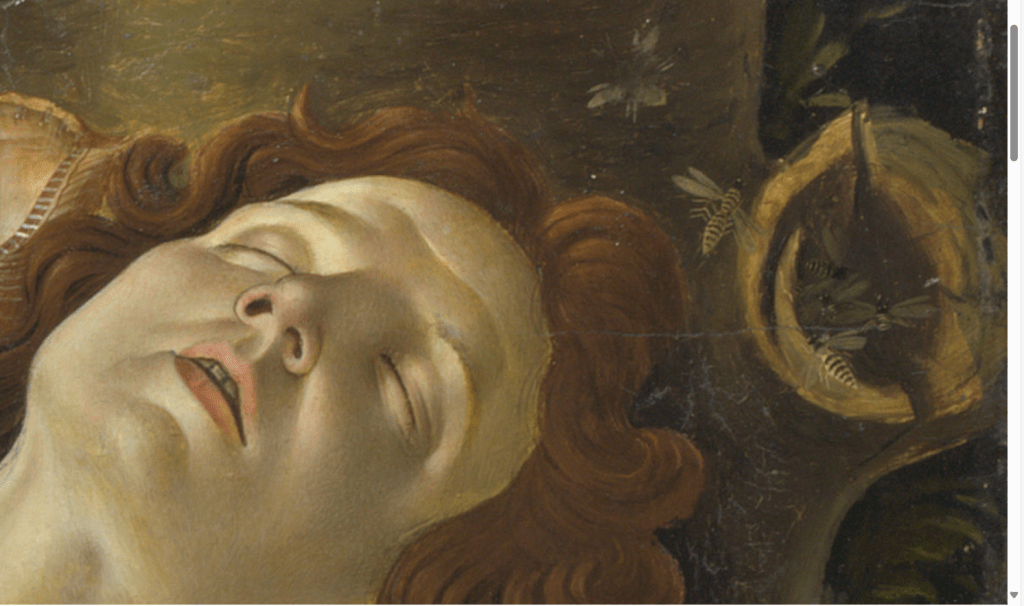
In Boticelli’s painting Venus and Mars, there’s a small wasp nest far to the right, near Mars’ head. Wasps are associated with Mars (and his Greek counterpart, Ares) as animals that are considered aggressive or warlike, but this may not be why Boticelli chose to include them. The painting may have been commissioned by the Vespucci family (from the Italian “vespa,” or “wasp”), and the inclusion of the wasp nest may have been a nod to that.
Ichneumon wasps, a family of parasitoid wasps, were also instrumental in strengthening Charles Darwin’s doubts about the existence of a benevolent creator:
I cannot persuade myself that a beneficent and omnipotent God would have designedly created the Ichneumonidae with the express intention of their feeding within the living bodies of caterpillars[.]
I have seen multiple references to wasps as sacred animals in Indigenous American cultures, but haven’t found many specific examples of this — particularly examples sourced from Indigenous peoples themselves. This isn’t to say that this isn’t true, but any references to wasps as sacred, totemic, or spirit animals in generic “Native American” culture should be taken with a grain of salt. (North America is kind of a huge place.) One specific story comes from the Diné people and tells the story of the First World — known as Ni’hodilhil, the Dark or Black World. This was a black place surrounded by four cloud columns: Black Night to the north, White Dawn to the east, Blue Daylight to the south, and Yellow Twilight to the west. The First Man, along with a perfect ear of white corn, was formed at the place where Black Night and White Dawn met. The First Woman, along with a perfect ear of yellow corn, was formed where Blue Daylight and Yellow Twilight met. At that time, creatures did not have their present forms. They were as mists, but would one day become their present shapes. In the story, the first man and first woman meet and live together. Gradually, other beings appear. First is Great-Coyote-Who-Was-Formed-in-the-Water, who hatched from an egg and knew all that went on under the water. Second was another Coyote, First Angry, who insisted that he had been born first, and brought witchcraft into the world. After that, four more beings appeared. They were the Wasp People, and they knew how shoot and harm others. They were followed by the Red Ants, the Black Ants, and many others, until the world became crowded and was full of arguing. Eventually, the Gods became angry and the occupants of the First World were forced to leave. The First Man planted a reed in the east, which grew tall and strong. The First Man, First Woman, and all of the other creatures of the world climbed up it to safety, to the Second World.
Ahti, a little-known Egyptian deity, was represented as a hippopotamus with the head of a wasp. Not much is known about her, though her interesting composition has led some scholars to associate her with chaos, disorder, and spite.
In Hindu mythology, wasps are associated with Bhramari — the goddess of bees. Bees, wasps, hornets, spiders, termites, mosquitoes, and biting flies cling to her body, and she could send them out to attack for her. In the tenth book of the Devi Bhagavata Purana, there is a powerful asura named Aruna. He performs a penance to Brahma, and, in return, Brahma makes it so Aruna cannot be killed in war by any man, woman, weapon, bipedal creature, quadrupedal creature, or any combination thereof. Feeling suitably overpowered, Aruna called on other beings to attack the devas. He nearly succeeded in beating them, too, until Adi Parashakti appeared and began releasing bees from her hands. Calmly, she continued releasing insects that clung to her body, making her larger and larger and creating the divine form of Bhramari. When all of Aruna’s army had been defeated except him, she released her insects upon him to tear him limb from limb.
John Gerard, a sixteenth century herbalist, had a method of tree divination using acorns. The technique involved finding an acorn at a specific time of year (likely autumn), breaking it open, and examining the contents:
If there was an ant inside, there’d be an abundant harvest in the coming year.
On the other hand, a worm that attempts to crawl away means a light harvest.
A spider was a harbinger of pestilence for humans.
A white worm was a harbinger of pestilence for animals.
If the worm thrashed and turned away, however, it meant the plague.
If there was a worm that “flew away” (perhaps by growing into an adult knopper gall wasp), it foretold war.
Some modern witches use deceased wasps as an ingredient in banishing or protective powders. Combine them with ingredients like salt, hot pepper, and garlic, and grind to a fine powder. Use to dress candles, sprinkle around borders, et cetera.
The Symbolism of Wasps
Wasps represent war, arguments, and violence. This is probably undeserved, as there are plenty of non-aggressive wasp species. (I mean, I woke up the other day with a little ichneumon wasp crawling on my leg. She was tiny, harmless, and seemed at least as confused as I was, considering both of us were A) in a bed and B) under a blanket.)
Wasps’ violence isn’t always unjustified, however. These creatures, and stinging insects in general, also frequently represent punishment and wrath. Even in the story of Bhramari, where wasps are part of the insect army that eventually defeat Aruna, they are part of the righteous, defensive wrath of the goddess.
They’re also symbols of strictly enforced boundaries and protection.
On the other hand, dreaming of wasps is said to represent evil and negative emotions. Dreams of being stung by a wasp may indicate envy. Killing a wasp in a dream represents bravery in overcoming the negativity or malicious actions of others.
Are wasps aggressive? They certainly can be, but this isn’t directionless aggression. In reality, they’re very protective. The trouble is, it’s often difficult for humans to tell where our territory ends and theirs begins, which frequently brings us into conflict. Still, wasps perform very important functions as pollinators and predators of pest insects, so it’s worth learning about your local wasp species and finding ways to coexist whenever possible. Sometimes that long “stinger” is just an ovipositor, and that wasp is on the way to take care of your garden for you!
Last week was spiders, this week we’re doing the magical meaning and symbolism of wasps.
Why wasps?
In temperate climates, late summer and early autumn when many wasps (the eusocial ones, at least) start losing direction. Like kids on spring break, they no longer have the structure they once did — the nest is likely done producing larvae, the newly-created queens are getting ready to hibernate, and the wasply lifecycle comes to a close to start back up in spring. This means that the workers, if they haven’t died already, are about to.
The lack of larvae to raise also means that the wasps’ dietary habits shift. Where babies need protein in order to grow big and strong (and adequate protein is so important, worker wasps have been observed shoving drones into lockers in order to make sure that the larvae eat first), the workers have already done all the growing they’re going to do. They don’t need a high protein diet; they need carbs for energy. This often puts them in conflict with humans, as sugar sources start to wind down a bit this time of year and humans are generally a veritable bonanza of sugary treats.
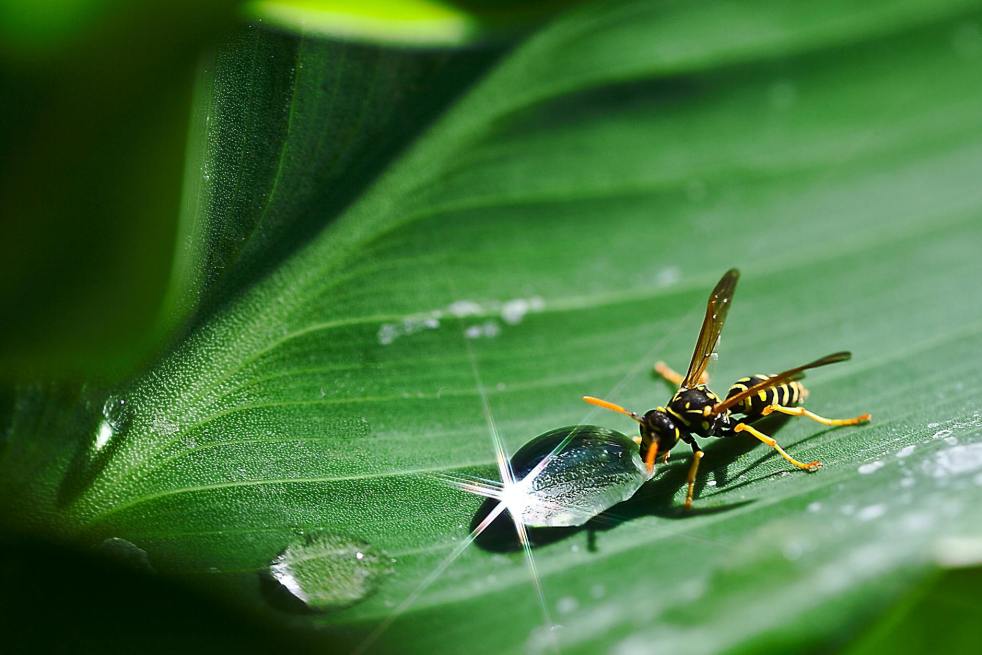
This one’s weirdly cute. Photo by David Hablu00fctzel on Pexels.com
So, if you’re noticing larger numbers of more aggressive wasps than usual, that’s probably why. They’re hungry, and they’re on a kind of wasply rumspringa. Don’t worry, though — they won’t be around much longer. It’ll get cold, the workers will die off, the queens will hibernate, et fin.
Right now, we have a wasp nest beneath a tree stump. We considered removing it, but it’s late enough that nature will take its course pretty soon, and then we can fill in the cavity to keep anyone else from setting up shop.
In honor of the last of the summer’s wasps, here are various bits of folklore, mythology, magical properties, and the symbolism of wasps.
Wasp Folklore
Insects feature pretty frequently in Japanese folklore and mythology, wasps included. In one story, the deity Susanoo-mikoto ordered his son-in-law, Ôkuninushino-kami, to sleep in a room infested with wasps and centipedes. Fortunately, Suseribimeno-mikoto, his wife, gives him an insect-repelling cloth to protect him.
One of the plays of Aristophanes, an ancient Greek playwright, is titled The Wasps. In it, the titular wasps are a group of jurors. Bdelycleon, son of Philocleon, has imprisoned his father after many, many unsuccessful treatments for Philocleon’s seeming addiction to trials. When the jurors (Philocleon’s comrades) learn of his imprisonment, they swarm Bdelycleon like wasps. Bdelycleon eventually gives in, and turns the house into a “courtroom” where his father can judge household disputes.
In Boticelli’s painting Venus and Mars, there’s a small wasp nest far to the right, near Mars’ head. Wasps are associated with Mars (and his Greek counterpart, Ares) as animals that are considered aggressive or warlike, but this may not be why Boticelli chose to include them. The painting may have been commissioned by the Vespucci family (from the Italian “vespa,” or “wasp”), and the inclusion of the wasp nest may have been a nod to that.
Ichneumon wasps, a family of parasitoid wasps, were also instrumental in strengthening Charles Darwin’s doubts about the existence of a benevolent creator:
I cannot persuade myself that a beneficent and omnipotent God would have designedly created the Ichneumonidae with the express intention of their feeding within the living bodies of caterpillars[.]
I have seen multiple references to wasps as sacred animals in Indigenous American cultures, but haven’t found many specific examples of this — particularly examples sourced from Indigenous peoples themselves. This isn’t to say that this isn’t true, but any references to wasps as sacred, totemic, or spirit animals in generic “Native American” culture should be taken with a grain of salt. (North America is kind of a huge place.) One specific story comes from the Diné people and tells the story of the First World — known as Ni’hodilhil, the Dark or Black World. This was a black place surrounded by four cloud columns: Black Night to the north, White Dawn to the east, Blue Daylight to the south, and Yellow Twilight to the west. The First Man, along with a perfect ear of white corn, was formed at the place where Black Night and White Dawn met. The First Woman, along with a perfect ear of yellow corn, was formed where Blue Daylight and Yellow Twilight met. At that time, creatures did not have their present forms. They were as mists, but would one day become their present shapes. In the story, the first man and first woman meet and live together. Gradually, other beings appear. First is Great-Coyote-Who-Was-Formed-in-the-Water, who hatched from an egg and knew all that went on under the water. Second was another Coyote, First Angry, who insisted that he had been born first, and brought witchcraft into the world. After that, four more beings appeared. They were the Wasp People, and they knew how shoot and harm others. They were followed by the Red Ants, the Black Ants, and many others, until the world became crowded and was full of arguing. Eventually, the Gods became angry and the occupants of the First World were forced to leave. The First Man planted a reed in the east, which grew tall and strong. The First Man, First Woman, and all of the other creatures of the world climbed up it to safety, to the Second World.
Ahti, a little-known Egyptian deity, was represented as a hippopotamus with the head of a wasp. Not much is known about her, though her interesting composition has led some scholars to associate her with chaos, disorder, and spite.
In Hindu mythology, wasps are associated with Bhramari — the goddess of bees. Bees, wasps, hornets, spiders, termites, mosquitoes, and biting flies cling to her body, and she could send them out to attack for her. In the tenth book of the Devi Bhagavata Purana, there is a powerful asura named Aruna. He performs a penance to Brahma, and, in return, Brahma makes it so Aruna cannot be killed in war by any man, woman, weapon, bipedal creature, quadrupedal creature, or any combination thereof. Feeling suitably overpowered, Aruna called on other beings to attack the devas. He nearly succeeded in beating them, too, until Adi Parashakti appeared and began releasing bees from her hands. Calmly, she continued releasing insects that clung to her body, making her larger and larger and creating the divine form of Bhramari. When all of Aruna’s army had been defeated except him, she released her insects upon him to tear him limb from limb. This story is especially interesting because the warlike symbolism of wasps is still present, but used in a defensive, benevolent sense.
John Gerard, a sixteenth century herbalist, had a method of tree divination using acorns. The technique involved finding an acorn at a specific time of year (likely autumn), breaking it open, and examining the contents:
If there was an ant inside, there’d be an abundant harvest in the coming year.
On the other hand, a worm that attempts to crawl away means a light harvest.
A spider was a harbinger of pestilence for humans.
A white worm was a harbinger of pestilence for animals.
If the worm thrashed and turned away, however, it meant the plague.
If there was a worm that “flew away” (perhaps by growing into an adult knopper gall wasp), it foretold war.
Some modern witches use deceased wasps as an ingredient in banishing or protective powders. Combine them with ingredients like salt, hot pepper, and garlic, and grind to a fine powder. Use to dress candles, sprinkle around borders, et cetera.
The Symbolism of Wasps
The symbolism of wasps generally revolves around war, arguments, and violence. This is probably undeserved, as there are plenty of non-aggressive wasp species. (I mean, I woke up the other day with a little ichneumon wasp crawling on my leg. She was tiny, harmless, and seemed at least as confused as I was, considering both of us were A) in a bed and B) under a blanket.)
Wasps’ connection to violence isn’t always unjustified, however. These creatures, and stinging insects in general, also frequently represent punishment and wrath. Even in the story of Bhramari, where wasps are part of the insect army that eventually defeat Aruna, they are part of the righteous, defensive wrath of the goddess.
They’re also symbols of strictly enforced boundaries and protection.
On the other hand, the symbolism of wasps in dreams is linked to evil and negative emotions. Dreams of being stung by a wasp may indicate envy. Killing a wasp in a dream represents bravery in overcoming the negativity or malicious actions of others.
Are wasps aggressive? They certainly can be, but this isn’t directionless aggression. In reality, they’re very protective. The trouble is, it’s often difficult for humans to tell where our territory ends and theirs begins, which frequently brings us into conflict. Still, wasps perform very important functions as pollinators and predators of pest insects, so it’s worth learning about your local wasp species and finding ways to coexist whenever possible. Sometimes that long “stinger” is just an ovipositor, and that wasp is on the way to take care of your garden for you!
(If you’re arachnophobic, you probably want to skip this one. Don’t worry — I’ll be back next week with some more non-spider related lore.)
This is Matilda. I was out checking for more ground candy (aka, the delicious maypops that fall off my porch’s vines when they’re ripe), when I happened to look up and realize that I was face-to-face with a massive orbweaver (Neoscona species).
Later that afternoon, once she’d had a chance to build a sizeable web right across the upper part of my window, I very carefully opened the window to snap multiple pics of her from a variety of angles. It was then that I realized that there was a fire truck and an ambulance in front of one of my neighbor’s houses.
(Note to neighbors: THERE WAS A COOL SPIDER.I PROMISE THAT I’M NOT A MANIAC.)
(Also the emergency vehicles left pretty uneventfully, so hopefully everyone is okay.)
*Ahem*
Anyhow, this is the time of year when sightings of these guys peak around here. So, in honor of Matilda, I figured now would be a good time to write a bit about the magical meaning of spiders.
Spider Folklore
In Greek mythology, the first spider was a woman named Arachne. She was a marvelously talented weaver — allegedly better than Athena herself. She challenged her to a weaving contest, and Arachne’s weaving was, indeed, very beautiful. However, while her weaving was flawless, Arachne had chosen to create a tapestry mocking the gods. (In some tellings, Athena is simply enraged by Arache’s pride.) Angered, Athena transformed her into a spider.
In Catholic Christian mythology, spiders are connected to faith. Saint Conrad of Constance, a German bishop, is said to have seen a spider fall into his cup during Easter Mass. While it was widely believed that all spiders were venomous (or, in this case, poisonous) Conrad drank the wine and trusted in his faith to preserve him.
Probably the best-known spider in mythology is Anansi, from the Ashanti people. He’s viewed as a cunning trickster figure. He’s so prominent, that he gave rise to the term “spider tales,” which encompasses several kinds of story within the Ashanti oral tradition.
In North America, spiders were viewed as either trickster figures, or ingenious creators. The Hopi and Diné people have Spider Grandmother, who plays a key role in the creation of the world.
In Peru, spiders frequently appear in ancient artworks (including the famous Nazca lines). While the specific significance of these depictions is often uncertain, it is known that the Cupisnique people had a spider deity associated with weaving, nets, war, and power.
In Australia, spiders sometimes appear in art and as clan totems.
The people of Kiribati Island and the Republic of Nauru, of Micronesia, both have spider figures that play a central role in their creation mythology.
In Japan, there are spider-like yokai called ogumo, yatsukahagi, or tsuchigumo. Tsuchigumo translates as “earth spider,” but likely didn’t originate as a spider at all. Historian Yoshiyuki Takioto put forth the idea that tsuchigumo were local chieftains (described as short people with long limbs, who lived in caves, eschewed civilization, and disregarded the imperial court), These chieftains were most likely shamans. The yokai tsuchigumo first turns up in medieval literature, as a spider-like figure 60 meters long. When killed, the heads of almost 2000 people fell from its belly.
In Scotland, spiders were an inspirational figure during the First War for Scottish Independence. After a series of defeats, Robert the Bruce hid in a cave. While there, he watched a spider struggle to climb a strand of silk. Despite failing over and over, the spider eventually succeeded. This gave him the encouragement he needed to go back into battle and eventually win Scotland’s independence.
It’s often said to be bad luck to kill a spider that you find in your home. This has a (perhaps unsurprising) grain of truth to it — killing spiders in your house means that you’re opening yourself up to all of the much less desirable things that spiders eat. If an infestation of flies or ants looks like bad luck to you, then you might want to heed this bit of folklore!
In dream dictionaries, dreaming of spiders is believed to represent:
Feeling like an outsider — like a spider in a web in the corner of a room.
Wanting to be an outsider.
A protective force.
A strong or overbearing feminine figure.
Rewards for one’s hard work.
Unpleasant relationships. Relationships one can’t escape, a (usually feminine) person who is draining one’s energy, a conflict with an overbearing person.
However, dreaming specifically of a rainbow colored spider is said to point to a situation that you probably want to avoid.
The Symbolism of Spiders
Spiders have far-reaching symbolism. Across cultures, they’ve been everything from tricksters to cosmic creators, to the unfortunate fate of the proud.
In general, these animals are associated with industry and creativity. Spider webs come in an astonishing variety of shapes and sizes — from small, silk-lined burrows to impressive constructs that are as delicate as they are massive.
They’re also associated with snares, webs, and trickery. Spiders who use webs to catch their food place them in places where they’ll be both efficient and unobtrusive — virtually invisible, until an unwitting insect (or unlucky hiker) bumps into them. Spiders who don’t use webs generally either rely on natural camouflage to hide them as they run down their prey, or conceal themselves and wait for the opportunity for ambush. In all cases, they are patient, diligent, and cunning. This can be good for you, if you’re seeking to emulate the spider a la Robert the Bruce. It can also be very bad, if you’re heading into a situation that may prove to be a trap. As with all things, context is important when it comes to interpreting omens.
Jumping spiders are ambush predators. Photo by Skyler Ewing on Pexels.com
Spiders are also connected to resiliency. No matter how many times their webs are destroyed, they rebuild them. They get knocked down, and they climb right back up again.
To an extent, spiders are also symbols of healing and rebirth. A spider can lose a leg or two and (if they survive the injury without losing too much hemolymph) will regrow them with subsequent molts.
Not a lot of people like spiders. Personally, I was never a fan of them — they terrified me as a kid. Eventually, I forced myself to take an interest in them, their body language, and their habits. I’m glad I did, because they’re really beautiful, fascinating, helpful creatures when you get right down to it.



















 Marble Crow