Neodruidry · Witchcraft

The Magical Meaning of a Solar Eclipse

Picture it. A group of early humans look up to the sky as it grows dark. A black orb moves into view, blocking the light of the light-giving Sun. The people shout in fear — will the Sun return? Will it be able to fight off the invader? After a few moments, the light returns. The Sun is safe.

If this sounds like a case of cavepeople being foolish and unadvanced, imagine this instead:

You walk outside to your car, travel mug of cold brew in hand. Your eyes are still bleary from sleep. You pat your pockets — wallet, phone, keys.
Suddenly, the sky flares into an indescribable bright green color. Angry clouds of magenta move in, obscuring everything from view. It seems as if the heavens themselves overturn, pouring down a rain of tiny, glowing meteors. Confused, and probably afraid your skin is going to be stripped from your bones, you duck back into the house to wait out this bizarre phenomenon.
Then, about three minutes later, the glowing meteor shower stops, the clouds part, the meteors sublimate into vapor, and it’s as if nothing ever happened.

And, lightyears away, peering through some kind of very advanced telescope, a bunch of aliens laugh their multiple asses off at the primitive Earth people who don’t even understand that glowing tiny meteor season is a perfectly normal and harmless phenomenon that happens naturally every twenty thousand years.

An image of Grogu, "Baby Yoda," pointing. He's wearing a brown robe and blue sneakers.
“lol, newbs.”
Photo by Erik Mclean on Pexels.com

Sure, eclipses aren’t that rare. Eclipse season happens every six months or so, after all, and even total solar eclipses occur somewhere about every year and a half. But total solar eclipses are also a whole other animal when compared to a partial solar eclipse.

Things need to line up just right (pun only slightly intended) for a total solar eclipse to happen. When they do, the total obscuration of the Sun is only visible across a narrow band of the planet. This very rarely happens in the same place twice. Like, you’re looking at about every 360-410 years or so, or a one-in-every-fourteen-generations kind of thing. You’ll most likely experience several partial eclipses in your lifetime, but what’re the odds you’ll ever be in the path of a total solar eclipse?

Back when people didn’t travel with the kind of swiftness and ease with which they do now, a total solar eclipse was a Very Big Deal. As a result, this phenomenon has accumulated a lot of folklore and metaphysical connections over time. Since we’re about to have one in the US on April 8th, I thought now might be a good time to look at some of the folktales, traditions, and magical practices surrounding solar eclipses of all forms.

In Chinese, the word for eclipse is 日食 (Rì Shí). It includes the word 食 (Shí), meaning edible, food, or to eat. It was once thought that a solar eclipse occurred when sun-eating dogs (in some interpretations, dragons or demons) would attack the Sun. People would fire arrows and bang pots and pans to drive them off and ensure the Sun’s survival.

The Choctaw people saw eclipses in a similar way. Instead of dogs or dragons, greedy squirrels would come to eat the sun. And, just like in China, people would make noise and fire arrows to shoo them away.

The belief that an eclipse was the Sun being eaten (or nearly being eaten) is or was very common all around the world. In Vietnam, it was a giant frog. In the Andes, a puma. In Java, the God of Darkness. In Indonesia, it’s Rahu… but the Sun burns his tongue, so he spits it out.

In ancient Greece, a lot of things were omens. A bolt of lightning flashed from left to right? Omen. You saw a bird flying a bit weird? Omen. Bad dream? Omen. Solar eclipse? Omen. Eclipses were thought to happen as a punishment when mortals displeased the Gods in some way. This is actually reflected in the English word “eclipse,” which comes from the Greek ekleipsis, meaning “abandonment,” or “to forsake a usual place.”

This is somewhat akin to Transylvanian folklore. There, it was said that solar eclipses happened because the Sun, displeased by people’s actions, turned away from the Earth.

The corona around a total solar eclipse.
Photo by melissa mayes on Pexels.com

The idea of a solar eclipse as a bad omen took a rather funny angle in ancient Babylon. There, kings would hire a temp to stand-in for them for the day. This way, they reasoned, any harm or bad luck that might come to them as a result of the eclipse would happen to the other guy instead.

In Australia, things are a bit different. Australian Aboriginal culture has a long tradition of astronomy, passed down orally, through artwork, and in ceremony, and many different tales about the Sun and the Moon. The Warlpiri and Wirangu people say that eclipses happen when the Sun-woman and Moon-man make love — his body covers hers from view, darkening the sky.

The Diné people of North America also see eclipses differently. Rather than a thing to be feared, they’re a time for peace and reflection. People still observe traditional eclipse ceremonies, and schools and businesses close for the day.

While nobody knows what the people of ancient Ireland thought about eclipses, we do know that they recorded them. The oldest known marking of an eclipse was made over 5,000 years ago. Images of it were carved into a stone cairn at Loughcrew, in Meath. (This doesn’t mean that other cultures didn’t bother recording eclipses, but these recordings either may not have survived, or were done in a symbolic form that has since been interpreted as something else by modern eyes.)
Some harmful solar eclipse superstitions are weirdly persistent. One bit of very stubborn folklore warns that, if you’re pregnant, you should stay indoors during an eclipse. This belief holds that eclipses create radiation which can harm a developing fetus. The thing is, the Sun’s solar radiation doesn’t change during an eclipse. The sometimes weirdly colored corona you see around the Moon’s silhouette during a total solar eclipse is an optical illusion. It’s caused by the interaction between the light at the sun’s edge, the atmosphere, and your perception, not unlike the green flash you can sometimes see on the beach at sunset.

This idea also sounds an awful lot like the idea of maternal impression, an obsolete theory that holds that certain mental or physical influences can affect a developing fetus. It’s the same school of thought that claimed that Joseph Carey Merrick, the “Elephant Man,” developed Proteus syndrome because his mother was frightened by an elephant while she was pregnant, or that pregnancy cravings will give a baby a birthmark in the shape of that specific food.

Speaking of food, another bit of modern-ish folklore holds that food prepared or left out during an eclipse will be poisoned by the same mysterious baby-mutating radiation mentioned above. The thing is, were this true, all of the food growing in the fields or being picked or transported during the eclipse would need to be thrown away. Also, what kind of radiation are we talking, here? Is aluminum foil enough to keep it out? A cabinet door? A fridge? The vague mention of “radiation” is like the vague mention of “toxins” — if it doesn’t ever get more specific than that, it’s probably a fake idea.

(I’ll be real with you, we’re probably better off believing that eclipses are the Sun being eaten. At least nobody wastes food that way, and pregnancy’s stressful enough as it is without having to worry about baby-mutating sky radiation. Besides, then you get to make some noise and have a party afterward to celebrate the Sun not becoming a snack!)

In general, eclipses were (and still are) very often viewed as an omen of some kind. One persistent belief holds that an eclipse within six months of your birthday foretells bad health. Many cultures, like the ancient Greeks mentioned above, saw eclipses as a bad omen and sign of divine disfavor. In the Czech Republic, on the other hand, Bohemian miners saw solar eclipses as a good omen for finding gold.

So, with such a long history of folklore and mythology behind it, what does the solar eclipse mean for magical practitioners today? That depends on a couple of things.

For one, many people still observe ancient eclipse traditions. If your cultural, religious, or magical tradition has a particular way of observing the eclipse, that can give it meaning for you.

For two, there isn’t really a guide for more modern traditions. In very modern magical circles, particularly those that are heavily shaped by astrology, eclipses are sometimes viewed as a very chaotic time during which people absolutely should not use magic. Others see it as an ideal time for manifestation, during which people definitely should use magic.
Social media has made everything weird and confusing.

For people whose traditions don’t have a specific eclipse ceremony or belief, solar eclipses are often viewed as times of change, transformation, and renewal. This is closest to my personal feelings. My path is largely informed by what information I’ve been able to find on ancient Celtic practices. Objects like the carvings at Loughcrew seem to indicate that solar eclipses were important events, but not a thing to be feared or hidden from. Seeing it as a quiet (literally quiet — in the path of totality, the darkness causes birds and insects to fall silent and its super eerie) time of renewal makes the most sense to me. I may use this time to charge some water, and I’ll celebrate once the Sun’s back doing its thing again, but that’s about it.

No matter what you decide to do, do it safely. Does this mean shielding yourself from negative energy? I guess, if you feel that it’s appropriate to do so. I mainly mean following NASA safety guidelines so you don’t burn your retinas out, though. Retinas are really important.
animals · life · Neodruidry

We have a spy.

As the weather warms up, the crows come back in force. They distribute themselves around the perimeter of their territory, sending a single “caw” in a kind of relay. As far as I can tell, it seems to mean, “Hi, I’m a bird! Status update: Still a bird!”

This single “caw” is passed from sentry to sentry until something happens to disrupt it. That could be a cat, an owl, a snake, or the sudden appearance of a quantity of snacks.

One of these sentries is positioned in the big maple tree in the back yard. As far as I can tell, he has exactly one mission: Keep tabs on my comings and goings.

I know this because I hear his single cries throughout the day, echoed by the equally single cries of his family group. As soon as I show up on the back deck, that single “caw” turns into a rapid series of calls. If I start putting out the crow salad, the shouts get even faster and more high-pitched. By the time I turn around to go back inside, the apple trees and the roof are full of black shapes.

A pair of crows investigate a platform filled with crow food.
Pardon the raindrops on the window pane.

Sometimes, they don’t even wait for me to go all the way inside before they swoop in and start eating. If they’re particularly feisty, they’ll barely hop away when I go out to refill. This seems to be out of a sense of avian practicality, rather than fear — it really seems like they fly up to the roofs to wait in order to be out of the way, not because they’re genuinely wary of me anymore.

I’ve found a mix of food that doesn’t seem to appeal much to other bird species, so this family can feed safely without concerns about being hassled or coming into contact with pathogens from unrelated birds that might otherwise swarm the feeder.

I can’t be positive, but I’m also reasonably certain that this sentry is the same li’l nerd who came and stared in my bathroom window after my Handsome Assistant and I returned from being out of town for a few days.

I can’t overstate how helpful they’ve been to have around — they deal with nuisance animals, and I’ve gotten a ton of free garden plants from them (and one small bouncy ball). I love this band of weirdos so much. It always makes me so happy to see them.

animals · life · Witchcraft

The Magical Meaning of Mockingbirds

I’ve been filling the little raised bed next to the house. It isn’t much, just a long, sturdy box made of cedar planks, but I didn’t want it to sit fallow for too long. I built it last autumn, a bit too late in the season to plant anything, but that’s okay — my objective was mainly to set it up and observe how it interacted with its surroundings. Would it get enough rainfall, or accumulate too much? Would the sun fall on it in the right way, or would it be too shady all day long?

Anyhow, gardening angsting aside, I returned from filling the bed with soil and compost to see a mockingbird eating on the deck. They eyed me curiously, but not warily, and didn’t seem to care much about what I did or how close I came. I said, “Hello.” They went about their business. It was all very chill. It was also interesting, because I’ve never seen a mockingbird back here before. There’ve been plenty of crows, starlings, a blue jay, juncos, house sparrows, a pair of cardinals, and absolute loads of morning derps, but no mockingbirds.

A close up of a gray mockingbird in green grass.
Photo by Tessa Riley on Pexels.com

That got me thinking: What kind of omen is a single, friendly mockingbird?

Mockingbird, known as Yapa or Yaupa, is a spirit that figures in Hopi Katsina ceremonies. Mockingbird is credited as the spirit being who first taught mankind to speak.

The Shasta people, a linguistic group of Indigenous peoples from the Klamath Mountains area of the Pacific Northwest, Mockingbird was a protector of the dead. (Considering their very protective tendencies, this makes a lot of sense.)

To people of the Southeastern US, mockingbirds were considered not only very intelligent, but capable of passing on this intelligence. Some even ate them in the hopes that they would then acquire the bird’s cleverness.

A mockingbird perched on a railing.
Photo by Connor kane on Pexels.com

In O’odham folklore, mockingbirds feature as mediators in two speeches used for rain ceremonies. In one, mockingbirds use their calls to calm a heaving Earth and bring gentle rains. In another, they carry the raucous shouts and laughter of intoxicated people to the home of the winds. The winds then send forth clouds and rain.

Across all of these Indigenous folktales and traditions, mockingbirds are known for their intelligence, ability to mimic sounds, and desire to protect.

In Harper Lee’s novel To Kill a Mockingbird, the titular bird represents innocence. It’s said that the mockingbird sings only for the pleasure of others, not for its own enjoyment — therefore, it’s a sin to kill one. In nature, they’re mostly harmless birds. They eat insects, fruit, seeds, and occasionally small reptiles or crustaceans.

They can, however, be very aggressive when it comes to defending their territory. I remember when a mockingbird built a nest just outside a hospital I was in. (It definitely made things more complicated when my Handsome Assistant came to visit me!) For this reason, they’re also associated with protection.

A mockingbird perched atop a bird feeder.
Photo by A. G. Rosales on Pexels.com

Mockingbirds are also highly intelligent. The name mockingbird comes from the birds’ talent for imitation, as does the scientific name of the northern mockingbird — Mimus polyglottos, which roughly translates to “many-tongued mimic.” They’ve been found to mimic the calls of other birds, insects, and amphibians, human voices, and even cellphones and landscaping equipment. All birds are considered messengers across various traditions, but mockingbirds are especially associated with communication and messages.

It’s said that mockingbirds can answer any question that’s asked of them. While that’s probably a lot of responsibility to pin on one bird, you can ask a mockingbird a pressing question and then observe its behavior for signs. Divination by the behavior of birds is called ornithomancy or augury, which is an ancient art that is or was practiced all around the world.

In light of all of this, I think my small gray visitor was a positive omen. I hope to see him or her many more times in the future… Just maybe not during nesting season. That could be complicated.

life

The Feline Terrible (almost) Twos

When you adopt a cat, it takes a little bit of time for their personality to unfold.

I remember bringing home Pye and Kiko — she had to stay confined for a bit, because she’d recently had an operation (one of her hind legs had been barely injured and she needed a bunch of necrotic skin and muscle removed), but Pye was free to roam around.

A small female orange tabby cat sits on the arm of a blue sofa.
She got better.

Instead, he decided to find a sunbeam on the bed and curl up. He pretty much owned the place, and he knew it immediately.

He was a kitten at the time, but an older one. At about eleven months (give or take), he was at the end of his kitten stage. Allegedly.

A few weeks later, he started misbehaving more. He wanted more attention, but he wouldn’t come over to receive it. No. Instead, he’d hassle Kiko. Push things over. Yell at the ceiling. Climb into places he didn’t fit, then sternly make eye contact as if to say, “Look what you made me do.”

We couldn’t figure out what his deal was. We figured that, as he’d become more comfortable, his true personality was coming out more. And, to be honest, he was being a bit of a dick about it.

That’s when I discovered the remedy: I had to call him over to me, make a space for him under my arm, and gently hold his face for him as he slept. He would not come cuddle of his own volition. He would not come tap or meow at me to get my attention. He’d act up, and I’d have to put him down for a nap like a cranky toddler. Once he’d slept for a bit (wearing my hand like some kind of disturbingly organic sleep mask), he’d be a perfect angel.
I don’t know, man.

A large male orange tabby cat lays on the edge of a bed. He's curled up on his side, paws in the air.
His entire internal monologue is just hold music.

He eventually grew out of this phase around age two, and it was as if it never happened. I just figured he was a weirdo and went on with life. He gradually settled down into a cat who is very much a buddy who wants to hang out with us all day, but actually prefers not to be cuddled.

Now, we have Pye, Kiko, and JJ. We’ve had JJ since she was a tiny, very sick baby, so we’ve been able to see her personality develop from the beginning. Once she hit a little over a year old… well, she suddenly started doing the same thing Pye did.

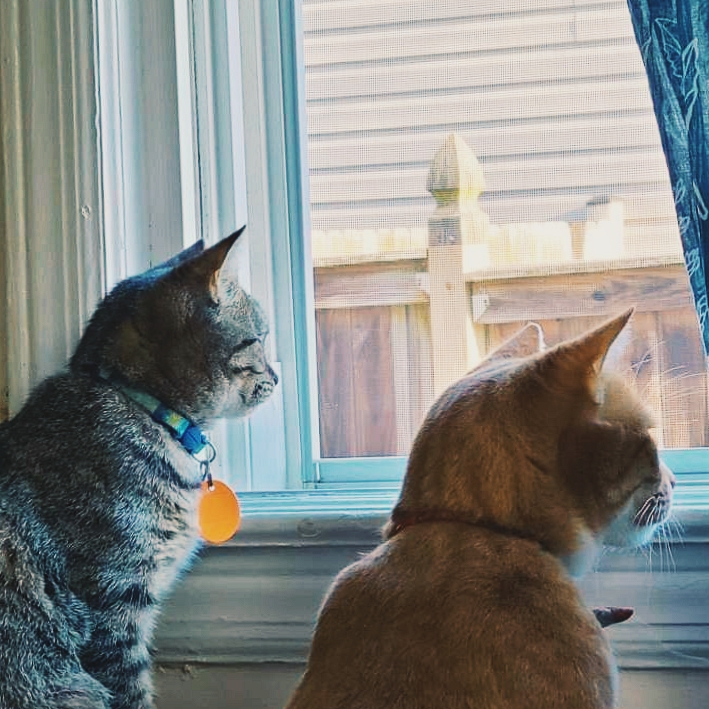
A large male orange tabby sits beside a much smaller female gray tabby. They look out of a window together.
Did he teach her the ways?

Acting up. Misbehaving. Hassling Kiko. Chewing on Pye’s face (though he’s pretty good natured about it). Being rambunctious and cranky until and unless she is given a nap. At times, circling me like a tiny shark and making small clown honking noises.

I’m not sure what it is about this age that seems to have instilled this very odd tendency in both of them. It seems like there’s some kind of physical or mental growth spurt that coincides with a) an increased need for snuggles and sleep, and b) an absolute refusal to admit it. Like human children testing boundaries and asserting their independence, it seems like they push themselves until they become tired and cranky, and I have to be the one to notice this and enforce naptime.

Pye seemed to grow out of this eventually, and I’m pretty confident JJ will too. It’s just interesting to see how nature doesn’t conform to a neat timetable — we can say that cats are kittens until one year of age, but there’s still so much growing and developing that they do beyond that. They’re not babies, but they still aren’t adults yet. There’s boundary testing and a lot of feelings, but it seems like naps and snuggles are suitable emotional reset buttons.

crystals

Lemon Quartz vs Citrine vs Tangerine Quartz vs Golden Healers — FIGHT!

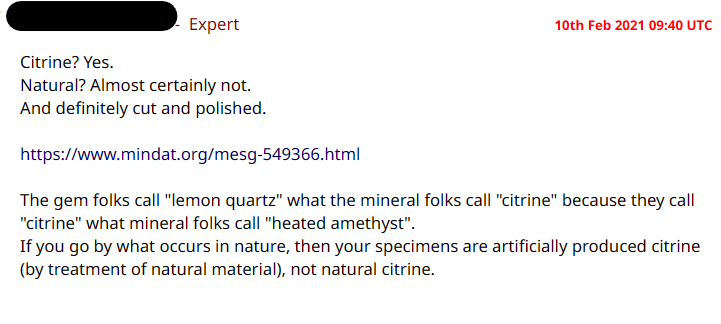
Before I get into this, there’s a quote on a Mindat thread that I think sums it up pretty well:

The discussion was on lemon quartz versus citrine, with one poster attempting to discern if their specimens were natural, untreated citrine. If it seems kind of confusing… it probably should, to be honest.

I’ve written about citrine in the past, and I think I did an alright job of covering the chemical and physical properties of natural citrine and heat-treated amethyst. This time, I’d like to look at a couple of other semi-related mineral specimens.

Lemon quartz is a variety of quartz that presents with a light yellow color. It’s unmistakably yellow, too — not the toasty orange of heated amethyst, or the smoky yellow, apple juice hue of a lot of natural citrine.

So, is it dyed? Irradiated? Cooked? What’s the difference between one type of yellow quartz, and another type of yellow quartz? While it does certainly seem like some lemon quartz is just light, very yellow citrine, this isn’t always the case.

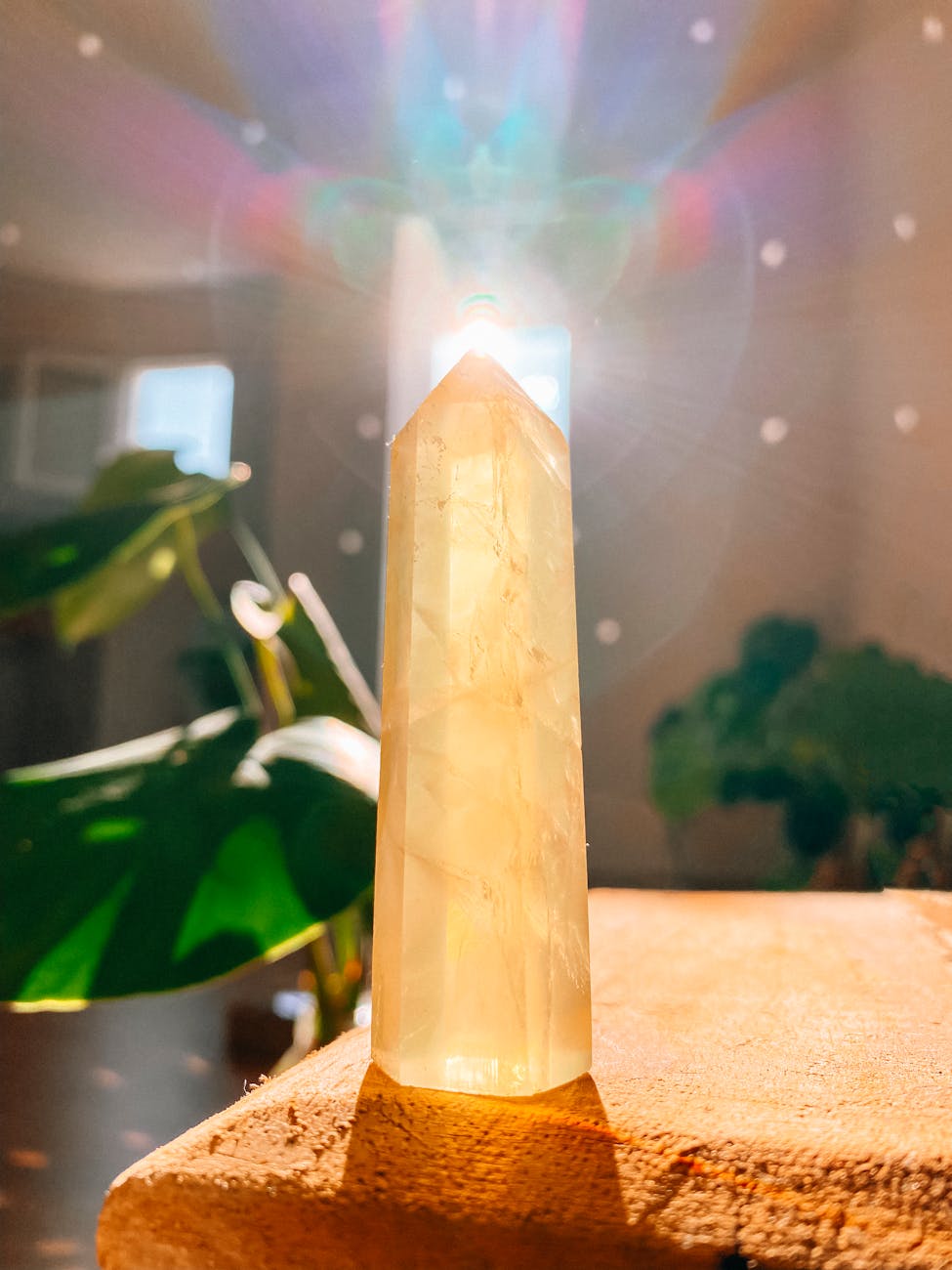
A tower of a translucent, honey-colored mineral sits on a wooden table. In the background, there are several houseplants and a rainbowy lens flare.
Pexels assures me that this is citrine, but it honestly looks more like a faceted and polished honey calcite to me. Photo by Alina Vilchenko on Pexels.com

Ouro Verde quartz, which is also called lemon quartz, is a treated gemstone with a greenish yellow color. These are made by heating irradiated, very dark smoky quartz. (There’s a very interesting explanation of the treatment and discovery of this quartz here.)

To sum up: Specimens sold as lemon quartz may be either particularly yellow citrines, or a bright greenish yellow quartz produced by irradiation and heat treatment.

With all of the above in mind, how do you know if you have natural lemon quartz?

As I briefly explained in my post about citrine and heat-treated amethyst, the best way to tell is to observe how the stone behaves in light. Hold it up to a polarized light source and turn it from side to side. Does the color seem to shift a bit from one angle to the other? The stone is exhibiting pleochroism, a hallmark of natural citrine. If the stone is very yellow, that citrine can also be considered a lemon quartz. Heated amethyst doesn’t exhibit this phenomenon, and neither would irradiated and heated clear quartz.

It should also be noted that, in their natural forms, crystals don’t often exhibit the kind of bright hues you can get from heating and irradiating stuff. If it’s really bright yellow — bright, sunny, lemon-candy-highlighters-and-pineapple-Fanta yellow — it’s likely had some help getting there.

Look, you pick a fruit, and there’s probably someone online selling quartz named after it. It’s like when people were posting about “strawberry makeup” and “latte makeup,” when what they really meant was “pink blush and eyeshadow” or “different shades of tan eyeshadow and also maybe some bronzer.”

Gem folks and mineral folks very often don’t use the same names for things. In the gem trade, having something that sounds new, unique, and exotic helps you stand out and improves the marketability of your stones. Mineral folks are more concerned with identification, so interesting new names are more of a hindrance than a help. Neither is necessarily better, they’re just two ways of approaching vastly different goals.

The trade names that stones are given don’t need to have any real meaning or relation to the stone’s actual composition. They don’t even have to relate to each other. While they’re both citrus-y, natural lemon quartz is yellow citrine and tangerine quartz is quartz with a coating of iron oxide.

You’ve probably seen or heard of aura quartz before. This is quartz that is colored by vapor deposition, in which the stone is coated with a micro thin layer of vaporized metal ions. This thin layer of metal gives it a shiny, brightly colored finish, and the specific metal ions you use determine the final color.

Sometimes, a process similar to this can occur in nature. Tangerine quartz is quartz that has received a blanket of iron oxide particles at some point during its formation, giving it an orange color. Depending on when this happens, the iron oxide may be present as phantoms or inclusions within the stone. Sometimes, it’s just a surface coating.

When nature throws quartz and various metal oxides together, you can get some really funky-looking crystals. I saw a tiny double-terminated quartz the other day that had so much iron oxide in/on it, it looked like red jasper. Wild.

Quartz and iron oxide. It’s just that sometimes iron oxide is yellow instead of orange or red.

Golden healers are often the color of citrine, but they get their color by the same mechanism that tangerine quartz does. Quartz grows, a coating of metal particles happens to it, et voilà — you get a golden yellow crystal.

Arkansas, in particular, is home to a beautiful variety of naturally occurring quartz sometimes sold as “solaris quartz.” As these stones form, they receive a layer of iron and titanium. It gives them an interesting golden yellow-orange color (and sometimes a bit of iridescence, too).

Any type of quartz can be a golden healer, as long as the right conditions are met. I have a few Herkimer quartz specimens that are totally or partially covered in golden yellow iron oxide. I’ve even seen amethysts with the typical golden healer coating.

As an aside, golden healers are unrelated to wounded healers, though you can have a crystal that’s both a golden and wounded healer. In metaphysical circles, wounded healers are crystals that have either been damaged at some point or have broken and self-healed during their formation. I’m told that these are considered some of the best crystals for crystal healing, as they have experienced what it’s like to be “injured.”

This is a bit of a tricky question to answer. The closest I can come is probably, “what do colors mean in your tradition?”

Lemon quartz can be used the same way as citrine, because it is — it’s just on the yellower end of the spectrum. Ouro Verde quartz, as a treated quartz, is still perfectly fine any situation in which you’d choose a yellow or green stone.

Golden healers and tangerine quartz aren’t super different. Golden healers sometimes include titanium ions, and sometimes are just coated with yellow iron oxide. Tangerine quartz is more orange. Use golden healers in situations that call for the color yellow or gold, and tangerine for those that call for the color orange.

In a lot of guides to color magic, yellow is associated with the element of Air, the intellect, friendship, and joy. Orange is associated with the element of Fire, creativity, willpower, and optimism. Green is connected to the element of Earth, prosperity, and fertility. However, all stones are innately connected to the element of Earth because they’re stones. Where the line falls between “yellow” and “green” or “yellow” and “orange” is also highly subjective.

For this reason, I’m hesitant to point to a specific metaphysical use for these minerals. Use the one that seems to volunteer to you. I guarantee, even if you pick the “wrong” kind, nobody is going to explode. Consider it a helpful exercise for your intuition!

The fact is that nature abhors absolutes. Everything — and I do mean everything — exists on a kind of gradient. At what point does a citrine become a lemon quartz, or a golden healer become a tangerine quartz? The only answer I can really give you is, “when it seems like it.” Trade names shouldn’t influence how much you enjoy your stones (or how you use them). It’s fine to be curious about how things get the names they do, but don’t give your power away to what is, a lot of the time, just a marketing gimmick.

Plants and Herbs

Phlox Folklore and Magical Uses

Right now, my moss phlox (Phlox subulata) is absolutely popping off. I posted some photos in my last post about murdering the lawn, and they’ve continued to open more flowers as the days go on.

Phlox is more than just a pollinator-friendly native groundcover, however. Though most species are in North America, they’re a useful (if often overlooked) magical ally and ingredient for all kinds of traditions.

The name “phlox” comes from the Ancient Greek word phlox, for “blaze.” I’ve seen two reasons given for this etymology: One is that the intensely colored flowers are as bright as little flames. The other is the flame-shaped flower clusters of upright varieties of phlox.

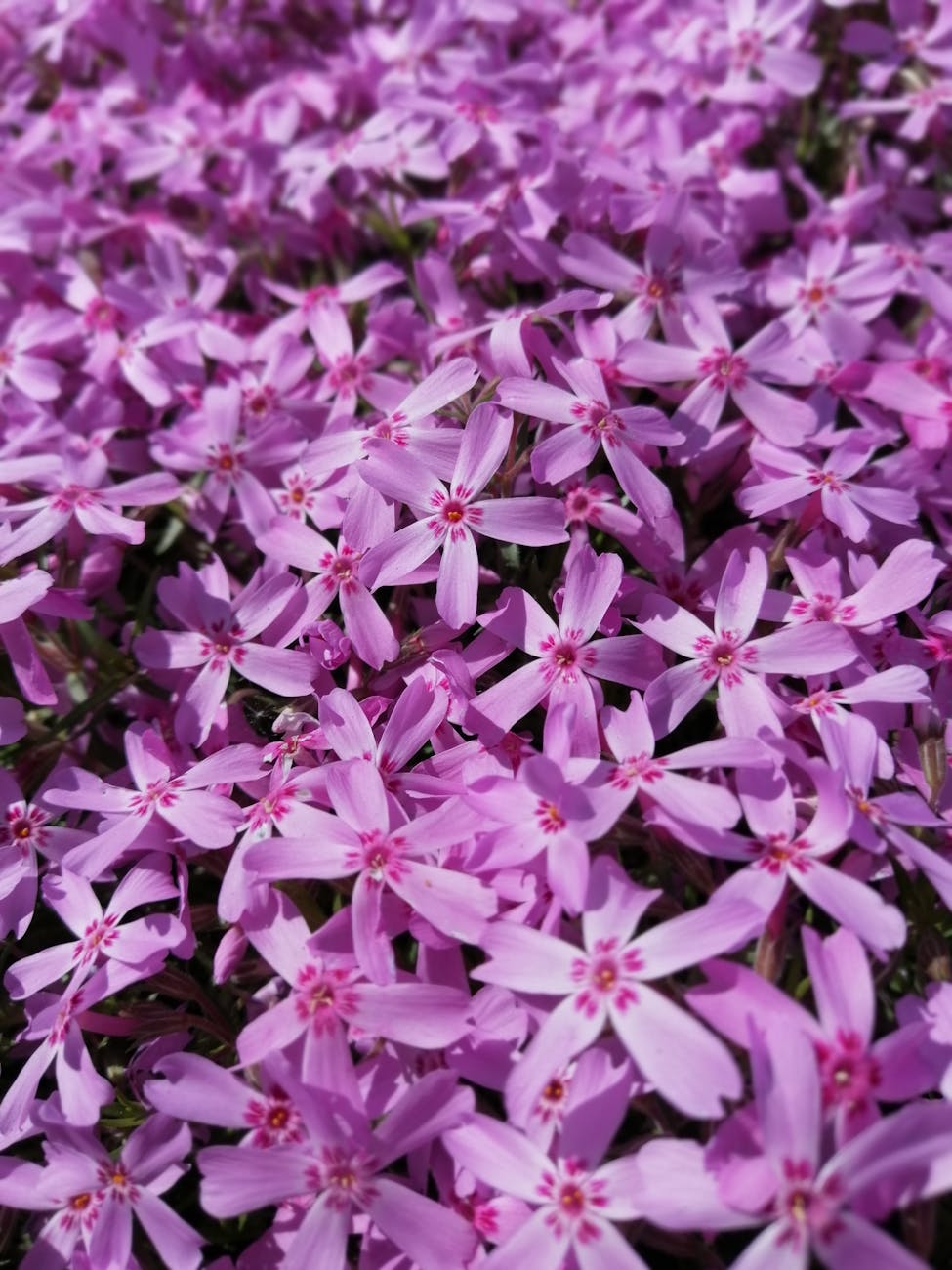
A bunch of violet-colored phlox flowers.
Photo by u042eu043bu0438u0430u043du043du0430 u041eu0441u0438u043fu043eu0432u0430 on Pexels.com

It’s said that phlox flowers were created by the torches of Odysseus’ men when they descended to Hades. When they returned, they threw their torches to the ground, where they became phlox flowers. This tale most likely refers to Polemonium caeruleum, a member of the phlox family known as Jacob’s ladder or Greek valerian.

The kantuta (Cantua buxifolia), also known as the Peruvian magic tree, is a tree with bright, trumpet-shaped flowers. It’s the national flower of both Bolivia and Peru.
An Incan legend tells of two kings who, jealous of each other’s wealth, went to war against each other. They were evenly matched, and, in the final battle, both struck mortal blows. On their deathbeds, they called their sons to them and made them swore to avenge their deaths — even though their sons hadn’t been in favor of the senseless war in the first place. Nonetheless, their sense of filial piety drove them to continue their fathers’ war.
History repeated itself, and the two sons also inflicted mortal wounds on each other. However, instead of demanding that the war continue, they forgave each other and died in peace. They were buried together, on the green ground of the battlefield.
Pachamama, the Goddess of fertility, punished the sons’ unjust fathers by making their stars fall from the heavens. When they landed on Earth again, they became the mountains Illimani and Illampu. The melting snows that run down them and water the valleys below are their tears of regret for what they have done. The kantuta trees represent unity and the hope that such a war should never happen again.

A North American legend tells a similar tale, but about Phlox subulata. There, the Creek and Chickasaw peoples engaged in a battle when one nation disrespected the other. It was seen as an attempt to provoke a war, and the two nations battled for days.
When the Chickasaw people tried to retreat, they were trapped by a wall of flames. In desperation, a young boy asked all of the animals for help extinguishing the fire so his people could escape. The animals tried, but they were unsuccessful and exhausted by the attempt — the deer’s long tail was burned off by the intense flames, and the once-white squirrel was stained gray with ashes. Taking pity on the animals and people, the Great Spirit changed the burning flames into bright phlox flowers.

In Victorian floriography (the cryptographic “language of flowers”), phlox meant “our souls are united,” or even “we think/feel alike.”

Blue phlox flowers.
Photo by Julia Filirovska on Pexels.com

Planting it in a garden is said to encourage family harmony and unity within the household.

Another source holds that phlox flowers symbolize pleasant dreams and love.

Phlox is associated with the elements of Earth and Fire.

The best way to use phlox is to find a variety native to your area, and plant it. (If you’re in the eastern US, Phlox subulata makes a great substitute for turf grass.) The presence of phlox is said to encourage unity and peace, and forges a harmonious household.

You can also use phlox flowers based on their color. Include dried flowers in sachets, jar spells, or herbal offerings. Since they’re a very peace-love-and-harmony plant, that may affect your perception of what each color is good for. Pink flowers are the most suitable for love, and red for passion, while white or blue are best for peace and healing. Purple flowers are useful for meditative or spiritual pursuits. Oranges and yellows are helpful for positivity and optimism. This isn’t really a flower you’d want to include in, for example, banishing work.

Phlox is associated with protection, but, from the folklore and legends that I’ve seen, this mostly seems to be “protection from harm by calming hostilities.” It doesn’t seem to be a flower for more aggressive protection magic.

To harvest phlox flowers, pick them early in the morning — just after the dew has dried. Hang them upside-down somewhere dry and out of sunlight. (Dried flowers inevitably lose some of their color, but exposure to bright light can cause their colors to fade more.) Once the flowers are dry, store them in a jar in a cool, dark, dry area.

From Odysseus to Illimani and Illampu, phlox flowers are representations of hope, togetherness, and peace. Their legends talk about the senselessness of war and the relief that comes when peace is achieved. They’re excellent allies for works involving calming, hope, and unity.

life · Neodruidry

Happy Spring Equinox!

Hello! It’s Tuesday. It’s also the Equinox, Alban Eilir, or, in some traditions, Ostara. (Unless you’re in the southern hemisphere, in which case: Happy Mabon!) This is essentially the second part of the celebrations of spring: Imbolc, the Equinox, and Beltane. If Imbolc is when spring wakes up, the Equinox is when it really gets going, and Beltane is the height of its strength.

Since it’s Tuesday, our celebrations this year are small. There’s a bigger ritual and feast planned for this weekend, but this weekend’s also likely to be very cold and rainy. Appropriate for early spring, but it does nonetheless put a damper on being outside. (⍩)

Many different colors and varieties of daffodils and tulips.
Photo by Vural Yavas on Pexels.com

As you read this, my Handsome Assistant and I will be replanting a rose bush. It’s a lovely bush with bright pink flowers, and I pruned it quite a bit to get rid of the crossed branches and dead wood. We’re moving it to the back yard, between the raspberries and the Carolina allspice sapling. That area gets tons of sun and, since the yard is essentially a hill, could use more plants to help absorb rainfall and keep everything in place.

I’m also planting some arugula and extra peas in the raised vegetable bed. I planted plenty of peas in containers, and they’re growing well already, but I’ve still got lots to use! The arugula came as a gift from an Etsy seller, secreted away inside a package with a beautiful vintage linen shirt. (This is part of why I love Etsy and indie sellers in general — I can’t tell you how many times I’ve gotten vegetable seeds, small crystals, stickers, or other fun things with orders.)

We’re also sifting through compost. Our tumbler is black and in a sunny area, so, between the solar radiation outside and the heat of biological activity inside, it fortunately manages to stay plenty warm all year round. It’s a good time to sort through, separate the finished compost from the still-composting scraps, and put it away for use in the near future.

A close up of a branch covered in pink cherry blossoms.
Photo by Anelia on Pexels.com

Otherwise, it’s time to air out the house some more, bring in fresh spring flowers, give all of the windows and linens a good wash, and use up the last of the food that was stored for winter.

This year, I’d like to honor Fliodhais. She’s an Irish Goddess of cattle and fertility, though, in the recent past, she was mistaken for a forest deity as well. I don’t have cattle, and I don’t drink milk, but some fertility could certainly help my garden right now. I’d also love to see the crows and other birds bring their babies back! There’s whiskey in the chalice, seeds for new growth, and blessed incense to release into the air.

Whether you celebrate this High Day or not, it’s hard not to see the way that the land is really reviving herself. Yards are full of spring ephemerals, there are red-breasted robins everywhere, and the shifting angle of the sun brings renewed light and warmth. Happy Equinox!

May the song of this, my blessing, be joined by the chorus of the birds in the sky,
May the spring breezes bring peace and balance.

Excerpt of AODA Air Blessing prayer
crystals · life

The GLMSMC Gem, Mineral, and Fossil Show (or, Why I Have a Small Quantity of Uranium Now)

This past weekend was the 58th annual GLMSMC Gem, Mineral, and Fossil Show. It fell at a slightly weird time for us — I’m still in an ennui, and my Handsome Assistant has Dungeons & Dragons Hot Boy Activities every other weekend — but it A) it only comes once a year, 2) we’d been looking forward to it before realizing it happened at such a bad time, and III) it’s pretty easy to control how much time you spend there. Most of the time.

This year, to save some time and our limited energy, we skipped most of the displays on the first floor. If you’ve never been to the show, don’t miss these. They’re local minerals, geology displays, some really neat insect taxidermy, activities for kids, and a really cool blacklight tent of wild-looking fluorescent minerals.

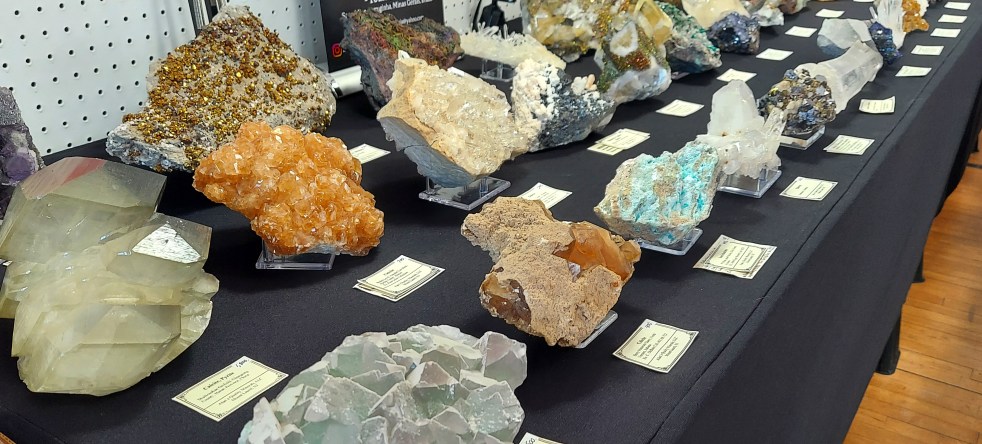
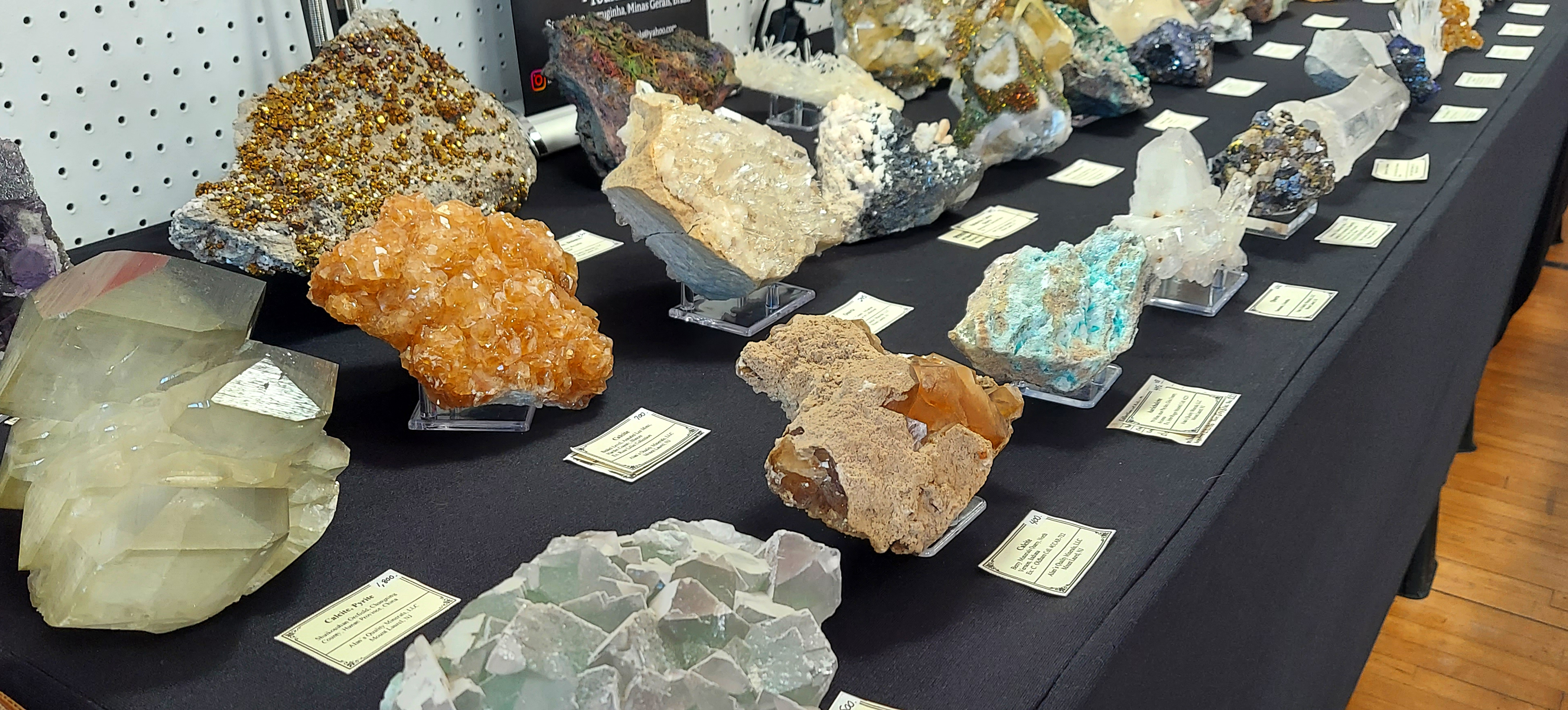
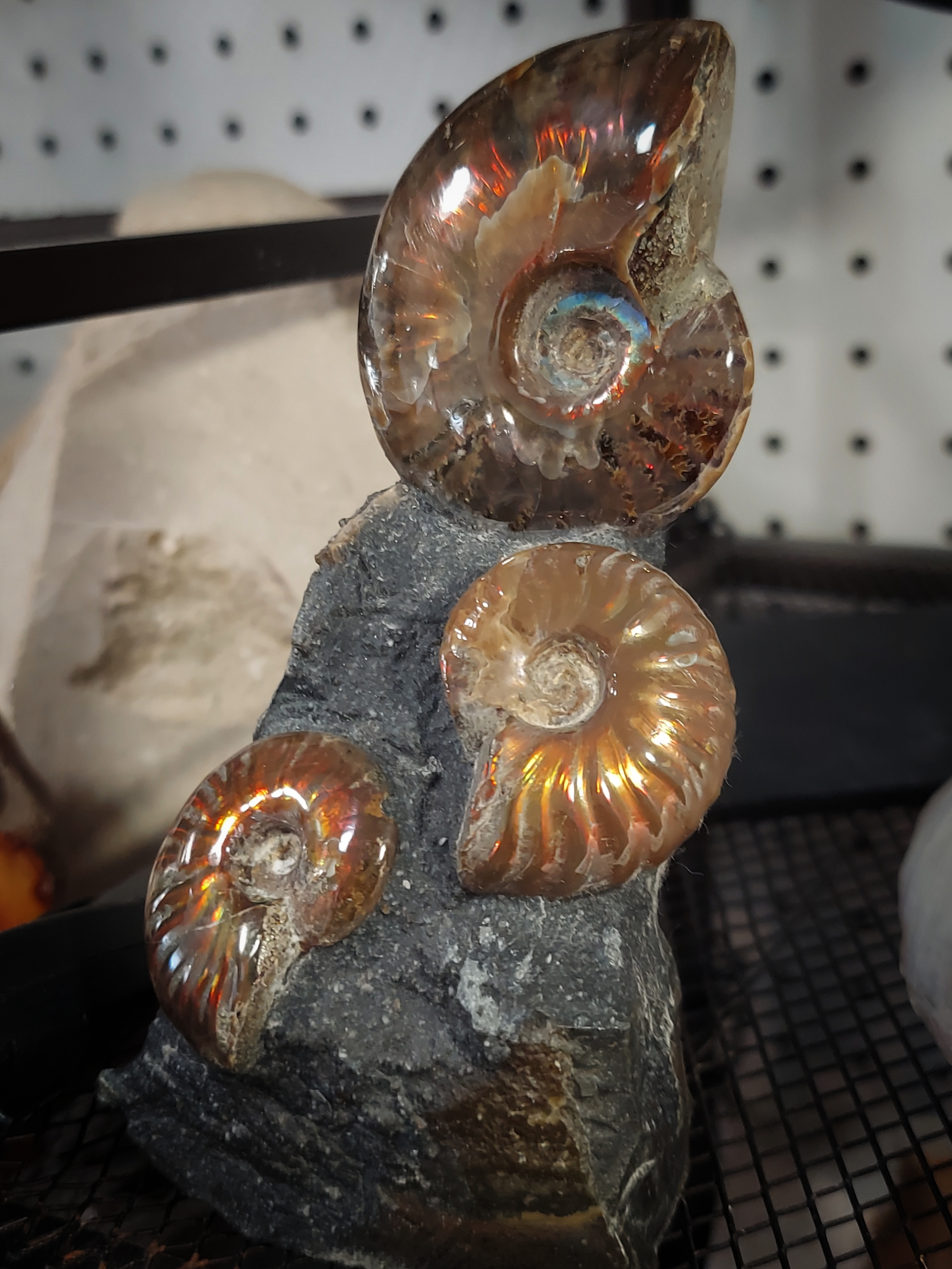
The second floor is the vendors. When I say “vendors,” I mean sellers of stones of every description. Tumbled minerals like pieces of brightly colored candy. High-end faceted jewels of every color. Opal cabochons like fragments of rainbows. Fossilized creatures that seem to come from an alien world. Fist-sized geodes promising worlds of never-seen minerals within. Ropes upon ropes of artisan crafted beads.

What I’m saying is, it’s really cool and you should see it. It is an excellent place to go if you want to look through trays upon trays of precious minerals (many of which are domestically sourced, like some beautiful Herkimer quartz and uncommon minerals from Pennsylvania) and feel very fancy.

Last year, we “rolled the geode gacha” as my Assistant says, and ended up with a beautiful specimen of smoky quartz with sharp, clear calcite blades growing within. This year, we picked a small, reddish stone with some interesting globular formations outside that I thought might mean some botryoidal or mammillary formations inside.

Sure enough, the inside was filled with beautiful, rounded mounds of a soft gray, druzy mist, like little hillsides under snow. That’s not the most interesting part, though. That’d be this:

A blacklight shines on a pair of geodes, displaying small areas of bright green.

It’s a bit difficult to make out with the ambient lighting and the way my phone tends to handle such things, but these geodes showed several bright (and I mean bright) green specks and areas. You can really see one on the small rounded globule at the bottom of the first geode, and at the top of the second.

“Those are uranium inclusions,” the seller helpfully explained.

“Oh! Neat!” We replied.

And this is how we came into possession of a very small quantity of radioactive material. It’s really pretty in person — my plan is to find a small blacklight that I can mount in my mineral cabinet, and give this specimen a home that’ll show it to its best advantage.

(I’m not too concerned about radioactivity. This mineral appears to be chalcedony, in which uranyl ions can appear as a natural contaminant. These ions mostly emit alpha particles and weak gamma rays, and I wouldn’t honestly expect a specimen with only a few inclusions to emit much detectable radiation at all. I cleaned it well to remove inhalable dust. In a cabinet, in a well-ventilated room, located a few feet from where people sit, this geode is probably safer than my kitchen’s granite countertops.)

This is also a great place to go if you enjoy collecting fossils. This year, there were some really excellent specimens from a cave bear, Ursus spelaeus, including a bunch of jaws and fully-intact paw!

Some fossilized jaws, with teeth, from cave bears. In the foreground, there's a whole fossilized paw with five wicked-looking claws.

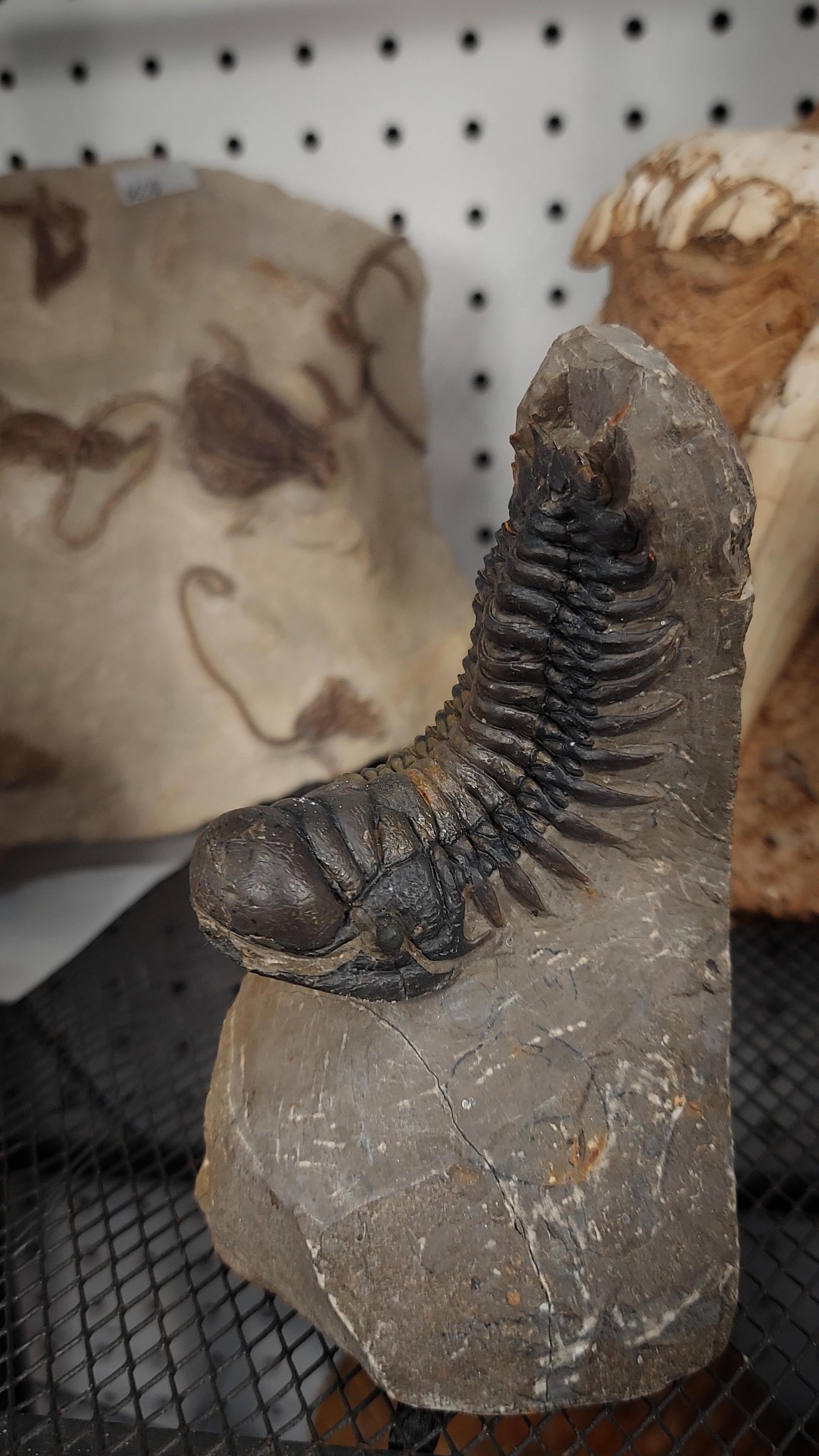
There were also fascinating specimens of smaller guys, too. Last year, we brought home a trilobite. This year, we just took pictures. Several specimens were loose, like little armored cabochon jewels. Others were still embedded in ancient silt, like tiny aliens traversing an undiscovered moon.

Also, there was a facehugger.

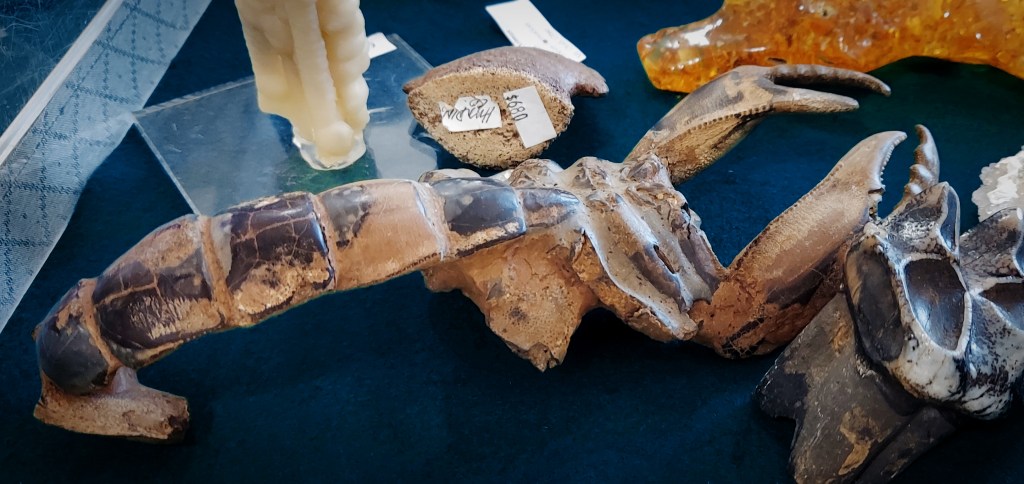
Some sort of prehistoric scorpion (possibly Pulmonoscorpius kirktonensis). It's roughly a foot long, with its tail arched beneath it and its massive claws upraised.

Some tables held rare specimens in combination. Giant dogtooth calcites growing on beds of glittery chalcopyrite. Tiny, fine threads of stibnite jutting up from barite and quartz. Really pretty stuff worthy of a museum (or the display of someone with a much bigger cabinet than I have). As beautiful as they were, they were some of the most challenging to photograph — each one was like a tiny ecosystem of its own, and their depth and complexity made it difficult to choose a spot to focus on!

We came home with some interesting crystal carvings, our geode, a particularly lovely amethyst specimen, and a small bit of amber (I like to offer them to Freya when I can).

Admission to the show is only six dollars, and you can save a buck by downloading and printing out the coupon on their website. Even if you didn’t get to attend this year’s show, mark your calendar for next year — it’s always a good time, and there are tons of beautiful things to see!

life · Plants and Herbs

Grassassination, a Year and a Half Later.

It’s been a while since I’ve written about my ongoing battle against the lawn. It started with a tarp, then went on to solarizing, then sheet mulching, then replacing the unwanted turf grass with native groundcovers, to discovering some kind of gigantic alien mystery plant we didn’t plant that accidentally ended up being delicious.

So, since it’s been about a year and a half, how’s it going?

The grass hasn’t come back. Instead, the area is made up of (mostly) mulch, interspersed with some slow-growing moss phlox (Phlox subulata), bee balm (Monarda fistulosa), violets (Viola sororia), and echinacea (Echinacea purpurea) plants. Occasionally, I’ll find a patch of native wild onion (Allium canadense). The border closest to the house is made up of non-native strawberries, which the birds, squirrels, carpenter bees, and also I seem to enjoy. Along the front path, there’s thread leaf coreopsis (Coreopsis verticillata). In the center, there’s the little redbud tree (Cercis canadensis).

A white Phlox subulata flower.
A flower from one of the white Phlox subulata plants. These guys actually flowered pretty much all through winter!

There are also small mats of non-native “weeds,” like chickweed, purple deadnettle, and speedwell. These aren’t exactly what I was going for, but they do have several advantages over grass:

  1. I’m not allergic to them. Flowering plants like these are typically pollinated by insects. Grasses are wind pollinated. Wind pollinated plants are much more likely to be responsible for allergies, because their pollen ends up in the air (and eventually your eyes, nose, and lungs). This is also why bee pollen is generally not a great way to desensitize oneself to hay fever — it’s primarily made up of sticky, heavier flower pollens, rather than the wind-carried pollens that people with hay fever most commonly react to.
  2. They’re edible. Chickweed is actually pretty nutritious, and so is purple deadnettle. I’m not up on all of the nutrition facts and medicinal uses of speedwell, but I am assured that it is also edible.
  3. They’re not invasive enough to be restricted. While these three plants aren’t native species, they typically have pretty shallow root systems and aren’t super competitive.
  4. They require no effort. Unlike lawn grasses, they don’t need fertilizing, pesticide, weed treatment, or supplemental irrigation. While they’re not as beneficial as native groundcovers, they’re at least not a net negative like turf grass.
  5. They’re an early food source for pollinators and small herbivores. Since they’re not native to the US, they haven’t evolved alongside our native pollinators and thus aren’t really an ideal source of nectar. They do, however, provide more food that a mowed monoculture lawn does.
  6. Honestly, it looks better. I’m not a fan of the manicured look of suburban lawns. This spot has a ways to go still, but tiny blue, purple, and white flowers and multi-hued foliage beat grass any day.

Tiny blue speedwell flowers.
Itty bitty speedwell.

Should anyone run out and sow a speedwell, deadnettle, or chickweed lawn? No, not in the US. (Non-native clover lawns aren’t really a great idea, either.) Nonetheless, I’m in less of a hurry to eradicate these plants than I was to get rid of the grass. It’s reassuring to see other plants moving into an area that was once a mowed, lifeless monoculture.

And, if you’re an invasivore, you can always eat them.

Bright purple Phlox subulata flowers.
Some of the purple moss phlox. Oddly, these guys didn’t flower as resiliently as the white did. They’re putting out more flowers now, though!

This year, the plan is to plant more moss phlox and bee balm, and maybe another coreopsis or two. I’d also like to find a source for native strawberries. These grow in slightly different conditions to the cultivated strawberries you usually see in garden stores and groceries and are a good addition to “edible landscaping” plans. For now, I’m pretty happy with the progress this little patch of dirt has made!

life

The Return of the Great Big Ennui

Note: This post contains a brief mention of self-termination.

Hello! I’m mentally ill.

I’ve never seen the point of beating around the bush about it. As a child, I was taught that there was a stigma around mental illness, therapy, and medication (a lesson that, among many others, luckily didn’t take). It just didn’t make much sense to me — if my pancreas or thyroid didn’t work the way it was supposed to, and I needed medication to help me, would I be ashamed? Why is it suddenly different if it’s brain tissue instead of glandular tissue?

I also don’t use person-first language for myself. I don’t have a mental illness. I have jackets and shoes I can take off if I want to. I have hair I can shave off if it annoys me. I am mentally ill. I can’t take that off like an itchy sweater. I’ll use person-first langauge for other people if that’s their preference, but it’s not for me.

So, cyclothymia (sometimes known as bipolar III) is marked by periods of hypomania, alternating with a kind of depression I refer to as “The Ennui.”

Why ennui? I call it ennui because, for me, it’s a feeling marked by bone-deep, existential boredom. Nothing is exciting. Nothing is inspiring. The things I usually enjoy become thin, gray, muffled, and flavorless. I start to be afraid that nothing will ever make me happy or enthusiastic about life again. And every time, I begin wondering if I should “encompass my own demise,” as it were, and save myself some time.

I also call it ennui to trivialize it to myself. To name a thing is to gain a measure of power over it. To name a feeling of anhedonia so deep that it threatens my existence, and name it after something as unserious as ennui, helps shrink it a little bit. It’s a reminder that this state is fleeting — just a temporary eddy in my various brain sauces, however unpleasant it may feel.

This ennui happens completely irrespective of what else I have going on. It happens on its own inscrutable, irregular schedule, independently of my hormonal cycle, the time of year, or anything else. I could have an event that I’ve been looking forward to for months and, when I hit an ennui cycle, that feeling deadens completely. I could have absolutely no reason to feel down, sad, or uninspired, and my brain chemistry literally could not give less of a shit about any of that.
If it’s ennui time, it’s ennui time.

Fortunately (for a very questionable definition of “fortunately”), this has happened often enough that I know, on a logical level, that it’s temporary. I certainly don’t feel it in the thick of things — that’s where a lot of that worry comes from, the idea that this is forever and I will only ever feel this way for as long as I live. But it’s always been temporary before.

There’s no cure for this. There’s barely treatment for it. I use an SSRI to handle the symptoms of panic disorder, but those typically aren’t the best for your various bipolars. Nonetheless, I’d rather have to deal with periodic ennui than the absolutely brutal panic attacks I used to experience, so here we are.

(Because I know there are caring people out there who offer advice because they don’t want to see another person suffer needlessly — I have a very good supplement regimen and diet, based on some in-depth blood tests and the advice of my excellent general practitioner. My GP is also a psychiatric nurse practitioner, so I’m all good on that front.)

So, if I haven’t been posting as much lately, it’s because I haven’t been doing much lately. I go through the motions — cooking, cleaning, doing paid writing gigs, tidying up the garden, making plans in the hopes that I might one day actually care about doing them — but there’s a very deep sense of “why bother?” about it all.
What difference does any of it make in the face of eventual oblivion?
Will the heat death of the universe care if I get dressed or not?

If this sounds like you, or someone you love, remember this: It’s temporary. It won’t feel like it is when you’re in the moment, but it is. Eventually, it’ll lift. When it does, do the things you need to take care of yourself. Set up a simplified routine that you can follow, even in the midst of an ennui. It won’t fix it, but it’ll make it more bearable and keep you from backsliding and feeding further into that despair.

For me, it looks a little like this:

  • A simple exercise routine. At one point, all I could do was tai chi in bed, so I did that. Now, I do about ten minutes of stretching, and ten more minutes of literally any other intentional, somewhat vigorous movement. It’s not going to get me jacked or anything, but that’s not really my priority at times like this.
  • Several simple sets of clothing. My criteria were that they had to be inexpensive enough for me to have several of them, so I could rotate them and have clean clothes even when I wasn’t able to do laundry. They also had to be comfortable, but something that I could conceivably leave the house in if I absolutely had to. Lastly, I wanted something that wasn’t disposable “fast fashion” or made of synthetic fibers that would annoy my skin. I decided on a set of recycled silk caftans, and they’ve worked out really well for me.
  • Simple, reasonably healthy food that requires very little energy to prepare. Sometimes, when I feel The Ennui coming on, I make a big pot of lentil soup or kitchari and a loaf of bread to last me through the worst of things. Other times, I eat a lot of stuff like this instant split pea soup. It has a simple ingredient list, plenty of protein, fiber, and potassium, and not a ton of salt. Open it, plop it in a bowl, microwave, done. I also like having a bottle of vegetable juice, some kind of protein powder, shelf-stable plant milk, and a fortified breakfast cereal on hand, just to fill in the gaps.
  • Simple hygiene. A low-maintenance haircut and uncomplicated skin- and haircare. Trader Joe’s facial cleanser and some jojoba oil. Lip balm. If I feel up to it, some hyaluronic acid serum. Moisturizing body wash, so I don’t need to bother with lotion. Even when I don’t have the energy for anything else, it at least keeps my skin clean and feeling okay.
  • A pill organizer. My memory is very damaged from pseudotumor cerebri at the best of times and seems to get worse when my mood dips. A pill organizer ensures that I don’t miss anything and accidentally make myself feel even more terrible.
  • Something to listen to. It doesn’t really matter what it is. I prefer listening to YouTubers or podcasts, only because having a person talking as background noise seems to be more helpful than music alone. I like:
    • ManlyBadassHero, for very relaxed horror game playthroughs. The games might be scary, but the videos very much aren’t. They’re chill and funny.
    • Zachary Michael and Zachary Michael Also, for reaction videos. Zachary Michael can be a bit polarizing (people seem to either love them or can’t stand them), but I enjoy their videos. They’re upbeat, funny, and often very heartfelt.
    • WiLLo Davis, for other reaction videos. Willo is also a musician, and the parody songs he makes to go with his videos are just *chefkiss*.
    • Dreamingofavalon. This channel has been more-or-less on indefinite hiatus for a long time, but their old videos are very lighthearted, upbeat, and uplifting. Lyn went on to start Desert Plants of Avalon with her partner, Hans. These videos have the same general feel as Dreamingofavalon does but are all about cacti and succulents.
    • SeizureRobot5000, for very specific reaction videos. SR5000 makes videos about musician, YouTuber, and dank food hacker Josh Saunders, alias KingCobraJFS, and they’re some of the funniest things I’ve listened to (especially the videos with Chauncey).
    • Robert Welsh, for makeup and beauty. I don’t care about either, but I could listen to him do deep dives into beauty companies all day. Some beauty industry controversies are bonkers.
    • I also like the Last Podcast on the Left. In particular, I usually listen to their series on Aleister Crowley when I’m feeling bad. Their cult, occult, and paranormal content is my favorite, but they also have a lot of true crime and alien episodes as well.
    • This Paranormal Life is a smaller comedy podcast put out by two best friends. In each episode, they investigate a paranormal tale, case, or claim and determine if it’s truly paranormal or not. The hosts’ chemistry and humor are fantastic, and I’ve loved every episode they’ve put out.
    • I’ve also gotten into watching Chinese historical dramas, like Ruyi’s Royal Love in the Palace. I don’t even necessarily watch the episodes in order. They’re just beautifully costumed and full of intrigue.

Remember, any self-care worth doing is worth doing badly. I may not be able to home cook meals, but reasonably healthy packaged food is better than no food at all (or eating half a jar of olives while standing over my trash can). I may not be able to exercise, but a few minutes of stretching or walking in place is better than not moving at all. This is one situation where half-assing something beats the alternative.

I don’t know if this will help anyone, but it helps me. Remember, this feeling doesn’t last forever. It doesn’t even last all that long, though it can certainly feel like it. The trick is to have a simple plan in place so you can properly take care of yourself in the midst of it all. Set this up when you don’t need it, so you can lean on it when you do.