
life

So I guess we’re doing Turkish Historical Dramas now.

My YouTube recommendations are often… eclectic. A while back, I got into Chinese historical dramas due to a handful of YouTube shorts about Ruyi’s Royal Love in the Palace. From there, I started getting recommendations for The Great and The Serpent Queen.

Then I started getting clips of Muhteşem Yüzyıl, or Magnificent Century.

From left to right: Ibrahim, Hatice, Valide Sultan Hafsa, Sultan Suleiman, Hürrem, and Mahidevran.

It’s ostensibly the story of Sultan Suleiman the Magnificent and Hürrem Sultan. In reality, it goes quite a bit deeper… But more on that in a moment.

It’s not historically accurate, by any means — I would by no means look to this for an accurate representation of… well, much of anything. Characters have been added, removed, and combined as needed, and timelines have been fudged almost beyond recognition — but it’s entertaining. Some characters have been scrubbed clean, others have been demonized. In the search for a good villain and heightened drama, some characters are brought together that never actually met in real life.

The costumes are gorgeous, albeit woefully inaccurate. They’ve been very The Tudors-ified — they have a “historic” feel, but the colors, embroidery, adornment, and amount of skin they show are all very modern.

Still, it’s a dramatic bit of fiction set against the backdrop of actual historical events. Everyone is gorgeous, the clothing and jewelry are stunning, and there’s loads of political maneuvering and fancy ladies staring daggers at each other at parties.

I have some distant Turkish and Armenian ancestry, but I never really had much of an interest in Ottoman history. While I wouldn’t say Magnificent Century has really taught me anything, it has at least piqued an interest in something I didn’t dedicate much thought to before.

But the most fascinating aspect of Magnificent Century may not be in the show itself at all.

As this article in The New Yorker put it,

On the surface, “Magnificent Century” looks like a quintessential product of the Erdoğan years. Thanks to Erdoğan’s economic policies, Turkey has a thriving television industry, capable of staging elaborate period dramas, and a prosperous family-oriented middle class of observant Muslims eager to watch their own values reflected in a historical imperial setting. And, much as Erdoğan’s foreign policy has promoted relations with former Ottoman lands, the show has conquered large audiences in Balkan, Caucasian, and Arab countries not known for their fond memory of Ottoman rule. Broadcast to more than two hundred million viewers in fifty-two countries, “Magnificent Century” has accomplished one of Erdoğan’s main goals: making a powerful, non-secularist, globally involved version of Turkey seem both plausible and appealing.

(This isn’t unique to Türkiye, either. Exporting TV series, movies, and music is a huge part of nation branding.)

However, it goes on to point out that Erdoğan and is ilk are not fans. In an attempt to make this slice of history palatable and suitable for prime time viewing, conservative viewers claim that the show sullies Suleiman’s memory.

Conservative viewers had already objected to the amount of time Süleyman spent in the harem; to a chalice from which he occasionally drank some unknown, potentially alcoholic beverage; and to the low-cut gowns of the harem women. When “Magnificent Century” first aired, Islamist demonstrators marched to the television-station offices and threw eggs at the building, while a man dressed as Süleyman read out an “imperial edict” denouncing the show.

Outside of Turkey, critics have denounced the show as an attempt to whitewash Ottoman history. Other critics argue that it wasn’t scrubbed clean enough in the right ways. For the show’s creators, Durul and Yağmur Taylan, the important thing was to depict the Ottoman empire mostly from the perspective of the enslaved women who lived in it. The script was written by a woman. The shifting protagonists and antagonists are women. While Ottoman history provides the backdrop, Suleiman is less a character than he is a vehicle for narrative tension between the members of the harem.

No one is a clear hero — everyone is morally gray. Everyone does questionable things in their pursuit of power, wealth, love, and safety. In a world where the Sultan’s favor can absolutely make or break the fate of you and your entire lineage, things get weird. Alliances shift. Loyalties form and dissolve like sugar crystals. Friendship is a facade, and love is a lie.

Despite the controversy, Magnificent Century became (and honestly still is) wildly popular. Its fanbase is also extremely divided: Is Hürrem the heroine, or a villain? Is Suleiman a hero or villain? What about Mahidevran?
Do the other characters deserve the fates they get at their hands?
How far is too far?

Is it even possible to come to truly love someone when you’re considered their property?

I would no more watch Magnificent Century for historical accuracy than I would watch The Tudors, The Great, or The Serpent Queen for the same. However, if you like complex intrigue and dramatic tension between people in fabulous gowns, it’s certainly worth watching. Best of all, you can find it on YouTube for free.

animals · Uncategorized

The Magical Meaning of Opossums

We have a marsupial!

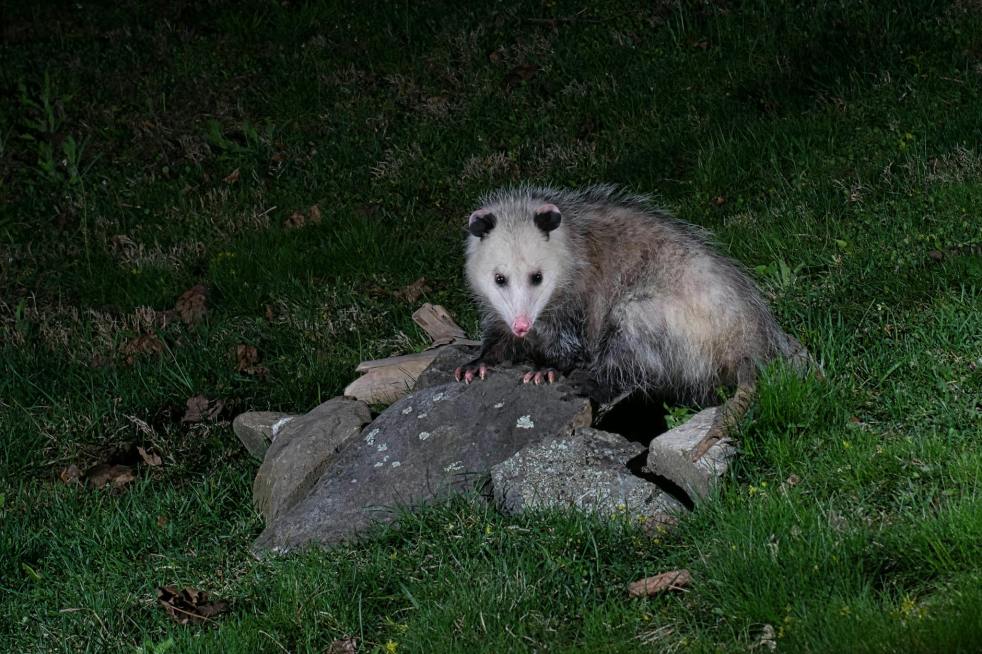
He appeared on the deck railing at 3 AM a few weeks ago, trundling along like one of the ROUS from The Princess Bride. (Which is to say, he moved like a very small man in an opossum suit.) I was so excited I almost shook my Handsome Assistant awake.

When he returned the next day to snuffle around the platform feeders, I actually went outside to offer him a small quantity of the kibble and dried bugs I use to feed the crows. He seemed pretty relaxed about the whole thing — just kind of leaned back and gave me a look that distinctly said, “Are you @#$% serious right now?

It was when my Handsome Assistant and I were watching Hellier a few days later that I realized that I’d never survive a monster movie. If I lived in Kelly, KY, and encountered the Kentucky Goblins, I would 100% have tried to give them Capri Suns and crackers and ended up 1000% dismembered inside an abandoned coal mine.

But my impending mortality at the hands of something I’m trying to give snackies to is neither here nor there. Since there is an opossum, I thought I would explore the magical meaning of these creatures.

The Virginia opossum is the source of the name “opossum.” It comes from a Powhatan word meaning “white animal,” which derives from a Proto-Algonquian word meaning “white dog.” The Spanish words for opossum, tlacuache and zarigüeya, derive from the Nahuatl tlaquatzin and Guarani sarigweya.

There is a large difference between opossums and possums (and Possum). Opossums live in the Americas, have skinny tails, and are grayish with white faces. Brush-tailed possums are from Australia, have fluffy tails, and are brownish. They are unrelated. The kind we have where I live, the Virginia opossum, is a member of Didelphimorphia (specifically, Didelphis virginiana).
Some say that, due to a colossal mix-up, we ended up with Australia’s possum and they ended up with ours. For the purposes of this post, I’m going to focus on the American opossums.

The Virginia opossum. Photo by Skyler Ewing on Pexels.com
The Australian brush tailed possum. Photo by Charles J. Sharp, CC BY-SA 4.0 https://creativecommons.org/licenses/by-sa/4.0, via Wikimedia Commons.

It’s often said that opossums “play dead” when confronted with a threat. In reality, they have a few different responses. They’re more likely to attempt to flee, or puff themselves up, hiss, and try to appear more threatening. In some situations, an automatic anxiety response may cause them to feign death, during which their heart rate and breathing slow, they lie motionless, and they emit a foul-smelling fluid from their butts.

It’s also often said that opossums are voracious tick eaters. This is not true. They are opportunistic omnivores, and they do eat a ton of insects, but the study that gave rise to this myth involved opossums in a laboratory setting during which they didn’t have much other choice. (It’d be like covering a human in peanut butter, locking them in a room for several days, and then saying that their diet primarily consists of nut spreads.) When the stomach contents of wild opossums were analyzed, there actually weren’t any ticks in there.
Still! Even though they’re not the tick-decimating forces of nature folklore paints them to be, they’re a vital part of the ecosystem that helps control numerous other problem species. They’re basically organic garden pest control that screams at their own butts.

Interestingly, opossums aren’t often found in indigenous American folklore. When they appear in North American lore, they’re usually buffoonish characters. (In fact, their feigning death is often portrayed as stemming from embarrassment!)
In South America, however, opossums are clever tricksters. Some groups even regard Opossum as a Prometheus-like figure.

In modern symbolism, opossums are seen to represent cleverness. This may come from the belief that they deliberately choose to “play dead.” (They also have really weirdly dexterous little paws and opposable thumbs on their feet.)

They’re also widely regarded as symbols of patience, perseverance, and survival against the odds. They’re slow-moving and very deliberate animals, and, when in a “feigning death” state, can remain motionless for hours to wait out predators.

Sometimes, opossums are viewed as symbols of rebirth since they seem to come alive after playing dead.

Dreaming of an opossum is believed to represent an illusion. Something may not be what it appears to be. It can be a sign from your subconscious that a situation isn’t right, and you need to look closer to find the truth.

Opossums are commonly associated with the Moon and lunar magic. They’re nocturnal, and their silvery fur and pale faces connect them to these energies.

Personally, I don’t care if Francis (by the way, I named the opossum Francis) never eats a single tick. I’m very happy to share this garden space with him. He is my precious garbage son and I love him very much.

Plants and Herbs

Lemon Verbena Folklore and Magical Properties

I wrote a post about vervain a while ago, which I chose to limit to Verbena officinalis and V. hastata. Today, I wanted to revisit this subject with a post on a vervain relative: Aloysia citrodora, lemon verbena.

Lemon verbena is native to South America, and was introduced to Europe in the 17th century. It’s a member of family Verbenaceae with a bright, citrusy odor (hence it’s name, citrodora). It has a long history of use in cooking and, while it was only introduced to Europe fairly recently, it has made a name for itself in various systems of European-based folk and ceremonial magic.

Within its native range, lemon verbena seems to be primarily used as a medicinal and food ingredient.

Medicinally, lemon verbena appears to boost sleep quality. Lemon verbena is also used as a digestive aid, and has demonstrated very interesting antioxidant and antitumor properties. There are mixed messages about its toxicity — while it’s generally regarded as safe for humans, some sources say that it’s toxic to animals.

Historically, lemon verbena was used to treat gout, as a diuretic, and to treat inflammation of the spleen or liver.

A blend of dried herbs in a teacup, against a white background scattered with more herbs.
Photo by lil artsy on Pexels.com

Putting a sachet of lemon verbena under one’s pillow is said to keep away bad dreams.

Lemon verbena is a pretty traditional luck herb. It’s said to convert misfortune to good luck, and is useful for cleansing, protecting, uncrossing, love magic, and attracting what you want. It also acts as a strengthening herb, meaning that it adds power to anything to which it is added, so it’s a good addition to herbal formulas for positive effects.

Interestingly, lemon verbena is yet another cleansing/protecting type herb that crosses over into a natural pest repellent. It’s often grown and used to keep mosquitoes away (possibly because its strong, lemony aroma covers up the natural scent of carbon dioxide that female mosquitoes use to detect people).

Lemon verbena is typically associated with the planet Mercury.

The easiest way to use lemon verbena is by steeping it. Get some of the dried herb and brew it like you would a tea. Strain out the plant matter, and use the liquid as an offering, drink it, add it to floor, door, or window wash water, you name it. Brew it with intention, stir it clockwise using your dominant hand, and visualize it filling with energy as you do.

While this herb has a very pleasant, citrusy scent and has been used in perfumes in the past, this is no longer advised. Natural components of lemon verbena essential oil are photosensitizing. So, if you’re looking for something to add to, say, an anointing oil, maybe give lemon verbena oil a miss. It’s fine for aromatherapy uses, but shouldn’t be placed on skin. If you have sensitive skin, I’d avoid adding lemon verbena tea to ritual baths, too.

Bottles of oils on a wooden tray, set on a wooden counter in a very modern-looking bathroom.
Photo by Pixabay on Pexels.com

As a tropical plant, lemon verbena isn’t the easiest to grow outside of that zone. It seems to have limited invasive potential in most of the US because it doesn’t get very large here, doesn’t proliferate very readily, and dies at the first sign of a freeze. In warm, moist areas (like Florida, for example), lemon verbena has an easier time self-seeding and expanding via root suckers. Plant with caution.

Lemon verbena is a beautiful, interesting herb with some fascinating properties. It’s easy to come by anywhere teas or dried herbs are sold, and very easy to use. (Just don’t get the oil on your skin and then go in the sun!) For many modern magic practitioners and herbalists, it’s a staple ingredient that it always pays to have on hand.

Plants and Herbs · Witchcraft

Myrtle Folklore and Magical Properties

So, something funny happened.

Two years ago, I purchased a set of three elderberry starts. (Not quite saplings, since they were still very tiny.) I planted them, looked after them, and then pretty much let them do their thing once they got established. When I noticed buds on one, I was very excited — it was a little early for a baby elderberry to put out flowers, but so what? Elderberry flowers!

Except…

A close-up of a cluster of hot pink crepe myrtle/crape myrtle flowers.

Don’t get me wrong. They’re beautiful and vibrant. They’re just also extremely not elderberries.

Couldn’t be farther from elderberries, actually. This small tree is a stunning example of a Lagerstroemia — also known as the crape (or crepe, or crêpe) myrtle.

While I was looking forward to experiencing my first home-grown elderberries this year, I am willing to settle for a very pretty crape myrtle. This tree isn’t native to this area (in fact, there are no Lagerstroemia species native to the US), but it’s very common in the southeast and the seeds have become a food source for birds like goldfinches, cardinals, and dark-eyed juncos, among others. While I’m far more in favor of planting native plants, the fact that many native species of birds have shifted to using crape myrtle seeds as a winter food source is a very big (and legitimately fascinating) deal. If left unchecked, crape myrtles can produce a lot of seeds and will multiply prolifically. If native bird species are taking to crape myrtle seeds as a winter food source — and even seemingly preferring them to commercial bird seeds — that’s a good thing. It allows these birds to take the place of their natural predators and may keep volunteer crape myrtles from becoming a problem.

But enough about my myrtle problems. Here’s some more neat stuff about myrtles in general.

Crape myrtles (Lagerstroemia) are native to parts of Asia, Australia, and the Indian subcontinent, and they’re somewhat distantly related to what we usually consider myrtles (Myrtus). Same with lemon myrtles (Backhousia citriodora), which are found in Australia.
Myrtus species can be found in the Mediterranean, western Asia, India, and northern Africa. Lagerstroemia, Backhousia, and Myrtus are genera in the order Myrtales.

There are also bog myrtles (Myrica gale), which are found pretty much anywhere in the northern hemisphere where you can find bogs, and bayberries (like Myrica pensylvanica, M. carolinensis, M. californica, and a whole bunch of others). These are wax myrtles, part of the order Fagales, and are actually more closely related to beech trees.
(Vinca, also known as “creeping myrtle” or “lesser periwinkle,” is not related to myrtles. It’s also a bit of an invasive nightmare here.)

For the purpose of this post, I’m going to focus on members of Myrtaceae.
(Wax myrtles, you’ll get your turn. Promise.)

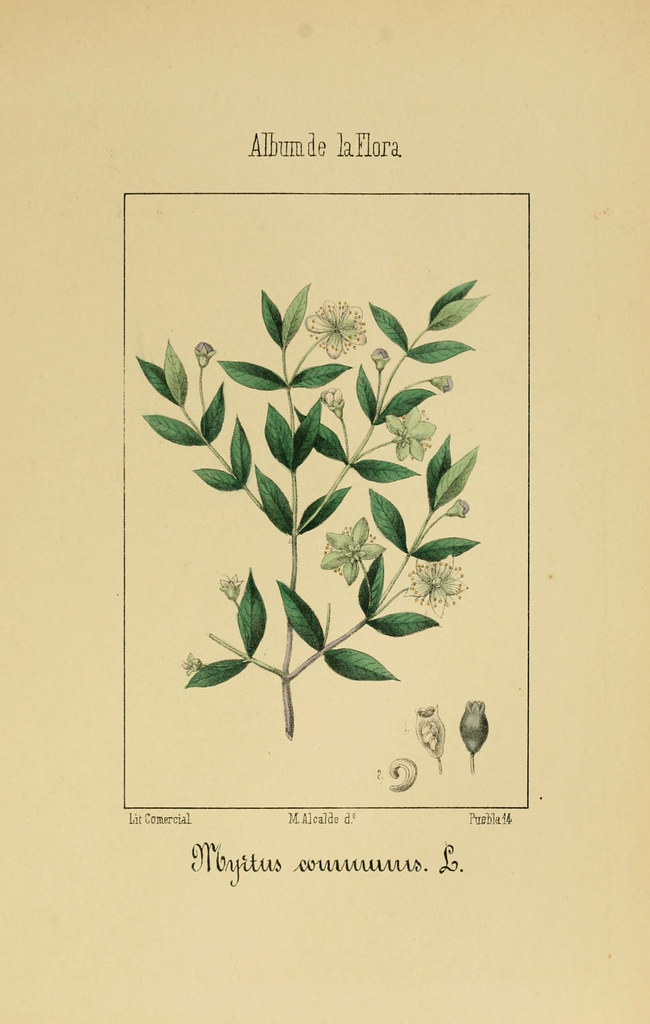
A botanical illustration of Myrtus communis, the common myrtle.
n208_w1150 by BioDivLibrary is licensed under CC-PDM 1.0

Common myrtle (Myrtus communis) is used as a culinary herb and medicinal plant. Figs, threated onto a myrtle skewer and roasted, acquire a unique flavor from the essential oils present in the wood. The seeds, dried and ground, have an interesting, peppery flavor often used in sausages. As a medicinal plant, it’s been used to treat scalp and skin conditions, to stop bleeding, and to treat sinus problems. (Unfortunately, there’s limited evidence that myrtle really does much for that last one.)

Lemon myrtle (Backhousia citriodora) is also a culinary and medicinal plant. As a culinary herb, it’s used to flavor any dish you might flavor with lemon: desserts, fish, poultry, or pasta. It’s especially useful for flavoring dairy-based dishes, since the acidity of actual lemon juice tends to ruin the texture of milk products.
Medicinally, the oil has some pretty significant antimicrobial activity. The leaves themselves are also very relaxing.
(I’ve had the dried leaves in tea, where I find it really shines — it’s got a delightful citrusy flavor with a bright, subtly sweet taste, and it absolutely knocks me out.)

In ancient Greece, the myrtle tree was a sacred tree for Aphrodite and Demeter. Seeing one in a dream or vision was considered good luck if you were either a farmer or a woman. It was also connected to the minor deity Iacchus, for whom there isn’t really much information — he was often syncretized with Dionysus, and Dionysus was all about wreaths and garlands. He could also have been a son of Dionysus, a son of Demeter, or a son of Persephone.

There are also three ancient Greek origin stories for the common myrtle. In one, an athlete named Myrsine outdid all of her rivals. In retaliation, they killed her and the goddess Athena turned her into a beautiful myrtle tree. In another, a priestess of Aphrodite broke her vows to get married (either willingly or unwillingly, depending on the version). Aphrodite then turned her into a myrtle tree, either as a punishment (for willingly breaking her vows) or as protection (against the husband who abducted her to marry). In the third version, a nymph turned herself into a myrtle tree in order to avoid Apollo’s unwanted advances.

Pink crape myrtle flowers on the branch.
Photo by Griffin Wooldridge on Pexels.com

In Japan, crape myrtles are known as sarusuberi (百日紅). Their striking flowers are often found in traditional artwork and make very striking bonsai.

Crape myrtles don’t have much history in old grimoires or European magical systems, purely because they weren’t really around centuries ago. When you’re reading about largely European folk magic, ceremonial magic, mythologies, or herbal medicine, they’re going to be talking about Myrtus species, not Lagerstroemia. That said, crape myrtle flowers are associated with general positivity, love, and romance.

Lemon myrtles don’t have much history in European magical systems, either. Like crape myrtles, this doesn’t mean that they don’t have value. In modern western magic, lemon myrtle is usually considered a solar herb and all of its attributes: purification, positivity, luck, and protection.

As a plant of Aphrodite and Demeter, common myrtle makes a good offering for either of these deities. (This isn’t always the case — sometimes, when a plant is sacred to a god, it means don’t touch that plant.) Since these goddesses are shown wearing wreaths of myrtle, it’s not a terrible idea to weave a myrtle wreath and either wear it while doing devotional work, or place it as an offering to one of them.

A hand holding a sprig of myrtle, showing the plant's leaves and berries.
Photo by Furkan Films on Pexels.com

Common myrtle is also very strongly associated with love and marriage. In Eastern Europe, myrtle wreaths were held over the heads of a marrying couple (now, people use crowns instead). All the way across the sea, in Appalachia, one method of love divination involves throwing a sprig of myrtle into a fire. If you watch the smoke closely, it’s said to form the shape of your true love’s face.

Myrtle is more than a love and marriage herb, however. It’s also considered protective. As mentioned in myrtle’s Greek origin stories, two of them describe women turning (or being turned) into myrtle trees in order to escape men. In England, it was also thought that blackbirds used myrtle trees to protect themselves against malevolent sorcery.

Common myrtle is associated with Venus and the Moon. Lemon myrtle is associated with the Sun.

If you have access to dried common or lemon myrtle as a culinary spice, you’re in luck — these are ideal ingredients for kitchen witchery. Combine them with other ingredients that match your intention (for example, make a delectable chamomile and lemon myrtle tea for luck, just be ready for a nap first), ask the herbs for their help, and you’re good to go.

Lemon and common myrtles have a high concentration of essential oils, so they’re good for infusing. Place some of the dried leaves in a carrier oil, like sweet almond or jojoba, and allow them to sit in a warm, dark area. Shake them regularly, and decant or strain the oil after a month or so. You’ve made an oil you can use for anointing, dressing candles, you name it.

If you want to use common myrtle for love divination, brew a cup of myrtle tea and read the leaves. You can also toss a branch of fresh myrtle into a fire and read the smoke.

I wouldn’t recommend planting myrtle trees if you live outside of their native range, but, if you’re in the southeastern US like me, you probably have access to loads of them anyway. You can find lemon myrtle in tea and spice shops. Same with common myrtle. Crape myrtle grows by the roadsides here as a landscaping plant. (If you’re me, you might even think you’re planting an elderberry start and end up with a crape myrtle instead!)

Even if you can’t grow myrtles yourself, I recommend experiencing their delightful colors, flavors, and aromas at least once. Each myrtle species and relative has their own fascinating folklore and history of use,

Just for fun · life

I had an aura photograph done (and it is very blue).

So, my handsome assistant and I recently went to a small psychic fair. I’d never been to one before, so I figured a little, local one was the way to go. When I say “little,” I do mean little — there were only a few vendors and not many guests, so we had the opportunity to really browse and take in all of the artwork, mineral specimens, and assorted other good stuff without having to maneuver around crowds or budget our limited time between dozens of booths.

One booth offered aura photography. This isn’t something I’ve ever put stock in, but it was something I’ve nevertheless been curious about. Getting an aura photograph also feels almost like a rite of passage — if you’re inclined to go to psychic fairs and such in the first place, then you’re probably going to end up getting an aura photograph at some point.

The process was simple: Sit, breathe, relax, put your hand on a set of sensors, and get your photo taken. Quick, simple, and totally non-denominational and non-invasive. It’s like getting your birth chart done, but with more technology.

Auras are luminous fields of often-colorful energy around every living thing. According to some, the colors of these fields correspond to one’s personality, outlook, mood, and even physical health. The brightness, shape, and colors of auras are generally invisible to the majority of people, though some practitioners of various new age arts claim to be able to see them and there are several different techniques to train one’s eyes and mind to pick up on auras. Aura photography purports to capture this energy field and create a visual representation that anyone can see.

Once your aura photo’s done, you get a breakdown of the colors, their significance, and, depending on the photographer and their respective setup, a breakdown of your various other energetic characteristics. I got a very detailed report of my different energy centers, balance of yin/yang energy, and energy fluctuations.

In my case, my aura was primarily indigo, with some neat blue-greens at my head and feet, and pinks/purples at either side.

It would probably be a bit navel-gazey and not super helpful to do a deep dive into my own specific energy stuff, so I’ll refrain from doing so here. Suffice to say, it was intriguing enough for me to give it a deeper look. Not only did I read the full report (which was honestly eerily accurate), I also went looking for more answers.

Mainly answers to one question in particular:

The “photography” bit is somewhat of a misnomer. The photograph of you isn’t where the information comes from — it’s mostly an aid for visualization. Instead, the actual info comes from the hand sensors.

This is in contrast to Kirlian photography, which is something completely else (and something I haven’t tried yet).

The hand sensors themselves pick up multiple different things. They’re essentially biofeedback electrodes, picking up on things like temperature, heart rate, and skin conductivity. The idea behind aura photography is that these factors are impacted by one’s energy meridians and flow, so the machine can extrapolate information about your aura from the data the sensors collect.

Once the hand sensors have picked up the information they need, the accompanying software renders it into a colorful image as seen above. These colors are superimposed on the photograph of you, and there you have it — your aura photograph.

(I did not include the actual photo of me and my aura, because it was humid and I was a sweaty mess. You get a rainbow egg and human silhouette instead.)

I mean, auras are very subjective. I’m not one to engage in solipsism, but you can never know if other people are seeing the same things you do. Even looking at something that should be objective, like a painted wall, can yield dramatically different interpretations. What you see as blue, someone else may see as aqua, cerulean, or cobalt. Someone else may only see a shade of gray or interpret it as a completely different color.

Skeptics say that auras are a fake idea. Believers say that’s wrong, and auras are absolutely real. There’s no way to completely, objectively prove either, so it’s kind of a choose-your-own-adventure thing.

Go to two aura readers, and you’re very, very likely to hear two different interpretations. People’s auras are also in flux. Even the most accurate reading or photo, therefore, will only be able to tell you how things look right now.

Would I plan my life around the results of an aura photograph? No. Did I nonetheless find the experience valuable? Yes.

To me, aura photographs are useful just like many forms of divination are useful: They give you another angle from which to consider things. Since the information they present has a degree of randomness (or, at the very least, is based on input you can’t really control), they’re unlikely to present you with information that you’ve already thought of yourself.

It’s like when life coaches, counselors, and such started introducing tarot readings into their practices. This isn’t because tarot is necessarily a diagnostic or treatment tool. It’s because it’s a great way to get a new, unbiased angle from which to look at a situation. For example, if you’re having career problems and you keep pulling cards from the suit of Cups, you may start to recognize emotional or relationship aspects of your problems that you never considered before. It’s something that takes in a bit of chaos and spits out a new way to look at things.

This is what aura photography did for me. Seeing alleged weak spots led me to read about traditional methods for remedying these things. If nothing else, it has me adding more variety to my diet, trying new exercises, exploring different methods of meditation, and checking out different perfumes and colognes. Worst case scenario, I come out of this experience with some new recipes and activities that I enjoy.

That said, this shouldn’t be used to diagnose or monitor physical or mental illnesses. Some people claim that they can do so using various aura reading techniques, but these claims are dubious at best. By all means, combine energy healing with more conventional treatments, just don’t expect aura reading or photography to give you an accurate diagnosis. Get a second (and maybe a third or fourth) opinion from a doctor.

Would I do this again? Almost definitely! It was interesting and, like I said, surprisingly accurate at times. It’s something I could see doing every few years or so, as a way to mix things up and discover new angles to explore.

Plants and Herbs

Ivy Folklore and Magical Properties

Ah, ivy.

In the US, few outdoor plants are as divisive. There’s the very romantic ideal of an old, ivy-covered brick building in the Northeastern US, but also English ivy is invasive here. It’s a low-maintenance ground cover, but will also crowd out just about everything.

I wrote about vines in general a little bit ago. As I write this, I’ve just come back indoors from taking a walk around the yard and checking on how my plants’re doing. I was scoping out the raspberry canes when what to my wondering eyes should appear by a sneaky tendril of English ivy, creeping its way under the deck. With those two things in mind, I figured now might be a good time to do a deeper dive into one very specific vine: Ivy.

The ivies make up the genus Hedera. There are 12-15 distinct species within this genus, all native to Europe, eastward to Asia, and southward to northern Africa. The one that most English-speaking people think of when they hear the word “ivy” is common or English ivy, Hedera helix. (Pothos, Epipremnum aureum, is sometimes called “devil’s ivy” but is not related to Hedera. Neither is poison ivy, genus Toxicodendron.)

A dense growth of ivy covers a wall, surrounding a green door.
Photo by Pixabay on Pexels.com

In the Ogham alphabet, the few ᚌ (gort) is said to represent ivy. The Bríatharogaim for gort is “sweetest grass,” “suitable place for cows,” and “sating of multitudes.” The word “gort” also stems from a Proto-Indo-European root meaning “enclosure.” Some Ogham readers interpret gort as “field,” rather than “ivy,” which seems to be closer to its traditional sense. When the Ogham is conceptualized as a purely tree alphabet, gort becomes ivy. This few is associated with growth, prosperity, and the winding path toward enlightenment. On the flip side, it’s also connected to the word “gorta,” meaning “hunger” or “famine.”

In Irish folk stories, ivy is often described as surrounding the entrances of caves or secret doorways. Interestingly, in this context ivy is concealing these entrances from the outside world — either as a narrative flourish to give the text some more flavor, or as a deliberate guardian and barrier between the Otherworld and this one. In some tales, ivy is a protective plant against the fae.

In ancient Greece, ivy was connected to the God of wine, frenzy, and agriculture, Dionysus. He’s often pictured with a crown of ivy as a representation of his exalted and immortal status. In one tale, it’s said that he wore an ivy wreath to curb the effects of drinking wine — while grapes are a summer vine, ivy is a cooling, wintery evergreen. Thalia, the muse of comedy, was also depicted as wearing an ivy crown.

In Egypt, ivy was a sacred plant to Osiris. Similarly to Dionysus, ivy was connected to the concepts of immortality and rebirth.

The idea of buildings covered in ivy comes from the belief that this plant could protect one’s home and family from evil, as well as bring in good luck. This belief is also where ivy door wreaths come from.

While people often overstate the effectiveness of using indoor plants to remove pollutants from the air, research has shown that ivy may help reduce numbers of airborne mold spores. More study is needed to determine how effective this would be in the average home, as well as how many plants it’d take to cause an appreciable drop in mold spores.

English ivy is considered toxic, and consumption can cause gastric upset, pain, and vomiting. Some people are allergic to ivy, and may experience severe reactions. That said, this plant has historically been used medicinally to treat respiratory issues and extracts can still be found in some modern cold and cough remedies.

As an evergreen, ivy is often used for decoration during the winter holidays. It has a perpetual connection to the sun and springtime since it never loses its color, even during the depths of winter.

Magically, this plant is associated with fertility, abundance, protection, and good fortune. Some also use it to enhance divination or improve psychic abilities.

If you’re in the US, do not grow English ivy outdoors. If you’re going to grow it, pot it and keep it inside. While English ivy can be controlled with careful pruning, it can easily get out of hand and grow prolifically enough to starve and weaken trees by weighing down their limbs and blocking sunlight from reaching their leaves. It also has a habit of escaping and ending up where there isn’t anyone around to keep it pruned, damaging native forests. IWithin its native range, ivy provides food, shelter, and an increase in the biodiversity of forests. Outside of that range, it is mainly a way to slowly kill trees and turn every available surface into more ivy.

Ivy growing on a tree trunk.

If you really, really want to grow ivy in your garden, look for varieties that are considered non-invasive where you live.

Historically, the easiest ways to use ivy have been to have it near or on your front door, or even just to wear or carry a sprig. You could do this by tucking a fresh sprig in a pocket, a buttonhole, or even a hair clip whenever you go to do something that requires some extra luck and protection.

Traditionally, ivy was used to protect against supernatural entities and malevolent witchcraft. This makes it a good candidate for including in any spells, jars, or sachets intended to break or protect against hexes, jinxes, or curses.

If you do decide to keep English ivy in your home, whether live and potted or fashioned into a wreath or garland, keep it away from pets. While it does have medicinal properties, this is only when properly prepared by a skilled herbal practitioner. Otherwise, it’s considered toxic to dogs, cats, and humans.

Ivy is a beautiful little plant with a long history of symbolism behind it. As with many plants of considerable power, it needs to be treated responsibly — stay mindful of ivy’s place in (or outside of) your local environment and build a relationship with it accordingly. Whether you’re able to safely grow ivy outside, or must keep it confined to a pot indoors, this plant is a very handy and capable magical ally.

Plants and Herbs

Lemon Folklore and Magical Properties

Lemons have a rich history of folklore and magical use. In the US, it’s one of the quintessential summer fruits — owing, at least in part, to its cooling properties.

A lemon hanging from a lemon tree branch.
Photo by Samer Daboul on Pexels.com

Lemons can do more than cool you down on a hot day, though. They’re also integral to the “lemon cure” that made its way around Pinterest and other social media spaces. This involved cutting a lemon into slices, salting it, and placing it in your home to (depending on the source) remove or detect negative energy. This idea didn’t come out of nowhere, either. Lemons have historically been used to counteract evil, fight disease, and much more.

Nobody knows for sure where lemons (Citrus x limon) came from. Experts theorize that the first lemons were grown in India, and genetic studies show that they’re a hybrid between citron (Citrus medica) and bitter orange (Citrus x aurantium). Bitter oranges, in turn, are likely a cross between pomelos (Citrus maxima) and mandarins (Citrus reticulata). The name “lemon” stems from the Persian word “līmūn,” which referred to citrus fruit in general.

In American folklore, lemons were (and are) considered fruits of positive energy and purity. There are tales of lemon trees that would only bear fruit when a pure-hearted soul approached or cultivated them, and hanging a lemon above one’s front door is touted as a way to keep evil at bay.

In India, shopkeepers would hang lemons, chilis, and charcoal above their shop doors. This is a specifically designed to repel Alakshmi, a deity of misfortune and poverty. She is a dualistic figure to Lakshmi, and represents the fall that comes after pride, or the negative force that comes after increasing wealth. Her presence is said to cause malice, jealousy, and ruin.

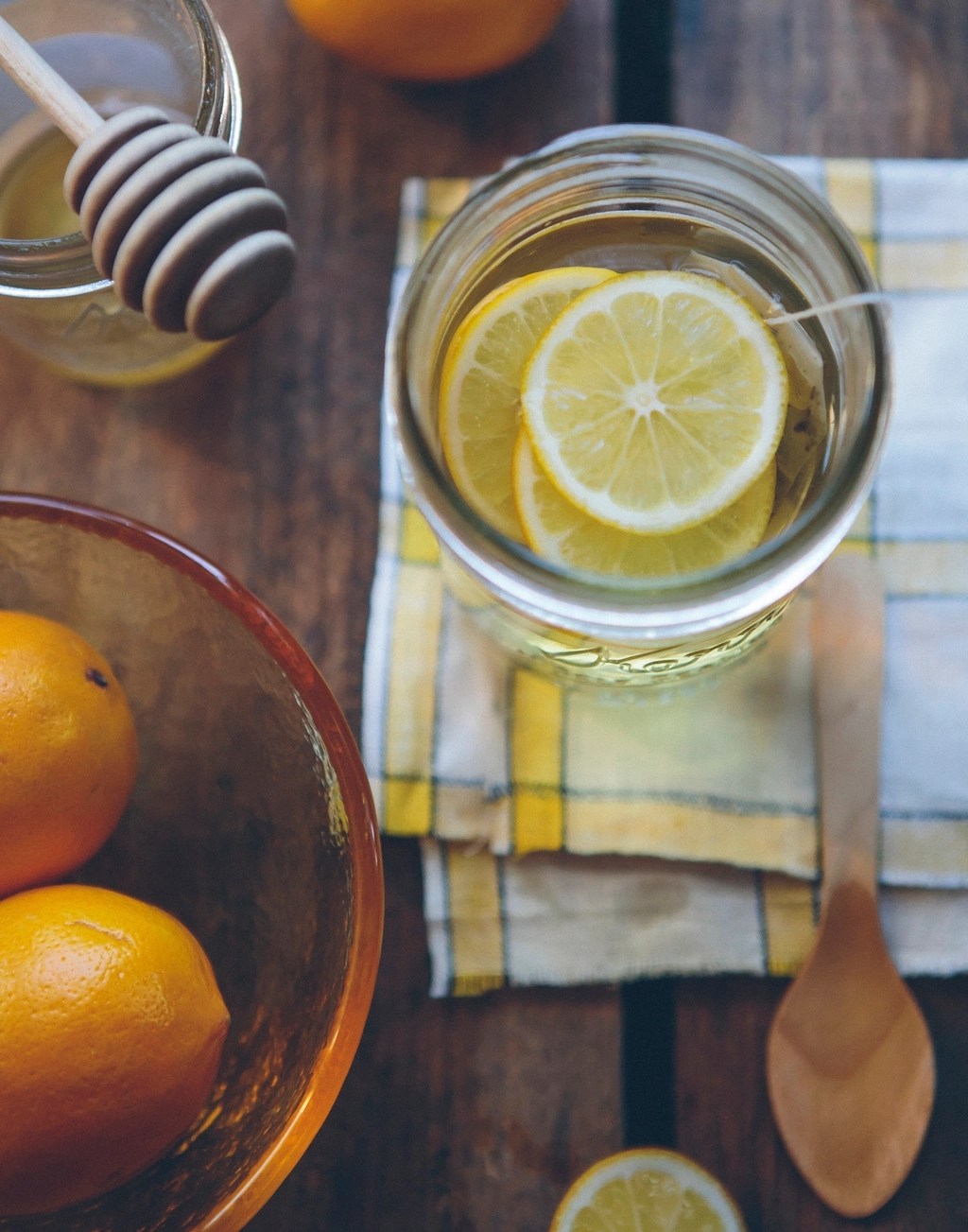
A jar of lemon tea, sitting atop a yellow and white napkin on a wooden table.

Meanwhile, in Greece and medieval Europe, lemons were associated with luxury — after all, they had to travel a long way to get there and required very specific conditions to grow. This gave them additional connections to abundance and prosperity.

Medicinally, lemons have been used to combat illnesses like sore throats and upper respiratory infections. Historically, their juice and preserved peels were used to aid digestion.

Today, lemons are commonly used as the base for the citrus pomanders commonly seen in the US around the winter holidays. Take a lemon, stud it with dried clove buds, and there you go — a pretty, festive, and wonderful-smelling pomander. These objects weren’t always holiday decorations, however.
Their origins are quite a bit darker.
Before the germ theory of disease was developed, people believed in miasma theory. Bad smells were thought to be the culprit when it came to all kinds of sickness, and people would wear or carry pomanders to ward them off. These were usually little sachets, rings, or metal cages containing fragrant ingredients that the user would hold up to their nose in order to keep from breathing in bad odors.
While citrus pomanders are often associated with Colonial-era crafts, few American colonizers would have been able to afford to wear or decorate with perfectly good food. Decorations like this were really more of a thing around the 1900s. Some confusion arose in the 1930s, when the Rockefellers helped restore parts of Williamsburg, Virginia. The residents were told that, to preserve the town’s Colonial-era museum-like quality, they weren’t allowed to decorate for the holidays since this wouldn’t be period-appropriate. Residents eventually struck a compromise in which they were allowed to decorate in a turn-of-the-century style that used fruits and greenery instead of blinking lights.
Hence, the citrus pomander as a questionably-authentic Colonial-era holiday decoration.

Overall, lemons are strongly associated with cleansing or repelling evil and attracting prosperity. The concept of prosperity is often expanded to include all good things, including fertility. Lemons are also frequently employed as catalysts in luck formulas. Lemon blossoms, in particular, are considered a powerful attractant for positive things.

Interestingly, lemons are somewhat contradictory when it comes to love — lemon blossoms are generally a romantic ingredient, and there are also traditions that involve using lemons to secure a partner. (For example, one Sicilian-American tradition involves a woman stealing a lemon from a St. joseph altar in order to get a husband.) On the flip side, as a sour fruit, lemons are used equally as often to end a relationship and drive away an unwanted suitor. Lemons are also used for mental clarity, which is generally an antidote to the twitterpated feeling of being in love!

A lemon cut into thin slices, sitting on a wooden cutting board.
Photo by RDNE Stock project on Pexels.com

One of the easiest ways to use lemons is in the lemon energy cure, as described at the top of this post. Take a good, firm, fresh lemon, and cut it into slices no more than a quarter inch thick. Sprinkle these slices with salt, and place them in the most high-traffic areas of your home — places like living rooms and dining rooms. Give the lemon a few days, then give it a look over. If it’s neatly dried, then all’s well. If it’s soft, mushy, discolored, bad-smelling, or moldy, repeat the process with a fresh lemon.

Some practitioners don’t even bother with the whole cutting and salting thing. Instead, they place whole lemons wherever necessary. If the lemons dry up, everything’s good. If they mold or decay, it’s time for a thorough cleansing and some new lemons.

Lemons are also good to add to floor, door, and window washes to remove bad or stagnant energy. Squeeze the juice of a fresh lemon into a bucket of fresh washing water and mop your home from back to front. Give your doors and windows a wipe down with the water as well.

In general, lemons are a good thing to keep around where people (especially guests) congregate. You never know what kind of energy other people are bringing in, so keeping some fresh lemons where you usually socialize is a good way to counteract any kind of negative energy that pops up. Pick up a pretty bowl from a thrift shop, add some bowl fillers and a few lemons, place it somewhere inconspicuous, and nobody’ll be the wiser.

Plants and Herbs

Mugwort Folklore and Magical Properties

The other day, after attending the drum class I wrote about yesterday, I was waiting in the herb shop to stock up on some things I need for teas, oils, and the like. I overheard the customer in front of me talking about mugwort, and, since it’s an herb I use often, I maybe kind of eavesdropped a little bit. What followed was a really interesting conversation about herbs, dreams, lucid dreaming, dream recall, and trance work.

It was so nice to get to talk about herbs with someone outside of a purely medicinal context, that I figured that this was a good week to talk about one of my absolute favorite plants: mugwort.
(And, if you were that person, I’m so sorry for being an eavesdropping weirdo but I also had a really fun time talking to you about herbs.)

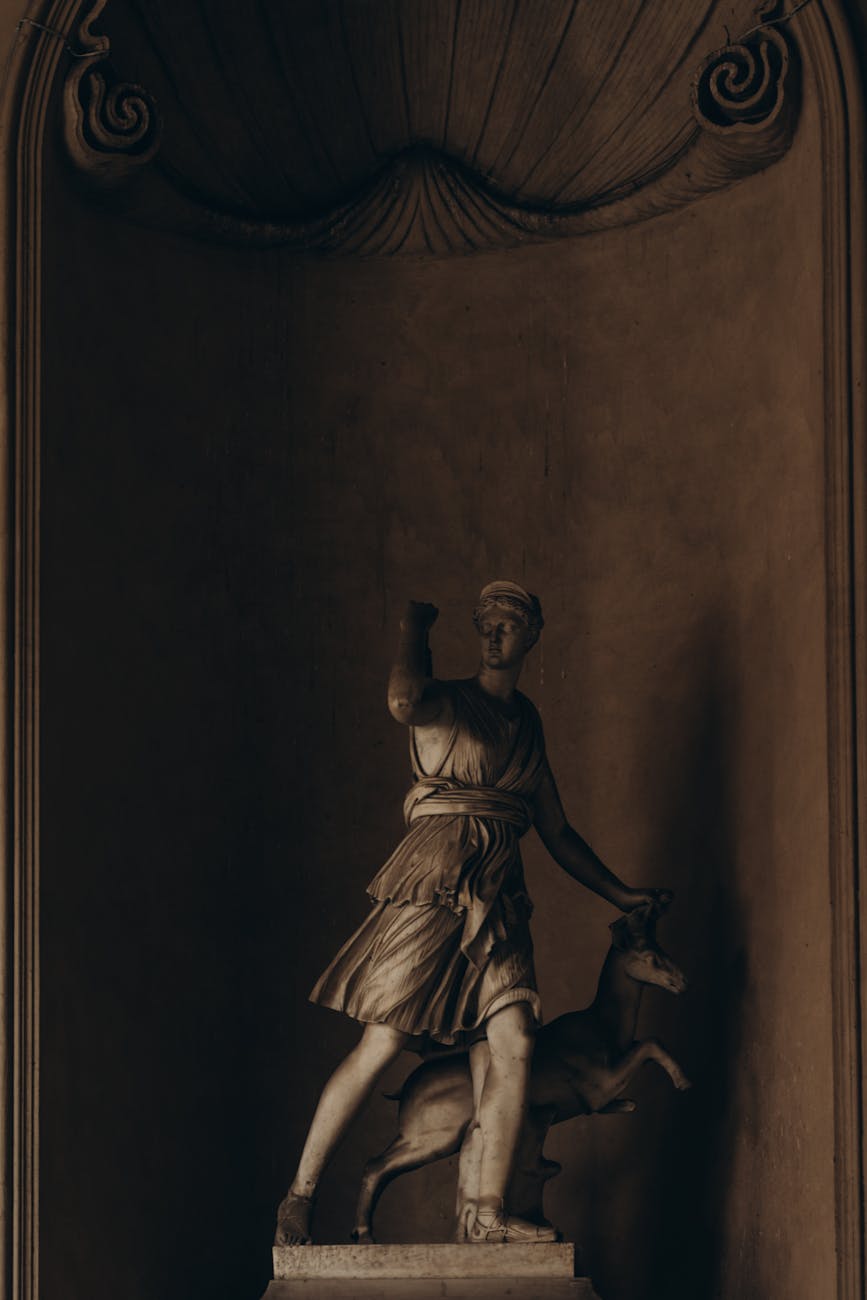
An old statue depicting Artemis alongside a stag.
Photo by V Marin on Pexels.com

Okay, I know the name “mugwort” leaves a bit to be desired in English — it’s not exactly the most phonetically pleasing word — but its scientific name is rather beautiful: Artemisia vulgaris. The “vulgaris” in this instance means “common,” like the “wort” in “mugwort” roughly translating to “plant.” Mugwort is a very interesting, very magical, and very common plant.
The “mug” in mugwort may come from its use as an insect-repelling herb. The Old English word “mygg” is where we get the modern word “midge.” Another possibility is from its use as a flavoring herb in brewing. The “Artemisia” in Artemisia vulgaris, naturally, comes from the lunar and woodland goddess Artemis.

Mugwort was an important herb to the ancient Greeks and Romans. Soldiers and travelers would place sprigs of it into their shoes, in order to ward off fatigue.

Mugwort is very commonly included in herbal blends for dreams, psychic abilities, divination, cleansing, protection, and banishing. Like so many other herbs that are used for cleansing and banishing, this may stem from mugwort’s use as a pest repellent — it can literally banish the evils of disease brought by insects, ergo it must be useful against other evils as well. (See also: Pennyroyal.)

In Christian mythology, mugwort is associated with John the Baptist. It’s said that he carried mugwort with him to ward off evil. As a result, people would wear garlands of the herb on St. John’s Day (June 24th) and toss them into fires to ensure protection for the next year.

In some shamanic practices, mugwort is a representation of ancient wisdom. This plant is often visualized as a kind of crone figure, and used to facilitate a connection to ancestors.

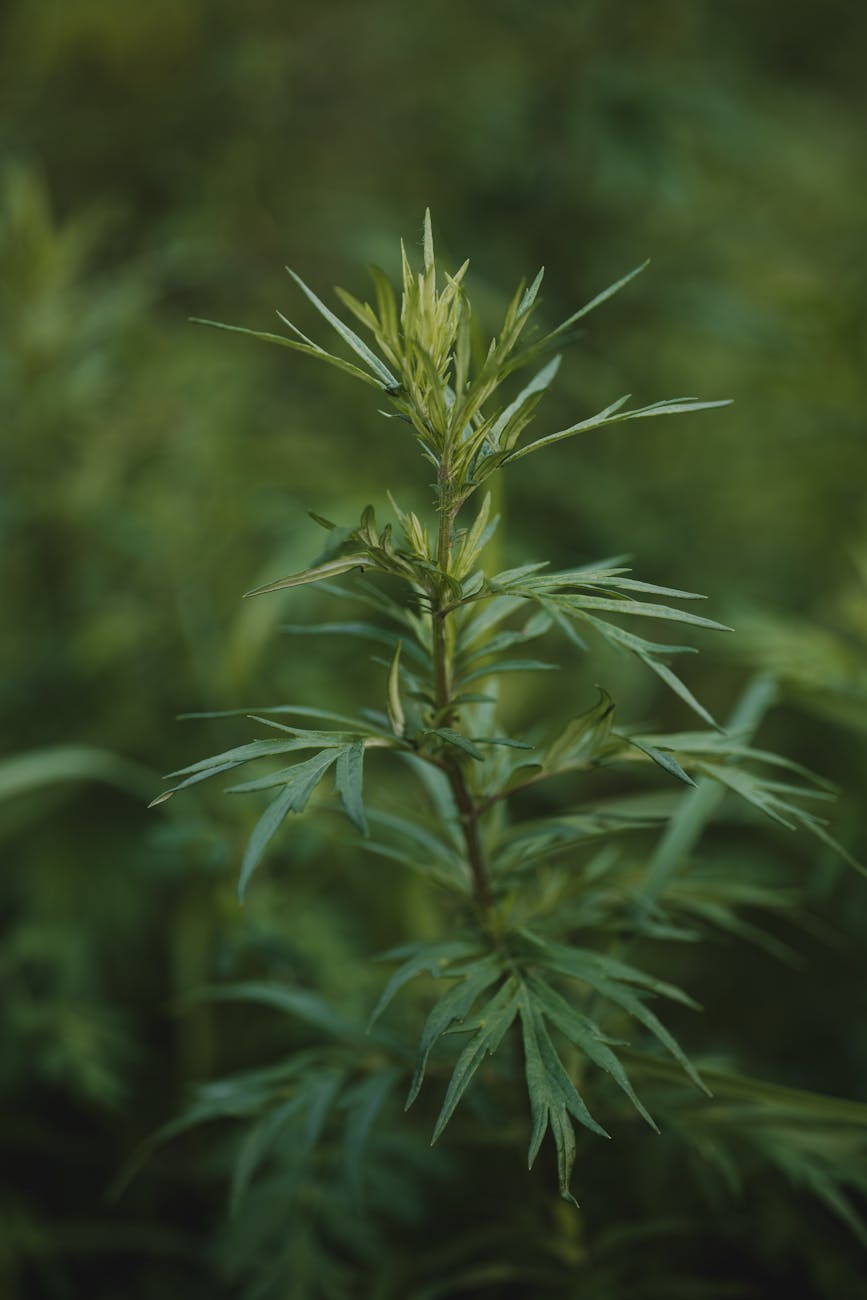
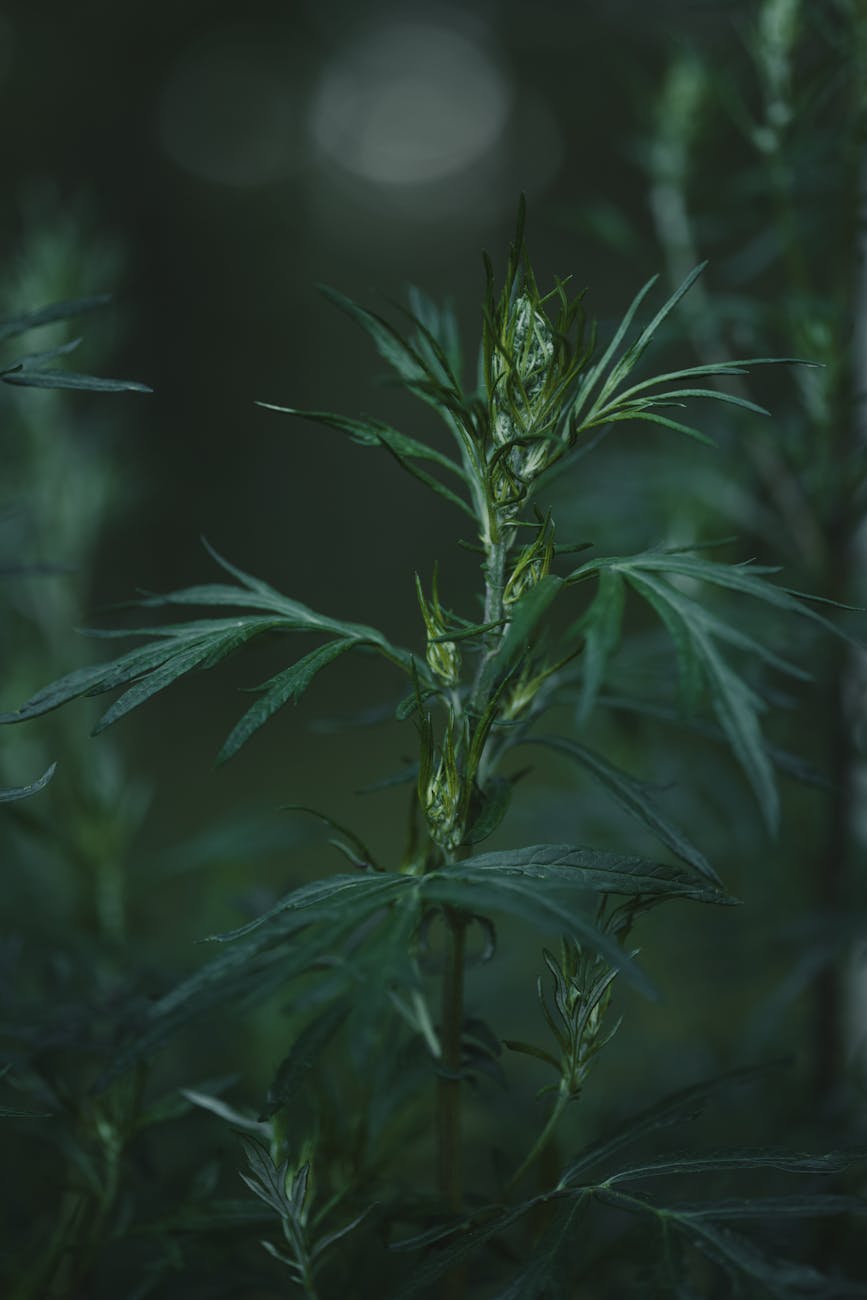
A close-up of a young sprig of mugwort.
Photo by Lauri Poldre on Pexels.com

Medicinally, mugwort was (and often still is) used to help ease difficult periods, treat menstrual irregularity, and as a mild pain reliever and anti-inflammatory. Mugwort is also used in the acupuncture practice of moxibustion, in which pieces of mugwort are placed at the end of acupuncture needles and burned.

Mugwort is also part of the Nine Herbs Charm according to one source, along with plantain, lamb’s cress, fumitory, chamomile, nettle, crab apple, chervil, and fennel. In this charm, mugwort is honored as the “oldest of plants,” strong against both poison and an unnamed force that travels the land. (This may be either a personification of evil, a venomous serpent, or a specific disease, but it’s referred to simply as “the loathsome thing.”)
The Nine Herbs Charm is a beautiful piece of poetry that combines Pagan and later Christian influences in a way that passes down important medical knowledge. The charm concludes with the recipe for a healing salve made by powdering the herbs, mixing them with old soap, mixing this with lye to make a paste, and combining it with boiled fennel. The charm is sung several times during the process — three times to each herb, then over the patient’s mouth, ears, and the wound being treated.
This is not only a magical consideration, but a practical one as well. It’s considered important to declare one’s intentions in adding an herb to a magical mixture, but the number of times the incantation is sung may correspond to how long it takes to powder and mix everything correctly. Singing it once while powdering an herb, for example, may yield a coarse consistency that doesn’t properly blend. Singing it three times, on the other hand, gives you the exact length of time needed to properly powder and mix the herbs. It’s like having a portable kitchen timer that not only tells you the recipe, it tells you what each ingredient is for and makes sure you do it right.

Mugwort was also used like hops before hops were a thing in brewing. Hops didn’t really achieve widespread use until the 15th century — before that, brewers used mugwort. It’s still used in food and teas for its unique flavor, which is like a bit astringent and savory, with a really interesting resinous character. Kind of like a mix between celery, mint, and eucalyptus.

While mugwort isn’t native to the US, it’s not exactly hard to find here, either. It does have a number of lookalikes, so you’ll want to get the help of a seasoned forager to make sure that you’re correctly IDing it. Start by looking for it in ditches, by roadsides, fields, and other places where the ground has been disturbed.
(Of course, if you’re foraging mugwort in order to consume it internally, avoid any that’s growing within ten feet of a roadside. In general, it’s better to avoid foraging near roadsides at all because the soil and plants there are contaminated by vehicular pollution. Leaving the plants in place ensures that you’re not consuming any of this pollution, and also allows them to remain and continue bioremediation.)

A large clump of mugwort, absolutely thriving next to a drainage ditch full of water.
Mugwort growing beside a drainage ditch in the Norton Marshes by Evelyn Simak is licensed under CC-BY-SA 2.0

Of course, as with many other plants, I advocate for growing mugwort if you want to develop a relationship with it. However, if you’re in the US or another area where mugwort is a problem, I recommend either growing it in containers, or trying a related native species. (Like Artemisia douglasiana, California mugwort, in the western US.)
If you’re looking for mugwort’s medicinal properties, stick with A. vulgaris or other Artemisia species specifically used in herbal medicine. Different species may not have the same active compounds in the same concentrations, and some may even have some not-very-desirable qualities as well.

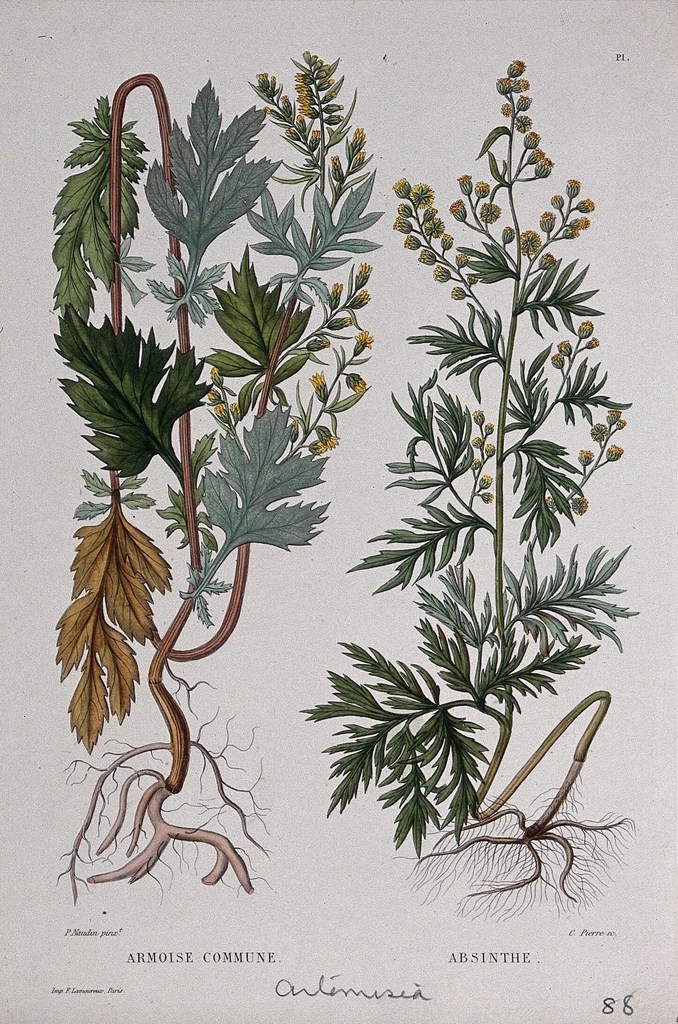
An old botanical illustration of a member of Artemisia.
The “Absinthe” on this illustration suggests wormword, Artemisia absinthum. However, the pointy leaves with green tops and silver undersides indicate mugwort.

Once you have some, using it is pretty easy:

  • Dry the leaves and add them to dream pillows along with herbs like lavender or chamomile. Squeeze the pillow and inhale the scent before dropping off to sleep.
  • Add dried mugwort to incense and light it before card reading, scrying, or other forms of divination.
  • Powder it fine and combine it with protective herbs, then sprinkle them in the corners of your home or around the border of your property.
  • Rub fresh mugwort on a black candle and burn it to banish a person, entity, or situation.
  • Dry whole sprigs of mugwort, tie them into bundles either alone or with other cleansing herbs, and burn to purify spaces and prepare them for ritual work.

You can consume mugwort as a tea or flavoring agent in breads, soups, poultry dishes, or beverages. However, high consumption of this herb does come with some unpleasant side effects like muscle spasms. If you’re looking to tap into mugwort’s psychic, trance, or dream benefits, you should still avoid consuming more than you’d normally get in an herbal tea, and avoid doing so for more than two weeks at a time. More isn’t always better.

If you’re pregnant or seeking to become so, avoid consuming mugwort. One of its chief medicinal uses has been to treat menstrual irregularity by stimulating uterine contractions. So, unless a qualified herbal practitioner says to use it, it’s best to avoid mugwort in these situations.

The mugwort of European folklore may not be from the US, but its invasive and resilient nature means that its probably here to stay. If you want to enjoy the long magical, mythological, culinary, and medicinal history of this herb, I recommend growing it in a container or purchasing the pre-dried herb to add to teas, incenses, sachets, or other preparations.

life

Learning to Drum

Every Saturday, Smile Herb Shop hosts drumming lessons taught by musician Nana Frimpong. It’s something that I’ve wanted to go to ever since I first found out about it, but never had the opportunity — Smile is pretty far from where we live now, and Saturdays are often one of the few opportunities that we have to take care of things that need attention.
So, when we realized we wouldn’t be able to go camping like we originally hoped to, it seemed like a good time to finally sign up.

Initially, I felt self-conscious — my Handsome Assistant and I were the first to show up to the class, so it was only Nana and us for some time. Fortunately, Nana is a very welcoming, friendly, and engaging teacher. In between teaching drumming, he played songs for us while we did hand stretches, told us about his family and childhood in Ghana, and showed us how music had shaped his life to make him the person he is today. His message was radically inclusive, using drumming and music as a uniting force across all people and all cultures. Not only was the class really enjoyable, it was deeply moving.

Being there brought up a lot of memories for me, too. Being a little kid at Powwows, listening to the heartbeat drum and dancing with my friends. Being older, going to local burns, learning to fire spin and dancing around the burning wicker man to the sound of drums. Even this past Beltane, when I sat with a group of very welcoming strangers and drummed for the maypole dancers. Drums have been integral to so many unifying, joyful experiences in my life.
As it turns out, I really, really missed that.

Gradually, more people filtered into the class. They brought their own drums. One person very generously offered snacks. Another, equally generous, recorded the music we were making on his phone. I had never met any of these people, some didn’t even live in the same state as I do. But there’s something really unifying about playing together. Making the same motions at the same time. Hearing the voices of each different drum come together in one song.

Most of all, it’s fun.
“Fun” seems like a silly way to put it, but I don’t have a better word. It’s fun to make something beautiful with strangers, in a way that cuts to the bone through all the pretenses we dress ourselves in.
It’s fun in a way that makes those other things not matter.

Next weekend, Nana will be hosting an outdoor concert as part of his drumming classes at Smile to celebrate his birthday. Slots in his classes are very inexpensive on Eventbrite — only about $11. If you’re interested in drumming for fun, to increase your musical abilities, or for healing, I definitely recommend attending.

Neodruidry · Witchcraft

A happy and fruitful Lughnasadh!

My Handsome Assistant and I were originally intending to go on a camping trip with a local Druid group that we’re part of, but with him still recovering from his accident, we decided (at the last minute) that it might be better to focus on getting him to 100% before we try tent camping.

So, rather than having singing, dancing, feasting, and ritual in a group, we had a smaller, homey version: fresh baked breads, homebrewed peach mead, music, ritual, and a spirit feast.

An image of a feast, featuring charcuterie, fresh fruit, big strawberries, sliced carrots and cucumbers, and lots of other delicious, seasonal food.
Photo by cottonbro studio on Pexels.com

What’s a spirit feast? Exactly what it sounds like — a feast conducted for deities, ancestors, spirits of the land, guardian and guiding spirits, and any spirits to whom we may owe a debt (for example, spirits of the land affronted by new construction, tree felling, and so forth).

Unlike the “dumb suppers” of Samhain, this is not just for ancestors and the beloved dead, and it’s more like a party. Offerings are carefully chosen and high quality. Incense. Flowers. Candles. Fresh bread. Wine. Fruit. Good food, well prepared. Is it a traditional part of Lughnasadh celebrations? Not really. But Lughnasadh is a time to offer the “first fruits,” and so, in the absence of being able to party with friends, it seemed an appropriate way to offer the first fruits.
It felt right. It was equal parts fun and moving. I’ll probably make it part of my celebrations from now on.
Lughnasadh, after all, may have its origins as a funerary feast for the mother of Lugh, Tailtiu. She died of exhaustion after preparing the land for agriculture, and represents the Earth that feeds us and the plants that are harvested and die back in the high summer heat. It seemed a good idea to pay back this sacrifice and invite the spirits of the land to a feast.

This year, the fruits of our garden are particularly abundant. The Virginia roses (Rosa virginiana) are all but bowed over with fruit. The passionflower (Passiflora incarnata) vines are thick and lush and heavy with their strange purple flowers and egg-like fruit. The pumpkins are pumpkining. The beautyberry (Callicarpa americana) is both beautiful and extremely berried.

It’s very good. I hope things are very good with you, too.