Uncategorized

A Happy and Blessed Alban Eilir

This past Saturday, my partner attended his first full-on ritual. A Druidry group that I’m part of collaborated with a pretty big, local Wiccan-inspired group to have an Ostara/Equinox celebration — there was a meditative walk through the forest, chanting, singing, dancing, and a big potluck full of tasty food.

And we almost completely missed all of it.

See, we’d offered to give a ride to a group member who doesn’t drive. “No biggie,” I thought, “Twenty minutes to go scoop him up, avoid the marathon, then we get out of the city and we’re good.” There was only one problem: The half-marathon pretty much bisected the entire city, to the point that getting out was very time-consuming and complicated. In the end, we almost had to drive back home and start over from there, because completely leaving the city and driving around it would’ve been faster and simpler than trying to go through it. Yuck.

This wouldn’t have been too bad, but we hit some navigation issues the rest of the way down. What was, “It’s okay, we’ll just miss the walk and make it in time for the ritual” then became, “Okay, so we’re going to miss the ritual, but we’ll be there for the potluck at least.”

Fortunately, fate smiled on us and we managed to roll up exactly when everyone was going from the pavilion to the ritual circle. The three of us ducked into the back of the line and picked up the lyrics and intonation of the chant on the fly.

(Fun fact: Mouthing the words “watermelon, carrots, peas, and bubblegum” can help you get through any lip-synching that you’re not sufficiently prepared for.)

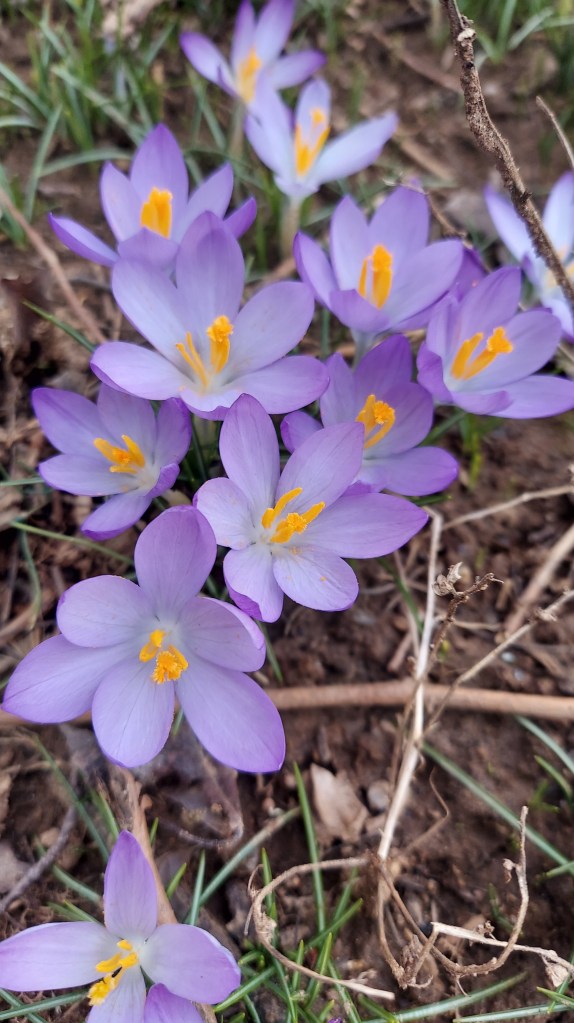
A small patch of purple crocus flowers.

We sang, we clapped and drummed, we spiral danced. Day and Night did a dance to illustrate the victory of light over the darkness and gave a short speech on how Night entrusted the world to Day, and Day would return it to Night during the darker, colder months of the year.

Then it was time to eat!

The food was amazing — I think I ate my weight in lemon bars and curried chickpea salad. (We brought some cases of sparkling water, because the potluck sign-up sheet only had one other person bringing beverages and extra fizzy water always seems to go over pretty well.) There was quiche, a whole chicken, very spicy-sweet beans, curried chickpeas, banana bread, lemon cake, lemon bars, artichoke and crab dip, crackers, cheese, fruit, jam, you name it.

The conversation was great, too. We met some very cool new people, and talk seemed to flow easily. We talked about brewing mead and making water kefir and why wasps are actually great. Despite the stress of trying to get there on time, the vibe was extremely chill and comfortable.

I also have possibly made friends? This is both delightful and terrifying because I’ve moved around a lot, I’ve always been socially anxious, and the pandemic has made things weird.

Anyhow, despite being trapped in a car with us for three hours, the person we’d given a ride too suggested taking a walk through the woods after we ate. Since the walk was the one part we’d ended up missing, the forest seemed lovely this time of year, and I was sincerely shocked that he wasn’t completely sick of us already, I was down for it.

We ended up posing for photos as part of an effort to Save Lake Accotink (which is a pretty complex issue — it’s a man-made body of water, and maintaining it requires regular dredging. This has become expensive and complicated. Opponents cite the cost and some environmental concerns, but the alternative to dredging is turning it into a managed wetland. I haven’t seen estimates for what kind of environmental and monetary impact this would have over time, so my concern is that the managed wetland would eventually become a neglected area and the silt that it now captures could negatively affect waterways downstream.

It also seems like a lot of the issue is development and poor stormwater management in the area, which creates water-impervious surfaces that allow more runoff into the lake. Lake Accotink has been around since the 40’s, so it’s been a watery habitat for a while now and I don’t know what kind of impact it would have to try to put that genie back in its bottle. In some of the articles I’ve read, the social and environmental concerns also seem tacked-on and secondary to the monetary cost. All of this is why I haven’t really formed an opinion on whether the lake should still be dredged or not — it seems like it’s going to be a very difficult, disruptive, kind of sucky situation for everyone and everything involved either way.)

We also saw… Well, we weren’t entirely sure what we saw.

What are those?”

We tried to creep closer down the bank without startling them. They were all standing in a row on a partially-submerged log, long, sleek black bodies pointed toward the sun like arrows, beaks tilted to the sky. My partner snapped a few blurry pictures of them, like cryptids, while we tried to guess at what kind of (bird? low-stakes chupacabra?) creature we were looking at. The bank was a bit treacherous, so we couldn’t get very close.

(They were cormorants, which I had never seen before because we don’t really hang out in the same kind of places. Standing there, they looked like something between a heron, a goose, and a loon.)

A dark colored water bird stands on the bank of a lake. They have a thin beak with a hook on the end, and bright orange patches near the edge of their mouth.
We weren’t able to get close enough to snap pics this clearly with our phone cameras, but here’s a better pic courtesy of SamuelStone on Pixabay.

The only real damper was the sheer number of beech trees that were carved over with graffiti. I’m not very good at identifying trees by their bark, but it seems like carving is almost an identifying characteristic for these guys. Their bark is a silky medium gray, which appears to make it almost an ideal canvas for thoughtless dipshits people who want to carve their name in something.

After a long day of car rides, dancing, singing, eating, talking, and walking, we made it back home in a decent amount of time. (Fortunately, the marathon was over and the city didn’t require any vehicular shenanigans.) I’m feeling energized and can’t wait for our last frost date to pass — I really want to get my hands back into the dirt!

Hoping you all had a lovely equinox,
J.

life · Neodruidry · Plants and Herbs

A Little Late Wassail.

This weekend, my partner and I had the pleasure of wassailing some baby trees.

Traditionally, this was something that was done December-ish, but this particular wassail was for some very young trees that’ll be going in the ground soon. Consider it a kind of baby tree blessing.

Wassailing is a ritual to bless fruit trees, drive away unwelcome spirits, and ensure a bountiful harvest. It involved drinking cider, singing, making noise, and giving offerings of drinks and cider-soaked toast to the trees.

This wassail was hosted by someone in a Druidry group to which I belong. Another member put together songs and blessings, and all of the attendees gave their own blessings to a little sour cherry, a baby fig, and a small (somewhat struggling) dogwood.

A red squirrel in the branches of a fruit-laden cherry tree.

(I wished that the fruit trees would produce lots of flowers and nectar for the insect community, and tons of fruit for the birds, squirrels, and human community. To the dogwood, I just said, “Good luck, buddy.”)

The food was incredible. There was wassail cake flavored with lots of bright orange zest, homemade root beer, chocolate-Guinness cake, meat and vegetarian hand pies, tiny apple hand pies, fresh vegetables, ginger snaps, cheese, fruit, and so much more. We’re still without a decent oven, so we brought some extra sparkling water, graham crackers, fancy chocolate, and vegan marshmallows for fire pit s’mores. In lieu of hanging cider-soaked toast on the trees, there were bits of cider-splashed graham cracker.

The singing was fun, the yelling and cheering was fun, and the blessings were heartwarming. There was an adorable dog who did happy zoomies all around the yard, with deep, happy “doggy laughs.” I can’t tell you the last time I went to any kind of house party, so the feeling of gathering with a bunch of kind, warm, intelligent, funny people was almost indescribable. (It also set off my brain’s own personal social anxiety afterparty, during which I questioned every interaction I had all afternoon for several hours.)

It was also really nice to see someone else working on turning their yard into a source of food for their family and the local fauna. It gave me some inspiration for things that might work well in this yard. The warming weather has me absolutely raring to go out and do more to keep my promise to the spirits of this spot, and now I’ve got images of redbuds and sour cherries dancing in my head.

Be in good health!

Blog · life

“I mean, I’m neutered. I don’t understand how this happened.”

It’s often said that orange cats all share custody of a single braincell. This isn’t meant disparagingly; they just have a certain dopey je ne sais quoi.

Nowhere is this more apparent than in Pye’s reaction to JJ.

Sure, he started out with the standard territorial huffiness when she first got here. Once she’d gotten her first round of baby shots, some antibiotics, dewormer, flea drops, and ear drops (she really had basically every parasite and minor problem a stray kitten could have), we decided it was time to test the waters of actual introduction.

Kiko wants nothing to do with her, but she doesn’t seem to want anything to do with anyone who isn’t my partner or me. So, no surprise there.

Pye seemed… baffled? Like here is this tiny creature, who appeared out of the ether, and holy crap is this where kittens come from? I can see the wheel wobble-spinning in his head. He’s neutered. How did this happen? How did he accidentally a baby??? help

Well, no matter. What’s done is done. If there’s one thing this magnificent himbo fool apparently doesn’t want to be, it’s a deadbeat dad.

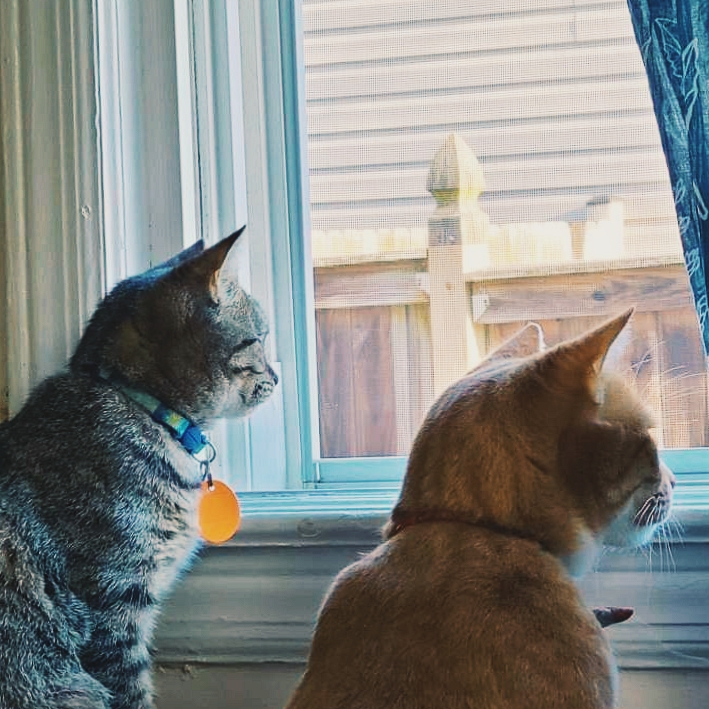
A small gray cat and much larger orange cat look out of a window together.
He teaches her the ways.

I’ve read that it takes on average eight months to a year for cats to become friends. I think he managed it in three days. They play together, and it’s genuine play. If there’s ever a growl, a whine, or a hiss, it’s quickly sorted out and they go back to playing. My partner was nervous about this — the first time one of them hissed, he wanted to separate them again. I stopped him with the reassurance that this was not only okay, it was a positive development. They’re new playmates, and they need to discover each other’s boundaries and learn how to navigate them. The only way for them to do that is to communicate between themselves and interfering would only hamper the process. JJ needs to learn to play nicely, and Pye needs to learn how to play with someone so much tinier than he is. Sure enough, half a second later they were back to chasing each other.

He’s also tried to groom her, though he seemed to very quickly discover that ear drops taste awful. Nonetheless, he is a dutiful boy and persisted in cleaning this small, weird, somewhat gross child.

The cutest part is when he gets tired. He’ll lope away, go lay down somewhere, and trill at her to follow him. JJ, being a font of infinite chaos energy, does not do this. Instead, she watches him and decides that what she should actually be doing is chewing on his face.
He puts up with a lot.

A close-up of a pair of cats. A small gray kitten lays on her back, paws pushing on the fluffy cheeks of a much larger orange cat.
Like, a lot-lot.

It’s also really cute to see the ways that he accommodates her. He lays down to be at her level, rolls on his back, and bats at her slowly. He chases her into the closet, and, as soon as she emerges, he trills and goofily bounds away so she’ll chase him. Seeing the give and take between this 20 pound orange dumbass and this cheeseburger-sized stripéd hellion is honestly really heartwarming.

Now, we just have to work on Kiko.

art · Just for fun

With My Sincerest Apologies to Dolly Parton.

I mean it.

Jolene, Part Two.

Jolene, Jolene, Jolene,
Jolene,
You gotta help me with this lying man.
Jolene, Jolene, Jolene,
Jolene,
Things went so wrong and now we need a plan.

I only meant to frighten him,
I never meant to do him in,
Now I don’t know what we should do,
Jolene.
You know he had us seeing red,
The rest’s a blur, but now he’s dead,
It was a crime of passion, this I swear to you,
Jolene.

He got upset when we accused
Him of two timing me and you,
And I think the neighbors heard it all,
Jolene.
Philanderers should get their due,
But now it’s up to me and you,
And we’re gonna need a lot more bleach,
Jolene.

Jolene, Jolene, Jolene,
Jolene,
We gotta find a place to put this man.
Jolene, Jolene, Jolene,
Jolene,
You grab those sheets, I’ll go get the gas can.

As long as we don’t drive to slow,
We’ll make it down to Mexico,
We’ll be in Tijuana by the break of day,
Jolene.
We’ll dye our hair, we’ll change our names,
Nothing will ever be the same,
But maybe it’s all for the best, Jolene.

Jolene, Jolene, Jolene,
Jolene,
You gotta help me with this lying man.
Jolene, Jolene, Jolene,
Jolene,
We’ll make a brand new start in a new land.
Jolene, Jolene.

I guess I technically wrote this unasked-for sequel to Dolly Parton’s song, but the fact is that I woke up with it in my head more or less fully formed. I do love a good murder ballad. This feels a bit like what would happen if “Jolene” met The Pierces “I Shot my Lover in the Head” and slightly ramps up some of the lesbian overtones many people have read in the original song.

Perhaps unsurprisingly, my partner was less than stoked that this fell out of my head. He was pretty good-natured about it, though.

Plants and Herbs · Witchcraft

Crocus Folklore & Magical Uses

It’s spring (kind of)!

At least, it’s getting spring-y here. Granted, I think we maybe had about four days of actual “winter,” but it’s been t-shirt weather for the past few days, and looks like it’s going to stay that way for at least another week.

Since things were warming up, I stepped out back to take a look at the yard. The elderberry bushed that I planted last year have some new leaves coming in, the bulbs I planted are starting to poke up through the mulch, and the apples are both looking good.

There’s also a large patch of surprise crocuses that seem to have popped up overnight next to my shed.

These are either Crocus vernus, the spring crocus, or Crocus tommasinianus, the woodland crocus. They’re beautiful, but decidedly not native to this area. (Crocus vernus and C. tommasinianus are related to C. sativus, the saffron crocus. However, these crocuses are definitely not a way to make rice more delicious.) Still, I am determined to enjoy them before it’s time to remove the bulbs and put in some native coralberry bushes. I’ll probably keep the bulbs and move them to somewhere where they’re less likely to spread.

If you’re also experiencing a flush of these tiny colorful flowers, here’s some old folklore and a few ways to make them magically useful.

Crocus Folklore

In ancient Greek legend, Crocus was a human man. The nymph Smilax was in love with him, but, ever the fuckboy, Crocus was dissatisfied with the affair. The gods turned him into a saffron crocus.

Another version of this story claims that Crocus was a companion of Hermes. Unfortunately, he stood up at an inopportune time during a discus throwing match, and Hermes accidentally killed him. As Crocus’ blood fell on the soil, saffron crocuses sprang up.

Spring crocuses are associated with Persephone, Aphrodite, and Venus. Mythology would also appear to tie this flower to Hermes.

A London source claimed that picking crocuses tended to “draw away the strength.” Therefore, only strong men or healthy young women should attempt to.

A field of purple and white crocuses at the base of a mountain.

According to Pliny, wearing crocus around the neck would prevent drunkenness. Interestingly, Swiss parents would place saffron around their children’s necks as a protective charm (presumably not against drunkenness, or else they’ve got some explaining to do).

In the Victorian language of flowers, crocuses represented cheer and youthful gladness.

This flower is associated with the planets Venus and Mercury, and the element of Water.

Crocus Magical Properties

Historic mentions of crocus as a protective charm typically refer to saffron crocus, not the spring crocuses. It can be hard to tease out folklore and uses attributed to spring crocuses, since the autumn-blooming saffron crocuses were generally considered more useful. For our purposes, I’m going to focus on spring crocuses here.

Spring blooming crocuses are used in charms for love, including platonic love or love of the self.

As an early spring-blooming flower, spring crocuses are also useful for spells for new beginnings.

These flowers are common altar decorations for Imbolc and Ostara. However, use caution if you bring spring crocuses indoors — all varieties of crocus other than C. sativus are toxic. Spring-blooming crocuses can cause diarrhea, vomiting, and digestive upset, while autumn-blooming crocuses can cause liver and kidney damage.

Simple Crocus Spells

You can include crocuses in charm bags for love. Add the dried flowers to a pink or red pouch along with rose petals, lavender flowers, and a bit of cinnamon bark. If you like, add a piece of rose quartz. Dress it with your favorite love-drawing oil (in a pinch, infuse some cinnamon, basil, and rose in grapeseed or sunflower seed oil, and use that) and keep it on you.

You can also use crocuses as a form of sympathetic magic. Plant a bulb along with a slip of paper with your name, and the name of your partner. Declare that as the plant grows, your love will flourish with it. When the flower is at its peak, pick it and save it for a love charm.

Neodruidry · Plants and Herbs · Witchcraft

It’s Imbolc season. Get the bucket.

I think a big part of what kept me from really connecting with a lot of Wiccan-based Paganism when I was younger was that, at the time, the available source material was pretty prescriptive. Sabbats were on specific days, with specific traditions attached, and there was an onus the follower to do things “right.”

Having lived in a pretty big range of climates, I can say that that’s had an impact, too. It’s hard to feel in the harvest or growing seasons when they just don’t line up with the harvest and growing seasons where these traditions were based. If the wheel of the year is supposed to reconnect humanity to nature and its cycles, a strict interpretation is the opposite of helpful. When I lived in California, for example, it felt like observing the traditional sacred days was sometimes counterproductive — spring didn’t look like it did in Europe, or even in the Eastern US. Neither did winter. It made things feel rote, which robbed them of meaning.

That’s why I’m a big proponent of celebrating the High Days when and how it makes sense to do so. If your growing zone means that you’re not going to see the first signs of spring until March, or won’t ever experience cold and snowfall, then so be it.

All of this is to say that the vast majority of my High Day traditions are pragmatic (perhaps to a fault).

Imbolc passed recently, amid surgeries (one for me, one for the Certified Lap Loaf. We’re both doing well!), falling down the stairs (just me. That part of me is not doing well.), and probably other stuff that I’m forgetting because of the first two things. A lot of ADF members celebrate the High Days on the nearest weekend, which is nice. Less pressure that way when your most-of-you isn’t working correctly.

A picture of the face of a small gray tabby cat. She looks very angry, probably about the blue nylon cone surrounding her head like some kind of fucked-up satellite dish.
Don’t let the barely concealed rage fool you. She’s purring here.

To me, Imbolc is refreshment. It’s deep cleaning, washing my front door, doing repairs, and making food. (This year, it’s also starting plans for home improvements that we won’t be able to do until later spring and early summer, like replacing the roof.) It’s also almost never actually on the first of February.

I don’t set up an Imbolc altar. I follow the same basic ritual structure that I do for any other day. For me, the main difference is the feeling of lightness and renewal that I carry through doing things like scrubbing grout, cleaning out garden beds, de-scaling the dishwasher, and chucking Affresh tablets down the garbage disposal.

When you’re re-learning lost, buried, or reinvented cultural traditions, it’s easy to get caught up in the need for accuracy and correctness. It’s also easy to forget why the High Days existed in the first place — to mark significant occasions throughout the year, largely based on what people who grew crops and raised animals considered significant.
When you get too invested in following the letter of a tradition, you can lose the spirit of it.

From my house to yours, here’s a small thing that I like to do each spring. It works equally well whenever you need to feel that sense of newness and freshness that only spring can bring.

Imbolc Home Cleansing

You’ll want to have:

  • A white candle. (The golden beige of natural beeswax is fine, too.)
  • Dried vervain.
  • Water.
  • A bowl.

First, steep the vervain in some hot water, as if you were going to make a tea. (I like to put vervain and water in a clear jar, then stick it in the sun for a while to infuse. If it’s cloudy where you are, a kettle of boiling water is fine.)

Vervain flowers.

Once the infusion cools, strain out the leaves and pour the resulting liquid into the bowl.

Next, light the candle. Declare, either out loud or to yourself, that this flame represents the return of the sun — whether that’s the literal return of longer daylight hours, or a metaphorical return of warmth and light is up to you.

Carry the bowl and candle to each room of your home, moving in a clockwise direction. Set the candle down in a safe spot and use your fingers to flick the vervain infusion around the perimeter of the room (be sure to get the corners). If you have prayers or chants that feel appropriate here, use them. I usually fall into a kind of stream-of-consciousness monologue about the objective of the working. It’s less important that your words sound nice than it is that they mean something to you and help you focus on what you’re doing.

When you’re through cleansing your entire home, offer the rest of the vervain infusion to your yard, garden, or nearest patch of green stuff. If your candle is small, you can let it burn completely and dispose of the remnants. If it’s a big one, snuff it and re-use it for a cleansing or purification ritual another day.

crystals

Howlite, Magnesite, and White Buffalo Turquoise: Are you being scammed?

Sometimes I feel like howlite and magnesite have a bit of a bad rap. They’re kind of like the flour of the gemstone world — pretty basic, of no offense to anyone, and able to be turned into all kinds of things that most people think are much more interesting. White howlite and magnesite get dyed and turned into imitation “turquoise,” “sodalite,” “lapis,” and just about any other opaque stone you can imagine.

It’s particularly good at imitating turquoise, to the point that there are standard operating procedures used for telling genuine turquoise from the faked howlite and magnesite stuff.

Unfortunately, that’s what makes it easy to pass off as rare, beautiful white buffalo turquoise to an unwary observer.

When a Turquoise Isn’t a Turquoise

This part might get a little confusing but hear me out: Howlite isn’t the same as white buffalo turquoise. Neither is magnesite. However, white buffalo turquoise also isn’t actually turquoise. For this reason, people prefer the term “white buffalo stone.”

A necklace made of blue-green turquoise nuggets.
Photo by Mahmoud Alaydi on Pexels.com

Turquoise is a phosphate of copper and aluminum (CuAl6(PO4)4(OH)8·4H2O). It’s usually a robin’s egg blue to blue green, but can also tend toward a more yellowish green color. Many specimens also exhibit spots, flecks, or spider web-like patterns of black, gray, or brown matrix material.

True turquoise has a pale bluish- or greenish-white streak when subjected to a streak test. It’s also about a 5-6 on the Mohs hardness scale, but it’s a fairly porous stone. Expensive, high-quality specimens are usually at the harder end of the scale, but softer, cheaper specimens are typically stabilized to improve durability. This stone has some other unique physical characteristics, but these are the ones that are most relevant to this subject.

A polished howlite stone showing gray veining.
Ra’ike (see also: de:Benutzer:Ra’ike), CC BY 3.0 https://creativecommons.org/licenses/by/3.0, via Wikimedia Commons

Howlite is a borate mineral, specifically a calcium borosilicate hydroxide (Ca2B5SiO9(OH)5). It’s a white, cream, or pale gray color, with dark gray to black veins that somewhat resemble matrix inclusions in turquoise. Rarely, howlite forms beautiful flowerlike formations of translucent crystals.

Howlite produces a white streak. It’s about a 3.5 on the Mohs scale, so it’s much softer than turquoise.

A dyed magnesite heart surrounded by a string of dyed magnesite beads.
Becritical, CC BY-SA 3.0 https://creativecommons.org/licenses/by-sa/3.0, via Wikimedia Commons

Magnesite is a magnesium carbonate mineral (MgCO3). It’s typically white, grayish, yellowish, or brownish, with gray veining.

Magnesite produces a white streak. It has a hardness of 3.5-5.0 on the Mohs scale.

White buffalo stone is a calcite mineral, akin to dolomite, with quartz. It’s found near turquoise and forms under similar conditions. The term “white buffalo” is actually a trade name and refers specifically to stones sourced from the Tonopah, Nevada mine owned by the Otteson family. This type of stone is also sometimes sold as white turquoise or sacred buffalo stone.

This stone is a cream to white color with black or brown veins of chert. Some specimens may show faint hints of blue or green from the iron and copper content of the surrounding rock. It’s a pretty soft stone at about 3.5 on the Mohs scale, and also exhibits a white streak.

How Do You Tell Them Apart?

So, we’ve got three white minerals that all exhibit a white streak when you rub them on an unglazed ceramic plate. How do you tell which is which?

It’s not easy, especially since white buffalo stone is pretty rare. The trade name refers to stone that’s found in only one mine in the world, so it’s not like a lot of samples have undergone the kind of testing that would simplify the identification process. (Honestly, I had a hard time even finding images of it because looking for “white buffalo stone” or “white turquoise” tends to return either nothing, or page after page of howlite!) In most cases, you’ll probably have to use a process of elimination.

The most reliable way is to go by hardness. While all of these stones are pretty soft, white buffalo stone is generally the softest.

You can also perform a visual comparison. Howlite and magnesite usually don’t polish up as well as turquoise or white buffalo stone, so they won’t look as shiny.

Magnesite also tends to have more diffuse veining that makes it resemble marble. The veining in howlite and white buffalo stone is more distinct.

If you have a black light, you can look at the stone’s fluorescence. Howlite gives off a sort of brownish yellow color, while magnesite gives off a bluish green.

If you’re willing to invest in a bit of equipment, you may want to pick up a refractometer. Refractive index testing is a reliable way to tell the difference between very similar minerals. Magnesite has a refractive index of 1.509 to 1.700, while howlite is 1.586 to 1.605. Turquoise falls between 1.610 – 1.650, but I have not found any measurements for white buffalo stone itself.

For most people, the easiest way to tell if they’ve duped is the price and location of the stone they’re buying. The cheaper it is, and the farther it is from Nevada, the more likely it is to be howlite or magnesite instead of genuine white buffalo stone. I always recommend that people buy mine- or miner-direct if at all possible, because it reduces the likelihood that you’ll be stuck dealing with unscrupulous middlemen and mislabeled stones.

Plants and Herbs · Witchcraft

Nutmeg Folklore & Magical Uses

It’s the time of year when Trader Joes brings out their Wassail Punch. I don’t really drink fruit juices straight, but I like ’em for flavoring water kefir. This one’s blend of fruit and spices makes the end result taste like cola, which is pretty neat.

(Cola is one of those flavors that isn’t really meant to taste like anything in particular. It’s spices. It’s citrus. It’s all kinds of things that add up to one immediately recognizable taste.)

Anyhow, one of the key flavors in Wassail Punch (and probably cola, to be honest), is nutmeg. It’s one of those things that I can immediately recognize when I taste it but am completely unable to remember on its own. It’s like… a clove- and cinnamon-less pumpkin pie? I guess?

It was also one of those most precious substances in the world for a while, and a nearly invaluable magical ingredient.

Nutmeg Magical Properties and Folklore

Nutmeg is a spice that comes from an evergreen tree, Myristica fragrans, native to Indonesia. It’s a weird seed, too — it grows inside of a fruit similar to an apricot, surrounded by an aril that looks kind of like a flat, fleshy spider or extremely underachieving facehugger. The dried aril is the source of the spice mace. The seed itself is the nutmeg.

An image of a ripe nutmeg fruit. The outside resembles an apricot, which has split to reveal the mace-covered nutmeg inside.

It takes a long time for nutmeg trees to bear fruit, though they can do so for several decades after that. Since the spice is native to such a small geographic area, an absolutely horrific amount of bloodshed happened in the name of obtaining it, farming it, and keeping anyone else from getting a hold of it. The Dutch tortured and killed the native people of Indonesia in order to control the nutmeg trade. They also tried their damnedest to keep the English and French from sneaking any viable seeds out of the country, by dipping the nutmegs in lime to keep them from sprouting.

People used to joke (inaccurately) about Manhattan being traded for glass beads. The Dutch really did trade Manhattan to the English for some sugar and nutmeg. For real, nutmegs were so valuable that traders would mix a handful of wooden replica nutmegs in with the real ones in order to dupe their customers.

A whole nutmeg, hollowed and filled with mercury, sealed with wax, and wrapped in a green cloth, is considered a powerful charm for luck in games of chance. (You can skip the mercury poisoning by just carrying a whole nutmeg. It’s fine. Really.)

Wrap a whole nutmeg in purple cloth, and it’s said to help you win court cases.

All forms of nutmeg are considered useful for money magic. Nutmeg oil is a common ingredient in money oils, while the powdered stuff is helpful in sachet and sprinkling powders.

Money and luck aren’t nutmeg’s only properties, however. An old spell from Louisiana involves sprinkling nutmeg in a woman’s shoe to get her to fall for you. Food and drinks flavored with nutmeg were also used as love potions.

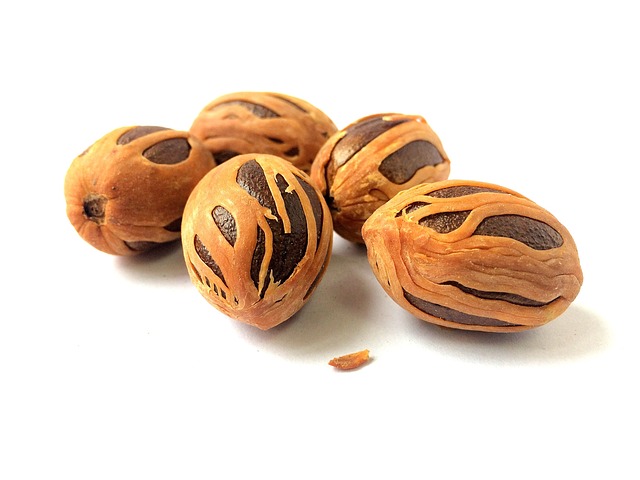
Whole nutmegs covered in mace.

Ground nutmeg was used as incense in ancient Rome.

One old remedy for rheumatism involved boiling nutmegs and cooling the resulting liquid. The nutmegs’ natural fats rise to the surface and cool, forming a solid layer. This is skimmed off and used as a topical balm. Nutmeg is a warming spice, so this would help encourage circulation and relieve some of the pain caused by cold weather aches.

Nutmeg can make you trip balls. This is not code language.
This spice is a hallucinogen, courtesy of a compound known as myristicin. Unfortunately, you have to consume a lot to feel the effects, at which point you’re putting yourself at risk of nutmeg poisoning. “A lot” is relative here — about 10 grams (two or so teaspoons) of ground nutmeg is about to trigger symptoms of toxicity. It’s not that much, but still way more than you’d typically use in cooking. Nutmeg poisoning is pretty awful, too. While I wasn’t able to find any stories of nutmeg-based fatalities, the cases I did find mentioned nausea, dizziness, heart palpitations, fatigue, confusion, and seizures. Yikes.

Nutmeg is associated with the element of Air, the suit of Swords in tarot, and the planets Jupiter and Mercury.

Using Nutmeg

The easiest way to use nutmeg is to make your favorite autumn or winter recipe that uses this spice for flavoring. Use a wooden or metal spoon to prepare it and stir it with your dominant hand. As you do this, picture energy coming up from the Earth, down from the sky, and running through your arm, down your hand, into the spoon, and finally into the food or beverage itself. Ask the nutmeg for help with whatever you want it to do, whether that’s getting laid or making some money. Pretty easy, bog-standard kitchen witchery, really.

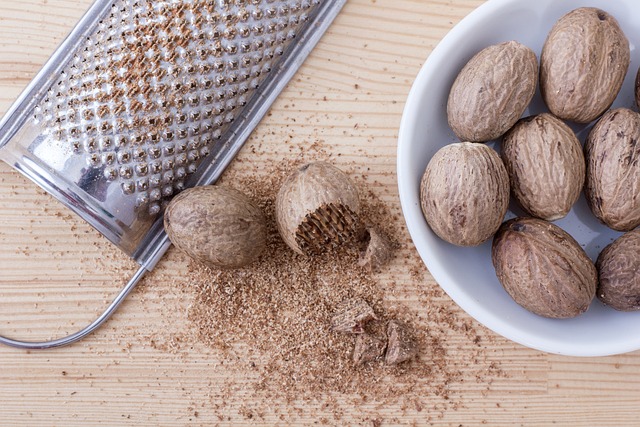
Whole nutmeg seeds, a nutmeg grater, and a little pile of ground nutmeg.

You can also use nutmeg by just… carrying it. As mentioned previously, whole nutmegs are a charm for luck and money. Wrap them in an appropriately colored cloth, anoint them with a suitable magical oil, ask them for their assistance, then keep them on you. When they get old and lose their potency, retire them by burying them in the soil and make a new charm with a fresh nutmeg.

You can also use nutmeg for meditation. I wouldn’t rely on it to induce a trance state, but drinking some warm milk flavored with honey and nutmeg can be a pleasant way to begin some meditative or journeying work. Just don’t use too much — the vast majority of nutmeg poisonings are from kids who eat it to get high and end up spending the night dizzy and throwing up instead.

Nutmegs are also good additions to charm bags or jar spells for money or luck. They’re very nice, potent, self-contained magical ingredients. If you have an assemblage of herbs, curios, and other tools, why not throw in a nutmeg? If you can’t afford a whole one, sprinkle in some of the ground stuff instead.

Nutmeg is a spice with a dark history (I mean, most of them have dark histories. Thanks, colonialism!). It’s preciousness as an incense and culinary ingredient has tied it to the concepts of luck and money, so you’ll most commonly see it in spells for financial abundance and good fortune. If you’re not a kitchen witch, a sprinkle of nutmeg can be a good place to start. If you need to practice magic discreetly, you really can’t go wrong with tucking a whole nutmeg in your bag or pocket.

Uncategorized

Time to prune the @#$% out of this apple tree.

I am not many things. An arborist is among them.

Unfortunately(?), with this house, I have become responsible for a smallish apple tree. I was excited to discover that it was a fruit tree when we first toured the place — there were a few sour greenish apples clinging to the scraggly branches. I didn’t know anything about apple trees, but this still seemed like a positive development.

I have since learned that apple trees are basically livestock.

I bought it a friend, a little Chehalis apple tree, so it could produce more fruit. I watered and fed it.

Like sheep, apple trees also need to be trimmed. Branches cross, or grow from weird, narrow angles, or jut straight up in the air. They weaken the tree, which sends its energy reserves to put leaves and buds on these branches that will inevitably snap in the wind and never bear fruit. They’re a source of illness, insects, and injury. In the event of some kind of apocalypse, it won’t take very long before it’s no longer fruitful — fruit trees as we know them have developed alongside humans, and we rely on each other for survival.

So that’s how I ended up on the internet looking up how to beneficially injure a small tree.

Narrow branch angles. Crossed branches. Watersprouts. I memorized what each one looked like, and how to best cut them. (At an angle, as close to the branch collars as possible.) Then, armed with a set of hedge clippers and a pair of saws, I trudged out to go sort shit out.

A dwarf apple tree that hasn't been pruned in years. It's winter, so the branches are bare.
Depicted: Fruit chaos.

I should note that I was not prepared for how much work it’d be. I figured it was cold out, so I dressed warmly — winter boots, my wedding sweatpants, a flannel, et cetera. Within minutes, I was stripping down.

The actual pruning process wasn’t too intimidating. The tree’s a dwarf, so it was easy enough to navigate the branches. I left some that I know I shouldn’t’ve, just because they were providing support for a wild grape vine that I’m hoping will return next year. Others, I either snipped with the clippers, or carefully sawed through while muttering apologies through clenched teeth.

If anything, the toughest part of the process was the anxiety. What if I cut something wrong, or that’d make it grow all weird? What if my tools weren’t clean enough, and I introduced some kind of disease into the soft, green wood? What if I was doing more harm than good?

When you’re climbing around under a tree and trying not to get cracked in the skull or speared through the eye with falling branches, it’s not the best time to start losing your nerve. I was projecting a lot of my own anxiety on the tree — I’ve been in a position where someone held me down and injured me, insisting it was for my own good, I know exactly how that feels — but maybe this wasn’t it. So, I did the tree-hugger thing.

I put my non-dominant hand on a robust branch and let myself fall into the xylem and phloem, breathing with the slow, wintry pace of the circulating sap. What I felt surprised me. There wasn’t really fear, though there was some pain. If I really had to describe it, it felt like what I imagine the cows in those hoof-trimming videos feel like. (If you haven’t fallen down that rabbit hole yet, you’re welcome.) Tension and relief. The acknowledgement that something is wrong, and fixing it won’t be fun, but the result will be worth it.

I’ll probably have to go back and do some more pruning, but I’ve got the bulk of it done. The problematic parts have been removed, so now everything else is just shaping and ensuring that the branches have enough space around them.

The end result remains to be seen. Hopefully, there’ll be plenty of apples next year!

life · Uncategorized

Sharpies, Spicy Crab Crepes, and Gratitude.

It is Thanksgiving.

I am on the landing of my stairs, stomach full of spicy crab crepes, mind whirling from xylene fumes, drawing esoteric symbols on the walls and wondering if I am half an orphan or just going to be expected to front bail money in the near future.

I’ve never really been big on Thanksgiving. Aside from its history as a holiday, I mostly associate it with being screamed at, having my hair yanked into shapes it was never meant to have, and dressed in stiff, uncomfortable clothing so I could go all of twenty feet downstairs to eat green bean casserole in my grandparents’ living room. The food was good, don’t get me wrong, and I love my grandparents, but I could’ve done without the rest of it.

As a result, my partner and I don’t really sweat it much. We have no big plans — if I’m feeling ambitious, I might make a turkey breast, stuffing, cranberry sauce, baked potatoes, and the like. This year, we figured it made more sense to just make a bunch of whatever we had in the freezer.
Mashed potatoes? Sure!
Peas? Okay!
Chocolate chip cookies? You bet!
Taco pizza, a thing I suggested when I realized I didn’t have mozzarella and only had shredded “Mexican blend” and figured I could also top a hot pizza with fresh tomatoes, peppers, lettuce, and salsa? Absolutely!

In the end, we said, “screw it” and had crepes delivered. They were open, it was early in the day, and neither of us were feeling hungry or energetic enough to go through the motions of putting together a Thanksgiving dinner. We didn’t have a turkey anyway, so nothing about dinner was going to be traditional.
Besides, crepes filled with spinach, avocado, and spicy shredded crab sounded incredible.

I did do my other annual traditions: I made a donation to the Mashpee Wampanoag people, and I called my grandpa.

“You talk to your mom lately?” He asked.

“No. I don’t. I haven’t in ten years or so,” I replied. It’s a conversation we have every time we speak. I don’t think it’s that he forgets — he just hopes the answer will be different each time. It isn’t. It won’t be.

That’s when he told me something strange. Every year, he’d sent her a check. Even though she doesn’t ever talk to him, she always cashed them. Except for the last two.

That tugged on my memory. A few months ago, I’d gotten a message from a distant relation. They’d talked to her for a while, then she’d just dropped off the map. Did I happen to know if she was okay? I didn’t.

Still on the phone, I messaged my ex-boyfriend. He was still friends with her on social media, chiefly due to a combination of morbid curiosity and a love of cringe comedy. No, he explained, she went from regularly posting her usual weird shit to dead silence since last February.

“Maybe she died,” my grandpa replied.

“I don’t know. Jail’s probably more likely,” I figured. She had a well-earned reputation for getting loud and shove-y when she drank, including punching her adult son in the face one evening after a funeral and slapping both of us around when we were small. After decades of not being either arrested or punched back, I wouldn’t be surprised if the world had finally gotten around to making her experience some consequences.

I’d like to say that I was concerned. That it gave me something to think about. Really, my mind could only go one of three ways: 1) She’d passed away or ended up jailed somewhere, and it was sad that she’d ostracized so many people and wasn’t able to pull her head out of her ass before that. 2) She’d gone silent in the hope that the people still in her orbit would feed her ego by vocally and publicly worrying about her. Or 3), she just didn’t give enough of a damn about anyone asking after her to bother to tell them that she was still alive.

It did put me back in the Thanksgiving spirit, though. I’m thankful that I’m not there. I’m thankful that I don’t have to deal with this in any but the most indirect of fashions. I’m thankful that my partner and I, despite not coming from the healthiest dynamics, have chosen and worked on having a loving, supportive, functional relationship. I’m thankful that JJ has finished her round of antibiotics and is experiencing a little stray kitten glow-up. I’m thankful that there will be taco pizza tomorrow.

And then I climbed to the top of my stairs, busted out a magnum Sharpie, and drew on my wall.