
Uncategorized

What’re you gonna do when Dracula comes for you?

I don’t usually write much about current events. It isn’t that I ignore them, or feel like they’ll bring down my vibe, or think I’m somehow above them — it’s mostly because I don’t think that anyone really needs or wants to hear about them from yet another random blogger. If I lack the experience and language to engage with something on more than a surface level, if I’m going through the same learning process as most everyone else, then there’s no real reason for me to give my two cents, you know?

Every once in a while, though, the news hits different.

By now, you’ve probably heard about the destruction of Lahaina, Hawaii. Depending on your personal social media ecosystem, you may have heard this blamed on Reptilians, energy weapons, and astrological occurrences. The thing that really got me, though, was an image of a “demonic face” in the flames.

It got me, because I remember seeing pretty much the same picture long ago. Only it wasn’t Hawaii, and it wasn’t an entire town — just two buildings. A devil’s face in the smoke billowing from the World Trade Center. A Rorshach’s test for the afraid.
“Look at that! A demon face!”
How easy is it for someone to dehumanize an enemy when they have a sign — however pareidolic, however blurry — that their enemies are in league with the forces of ultimate evil?

History may not repeat itself, but it certainly rhymes.

I remember another photo. Then-President Bush as he was delivered a folder of important documents, quietly setting them aside. That folder probably didn’t contain any information that could’ve stopped 9/11, but it was no less damning. The CIA had warned his administration months before, and nothing was done.

Sometimes, evil lives in mundane things.

Mundane things, like golf courses and farm land. When Hawaii was taken and sown with sugar cane and pineapples, its water was diverted from wetlands to farmland. When resorts and golf courses came, so was more water diverted. Monoculture brought with it invasive grasses, ill-adapted to Hawaii’s water cycle. Without wetlands, packed now with tinder, Hawaii gave all of the warning signs of a devastating fire. And nothing was done.

Evil lives in a jar of dirt, waiting for analysis. “Handle it with extra care,” they told me, “it’s evidence in litigation.” Evil lives in a board room where it’s debated whether or not it’s cheaper to remediate the soil, or just paying off the people who get sick from it.

It’s easy to point the finger at some kind of Evil Other. Dogmatic religions have been doing it for millennia in the form of devils and heathens. Cults do it by isolating members from non-members. The New Age movement does it by calling its devotees enlightened and high-vibrational and pointing the finger at the “unenlightened” and “low-vibrational.” Some just straight-up blame aliens.

It’s easy to do this, because we will never consider ourselves part of this Evil Other. If we aren’t part of the Evil Other, then we can’t have caused bad things, because it’s common knowledge that the Evil Other is responsible. It’s a tautology that saves us from examining our own mundane habits, and the way that they shape the world.

It’s also easy to blame an Evil Other, because cults, enlightenment, or orthorexia (or whatever your dogma of choice may be) always have a baked-in means of spiritual bypassing. Have the right beliefs, eat the right foods, be born the right way, wear the right things, buy the right stuff, and it will outweigh whatever mundane evil you might contribute to.

But it doesn’t really, does it?

Capitalism came to Hawaii, stripped it of its water, stripped its people of the ability to steward the land, and let it burn for the sake of the money it could get for sugar, pineapples, and vacations.

How many of the same people selling spiritual advice, Starseed activations, and life-coaching courses are willing to blame the Evil Other instead? How many more people are willing to try to extract money from the land even while it burns?

Reptilians, space lasers, and demons didn’t do this. (The photo of an “energy weapon” is a long exposure shot of a launch from years ago. It’s not the only one.) Greed did. The thirst for gold at any cost did. The Evil Other isn’t an alien or supernatural force, it’s us. Every time we engage in spiritual bypassing, every time we point the finger and blame the Other, it’s us. It always was.

There’s not a lot of money to be made in saying that capitalism is the problem. At least, not as much as posting about energy weapons and conspiracies (interspersed with the requisite amounts of platitudes, bare skin, and beach photos, as the algorithm demands).

There’s an old saying, “Before Enlightenment chop wood, carry water. After enlightenment chop wood, carry water,” and I think it fits here. Enlightenment — whatever form that may take for each of us — is within. It doesn’t change how we have to move through and engage with the world. It absolves us of nothing.

But say I’m wrong. Say that it’s all true — the Reptilians, the demons, the space lasers. History has rhymed often enough to show us the tools they use. We should know what unchecked greed looks like, what it does, and how it operates. Why are we willing to use these same tools as long as they’re making us money?

What makes us think that saying the right words, buying the right things, eating the right foods, and thinking the right things make us immune from wrongdoing?

Evil is what evil does. Not what it says, wears, eats, or believes. Would we even recognize it when it stares us in the face?

Plants and Herbs

Echinacea Folklore and Magical Properties

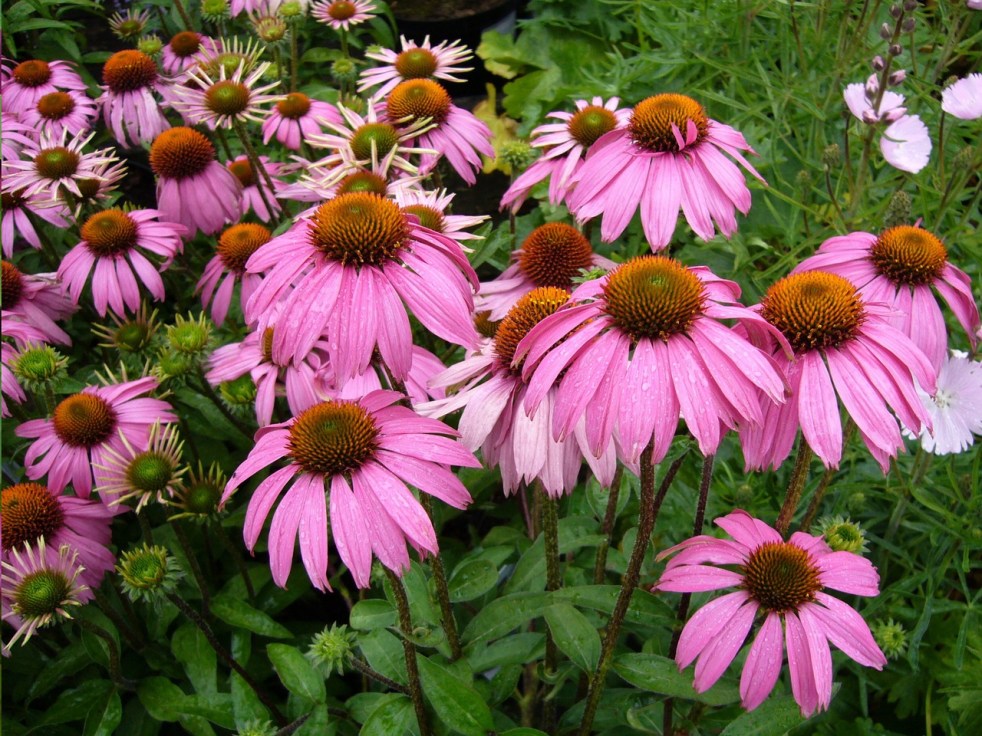
Echinacea, or coneflower, is a genus of flowering plants found solely in parts of the US. They’re native to where I currently live, so I’ve added several different wild type and nativar plants to the front and back yards here. They’re a unique addition to the landscape, and help bring in even more pollinators than the bee balm and anise hyssop already do!

These flowers are probably best known for their medicinal qualities. The first time I’d ever heard of echinacea was from my father’s former significant other. She had some echinacea tea, and I overheard her talking about how she used it medicinally. (Though they’ve since split up, I’m still friends with her — she went on to become a bodywork therapist who specializes in sound healing and craniosacral therapy, and is one of the founders of the nonprofit Columbia Resilience Integrated Health Community Project. She’s a pretty cool lady.)

Unfortunately, the popularity of echinacea means that wild populations are suffering from overharvesting (two species, E. tennesseensis and E. laevigata, have only recently recovered from being on the endangered species list). If you want to use these plants, it’s best to grow your own. Fortunately, that’s really easy to do — they self-seed super easily and will grow pretty much anywhere there’s sun. They’re also great for helping populations of native pollinators.

Since these are American plants, they’re not found in European-based grimoires. They’re still very valuable to develop a relationship with, even if they don’t show up in old world folk or ceremonial magic.

To the Ute people, echinacea’s traditionally called “elk root” due to the belief that injured elk sought out these plants to use medicinally.

Echinacea roots are used as a physical and spiritual medicine. They’re a traditional healing herb for burns, pain, and inflammation, and some peoples have chewed them as part of their ritual purification ceremonies.

The name “echinacea” comes from the Greek word for hedgehog, “ekhinos.” This is because the center of the flowers is round and spiky, like a hedgehog.

Today, echinacea is often touted as a way to help prevent or eliminate respiratory viruses like the common cold. Research doesn’t really bear out assertions that coneflower can significantly help with the common cold, but there’s evidence to suggest that coneflower’s immune activity may have a lot to do with the bacterial populations within the plant itself. These studies are on isolated cells in vitro, however, not on humans. Overall, it seems like echinacea isn’t really a great remedy for upper respiratory viruses.

Topically, infusions of echinacea are helpful for soothing the skin. Prepare a strong brew of the root (and any other soothing herbs you like, like chamomile or marshmallow), filter out the plant matter, and add the liquid to a bath.

Some green witches use echinacea as a way to increase the power of their spells. It’s best employed when attempting to overcome a problem that doesn’t respond to other measures, but adding a little of the root or seeds to any spell will help increase its effectiveness.

Hanging a sachet of echinacea over the bed is said to act as a fertility charm.

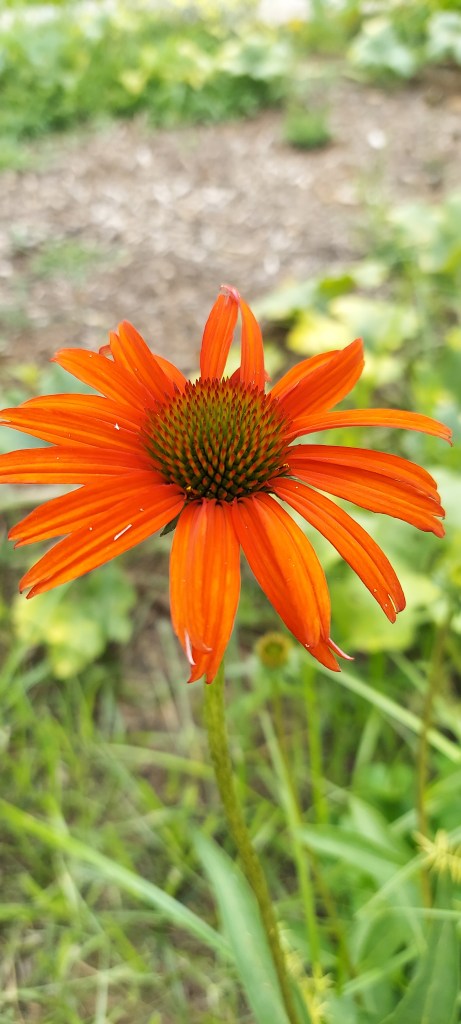
A bright red cultivar of echinacea, showing the characteristic spiky center surrounded by a ring of bright, daisy-like petals.
One of the bright scarlet echinacea cultivars in the front yard. You can see a bit of the mysterious pumpkin vine in the background.

Coneflowers are also associated with strength and vitality. Sprinkling powdered echinacea root in one’s shoes is said to increase physical vitality and endurance. This is particularly interesting to me, since the same is said of mugwort. Both echinacea and mugwort are pretty opportunistic plants that will tolerate poor soils. The plants’ own resilience could be why they’re connected to the idea of endurance and strength.

Some sources also claim that placing a single echinacea flower on one’s brow can enhance psychic abilities. Interestingly, mugwort is also used to enhance psychic abilities.

When cut and kept in a vase, it’s believed to bring prosperity into the home.

The large, brightly colored flowers are frequently used as natural offerings to the spirits of a place.

Coneflowers are also part of an herbal formula to attract same-sex love, particularly by men. Combine deerstongue herb (which has a lovely vanilla aroma), echinacea, and imitation musk, ambergris, and civet.

Echinacea is associated with the planet Mars and element of Earth.

In general, it seems like the flowers are used for offerings and laying on the body, and the roots and seeds are used for everything else. The roots and seeds are also said to have the most magical power. I can definitely see that — seeds, in particular, are symbols of infinite potential. If you want to start something new, include some seeds in your spell.

The easiest way to use echinacea magically is to include a bit of the whole seeds or ground root in sachets, jars, or herbal spell blends. There doesn’t seem to really be a limit to what this plant can empower.

You can also steep some larger bits of root in a carrier oil and use it as a protective or empowering anointing oil.

Personally, I plan to experiment with using echinacea alongside and in place of mugwort. There seems to be a fair amount of crossover in both their ecological and magical uses, though their planetary and astrological correspondences differ. Echinacea is native and grows like nobody’s business here, while mugwort is invasive. I’ll definitely harvest invasive wild populations of mugwort when I have the chance, but I’d like to see how far I can get with the herbs that I grow myself.

Medicinally, echinacea tea may be made from the flowers, leaves, or roots of Echinacea purpurea. This can be taken internally or used topically. Traditionally, it’s a remedy for inflammation and pain. Nowadays, it’s often touted as a treatment or preventative for respiratory viruses, but research shows that it probably isn’t very good at that last bit.

Overall, this herb is pretty safe, but people who are allergic to members of the daisy family will definitely want to avoid it. It isn’t known how safe this is for people who are pregnant or nursing, so ask your doctor if you have any concerns.

life · Plants and Herbs

Maypops!

Passiflora incarnata is a weird plant.

I bought three root cuttings last year, but they turned crispy and died shortly afterward.

Disappointed, I decided to try again with two more. Those died back to the ground late that autumn, and that seemed to be it. There was no sign of them this past spring, so I figured that particular experiment was also a failure.

Undaunted, I decided to try again. I purchased two more baby vines and planted them in roughly the same spot.

And then one (and only one) of the previous vines shot up out of the ground like it had something to prove. Like I’d committed some terrible affrontery by daring to try to replace it. Vining with a vengeance.

Not only did it reappear, it’s also about twice as big as the other two, and all three of them seem to be trying to outdo each other by putting out more and more buds.

A passionflower with bright bluish-purple, fringe-like petals and a white center.
My very first passionflower.

The only thing is that, while Passiflora species are generally considered self-fertile (the flowers contain both male and female parts, and they are positioned in a way that makes it very easy for pollen to just kind of end up where it needs to go), I’ve read a lot of sources that claim that P. incarnata is self-incompatible. In other words, the flowers are built in a way that should facilitate self-fertilization, but it’s just not into that.

Since the flowers also only last for a day, that means that there needs to be some very timely coordination between pollinators and the plant itself. Pumpkins are the same way, really — they have separate male and female flowers, but the flowers don’t last long. If a bug or hummingbird doesn’t show up at the right time, the flowers close up and that’s that.

Anyway, all of this is to say that, after my disastrous experiences trying to grow passionflower, I wasn’t expecting much. That’s why I was really surprised to go out on the porch and see these guys:

A close-up of a vine with a pair of small, green, vaguely egg-shaped fruit.

Maypops! (Aka, passionfruit!)

These aren’t anywhere near ripe yet. You have to wait for them to get really soft and wrinkly, or even to just drop off of the vine. (I probably won’t let them get that far, because I doubt I’d find them again once they fell.) In this way, they’re kind of like pawpaws and American persimmons — once they seem like they’re way overripe and on the way to the compost bin, they’re perfect.

I’d like to try harvesting the rest of the plant for medicinal purposes, too. (I talked about some of these in my post about the folklore and magical uses of passionflower.) My handsome assistant and I go through a ton of chamomile, to the point where I’m starting to wonder if it’s possible to build up a tolerance. I’d like to try augmenting some of that with other relaxants. If I can grow them myself, so much the better.

Passionflower fruit are apparently much like pomegranates, in that the edible portion is little bags of juice around seeds. I’m not much for making jams or jellies, so that’s out. I don’t think they’d be conducive to drying, though I may try combining their juice with a more solid, neutral-tasting fruit (like pears) to make fruit leather. We’ve also been using our excess strawberries and pumpkins to flavor mead, so I could see using a batch to experiment with maypop juice.

So many possibilities!

Just for fun · life

Alex Dav’s music is a treasure, tbh.

Note: Nobody paid me or otherwise compensated me for this. I just really like Alex Dav’s music. Notice me, senpai.

I need background music.

Music, lighting, and scents are the most effective ways to set a vibe, to me. I can be in a parking garage, but if there’s some chill music playing, the faint scent of incense wafting on the air, and patches of a nice, peachy-colored sunset kind of sliding in between the concrete pillars, it’s nice. Cozy. Meditative.

That’s why I was so happy to come across Alex Dav’s music on YouTube. I was even happier to find it on Spotify, where I can just kind of keep it on without commercial breaks.

All of the songs feature a hang (also called hang drum), guitar, kalimba, piano, variety of drums, and more. Most, if not all, are tuned to a frequency of 432 Hz.

432 Hz is regarded as a “healing frequency.” Meditating to it is said to produce deeper states of relaxation. Doing so before bed may even improve sleep quality. Some also credit it with helping to release energetic blockages within the body.

While this all sounds very unscientific, there is a little bit of research to back it up. A double-blind cross-over study comparing listening sessions involving music at 440 Hz and 432 Hz had some very interesting results: The study participants experienced a slight decrease in blood pressure values (although not significant), a marked decrease in heart rate, and a slight decrease of respiratory rate values when listening to 432 Hz versus 440 Hz. These values do point to a greater state of relaxation. Subjectively, researchers also noted that “[t]he subjects were more focused about listening to music and more generally satisfied after the sessions in which they listened to 432 Hz tuned music.”

I use it for meditation, divination, maintaining a relaxed atmosphere at home, and just as background sound. It’s at once organic and ethereal, earthy and dreamlike. Personally, even as just background music, I feel like it helps me be more relaxed and creative. It’s even what inspired me to pick up a (smaller, less fancy) tongue drum.

If you’d like something that you can just turn on and go about your day, Alex Dav’s YouTube channel also has multiple live streams that are just music, all day long. If you want sleep music, there are some tracks that subtly loop for 12 hours. I highly recommend them!

Blog · life

Maybe it’s like an emotional support hornet’s nest.

I try to coexist with stuff. I really do. I don’t like confrontation, and I’ve found that even the most noxious weeds or aggressive creatures are usually helpful for something. The yard is full of edible weeds, bees, and predatory bugs, and life is pretty good. I don’t mind spiders in my house. I very carefully evict the occasional confused grass-carrying wasp or pipe organ mud dauber that wanders in.

And then there are the yellowjackets that built a nest right above the front door. There’re these two little gaps in the porch roof that didn’t really seem deep enough to say “hey, homestead in me,” but I guess I was very wrong about that. The end result? A ceiling crevice jam-packed with wasps.

During their initial building stage, they were preoccupied enough that I barely noticed them. Really, I spotted one or two flying to that spot and didn’t think much of it. When I noticed a dead yellowjacket laying on one of the leaves of the passionflower vine growing on the porch railing, I had… concerns.

When they began to get a bit more territorial, I had more concerns. If they’d built almost literally anywhere else, it would’ve been fine. The shed? No problem, just move the important stuff to the other shed, keep the door closed, and wait to clean up during winter. In the yard somewhere? Also not an issue, they can be territorial against other wasps and are pretty easily avoided by humans.

This wasn’t our first brush with yellowjackets, either. A ground-dwelling species built a massive nest in a hollow under a tree stump in the front yard. This, again, wouldn’t have been an issue were it not for the fact that people had to walk there, and the yellowjackets appeared to have very mixed feelings about the whole thing. The deal appeared to be very much the same with the ones in the porch.

My partner and I could avoid them because we knew they were there, but what about visitors? Delivery people? Mail carriers? I wasn’t trying to be the reason why an Uber Eats driver trying to make ends meet had to pay for an emergency room visit, you know?

I put in special delivery instructions a couple of times — “Wasps have taken over the porch. Please go to the side door. I cannot overstate how many wasps there are, and they are all so angry” — and keep my fingers crossed that the delivery people actually followed them. I would’ve gone out there and put up a physical sign, but that would’ve required them to get close enough to read it, and also actually going outside to tape something to an area actively swarmed by yellowjackets.

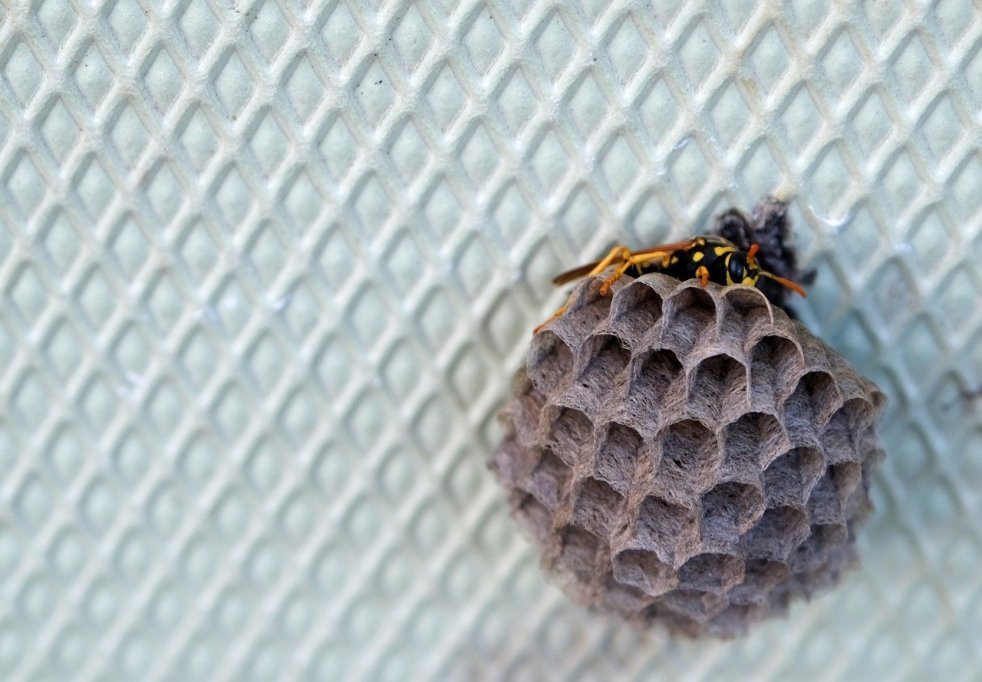
A pair of yellowjackets construct a nest in the angle formed by two wooden beams.
Like this, but with more rage.

And so, we called our Wasp Guy.

His name is Mohammed, and he is, unironically, the straight-up rawest dude I know. His company claims to provide environmentally friendly pest control, and I’m like 90% certain it’s because he just suits up and sort of… confiscates unwanted hives and nests and such. He has a huge (vacant) hornet’s nest he keeps in his van. For fun.

The man is also an absolute surgeon. If he’s there to handle a wasp nest, those wasps will be handled (probably literally) and the neighboring pollinators will never find out. None of my carpenter bees were harmed in the removing of these wasps, and still happily follow me around like dumb little hoverpuppies. The anise hyssop and coreopsis are absolutely packed with miner bees, sweat bees, honeybees, you name it. Even the ants that hang out on the passionflower on the porch (they treat the nectaries like some kind of tiny insect TGI Friday’s) seem just sort of fine with everything.

A frozen Charlotte doll in a small wooden box adorned with fragments of vacant wasp nests.
I just thought this looked cool, to be honest.

While I’m not happy we had to remove the yellowjacket nest (they’re an important predatory species for pest bugs, and, since they tolerate the cold a bit better than bees do, they pollinate early spring flowers!), I know there’s a point where insect territoriality and human territoriality collide. I’m just glad that this time was handled quickly, easily, and with minimal disruption to everyone else.

Just maybe try to build in the old maple tree or the shed on the hill next time, okay guys?

life

And about twenty seven gallons of pumpkin bisque.

So, I’ve been picking pumpkins.

Well, that’s kind of an understatement — I’ve been attempting to gather and process pumpkins quickly enough to actually make a dent in the sheer number of them. It takes about an hour to cut and bake two of them, then I need to let them cool, then puree and freeze them. Each pumpkin seems to yield a little over 16 ounces of puree. That’s enough for either one pie, one batch of pumpkin cream sauce, or one pot of pumpkin soup.

In other words, this is basically a replay of when my spouse and I went strawberry picking. This last time, we sprung for the big cardboard flat. I still have a whole loaf of strawberry bread in the freezer, two gallon bags of whole berries, and two trays of frozen strawberry puree.

I’m either going to run out of space in the freezer for pureed pumpkin, or be completely sick of pumpkin and pumpkin-adjacent things by the time October rolls around.

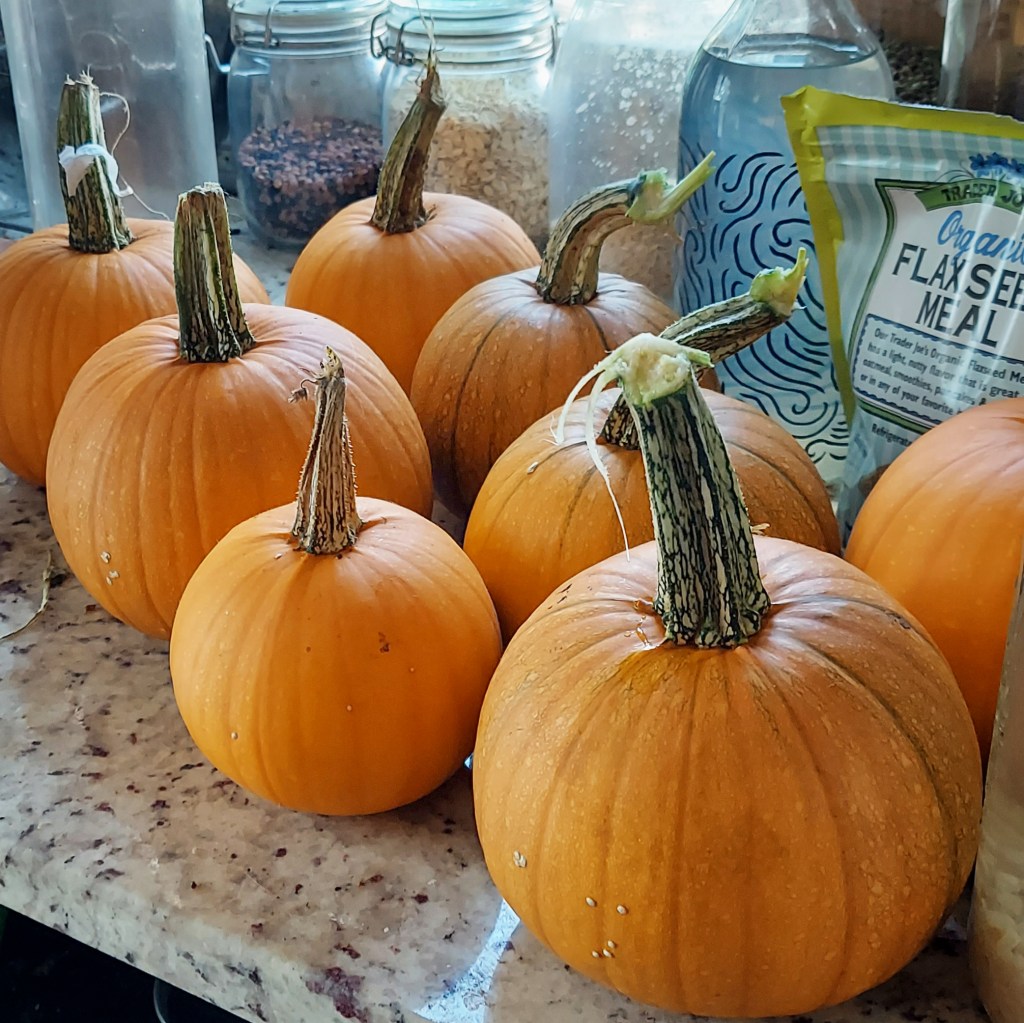
Eight pumpkins, sitting on a granite countertop. There's a bag of flaxseed meal and some glass canisters of rice, beans, and oats in the background.
Some of the pumpkins that still need to ripen a bit.

Fortunately, pumpkin seems to keep well. Once it’s turned to pumpkin mush, I pack it into a one cup Souper Cube tray and freeze it. After it’s frozen, I can pop it out and stick it in a reusable freezer bag. I wish I had a chest freezer (but I also know that I’d just fill it up with nonsense if I did).

In the meantime, I’m amassing pumpkin recipes. So far, I’m looking at egg- and dairy-free pumpkin pie, pumpkin cream sauce, and pumpkin bread with chocolate chunks. I hope everything turns out well, but I’m also slightly concerned that I’ll end up having to sneak around and drop off piles of excess pies and breads on my neighbors’ porches in the middle of the night.

I didn’t even plant these pumpkins. I’ve watered them maybe twice ever. I have the feeling they wouldn’t be nearly this prolific if I’d actually put effort into them.

divination · Witchcraft

The Whole Show — Combining Divination Methods

I love divination. Back when I’d just started learning, I knew that divination — more than any other magical skill — was something I wanted to become good at. I have different tarot decks that I use for different purposes, oracle decks, Lenormand cards, a set of ogham staves, a set of runes, a scrying bowl, and multiple stones that I use for crystal scrying. There’s just one problem: What do I use?

I used to get tripped by that a lot. Which method was going to be easier? Which was going to be more explicit? Which would be more accurate?

A set of carved wooden runes.

Why not use them all?

At first, I hesitated. Admittedly, some part of me was afraid that reading multiple divination methods would give me answers that were confusing at best, and contradictory at worst. It seemed like an easy way to end up concluding that divination wasn’t telling me anything useful to begin with.

Nonetheless, I pushed on. It had to be worth a try, right? In retrospect, I’m very glad I did.

When I have a very pressing question, I do a lot. I cast a rune and an ogham stave. I read a tarot spread of my own devising. I draw an oracle card. I scry in a stone or bowl. I go outside and see what the birds’re doing and what the trees have to tell me. I drop into a trance and see what bubbles up to the surface.

And every time, it paints a very clear, coherent picture.

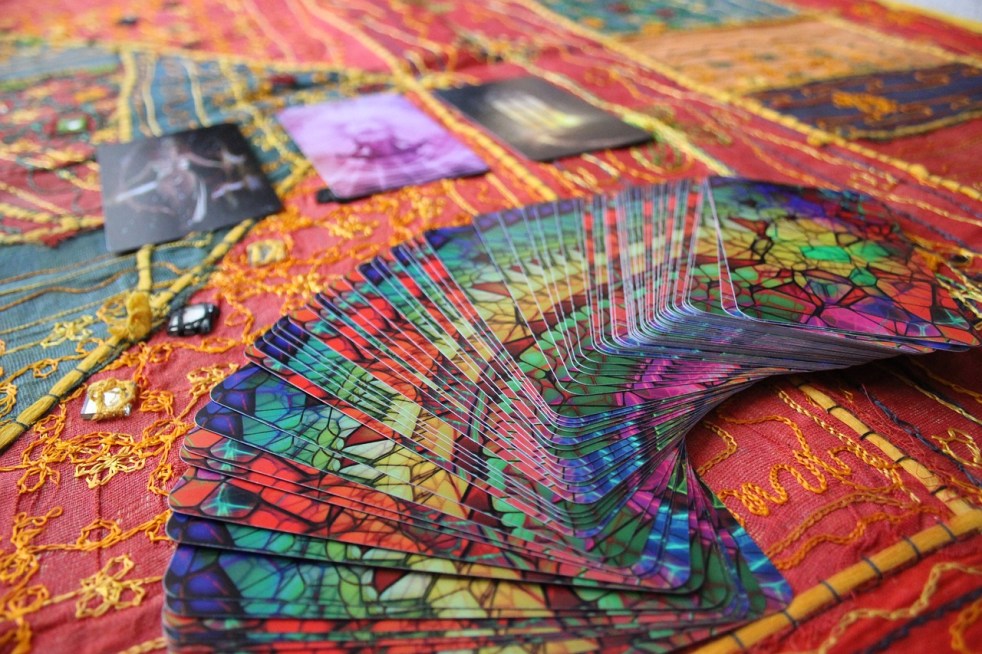
Tarot cards on a purple velvet cloth.

Each method has its own use case and emphasis, so how do you put all of that together?

The trickiest part is viewing each method in their own cultural context. Many guides to runes and ogham, for example, have simplified the meanings to the point where they’re very far removed from their original* interpretation.

(* Or allegedly original. There are large gaps in our historic knowledge of how some divination methods were used, which adds to the confusion. One example of this is the ogham forfeda. Is Mor the beech, Scots pine, or the sea?)

The lack of consensus means that it’s not really doable to just jump into multiple different divination methods and combine them immediately. It’s important to work with each one separately, to learn its limitations and develop a kind of personal interpretation of its meaning. This doesn’t mean that you have to reinvent the wheel by discarding all of their conventional interpretations, but I highly recommend keeping a divination record that allows you to look back and see how each reading turned out. This can show you what cards, runes, symbols, and so forth tend to show up for you, and when.

After that, the only question is what order to put everything in. Personally, I enjoy laying out the tarot spread first, then ogham, then runes, and finally an oracle card. Once I have this story before me, I consult nature and, if need be, scry or enter a trance.

Putting the results together is honestly the easiest part. Here’s how things shake out for me:

  • Tarot tends to show me the “why” of a situation — what feelings, mindsets, energies, and hidden facors are bringing something about.
  • If I use Lenormand, it tells me the “what.” While it might seem like that would be extremely useful, I usually skip Lenormand reading. Believe it or not, knowing what happens is usually a lot less important than knowing all of the other stuff. Think of it like being told the future by a genie who’s a bit of a prick — knowing what isn’t as helpful as knowing why, how you’ll feel about it, and what you need to do to.
  • Runes usually highlight the most important connecting concepts that unify the whole for me.
  • Ogham usually tells me what to do or focus on.
  • Oracle cards generally offer reassurance, or a way to look at the bright side and get through a difficult situation.
  • Nature augury tells me if a situation is generally positive or negative. If something very unusual appears to me, it can give more specific information akin to ogham reading.

If this sounds like a lot of work, it certainly can be! It’s also very rewarding, and even a bit thrilling to see everything come together.

If this interests you, but you don’t want to perform it yourself, that’s totally understandable. This is one of several readings I can do for you, if you like. Just check out my shop!

art · life

Working with a New Medium: Switching from Acrylic to Casein

Oil paint is not my friend.

To be fair, powerful solvents in general are not my friends. I get headaches at the drop of a hat, so working with paint thinner does not rank highly on my list of enjoyable activities.

That’s why I’ve always painted with acrylic. I’ve also taken steps to minimize how much of that acrylic escapes my studio — from using multiple jars of rinsing water, to multiple trays for evaporating that rinsing water, to stripping off the dried acrylic residue and trying to repurpose it.

Still, I don’t want to work with a medium that’s basic liquid plastic if I don’t have to. That’s where milk paint comes in. Rather than using acrylic as a binding agent, it uses a protein found in milk.

There are some key differences between acrylic and casein paint, though:

  • Casein is inflexible, while acrylic maintains flexibility when it dries. This means that acrylic is good for painting on stretched canvas, while casein is only really suitable for rigid substrates like wood or canvas-covered MDF.
  • Casein dries to a velvety, matte finish, while acrylic can be pretty shiny unless you add matte medium.
  • Casein takes a long time to dry fully. This means that you can wet it and re-work it. Once acrylic dries, it’s dry.
  • Casein works great as an underpainting medium, while acrylic has some drawbacks.
  • Casein dries to the touch very quickly. Acrylic stays wetter for longer, and the addition of retardants can further extend this drying time.
  • Casein has a bit of a smell, while acrylic doesn’t really smell like anything. I have to say that casein’s smell isn’t really objectionable, though. It smells kind of like lemon window cleaner, but the scent is very light.

These didn’t really influence my decision to start using casein paint, because I was more focused on reducing my dependency on acrylic media.

Here are two of my paintings. The first is acrylic, the other is casein:

As you can see, there are some differences in vibrancy and transparency. I also had to change a lot of my techniques in order to successfully work with casein. For example, I like to work wet-on-wet. That’s a bit more challenging with casein, because the under layers are pretty much dry to the touch by the time I’ve scooped up the next color I want to work in. I’m also not used to being able to re-wet and re-work paint once I’ve used it.

Casein also tends to have more opacity than acrylic. (This opacity can, of course, be reduced with the addition of a little water.) Some acrylic pigments are very opaque, but others are quite sheer — almost more like a glaze. Casein goes on like it means it.

I’ve noticed that I also have to work more quickly with casein. If I take too long, it’ll start to dry on me. The same dry-brushing techniques that I was taught with acrylic don’t really work here.

All in all, while working with casein has taken some adjustment on my part, I love it. I actually prefer it to acrylic now, especially when it comes to opacity. It’s a beautiful medium that’s been in use for millennia, and one that I hope sees even more use in the future.

animals · divination

The Magical Meaning of Starlings

Since there are still small, belligerent starlings all over the yard, I figured I’d make the best of a very noisy situation and write a bit on their magical significance. While I mostly know them as small weirdoes who periodically walk up to me and gape to be fed (which is almost admirable in its temerity, to be honest), they’re powerful, sacred animals in their own right.

Despite their ubiquity in my area, starlings aren’t native to the United States. The story is that they were brought here in the late 1800s in what is, perhaps, the silliest fashion imaginable. A German-American Shakespeare enthusiast named Eugene Schieffelin wanted the US to have all of the birds mentioned in Shakespeare’s plays, so he imported and released about sixty to eighty of them. (Invasive species who?) However entertaining this tale might be, it most likely isn’t actually true.

Shakespeare’s mention of starlings refers to their talent at mimicry:

Nay,

I’ll have a starling shall be taught to speak

Nothing but “Mortimer,” and give it him

To keep his anger still in motion.

spoken by Hotspur, in Act 1, Scene 3 of Henry IV
A murmuration of birds over a city, against a dark, cloudy sky.

In Rome, however, starlings were more than a curiosity or a passing note in a play. Starlings form very large, elaborate migrating flocks called murmurations. These are exceptionally striking formations of thousands of individual birds who seem to cover the sky in a flowing, undulating mass. Augurs, diviners who read the movement of birds, would watch these murmurations to receive messages from their gods. Some forms and flows were very good omens. Others, not so much.

In the Welsh Mabinogion, Branwen is sent to Ireland to marry King Matholwch . Her marriage is far from happy, however, so she tames a starling and teaches it to speak. She sends the starling back to Wales, where it alerts her brother Bran to come and save her.

Starlings can mimic far more than words. Mozart kept one as a pet, and it learned to repeat portions of his compositions. When it died, he was heartbroken. He performed a funeral that his biographer (and wife’s second husband) described thus:

When a bird died, he arranged a funeral procession, in which everyone who could sing had to join in, heavily veiled – made a sort of requiem, epitaph in verse.

Georg Nikolaus von Nissen 

Starlings also seem to imprint readily on people. Personally, I have made every attempt to avoid them, however their babies still don’t seem to have any issue strolling up to me with their mouths open, expectantly. It’s kind of like walking up to a grizzly bear and demanding spaghetti.

In general, the starling’s place in folklore seems to have been secured by their ability to bond with people, and their talent at mimicking speech and other sounds they encounter. Just watch this one, who not only imitates a human, but flawlessly mimics an Alexa unit immediately afterward:

It’s almost eerie!

Starlings are said to represent everything from freedom, to prosperity, to love. Given their folklore, they’re most strongly connected to communication and divination.

To divine using a flock of starlings (or even just one, though they always seem to show up in groups!) involves noting their number and behavior. It can sometimes be hard to count starlings, particularly since they can number in the thousands within a single murmuration.

If you observe them in flight, like the ancient Romans, pay attention to the shapes they form. What do they evoke for you?

Note the direction in which they’re flying. This means both the cardinal direction, and their relative direction. The east represents beginnings, renewal, spring, and the dawn. The south represents a climax, an apex, summer, and high noon. The west represents a decline, a release, autumn, and twilight. The north represents endings, death, winter, and midnight.

A starling clinging to the trunk of a tree.

In terms of relative directions, birds flying to the right generally indicates a positive or affirmative response. Birds flying to the left generally indicates a negative response.

As with any divination method, keep a journal of what you see and your interpretations. After some time has passed, revisit what you wrote and see how accurate it was. This can help you decode what the flight of birds means specifically to you.

Starlings are polarizing little guys. Some people absolutely love these noisy, funny little birds, while others hate them. I’ve come to be amused by their antics, though I’m also looking forward to when their fledglings are finally grown and it’s time for them to migrate!

life · Neodruidry

A Fruitful Lughnasadh

Today marks Lughnasadh, the celebration of the first harvest. This usually focuses on summer fruits and grains, so there’s lots of blueberries/bilberries, baked goods, apples, and pears.

In another sense, it’s about coming together to share. Traditionally, it happened during a time of year when the earliest crops were spent, and the next round wasn’t ready for harvest yet. Lugh is also credited with battling the powers of blight, which is connected to the scorching, drying heat of the summer’s hottest days. That meant celebrating with foods that either stored well (like apples and grains) or could be foraged this time of year (like bilberries).

A rolling pin and several balls of biscuit dough on a floured board.

It also started as a funerary feast. While it’s associated with the Celtic deity Lugh, he created this festival in remembrance of Tailtiu, his mother figure. She’d died of exhaustion after clearing the land for growing crops. That makes this festival a poignant combination of anticipation of what’s to come, and gratitude for what has passed. It’s joy and sorrow, thanksgiving and mourning. Tailtiu has passed on, but the land is ready.

This year, we were supposed to join in a camping trip and Lughnasadh celebration. Unfortunately, a combination of high temperatures and severe weather meant that that didn’t pan out the way we’d wanted. Instead, it’s given me more time to think and (as overused as this phrase may be) connect with this High Day.

Really, I’m at a Lughnasadh point in my life. The rise of AI chat bots has coincided with the natural end of several long-term paid writing projects that I’d been working on, so I’m not getting the same volume of work that I once was. At the same time, I’m investing more of my time, money, and energy into other things that haven’t yet paid off. There’s mostly been a lot of planning and reading stuff to help me figure out how to navigate this transition.

Fresh blueberries on a wooden surface.

But I’m not doing that today. Today, I’m extremely thankful for everything that the old cycle has given me. I’ve reaped some very generous harvests from it, and that’s awesome. I’m also excited for my next projects. Having less paid writing means less money, but it also means a lot more time and creative energy to put into things that have deeper meaning for me.

Today, I’m baking bread. I’m making these very strange (but very delicious) cookies full of dried berries and cacao chunks. I’m eating dried blueberries by the handful, and searching my strawberry plants for ripe, red berries.

Have a happy and abundant Lughnasadh, and I hope we all reap a good harvest in the days to come!