life

The bowels of the Earth are not great places to discover that you’re claustrophobic, tbh.

So, my Handsome Assistant and I took a bit of a staycation. Our original plan was to stay in a lovely (and haunted) bed and breakfast in Cape May, but we decided to put that trip off until next year and do more local activities.

One of those was visiting Luray Caverns.

I’ve wanted to check it out for a while. I like the idea of exploring caves. We didn’t really have them around where I grew up, so my friends and I compensated by finding unguarded drainage culverts and having many adventures in the glorious sewers of Long Island. I covered miles upon miles of that place, completely underground.

I had some reservations about Luray at first — not because I’m scared of caves (how much worse than a sewer can they be?) but because a lot of the reviews pointed out that the owners seemed to be more concerned with making money by packing as many people into the place as possible versus protecting and presenting the natural features of the caverns.

Still, we were planning on going in the middle of the week. It seemed kind of doubtful that we’d have massive throngs of people to contend with, so the crowd thing didn’t really worry me.

I did not, however, realize that my biggest problem would be air.

Let me be totally upfront with you — still, heavy air is an enormous panic trigger for me. It makes me feel like I can’t breathe. Like my lungs are working to pull air in, but not enough is actually moving. A lot of caves still have air flow patterns, governed by changes in air pressure and temperature. Caves with multiple entrances can even have breezes as fresh air enters and pushes old air out. I figured it’d be okay. Can’t be worse than a storm sewer, right?

We were somewhere on the banks of Dream Lake when the adrenaline began to take hold.

A photo of a cave filled with stalactites and stalagmites. The center is a very still pool of water, perfectly reflecting the cave ceiling.
Dream Lake. The water here is so clear and still, it perfectly reflects the stalactites above.

The closeness of the space, the thick, humid air, and the lack of any kind of movement got to me. It got to me bad. I felt a hot flush in my cheeks, tingling down both my arms, and a heavy feeling in my chest. Sweat prickled over every inch of my skin. I turned to my Handsome Assistant.

OkayIneedtogooutside.

Another formation, primarily of stalactites. One group has grown down to meet the stalagmites on the cave floor, forming a long, continuous pillar.
Pluto’s Ghost.

We turned around and started heading back in the wrong direction. Luray is arranged so that, once you’re in, the only way out is through. Fortunately, we weren’t super deep in and there weren’t large crowds. The walk back felt like it took forever, but we made it back out to breezes, space, and sunlight.

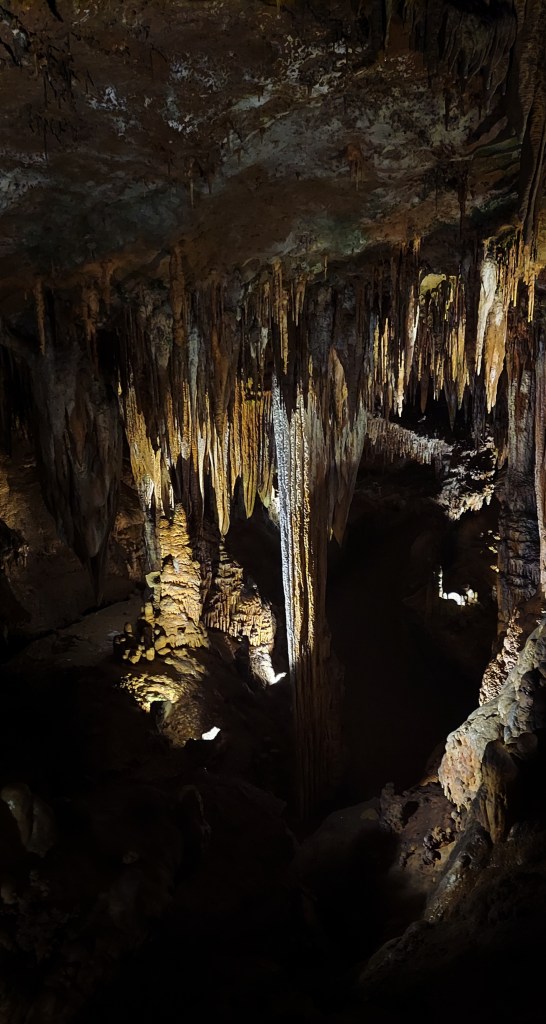
As far as the caverns themselves, they’re strange and beautiful. A lot of the formations have been damaged by irresponsible patrons, but many of them are still “living.” You can see water dripping. You can see the patterns of growth and erosion forming in real time. You can see the bright orange of deposited iron oxides, the white of calcite, the greens and blues of algae blooming from the lights in the cave.

A photo of the cavern ceiling, showing dripping stalactites pointing straight down.

I do agree with a lot of the reviews that criticize the ownership, however. For example, you enter and exit through the gift shop. While this may have been a matter of practicality in the beginning, they’ve recently excavated a new entrance and probably could have done so in a way that would’ve made the shop’s traffic patterns a bit easier to manage.

There are also a lot of very tight areas. People mentioned having to stand shoulder-to-shoulder and shuffle along the entire length of the caverns, which can be tough to manage with small, antsy children. One reviewer’s daughter experienced an asthma attack, and still had to go through the entire length of the caverns because there was no way to get her out otherwise. Things weren’t nearly as crowded when we went, but, again, we were able to go on a weekday. Scheduling a trip for an off-peak time seems like it makes everything a lot easier.

Would I go again? I don’t think so. Even though we weren’t there for very long, I feel like we got enough out of the experience. I also wouldn’t want to chance being there with a large crowd. Has this experience turned me off of caves in general? Also no. If anything, it’s made me more interested.

I just need to have a good escape plan. You know, just in case.

Plants and Herbs

Rosehip Folklore & Magical Properties

Roses (t least in their wild form) are fruit-bearing plants. These fruits, called rosehips or rose haws, are bright red, berrylike fruits that serve as a source of food for wildlife and people alike through the autumn and winter months. They’re high in vitamin C, and are frequently used in everything from supplements, to teas, to jellies, to skincare products.

They’re best harvested right after the first frost, when the fruits are bright red and slightly soft. That’s actually what prompted me to write this post — see, our first frost date is supposed to be in the middle of October. As of this writing, next weekend is supposed to be in the 80s. According to the National Weather Service, we’re not actually going to get frosty temperatures until the middle of freaking November. I could harvest the fruits anyhow and mimic the action of a frost by popping them in the freezer for a few hours, but still. 80 degrees.

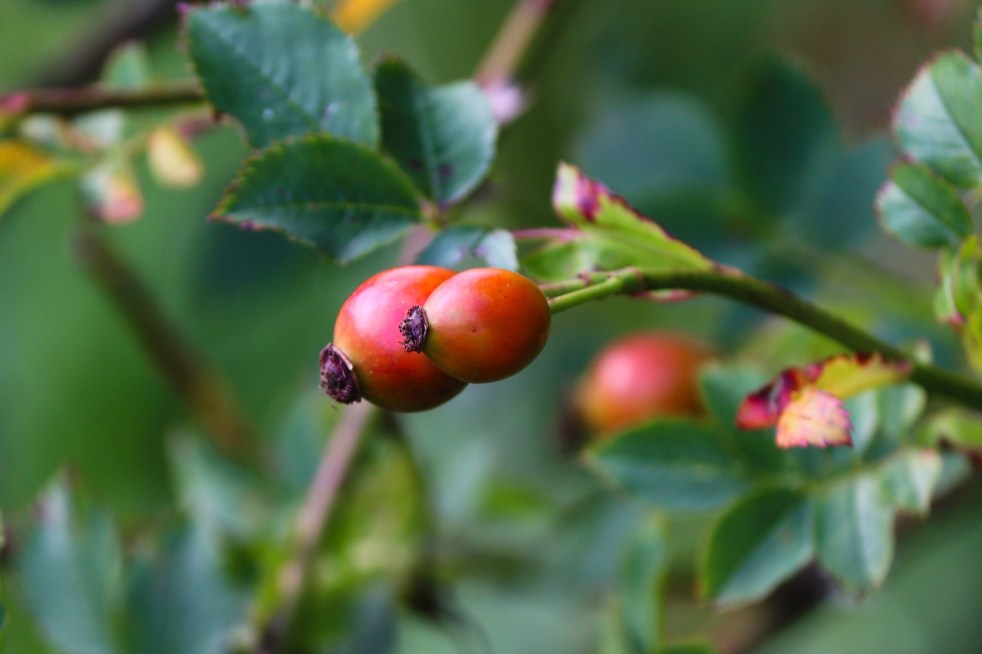
Some bright red, round rosehips on the plant.

(Side note, my Handsome Assistant and I were planning on taking a very off-season vacation on the beach. We weren’t planning on trying to swim or anything, but we decided to cancel anyway since it’d likely be too chilly to do much but hole up. Go figure!)

Rosehip Magical Uses and Folklore

Medicinally, rosehips are used for anything that benefits from more vitamin C. They’re boiled into syrup and given for colds, and used in tea over winter (when fresh fruit is in short supply). The fruit is also a mild diuretic that can help with certain urinary disorders, while the seeds, when boiled, may be helpful for symptoms of gout.

The fruit portion of a rosehip forms a kind of capsule around the seeds. These seeds are covered in irritating hairs, which is why it’s important to clean rosehips before using them. These hairs are so irritating, in fact, that they can be used to make itching powder!

Not all roses will form hips. Flat blooms, as opposed to cup or globular blooms, generally have the easiest time doing so. The reason for this is simple: cup and globular blooms are bred for show, and have masses of petals that cover their stamens and pistils. Since pollination is necessary for fruit production, bees need to be able to get in there to pollinate. This is easy for them with flat blooms, and next to impossible with more complex shapes. Deadheaded roses also won’t produce hips, since the portion that would become the hip gets cut off in the process.

Rosehips are useful for all of the same things that roses are. They shine in love and beauty magic (due, in part, to their vitamin C content). Used in ritual baths or to infuse oils, they can have a brightening effect on the skin.

Some more rosehips. These are still very green and not yet ripe.

Rosehips are also used in spells for good luck and prosperity.

To banish nightmares, place some rosehips under your pillow. You might want to use dried hips for this, since fresh ones could end up leaving you with a sticky, squishy, unpleasant surprise in the morning!

Since rosehips house rose seeds, they’re a good general addition to spells to increase anything. All seeds have immense potential and are used in magic for growth, so you can include rosehips in any spell to increase love (including self-love), money, luck, you name it.

Using Rosehips

To use fresh rosehips, wash them well, slice them open, and remove the seeds and hairs with a spoon. You can then dry them, make them into jelly, or eat them fresh. Dried hips from the store are good to go as they are.

Add fresh or dried hips to magical teas or other recipes. They have a tart flavor that pairs well with lots of drinks and dishes. Stir with your dominant hand as you cook, and intentionally infuse the mixture with the energy that you want to attract or increase.

To keep nightmares at bay, include dried hips in a dream pillow. Lavender, lemon balm, and rosemary also work very well here.

Dried rosehips (and rose seeds) are great additions to spell jars. As I mentioned above, they bring extra energy to increase whatever it is you’re looking to grow or attract.

On the other hand, the irritating hairs around rose seeds are good for protection or banishing spells. Add them to powders to keep unwanted people or spirits at bay. Sprinkle them under your doormat and instruct them to annoy anything and anyone who shouldn’t be at your door.

Rosehips are as useful as they are beautiful. If you have garden space, I highly recommend planting some wild type roses to help feed birds and other animals (and provide you with lots of powerful magical ingredients). If you don’t, keep your eyes peeled when you’re out and about — you may just find some wild roses with plenty of hips to share.

Just for fun · life

“ANTLERED CREATURE! WHERE ARE YOU GOING?”

This past Saturday, my Handsome Assistant and I attended Raven’s Night at The Birchmere. It was kind of a spur-of-the-moment thing — when I’ve got downtime, I crack open the websites for some local theaters and concert venues, send my Assistant whatever looks interesting, and we get tickets more or less at random. (It’s how we ended up going to a late-night showing of Inu-Oh and getting pretty much the entire theater to ourselves.)

And so, we found ourselves at a theatrical Halloween belly dance show. To our chagrin, we arrived too late for the magic show, carnival, costume contest, and tarot readers, but we did get there in time for the dancing itself. I ended up talking to a very lovely woman about gemstones for a bit before we sat down, then my Handsome Assistant and I ordered some drinks and found a seat off to the right side of the venue, near the wall. With just a few minutes to go before the show started, I excused myself to sneak to the restroom.

Here’s the part where I should explain that, even though we didn’t arrive in time for the costume contest, I still dressed up. It wasn’t much of a costume — a cashmere and silk paisley caftan, a shawl in a different paisley, and a feathered mask of a deer skull from Higgins Creek. (Which, by the way? Perfect for occasions like this. It can double as a mask or hat and is equally comfortable either way. Move it out of the way to drink or see better, and slip it back into place when need be. Like I said, perfect.)

Anyhow. I slip out of the seating area to the one place where I knew there was a restroom — the other side of the venue. I was maybe halfway there when I heard a voice behind me.

“CREATURE!”

I couldn’t really make it out, though, and also I was in a venue full of people in costumes.

“ANTLERED CREATURE!”

Oh.

“WHERE ARE YOU GOING?”

I returned to the direction of the voice, where a very nice security person pointed out that there were restrooms right next to the seating area. Right under a large red sign marked “Restrooms,” in fact. Whoops. (Side note, masks are also excellent for navigating socially awkward situations.)

The show itself was an excellent time. The highlights, for me, were almost too numerous to name. There was a beautiful performance by Taschen*. Another mesmerizing allegorical depiction of prudence by Irina Akulenko*, Han Chen*, and Stephanie Cheng*, with costumes and movements that seemed almost reptilian. They started fully veiled, slowly raising their veils to show three faces each — one mask for the past, one for the future, and their own faces for the present. (After a point, it was almost impossible to tell which face was the “true” one.) Raqs al Taneen gave a gorgeous, gender-bending interpretation of what would’ve happened if Sarah had never escaped the Labyrinth. Morgana blended dance, animal mimicry, and martial arts in a dance that seemed half theater, half ritual. Spirit of Ma’at* was a high energy celebration. There was sword dancing, drag, costume transformations, erotic poetry, and some really unique and interesting sound design.

(*Unfortunately, searching did not yield websites or social media profiles for these performers. If you happen to know if they have web presences I can link to, please let me know.)

Like I said, it was a good time. Parts of it reminded me of reading about Aleister Crowley’s theatrical rituals (for which he actually received reviews from theater critics). Some performances adhered more to the masquerade theme than others, but all of them brought their own stories to tell through costume, music, and movement.

As it gets colder, my Handsome Assistant and keep busy. We just shift away from camping and fairs and move indoors. All told, Raven’s Night was a hell of a way to kick off our autumn and winter activities.

Plants and Herbs

Maple Folklore & Magical Properties

This past weekend, my Handsome Assistant and I took a small drive down Falls Road (alias Scenic Route 25). This was recently dubbed the second-best route in the country for seeing fall colors, and, while the leaves haven’t quite reached their peak just yet, it was a really lovely drive.

Red maples (Acer rubrum) are one of my favorite trees to see in autumn, and I’m lucky to share a home with one. Their leaves turn a vibrant scarlet every autumn, hence the name.

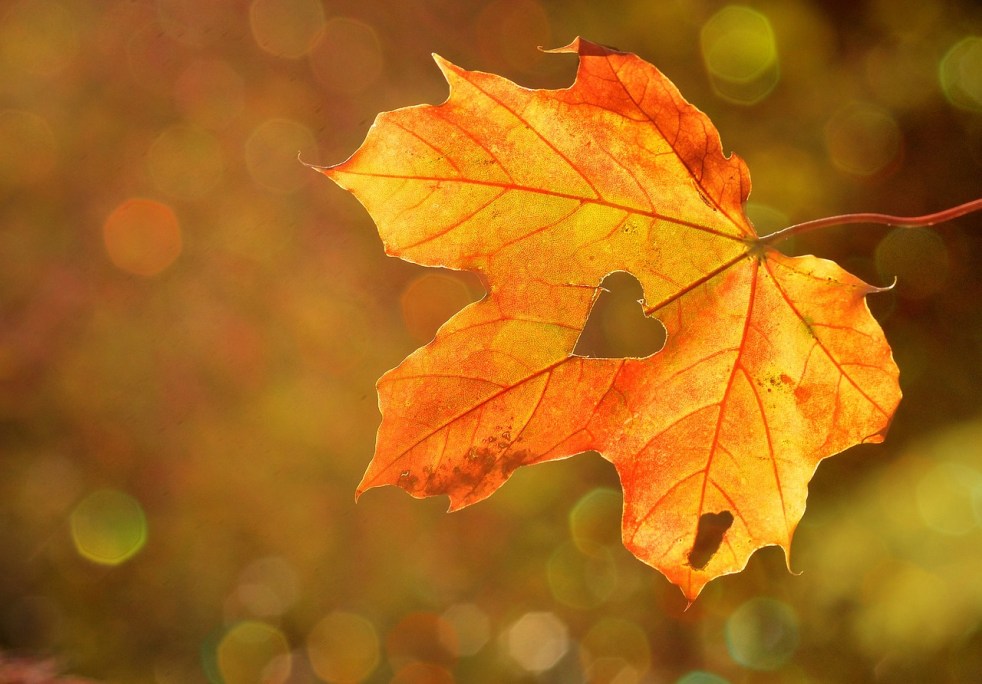
Bright red maple leaves on a branch.

Honestly, I just love maples in general. As a little kid, I used to pick up their samaras (we called them “pollynoses”) from the sidewalk, open the seed capsules, and stick them on the end of my nose. I bake primarily with maple syrup. I’m trying to convince my Handsome Assistant to make his next back of mead a batch of acerglyn (a similar beverage made of half honey, half maple syrup) instead.

I probably don’t need to say that trees have featured prominently in Pagan practices probably ever since the first Pagan. Each one has its own traits and associations, and, when it comes to working with the wood, leaves, or fruits, its own magical properties.

To be honest, maples were so ubiquitous where I grew up that I didn’t know they weren’t more widely harvested from. When I was thirteen, I was a foreign exchange student, which resulted in a brief stay in the Netherlands before going to Sweden. My student group (jetlagged and exhausted) stopped at a cafe on our first day there, where I happily ordered a plate of silver dollar pancakes and syrup.

But it was not syrup.
It was stroop.

Stroop (rhymes with “rope”) is often made of boiled-down fruit, water, and sugar, but can also be made with molasses and brown sugar. While it isn’t bad by any means, the latter variety is kind of an unpleasant surprise when you’re a kid who’s used to maple syrup with pancakes, hates molasses, and also desperately needs a nap. Not knowing any better, I drenched my pancakes in stroop and made myself a very avoidable struggleplate.

Anyway, all of this is to say that maples rock, maple syrup is the food of the Gods and should absolutely never be taken for granted, and I may still carry some molasses-induced trauma.

Maple’s genus, Acer, is Latin for “sharp.” This is due to their very unique, pointy leaves.

An Abenaki story tells how maple syrup once flowed freely from trees. It came so easily, people would lay on their backs and just let the syrup run right into their mouths. The legendary figure Glooskap saw how lazy people had become, so he turned the thick, sweet syrup into runny sap. From then on, if people wanted to eat maple syrup, they would have to work for it!

Another story, said to be of Haudenosaunee origin, tells of a man who watched a red squirrel nibble the end of a maple branch. The sap flowed until the sugars dried, hardened, and crystallized. The squirrel then came back to lick the sweet maple sugar.

In European-based magical systems, maple syrup is often used as an ingredient in love spells.

Maple sugar or syrup is also a useful ingredient in sweetening jars.

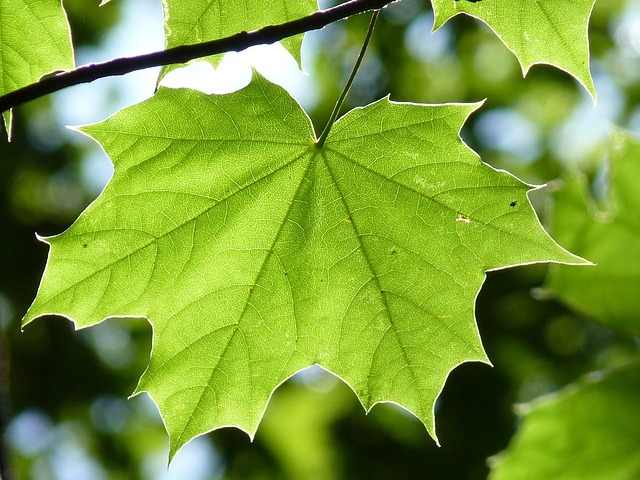
A bright green maple leaf.

By contrast, maple wood is considered very protective. It was sometimes incorporated into doorframes for this purpose.

Some sources consider maple to be good for prosperity and abundance in general.

As wand wood, maple is known for having a somewhat erratic energy. It also helps dispel negative energy, center oneself, and reveal paths and options one may not have considered.

Maples, particularly silver maple (Acer saccharinum) are considered Moon plants. They’re also associated with the element of Water.

Working with maple can be as simple as using magical tools made from the wood. Every tree — and thus every wood — has its own energy. I haven’t personally found maple to be erratic, but, to be totally honest with you, I’m erratic enough myself. (I think it also helps to have sourced the wood from a tree that I know pretty well!)

If you’re in the eastern US, you’re probably located near a maple tree. If that maple tree is anything like the one here, it probably drops plenty of sticks and smallish branches every time there’s a storm. Should you be of a mind to make your own magical tools, deadfall maple wood is honestly really easy to come by.

I can only vouch for red maple, but, once the bark and cambium are stripped off, the wood itself is light and silky-feeling. Sanded well, it takes on an almost metallic sheen. I love it.

The next easiest way to work with maple is to use maple syrup. You’ll need the real stuff for this, unfortunately — the fake stuff is cheaper, but also doesn’t really bear any resemblance to the genuine article. (There’s a good reason for that, too. Maple sap is chemically very complex, and we still don’t really understand all of the different compounds and reactions that give boiled sap its flavor. That makes it pretty much impossible to make a decent imitation syrup.)

If you’re looking to make a sweetening jar, artificial syrup is probably fine if you can’t get your hands on the real stuff. That said, plain sugar and tap water will make you a perfectly fine simple syrup that’ll a) be cheaper, b) let you add your intention or energy during the syrup-making process, and c) let you bypass the artificial flavors, colors, and other ingredients that don’t really add anything to the magic-making.

Otherwise, add maple syrup to your favorite edible magical recipes. Like I mentioned above, I bake with it almost exclusively — it’s pricey, but I love what it does for the flavor and texture of desserts. Seriously. It makes amazing breads and cakes, and is fantastic in chocolate chip cookies. Add the maple syrup, thank the tree for its sacrifice, tell the syrup what you want it to do for you, and stir your concoction clockwise using your dominant hand. Easy peasy.

Maple samaras (aka, pollynoses) can also be helpful additions to a charm bag. They end up all over the place in late spring to early autumn, so, if there’s a maple anywhere near you, you probably won’t have any trouble finding some. Add them to bags for prosperity, love, or protection.

Plants and Herbs

The beauties are berrying!

Thank you for being patient with me while I slept for essentially a week straight. It may have “just” been a vintage cold, but that coupled with the rainy weather was enough to put me out. If there’s one nice thing to come out of that, though, it’s emerging from my tiny, forced hibernation to see the ways the garden is changing as the days shorten and temperatures drop.

Earlier this year, I planted an American beautyberry (Callicarpa americana) bush. By “planted a bush,” I primarily mean “stuck a stick in the ground.”

The original sapling was a tiny, nearly leafless thing with just a few roots. This year alone, it’s managed to grow into a roughly three-foot-tall bush with tons of leaves, tiny flowers, and — eventually — fruits.

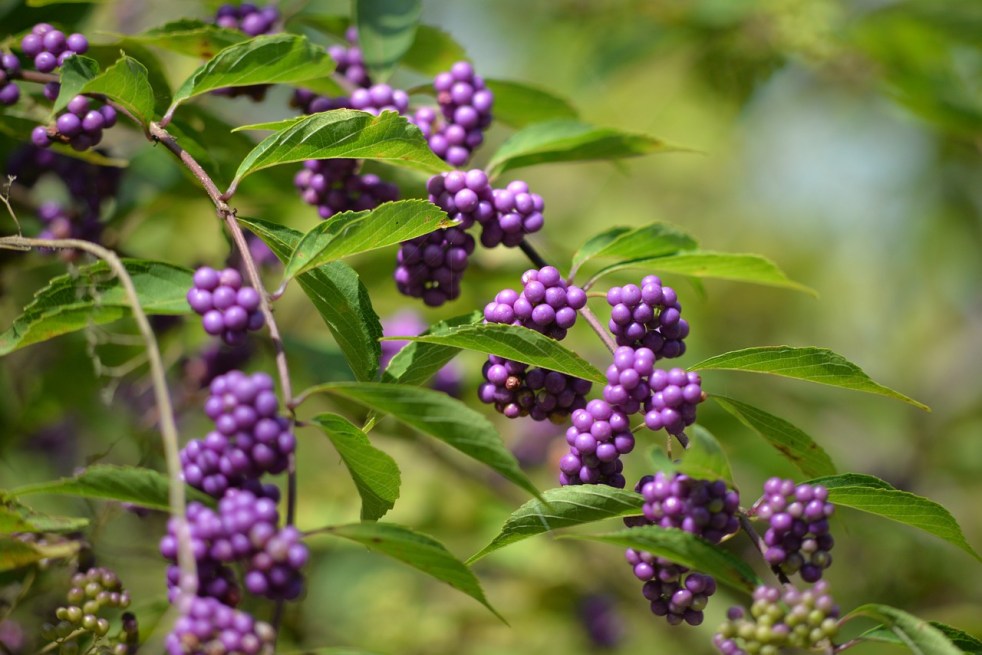
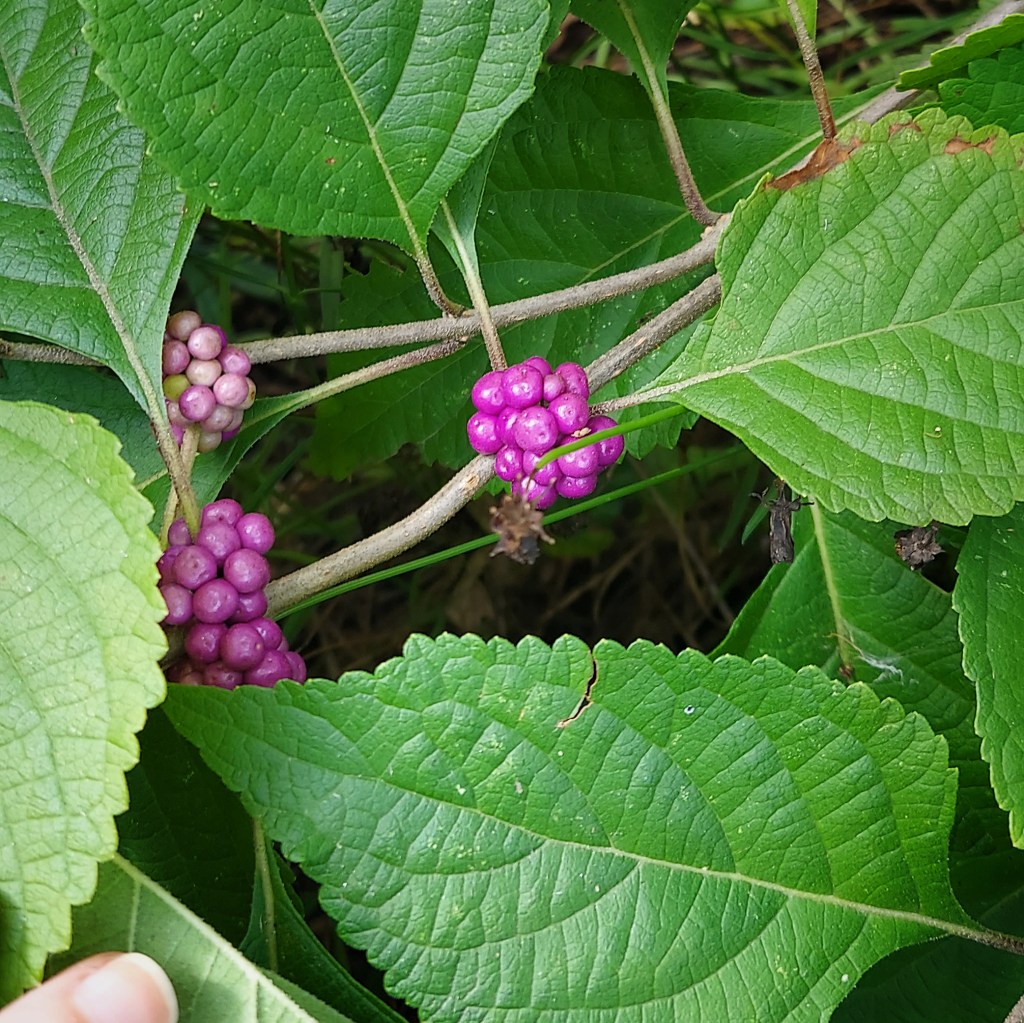
Tiny clusters of bright pink beautyberries hidden among serrated green leaves.

The fruits are all starting to really ripen, which has been incredible to see. While the flowers of beautyberry are rather indistinct and unremarkable, the berries are absolutely gorgeous: tight clusters of tiny, round, bright magenta berries that can persist through the cold months. While they aren’t a first choice for birds and other animals, this actually makes them even more valuable to wildlife once winter really hits. When other, more palatable sources of food are used up, beautyberry’s there to help keep everyone going.

The berries are bright, attention-grabbing, and non-toxic, so why aren’t they more popular among wildlife? It’s purely a matter of taste — literally. I’ve eaten a few ripe beautyberries straight off of the bush, and the opening flavor is sweet and very unique. It’s hard to describe, but, if I had to, I’d say it’s a combination of lemon, grape, and cucumber, perhaps with very subtle notes of raspberry and bergamot.

A close-up of a cluster of beautyberries, held in the palm of my hand.

Unfortunately, this is followed by a rather bitter aftertaste. I don’t think it’s a dealbreaker when it comes to snacking on a few here and there, but I can absolutely see how an animal with an abundance of other food sources might. If I had to describe the bitterness, I’d say it’s about on the level of grapefruit.

Medicinally, beautyberries are really interesting. The leaves contain aromatic compounds that have been said to repel mosquitoes comparatively to DEET. People indigenous to its range have used it as a natural bug repellent, and researchers have extracted some unique compounds that “showed significant repellent activity against [Aedes egypti] and Anopheles stephensi.” Anecdotally, some people claim it’s also effective against ticks, but other users have found it to be of little use. There are loads of DIY mosquito repellent recipes using C. americana available on the internet, but those that macerate the leaves in alcohol (ethanol or isopropanol) are likely to be more effective than those that use water.

Other than making mosquito repellent, the leaves and roots are traditionally used to treat colic, edema, dysentery, stomach pain, rheumatism, and symptoms of malaria.

Researchers have also found an aromatic compound, 12(S),16ξ-dihydroxycleroda-3,13-dien-15,16-olide, that can help treat antibiotic-resistant staph infections. MRSA is a big deal because it can be very difficult to treat. Beta-lactam antibiotics are some of the safest ones we’ve got, but don’t work very well against resistant bacteria. The compound found in beautyberry helps to restore drug-resistant staph’s sensitivity to oxacillin, a beta-lactam antibiotic.

C. americana is only one species of beautyberry. There are also C. japonica from Japan, and C. dichotoma and C. bodinieri from China. Beautyberries all look alike, but there are some key differences to look for if you’re not sure which bush you’ve got.

C. americana has magenta berries that grow very closely around the stems of the bush. There’s basically no airspace between the bark and the berries, which gives these plants a rather unusual appearance. One cultivar, C. americana var. lactea, produces white berries.

A close-up of C. americana, showing the berries closely packed around the stems.
Another shot of “my” beautyberry, showing the lack of space between the berries and the stem.

Asian species of beautyberry look very similar to C. americana but produce berries in clusters on short stems. Instead of closely circling the branches of the bush, there’s a little bit of air space between them.

An image of C. bodinieri, showing the fruits on short stems.
C. bodinieri, showing its slightly different fruit distribution.

If you’re me, you get a little sapling, find a place with lots of sun, stick it in the ground, and wish it the best of luck. Wild beautyberry is found in meadows, woods, and the edges of ponds and streams. It’s not really picky.

I admit, I’m probably not a great person to ask how to grow things. Most of my most successful plants have been accidents (hi, pumpkins) and part of the reason that I love gardening with native plants and nativars is because they don’t require coddling. Find an appropriate spot, and the plant’ll know what to do.

At the moment, the beautyberry bush I planted is still fairly small. While it’s putting out berries like a champ, there aren’t enough for me to harvest some and leave enough for the birds. Since it’s done so well, though, I’ll definitely be looking for more places to add it to the landscape. By next year, I’ll hopefully have enough for jam, sauce, and even pie!

life

Gonna take this cold on Antiques Roadshow.

Hello! I went to the Maryland Renaissance Festival yesterday, and I think I’m dyin.

Okay, not really. I did do much more than my accustomed amount of walking, though, and it was one of those days that seems to alternate between toasty and very chilly, which is pretty much guaranteed to give me a headache. By the time I got home, I felt like I’d been run over. (And I’ve been run over.)

My Handsome Assistant and I make a point to go to at least one Ren Faire a year. In my case, I think it’s genetic — my dad was very into that kind of thing, to the point where he actually made his own armor and chainmail. There’s a baby picture of me, bare-ass naked, with an adult-sized morion helmet on. He had a collection of swords. (I think it was one of the many bones of contention in my parent’s marriage, which is why I’m also glad that my Handsome Assistant and I can agree that swords are cool and a large knife collection is a good thing to have. But I digress.)

This year, we met up and hung out with our Druid group. Well… as much as its possible to “meet up” and “hang out” at any large event like this. Even times when I’ve gone there with groups of friends, everyone ends up splitting up and meeting periodically throughout the day. This was no exception. We met up to go to the Bee Folks, then got separated when my Handsome Assistant got sidetracked by a sculptor and I went to go find him. We met up again, later, when everyone else was watching a band play and he and I were looking for somewhere to sit down for a bit.

The two of us bought some artwork and some sculptures for the garden, pounds of specialty honey for mead brewing, more specialty honey because it’s delicious, and a large bag of honey candy for cold season. I found a shirt I liked, he found a pauldron he liked, and so we continued the tradition of adding one piece or so to each of our costumes every year. It was fun, the food was good (there were even options for herbivores like me), the music was good, and I had a good time, as always.

The following morning, though? Woof.

I have one working nostril, and my lungs appear to have accumulated several pounds of Substances throughout the evening. COVID tests were negative, so I’m pretty sure I’m just dealing with a regular vintage cold. A bit of stuffiness from the before times, if you will. It almost makes me miss being on massive doses of Diamox — it altered the pH of my blood to the point where I never got sick. This also meant that I had chloride acidosis pretty much constantly, but still.

It’s a good thing we got all of that honey.

Now, I’m settled in with warm blankets and a wonderful-yet-incredibly-impractical mug which I love. It’s massive and great for when I feel sick, but the handle is goofily small. It used to have a gold image of a crystal ball on the side that said, “Your Future is Bright!” but an accidental trip through the dishwasher has rubbed off the gold until all it says is “Ufb.” Which, to be fair, is usually exactly how I’m feeling when I most want to use this mug.

And so, for the time being, I am taking naps and doing my usual autumn cleaning. I also have a raised bed that I’d like to plant with cold-weather crops, but I haven’t decided what I want to plant yet. (After last year, I’m probably not doing kale again. There were so many seeds, and there’s volunteer kale everywhere now. I even saved half a jam jar of broccoli/kale/some kind of hybrid seeds for growing microgreens, so I am full up with brassicas.)

Here’s hoping everyone else is successful at staving off autumn and winter bugs.

life

THE BOYS’RE BACK IN TOOOO-OOO-OOOWN!

Not long ago, I wrote about the family of starlings that had pretty much taken over. A squawping mass of tiny kicks, punches, flung food, and babies that would walk up and demand to be fed by anything that moved (and a few things that didn’t).

While they were fun to watch, they also seemed to drive away a lot of the other birds that visited me — especially the crows. Given how much energy I’d put into building a relationship with my local crows, this bummed me out. Still, I knew that starlings aren’t forever, and it wouldn’t be long before they’d join a migratory murmuration and the yard would be peaceful once again.

At that point, I figured, I could try attracting crows again. They might not be the same family that I’d grown to love, but I knew this area was hospitable to breeding populations of crows and would easily become so again.

Anyhow, the starlings have gone on their yearly vacation. I discovered this when I woke up the other morning to big, black shadows passing over the skylight. I went to investigate, and what to my wondering eyes should appear but…

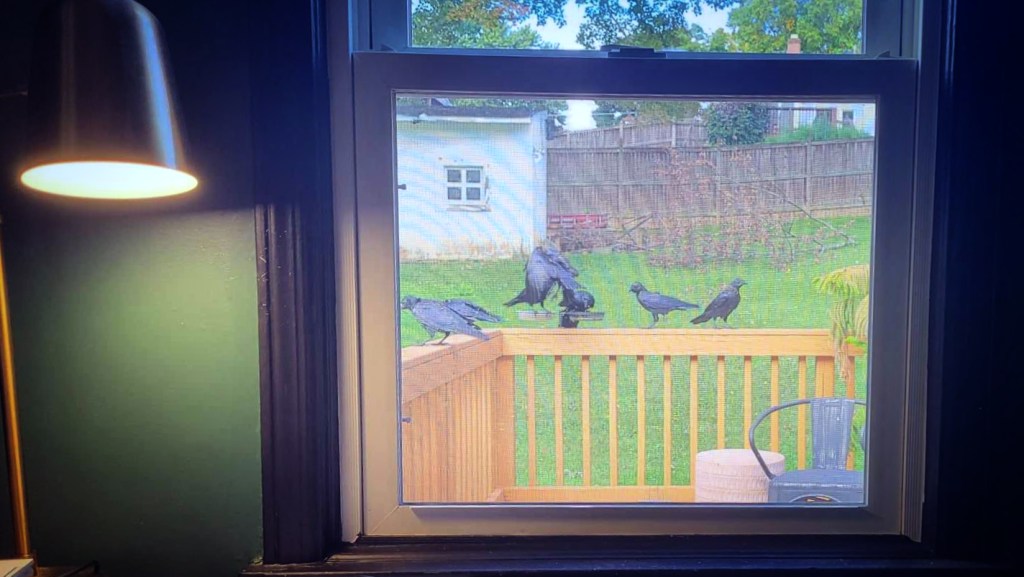
A view through a window, showing seven crows crowding around a feeder.
The view from my Handsome Assistant’s office. Not shown: The other six crows at the feeder on the other side of the deck.

All of the crows.
At the same time.

I knew it was the same group because they have a handful of pretty visually and behaviorally distinct individuals. They scrapped over cat kibble, raisins, nuts, and fancy organic peanut butter cereal (which is apparently a very hot commodity among corvids). I went outside to refill the feeders once they’d nearly wiped them out, and they flew off to the roof, waited for me to finish, and immediately swooped back to resume feeding.

It feels nice. As far-fetched as it seemed, there was always a nagging fear that I’d done something wrong somehow. Something to drive them away. Crows are intelligent, perceptive creatures, and I’ve heard stories of them spurning people for things like imitating the wrong crow calls. It’s good to have some confirmation that it wasn’t me — if anything, it seems like they’d been champing at the bit to get back and hang out.

It was also great to see how much they remembered. In the beginning, they’d fly off when I went outside. Things got to the point where they’d hop to the roof, at most, and wait for me to fill the feeders. Sometimes, if I was sitting down on the deck, they’d land near me to eat anyhow. Despite their hiatus, they still aren’t afraid. A couple flaps to perch on the roof, or the fence, or the shed, and they’re content to wait patiently and watch me put more food down.

A group of five crows swooping in to feed.

I missed these dorks so much. ❤

life · Neodruidry · Witchcraft

Mabon 2023 (Or, “And then we accidentally gatecrashed a youth group.”)

I hope everyone had a good autumnal equinox, as rainy and chilly as it may have been!

Friday saw my Handsome Assistant and I hurriedly packing — he’d had to work and wasn’t able to get time off, and I’d spent most of Thursday processing fruits and vegetables and baking things. So, we pretty much grabbed whatever seemed like it’d come in handy for camping, shoved it in the car, and zoomed off.

A few hours later, we were driving down winding roads through the forest during golden hour, looking at the Shenandoah Mountains bathed in that soft orange light and listening to the wind through the trees. I couldn’t help myself — I turned on The Hu, and I turned it up.

We pulled into the campground moments later, windows down and music blaring, and hopped out to use the bathroom before going to find our group. There was a handful of people standing by one of the cabins in the distance, so we cheerfully strode up to them to discover that they were actually complete strangers. Baffled strangers. Slightly disturbed strangers.

“Um. Is this the MeetUp group…?” I asked.

“… No. This is a Lutheran Youth Group.”

“… Oh. Sorry. Mybadgottagobye!”

A few more moments and a short drive later, we found our actual campground.

After this minor slipup, the rest of the weekend passed with feasting (so much feasting), singing, chanting, poems, stories, a bonfire, divination, and rain (so much rain).

We stayed in a cabin affectionately called the Murder Cabin. Oddly enough, this was called the Murder Cabin before I discovered that one of the bunks had what appeared to be a bloodstain (it was not. We discovered this after a friend realized it looked too shiny to be blood and tentatively touched it. It was still wet and slightly oily, and we both jumped back shouting, “Oh God! Oh no! Oh God! Oh God!” One of our other friends woke up in the middle of the night to discover that he was sharing his bunk with a family of fieldmice, and I feel like fieldmice are too cute to just hang out in a Murder Cabin.)

I’d stayed in a cabin just like this as a kid, when I went to summer camp one year. I knew that they fit a twelve-year-old reasonably well but wasn’t entirely sure how well they’d fit one jacked, full grown human man and a smaller, more gremlin-style human at the same time. We’d brought our tent but forgot a second sleeping bag and the air mattress. As a result, we both crammed into a single sleeping bag, in a single bunk, and he ended up with his butt out the window and the beginnings of hypothermia. (I, however, felt fine and toasty where I was, nestled in the sleeping bag with him as a draft blocker.)

I always feel energized by being in the woods with friends. At events like this, I honestly rarely sleep. The first WickerMan I went to, I stayed up for three days then went home and absolutely crashed for a day and a half. This was no different — Handsome Assistant and I stayed up until about threeish every evening, only going back to the cabin once everyone else was ready to go back to theirs, too. (The first night, we accidentally dropped his heavy leather coat from the top bunk and startled one of our bunkmates awake, but they were very good-natured about it.)

I didn’t drink, which was probably good. I’m the kind of drunk who immediately starts complimenting strangers, telling people I love them, and becoming Eternal Best Friends with people whose names I may or may not actually remember in the morning. Also, I get terrible hangovers.
I did, however, enjoy some herbal medicine and enough sugar to send a hummingbird into a diabetic coma. (These things are probably connected.)

The Mabon ritual was beautiful. It was originally planned for outdoors, but there was a ton of rain and a big drop in temperature, so we moved it into a pavilion instead. We sang and chanted, taking turns going to a meditation tent for some solitary reflection and relaxation. When we each returned, we took a small wooden lantern as a reminder of the light that we’d each carry within us through the dark months.

Afterward, there was a feast. I’d brought pumpkin bread, strawberry scones, a vegan quiche, and vegan queso and chips, but the only things that had survived the previous day were the scones, so I put them out alongside the other dishes. Handsome Assistant grilled venison and bison burgers and brought homemade blackberry mead, someone had made a gorgeous salad with pecans, apples, greens, and pomegranate, there were black and white cookies (perfect for the equinox), breads, cheeses, fruits, salads, and just so much beautiful food.

One of the completely unironically fun things about this gathering was that it was two separate groups. On one hand, there were the Druids. On the other, there were the pan-Pagans, with more of a Witchy vibe. It was just neat seeing the similarities and differences in cultures and practices. Kind of a “fancy” versus “feral” groove, in the best way. As someone who has identified with both Druids and Witches at various points, I can see why I ended up on the path of Druidry.

After the ritual, the rain stopped for a bit. A friend built a fire, and those of us who didn’t go to bed early went out to stand around it, tell jokes and stories, and get warm and dry again. (An awning had dumped what felt like a cup of water down the back of my neck, so I was turning like a person-shaped pile of döner kebab to make sure I got evenly dry and toasty.)

This same friend remarked that he was sad that the weekend was almost over. I agreed. Even though it’d been cold and rainy, the laughing, the camaraderie, and the connection was just so awesome. I pointed out that, while it was almost over, it was also a day closer to next year’s.

And that’s what it’s about, right? Recognize the turning of the year. We’re heading into the cold days, but that just means that there’s an entire spring and summer ahead in the future. Just like I came home and crashed for seventeen (!) hours straight, I’ll have a restful winter and be ready to run amok again.

Plants and Herbs

Pumpkin Folklore & Magical Properties

I mean, this one was pretty much inevitable.

(For a useful companion guide, you may also want to read this bit about nutmeg.)

I was never much of a fan of pumpkins growing up, but my experience with them was also limited to cleaning handfuls of cold, stringy, slimy pumpkin guts out of jack-o-lanterns and eating pasty-textured pumpkin pie from the grocery store. This year was my first experience processing fresh pumpkins, and it’s changed my entire outlook.

For as much work as it is to halve them, remove the prickly stems, clean them out, roast them, and puree them, it’s very well worth it. The flavor of a freshly roasted pumpkin is sweet, almost buttery, and nothing like the canned pumpkin pie filling of my youth. (Which is, let’s be honest, mostly made of other types of squash anyhow.)

As I’ve been gradually processing more of my ludicrous pile of pumpkins, I figured it’d be a good time to write a bit about their magical uses and relevant folklore.

While pumpkins are the predominant produce for jack-o-lanterns in the US, it wasn’t always this way. The original jack-o-lanterns were carved from turnips, and absolutely terrifying. While they’re a lot smaller than your average carving pumpkin, you can fit a ton of unsettling details into a turnip.

Jack-o-lanterns were originally used to keep confused or malevolent spirits at bay during the autumn months. They’re also connected to the Irish tale of Stingy Jack, a drunkard who managed to get himself barred from entering Heaven or Hell, and was thus condemned to roam the Earth with a candle in a turnip to light his way.

A big pumpkin, carved with a big, pale, toothy grin.

While the origins of the poem “Peter, Peter, Pumpkin-Eater” are unclear, it may have some fairly dark origins. One source claims that “Had a wife, and couldn’t keep her” refers to his wife’s infidelity. Putting her “in a pumpkin shell” was a euphemism for using a chastity belt. Another source claims that putting her in a pumpkin shell was intended more literally — Peter murders his wife, and conceals her body in a large pumpkin. The structure and subject matter of the poem hints that it may have come from an older rhyme from Scotland. While this rhyme doesn’t mention pumpkins (since pumpkins are native to the Americas), it does mention a Peter and an unkeepable wife. However, rather than putting her in a pumpkin shell, he lets her be eaten by rodents:

Peter, my neeper

Had a wife

And he couldn’t keep her

He pats her I the way

And lat a’ the mice eat her.

What the fuck, Peter.

Seeds, in general, are considered useful for beginning or attracting new things. Pumpkin seeds, being large, are easy to mark. This means that pumpkin seeds can be ideal components for any spell that involves making positive changes in your life. (As long as those don’t involve banishing things. You’ll probably want to use cloves or garlic for that instead.)

In religions that sprang from the African diaspora, pumpkins are associated with several major deities, particularly Oshun and Shango. Oshun is a goddess of rivers, love, and fertility, which echoes the connections between pumpkins, the element of Water, and the concepts of fertility and abundance as seen in other cultures and traditions.

To some groups indigenous to Mexico, pumpkins were considered a strengthening, fortifying food that increased endurance and protected against cold.

According to a Huron creation story, pumpkins arose when a divine woman died in childbirth. All of the plants necessary for life sprang up from her body: Beans grew from her legs, corn sprang from her body, and pumpkin vines grew from her head.

Pumpkins are associated with the Moon and the element of Water. They’re generally considered symbols of prosperity, protection, and fertility.

Like muscadines, these are one of the easiest magical ingredients to use. They’re edible, so prepare them with intention and the proper techniques, then eat them. Bingo, bango.

To use the seeds, clean them well and dry them thoroughly. Using a fine, non-toxic, felt-tipped pen, write your desires on a pumpkin seed. (You’ll probably only be able to fit a single word, or a symbol. That’s fine!) Seeds represent the power of infinite possibility. You can plant the seed so your luck grows as the pumpkin vine does, set it outside so your wishes may be carried to the divine by birds or squirrels, or cast it into a body of water.

Pumpkins, candles, and a pair of hands holding a deer skull.

Pumpkins are traditionally a good offering to water spirits. Depending on the spirit, however, cutting or cooking the pumpkin first may be taboo.

If you decide to carve a jack-o-lantern, empower it to protect your home from evil. Set one or two as guardians at all of the doors leading into your home.

While there’s a ton of pumpkin scented and flavored things around this time of year, most of them don’t actually contain pumpkin. They’re more likely to be a combination of fragrance oils or artificial flavors. Likewise, pumpkin spice doesn’t contain pumpkin — it’s a blend of spices used in pumpkin dishes, like pies and cakes. This spice blend can be used for its own magical purposes, but it isn’t really the same as actual pumpkin.

I’ve still got a lot of pumpkins to go through, but, according to my Handsome Assistant, I’ve also devised a pumpkin bread recipe that knocks it out of the park. (I’ll post it, it just needs a Mabon feast test drive first!) I’ve got a ton of potlucks with like-minded individuals to attend over the next few months, so I’ll be bringing plenty of prosperity and protection magic with me.

life · Plants and Herbs

The most important things I’ve learned about gardening.

I’ve posted a lot about my stumbling efforts at growing things, from murdering the front lawn on purpose, to accidentally planting way too many passionflower vines. It’s certainly been a learning experience, though not in any of the ways that I ever expected.

A pair of ripening pumpkins.

See, I thought I’d learn stuff about soil composition and companion planting. I kind of did the former, if by “learning about soil composition” you mean “discovering that this soil is almost entirely hard clay, good luck.” I have developed strong opinions about mulch, however.

If I had to sum up the two biggest lessons that I’ve learned in my first full year of being responsible for an entire yard, they’d go something like this:

As part of my current course of Druid studies, I’m required to plant and tend a tree (or, lacking a tree, another, smaller plant). I began this study pretty much right after my Handsome Assistant and I planted an Eastern redbud in the front (formerly grass) plot. I was given the okay to use that tree, so that’s what I’ve been working with.

The lesson is supposed to involve building a relationship from planting, watering, and helping a young tree become established, to watching it grow. To be honest, I think I’ve watered this tree maybe three times over several months. It’s native to the area. It’s fine with this soil. It’s putting out new branches and beautiful, heart-shaped leaves on a nearly daily basis.

This seemed a bit like cheating, so I thought I’d start a smaller, auxiliary tree. I wasn’t sure what to plant at first, but the birds made that decision for me: There are an abundance of mulberry sprouts, courtesy of the crows and other birds. They didn’t enjoy being moved, but are doing just fine with minimal intervention. My takeaway here if that if I have to carefully nurture a plant, it probably isn’t the right one. Nature, even transplanted nature, doesn’t really need as much intervention as one might assume.

As for the potluck… I’ve mentioned all of the pumpkins in previous entries. (They’ve made for some amazing pumpkin bread.) There’re also sprigs of various kales popping up random places where they were certainly not planted, a thriving bush of bright orange cherry tomatoes, the aforementioned mulberry bushes, and what appears to be a chia plant.

A carpenter bee, a Peck's skipper butterfly, and a sachem butterfly visiting the same flower spike on an anise hyssop plant.

Really, it seems like I don’t actually have to worry about planting fruits and vegetables myself. If I help make this place welcoming enough, tiny guests will show up and bring food. That food may not always show up where I anticipate it, but it flourishes, and I end up with more than enough to share.

A cluster of cherry tomatoes. Most are still green, but a few are beginning to blush orange.

The plants here have mostly gone to seed, so the pollinator garden is as full of birds as it is bees and butterflies. I have no idea what horticultural surprises next spring and summer may hold, but I’m excited to find out!