animals · Blog · life

My house caught on fire, and now it has wasps and ducks.

Hello! It’s… uh. It’s been a while.

The past few months have been pretty intense. I downgraded my WordPress hosting, because I found that I wasn’t using many of the benefits of my upgraded package. This sounds simple, but, in reality, required a lot of back-and-forth between three chat bots, some emails, and a discussion forum. Either way! It’s all sorted now and, if anything breaks in the near future, it’s entirely because I’m messing with themes and colors again.

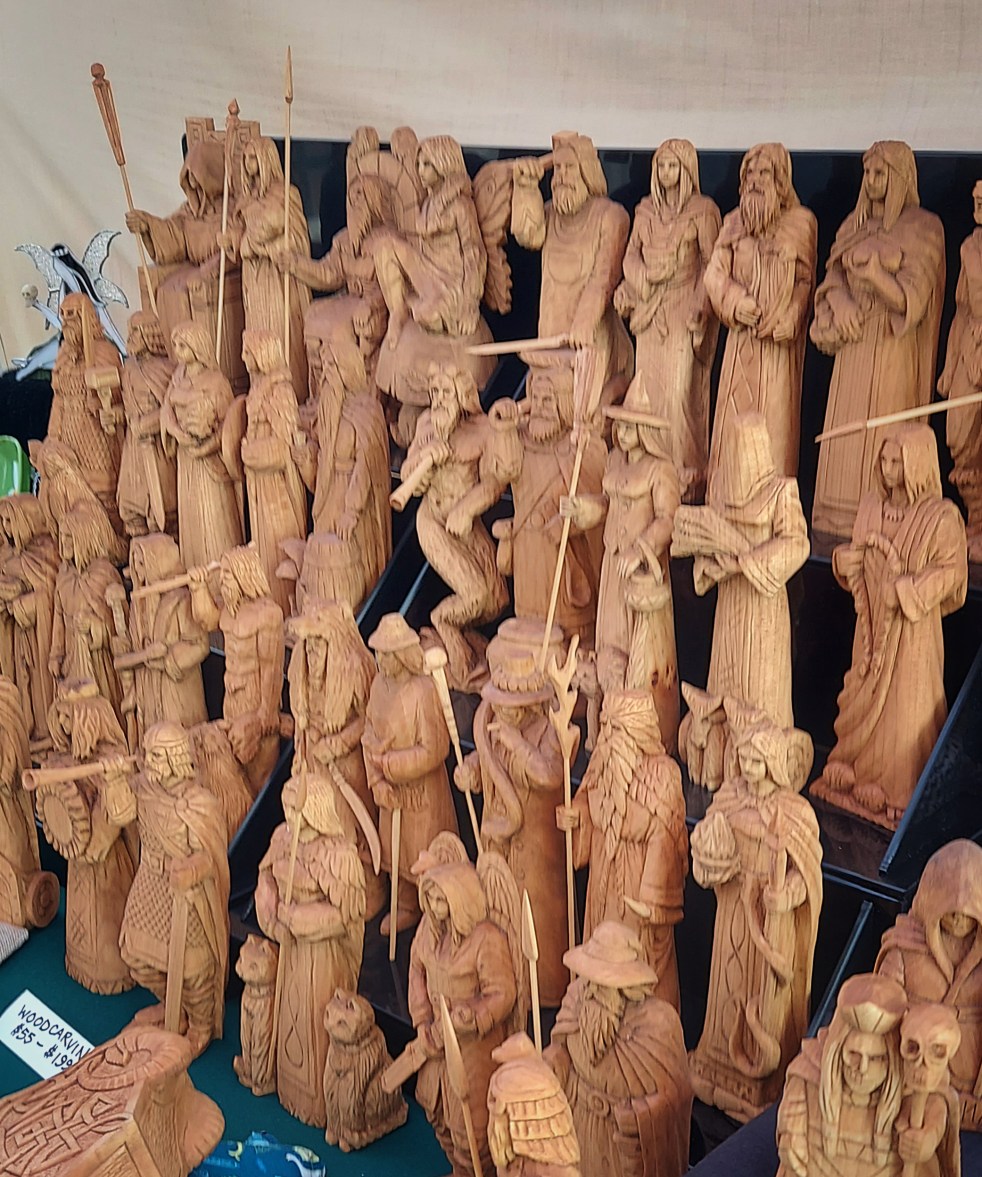
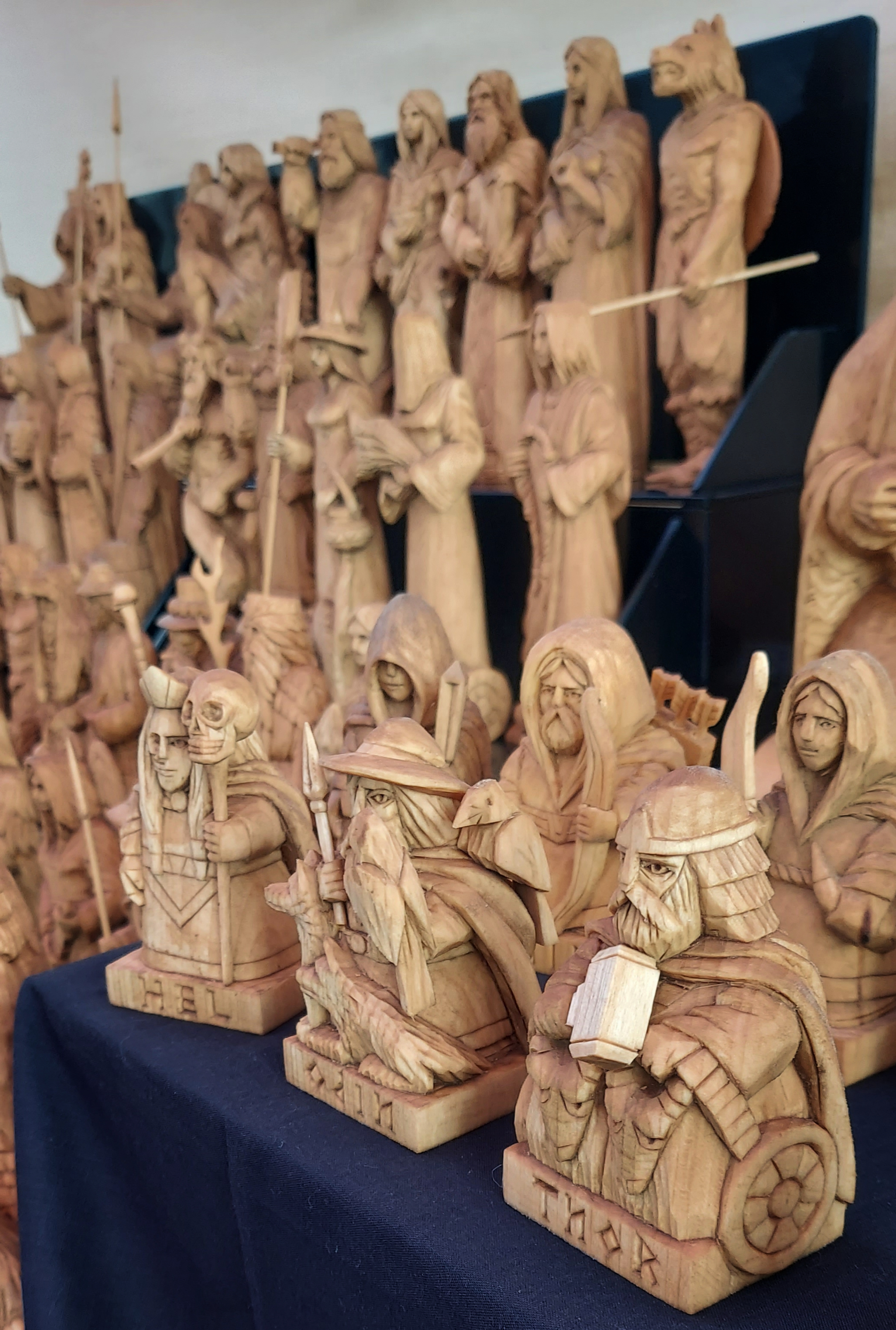
Now, as for the rest… I vended at my first in-person event this year! It was a great experience, I sold a ton of artwork and sculptures, and I’m very happy.

Then, shortly afterward, my house caught on fire some. I was sitting in the bath when I smelled something like melting plastic. I checked the bathroom window, but it definitely wasn’t coming from outside. When the smell intensified, I asked my Handsome Assistant to see if he could track it down.
He came running back with a fire extinguisher, there was smoke everywhere, cats were evacuated, fire department was called, and I sat in the driveway for a while chatting with friends on Discord because I’m pretty sure that was the one thing tethering my sanity in the midst of all of the chaos at that particular moment.

Anyhow! Everyone’s fine and the house is habitable. However, as a public service announcement: Do not leave your bathroom vent fans on when you’re not around, they are absolutely capable of subterfuge. As it turns out, our basement bathroom vent fan’s wiring blew out in a rather spectacular fashion. Like, flames. Melted insulation. A scorched gas line. If we hadn’t been home, or I hadn’t smelled it when I did, it would’ve been a catastrophe. As it is, it’s just been a very stressful series of inconveniences – including having no heat for several weeks.

Also, yellowjackets live in the walls now. This is totally unrelated to the fire. They just saw some gaps around the powerlines and decided it was free real estate, and now they live there. Sometimes they get into our bedroom. I woke up gently spooning one this morning.

If circumstances were different, these guys would’ve died off with the first frost as they usually do. Since they’re living in the walls, they’re here to stay. Or at least for way longer than my Handsome Assistant and I are comfortable with sharing a space with them. I don’t mind stinging insects, but as far as housemates go… I mean, they’re not great.

Lastly, we have ducks!
We did not initially intend to get ducks.
My Handsome Assistant likes the idea of having egg-producing pets, despite the fact that neither of us eat eggs. (It is his latent Ohio prepper sensibilities.)
These are not egg-laying ducks.

What happened is a friend of ours rescued some ducklings from Tractor Supply. It was the end of the season, the store can’t return them to the breeder, so they just… had these unsexed ducklings. Friend took them, since friend already has necessary ducky infrastructure, and the ducklings grew into three handsome Rouen drakes and one lovely hen.

(Pause for sounds of dread from people who have kept drakes and hens before.)

Duck mating is… Let’s call it “hardcore.” It’s dangerous for the hens at the best of times, and that’s even with a good ratio of drakes to hens. Which is about 1:3-4 at minimum, not 3:1. So, friend needed to find a home for these drakes before the spring breeding season rolls around. If no one took them, they’d have to make the difficult decision to cull the drakes for the safety of the hen, which they really didn’t want to have to do.

So, bleeding heart that I am, I decided we were going to keep ducks.

And honestly? It’s been great. We built them a run and a coop, set up a pool, gave them a separate water source, and feed them a variety of fresh foods alongside a healthful prepared diet. They’re three handsome Rouens, and they’re also a lot of fun. They get excited when I walk outside or talk to them through the window. They wag their tails and bob their heads. They’ll eat treats from my hand and listen very well when I tell them it’s time for bed.
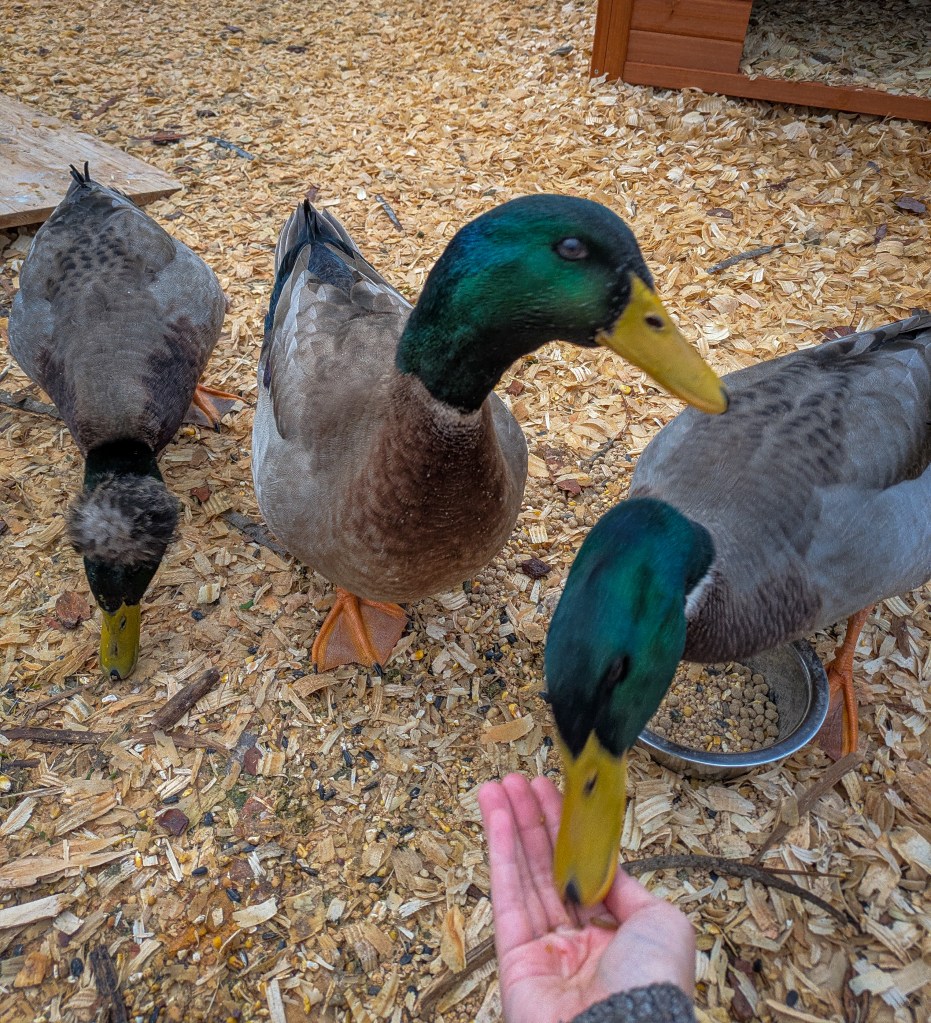
Three ducks with bright green heads and gray bodies eat black soldier fly larvae from a person's hand.
Left to right, Marcus, Eddie, and Robert.

… Alright, they listen well when I walk in and say, “Alright handsome boys, it’s time to go eepy-sleepy’! Ready? Let’s go!” In high-pitched parentese like a demented Disney princess.

We’ve only had them for a little while, and I already love them. There’s Marcus, the crested one and the smallest of the three. There’s Robert, the second largest and boldest. And there’s Eddie, the largest and the unwitting target of Marcus’… affections.

Ducks, like many other animals, will mount each other in a display of dominance. So, much like a high school transfer student, Marcus has apparently decided that since he’s in a new place, it is time to try to be the Cool Important Duck. A strategy that would make more sense if he weren’t shy and less than half the size of Eddie.
Eddie’s mostly just confused by the tiny hat-wearing maniac trying to climb on his back.

So, my time a way has mostly been dealing with housefire remediation logistics, rebuilding, setting up duck infrastructure, and finding a way to get the wasps out of the walls.

How are yous all doing?
animals

The Magical Meaning of Wasps

Last week was spiders, this week we’re doing wasps.

Why wasps?

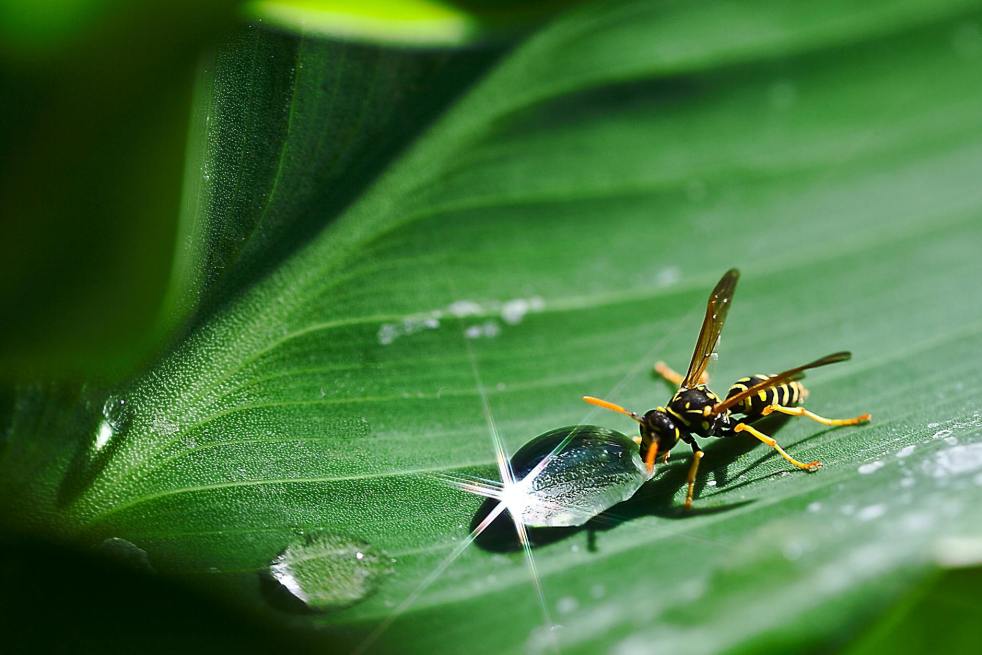
In temperate climates, late summer and early autumn when many wasps (the eusocial ones, at least) start losing direction. Like kids on spring break, they no longer have the structure they once did — the nest is likely done producing larvae, the newly-created queens are getting ready to hibernate, and the wasply lifecycle comes to a close to start back up in spring. This means that the workers, if they haven’t died already, are about to.

The lack of larvae to raise also means that the wasps’ dietary habits shift. Where babies need protein in order to grow big and strong (and adequate protein is so important, worker wasps have been observed shoving drones into lockers in order to make sure that the larvae eat first), the workers have already done all the growing they’re going to do. They don’t need a high protein diet; they need carbs for energy. This often puts them in conflict with humans, as sugar sources start to wind down a bit this time of year and humans are generally a veritable bonanza of sugary treats.

A close-up of a wasp's face.
Photo by David Hablu00fctzel on Pexels.com

So, if you’re noticing larger numbers of more aggressive wasps than usual, that’s probably why. They’re hungry, and they’re on a kind of wasply rumspringa. Don’t worry, though — they won’t be around much longer. It’ll get cold, the workers will die off, the queens will hibernate, et fin.

Right now, we have a wasp nest beneath a tree stump. We considered removing it, but it’s late enough that nature will take its course pretty soon, and then we can fill in the cavity to keep anyone else from setting up shop.

In honor of the last of the summer’s wasps, here are various bits of folklore, mythology, and magical properties associated with these creatures.

Insects feature pretty frequently in Japanese folklore and mythology, wasps included. In one story, the deity Susanoo-mikoto ordered his son-in-law, Ôkuninushino-kami, to sleep in a room infested with wasps and centipedes. Fortunately, Suseribimeno-mikoto, his wife, gives him an insect-repelling cloth to protect him.

One of the plays of Aristophanes, an ancient Greek playwright, is titled The Wasps. In it, the titular wasps are a group of jurors. Bdelycleon, son of Philocleon, has imprisoned his father after many, many unsuccessful treatments for Philocleon’s seeming addiction to trials. When the jurors (Philocleon’s comrades) learn of his imprisonment, they swarm Bdelycleon like wasps. Bdelycleon eventually gives in, and turns the house into a “courtroom” where his father can judge household disputes.

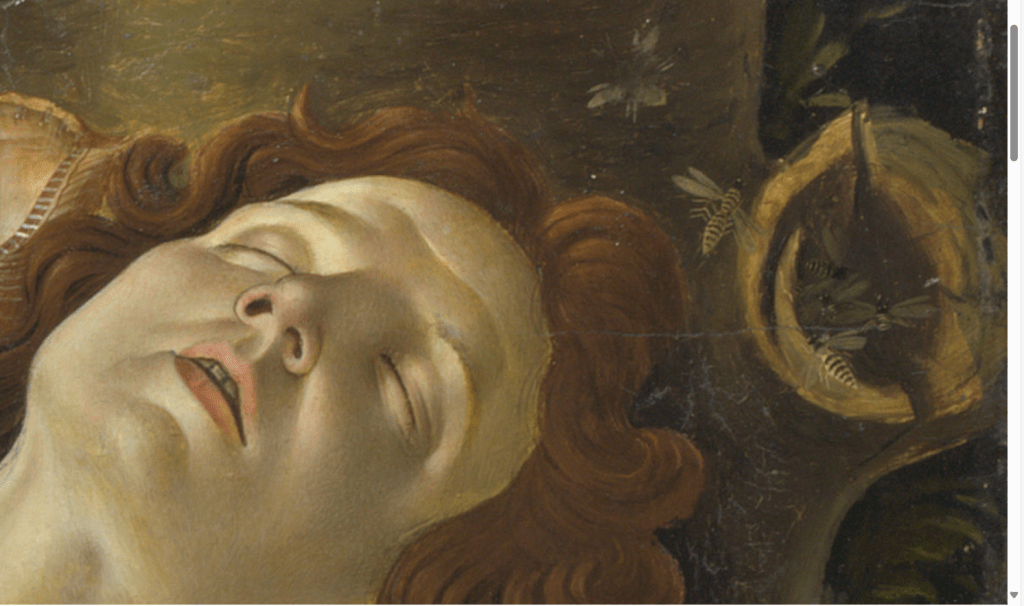
In Boticelli’s painting Venus and Mars, there’s a small wasp nest far to the right, near Mars’ head. Wasps are associated with Mars (and his Greek counterpart, Ares) as animals that are considered aggressive or warlike, but this may not be why Boticelli chose to include them. The painting may have been commissioned by the Vespucci family (from the Italian “vespa,” or “wasp”), and the inclusion of the wasp nest may have been a nod to that.

Detail from Botticelli's Venus and Mars, showing Mars' face and an adjacent wasp nest.

Ichneumon wasps, a family of parasitoid wasps, were also instrumental in strengthening Charles Darwin’s doubts about the existence of a benevolent creator:

I cannot persuade myself that a beneficent and omnipotent God would have designedly created the Ichneumonidae with the express intention of their feeding within the living bodies of caterpillars[.]

I have seen multiple references to wasps as sacred animals in Indigenous American cultures, but haven’t found many specific examples of this — particularly examples sourced from Indigenous peoples themselves. This isn’t to say that this isn’t true, but any references to wasps as sacred, totemic, or spirit animals in generic “Native American” culture should be taken with a grain of salt. (North America is kind of a huge place.)
One specific story comes from the Diné people and tells the story of the First World — known as Ni’hodilhil, the Dark or Black World. This was a black place surrounded by four cloud columns: Black Night to the north, White Dawn to the east, Blue Daylight to the south, and Yellow Twilight to the west. The First Man, along with a perfect ear of white corn, was formed at the place where Black Night and White Dawn met. The First Woman, along with a perfect ear of yellow corn, was formed where Blue Daylight and Yellow Twilight met.
At that time, creatures did not have their present forms. They were as mists, but would one day become their present shapes.
In the story, the first man and first woman meet and live together. Gradually, other beings appear. First is Great-Coyote-Who-Was-Formed-in-the-Water, who hatched from an egg and knew all that went on under the water. Second was another Coyote, First Angry, who insisted that he had been born first, and brought witchcraft into the world. After that, four more beings appeared. They were the Wasp People, and they knew how shoot and harm others. They were followed by the Red Ants, the Black Ants, and many others, until the world became crowded and was full of arguing.
Eventually, the Gods became angry and the occupants of the First World were forced to leave. The First Man planted a reed in the east, which grew tall and strong. The First Man, First Woman, and all of the other creatures of the world climbed up it to safety, to the Second World.

A black and yellow wasp on a white flower.
Photo by Pixabay on Pexels.com

Ahti, a little-known Egyptian deity, was represented as a hippopotamus with the head of a wasp. Not much is known about her, though her interesting composition has led some scholars to associate her with chaos, disorder, and spite.

In Hindu mythology, wasps are associated with Bhramari — the goddess of bees. Bees, wasps, hornets, spiders, termites, mosquitoes, and biting flies cling to her body, and she could send them out to attack for her. In the tenth book of the Devi Bhagavata Purana, there is a powerful asura named Aruna. He performs a penance to Brahma, and, in return, Brahma makes it so Aruna cannot be killed in war by any man, woman, weapon, bipedal creature, quadrupedal creature, or any combination thereof. Feeling suitably overpowered, Aruna called on other beings to attack the devas. He nearly succeeded in beating them, too, until Adi Parashakti appeared and began releasing bees from her hands. Calmly, she continued releasing insects that clung to her body, making her larger and larger and creating the divine form of Bhramari.
When all of Aruna’s army had been defeated except him, she released her insects upon him to tear him limb from limb.

John Gerard, a sixteenth century herbalist, had a method of tree divination using acorns. The technique involved finding an acorn at a specific time of year (likely autumn), breaking it open, and examining the contents:

  • If there was an ant inside, there’d be an abundant harvest in the coming year.
  • On the other hand, a worm that attempts to crawl away means a light harvest.
  • A spider was a harbinger of pestilence for humans.
  • A white worm was a harbinger of pestilence for animals.
  • If the worm thrashed and turned away, however, it meant the plague.
  • If there was a worm that “flew away” (perhaps by growing into an adult knopper gall wasp), it foretold war.
A wasp climbing on a mossy stick.
Photo by Pixabay on Pexels.com

Some modern witches use deceased wasps as an ingredient in banishing or protective powders. Combine them with ingredients like salt, hot pepper, and garlic, and grind to a fine powder. Use to dress candles, sprinkle around borders, et cetera.

Wasps represent war, arguments, and violence. This is probably undeserved, as there are plenty of non-aggressive wasp species. (I mean, I woke up the other day with a little ichneumon wasp crawling on my leg. She was tiny, harmless, and seemed at least as confused as I was, considering both of us were A) in a bed and B) under a blanket.)

Wasps’ violence isn’t always unjustified, however. These creatures, and stinging insects in general, also frequently represent punishment and wrath. Even in the story of Bhramari, where wasps are part of the insect army that eventually defeat Aruna, they are part of the righteous, defensive wrath of the goddess.

They’re also symbols of strictly enforced boundaries and protection.

On the other hand, dreaming of wasps is said to represent evil and negative emotions. Dreams of being stung by a wasp may indicate envy. Killing a wasp in a dream represents bravery in overcoming the negativity or malicious actions of others.

Are wasps aggressive? They certainly can be, but this isn’t directionless aggression. In reality, they’re very protective. The trouble is, it’s often difficult for humans to tell where our territory ends and theirs begins, which frequently brings us into conflict. Still, wasps perform very important functions as pollinators and predators of pest insects, so it’s worth learning about your local wasp species and finding ways to coexist whenever possible.
Sometimes that long “stinger” is just an ovipositor, and that wasp is on the way to take care of your garden for you!

Blog · Just for fun

Cozy Horror Picks for October

I like cozy horror. No jump scares, just a deeply unsettling vibe. The more it blurs the lines between fiction and reality, the better. I like my horror weird, too. Surreal. Like taking a nice walk down a country lane on a soft drizzly morning and encountering something gray and viscous moving toward you that may once have been a deer.
That kind of thing.

These are my favorite pieces of cozy horror, perfect for an October afternoon:

1. I am in Eskew

I am in Eskew is a surreal horror audiodrama that follows the life of a man living (or trying to) in an ever-shifting city that seems bent on tormenting him. Every episode is essentially an audio diary, narrated by one (and eventually two) voices with the sound of rain in the background. It’s very weird.
It’s very unsettling.
It’s also weirdly soothing.

This series is also complete, so you don’t have to worry about waiting for new episodes to drop.

2. The Codex Seraphinianus

The Codex Seraphinianus is an illustrated guide to an imaginary world, complete with indecipherable writing. Why is the writing indecipherable? Because it’s meant to be — it’s asemic, and intended to convey the wonder and mystery of a child “reading” a book they don’t yet understand. While this book isn’t exactly horror, I’ve included it here because it does create a delightfully unsettling atmosphere — like a discarded relic from a complete, complex, fully fleshed-out world that you don’t understand, never knew existed, and operates entirely differently from your own.

3. Modes of Thought in Anterran Literature

This is another audiodrama, and it’s just delightful. It’s delivered as a series of lectures (and some assorted other recordings here and there) given by a professor who was once a big name in classical studies, but seems to have gone off the deep end. Upon getting tenure and the permission to teach one class of his choosing, he created “Modes of Thought in Anterran Literature” — a class dedicated to analyzing the literature of a long-dead society.

Anterra is also the world’s oldest civilization, tens of thousands of years older than any other recorded society. It was completely unknown until a Chinese submarine sank in the Pacific, coming to rest nearly on top of an Anterran city.

The character of the unnamed professor is engaging, but also soothing enough to make this a decent podcast to sleep to. There are virtually no jumpscares here — just the creeping dread of uncovering the secrets of a dead civilization, including what caused them to mysteriously collapse.

4. The Magnus Archives

The Magnus Archives is an episodic horror anthology, though all of the stories are connected by common threads. The Magnus Institute is an organization dedicated to studying the bizarre. Jonathan Sims, the Institute’s new head archivist, sits down to convert hundreds of written records to audio and, when necessary, add follow-up notes based on research by his team.

Individually, the stories are spooky enough. Once you get deep enough in, a bigger, much more frightening picture starts to emerge.

5. Welcome to Night Vale

Night Vale is a sleepy desert town with some… interesting characteristics. Welcome to Night Vale is an audiodrama in the form of a nightly news show. Hosted by the very soothing-voiced Cecil, it blends the surreal and the macabre with the everyday.

I first got into Night Vale when I was living in California, shortly after being diagnosed with intracranial hypertension. I was severely disabled at the time, unable to leave the house (or bed, most days). Night Vale kept me company, kept me entertained, and provided the perfect blend of humor, horror, and relaxation that I needed.

6. Junji Ito’s Cat Diary: Yon & Mu

Yon and Mu are two cats owned by renowned horror manga artist Junji Ito and his wife. The cat diary details Ito’s life as he adjusts to living with two cats — but, because it’s him, the illustrations are hilariously unsettling. He uses exaggerated horror to illustrate some of the most mundane aspects of living with a cat, and the end result is often more funny and heartwarming than frightening.

7. Weeping Cedars

Weeping Cedars is an audiodrama in the form of a documentary on the small upstate New York town of Weeping Cedars. It’s the site of more than its share of group violence and hysteria, but that’s not the strangest part. The town also seems to just sort of “forget” all of these tragedies, so nobody notices that things have developed a strangely cyclical — possibly even predictable — pattern.

The documentarians try to uncover the lost secrets behind these events, but is it too late? Can they do more than just sit and watch as things continue to unravel?

8. The Last Movie

The Last Movie is an audiodrama set in the same universe as Tanis (one I probably would also recommend, but sadly not beyond the first season or so). Nic Silver and MK investigate the existence of an underground — and possibly cursed — movie.

It’s short, self-contained, and very good if (like me) you’re a fan of cursed media.

9. The Dark Pool

The Dark Pool is another audiodrama, this time set in Maryland. A college professor and a group of students engage in a series of meditation exercises, and record their follow-up conversations. However, as the series goes on, it becomes terrifyingly apparent that there’s a lot more going on than just learning to quiet the mind. As the experiment continues, they begin experiencing bizarre phenomena. Will they be able to break free, or have they already gotten the attention of something they can’t escape?

Here’s hoping your autumn is equal parts cozy and strange!

animals

The Magical Meaning of Spiders

(If you’re arachnophobic, you probably want to skip this one. Don’t worry — I’ll be back next week with some more non-spider related lore.)

This is Matilda. I was out checking for more ground candy (aka, the delicious maypops that fall off my porch’s vines when they’re ripe), when I happened to look up and realize that I was face-to-face with a massive orbweaver (Neoscona species).

A close up of a large, hairy orb weaver perched in the center of a web.

Later that afternoon, once she’d had a chance to build a sizeable web right across the upper part of my window, I very carefully opened the window to snap multiple pics of her from a variety of angles.
It was then that I realized that there was a fire truck and an ambulance in front of one of my neighbor’s houses.

(Note to neighbors: THERE WAS A COOL SPIDER. I PROMISE THAT I’M NOT A MANIAC.)

(Also the emergency vehicles left pretty uneventfully, so hopefully everyone is okay.)

*Ahem*

Anyhow, this is the time of year when sightings of these guys peak around here. So, in honor of Matilda, I figured now would be a good time to write a bit about the magical meaning of spiders.

In Greek mythology, the first spider was a woman named Arachne. She was a marvelously talented weaver — allegedly better than Athena herself. She challenged her to a weaving contest, and Arachne’s weaving was, indeed, very beautiful. However, while her weaving was flawless, Arachne had chosen to create a tapestry mocking the gods. (In some tellings, Athena is simply enraged by Arache’s pride.) Angered, Athena transformed her into a spider.

A close up of a jumping spider's face, showing their fuzzy pedipalps and big, black, almost puppylike eyes.
Photo by Pixabay on Pexels.com

In Catholic Christian mythology, spiders are connected to faith. Saint Conrad of Constance, a German bishop, is said to have seen a spider fall into his cup during Easter Mass. While it was widely believed that all spiders were venomous (or, in this case, poisonous) Conrad drank the wine and trusted in his faith to preserve him.

Probably the best-known spider in mythology is Anansi, from the Ashanti people. He’s viewed as a cunning trickster figure. He’s so prominent, that he gave rise to the term “spider tales,” which encompasses several kinds of story within the Ashanti oral tradition.

In North America, spiders were viewed as either trickster figures, or ingenious creators. The Hopi and Diné people have Spider Grandmother, who plays a key role in the creation of the world.

Another close up of a very cute, fuzzy white jumping spider.
Photo by Pixabay on Pexels.com

In Peru, spiders frequently appear in ancient artworks (including the famous Nazca lines). While the specific significance of these depictions is often uncertain, it is known that the Cupisnique people had a spider deity associated with weaving, nets, war, and power.

In Australia, spiders sometimes appear in art and as clan totems.

The people of Kiribati Island and the Republic of Nauru, of Micronesia, both have spider figures that play a central role in their creation mythology.

In Japan, there are spider-like yokai called ogumo, yatsukahagi, or tsuchigumo. Tsuchigumo translates as “earth spider,” but likely didn’t originate as a spider at all. Historian Yoshiyuki Takioto put forth the idea that tsuchigumo were local chieftains (described as short people with long limbs, who lived in caves, eschewed civilization, and disregarded the imperial court), These chieftains were most likely shamans.
The yokai tsuchigumo first turns up in medieval literature, as a spider-like figure 60 meters long. When killed, the heads of almost 2000 people fell from its belly.

In Scotland, spiders were an inspirational figure during the First War for Scottish Independence. After a series of defeats, Robert the Bruce hid in a cave. While there, he watched a spider struggle to climb a strand of silk. Despite failing over and over, the spider eventually succeeded. This gave him the encouragement he needed to go back into battle and eventually win Scotland’s independence.

A slender black and yellow spider perched on its web.
Photo by Pixabay on Pexels.com

It’s often said to be bad luck to kill a spider that you find in your home. This has a (perhaps unsurprising) grain of truth to it — killing spiders in your house means that you’re opening yourself up to all of the much less desirable things that spiders eat. If an infestation of flies or ants looks like bad luck to you, then you might want to heed this bit of folklore!

In dream dictionaries, dreaming of spiders is believed to represent:

  • Feeling like an outsider — like a spider in a web in the corner of a room.
  • Wanting to be an outsider.
  • A protective force.
  • A strong or overbearing feminine figure.
  • Rewards for one’s hard work.
  • Unpleasant relationships. Relationships one can’t escape, a (usually feminine) person who is draining one’s energy, a conflict with an overbearing person.

However, dreaming specifically of a rainbow colored spider is said to point to a situation that you probably want to avoid.

Spiders have far-reaching symbolism. Across cultures, they’ve been everything from tricksters to cosmic creators, to the unfortunate fate of the proud.

In general, these animals are associated with industry and creativity. Spider webs come in an astonishing variety of shapes and sizes — from small, silk-lined burrows to impressive constructs that are as delicate as they are massive.

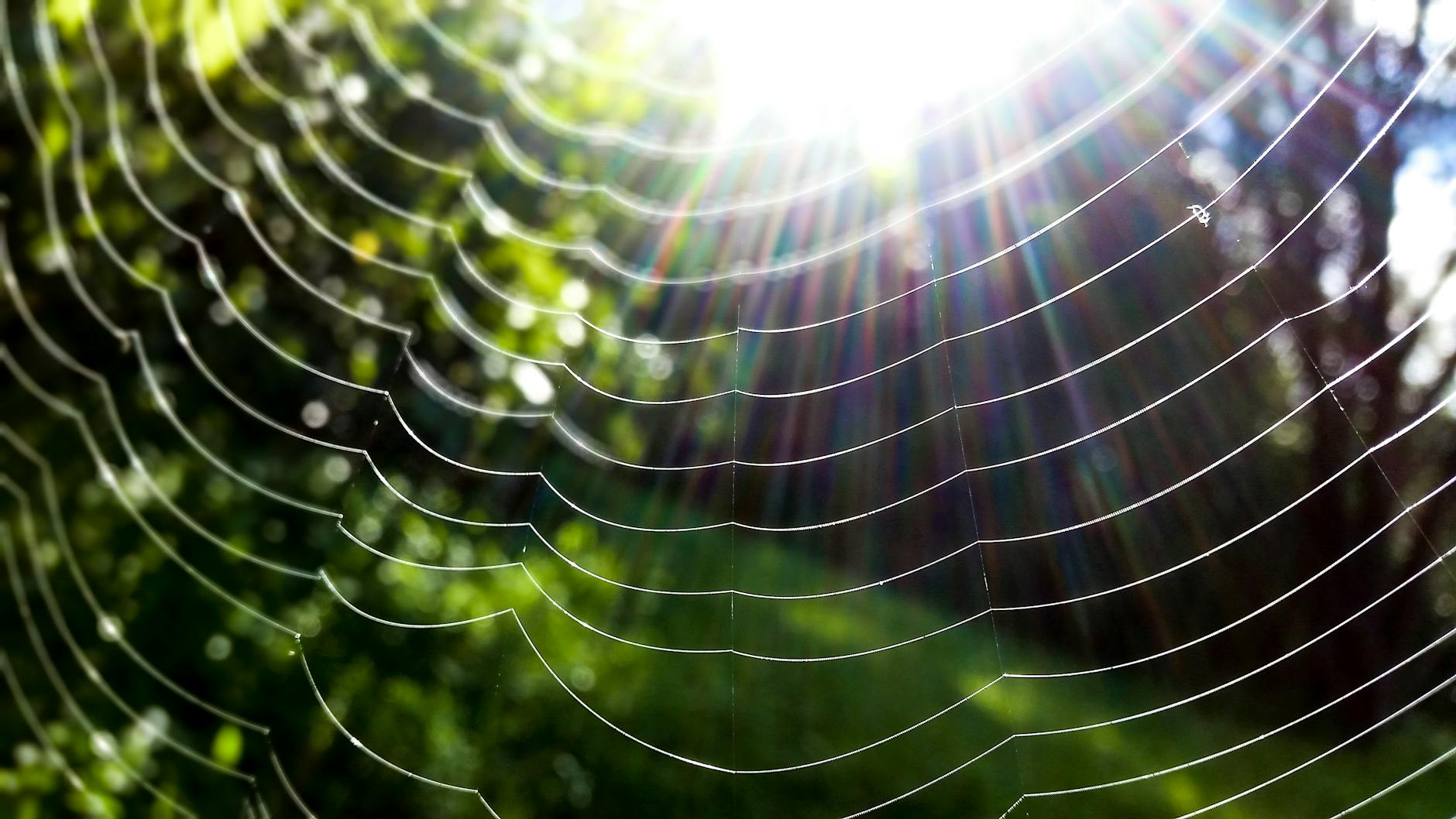
Strands of a spider's web, highlighted in the sunlight. There are trees and shrubs visible in the background.
Photo by Phil Kallahar on Pexels.com

They’re also associated with snares, webs, and trickery. Spiders who use webs to catch their food place them in places where they’ll be both efficient and unobtrusive — virtually invisible, until an unwitting insect (or unlucky hiker) bumps into them. Spiders who don’t use webs generally either rely on natural camouflage to hide them as they run down their prey, or conceal themselves and wait for the opportunity for ambush. In all cases, they are patient, diligent, and cunning.
This can be good for you, if you’re seeking to emulate the spider a la Robert the Bruce.
It can also be very bad, if you’re heading into a situation that may prove to be a trap.
As with all things, context is important when it comes to interpreting omens.

A close up of a jumping spider, on what appears to be a striped rug or blanket.
Jumping spiders are ambush predators. Photo by Skyler Ewing on Pexels.com

Spiders are also connected to resiliency. No matter how many times their webs are destroyed, they rebuild them. They get knocked down, and they climb right back up again.

To an extent, spiders are also symbols of healing and rebirth. A spider can lose a leg or two and (if they survive the injury without losing too much hemolymph) will regrow them with subsequent molts.

Not a lot of people like spiders. Personally, I was never a fan of them — they terrified me as a kid. Eventually, I forced myself to take an interest in them, their body language, and their habits. I’m glad I did, because they’re really beautiful, fascinating, helpful creatures when you get right down to it.

animals · life

Pagan Pride 2024! (In which I meet some very handsome lads.)

This past Saturday was Pagan Pride at the Unitarian Universalist Congregation of Frederick. If you’ve never been, I highly recommend it — there’s live music, workshops on a variety of subjects, food, and tons of vendors of all kinds of cool stuff!

(I, personally, came away with a mug, some artwork, a mushroom-shaped incense holder, a pin, a set of earrings, dried organic lavender, magnesium butter, a really cool jar shaped like a skull, a hand-dyed and block printed bandana, and a display of a mossy log set with three corked test tubes. The stump in the front yard has been putting out a ton of interesting mushrooms lately, and I’ve been dehydrating what I can identify. I’m looking forward to displaying them once they’re done!)

This year, I decided to skip the workshops in favor of hanging out with friends (actually, many of the friends that I just saw at the Mabon celebration), listening to music, and eating delicious sorbet. The Street Cow‘s Cowabunga sorbet pop is non-dairy, real fruit puree, and awesome.

An image of a series of moon-shaped suncatchers. They're all made of copper wire, decorated with gemstones, brass charms, and crystals.

Also, I met some very handsome lads.

This is Spectre.

An image of a snowy owl, with his beak agape.
Spectre is fine, it was just toasty out and he is a young boy who is very excited to see new things.

He was part of Avian Encounters, a group of falconers who provide people with the chance to learn about and see raptors close up. These are all trained birds, kept by licensed professionals who know how to properly feed, care for, and mentally engage them. Getting to see birds like this up close is a rare and fascinating experience.

They also had a little screech owl, an American kestrel…

And (oh, be still my heart) a gorgeous African pied crow.

A close up of an African pied crow, showing their distinctive white chests and backs. They look like black crows that are constantly wearing little white sweater vests.

“May I take a picture of him?” I asked, barely able to contain my excitement.

“Sure! If you make a donation, you can also hold him and take a picture.”

!!!!

A photo of the author with the pied crow perched on their arm.

Needless to say, I did. He sat still for a short video (the picture to the right is a still), before hopping back to his handler. The whole time, I gushed to him (like a starstruck dork) about how pretty he is.

Human celebrities are all well and good (I saw one of my favorite musicians not long ago and managed to be surprisingly normal about it). A really cool bird or bug, though? I will absolutely lose my mind.

Pagan Pride is delightful every year, but this year was particularly special. I really hope Avian Encounters is there next year, too — the birds are all beautiful, alert, and well cared-for, and it’s a great opportunity to learn more about them and get some close-up reference photos for paintings.

life

Faun @ Baltimore Soundstage

Wednesday night, my Handsome Assistant and I went to go see Faun at Baltimore Soundstage. (I know — I mostly listen to folk metal, but I also enjoy a fair bit of regular Pagan folk, too. My Assistant is predominately into punk, but still lets me drag him along.)

By the time we left, I was sweaty and exhausted. We stopped at a Wawa on the way home, where I proceeded to eat half a tube of Pringles for dinner.
And the show was 1000% worth it.

Faun band members Stephan, Oliver, and Adaya on stage, in front of a large banner with a deer skull and the name "Faun."

For real. I know live music sounds completely different from studio recordings. Studio recording flattens things out (especially with the loudness wars), but I don’t think I’ve ever heard quite as dramatic a difference between a band’s studio recordings and their live performances as I did with Faun. Their melodies have a depth and complexity that I couldn’t really appreciate before, and oh man did it make for a fantastic show.

Even my Handsome Assistant, for whom Faun would not be his first choice, admitted that it was probably the best live show he’d heard.

Remember a few days ago, when I wrote about the chants workshop at the Mabon camping trip? Specifically, how the resonance of the chants themselves had profound impacts on the chanters? It was like that. Skin-tingling, heart-pumping, literally entrancing music.

The between song banter was also funny and clever. Oliver s. Tyr gave cultural and historical context for songs, interspersed with jokes and bits of mythology.

Singer Laura Fella didn’t appear on this tour. (She very recently had a baby, so congratulations to her and her family!) This meant that they weren’t able to perform some of their songs that rely on having both her and Adaya, so they played a few of their older songs instead.

Another shot of the band on stage, featuring Alex, Stephan, Oliver, Niel, and Adaya.

The show closed with Hymn to Pan, which seemed like the perfect ending — I used to have it on a sleep/relaxation playlist, and I love listening to it to unwind. It was also beautiful to hear the entire venue sing the chorus. Literally the best choice of encore.

This was the first opportunity I’ve had to see Faun live, and I’m so happy I did. It was an incredible show. Even though getting there involved an hour’s drive each way after a long workday, both my Handsome Assistant and I left feeling happy and energized.

Some kind souls on Spotify have also made playlists of Faun’s 2024 setlist. While they aren’t completely accurate to what the band played Wednesday night, they’re still very good listening and a wonderful introduction to Faun’s work.

Plants and Herbs

Nepenthes (Pitcher Plant) Folklore and Magical Properties

Now that I’m home, I’ve been spending the day unpacking, straightening up the house, taking care of my cats and plants, and eating pho. It didn’t take me long to notice some new… uh, additions.

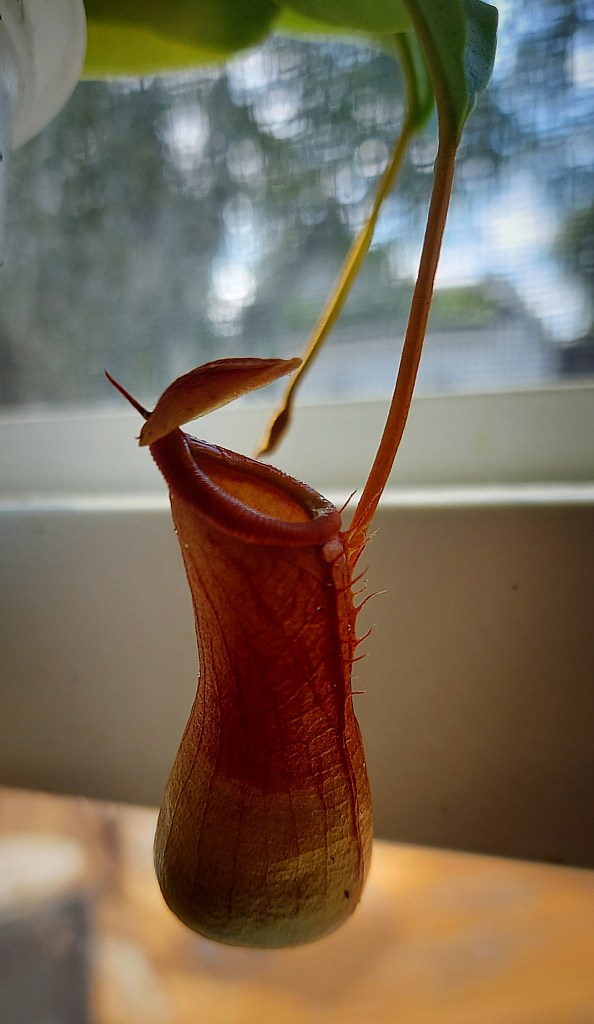
A close-up of an N. ventrata pitcher.
Audrey’s newest pitcher.

This is Audrey. Every so often, especially if she’s gotten plenty of humidity, she puts out gorgeous little pitchers. I reward her by hand-feeding her dried black soldier fly larvae.

A close-up of another pitcher on the same plant.
Another pitcher on the opposite side.

Since she seemed to be in particularly good humor when I came home, I thought now might be a good time to take a deeper look at the folklore and magical properties of the beautiful, unique, profoundly strange Nepenthes.

The plant genus Nepenthes is named for nepenthe, an ancient medicine said to heal sorrow and induce forgetfulness. It’s mentioned in ancient Greek literature, and is typically depicted as originating in Egypt.
It also appears in the Edgar Allan Poe poem “The Raven”:

Respite—respite and nepenthe, from thy memories of Lenore;
Quaff, oh quaff this kind nepenthe and forget this lost Lenore!”
Quoth the Raven, “Nevermore.”

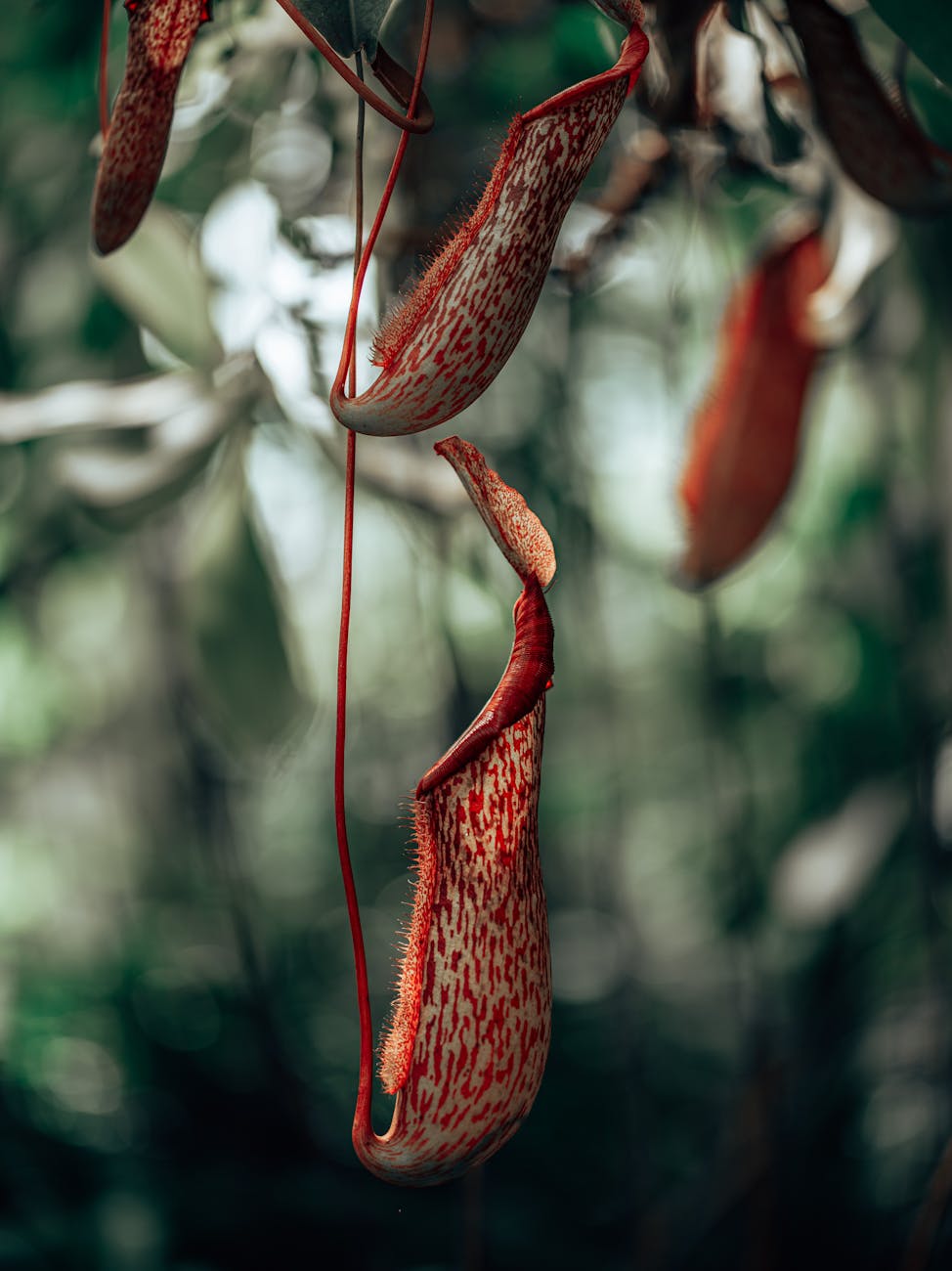
An image of an open pitcher plant, displaying the "lid," slender neck, and round belly of the pitcher.
Photo by Phoebeud83dudc1f on Pexels.com

Nepenthes consists of numerous species. In garden centers and plant nurseries, you’re most likely to encounter N. x ventrata — a hybrid of a N. ventricosa and N. alata.

Pitcher plants prey on insects by providing sugar and water to lure them into their pitchers. Their leaves have nectaries — special glands that secrete sweet nectar — and their pitchers contain water and digestive enzymes. Insects are attracted to the presence of food and water, and end up caught in the pitchers where they eventually drown and get digested.
(They’re pretty much Hotel California for bugs.)

However, not all pitcher plants feed on insects. N. lowii, a species native to Borneo, is known for its… rather unique shape.
Toilets.
The pitchers look like toilets.
Not only do they look like toilets, they are toilets.
N. lowii has an interesting relationship with a local shrew species. As with insects, the shrews are attracted to the pitcher plant’s nectar. While they’re there, they generally end up crapping directly into the conveniently toilet-shaped pitchers. The shrews get free nectar, and N. lowii gets free nutrient rich shrew leavings.

A close up of the mouth of N. bicalcarata, showing the pitcher's "lid" and two pointy "teeth."
Nepenthes bicalcarata, known for its two pointy “teeth.” It has a mutualistic relationship with a species of carpenter ant that makes nests in the plant’s tendrils. The plant benefits by receiving nutrients in the form of dead ants and ant feces. Photo by Yufan Jiang on Pexels.com

Other pitcher plants have symbiotic relationships with frogs. The frogs hang out in the pitchers, just under their “lids.” They eat insects that are attracted to the plant, and, as with the shrews, leave their nutritious little doots behind. They help dispose of pest insects that are more likely to harm the pitcher plant than to feed it, and the plant still gets a boost of nutrients.

One other pitcher plant species, N. rajah, has pitchers large enough to snare rats. It’s a particularly visually striking species.

In pitcher plants’ native areas, they’re often used as a source of clean water. When the pitchers initially form, they come complete with a little bit of water in their bellies to dilute the plant’s digestive enzymes to a usable level. People will sometimes crack open a fresh pitcher and drink the water inside. The trick is to use a very fresh, young pitcher — once the pitcher has opened itself, and its “lid” is raised, it may be contaminated and is no longer safe to drink.

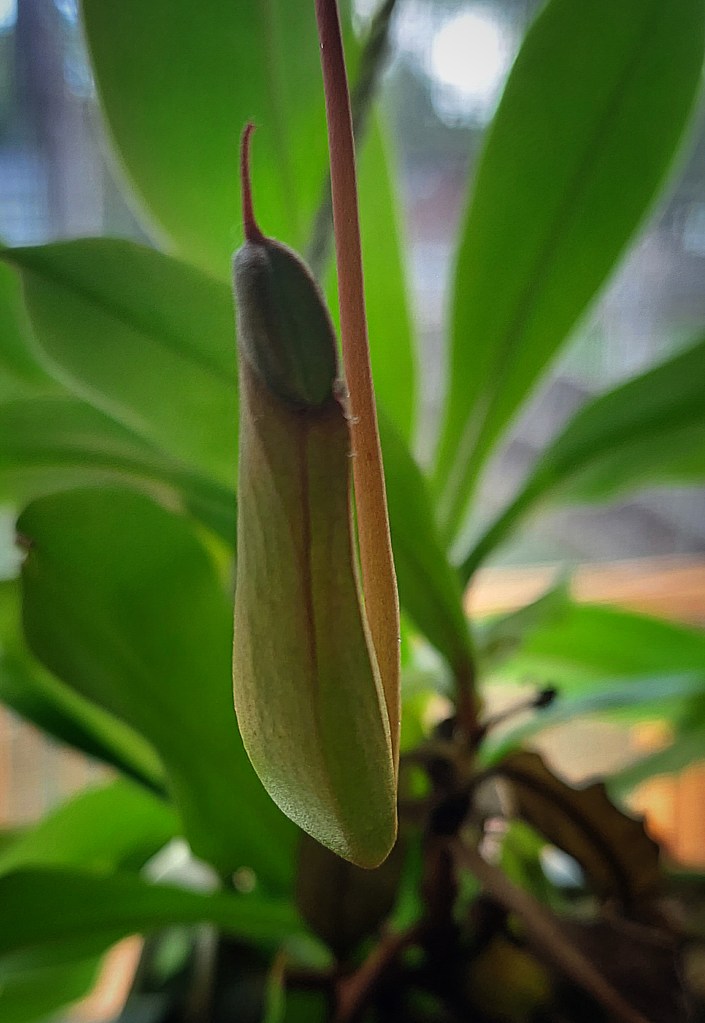
A close up of a young pitcher, with its "lid" still sealed.
This is an earlier image of the first pitcher pictured in this post. Notice how it’s greener, slimmer, and its “lid” hasn’t opened yet. Even in this state, it has a generous amount of liquid in the belly of the pitcher. At this stage, the pitcher hasn’t yet come into contact with any insects.

Interestingly, this water is more than just a refreshing drink on a hot day. It’s also used as medicine. Nepenthes water has been used to treat digestive issues and constipation (which makes sense, considering it’s just water and stuff that helps digest things), as well as urinary tract infections.
An extract of the plant is also used to prevent scar formation.

A view of particularly striking Nepenthes pitchers, with bright red hairs and streaks on their otherwise-green pitchers.
Photo by Egor Komarov on Pexels.com

There aren’t a whole lot of resources for those looking for typical European-based magical uses for Nepenthes species. From my own experience, these plants seem to be very useful for attraction. Just be warned — while they’re effective, they aren’t quite as docile and well-intentioned as something like rose or lavender. (All things considered, this probably isn’t too surprising for a carnivorous plant!)
They’re also helpful for defense and healing.
Lastly, Considering the enormous crossover between “plants that repel or get rid of pests” and “plants historically used for purification,” it may be worth experimenting with pitcher plants as a potential purification herb.

Elementally, pitcher plants are associated with Water.

If you have access to fresh pitchers, you can add the water to a ritual bath or window, door, and floor wash for attraction. Just make sure that these are fresh, unopened pitchers. You really don’t want to be dumping partially decayed bug soup into your bath.

If you don’t have access to them, then you can also use dried pitchers. Like any other part of a plant, they don’t last forever — the pitchers have a lifespan and naturally dry up and fall off after a while. Just make sure that whatever pitchers you use are cleaned up, free of insect parts, and completely dried.

Dried pitchers are suitable for container magic like jars, sachets, or spell bottles. They also look really cool when they’re pressed in a book or between glass.

I love carnivorous plants, but it’s not always easy to find resources for using them in western magic. Since I’ve begun keeping them and developing a close relationship with them, I’ve found that they have a wonderful variety of potential magical (and even medicinal) uses. Pitcher plants don’t just help keep homes bug-free, they’re also incredibly interesting and versatile friends to have!

life · Neodruidry · Witchcraft

Mabon 2024

This past weekend was the Mabon camping trip! My Handsome Assistant and I are part of a local Druidry group, and that group teams up with another Pagan group to go have a fantastic time in the woods.

(If you aren’t sure what Mabon is, here is a brief rundown.)

There’s food (lots of food), singing, stories, rituals, and catching up with friends, all set in a beautiful forest. Last year, things got a bit cold and damp. This year, the weather was better, and my Assistant and I knew what to expect. We were more thoroughly prepared (air mattress, extra blankets and sleeping bags, extra dishes, a solar powered fan), so it made for a much more comfortable trip.

The rain also stayed away just long enough for the weekend’s rituals, which was very important.

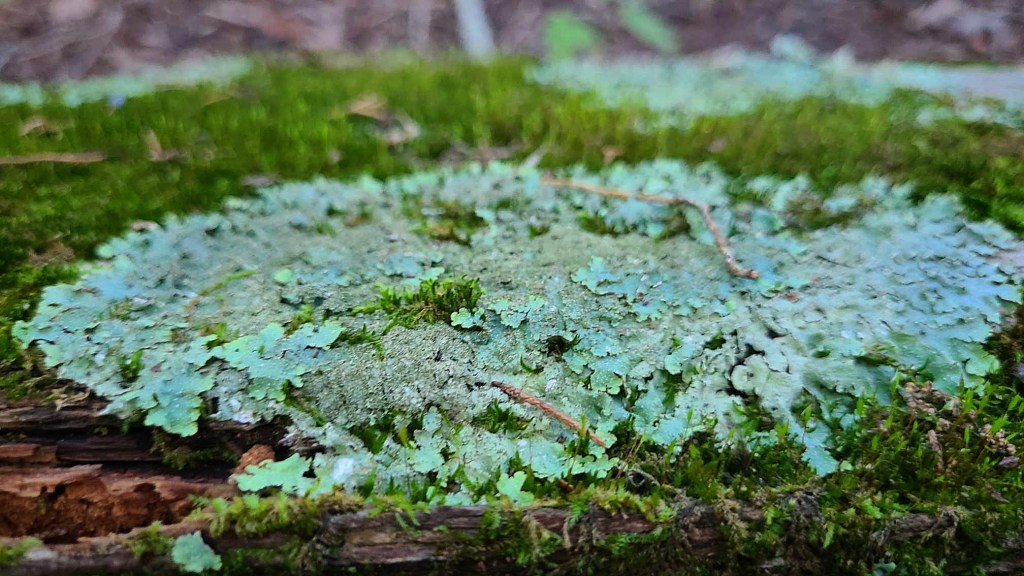
A close-up of some very pretty lichen, growing in a bed of moss.
Fortunately, there was just enough rain to make the mosses and lichens really pop.

Earlier, during the Midsummer goods and gear swap, a couple of us floated the idea of having a masquerade party. It wasn’t a serious plan at the time — mainly a “this would be really cool” kind of thing. Later, during a planning Zoom call, I mentioned that some of us thought a masquerade would be really neat. Maybe for Samhain?

One of the group’s Stewards knew of a ritual that involved masking — the Council of All Beings. Another person found chants that suited the occasion. Another wrote the transitions and spoken parts of the ritual structure. By the end, it was a beautiful, adaptable, and powerfully creative work.

Some people came to the trip prepared, already knowing which being they’d embody, having a mask or costume, and knowing exactly what they wanted to say. Others took time in the woods or labyrinth, waiting to see what reached out to them and asked to be represented. I’d gotten some inspiration a while before Mabon, so I was all set to go.

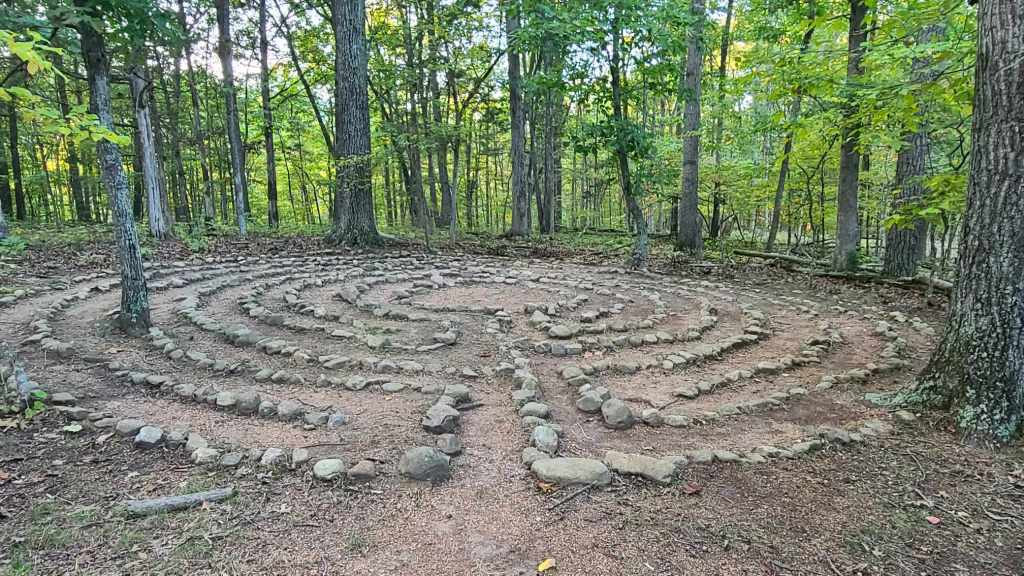
A photo of a labyrinth in a forest. The labyrinth is made up of stones, set in a spiraling pattern in a clearing.

The ritual itself was wonderful. The masks were gorgeous, and seeing what kind of entities inspired/spoke through people was fascinating. Some represented a specific organism — like the critically endangered regent honeyeater. Others represented a genus or type of being, like moths, small snakes, or coral. Others represented something broader, like smoke or the sun. Some were natural features, like the bedrock or an underground spring. There were representations from a variety of cultures and cosmologies, all brought together to express themselves through us. I loved it.

(I was the necrobiome, aka all of the little guys that dispose of trash and dead things. I had some trouble figuring out how to express “a tiny ecosystem of various bacteria, fungi, insects, and scavengers” through a mask, so I ended up settling on a skeletal deer mask instead. The presence of decomposition bacteria and fungi was somewhat implied.)

A humanoid figure in a forest. The figure is standing with their arms at their sides, staring directly at the camera. They are wearing gray boots, bandages around both hands, and a black shroud that covers them from their head down to their knees. They are also wearing a deer's skull as a mask, over the shroud. 
The photo also appears to be glitchy, with smeared areas and light leaks.
My Handsome Assistant took some photos of me all dressed up. I used them for some little analog horror-style photo manips, and I’ll be honest… this one really makes me want to go ominously photobomb strangers.

We also had an icebreaking and learning exercise called Birds of a Feather, where we wore small tags labeled with subjects we wanted to talk about — either things we found interesting and were well versed in already, or stuff we wanted to learn. It sparked a lot of very interesting conversations!

There was also a chants workshop, where a group of us got together to try various chanting techniques and see how they felt both through our own voices and hearing them in a group. (Some of the non-verbal chants, I thought, felt especially powerful. I love exploring and working with different sonic frequencies, so feeling and participating in chants that ran the gamut from “results in full-body tingles” to “surprisingly like the drone of a titanic beehive” was particularly fascinating.)

One group member also gave a talk about spiritual experiences at various megaliths in Ireland. Both my Assistant and I found it really interesting — enough to where he’s sincerely trying to figure out how to create some form of mobile hyperbaric compression chamber so I can get on a plane without Problems.

And then there was food.
(So much food.)
Every meal was a potluck, and there was something for everyone. Vegan, vegetarian, carnivore, gluten-free, nut-free. There was fresh fruit, Koren barbecue ribs, vegan fennel and garlic sausages, fresh bread, pudding made from foraged pawpaws, homebrewed peach mead, vegetable soup made from home-grown vegetables, curried chickpea salad, and a ton of other things I’m probably forgetting.
I ate like a combination of a Redwall character and some kind of Roman emperor all weekend, and it was delightful.
(My Handsome Assistant jokes that he puts on five pounds over Mabon, then spends the rest of the year losing it.)

I also stayed up way too late every night, mostly sitting around the fire hearing/telling stories, talking about things, and having the occasional smoke. This came back to bite me on Saturday, when I set an alarm to wake up, realized I had a terrible headache, and decided to sleep in. This would have meant that I’d miss the Equinox ritual Saturday morning, fortunately my Assistant and I had accidentally set up our tent right next to the ritual area.
I heard the drums going, bolted upright, wrapped myself in a blanket, and poked my head through the tent flap to watch.
It worked out okay until the calling of the quarters got to the South, which meant that everyone turned to face me, who was currently sitting due south and staring out of my tent like some kind of small cryptid. (I kind of slowly retreated behind my tent flap again until that part was over, Homer-Simpson-backing-into-a-bush style.)

So, while I am glad to be home again, I’m sad Mabon’s over. I’ll see (almost) everyone soon, but man do I miss that vibe.

Uncategorized

Comfrey Folklore and Magical Properties

I wanted to love comfrey. I really did.

Unfortunately, the local herbivores had other things in mind.

(Mostly eating it immediately after planting.)

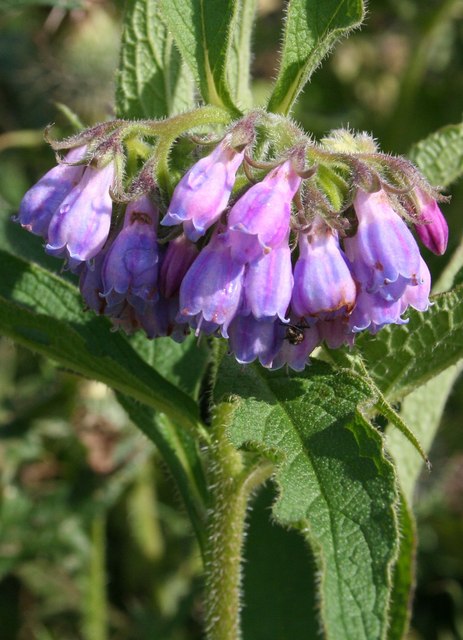
A cluster of bell-shaped purple comfrey flowers.
Comfrey by Anne Burgess is licensed under CC-BY-SA 2.0

Comfrey (Symphytum officinale) isn’t a native plant in the US, but it has still become an indispensable garden ally for many people. It has a long tap root, so it can reach into deeper layers of the soil to draw nutrients upward. It also has a favorable nitrogen/phosphorus/potassium ratio. acts as an accumulator, drawing and gathering nutrients from the air and soil within its leaves. Gardeners then cut the plant and either scatter the leaves as green mulch, compost them, or allow them to decompose by themselves and use that liquid to irrigate their plants. They’re really cool little plants and considered tremendously helpful.

Unless they aren’t.

But that’s okay! Even if they might not be great dynamic accumulators, they’re wonderful medicinal pl-

Oh.

As it turns out, comfrey’s most remarkable characteristic may be all of the controversy it generates.

Anyhow, as I am planning next year’s garden and contemplating whether I want to try planting a fourth(!) round of comfrey starts, I thought now might be a good time to write a little about the folklore and various uses of comfrey.

Comfrey is a borage relative native to Europe and parts of Asia, and it likes to grow in wet areas. It’s also known as boneset, knitbone, knitback, and a host of other names that refer to the plant’s traditional use as a remedy for bone and joint issues.
It should not be confused with common boneset (Eupatorium perfoliatum), which is native to North America and part of the aster family.
(This is why standardized names are so important!)

The name “comfrey” also refers to the plant’s use to heal bones. It’s derived from the Latin words “con firma,” meaning “to grow together.”

Multiple physicians throughout history have mentioned comfrey’s healing abilities. Dioscorides prescribed it for broken bones, respiratory issues, and wounds. In her book Physia, Hildegard of Bingen made mention of comfrey’s potential for toxicity:

the internal application of comfrey disrupts the entire order of bodily humors. However, when applied to the skin, it heals ulceration of the limbs.

Hildegard of Bingen, Physia

In addition to medicine, comfrey is sometimes used as a culinary vegetable. It should not be eaten raw, however, and the leaves must be picked while young. The time of year also matters, as comfrey has higher concentrations of toxic compounds early in spring.

The Russian varietal of comfrey, S. x uplandicum, is often used in gardens. Since comfrey can become an invasive problem outside of its native range, there are sterile varieties specifically for growing and fertilizing the garden. These can be propagated by division but won’t self-sow.

Magically, comfrey is a plant of many uses. It’s used in protection spells, as well as those for healing, protection, abundance, and fertility. In general, if you want to accumulate good stuff and make sure you get to keep it, comfrey is a helpful herb.

I’ve personally used it to make charms to protect vehicles.

Comfrey is sometimes added to baths for strengthening divination abilities and cleansing. (However, it’s not a good idea to do this too often for safety reasons.)

Comfrey is associated with the planets Saturn and Venus, the elements of Earth and Water, and the deities Hecate and Brigid.

Using comfrey in the garden is pretty straightforward. Plant it (be sure to choose a sterile variety), let it grow, cut it back, cram a bunch of it into a five-gallon bucket, and wait for them to break down into comfrey goop. Dilute it in water (about 1 part comfrey to 15 parts water) and use this water to irrigate your plants. If that sounds like too much, you can also just shred the leaves and use them to mulch plants, toss them into compost, or use them to line pots.
Are there plants that make better dynamic accumulators? Sure, but you’re not going to hurt anything by making comfrey fertilizer, either. If it seems to work for you, your soil, and your plants, go for it!

Medicinally, comfrey is a bit troublesome. It has a long history of use for aches, pains, and broken bones. It was used both internally and externally, but it’s internal use is no longer recommended. Like a lot of other borage relatives, comfrey contains compounds that can cause liver problems. While some authorities state that the danger of comfrey is overstated, I still recommend using caution with this herb. Don’t take it internally (or use it topically for extended periods of time) unless it is recommended to you by a qualified medical practitioner.

A vintage illustration of a whole comfrey pant -- roots, leaves, and flowers.

Magically, add dried comfrey to jars, bottles, or sachets for love, fertility, protection, or abundance. It’s also said that wrapping your money in a whole comfrey leaf before spending it (or gambling) will help ensure that it returns to you.

Personally, I like comfrey. It’s a beautiful plant and, with responsible use, a valuable ally in the garden, the home pharmacy, and the magical herb cabinet. While it’s certainly generated more than its share of controversy over the millennia, I find it a very worthwhile herb to get to know.

life

I could never have planned a better prank than this.

I’m not really a fan of pranks, chiefly because most of what the internet has come to consider “pranks” aren’t actually funny.

But oh man, did fate line up some extremely perfect timing yesterday.

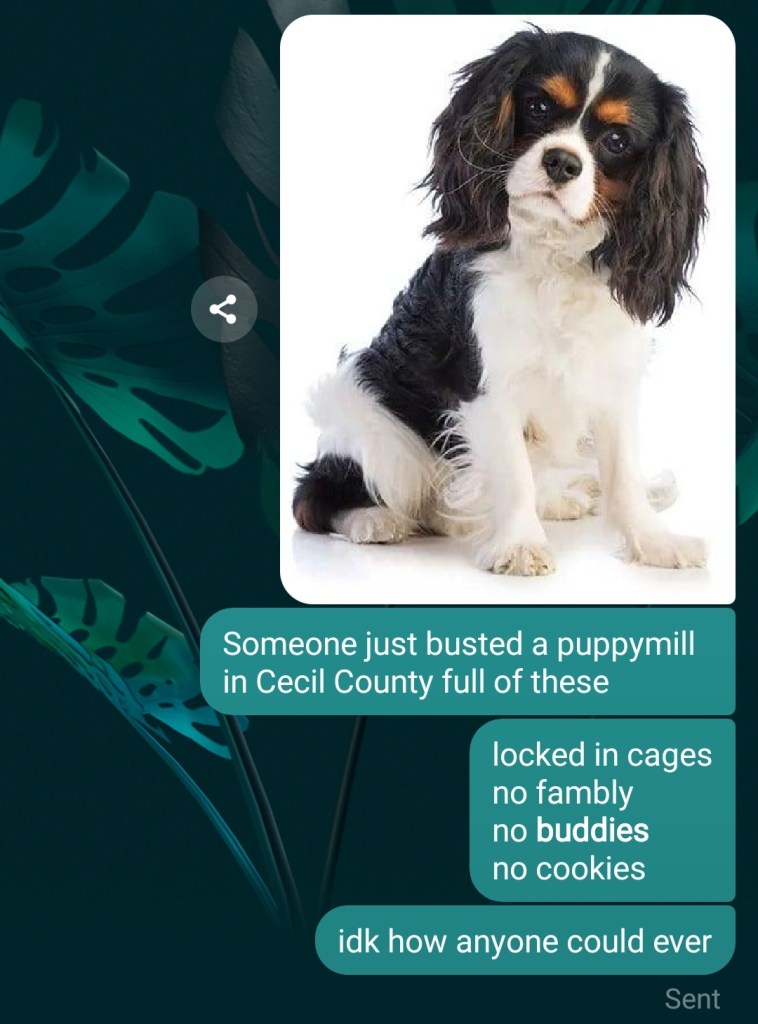
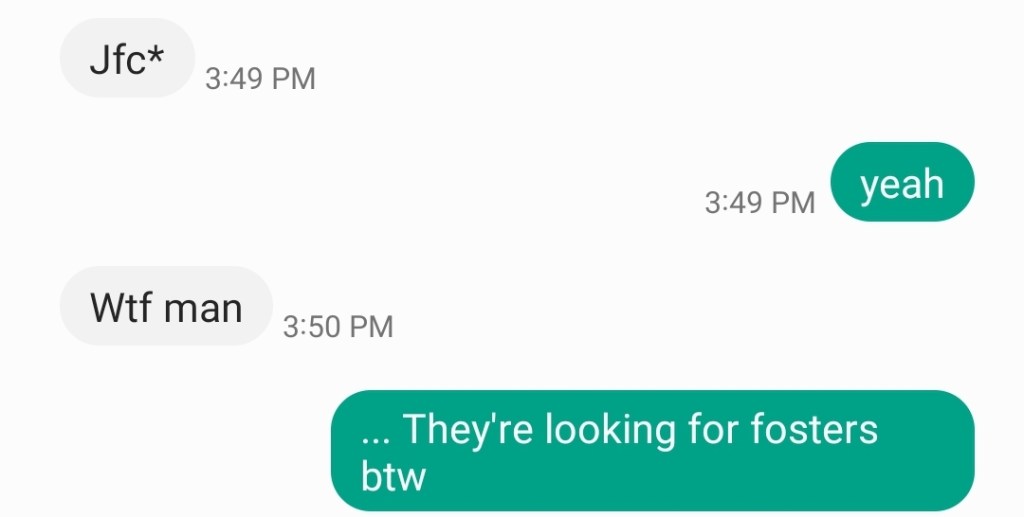
My Handsome Assistant was in office. I message him frequently — usually not anything of consequence, just what the cats did, pictures of cool bugs I found, etc. Earlier in the day, I saw a notice about a puppy mill bust in Cecil County. 23 dogs, mostly Cavalier King Charles Spaniels, bichons, and shih tzu, are currently looking for foster homes while rescues sort through their assorted health problems, issues due to neglect, and so forth. Animal neglect and abuse upset me, so I vented to him about it for a bit.

(Also, I was maybe kind of hoping I could tug on a few heartstrings and get him to agree to try to foster.)

Anyhow, a half hour later, my phone buzzed.
The camera system detected “a pet” in the front yard.
I do not have pets in the front yard.

Nonetheless, there, on the camera, was an adorable little fluffy white dog snuffling around the front porch. I dropped my phone and hurried outside to get a better look — was he alone? Lost? Were his people close by? Was he at risk of getting stuck in the fence? Running into the street? Being captured by owls?
There’s a nest of ground wasps — what if he got stung?

Sure enough, there was a little white dog hustling around the yard. I called to him and he happily trotted over, wagging his tail. He seemed outgoing and relaxed, so I let him sniff my hand and gave him an ear scratch. He also had a collar and tag, so finding his family should’ve been no problem.

And it wouldn’t have been, had I not left my phone inside.

Dilemma.

Not wanting to lose track of him or have him run into the street/be captured by owls/eat a bunch of wasps, I was torn for a moment.
There was only one thing to do.
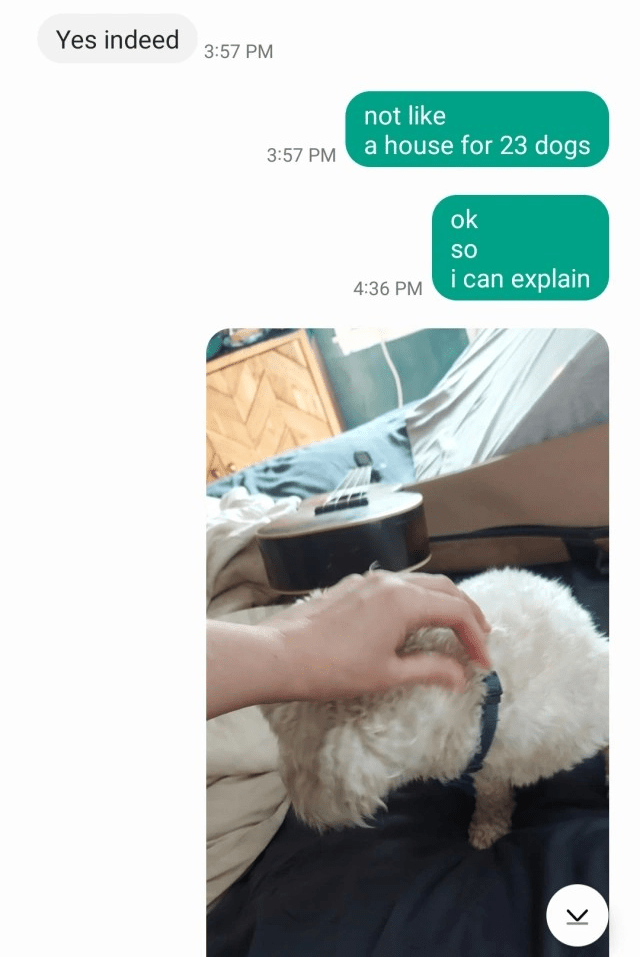
I didn’t have a leash or a way to secure him in the meantime, so I gingerly scooped that little dog up and carried him inside to hang out while I figured out where the #$%& I left my phone.

He seemed perfectly okay with this. I set him down, he sniffed around a bit and wagged his tail, all, “Hello! Yes! Okay!”

That was when I had a brilliant idea.

Phone in hand, I snapped a few pics, sent them to my Handsome Assistant along with an “I can explain,” and brought the little guy back outside to call his family. They came over to pick him up not long after and were very nice. He hung out on the porch with me until then, getting pets and being extremely chill and good-natured about everything.

Honestly, as far as ways to meet your neighbors go, this is definitely one of the better ones.

It’s also a great way to confuse and startle your spouse when they know you have a soft spot for animals and are given to hypomanic states.

Seriously. I couldn’t’ve planned it better.

If you live in the Maryland or Delaware area, there are still several dogs looking for foster homes. They’re coming from a puppy mill, where they’ve been confined, underfed, overbred, and never offered the opportunity to be part of a family and just be dogs. If you have the ability to open your home to one of them (or one of any number of other dogs currently awaiting adoption), please consider filling out Renee’s Rescues’ foster application.

Even if you’re not in MD or DE, there are always animal rescues looking for help with fostering. If you have the time and love to give, reach out to your local organizations to find out how you can help!