
Last week was spiders, this week we’re doing wasps.
Why wasps?
In temperate climates, late summer and early autumn when many wasps (the eusocial ones, at least) start losing direction. Like kids on spring break, they no longer have the structure they once did — the nest is likely done producing larvae, the newly-created queens are getting ready to hibernate, and the wasply lifecycle comes to a close to start back up in spring. This means that the workers, if they haven’t died already, are about to.
The lack of larvae to raise also means that the wasps’ dietary habits shift. Where babies need protein in order to grow big and strong (and adequate protein is so important, worker wasps have been observed shoving drones into lockers in order to make sure that the larvae eat first), the workers have already done all the growing they’re going to do. They don’t need a high protein diet; they need carbs for energy. This often puts them in conflict with humans, as sugar sources start to wind down a bit this time of year and humans are generally a veritable bonanza of sugary treats.

So, if you’re noticing larger numbers of more aggressive wasps than usual, that’s probably why. They’re hungry, and they’re on a kind of wasply rumspringa. Don’t worry, though — they won’t be around much longer. It’ll get cold, the workers will die off, the queens will hibernate, et fin.
Right now, we have a wasp nest beneath a tree stump. We considered removing it, but it’s late enough that nature will take its course pretty soon, and then we can fill in the cavity to keep anyone else from setting up shop.
In honor of the last of the summer’s wasps, here are various bits of folklore, mythology, and magical properties associated with these creatures.
Wasp Folklore
Insects feature pretty frequently in Japanese folklore and mythology, wasps included. In one story, the deity Susanoo-mikoto ordered his son-in-law, Ôkuninushino-kami, to sleep in a room infested with wasps and centipedes. Fortunately, Suseribimeno-mikoto, his wife, gives him an insect-repelling cloth to protect him.
One of the plays of Aristophanes, an ancient Greek playwright, is titled The Wasps. In it, the titular wasps are a group of jurors. Bdelycleon, son of Philocleon, has imprisoned his father after many, many unsuccessful treatments for Philocleon’s seeming addiction to trials. When the jurors (Philocleon’s comrades) learn of his imprisonment, they swarm Bdelycleon like wasps. Bdelycleon eventually gives in, and turns the house into a “courtroom” where his father can judge household disputes.
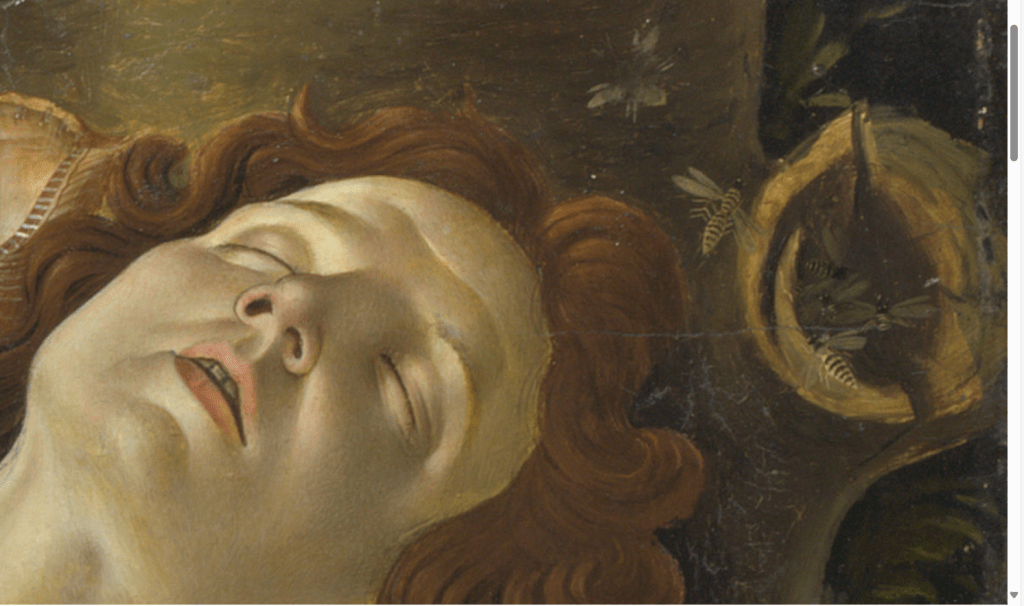
In Boticelli’s painting Venus and Mars, there’s a small wasp nest far to the right, near Mars’ head. Wasps are associated with Mars (and his Greek counterpart, Ares) as animals that are considered aggressive or warlike, but this may not be why Boticelli chose to include them. The painting may have been commissioned by the Vespucci family (from the Italian “vespa,” or “wasp”), and the inclusion of the wasp nest may have been a nod to that.
Ichneumon wasps, a family of parasitoid wasps, were also instrumental in strengthening Charles Darwin’s doubts about the existence of a benevolent creator:
I cannot persuade myself that a beneficent and omnipotent God would have designedly created the Ichneumonidae with the express intention of their feeding within the living bodies of caterpillars[.]
I have seen multiple references to wasps as sacred animals in Indigenous American cultures, but haven’t found many specific examples of this — particularly examples sourced from Indigenous peoples themselves. This isn’t to say that this isn’t true, but any references to wasps as sacred, totemic, or spirit animals in generic “Native American” culture should be taken with a grain of salt. (North America is kind of a huge place.)
One specific story comes from the Diné people and tells the story of the First World — known as Ni’hodilhil, the Dark or Black World. This was a black place surrounded by four cloud columns: Black Night to the north, White Dawn to the east, Blue Daylight to the south, and Yellow Twilight to the west. The First Man, along with a perfect ear of white corn, was formed at the place where Black Night and White Dawn met. The First Woman, along with a perfect ear of yellow corn, was formed where Blue Daylight and Yellow Twilight met.
At that time, creatures did not have their present forms. They were as mists, but would one day become their present shapes.
In the story, the first man and first woman meet and live together. Gradually, other beings appear. First is Great-Coyote-Who-Was-Formed-in-the-Water, who hatched from an egg and knew all that went on under the water. Second was another Coyote, First Angry, who insisted that he had been born first, and brought witchcraft into the world. After that, four more beings appeared. They were the Wasp People, and they knew how shoot and harm others. They were followed by the Red Ants, the Black Ants, and many others, until the world became crowded and was full of arguing.
Eventually, the Gods became angry and the occupants of the First World were forced to leave. The First Man planted a reed in the east, which grew tall and strong. The First Man, First Woman, and all of the other creatures of the world climbed up it to safety, to the Second World.

Ahti, a little-known Egyptian deity, was represented as a hippopotamus with the head of a wasp. Not much is known about her, though her interesting composition has led some scholars to associate her with chaos, disorder, and spite.
In Hindu mythology, wasps are associated with Bhramari — the goddess of bees. Bees, wasps, hornets, spiders, termites, mosquitoes, and biting flies cling to her body, and she could send them out to attack for her. In the tenth book of the Devi Bhagavata Purana, there is a powerful asura named Aruna. He performs a penance to Brahma, and, in return, Brahma makes it so Aruna cannot be killed in war by any man, woman, weapon, bipedal creature, quadrupedal creature, or any combination thereof. Feeling suitably overpowered, Aruna called on other beings to attack the devas. He nearly succeeded in beating them, too, until Adi Parashakti appeared and began releasing bees from her hands. Calmly, she continued releasing insects that clung to her body, making her larger and larger and creating the divine form of Bhramari.
When all of Aruna’s army had been defeated except him, she released her insects upon him to tear him limb from limb.
John Gerard, a sixteenth century herbalist, had a method of tree divination using acorns. The technique involved finding an acorn at a specific time of year (likely autumn), breaking it open, and examining the contents:
- If there was an ant inside, there’d be an abundant harvest in the coming year.
- On the other hand, a worm that attempts to crawl away means a light harvest.
- A spider was a harbinger of pestilence for humans.
- A white worm was a harbinger of pestilence for animals.
- If the worm thrashed and turned away, however, it meant the plague.
- If there was a worm that “flew away” (perhaps by growing into an adult knopper gall wasp), it foretold war.

Some modern witches use deceased wasps as an ingredient in banishing or protective powders. Combine them with ingredients like salt, hot pepper, and garlic, and grind to a fine powder. Use to dress candles, sprinkle around borders, et cetera.
The Symbolism of Wasps
Wasps represent war, arguments, and violence. This is probably undeserved, as there are plenty of non-aggressive wasp species. (I mean, I woke up the other day with a little ichneumon wasp crawling on my leg. She was tiny, harmless, and seemed at least as confused as I was, considering both of us were A) in a bed and B) under a blanket.)
Wasps’ violence isn’t always unjustified, however. These creatures, and stinging insects in general, also frequently represent punishment and wrath. Even in the story of Bhramari, where wasps are part of the insect army that eventually defeat Aruna, they are part of the righteous, defensive wrath of the goddess.
They’re also symbols of strictly enforced boundaries and protection.
On the other hand, dreaming of wasps is said to represent evil and negative emotions. Dreams of being stung by a wasp may indicate envy. Killing a wasp in a dream represents bravery in overcoming the negativity or malicious actions of others.
Are wasps aggressive? They certainly can be, but this isn’t directionless aggression. In reality, they’re very protective. The trouble is, it’s often difficult for humans to tell where our territory ends and theirs begins, which frequently brings us into conflict. Still, wasps perform very important functions as pollinators and predators of pest insects, so it’s worth learning about your local wasp species and finding ways to coexist whenever possible.
Sometimes that long “stinger” is just an ovipositor, and that wasp is on the way to take care of your garden for you!

 Marble Crow