
The other day, after attending the drum class I wrote about yesterday, I was waiting in the herb shop to stock up on some things I need for teas, oils, and the like. I overheard the customer in front of me talking about mugwort, and, since it’s an herb I use often, I maybe kind of eavesdropped a little bit. What followed was a really interesting conversation about herbs, dreams, lucid dreaming, dream recall, and trance work.
It was so nice to get to talk about herbs with someone outside of a purely medicinal context, that I figured that this was a good week to talk about one of my absolute favorite plants: mugwort.
(And, if you were that person, I’m so sorry for being an eavesdropping weirdo but I also had a really fun time talking to you about herbs.)
Mugwort Magical Uses and Folklore

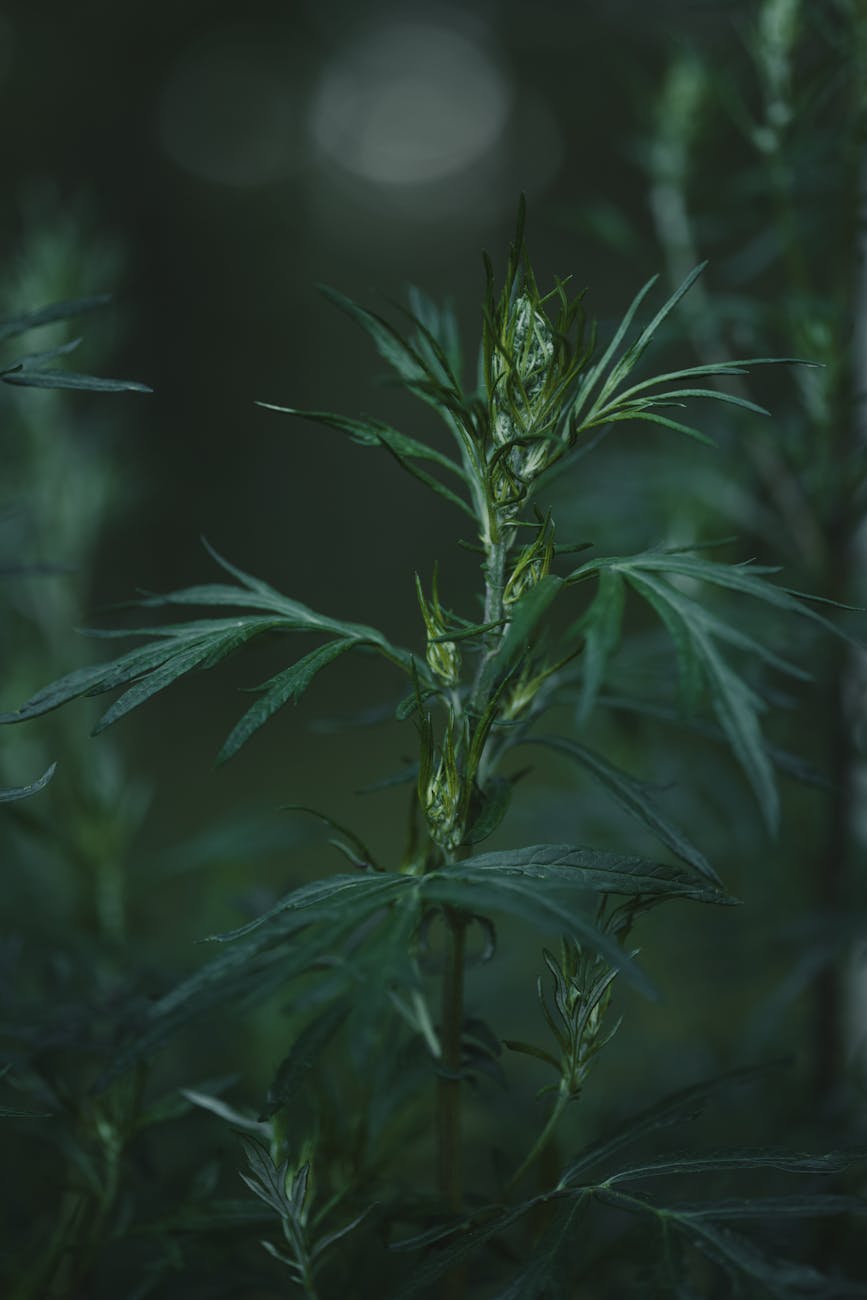
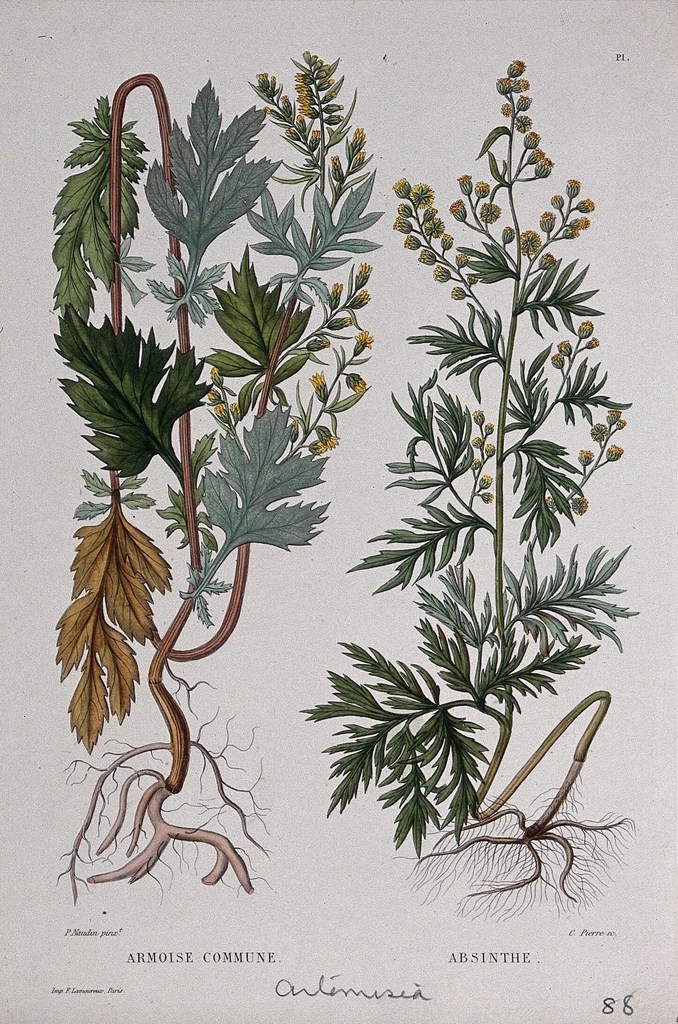
Okay, I know the name “mugwort” leaves a bit to be desired in English — it’s not exactly the most phonetically pleasing word — but its scientific name is rather beautiful: Artemisia vulgaris. The “vulgaris” in this instance means “common,” like the “wort” in “mugwort” roughly translating to “plant.” Mugwort is a very interesting, very magical, and very common plant.
The “mug” in mugwort may come from its use as an insect-repelling herb. The Old English word “mygg” is where we get the modern word “midge.” Another possibility is from its use as a flavoring herb in brewing. The “Artemisia” in Artemisia vulgaris, naturally, comes from the lunar and woodland goddess Artemis.
Mugwort was an important herb to the ancient Greeks and Romans. Soldiers and travelers would place sprigs of it into their shoes, in order to ward off fatigue.
Mugwort is very commonly included in herbal blends for dreams, psychic abilities, divination, cleansing, protection, and banishing. Like so many other herbs that are used for cleansing and banishing, this may stem from mugwort’s use as a pest repellent — it can literally banish the evils of disease brought by insects, ergo it must be useful against other evils as well. (See also: Pennyroyal.)
In Christian mythology, mugwort is associated with John the Baptist. It’s said that he carried mugwort with him to ward off evil. As a result, people would wear garlands of the herb on St. John’s Day (June 24th) and toss them into fires to ensure protection for the next year.
In some shamanic practices, mugwort is a representation of ancient wisdom. This plant is often visualized as a kind of crone figure, and used to facilitate a connection to ancestors.
Medicinally, mugwort was (and often still is) used to help ease difficult periods, treat menstrual irregularity, and as a mild pain reliever and anti-inflammatory. Mugwort is also used in the acupuncture practice of moxibustion, in which pieces of mugwort are placed at the end of acupuncture needles and burned.
Mugwort is also part of the Nine Herbs Charm according to one source, along with plantain, lamb’s cress, fumitory, chamomile, nettle, crab apple, chervil, and fennel. In this charm, mugwort is honored as the “oldest of plants,” strong against both poison and an unnamed force that travels the land. (This may be either a personification of evil, a venomous serpent, or a specific disease, but it’s referred to simply as “the loathsome thing.”)
The Nine Herbs Charm is a beautiful piece of poetry that combines Pagan and later Christian influences in a way that passes down important medical knowledge. The charm concludes with the recipe for a healing salve made by powdering the herbs, mixing them with old soap, mixing this with lye to make a paste, and combining it with boiled fennel. The charm is sung several times during the process — three times to each herb, then over the patient’s mouth, ears, and the wound being treated.
This is not only a magical consideration, but a practical one as well. It’s considered important to declare one’s intentions in adding an herb to a magical mixture, but the number of times the incantation is sung may correspond to how long it takes to powder and mix everything correctly. Singing it once while powdering an herb, for example, may yield a coarse consistency that doesn’t properly blend. Singing it three times, on the other hand, gives you the exact length of time needed to properly powder and mix the herbs. It’s like having a portable kitchen timer that not only tells you the recipe, it tells you what each ingredient is for and makes sure you do it right.
Mugwort was also used like hops before hops were a thing in brewing. Hops didn’t really achieve widespread use until the 15th century — before that, brewers used mugwort. It’s still used in food and teas for its unique flavor, which is like a bit astringent and savory, with a really interesting resinous character. Kind of like a mix between celery, mint, and eucalyptus.
Using Mugwort
While mugwort isn’t native to the US, it’s not exactly hard to find here, either. It does have a number of lookalikes, so you’ll want to get the help of a seasoned forager to make sure that you’re correctly IDing it. Start by looking for it in ditches, by roadsides, fields, and other places where the ground has been disturbed.
(Of course, if you’re foraging mugwort in order to consume it internally, avoid any that’s growing within ten feet of a roadside. In general, it’s better to avoid foraging near roadsides at all because the soil and plants there are contaminated by vehicular pollution. Leaving the plants in place ensures that you’re not consuming any of this pollution, and also allows them to remain and continue bioremediation.)

Of course, as with many other plants, I advocate for growing mugwort if you want to develop a relationship with it. However, if you’re in the US or another area where mugwort is a problem, I recommend either growing it in containers, or trying a related native species. (Like Artemisia douglasiana, California mugwort, in the western US.)
If you’re looking for mugwort’s medicinal properties, stick with A. vulgaris or other Artemisia species specifically used in herbal medicine. Different species may not have the same active compounds in the same concentrations, and some may even have some not-very-desirable qualities as well.
Once you have some, using it is pretty easy:
- Dry the leaves and add them to dream pillows along with herbs like lavender or chamomile. Squeeze the pillow and inhale the scent before dropping off to sleep.
- Add dried mugwort to incense and light it before card reading, scrying, or other forms of divination.
- Powder it fine and combine it with protective herbs, then sprinkle them in the corners of your home or around the border of your property.
- Rub fresh mugwort on a black candle and burn it to banish a person, entity, or situation.
- Dry whole sprigs of mugwort, tie them into bundles either alone or with other cleansing herbs, and burn to purify spaces and prepare them for ritual work.
You can consume mugwort as a tea or flavoring agent in breads, soups, poultry dishes, or beverages. However, high consumption of this herb does come with some unpleasant side effects like muscle spasms. If you’re looking to tap into mugwort’s psychic, trance, or dream benefits, you should still avoid consuming more than you’d normally get in an herbal tea, and avoid doing so for more than two weeks at a time. More isn’t always better.
If you’re pregnant or seeking to become so, avoid consuming mugwort. One of its chief medicinal uses has been to treat menstrual irregularity by stimulating uterine contractions. So, unless a qualified herbal practitioner says to use it, it’s best to avoid mugwort in these situations.
The mugwort of European folklore may not be from the US, but its invasive and resilient nature means that its probably here to stay. If you want to enjoy the long magical, mythological, culinary, and medicinal history of this herb, I recommend growing it in a container or purchasing the pre-dried herb to add to teas, incenses, sachets, or other preparations.

 Marble Crow
After coming across your post earlier today, I happened to go on a walk with a good friend that turned into a 4-hour wander. We’re both familiar with mugwort’s versatility, so when I recalled your mention of ancient Romans and Greeks placing sprigs in their shoes, we decided it was worth a try.
Let me tell you, they were onto something! The mugwort gives a pleasant cooling sensation as you walk on it, and my feet are dramatically less sore than they’d normally be.
LikeLike