
Do you have little to no success with plants?
Do you want to get into gardening, but lack confidence?
Hoo boy, are hen and chicks succulents made for you.
Members of the genus Sempervivum, these succulents are also known as “live forever” or “houseleek.” They have the plump leaves of your average succulent but can thrive in growing zones 9-4. I have one that I stuck in a pot on my deck and did literally nothing for — not even water — and it’s filled the pot, put out tons of little green pups, and is flowering like there’s no tomorrow.

Along with their easygoing nature, hen and chicks plants have some interesting folklore and usages in magical disciplines.
Hen and Chicks Magical Properties and Folklore
Let’s look at their common names first. “Hen and chicks” derives from their most notable method of reproduction — in addition to producing seeds, they send off little offsets in the form of round rosettes which give the impression of a large mother “hen” plant surrounded by baby “chicks.” They’re called “live forever” because they’re evergreen and very difficult to kill. Lastly, the name “houseleek” has no relation to the other plants known as leeks. Instead, the word “leek” comes from the Anglo-Saxon word “leac,” meaning “plant.”
As for why they’re called something that literally translates to “house plant,” there’s an excellent reason for this. Hen and chicks plants were (and are) frequently grown on houses. (When I lived in California, the house I stayed in had some lovely Sempervivum growing on the roof.) This practice originated with the belief that these plants helped to ward off fire and lightning strikes.
These plants are also associated with prosperity, health, and luck. Possibly as an extension of their fire- and lightning-protective connections, some cultures grew Sempervivum on roofs as a way to ensure the health and wealth of a house’s occupants. In Wales, these plants are still sometimes grown on roofs for luck.
(Of course, if you live in the US and have an average modern shingle roof, you may not want to grow plants there. Excess moisture could cause problems, and using your roof as an ersatz garden could void your warranty. Sempervivum are great for green roofs, however.)
As for warding off fire and lightning strikes, there are a few reasons for this. Some species of Sempervivum grow fine, snow-white hairs on them, that look a bit like fine wool or thick cobwebs, and their growth habit can make them resemble a jutting, sculpted beard. This is reflected in the German name “Donnerbart,” or “Thunder beard.” These plants are connected to various thunder deities, like Thor and Zeus.
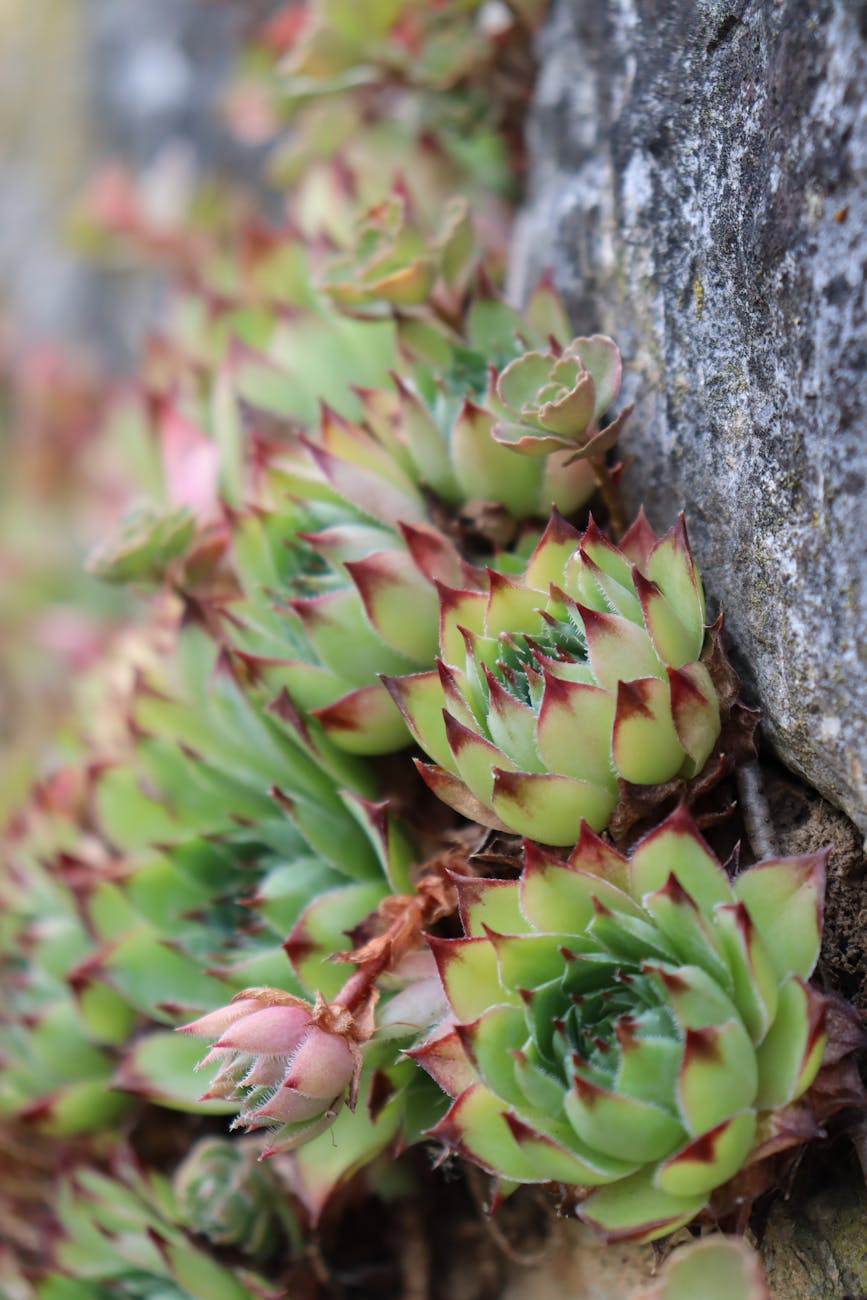
The other reason behind it is that Sempervivum can act less as a protector than as an indicator. These plants can thrive in very dry areas, but they still need some moisture to stay plump and green. The presence of healthy hen and chicks plants generally indicates that conditions aren’t conducive to combustion.
Houseleeks are also used to ward off attacks by malevolent magic.
Medicinally, Sempervivum plants are used similarly to Aloe vera. Topically, it is sometimes a treatment for cuts, burns, or warts. This herb was also considered a very useful treatment for diarrhea, while larger doses were a powerful emetic. Traditionally, it’s considered a very cooling herb.
Elementally, Sempervivum is associated with Fire. It is also connected to all thunder deities.
Using Hen and Chicks
From everything I’ve seen, Sempervivum‘s protective and lucky magical attributes are best employed by simply growing them. Give them a sunny spot and some well-draining soil in the right growing zones, and they’re pretty much good to go. (Of course, if you intend to use your hen and chicks plants in this fashion, it’s good form to ask them for their help.)
While these plants aren’t native to the US, I have noticed that they seem to be a favorite of small native pollinators. So far, I’ve seen three different species of sweat bee. They’re also useful for xeriscaping in especially challenging areas.
As I mentioned previously, you may want to avoid growing them on your roof. Yes, it’s very picturesque and cottagecore, and yes, it’s traditional, but having to pay upwards of five grand to fix or replace a modern shingle roof is none of those things. Plants trap moisture, which roofs need to shed. Their roots can infiltrate minute gaps between shingles, widening them and allowing water in. It may not happen immediately, but growing plants directly on a conventional roof, without any kind of barrier or container between the two, is generally not a good idea.
If you have a flat spot near your roof, like a windowsill, window box, or balcony, stick a couple Sempervivum plants in terracotta pots and put them there instead.
As for using them internally, I don’t recommend it. If you have a minor burn and don’t have a fresh aloe leaf handy, by all means, try applying some Sempervivum goop topically. Using these plants as an anti-diarrheal or purgative has largely dropped off in favor of other remedies, even in alternative medicine.
Hen and chicks plants are adorable, inexpensive, and exceptionally hard to kill. Magically, they’re just cute little protective and luck-drawing charms. If you have the space to devote to one (or a few), they’re well worth their tiny investment of time and money.

 Marble Crow