
It’s the first of the month! Did you remember to say “rabbit, rabbit?”
How’s it going?
As I write this, it’s almost 90° F. My cats are yelling at me for reasons utterly inscrutable. My bearded dragon is demanding to go for a walk on the deck. My Handsome Assistant is at his other job, the one that does not entail handsomely assisting me. Nonetheless, the garden is looking wonderful and all is well.
The hydrangeas and roses are full of buds, the strawberries and blueberries are laden with immature fruits, and the beautiful irises my Handsome Assistant planted are vibrantly blooming.

These are sterile bearded irises (Iris × germanica), which aren’t native to this area. We do have our own native species, the blue flag iris (Iris versicolor), which typically grows in wet areas. A lovely art gallery near here has a beautiful water garden just full of blue flag iris.
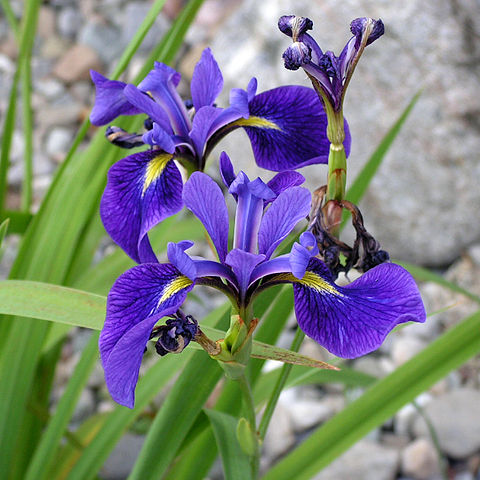
Irises bloom in spring and summer, so this is prime iris season and an excellent time to look into the mythology, folklore, and magical uses of these lovely flowers.
Iris Magical Properties and Folklore
First, let’s start with the name: Iris. These flowers are named for the Greek goddess Iris, who was a messenger between the gods and the rest of the world. She traveled on a rainbow and it was said that brightly colored flowers sprang up everywhere she stepped.
In ancient Greek legend, it was also said that iris flowers were one of the flowers gathered by Kore and the nymphs before she was abducted by Hades to become Persephone.
Irises are not only showy flowers, they’re one ornamental flower species that actually comes in pretty much every color. Many flowers (roses and sunflowers being particular examples) just don’t have the genes to produce certain color pigments, but irises boast a very impressive color palette.
(This is also why all of those ads for blue rose or sunflower seeds are scams. The closest thing you can find to a “blue” rose is probably best described as a sort of lavender shade, not an actual blue. Any photo of a blue rose or sunflower is of a flower that has either been artificially colored with dye or manipulated with image editing software.)
The roots of some varieties of iris are heavily used in perfumery. Called “orris root,” they are often used as a fixative and base note for perfumes and incense. The essence of the roots is said to smell like violets, and is commonly the source for natural “violet” perfumes.
Orris root is also a flavoring ingredient, particularly for gin. Iris roots contain some quantity of the toxic glycoside iridin, but the roots of perfume and flavoring varieties are relatively low. Other varieties, like the blue flag iris, contain much more iridin and should not be consumed.

Irises are sometimes used in land remediation. Yellow iris, in particular, is used to clean up polluted waterways since it’s excellent at snatching and holding on to nutrient pollutants (think things like fertilizer runoff from agriculture) that would otherwise fuel dangerous algal blooms and fish kills. Unfortunately, they’re so good at this that they’ve become a bit of a problem in some heavily polluted areas — the nutrients they grab onto fuel their growth so much, they can actually clog waterways.
Irises have a long history as an image of nobility and authority. They’re the origin for the fleur-de-lis of French heraldry, where each “petal” represents a sector of society: the peasantry, the nobility, and the clergy. In the 15th century BCE, Pharaoh Thutmose III conquered Syria, which had an abundance of native irises. He brought the flowers back to Egypt, where it became a symbol of power and authority.
In Asia, irises are more likely to connect to the idea of banishing evil. One variety of Chinese iris, Iris anguifuga, was thought to keep snakes from entering anywhere it was grown. It grows during winter and becomes dormant in spring and summer, during which snakes can sneak into the garden again. The ground roots are also used as a remedy for snakebite. In Japan, irises were associated with exorcism.
In addition to authority and banishing, irises are also frequently connected to death. They’re a common flower to plant in Muslim graveyards in Iran, and the ancient Greeks also would plant these flowers on graves in the hope that the deity Iris would come to escort the deceased to the afterlife.
Overall, culturally, irises seem to be a very commanding flower. Even in areas where they aren’t specifically connected to the idea of authority, they’re associated with commanding evil or unwanted things to leave, or making requests of the gods themselves. If you look at an iris, this makes sense — they stand tall and straight, with large, showy blooms like flags.
Magically, irises are typically used for purification and wisdom. Orris root, specifically, is frequently employed in formulas for meditation, divination, and love-drawing. In Hoodoo, orris root is a very common love herb.
Irises are ruled by the Moon and Mercury, and connected to the element of Water.
Using Irises
As with many other plants, one of the best ways to work with iris is to grow it. Since it has a firm reputation as a plant for authority and keeping evil away, it’s a good candidate for growing around the edges of one’s space.
Of course, you can also always work with orris root. One common way to employ it is as an ingredient in incense, magical powders, and container spells. Use chips of the root in herbal sachets or jars or grind it into a fine powder for powders and incense. While it seems to have a very iron-fist-in-a-velvet-glove presence, this isn’t exactly an ingredient for “asking politely.” It has a reputation as a persuasive or commanding herb.

I also feel that orris root is a power herb, if only through its very commanding properties and presence. Remember, from France to ancient Egypt, the iris flower was a symbol of power and authority. Add it to magical mixtures to increase their power.
Orris root powder is also used as-is in some traditions. Take a pinch of the powder and blow it onto a significant other’s clothes to keep them faithful and ensure that they return your love. However, particularly given orris/iris’s commanding nature, it might be best to do this with some kind of consent from your partner.
Considering the herb’s connections to authority and love, it seems like a natural choice for formulas related to popularity and charisma. A “queen bee” sort of herb, if you will.
I love irises. I think they’re stunningly beautiful and come in an amazing array of colors from deep reds to bright blues. The availability of sterile iris varieties also means that you can enjoy them with less fear of them taking over your garden. Worse comes to worse, if you end up with too many bearded irises, dig them up and dry chips of the roots for use in magical or meditative formulas.

 Marble Crow
I’m jealous. We’re still in the 70s.
LikeLike