
Hello! How’re you doing?
I sprained my ankle a little bit ago when I made the foolhardy error of trying to get my mail. This has, as you can imagine, somewhat curtailed my adventures. (Well, with the exception of going to see Whose Live Anyway at Warner Theater. Shoutout to the lady who let us go in through the lounge so I wouldn’t have to walk as much! I hope you experience a series of small, comfortable miracles.)
Fortunately, I’ve got plenty to get up to at home. For example, right now, the yard is filled with flowers. Many, I planted — moss phlox, strawberries, blueberries, apple blossoms, pear blossoms — and many I didn’t. I expected to see the same violets, dandelions, and stars of Bethlehem that I saw last year. What I did not expect was all of the bluebells.
We didn’t have bluebells last year.
I didn’t plant bluebells.
Whycome bluebells?
The particular species we have right now seems to be Spanish bluebell (Hyacinthoides hispanica). I know it probably isn’t English bluebell (H. non-scripta) and definitely isn’t native Virginia bluebell (Mertensia virginica). Nonetheless, they’re delightful little flowers and I’m enjoying them. They don’t seem to be stealing space or resources from anything but the grass that I’m systematically attempting to assassinate anyway at the moment, so they can stay for now.
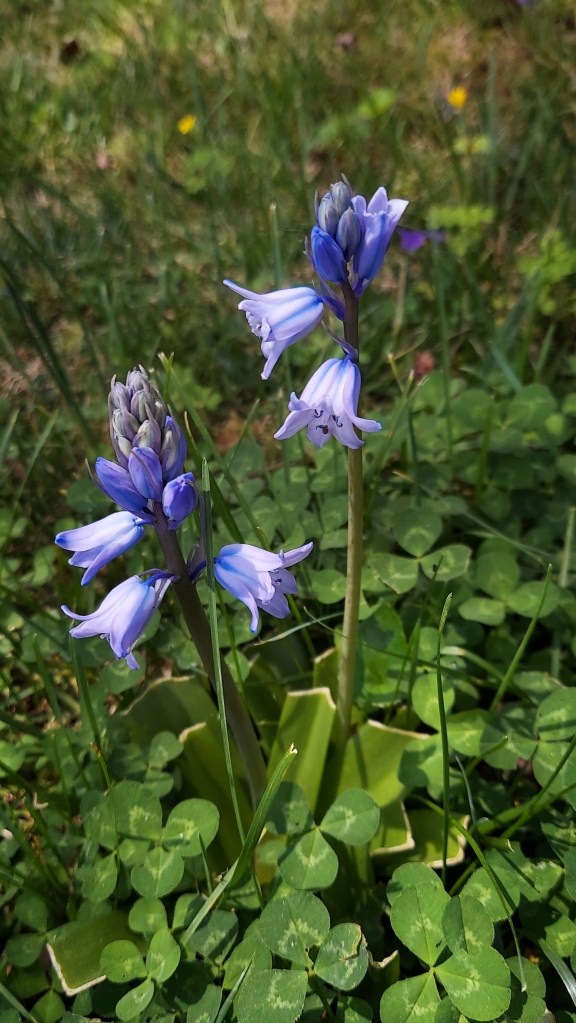
(Spanish bluebells are a bigger issue in the UK, where they’re more likely to be invasive and can hybridize easily with — and eventually displace — native H. non-scripta. The bluebells we have here won’t hybridize, however, as they’re not closely related at all.)
Either way, I’m always in search of new plants to study and write about, so the appearance of these guys is pretty fortunate — I haven’t really looked into bluebells before this, and I like that they’re demanding my attention now.
Bluebell Magical Properties and Folklore
Bluebells are strongly associated with faeries. The fae were believed to ring them, just like you would a metal bell, in order to call other faeries.
However, should you hear the soft tinkling of bells when you’re near bluebells, watch out — anyone who hears the bluebells ring was said to experience the death of a loved one soon after.
This connection to faerie magic is also why it was considered unwise to pick a bluebell. Anyone foolish enough to do so put themselves at risk of being cursed or led astray by the faeries.
A similar, but unrelated, plant is known as the harebell, witch’s bell, or Scottish bluebell (Campanula rotundifolia). These flowers get their name because hares frequent fields of them. It was even said that witches would disguise themselves as hares and conceal themselves amidst the harebells.
It has been a frequent complaint, from old times, as well as in the present, that certain hags in Wales, as well as in Ireland and Scotland, changed themselves into the shape of hares, that sucking teats under this counterfeit form, they might stealthily rob other people’s milk.”
(It’s weird how much traditional witchcraft reportedly revolved around stealing milk. Case in point, the tilberi.)
These bluebells were also known as “the aul’ man’s bell,” where the “old man” in question is the Christian Devil.

Bluebells are also connected to love magic. This seems to be largely due to the fact that they’re tenacious, bulb-growing plants. They even send out contractile roots that allow them to sort of “burrow” into the soil where there’s more moisture and protection. As a result, they come back year after year and are considered a symbol of enduring love.
They’re also used for a kind of love magic. Should you be able to brave the faeries’ wrath, pick a single bluebell flower, and turn it inside out without tearing it, you could ensure that your true love returned your affections.
Bluebells are related to hyacinths, and, like hyacinths, they actually can come in a variety of colors — pale to deep blue, violet, and pink. As with other flowers that come in many colors, their colors do, to an extent, dictate their potential magical uses. Pink flowers, as a rule, are useful for love magic. This can be attracting new love, strengthening an existing love, or even just helping with emotional healing and self-love. Purple flowers, crystals, and such are commonly used for more mystical, psychic, or divinatory pursuits, as well as ambition and success. Blue flowers and the like are helpful in rituals for healing, peace, truth, and emotional understanding.
Speaking of which, putting a wreath of bluebells around a person’s neck was said to compel them to speak only the truth.
While bluebells produce a wide range of compounds with potential medical uses, this is one of those situations where there’s a fine line between “medicine” and “poison.” Some of these compounds may be the next line of anticancer drugs, if they’re properly standardized. If you just straight-up eat bluebells, however, you’re setting yourself up for an evening of nausea, pain, and heart rhythm disturbances. Possibly even a long nap on the wrong side of the grass.
Today, bluebells are considered an ancient woodland indicator. This means that they’re commonly found thriving on the floors of old growth forests.

In Victorian floriography, the “language of flowers,” bluebells represented kindness.
Bluebells are associated with the planet Saturn and the Moon, as well as the element of Air.
Using Bluebells
Overall, the message of the bluebells seems to be pretty clear: They’re beautiful, they can represent things like kindness, resilience, and everlasting love… and if you pick them, you’re screwed.
(No, seriously. Depending on where you live, if the faeries don’t get you, the legality of picking wild bluebells might.)
I’ve found several references to drying bluebells and keeping them in the bedroom, but not any definitive reason to do this. Presumably, this may tie into bluebell’s association with peace or love magic. It definitely seems to be either a peaceful dream thing, a romantic love thing, or a “do this to dream of your lover” thing.
Bluebells could theoretically be offered to faeries or other nature spirits. However, since this would involve picking the bluebells first, they might interpret it more like the horse head scene in The Godfather. A much safer bet would be to designate an area of your garden for the faeries and keep an offering of potted bluebells there instead.
If you’re in the United States, you may want to consider planting native bluebells in your garden. Should you choose to work with English or Spanish bluebells, do so conscientiously — avoid planting them directly in the soil, as their sheer resiliency means that they can become invasive under the right circumstances.
All told, I’d recommend enjoying bluebells as they are, as harbingers of faeries, reservoirs of nectar for pollinators, and indicators of ancient forests. These are one plant that is best worked with in situ, rather than picked, dried, and added to a spell.

 Marble Crow