
A baby, stolen from his mother by a bloodthirsty goddess.
Human populations driven to war by an ancient entity.
If these don’t sound like the mythological Irish hero Cú Chulainn‘s story, you’re not wrong exactly, but they are what opens the action in Paul J. Bolger, Barry Devlin, and Dee Cunniffe’s Hound.
This is a retelling of the life of Cú Chulainn, but reframed to suit the constraints of a graphic novel. The artwork is gorgeous and heavily stylized, and the story does a very good job of hitting the high points. Some artistic liberties were taken, which the book acknowledges — the story is framed as told by the Morrígan, who outright says that there are many versions. “But remember… I was there. They were not.”
Hound is ultimately a tale about destiny. Who controls it? Do we, or are the wheels set in motion long before we’re able to make our own decisions? How do we win against the whims of forces beyond us? Can we overcome our innermost nature? How do you struggle against a god?
First, the art style. The book is illustrated entirely in black, white, and blood red. The linework is sharp, evocative of danger and madness. The characters also all have visually distinct appearances — there’s no “same facing” here. Not only do they have distinct faces, they have unique hair, tattoos, and jewelry, too. This is important, because the story moves quickly and people can come and go in a blur.
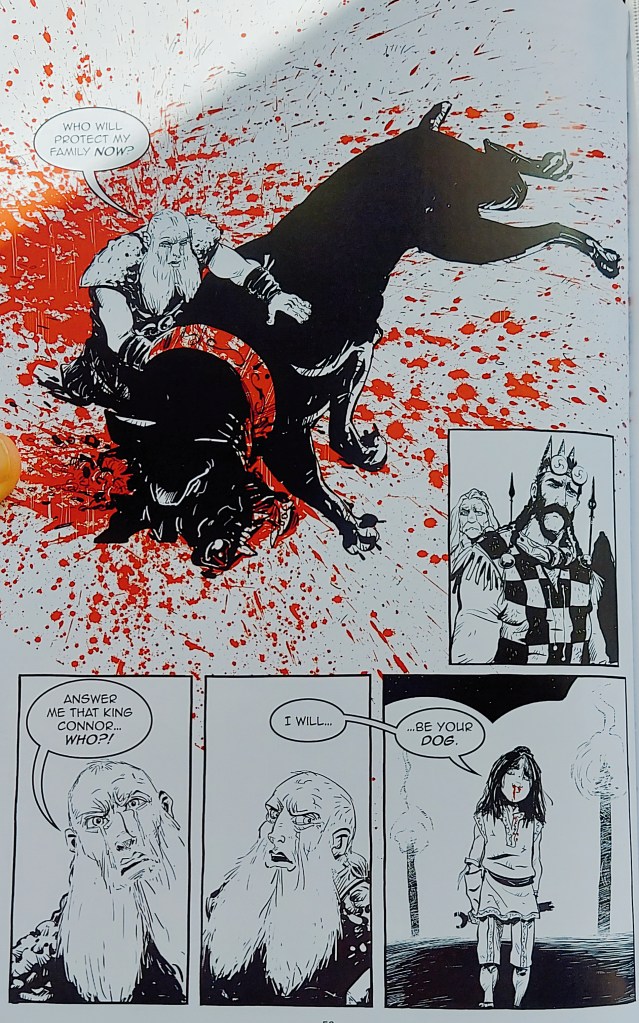
Many characters were blended or altered in order to make a smoother, more cohesive story. Some of the mysterious elements of the original (like Deichtine giving birth to Cú Chulainn, who has multiple foster parents) are greatly simplified (Cú Chulainn is kidnapped and raised by the Morrígan, who uses this time to plant the seed of his madness). This isn’t entirely a bad thing — Cú Chulainn’s story is long and complex, with many figures who come and go and have their own, branching stories. Condensing it into a graphic novel requires a bit of ingenuity.
As a graphic novel, it’s excellent. The story is ancient, but it feels fresh. The artwork suits the material. The artistic liberties that were taken with the story help to make it a cohesive, self-contained novel.
From a mythological perspective, it also seemed like some liberties were taken in places where they didn’t quite make sense. Aífe (Eva in the book) is an entirely different character. Rather than being a woman warrior who nearly bests Cú Chulainn in single combat before he creates a diversion, she’s Scáthach’s rebellious — and kind of whiny — daughter. Rather than Cú Chulainn demanding she bear him a son after he defeats her, the two of them get hot and heavy during a hunting montage. Rather than Cú Chulainn giving her a gold ring and telling her to send his son to find him in seven years, she’s butthurt that Cú Chulainn left her for Emer and sends the boy to hunt him down herself.
It’s understandable that a modern telling of Cú Chulainn’s story, where he’s the hero, wouldn’t want to include him demanding Aífe sleep with him in exchange for her life. Nonetheless, I don’t feel like this telling of the story really did her justice. She’s Scáthach’s rival. A legitimate threat, to the point where Scáthach drugs Cú to keep him safely out of the battle. A woman warrior capable of defeating Cú Chulainn. A lot of that was lost, I feel.
King Conchobar is also very different. By all accounts, he was a good king. In Hound, he’s portrayed as almost peevish. This worsens as the story progresses and he develops a grudge against Cú over Emer. Here, it’s the king who sends Cú to Scáthach as punishment.
A significant part of Emer‘s character was lost, as well. In the original, she tells Cú that she’ll only marry him when he proves himself worthy. She isn’t engaged to a king — in fact, kings turn down her father’s offer of her hand, because they know Cú wants her and know better than to get on his bad side. In Hound, it seems that Emer is flattened and her agency taken away. There, she’s engaged to the king against her will, who rejects her when she falls in love with Cú. This takes place over a couple panels’ worth of a travel montage. Why do they fall in love when she’s shown doing nothing but complaining and apparently has complete disdain for Cú? Your guess is as good as mine.
Perhaps my biggest character gripe is the Morrígan. In Hound, she is decidedly one-note. Almost more cryptid than deity, she is a shapeshifting entity who is dissatisfied with the lasting peace among humans. She kidnaps Cú in order to make him her warrior, to stir things up. She instigates the cattle raid to cause war. She has no motivation here other than to cause bloodshed. Alas, every story like this needs a villain, and she’s set up to fit that particular bill.
(She’s also portrayed as a single entity, rather than a triple goddess, but that’s not really an issue.)
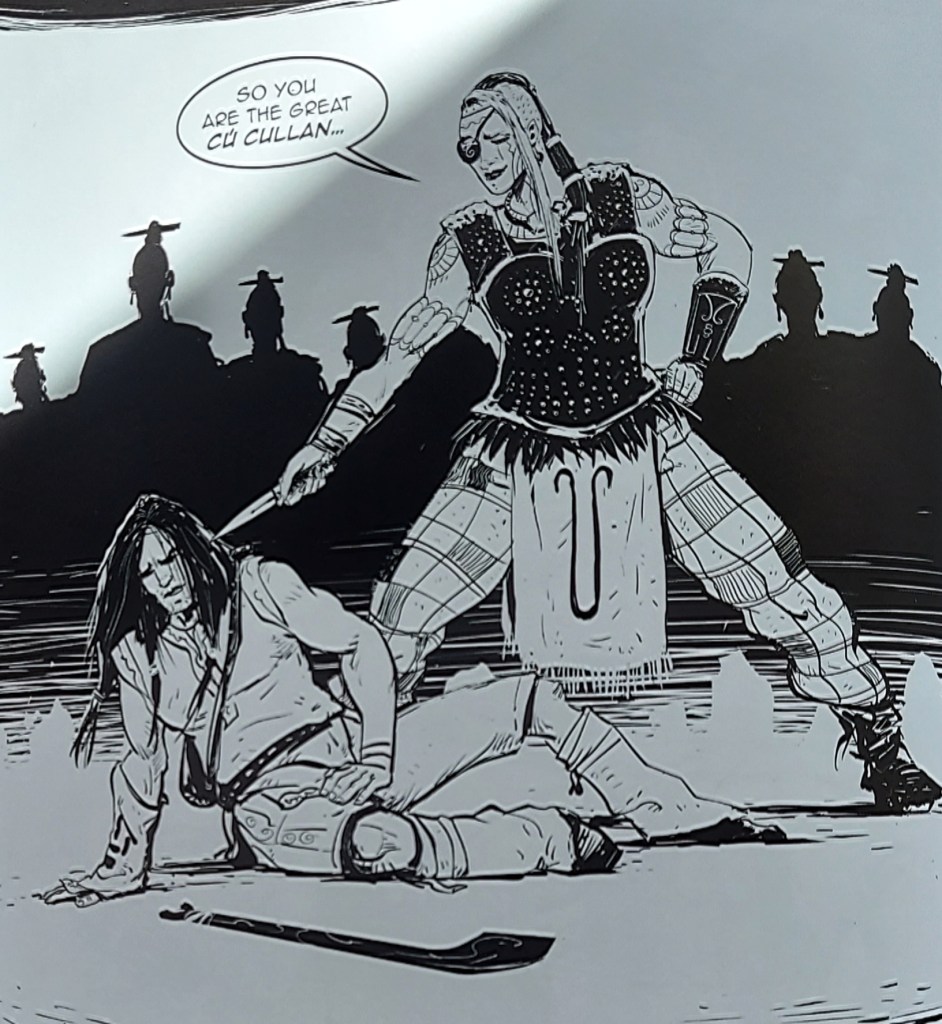
I do like how Hound treats Scáthach (simplified to Skye), however. She isn’t portrayed as “comic book hot.” There are no spine-snapping poses, skintight outfits, or fight-inhibiting titties here. Her strength is not an informed characteristic — she exudes it. She is a powerful figure. She has a wild, animal sensuality that is far removed from standard comic heroines. This is a woman who can and will use her thighs to crush a skull like a watermelon. (And she’ll put you through a training montage until you can do the same.)

As for the other characters, I wish I had more to say. At one point, we’re introduced to a five-man band of Scáthach’s students, but they don’t end up being as significant as I expected. (The only exception is Ferdia.) The story, as dense as it is, moves much too quickly to really become invested in many of Cú’s relationships. People die left and right, but in a way that’s hard to care about.
Ferdia, on the other hand, is treated well. He’s portrayed as a boisterous bruiser, a fitting blood brother for Cú, who is capable of holding his own even without the divine favor Cú has. He’s Medb’s champion, but he’s not a villain. He’s strong, handsome, honorable, and his final meeting with Cú is appropriately upsetting. He’s given weight in a way that the other characters — even some very important ones — are not.
This is not to complain about the story itself, however. Like I said, there are limits to portraying a tale like this in a graphic novel format. Some characters need to be simplified, and others removed. That said, I do think there are some places where this simplification wasn’t strictly necessary or could have been handled differently. (Cú having to leave Emer would’ve been more impactful if she were closer to her original portrayal, for example.) It’s likely that the only way around this would be to split Hound into multiple volumes so everyone could get some more page time and character/relationship development.
I know what you’re probably thinking, though.
“Okay, so this is Cú Chulainn in a visual medium… What about the warp spasm?!”
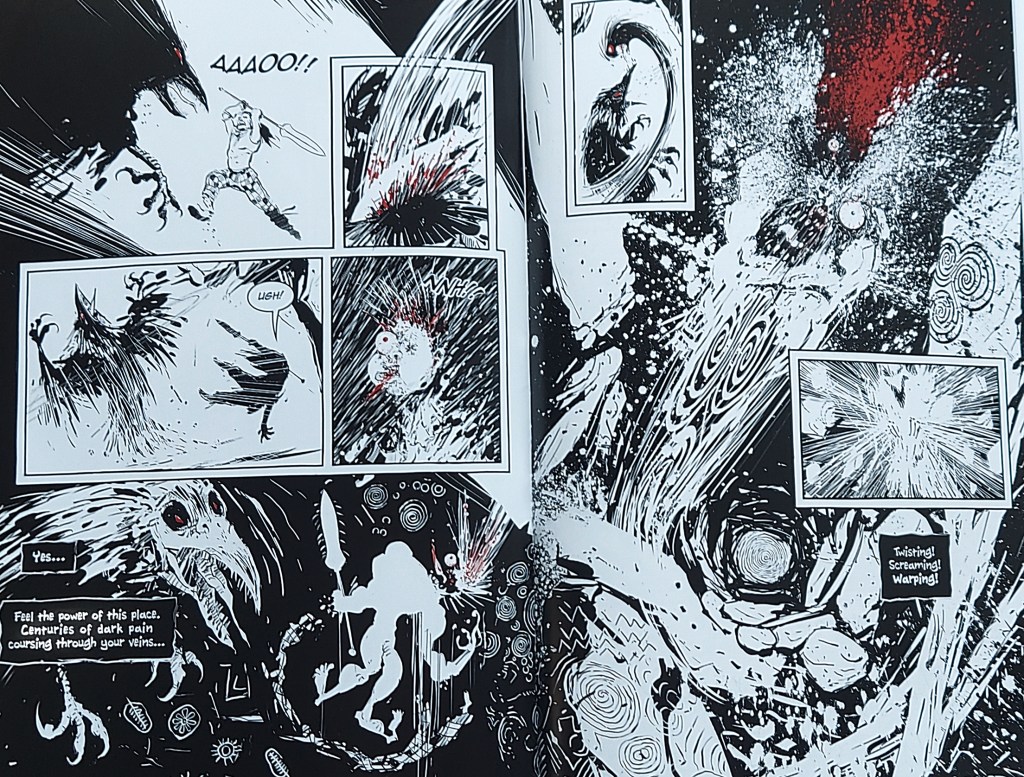
Don’t worry. It doesn’t disappoint. You know how horror stories are always scarier before you actually see the monster? In Hound, the artwork does a great job of suggesting and evoking without fully showing. Your imagination can fill in the details, and that’s always scarier than anything anyone can draw for you.
I absolutely recommend this book to readers who are interested in Irish legends, or for whom the story of Cú Chulainn resonates. I wouldn’t, however, recommend it to people looking for a historically faithful representation of the tale. It’s a beautiful book and, as long as it is respected as a dark fantasy adaptation of an ancient story, it’s extremely enjoyable.

 Marble Crow