
This past weekend, my Handsome Assistant and I took a small drive down Falls Road (alias Scenic Route 25). This was recently dubbed the second-best route in the country for seeing fall colors, and, while the leaves haven’t quite reached their peak just yet, it was a really lovely drive.
Red maples (Acer rubrum) are one of my favorite trees to see in autumn, and I’m lucky to share a home with one. Their leaves turn a vibrant scarlet every autumn, hence the name.

Honestly, I just love maples in general. As a little kid, I used to pick up their samaras (we called them “pollynoses”) from the sidewalk, open the seed capsules, and stick them on the end of my nose. I bake primarily with maple syrup. I’m trying to convince my Handsome Assistant to make his next back of mead a batch of acerglyn (a similar beverage made of half honey, half maple syrup) instead.
I probably don’t need to say that trees have featured prominently in Pagan practices probably ever since the first Pagan. Each one has its own traits and associations, and, when it comes to working with the wood, leaves, or fruits, its own magical properties.
To be honest, maples were so ubiquitous where I grew up that I didn’t know they weren’t more widely harvested from. When I was thirteen, I was a foreign exchange student, which resulted in a brief stay in the Netherlands before going to Sweden. My student group (jetlagged and exhausted) stopped at a cafe on our first day there, where I happily ordered a plate of silver dollar pancakes and syrup.
But it was not syrup.
It was stroop.
Stroop (rhymes with “rope”) is often made of boiled-down fruit, water, and sugar, but can also be made with molasses and brown sugar. While it isn’t bad by any means, the latter variety is kind of an unpleasant surprise when you’re a kid who’s used to maple syrup with pancakes, hates molasses, and also desperately needs a nap. Not knowing any better, I drenched my pancakes in stroop and made myself a very avoidable struggleplate.
Anyway, all of this is to say that maples rock, maple syrup is the food of the Gods and should absolutely never be taken for granted, and I may still carry some molasses-induced trauma.
Maple Magical Properties and Folklore
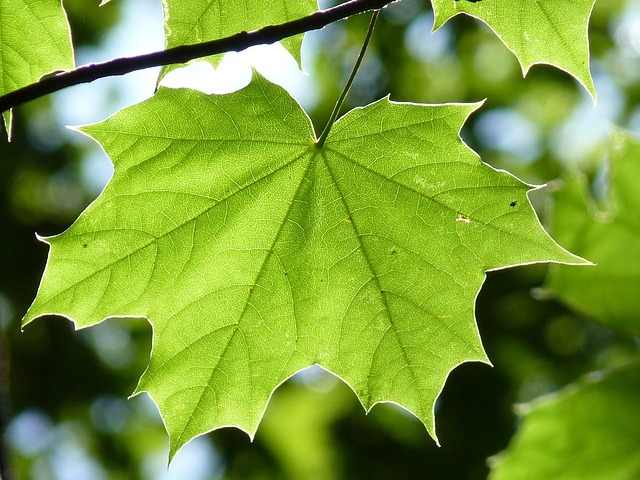
Maple’s genus, Acer, is Latin for “sharp.” This is due to their very unique, pointy leaves.
An Abenaki story tells how maple syrup once flowed freely from trees. It came so easily, people would lay on their backs and just let the syrup run right into their mouths. The legendary figure Glooskap saw how lazy people had become, so he turned the thick, sweet syrup into runny sap. From then on, if people wanted to eat maple syrup, they would have to work for it!
Another story, said to be of Haudenosaunee origin, tells of a man who watched a red squirrel nibble the end of a maple branch. The sap flowed until the sugars dried, hardened, and crystallized. The squirrel then came back to lick the sweet maple sugar.
In European-based magical systems, maple syrup is often used as an ingredient in love spells.
Maple sugar or syrup is also a useful ingredient in sweetening jars.
By contrast, maple wood is considered very protective. It was sometimes incorporated into doorframes for this purpose.
Some sources consider maple to be good for prosperity and abundance in general.
As wand wood, maple is known for having a somewhat erratic energy. It also helps dispel negative energy, center oneself, and reveal paths and options one may not have considered.
Maples, particularly silver maple (Acer saccharinum) are considered Moon plants. They’re also associated with the element of Water.
Using Maple
Working with maple can be as simple as using magical tools made from the wood. Every tree — and thus every wood — has its own energy. I haven’t personally found maple to be erratic, but, to be totally honest with you, I’m erratic enough myself. (I think it also helps to have sourced the wood from a tree that I know pretty well!)
If you’re in the eastern US, you’re probably located near a maple tree. If that maple tree is anything like the one here, it probably drops plenty of sticks and smallish branches every time there’s a storm. Should you be of a mind to make your own magical tools, deadfall maple wood is honestly really easy to come by.
I can only vouch for red maple, but, once the bark and cambium are stripped off, the wood itself is light and silky-feeling. Sanded well, it takes on an almost metallic sheen. I love it.
The next easiest way to work with maple is to use maple syrup. You’ll need the real stuff for this, unfortunately — the fake stuff is cheaper, but also doesn’t really bear any resemblance to the genuine article. (There’s a good reason for that, too. Maple sap is chemically very complex, and we still don’t really understand all of the different compounds and reactions that give boiled sap its flavor. That makes it pretty much impossible to make a decent imitation syrup.)
If you’re looking to make a sweetening jar, artificial syrup is probably fine if you can’t get your hands on the real stuff. That said, plain sugar and tap water will make you a perfectly fine simple syrup that’ll a) be cheaper, b) let you add your intention or energy during the syrup-making process, and c) let you bypass the artificial flavors, colors, and other ingredients that don’t really add anything to the magic-making.
Otherwise, add maple syrup to your favorite edible magical recipes. Like I mentioned above, I bake with it almost exclusively — it’s pricey, but I love what it does for the flavor and texture of desserts. Seriously. It makes amazing breads and cakes, and is fantastic in chocolate chip cookies. Add the maple syrup, thank the tree for its sacrifice, tell the syrup what you want it to do for you, and stir your concoction clockwise using your dominant hand. Easy peasy.
Maple samaras (aka, pollynoses) can also be helpful additions to a charm bag. They end up all over the place in late spring to early autumn, so, if there’s a maple anywhere near you, you probably won’t have any trouble finding some. Add them to bags for prosperity, love, or protection.

 Marble Crow