
I’ve posted a lot about my stumbling efforts at growing things, from murdering the front lawn on purpose, to accidentally planting way too many passionflower vines. It’s certainly been a learning experience, though not in any of the ways that I ever expected.

See, I thought I’d learn stuff about soil composition and companion planting. I kind of did the former, if by “learning about soil composition” you mean “discovering that this soil is almost entirely hard clay, good luck.” I have developed strong opinions about mulch, however.
If I had to sum up the two biggest lessons that I’ve learned in my first full year of being responsible for an entire yard, they’d go something like this:
1. If I plant native (or near-native) plants, everything pretty much takes care of itself.
As part of my current course of Druid studies, I’m required to plant and tend a tree (or, lacking a tree, another, smaller plant). I began this study pretty much right after my Handsome Assistant and I planted an Eastern redbud in the front (formerly grass) plot. I was given the okay to use that tree, so that’s what I’ve been working with.
The lesson is supposed to involve building a relationship from planting, watering, and helping a young tree become established, to watching it grow. To be honest, I think I’ve watered this tree maybe three times over several months. It’s native to the area. It’s fine with this soil. It’s putting out new branches and beautiful, heart-shaped leaves on a nearly daily basis.
This seemed a bit like cheating, so I thought I’d start a smaller, auxiliary tree. I wasn’t sure what to plant at first, but the birds made that decision for me: There are an abundance of mulberry sprouts, courtesy of the crows and other birds. They didn’t enjoy being moved, but are doing just fine with minimal intervention. My takeaway here if that if I have to carefully nurture a plant, it probably isn’t the right one. Nature, even transplanted nature, doesn’t really need as much intervention as one might assume.
2. It’s not so much a garden as it is a kind of potluck.
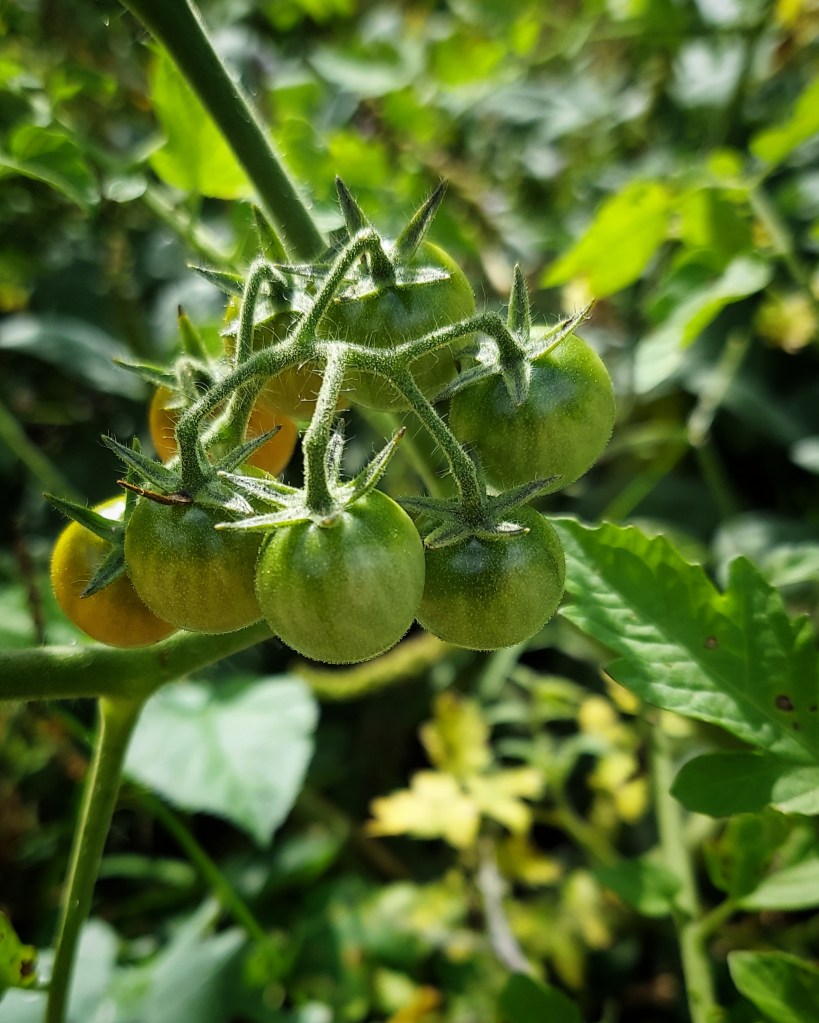
As for the potluck… I’ve mentioned all of the pumpkins in previous entries. (They’ve made for some amazing pumpkin bread.) There’re also sprigs of various kales popping up random places where they were certainly not planted, a thriving bush of bright orange cherry tomatoes, the aforementioned mulberry bushes, and what appears to be a chia plant.

Really, it seems like I don’t actually have to worry about planting fruits and vegetables myself. If I help make this place welcoming enough, tiny guests will show up and bring food. That food may not always show up where I anticipate it, but it flourishes, and I end up with more than enough to share.
The plants here have mostly gone to seed, so the pollinator garden is as full of birds as it is bees and butterflies. I have no idea what horticultural surprises next spring and summer may hold, but I’m excited to find out!

 Marble Crow