
Oh, gypsum. You’re fertilizer, walls are made of you, you make tofu tofu, and you’re also some of the most coveted minerals on the crystal market.
If you like collecting or working with crystals, you’ve almost definitely seen it. It’s usually marketed as selenite (though it also frequently appears in flowerlike forms called desert roses).
There’s only one problem — like olive oil, wasabi, and citrine crystals, the selenite you know and love may not actually be selenite at all. This is another situation where mineral names and trade names collide, like you see with white turquoise.
Selenite is a very common name for gypsum in the crystal trade. It’s usually used to describe the fibrous, silky, silvery-looking form of gypsum sold as rough wands, polished wands, palm stones, or heart shapes. These stones have a silvery sheen and a decidedly lunar feel, so the name selenite makes sense, right?
Unfortunately, it’s a bit more complicated than that.
Selenite vs Satin Spar
Okay, so. Selenite and satin spar are both the same mineral: gypsum. Gypsum is a variety of calcium sulfate, so it’s pretty common. There’s a good chance you live in it, and an even better one that you’ve eaten it before. No big deal.
The difference between selenite and satin spar lies entirely in how they form.

Satin spar forms as thin, fibrous crystals. If you’ve ever seen it crumble (which isn’t uncommon to observe — gypsum is soft), you might have noticed that the remnants look more like small splinters. This gives this mineral a silky, translucent appearance with a silvery sheen. It usually exhibits chatoyancy, or a “cat’s eye” effect. Because of how it forms, this is the mineral that you usually see sold as “selenite wands,” palm stones, or charging bowls.
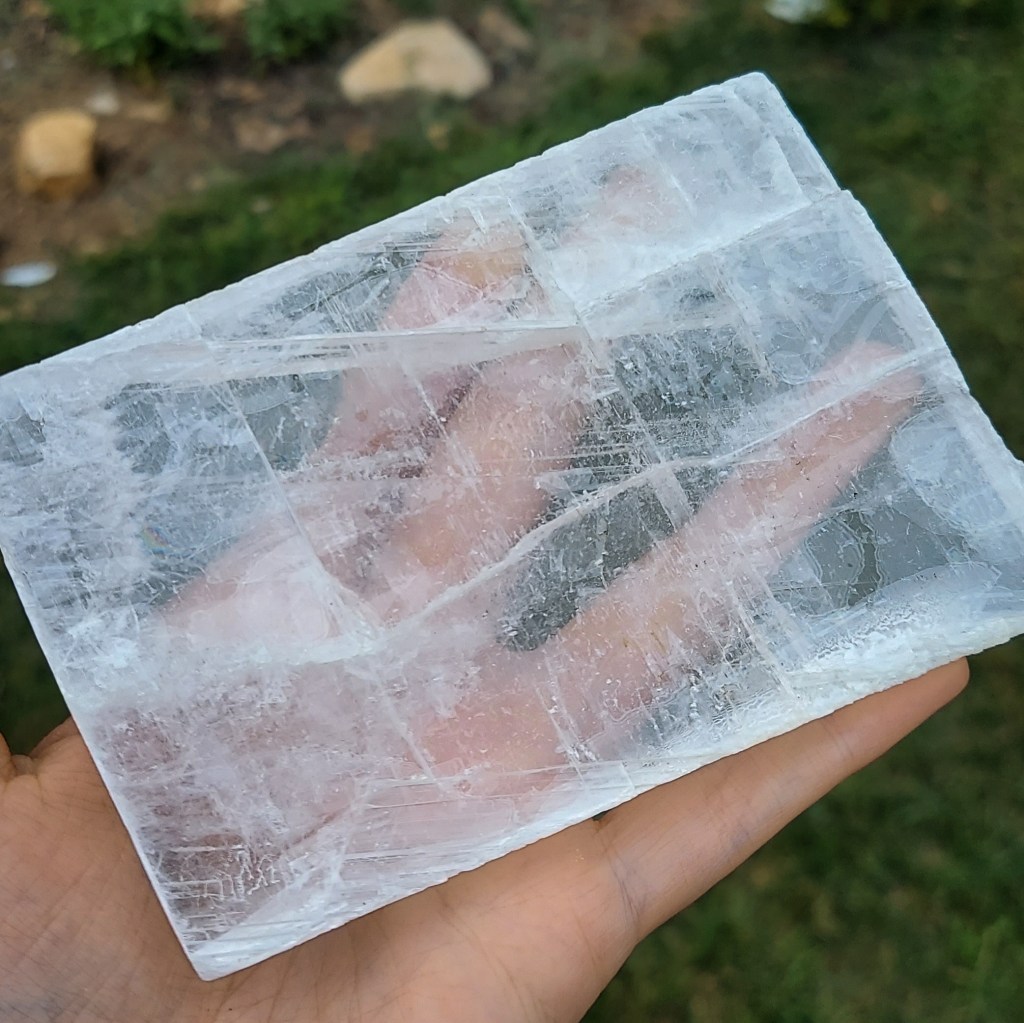
Actual selenite forms as sheets. It’s usually transparent and colorless, though it may have impurities that give it a cloudy appearance. It’s much rarer than satin spar and is usually sold as flat specimens. The way it fractures means that it isn’t a good choice for carving into wands. Its unique crystal form is best exhibited as-is, though you may see it sold as charging plates.
Are there any other important differences?
Nope. The chemical composition, hardness, solubility, and everything else is completely the same. The only differences are clarity, fracture planes, and formation.
What about metaphysical uses?
Satin spar and selenite are used identically. They’re both considered very high-energy crystals that are used to cleanse rooms, people, and objects, or even cleanse and charge other crystals. If you have a selenite that you’ve suddenly realized is actually satin spar, that’s okay. There’s virtually no metaphysical difference between the two.
Does the difference matter?
If you work with crystals in a magical or metaphysical sense, then no. The usage, properties, and care instructions for satin spar and selenite are exactly the same.
If you collect minerals or have some specimens that you plan to sell to gem collectors, then yes. Selenite is rarer than satin spar. It forms and looks differently. If you have satin spar in your collection, and you want to find a piece of actual selenite, you’d be pretty disappointed to find that all of the “selenite” on the market is just more satin spar!
Should I call my specimen selenite, or satin spar?
I’m all for accuracy, so I prefer to call selenite selenite, and satin spar satin spar. However, I also get that “selenite” has been a trade name for satin spar for a long time now, and me taking a pedantic stand isn’t likely to change that.
Like I said, it might be a good idea to remember that there is a difference. In magical and metaphysical circles, nobody’s that likely to care much. In gem collecting circles, people are more likely to use the term that’s more technically correct.
If you want to split the difference, you could call satin spar “satin spar selenite.” This isn’t really right, but it probably has the best shot at ensuring that the person you’re talking to knows what you mean.
Or just call them all gypsum and let everyone else figure it out.

 Marble Crow