
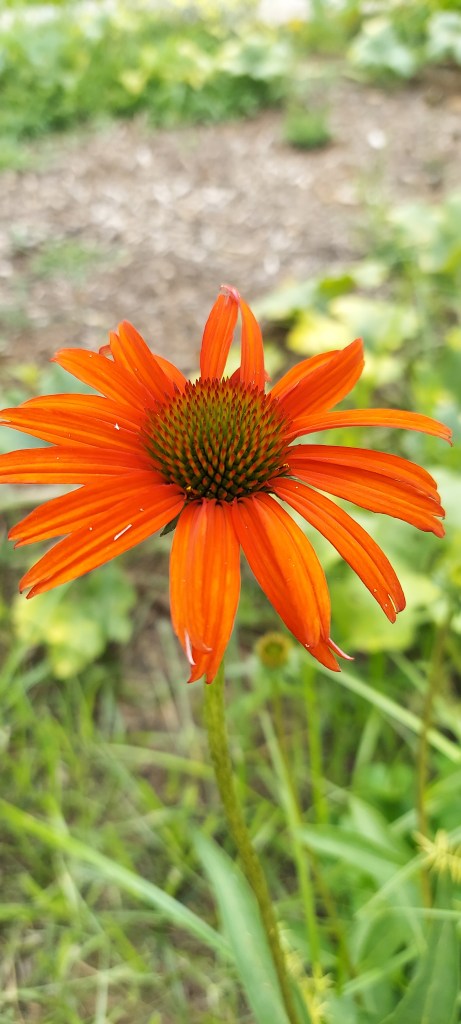
Echinacea, or coneflower, is a genus of flowering plants found solely in parts of the US. They’re native to where I currently live, so I’ve added several different wild type and nativar plants to the front and back yards here. They’re a unique addition to the landscape, and help bring in even more pollinators than the bee balm and anise hyssop already do!
These flowers are probably best known for their medicinal qualities. The first time I’d ever heard of echinacea was from my father’s former significant other. She had some echinacea tea, and I overheard her talking about how she used it medicinally. (Though they’ve since split up, I’m still friends with her — she went on to become a bodywork therapist who specializes in sound healing and craniosacral therapy, and is one of the founders of the nonprofit Columbia Resilience Integrated Health Community Project. She’s a pretty cool lady.)
Unfortunately, the popularity of echinacea means that wild populations are suffering from overharvesting (two species, E. tennesseensis and E. laevigata, have only recently recovered from being on the endangered species list). If you want to use these plants, it’s best to grow your own. Fortunately, that’s really easy to do — they self-seed super easily and will grow pretty much anywhere there’s sun. They’re also great for helping populations of native pollinators.
Since these are American plants, they’re not found in European-based grimoires. They’re still very valuable to develop a relationship with, even if they don’t show up in old world folk or ceremonial magic.
Echinacea Magical Uses and Folklore
To the Ute people, echinacea’s traditionally called “elk root” due to the belief that injured elk sought out these plants to use medicinally.
Echinacea roots are used as a physical and spiritual medicine. They’re a traditional healing herb for burns, pain, and inflammation, and some peoples have chewed them as part of their ritual purification ceremonies.
The name “echinacea” comes from the Greek word for hedgehog, “ekhinos.” This is because the center of the flowers is round and spiky, like a hedgehog.
Today, echinacea is often touted as a way to help prevent or eliminate respiratory viruses like the common cold. Research doesn’t really bear out assertions that coneflower can significantly help with the common cold, but there’s evidence to suggest that coneflower’s immune activity may have a lot to do with the bacterial populations within the plant itself. These studies are on isolated cells in vitro, however, not on humans. Overall, it seems like echinacea isn’t really a great remedy for upper respiratory viruses.
Topically, infusions of echinacea are helpful for soothing the skin. Prepare a strong brew of the root (and any other soothing herbs you like, like chamomile or marshmallow), filter out the plant matter, and add the liquid to a bath.
Some green witches use echinacea as a way to increase the power of their spells. It’s best employed when attempting to overcome a problem that doesn’t respond to other measures, but adding a little of the root or seeds to any spell will help increase its effectiveness.
Hanging a sachet of echinacea over the bed is said to act as a fertility charm.
Coneflowers are also associated with strength and vitality. Sprinkling powdered echinacea root in one’s shoes is said to increase physical vitality and endurance. This is particularly interesting to me, since the same is said of mugwort. Both echinacea and mugwort are pretty opportunistic plants that will tolerate poor soils. The plants’ own resilience could be why they’re connected to the idea of endurance and strength.
Some sources also claim that placing a single echinacea flower on one’s brow can enhance psychic abilities. Interestingly, mugwort is also used to enhance psychic abilities.
When cut and kept in a vase, it’s believed to bring prosperity into the home.
The large, brightly colored flowers are frequently used as natural offerings to the spirits of a place.
Coneflowers are also part of an herbal formula to attract same-sex love, particularly by men. Combine deerstongue herb (which has a lovely vanilla aroma), echinacea, and imitation musk, ambergris, and civet.
Echinacea is associated with the planet Mars and element of Earth.
Using Echinacea
In general, it seems like the flowers are used for offerings and laying on the body, and the roots and seeds are used for everything else. The roots and seeds are also said to have the most magical power. I can definitely see that — seeds, in particular, are symbols of infinite potential. If you want to start something new, include some seeds in your spell.
The easiest way to use echinacea magically is to include a bit of the whole seeds or ground root in sachets, jars, or herbal spell blends. There doesn’t seem to really be a limit to what this plant can empower.
You can also steep some larger bits of root in a carrier oil and use it as a protective or empowering anointing oil.
Personally, I plan to experiment with using echinacea alongside and in place of mugwort. There seems to be a fair amount of crossover in both their ecological and magical uses, though their planetary and astrological correspondences differ. Echinacea is native and grows like nobody’s business here, while mugwort is invasive. I’ll definitely harvest invasive wild populations of mugwort when I have the chance, but I’d like to see how far I can get with the herbs that I grow myself.
Medicinally, echinacea tea may be made from the flowers, leaves, or roots of Echinacea purpurea. This can be taken internally or used topically. Traditionally, it’s a remedy for inflammation and pain. Nowadays, it’s often touted as a treatment or preventative for respiratory viruses, but research shows that it probably isn’t very good at that last bit.
Overall, this herb is pretty safe, but people who are allergic to members of the daisy family will definitely want to avoid it. It isn’t known how safe this is for people who are pregnant or nursing, so ask your doctor if you have any concerns.

 Marble Crow