
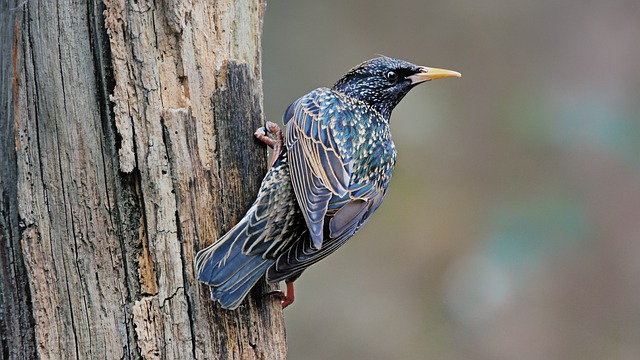
Since there are still small, belligerent starlings all over the yard, I figured I’d make the best of a very noisy situation and write a bit on starling symbolism and magical significance. While I mostly know them as small weirdoes who periodically walk up to me and gape to be fed (which is almost admirable in its temerity, to be honest), they’re powerful, sacred animals in their own right.
Starling Folklore
Despite their ubiquity in my area, starlings aren’t native to the United States. The story is that they were brought here in the late 1800s in what is, perhaps, the silliest fashion imaginable. A German-American Shakespeare enthusiast named Eugene Schieffelin wanted the US to have all of the birds mentioned in Shakespeare’s plays, so he imported and released about sixty to eighty of them. (Invasive species who?) However entertaining this tale might be, it most likely isn’t actually true.
Shakespeare’s mention of starlings refers to their talent at mimicry:
Nay,
I’ll have a starling shall be taught to speak
Nothing but “Mortimer,” and give it him
To keep his anger still in motion.
spoken by Hotspur, in Act 1, Scene 3 of Henry IV
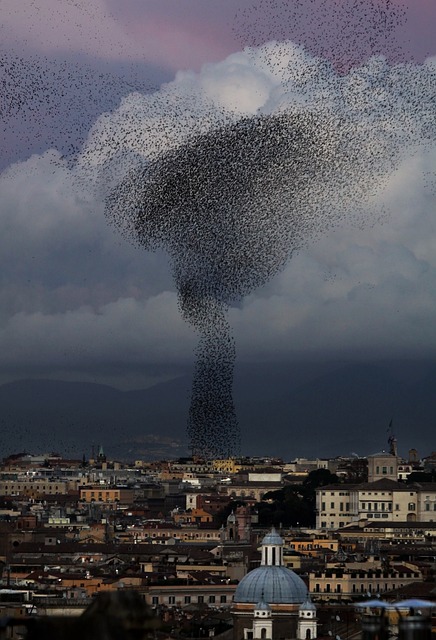
In Rome, however, starlings were more than a curiosity or a passing note in a play, and starling symbolism was a important thing. Starlings form very large, elaborate migrating flocks called murmurations. These are exceptionally striking formations of thousands of individual birds who seem to cover the sky in a flowing, undulating mass. Augurs, diviners who read the movement of birds, would watch these murmurations to receive messages from their gods. Some forms and flows were very good omens. Others, not so much.
In the Welsh Mabinogion, Branwen is sent to Ireland to marry King Matholwch . Her marriage is far from happy, however, so she tames a starling and teaches it to speak. She sends the starling back to Wales, where it alerts her brother Bran to come and save her.
Starlings can mimic far more than words. Mozart kept one as a pet, and it learned to repeat portions of his compositions. When it died, he was heartbroken. He performed a funeral that his biographer (and wife’s second husband) described thus:
When a bird died, he arranged a funeral procession, in which everyone who could sing had to join in, heavily veiled – made a sort of requiem, epitaph in verse.
Georg Nikolaus von Nissen
Starlings also seem to imprint readily on people. Personally, I have made every attempt to avoid them, however their babies still don’t seem to have any issue strolling up to me with their mouths open, expectantly. It’s kind of like walking up to a grizzly bear and demanding spaghetti.
In general, the starling’s place in folklore seems to have been secured by their ability to bond with people, and their talent at mimicking speech and other sounds they encounter. Just watch this one, who not only imitates a human, but flawlessly mimics an Alexa unit immediately afterward:
It’s almost eerie!
The Symbolism of Starlings
Starlings are said to represent everything from freedom, to prosperity, to love. Given their folklore, starling symbolism is most strongly connected to communication and divination.
To divine using a flock of starlings (or even just one, though they always seem to show up in groups!) involves noting their number and behavior. It can sometimes be hard to count starlings, particularly since they can number in the thousands within a single murmuration.
If you observe them in flight, like the ancient Romans, pay attention to the shapes they form. What do they evoke for you?
Note the direction in which they’re flying. This means both the cardinal direction, and their relative direction. The east represents beginnings, renewal, spring, and the dawn. The south represents a climax, an apex, summer, and high noon. The west represents a decline, a release, autumn, and twilight. The north represents endings, death, winter, and midnight.
In terms of relative directions, birds flying to the right generally indicates a positive or affirmative response. Birds flying to the left generally indicates a negative response.
As with any divination method, keep a journal of what you see and your interpretations. After some time has passed, revisit what you wrote and see how accurate it was. This can help you decode what the flight of birds means specifically to you.
Starlings are polarizing little guys. Some people absolutely love these noisy, funny little birds, while others hate them. I’ve come to be amused by their antics, though I’m also looking forward to when their fledglings are finally grown and it’s time for them to migrate!

 Marble Crow
2 thoughts on “The Magical Meaning and Symbolism of Starlings”